seats KIA Sedona 2012 2.G User Guide
[x] Cancel search | Manufacturer: KIA, Model Year: 2012, Model line: Sedona, Model: KIA Sedona 2012 2.GPages: 370, PDF Size: 6.75 MB
Page 88 of 370
371
Features of your vehicle
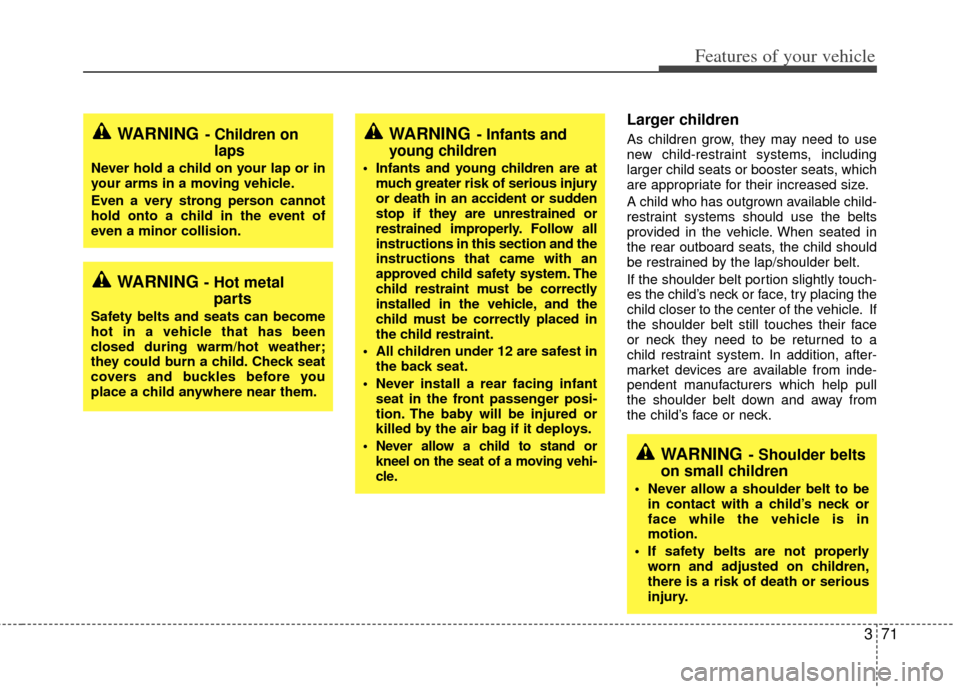
Larger children
As children grow, they may need to use
new child-restraint systems, including
larger child seats or booster seats, which
are appropriate for their increased size.
A child who has outgrown available child-
restraint systems should use the belts
provided in the vehicle. When seated in
the rear outboard seats, the child should
be restrained by the lap/shoulder belt.
If the shoulder belt portion slightly touch-
es the child’s neck or face, try placing the
child closer to the center of the vehicle. If
the shoulder belt still touches their face
or neck they need to be returned to a
child restraint system. In addition, after-
market devices are available from inde-
pendent manufacturers which help pull
the shoulder belt down and away from
the child’s face or neck.WARNING- Infants and
young children
Infants and young children are at
much greater risk of serious injury
or death in an accident or sudden
stop if they are unrestrained or
restrained improperly. Follow all
instructions in this section and the
instructions that came with an
approved child safety system. The
child restraint must be correctly
installed in the vehicle, and the
child must be correctly placed in
the child restraint.
All children under 12 are safest in the back seat.
Never install a rear facing infant seat in the front passenger posi-
tion. The baby will be injured or
killed by the air bag if it deploys.
Never allow a child to stand or
kneel on the seat of a moving vehi-
cle.WARNING- Shoulder belts
on small children
Never allow a shoulder belt to be
in contact with a child’s neck or
face while the vehicle is in
motion.
If safety belts are not properly worn and adjusted on children,
there is a risk of death or serious
injury.
WARNING- Children onlaps
Never hold a child on your lap or in
your arms in a moving vehicle.
Even a very strong person cannot
hold onto a child in the event of
even a minor collision.
WARNING - Hot metal parts
Safety belts and seats can become
hot in a vehicle that has been
closed during warm/hot weather;
they could burn a child. Check seat
covers and buckles before you
place a child anywhere near them.
Page 89 of 370
Features of your vehicle
72
3
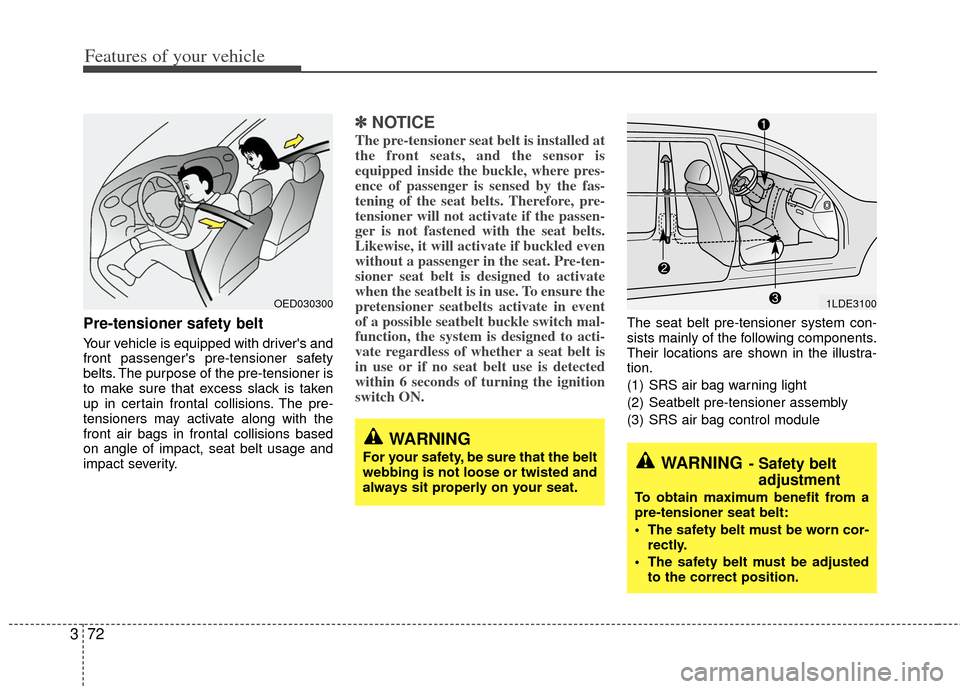
Pre-tensioner safety belt
Your vehicle is equipped with driver's and
front passenger's pre-tensioner safety
belts. The purpose of the pre-tensioner is
to make sure that excess slack is taken
up in certain frontal collisions. The pre-
tensioners may activate along with the
front air bags in frontal collisions based
on angle of impact, seat belt usage and
impact severity.
✽ ✽
NOTICE
The pre-tensioner seat belt is installed at
the front seats, and the sensor is
equipped inside the buckle, where pres-
ence of passenger is sensed by the fas-
tening of the seat belts. Therefore, pre-
tensioner will not activate if the passen-
ger is not fastened with the seat belts.
Likewise, it will activate if buckled even
without a passenger in the seat. Pre-ten-
sioner seat belt is designed to activate
when the seatbelt is in use. To ensure the
pretensioner seatbelts activate in event
of a possible seatbelt buckle switch mal-
function, the system is designed to acti-
vate regardless of whether a seat belt is
in use or if no seat belt use is detected
within 6 seconds of turning the ignition
switch ON.
The seat belt pre-tensioner system con-
sists mainly of the following components.
Their locations are shown in the illustra-
tion.
(1) SRS air bag warning light
(2) Seatbelt pre-tensioner assembly
(3) SRS air bag control module
WARNING- Safety belt
adjustment
To obtain maximum benefit from a
pre-tensioner seat belt:
The safety belt must be worn cor-
rectly.
The safety belt must be adjusted to the correct position.
1LDE3100OED030300
WARNING
For your safety, be sure that the belt
webbing is not loose or twisted and
always sit properly on your seat.
Page 91 of 370
Features of your vehicle
74
3
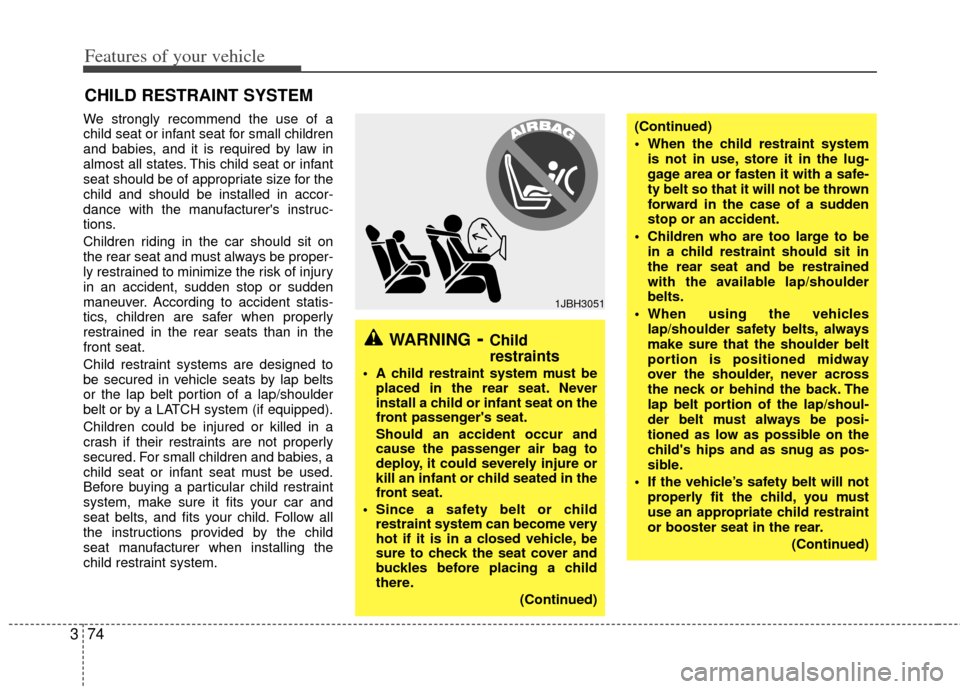
We strongly recommend the use of a
child seat or infant seat for small children
and babies, and it is required by law in
almost all states. This child seat or infant
seat should be of appropriate size for the
child and should be installed in accor-
dance with the manufacturer's instruc-
tions.
Children riding in the car should sit on
the rear seat and must always be proper-
ly restrained to minimize the risk of injury
in an accident, sudden stop or sudden
maneuver. According to accident statis-
tics, children are safer when properly
restrained in the rear seats than in the
front seat.
Child restraint systems are designed to
be secured in vehicle seats by lap belts
or the lap belt portion of a lap/shoulder
belt or by a LATCH system (if equipped).
Children could be injured or killed in a
crash if their restraints are not properly
secured. For small children and babies, a
child seat or infant seat must be used.
Before buying a particular child restraint
system, make sure it fits your car and
seat belts, and fits your child. Follow all
the instructions provided by the child
seat manufacturer when installing the
child restraint system.
CHILD RESTRAINT SYSTEM
WARNING- Child
restraints
A child restraint system must be
placed in the rear seat. Never
install a child or infant seat on the
front passenger's seat.
Should an accident occur and
cause the passenger air bag to
deploy, it could severely injure or
kill an infant or child seated in the
front seat.
Since a safety belt or child restraint system can become very
hot if it is in a closed vehicle, be
sure to check the seat cover and
buckles before placing a child
there.
(Continued)
(Continued)
When the child restraint systemis not in use, store it in the lug-
gage area or fasten it with a safe-
ty belt so that it will not be thrown
forward in the case of a sudden
stop or an accident.
Children who are too large to be in a child restraint should sit in
the rear seat and be restrained
with the available lap/shoulder
belts.
When using the vehicles lap/shoulder safety belts, always
make sure that the shoulder belt
portion is positioned midway
over the shoulder, never across
the neck or behind the back. The
lap belt portion of the lap/shoul-
der belt must always be posi-
tioned as low as possible on the
child's hips and as snug as pos-
sible.
If the vehicle’s safety belt will not properly fit the child, you must
use an appropriate child restraint
or booster seat in the rear.
(Continued)
1JBH3051
Page 92 of 370
375
Features of your vehicle
Installing a child restraint system
For safety reasons, we recommend that
the child restraint system be used in the
rear seats.
Since all passenger safety belts move
freely under normal conditions and only
lock under extreme or emergency condi-
tions (emergency lock mode), you must
manually change these safety belts to
the auto lock mode to secure a child
restraint.WARNING- Child seat
installation
Before installing the childrestraint system, read the instruc-
tions supplied by the child
restraint system manufacturer.
If the safety belt does not operate as described in this section, have
the system checked immediately
by your authorized Kia dealer.
Failure to observe this manual's instructions regarding child
restraint system and the instruc-
tions provided with the child
restraint system could increase
the chance and/or severity of
injury in an accident.
WARNING
Never place a rear-facing child
restraint in the front passenger
seat, because of the danger that an
inflating passenger side air bag
could impact the rear-facing child
restraint and kill the child.
(Continued)
Never allow a child to stand up orkneel while the vehicle is moving.
Never use an infant carrier or child seat that "hooks" over a
seatback. It will not provide ade-
quate protection in an accident.
Never allow a child to be held while they are in a moving vehi-
cle, as this could result in serious
injury to the child in the event of
an accident or a sudden stop.
Holding a child in a moving vehi-
cle does not provide the child
with any protection during an
accident, even if the person hold-
ing the child is wearing a seat
belt.
After an accident, have an autho- rized KIA dealer check the child
restraint system, seat belt, tether
anchor and lower anchor.
If there is not enough space to place the child restraint system
because of the driver's seat,
install the child restraint system
in the rear right seat.
Page 94 of 370
377
Features of your vehicle
Child seat lower anchors
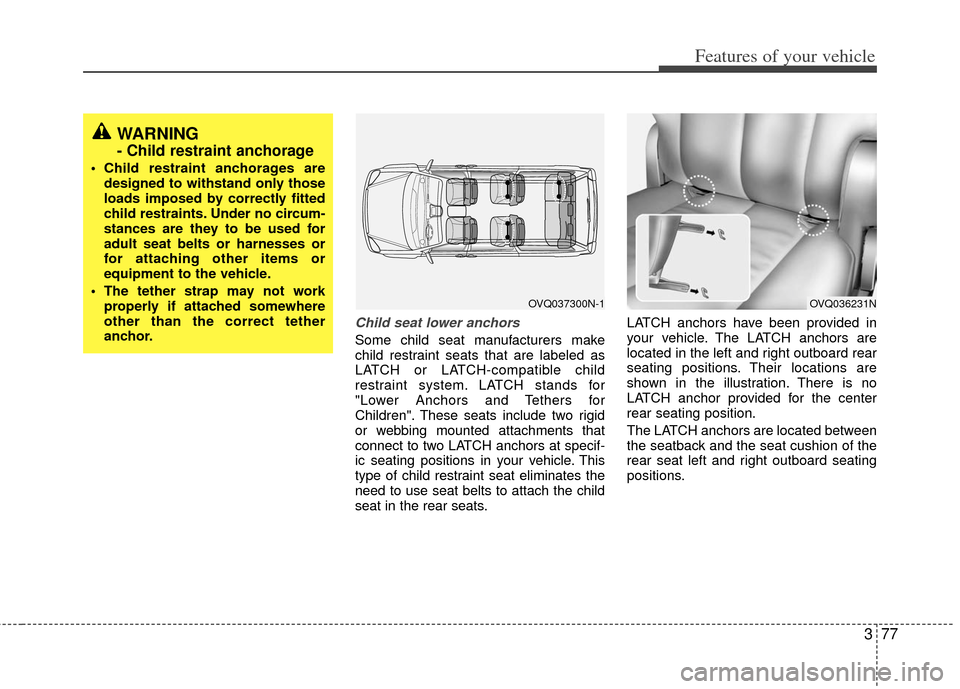
Some child seat manufacturers make
child restraint seats that are labeled as
LATCH or LATCH-compatible child
restraint system. LATCH stands for
"Lower Anchors and Tethers for
Children".These seats include two rigid
or webbing mounted attachments that
connect to two LATCH anchors at specif-
ic seating positions in your vehicle. This
type of child restraint seat eliminates the
need to use seat belts to attach the child
seat in the rear seats. LATCH anchors have been provided in
your vehicle. The LATCH anchors are
located in the left and right outboard rear
seating positions. Their locations are
shown in the illustration. There is no
LATCH anchor provided for the center
rear seating position.
The LATCH anchors are located between
the seatback and the seat cushion of the
rear seat left and right outboard seating
positions.
WARNING
- Child restraint anchorage
Child restraint anchorages are
designed to withstand only those
loads imposed by correctly fitted
child restraints. Under no circum-
stances are they to be used for
adult seat belts or harnesses or
for attaching other items or
equipment to the vehicle.
The tether strap may not work properly if attached somewhere
other than the correct tether
anchor.
OVQ036231NOVQ037300N-1
Page 95 of 370
Features of your vehicle
78
3
Follow the child seat manufacturer’s
instructions to properly install child
restraint seats with LATCH or LATCH-
compatible attachments.
Once you have installed the LATCH child
restraint, assure that the seat is properly
attached to the LATCH and tether
anchors. Also, test the child restraint seat
before you place the child in it. Tilt the
seat from side to side. Also try to tug the
seat forward. Check to see if the anchors
hold the seat in place.
Placing a passenger safety belt
into the auto lock mode
The use of the auto lock mode will
ensure that the normal movement of the
child in the vehicle does not cause the
safety belt to be pulled out and loosen
the firmness of its hold on the child
restraint system. To secure a child
restraint system, use the following proce-
dure.
WARNING
If the child restraint is not anchored
properly, there is a significant risk
of a child being seriously injured or
killed in a collision.
WARNING - LATCH lower
anchors
LATCH lower anchors are only to be
used with the left and right rear out-
board seating positions. Never
attempt to attach an LATCH
equipped seat in the center seating
position. You may damage the
anchors or the anchors may fail and
break in a collision.
WARNING
Install the child restraint seat fully
rearward against the seatback with
the seatback in a vertical position,
not reclined.
WARNING
When using the vehicle's
"LATCH" system to install a child
restraint system in the rear seat,
all unused vehicle rear seat belt
metal latch plates or tabs must be
latched securely in their seat belt
buckles and the seat belt webbing
must be retracted behind the
child restraint to prevent the child
from reaching and taking hold of
unretracted seat belts. Unlatched
metal latch plates or tabs may
allow the child to reach the unre-
tracted seat belts which may
result in strangulation and a seri-
ous injury or death to the child in
the child restraint.
Do not place anything around the lower anchors. Also make sure
that the seat belt is not caught in
the lower anchors.
CAUTION
Do not allow the rear seat belt web-bing to get scratched or pinched bythe Child-seat latch and LATCH anchor during the installation.
Page 96 of 370
379
Features of your vehicle
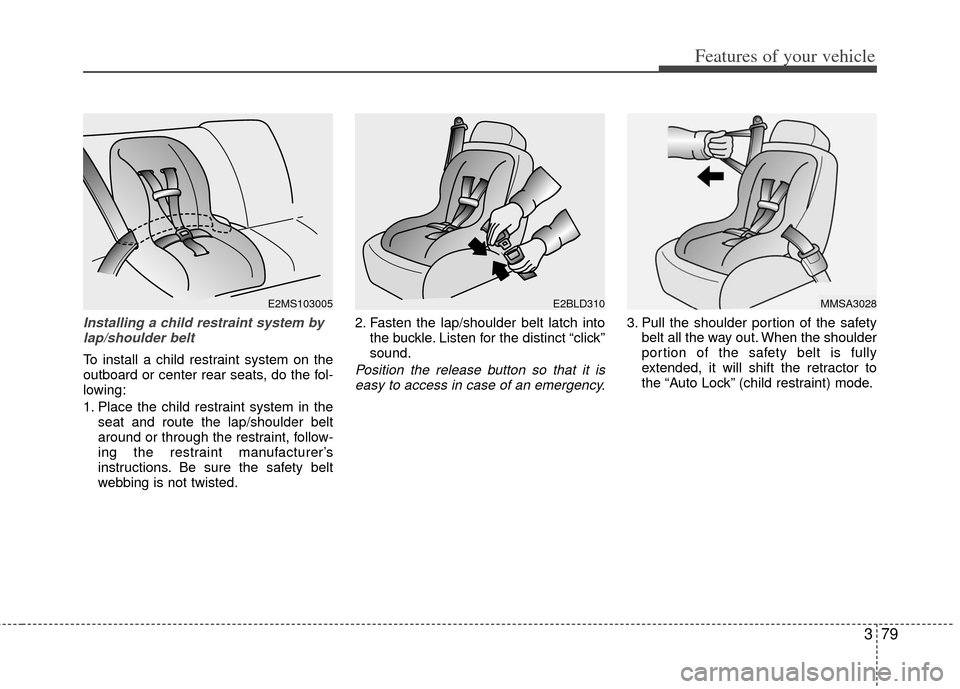
Installing a child restraint system bylap/shoulder belt
To install a child restraint system on the
outboard or center rear seats, do the fol-
lowing:
1. Place the child restraint system in the seat and route the lap/shoulder belt
around or through the restraint, follow-
ing the restraint manufacturer’s
instructions. Be sure the safety belt
webbing is not twisted. 2. Fasten the lap/shoulder belt latch into
the buckle. Listen for the distinct “click”
sound.Position the release button so that it iseasy to access in case of an emergency.
3. Pull the shoulder portion of the safety belt all the way out. When the shoulder
portion of the safety belt is fully
extended, it will shift the retractor to
the “Auto Lock” (child restraint) mode.
E2MS103005E2BLD310MMSA3028
Page 107 of 370
Features of your vehicle
90
3
The advanced SRS offers the ability to
control the air bag inflation with two lev-
els. A first stage level is provided for mod-
erate-severity impacts. A second stage
level is provided for more severe impacts.
According to the impact severity, seating
position and safety belt usage, the
SRSCM (SRS Control Module) controls
the air bag inflation. Failure to properly
wear safety belts can increase the risk
or severity of injury in an accident.
Additionally, your SRS is equipped with
an occupant classification system in the
front passenger’s seat. The occupant
classification system detects the pres-
ence of a passenger in the front passen-
ger’s seat and will turn off the front pas-
senger’s air bag under certain conditions.
For more detail, see “Occupant
Classification System” in this section.CAUTION
If the seat position sensor is not working properly, the SRS air bagwarning light on the instrumentpanel will illuminate even if there isno malfunction of the SRS air bag system, because the SRS air bagwarning light is connected with theseat position sensor. If the SRS airbag warning light does not illumi-nate when the ignition key is turnedto the "ON" position, if it remainsilluminated after illuminating orblinking for approximately 6 sec-onds, or if it illuminates while the vehicle is being driven, have anauthorized Kia dealer inspect theseat position sensor and theadvanced SRS air bag system assoon as possible.WARNING
Modification to the seat structure can adversely affect the seat
position sensor and cause the air
bag to deploy at a different level
than should be provided.
Failure to properly wear safety belts can increase the risk or
severity of injury by causing the
air bags to deploy at a different
level than should be provided.
Do not place any objects under- neath the front seats which could
damage the seat position sensor
or interfere with the occupant
classification system.
Do not place any objects that may cause magnetic fields near the
front seat. These may cause a
malfunction of the seat position
sensor.
(Continued)
Page 108 of 370
391
Features of your vehicle
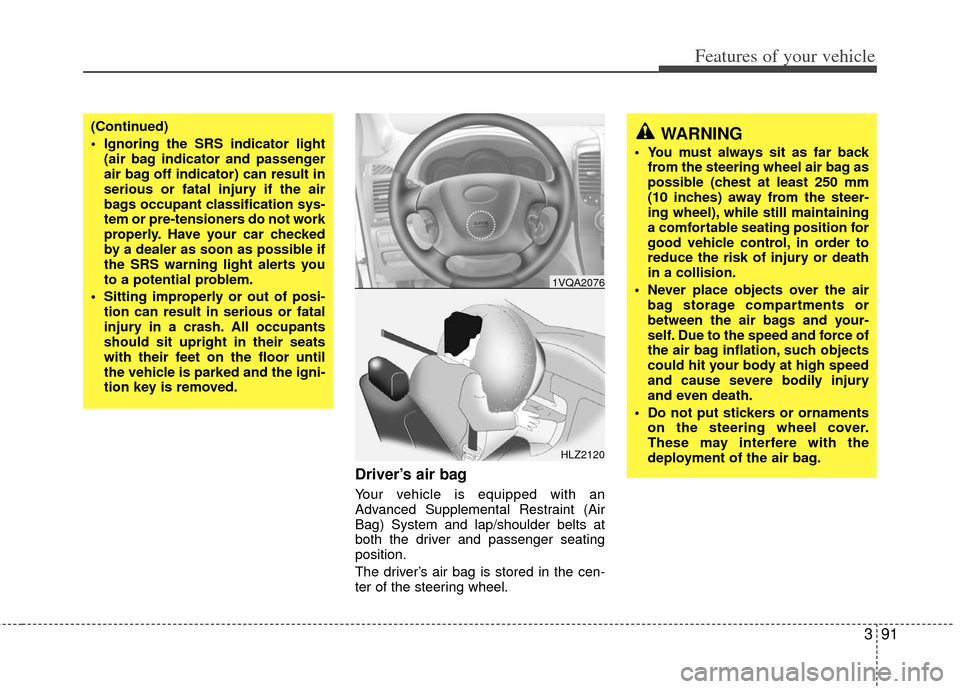
Driver’s air bag
Your vehicle is equipped with an
Advanced Supplemental Restraint (Air
Bag) System and lap/shoulder belts at
both the driver and passenger seating
position.
The driver’s air bag is stored in the cen-
ter of the steering wheel.
(Continued)
Ignoring the SRS indicator light(air bag indicator and passenger
air bag off indicator) can result in
serious or fatal injury if the air
bags occupant classification sys-
tem or pre-tensioners do not work
properly. Have your car checked
by a dealer as soon as possible if
the SRS warning light alerts you
to a potential problem.
Sitting improperly or out of posi- tion can result in serious or fatal
injury in a crash. All occupants
should sit upright in their seats
with their feet on the floor until
the vehicle is parked and the igni-
tion key is removed.WARNING
You must always sit as far backfrom the steering wheel air bag as
possible (chest at least 250 mm
(10 inches) away from the steer-
ing wheel), while still maintaining
a comfortable seating position for
good vehicle control, in order to
reduce the risk of injury or death
in a collision.
Never place objects over the air bag storage compartments or
between the air bags and your-
self. Due to the speed and force of
the air bag inflation, such objects
could hit your body at high speed
and cause severe bodily injury
and even death.
Do not put stickers or ornaments on the steering wheel cover.
These may interfere with the
deployment of the air bag.
HLZ2120
1VQA2076
Page 109 of 370
Features of your vehicle
92
3
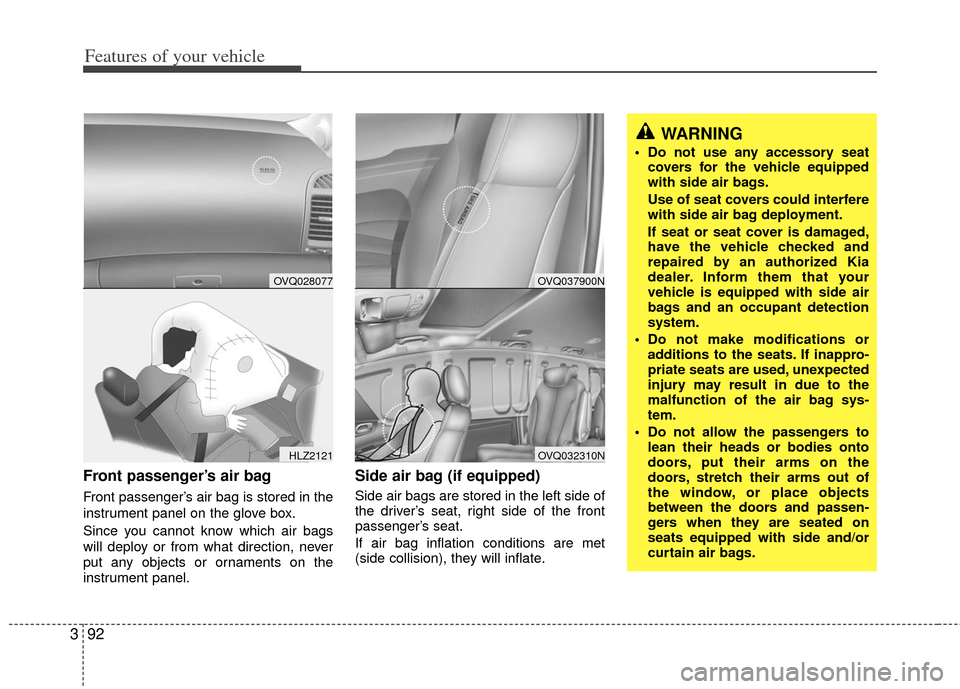
Front passenger’s air bag
Front passenger’s air bag is stored in the
instrument panel on the glove box.
Since you cannot know which air bags
will deploy or from what direction, never
put any objects or ornaments on the
instrument panel.
Side air bag (if equipped)
Side air bags are stored in the left side of
the driver’s seat, right side of the front
passenger’s seat.
If air bag inflation conditions are met
(side collision), they will inflate.
OVQ028077
HLZ2121
WARNING
Do not use any accessory seat
covers for the vehicle equipped
with side air bags.
Use of seat covers could interfere
with side air bag deployment.
If seat or seat cover is damaged,
have the vehicle checked and
repaired by an authorized Kia
dealer. Inform them that your
vehicle is equipped with side air
bags and an occupant detection
system.
Do not make modifications or additions to the seats. If inappro-
priate seats are used, unexpected
injury may result in due to the
malfunction of the air bag sys-
tem.
Do not allow the passengers to lean their heads or bodies onto
doors, put their arms on the
doors, stretch their arms out of
the window, or place objects
between the doors and passen-
gers when they are seated on
seats equipped with side and/or
curtain air bags.
OVQ037900N
OVQ032310N