oil level KIA Soul 2014 2.G Owner's Manual
[x] Cancel search | Manufacturer: KIA, Model Year: 2014, Model line: Soul, Model: KIA Soul 2014 2.GPages: 500, PDF Size: 13.89 MB
Page 167 of 500
481
Features of your vehicle
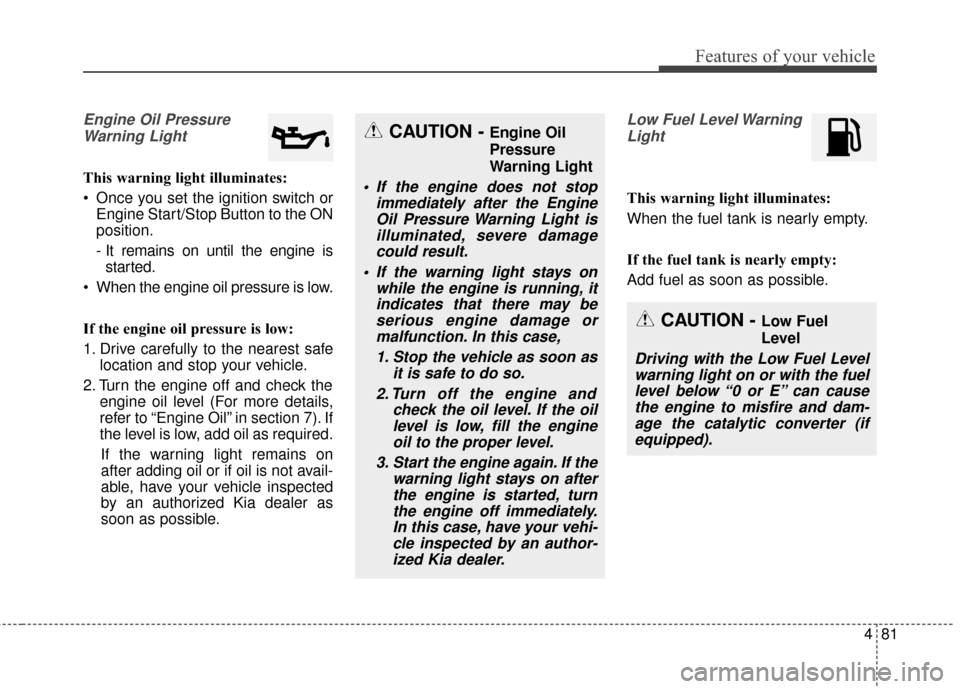
Engine Oil PressureWarning Light
This warning light illuminates:
Once you set the ignition switch or Engine Start/Stop Button to the ON
position.
- It remains on until the engine isstarted.
When the engine oil pressure is low.
If the engine oil pressure is low:
1. Drive carefully to the nearest safe location and stop your vehicle.
2. Turn the engine off and check the engine oil level (For more details,
refer to “Engine Oil” in section 7). If
the level is low, add oil as required.
If the warning light remains on
after adding oil or if oil is not avail-
able, have your vehicle inspected
by an authorized Kia dealer as
soon as possible.
Low Fuel Level Warning Light
This warning light illuminates:
When the fuel tank is nearly empty.
If the fuel tank is nearly empty:
Add fuel as soon as possible.
CAUTION - Engine Oil
Pressure
Warning Light
If the engine does not stop immediately after the EngineOil Pressure Warning Light isilluminated, severe damagecould result.
If the warning light stays on while the engine is running, itindicates that there may beserious engine damage ormalfunction. In this case,
1. Stop the vehicle as soon as it is safe to do so.
2. Turn off the engine and check the oil level. If the oillevel is low, fill the engineoil to the proper level.
3. Start the engine again. If the warning light stays on afterthe engine is started, turnthe engine off immediately.In this case, have your vehi-cle inspected by an author-ized Kia dealer.
CAUTION - Low Fuel
Level
Driving with the Low Fuel Levelwarning light on or with the fuellevel below “0 or E” can causethe engine to misfire and dam-age the catalytic converter (ifequipped).
Page 291 of 500
Driving your vehicle
45
Before entering vehicle
• Be sure that all windows, outsidemirror(s), and outside lights are
clean.
Check the condition of the tires.
Check under the vehicle for any sign of leaks.
Be sure there are no obstacles behind you if you intend to back up.
Necessary inspections
Fluid levels, such as engine oil,
engine coolant, brake fluid, and
washer fluid should be checked on a
regular basis, at the exact interval
depending on the fluid. Further
details are provided in chapter 7,
“Maintenance”.WARNING
Driving while distracted can
result in a loss of vehicle con-
trol, that may lead to an acci-
dent, severe personal injury,
and death. The driver’s primary
responsibility is in the safe and
legal operation of a vehicle, and
use of any handheld devices,
other equipment, or vehicle sys-
tems which take the driver’s
eyes, attention and focus away
from the safe operation of a
vehicle or which are not permis-
sible by law should never be
used during operation of the
vehicle.
BEFORE DRIVING
Page 347 of 500
Driving your vehicle
60
5
Use high quality ethylene gly-
col coolant
Your vehicle is delivered with high
quality ethylene glycol coolant in the
cooling system. It is the only type of
coolant that should be used because
it helps prevent corrosion in the cool-
ing system, lubricates the water
pump and prevents freezing. Be sure
to replace or replenish your coolant
in accordance with the maintenance
schedule in section 7. Before winter,
have your coolant tested to assure
that its freezing point is sufficient for
the temperatures anticipated during
the winter.
Check battery and cables
Winter puts additional burdens on
the battery system. Visually inspect
the battery and cables as described
in section 7. The level of charge in
your battery can be checked by an
authorized Kia dealer or a service
station.
Change to "winter weight" oil
if necessary
In some climates it is recommended
that a lower viscosity "winter weight"
oil be used during cold weather. See
section 8 for recommendations. If
you aren't sure what weight oil you
should use, consult an authorized
Kia dealer.
Check spark plugs and igni-
tion system
Inspect your spark plugs as
described in section 7 and replace
them if necessary. Also check all
ignition wiring and components to be
sure they are not cracked, worn or
damaged in any way.
To keep locks from freezing
To keep the locks from freezing,
squirt an approved de-icer fluid or
glycerine into the key opening. If a
lock is covered with ice, squirt it with
an approved de-icing fluid to remove
the ice. If the lock is frozen internally,
you may be able to thaw it out by
using a heated key. Handle the heat-
ed key with care to avoid injury.
Use approved window washer
anti-freeze in system
To keep the water in the window
washer system from freezing, add an
approved window washer anti-freeze
solution in accordance with instruc-
tions on the container. Window wash-
er anti-freeze is available from an
authorized Kia dealer and most auto
parts outlets. Do not use engine
coolant or other types of anti-freeze
as these may damage the paint fin-
ish.
Page 359 of 500
What to do in an emergency
46
IF THE ENGINE WILL NOT START
If engine doesn't turn over or
turns over slowly
1.If your vehicle has an automatictransaxle, be sure the shift lever is
in N (Neutral) or P (Park) and the
emergency brake is set.
2.Check the battery connections to be sure they are clean and tight.
3.Turn on the interior light. If the light dims or goes out when you operate
the starter, the battery is dis-
charged.
4.Check the starter connections to be sure they are securely tight-
ened.
5.Do not push or pull the vehicle to start it. See instructions for "Jump
starting".
If engine turns over normally
but does not start
1.Check the fuel level.
2.With the ignition switch in theLOCK position, check all connec-
tors at the ignition coils and spark
plugs. Reconnect any that may be
disconnected or loose.
3.Check the fuel line in the engine compartment.
4.If the engine still does not start, call an authorized Kia dealer or seek
other qualified assistance.
WARNING
If the engine will not start, do
not push or pull the vehicle to
start it. This could result in a
collision or cause other dam-
age. In addition, push or pull
starting may cause the catalytic
converter to overload and cre-
ate a fire hazard.
Page 390 of 500
77
Maintenance
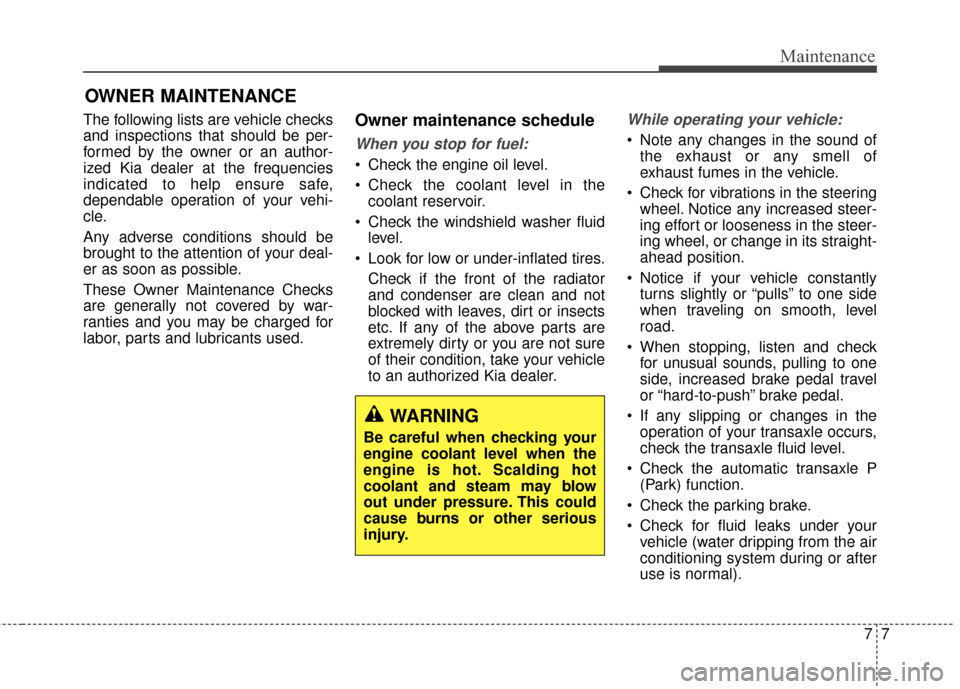
OWNER MAINTENANCE
The following lists are vehicle checks
and inspections that should be per-
formed by the owner or an author-
ized Kia dealer at the frequencies
indicated to help ensure safe,
dependable operation of your vehi-
cle.
Any adverse conditions should be
brought to the attention of your deal-
er as soon as possible.
These Owner Maintenance Checks
are generally not covered by war-
ranties and you may be charged for
labor, parts and lubricants used.Owner maintenance schedule
When you stop for fuel:
Check the engine oil level.
Check the coolant level in thecoolant reservoir.
Check the windshield washer fluid level.
Look for low or under-inflated tires. Check if the front of the radiator
and condenser are clean and not
blocked with leaves, dirt or insects
etc. If any of the above parts are
extremely dirty or you are not sure
of their condition, take your vehicle
to an authorized Kia dealer.
While operating your vehicle:
Note any changes in the sound ofthe exhaust or any smell of
exhaust fumes in the vehicle.
Check for vibrations in the steering wheel. Notice any increased steer-
ing effort or looseness in the steer-
ing wheel, or change in its straight-
ahead position.
Notice if your vehicle constantly turns slightly or “pulls” to one side
when traveling on smooth, level
road.
When stopping, listen and check for unusual sounds, pulling to one
side, increased brake pedal travel
or “hard-to-push” brake pedal.
If any slipping or changes in the operation of your transaxle occurs,
check the transaxle fluid level.
Check the automatic transaxle P (Park) function.
Check the parking brake.
Check for fluid leaks under your vehicle (water dripping from the air
conditioning system during or after
use is normal).
WARNING
Be careful when checking your
engine coolant level when the
engine is hot. Scalding hot
coolant and steam may blow
out under pressure. This could
cause burns or other serious
injury.
Page 410 of 500
727
Maintenance
ENGINE OIL
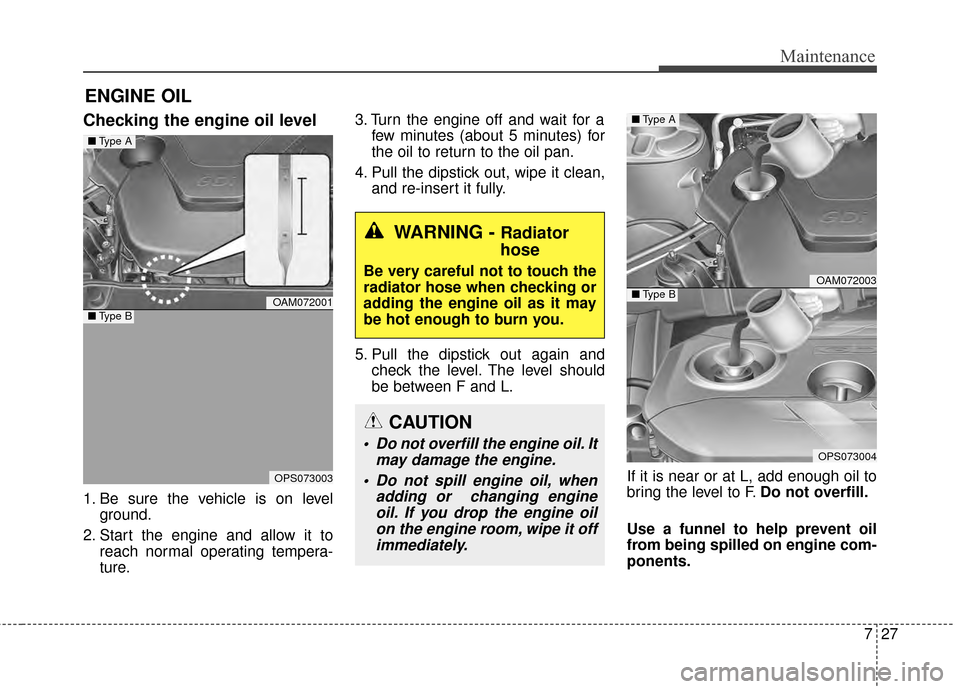
Checking the engine oil level
1. Be sure the vehicle is on levelground.
2. Start the engine and allow it to reach normal operating tempera-
ture. 3. Turn the engine off and wait for a
few minutes (about 5 minutes) for
the oil to return to the oil pan.
4. Pull the dipstick out, wipe it clean, and re-insert it fully.
5. Pull the dipstick out again and check the level. The level should
be between F and L.
If it is near or at L, add enough oil to
bring the level to F.Do not overfill.
Use a funnel to help prevent oil
from being spilled on engine com-
ponents.
WARNING - Radiator
hose
Be very careful not to touch the
radiator hose when checking or
adding the engine oil as it may
be hot enough to burn you.
CAUTION
Do not overfill the engine oil. It
may damage the engine.
Do not spill engine oil, when adding or changing engineoil. If you drop the engine oilon the engine room, wipe it offimmediately.
OAM072001
OPS073003
■ Type A
■Type B
OAM072003
OPS073004
■Type A
■Type B
Page 415 of 500
Maintenance
32
7
BRAKE/CLUTCH FLUID
Checking the brake/clutch*
fluid level
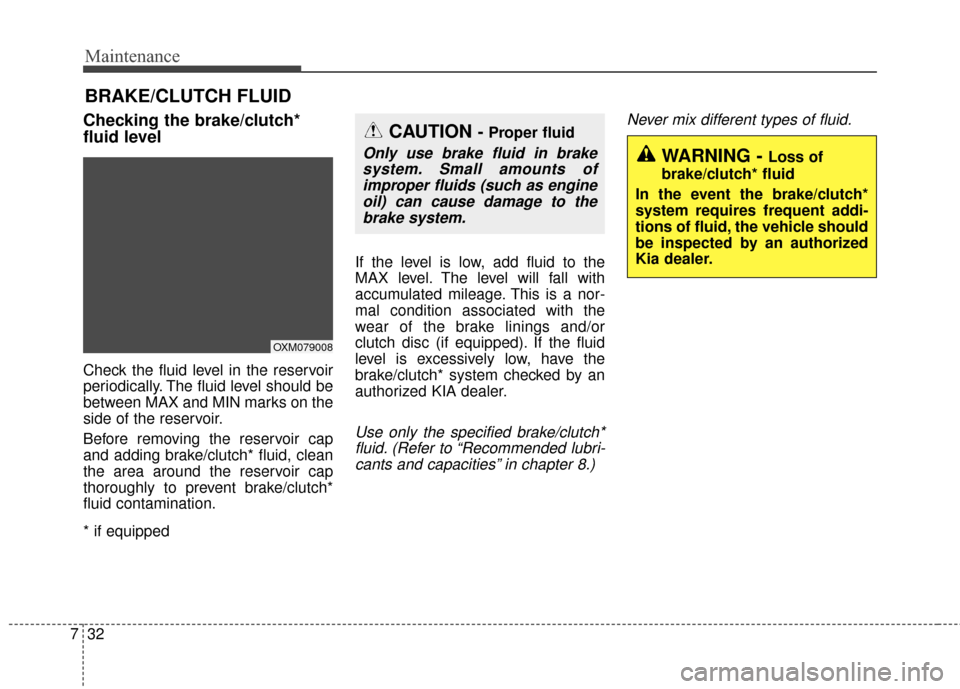
Check the fluid level in the reservoir
periodically. The fluid level should be
between MAX and MIN marks on the
side of the reservoir.
Before removing the reservoir cap
and adding brake/clutch* fluid, clean
the area around the reservoir cap
thoroughly to prevent brake/clutch*
fluid contamination.
* if equipped If the level is low, add fluid to the
MAX level. The level will fall with
accumulated mileage. This is a nor-
mal condition associated with the
wear of the brake linings and/or
clutch disc (if equipped). If the fluid
level is excessively low, have the
brake/clutch* system checked by an
authorized KIA dealer.
Use only the specified brake/clutch*
fluid. (Refer to “Recommended lubri-cants and capacities” in chapter 8.) Never mix different types of fluid.
OXM079008
WARNING - Loss of
brake/clutch* fluid
In the event the brake/clutch*
system requires frequent addi-
tions of fluid, the vehicle should
be inspected by an authorized
Kia dealer.
CAUTION - Proper fluid
Only use brake fluid in brake system. Small amounts ofimproper fluids (such as engineoil) can cause damage to thebrake system.
Page 453 of 500
Maintenance
70
7
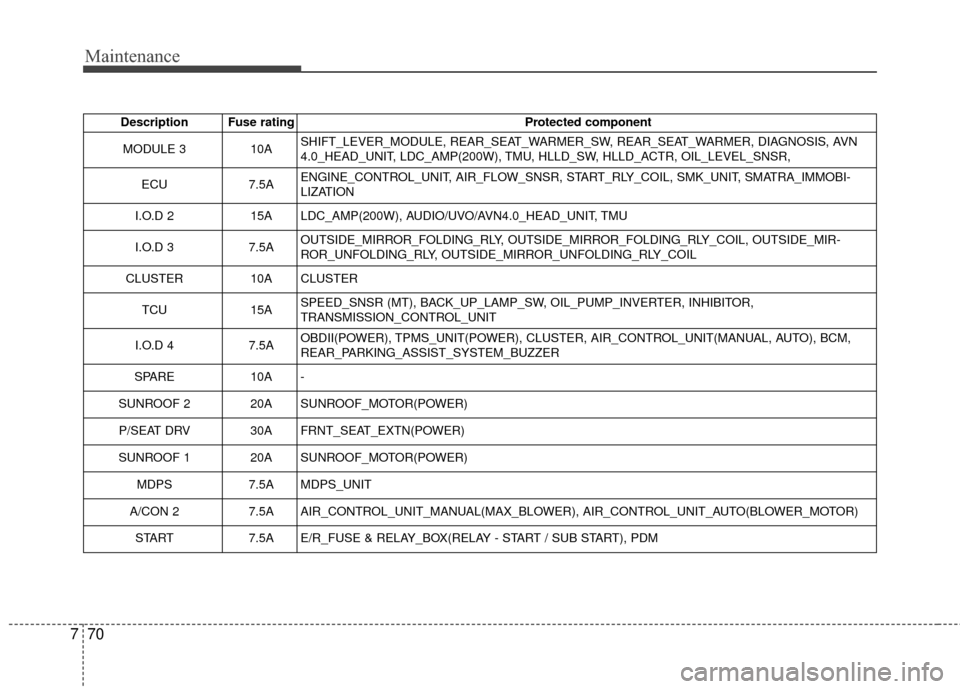
Description Fuse rating Protected component
MODULE 3 10ASHIFT_LEVER_MODULE, REAR_SEAT_WARMER_SW, REAR_SEAT_WARMER, DIAGNOSIS, AVN
4.0_HEAD_UNIT, LDC_AMP(200W), TMU, HLLD_SW, HLLD_ACTR, OIL_LEVEL_SNSR,
ECU 7.5AENGINE_CONTROL_UNIT, AIR_FLOW_SNSR, START_RLY_COIL, SMK_UNIT, SMATRA_IMMOBI-
LIZATION
I.O.D 2 15A LDC_AMP(200W), AUDIO/UVO/AVN4.0_HEAD_UNIT, TMU
I.O.D 3 7.5AOUTSIDE_MIRROR_FOLDING_RLY, OUTSIDE_MIRROR_FOLDING_RLY_COIL, OUTSIDE_MIR-
ROR_UNFOLDING_RLY, OUTSIDE_MIRROR_UNFOLDING_RLY_COIL
CLUSTER 10A CLUSTER
TCU 15ASPEED_SNSR (MT), BACK_UP_LAMP_SW, OIL_PUMP_INVERTER, INHIBITOR,
TRANSMISSION_CONTROL_UNIT
I.O.D 4 7.5AOBDII(POWER), TPMS_UNIT(POWER), CLUSTER, AIR_CONTROL_UNIT(MANUAL, AUTO), BCM,
REAR_PARKING_ASSIST_SYSTEM_BUZZER
SPARE 10A -
SUNROOF 2 20A SUNROOF_MOTOR(POWER) P/SEAT DRV 30A FRNT_SEAT_EXTN(POWER)
SUNROOF 1 20A SUNROOF_MOTOR(POWER) MDPS 7.5A MDPS_UNIT
A/CON 27.5AAIR_CONTROL_UNIT_MANUAL(MAX_BLOWER), AIR_CONTROL_UNIT_AUTO(BLOWER_MOTOR)
START 7.5AE/R_FUSE & RELAY_BOX(RELAY - START / SUB START), PDM
Page 494 of 500
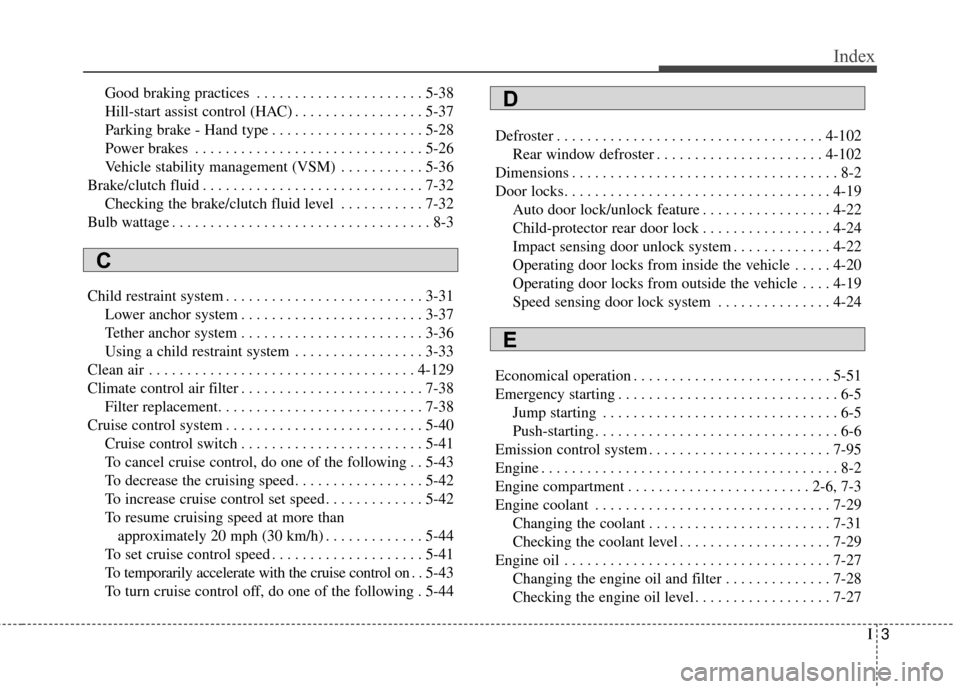
I3
Index
Good braking practices . . . . . . . . . . . . . . . . . . . . . . 5-38
Hill-start assist control (HAC) . . . . . . . . . . . . . . . . . 5-37
Parking brake - Hand type . . . . . . . . . . . . . . . . . . . . 5-28
Power brakes . . . . . . . . . . . . . . . . . . . . . . . . . . . . . . 5-26
Vehicle stability management (VSM) . . . . . . . . . . . 5-36
Brake/clutch fluid . . . . . . . . . . . . . . . . . . . . . . . . . . . . . 7-32 Checking the brake/clutch fluid level . . . . . . . . . . . 7-32
Bulb wattage . . . . . . . . . . . . . . . . . . . . . . . . . . . . . . . . . . 8-3
Child restraint system . . . . . . . . . . . . . . . . . . . . . . . . . . 3-31 Lower anchor system . . . . . . . . . . . . . . . . . . . . . . . . 3-37
Tether anchor system . . . . . . . . . . . . . . . . . . . . . . . . 3-36
Using a child restraint system . . . . . . . . . . . . . . . . . 3-33
Clean air . . . . . . . . . . . . . . . . . . . . . . . . . . . . . . . . . . . 4-\
129
Climate control air filter . . . . . . . . . . . . . . . . . . . . . . . . 7-38 Filter replacement. . . . . . . . . . . . . . . . . . . . . . . . . . . 7-38
Cruise control system . . . . . . . . . . . . . . . . . . . . . . . . . . 5-40 Cruise control switch . . . . . . . . . . . . . . . . . . . . . . . . 5-41
To cancel cruise control, do one of the following . . 5-43
To decrease the cruising speed . . . . . . . . . . . . . . . . . 5-42
To increase cruise control set speed . . . . . . . . . . . . . 5-42
To resume cruising speed at more thanapproximately 20 mph (30 km/h) . . . . . . . . . . . . . 5-44
To set cruise control speed . . . . . . . . . . . . . . . . . . . . 5-41
To temporarily accelerate with the cruise control on . . 5-43
To turn cruise control off, do one of the following . 5-44 Defroster . . . . . . . . . . . . . . . . . . . . . . . . . . . . . . . . . . . 4-\
102
Rear window defroster . . . . . . . . . . . . . . . . . . . . . . 4-102
Dimensions . . . . . . . . . . . . . . . . . . . . . . . . . . . . . . . . . . . 8-\
2
Door locks. . . . . . . . . . . . . . . . . . . . . . . . . . . . . . . . . . . 4-\
19 Auto door lock/unlock feature . . . . . . . . . . . . . . . . . 4-22
Child-protector rear door lock . . . . . . . . . . . . . . . . . 4-24
Impact sensing door unlock system . . . . . . . . . . . . . 4-22
Operating door locks from inside the vehicle . . . . . 4-20
Operating door locks from outside the vehicle . . . . 4-19
Speed sensing door lock system . . . . . . . . . . . . . . . 4-24
Economical operation . . . . . . . . . . . . . . . . . . . . . . . . . . 5-51
Emergency starting . . . . . . . . . . . . . . . . . . . . . . . . . . . . . 6-5 Jump starting . . . . . . . . . . . . . . . . . . . . . . . . . . . . . . . 6-5
Push-starting . . . . . . . . . . . . . . . . . . . . . . . . . . . . . . . . 6-6
Emission control system . . . . . . . . . . . . . . . . . . . . . . . . 7-95
Engine . . . . . . . . . . . . . . . . . . . . . . . . . . . . . . . . . . . . \
. . . 8-2
Engine compartment . . . . . . . . . . . . . . . . . . . . . . . . 2-6, 7-3
Engine coolant . . . . . . . . . . . . . . . . . . . . . . . . . . . . . . . 7-29 Changing the coolant . . . . . . . . . . . . . . . . . . . . . . . . 7-31
Checking the coolant level . . . . . . . . . . . . . . . . . . . . 7-29
Engine oil . . . . . . . . . . . . . . . . . . . . . . . . . . . . . . . . . . . 7-\
27 Changing the engine oil and filter . . . . . . . . . . . . . . 7-28
Checking the engine oil level . . . . . . . . . . . . . . . . . . 7-27
C
D
E
Page 499 of 500

Index
8I
Recommended cold tire inflation pressures . . . . . . . 7-47
Tire care . . . . . . . . . . . . . . . . . . . . . . . . . . . . . . . . . . 7-47\
Tire maintenance . . . . . . . . . . . . . . . . . . . . . . . . . . . 7-52
Tire replacement . . . . . . . . . . . . . . . . . . . . . . . . . . . . 7-51
Tire rotation . . . . . . . . . . . . . . . . . . . . . . . . . . . . . . . 7-49
Tire sidewall labeling . . . . . . . . . . . . . . . . . . . . . . . . 7-53
Tire traction . . . . . . . . . . . . . . . . . . . . . . . . . . . . . . . 7-52
Wheel alignment and tire balance . . . . . . . . . . . . . . 7-50
Wheel replacement . . . . . . . . . . . . . . . . . . . . . . . . . . 7-52
Towing . . . . . . . . . . . . . . . . . . . . . . . . . . . . . . . . . . . . \
. 6-24 Emergency towing . . . . . . . . . . . . . . . . . . . . . . . . . . 6-26
Removable towing hook (front) . . . . . . . . . . . . . . . . 6-25
Towing service . . . . . . . . . . . . . . . . . . . . . . . . . . . . . 6-24
Trip computer . . . . . . . . . . . . . . . . . . . . . . . . . . . . . . . . 4-72 Fuel Economy . . . . . . . . . . . . . . . . . . . . . . . . . . . . . 4-74
Overview . . . . . . . . . . . . . . . . . . . . . . . . . . . . . . . . . 4-72
Trip A/B . . . . . . . . . . . . . . . . . . . . . . . . . . . . . . . . . . 4-73\
Vehicle Break-In Process . . . . . . . . . . . . . . . . . . . . . . . . 1-5
Vehicle certification label . . . . . . . . . . . . . . . . . . . . . . . . 8-9
Vehicle identification number (VIN) . . . . . . . . . . . . . . . 8-9
Vehicle load limit . . . . . . . . . . . . . . . . . . . . . . . . . . . . . 5-62 Certification label . . . . . . . . . . . . . . . . . . . . . . . . . . . 5-66
Tire and loading information label. . . . . . . . . . . . . . 5-62
Vehicle weight glossary . . . . . . . . . . . . . . . . . . . . . . . . 5-68 Base curb weight . . . . . . . . . . . . . . . . . . . . . . . . . . . 5-68 Cargo weight . . . . . . . . . . . . . . . . . . . . . . . . . . . . . . 5-68
GAW (Gross axle weight) . . . . . . . . . . . . . . . . . . . . 5-68
GAWR (Gross axle weight rating) . . . . . . . . . . . . . . 5-68
GVW (Gross vehicle weight). . . . . . . . . . . . . . . . . . 5-68
GVWR (Gross vehicle weight rating) . . . . . . . . . . . 5-68
Vehicle curb weight . . . . . . . . . . . . . . . . . . . . . . . . . 5-68
Warning and indicator lights. . . . . . . . . . . . . . . . . . . . . 4-76 Indicator Lights . . . . . . . . . . . . . . . . . . . . . . . . . . . . 4-83
Warning lights . . . . . . . . . . . . . . . . . . . . . . . . . . . . . 4-76
Washer fluid . . . . . . . . . . . . . . . . . . . . . . . . . . . . . . . . . 7-34 Checking the washer fluid level . . . . . . . . . . . . . . . . 7-34
Windows . . . . . . . . . . . . . . . . . . . . . . . . . . . . . . . . . . . . \
4-26 Power windows . . . . . . . . . . . . . . . . . . . . . . . . . . . . 4-27
Windshield defrosting and defogging. . . . . . . . . . . . . 4-125 Automatic climate control system . . . . . . . . . . . . . 4-126
Defogging logic . . . . . . . . . . . . . . . . . . . . . . . . . . . 4-127
Manual climate control system . . . . . . . . . . . . . . . 4-125
Winter driving . . . . . . . . . . . . . . . . . . . . . . . . . . . . . . . . 5-59 Carry emergency equipment . . . . . . . . . . . . . . . . . . 5-61
Change to "winter weight" oil if necessary . . . . . . . 5-60
Check battery and cables . . . . . . . . . . . . . . . . . . . . . 5-60
Check spark plugs and ignition system . . . . . . . . . . 5-60
Don’t let your parking brake freeze . . . . . . . . . . . . . 5-61
Don't let ice and snow accumulate underneath . . . . 5-61
Snowy or icy conditions . . . . . . . . . . . . . . . . . . . . . . 5-59
V
W