tires KIA SPECTRA5 2006 User Guide
[x] Cancel search | Manufacturer: KIA, Model Year: 2006, Model line: SPECTRA5, Model: KIA SPECTRA5 2006Pages: 273, PDF Size: 2.83 MB
Page 223 of 273

1
2
3
4
5
6
7
8
91
2
3
4
5
6
7
8
9
Maintenance services / 7-3
Maintenance schedule / 7-4
Owner maintenance / 7-8
Engine compartment / 7-11
Engine oil and oil filter / 7-12
Engine cooling system / 7-13
Brakes and clutch / 7-15
Parking brake / 7-16
Drive belts / 7-17
Power steering / 7-18
Steering wheel / 7-19
Automatic transaxle / 7-20
Lubricants and fluids / 7-22
Air cleaner / 7-23
Air conditioner air filter / 7-24
Wiper blades / 7-25
Battery / 7-27
Tires and wheels / 7-30
Lubricant specifications / 7-37
Maintenance
LD CAN (ENG) 7.qxd 7/29/05 10:23 AM Page 1
Page 228 of 273
Maintenance67
1
2
3
4
5
6
7
8
9
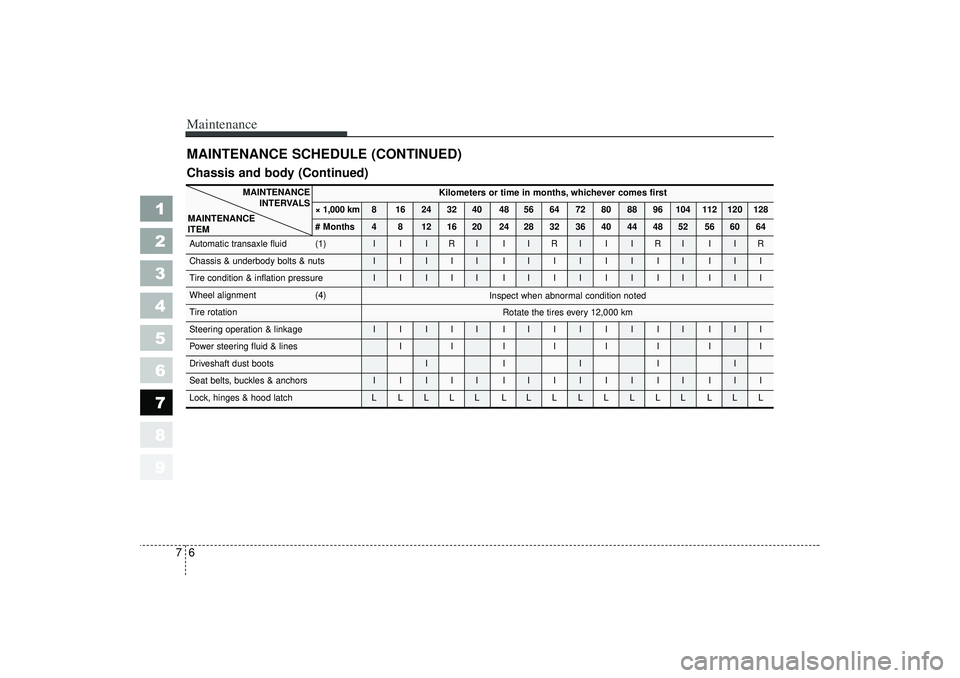
MAINTENANCE SCHEDULE (CONTINUED)
Kilometers or time in months, whichever comes first
× 1,000 km 8 16 24 32 40 48 56 64 72 80 88 96 104 112 120 128
# Months 4 8 12 16 20 24 28 32 36 40 44 48 52 56 60 64
Automatic transaxle fluid (1) I I I R I I I R I I I R I I I R
Chassis & underbody bolts & nuts I I I I I I IIIIIII III
Tire condition & inflation pressure I I I I I I IIIIIII III
Wheel alignment (4)
Tire rotation
Steering operation & linkage I I I I I I IIIIIII III
Power steering fluid & lines I I I IIIII
Driveshaft dust boots I I I I I
Seat belts, buckles & anchors I I I I I I IIIIIII III
Lock, hinges & hood latch L L L L L L LLLLLLL LLL
MAINTENANCE
INTERVALS
MAINTENANCE
ITEM
Inspect when abnormal condition noted
Rotate the tires every 12,000 km
Chassis and body (Continued)
LD CAN (ENG) 7.qxd 7/29/05 10:23 AM Page 6
Page 230 of 273

Maintenance87
1
2
3
4
5
6
7
8
9
OWNER MAINTENANCE Owner maintenance schedule The following lists are vehicle checks
and inspections that should be per-
formed by the owner or an
Authorized Kia Dealer at the fre-
quencies indicated to help ensure
safe, dependable operation of your
vehicle.
Any adverse conditions should be
brought to the attention of your deal-
er as soon as possible.
These Owner Maintenance Checks
are generally not covered by war-
ranties and you may be charged for
labor, parts and lubricants used.When you stop for fuel:
Check the engine oil level.
Check coolant level in coolant
reservoir.
Check the windshield washer fluid level.
Look for low or under-inflated tires. While operating your vehicle:
Note any changes in the sound of
the exhaust or any smell of
exhaust fumes in the vehicle.
Check for vibrations in the steering wheel. Notice any increased steer-
ing effort or looseness in the steer-
ing wheel, or change in its straight-
ahead position.
Notice if your vehicle constantly turns slightly or “pulls” to one side
when traveling on smooth, level
road.
When stopping, listen and check for strange sounds, pulling to one
side, increased brake pedal travel
or “hard-to-push” brake pedal.
If any slipping or changes in the operation of your transaxle occurs,
check the transaxle fluid level.
Check automatic transaxle P (Park) function.
Check parking brake.
Check for fluid leaks under your vehicle (water dripping from the air
conditioning system after use is
normal).
WARNING
Be careful when checking your
engine coolant level when the
engine is hot. Scalding hot
coolant and steam may blow out
under pressure. This could
cause serious injury.
LD CAN (ENG) 7.qxd 7/29/05 10:23 AM Page 8
Page 231 of 273
79
Maintenance
1
2
3
4
5
6
7
8
9
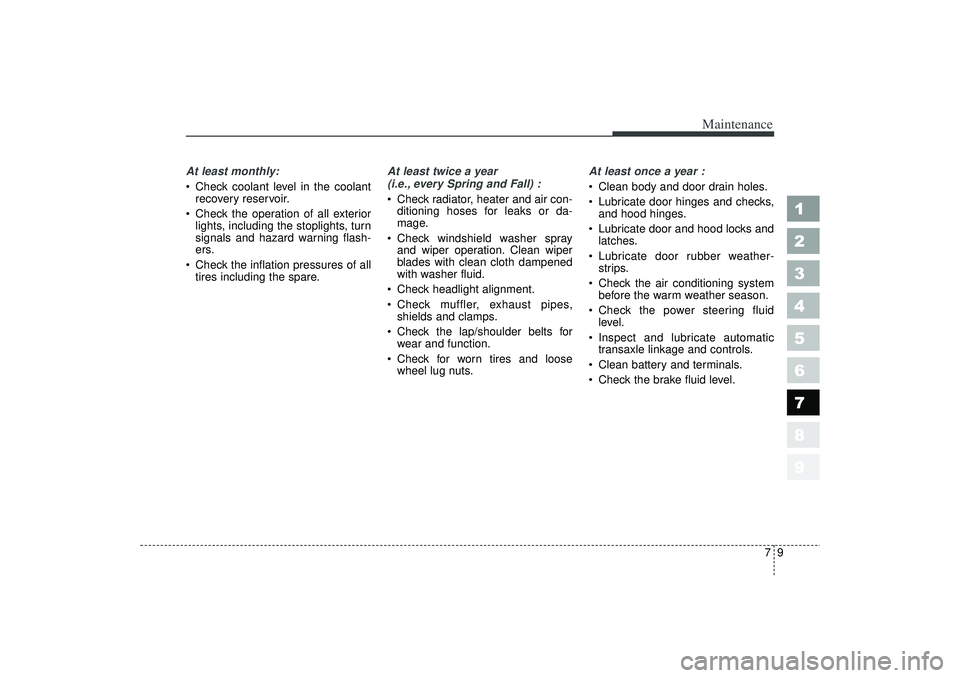
At least monthly:
Check coolant level in the coolantrecovery reservoir.
Check the operation of all exterior lights, including the stoplights, turn
signals and hazard warning flash-
ers.
Check the inflation pressures of all tires including the spare. At least twice a year
(i.e., every Spring and Fall) :
Check radiator, heater and air con-
ditioning hoses for leaks or da-
mage.
Check windshield washer spray and wiper operation. Clean wiper
blades with clean cloth dampened
with washer fluid.
Check headlight alignment.
Check muffler, exhaust pipes, shields and clamps.
Check the lap/shoulder belts for wear and function.
Check for worn tires and loose wheel lug nuts. At least once a year :
Clean body and door drain holes.
Lubricate door hinges and checks,
and hood hinges.
Lubricate door and hood locks and latches.
Lubricate door rubber weather- strips.
Check the air conditioning system before the warm weather season.
Check the power steering fluid level.
Inspect and lubricate automatic transaxle linkage and controls.
Clean battery and terminals.
Check the brake fluid level.
LD CAN (ENG) 7.qxd 7/29/05 10:23 AM Page 9
Page 252 of 273
Maintenance30
7
1
2
3
4
5
6
7
8
9
TIRES AND WHEELS Tires care For proper maintenance, safety, and
maximum fuel economy, you must
always maintain recommended tire
inflation pressures and stay within
the load limits and weight distribution
recommended for your vehicle.Inflation pressures All tire pressures (including the
spare) should be checked every day
when the tires are cold. “Cold Tires”
means the vehicle has not been driv-
en for at least three hours or driven
less than 1.6 km (one mile).
Recommended pressures must be
maintained for the best ride, top vehi-
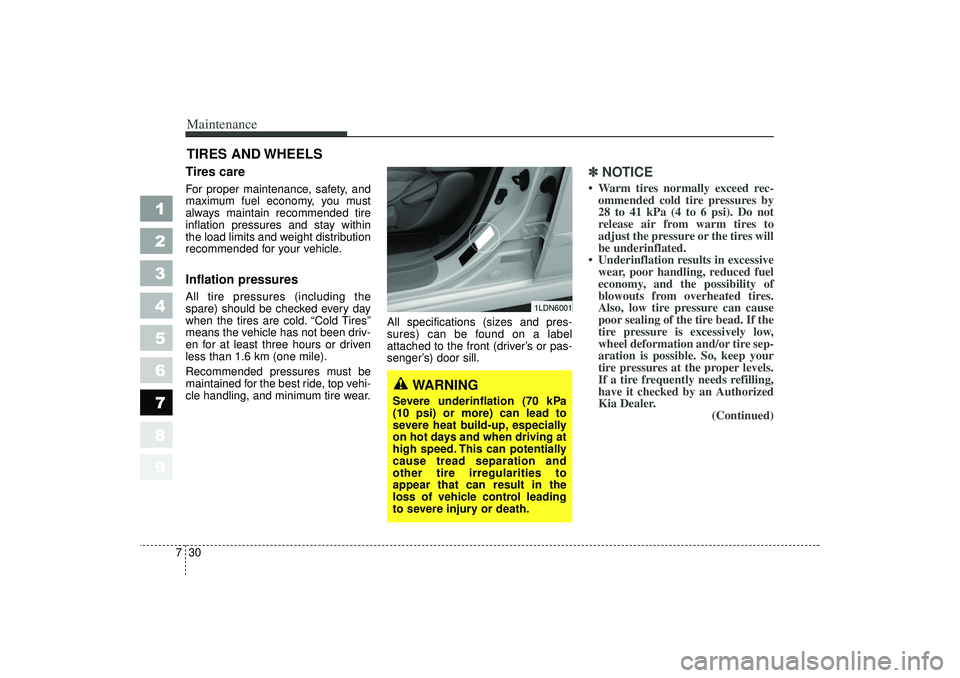
cle handling, and minimum tire wear. All specifications (sizes and pres-
sures) can be found on a label
attached to the front (driver’s or pas-
senger’s) door sill.
✽ ✽
NOTICE Warm tires normally exceed rec-
ommended cold tire pressures by
28 to 41 kPa (4 to 6 psi). Do not
release air from warm tires to
adjust the pressure or the tires will
be underinflated.
Underinflation results in excessive wear, poor handling, reduced fuel
economy, and the possibility of
blowouts from overheated tires.
Also, low tire pressure can cause
poor sealing of the tire bead. If the
tire pressure is excessively low,
wheel deformation and/or tire sep-
aration is possible. So, keep your
tire pressures at the proper levels.
If a tire frequently needs refilling,
have it checked by an Authorized
Kia Dealer. (Continued)
1LDN6001
WARNING
Severe underinflation (70 kPa
(10 psi) or more) can lead to
severe heat build-up, especially
on hot days and when driving at
high speed. This can potentially
cause tread separation and
other tire irregularities to
appear that can result in the
loss of vehicle control leading
to severe injury or death.
LD CAN (ENG) 7.qxd 7/29/05 10:23 AM Page 30
Page 253 of 273

731
Maintenance
1
2
3
4
5
6
7
8
9
(Continued)
Overinflation produces a harshride, handling problems, excessive
wear at the center of the tire tread,
and a greater possibility of dam-
age from road hazards.
Be sure to reinstall the tire infla- tion valve caps. Without the valve
cap, dirt or moisture could get into
the valve core and cause air leak-
age. If the cap have been lost,
install new one as soon as possible.
Tire rotation To equalize tread wear, it is recom-
mended that the tires be rotated
every 12,000 km (7,500 miles) or
sooner if irregular wear develops.
During rotation, check the tires for
correct balance.
When rotating tires, check for uneven
wear and damage. Abnormal wear is
usually caused by incorrect tire pres-
sure, improper wheel alignment, out-
of-balance wheels, severe braking or
severe cornering. Look for bumps or
bulges in the tread or side of tire.
Replace the tire if you find either of
these conditions. Replace the tire
also if you can see fabric or cord.
After rotation, be sure to bring the
front and rear tire pressures to spec-
ification and check lug nut tightness.
Refer to Section 8, Specifications. Disc brake pads and rear brake
shoes should be inspected for wear
whenever tires are rotated.
✽ ✽
NOTICERotate radial tires that have an
asymmetric tread pattern only from
front to rear and not from right to
left.
WARNING
- Tire Inflation
Overinflation or underinflation
can reduce tire life, adversely
affect vehicle handling, and lead
to sudden tire failure. This could
result in loss of vehicle control.
CBGQ0707CBGQ0707A
Do not include compact spare tire in rotation.
Directional tires (if equipped)
LD CAN (ENG) 7.qxd 7/29/05 10:23 AM Page 31
Page 255 of 273

733
Maintenance
1
2
3
4
5
6
7
8
9
Wheel replacement When replacing the metal wheels for
any reason, make sure the new
wheels are equivalent to the original
factory units in diameter, rim width
and offset.
WARNING
When replacing tires, nevermix radial, bias-belted, and
bias-type tires. All four tires
should be of the same size,
design and construction. Use
only the tire sizes listed on the
Tire Label found below the
door striker on the driver’s
side. Make sure that all tires
and wheels are the same size
and have the same load-carry-
ing capacity. Use only tire and
wheel combinations recom-
mended on the Tire Label or
by an Authorized Kia Dealer.
Failure to follow these precau-
tions can adversely affect the
safety and handling of your
vehicle.
(Continued)
(Continued)
The use of any other tire sizeor type may seriously affect
ride, handling, ground clear-
ance, tire clearance, and
speedometer calibration.
Driving on worn-out tires is very hazardous and will
reduce braking effectiveness,
steering accuracy, and trac-
tion.
It is best to replace all four tires at the same time. If that is
not possible, or necessary,
then replace the two front or
two rear tires as a pair.
Replacing just one tire can
seriously affect your vehicle’s
handling.
WARNING
A wheel that is not the correct
size may adversely affect wheel
and bearing life, braking and
stopping abilities, handling
characteristics, ground clear-
ance, body-to-tire clearance,
speedometer calibration, head-
light aim and bumper height.
LD CAN (ENG) 7.qxd 7/29/05 10:23 AM Page 33
Page 256 of 273
Maintenance34
7
1
2
3
4
5
6
7
8
9
Tire size designation A tire’s sidewall is marked with a tire
size designation. You will need this
information when selecting replace-
ment tires for your car. The following
explains what the letters and num-
bers in the tire size designation
mean.
Example tire size designation:
P195/60 R15 87H
(These numbers are provided as an
example only; your tire size designa-
tor could vary depending on your
vehicle.) P - Applicable vehicle type (tires
marked with the prefix “P’’ are
intended for use on passenger
cars or light trucks; however, not
all tires have this marking).
195 - Tire width in millimeters.
60 - Aspect ratio. The tire’s section height as a percentage of its
width.
R - Tire construction code (Radial).
15 - Rim diameter in inches.
87 - Load Index, a numerical code associated with the maximum
load the tire can carry.
H - Speed Rating Symbol. See the speed rating chart in this section
for additional information.
Wheel size designation Wheels are also marked with impor-
tant information that you need if you
ever have to replace one. The follow-
ing explains what the letters and
numbers in the wheel size designa-
tion mean. Example wheel size designation:
6.0 J x 15
6.0 - Rim width in inches.
J - Rim contour designation.
15 - Rim diameter in inches.
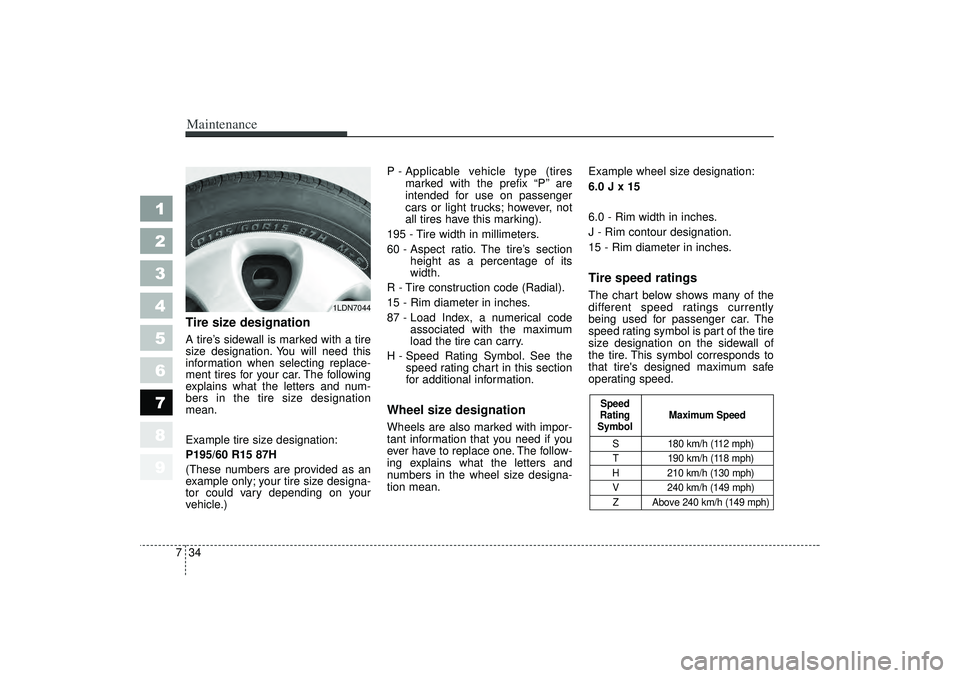
Tire speed ratings The chart below shows many of the
different speed ratings currently
being used for passenger car. The
speed rating symbol is part of the tire
size designation on the sidewall of
the tire. This symbol corresponds to
that tire's designed maximum safe
operating speed.
S 180 km/h (112 mph)
T 190 km/h (118 mph)
H 210 km/h (130 mph) V 240 km/h (149 mph)Z Above 240 km/h (149 mph)
Maximum Speed
Speed
Rating
Symbol
1LDN7044
LD CAN (ENG) 7.qxd 7/29/05 10:23 AM Page 34
Page 257 of 273
735
Maintenance
1
2
3
4
5
6
7
8
9
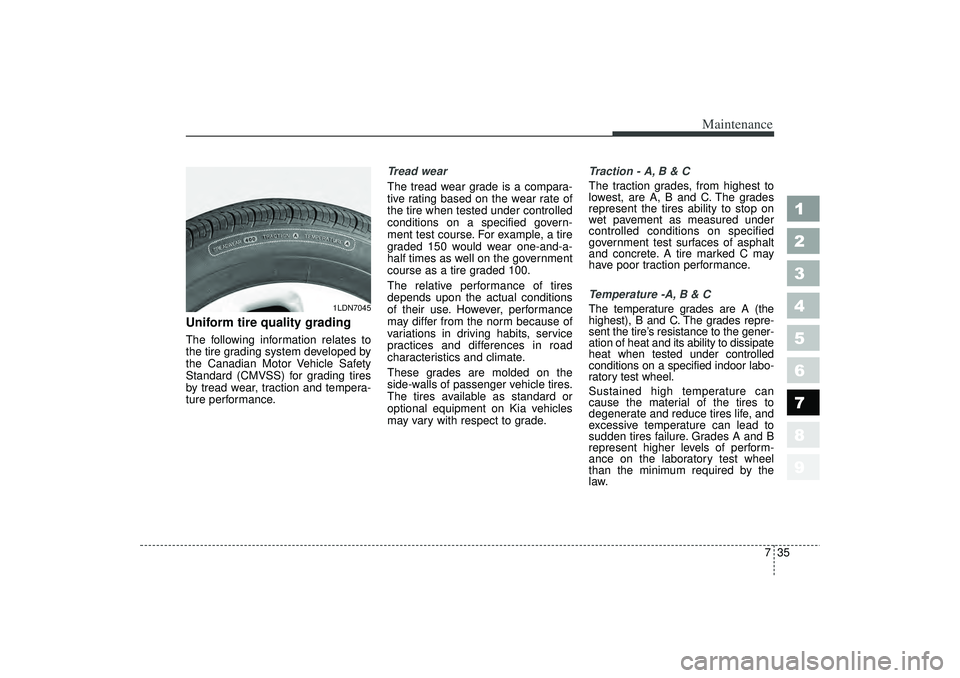
Uniform tire quality grading The following information relates to
the tire grading system developed by
the Canadian Motor Vehicle Safety
Standard (CMVSS) for grading tires
by tread wear, traction and tempera-
ture performance.Tread wear
The tread wear grade is a compara-
tive rating based on the wear rate of
the tire when tested under controlled
conditions on a specified govern-
ment test course. For example, a tire
graded 150 would wear one-and-a-
half times as well on the government
course as a tire graded 100.
The relative performance of tires
depends upon the actual conditions
of their use. However, performance
may differ from the norm because of
variations in driving habits, service
practices and differences in road
characteristics and climate.
These grades are molded on the
side-walls of passenger vehicle tires.
The tires available as standard or
optional equipment on Kia vehicles
may vary with respect to grade.Traction - A, B & C
The traction grades, from highest to
lowest, are A, B and C. The grades
represent the tires ability to stop on
wet pavement as measured under
controlled conditions on specified
government test surfaces of asphalt
and concrete. A tire marked C may
have poor traction performance.
Temperature -A, B & C
The temperature grades are A (the
highest), B and C. The grades repre-
sent the tire’s resistance to the gener-
ation of heat and its ability to dissipate
heat when tested under controlled
conditions on a specified indoor labo-
ratory test wheel.
Sustained high temperature can
cause the material of the tires to
degenerate and reduce tires life, and
excessive temperature can lead to
sudden tires failure. Grades A and B
represent higher levels of perform-
ance on the laboratory test wheel
than the minimum required by the
law.
1LDN7045
LD CAN (ENG) 7.qxd 7/29/05 10:23 AM Page 35
Page 258 of 273
Maintenance36
7
1
2
3
4
5
6
7
8
9
Checking a tire life
Tire strength and performance
decline with age. Any tires that are
over 6 year old, including the spare
(determined by the tire manufacture
date), should be replaced regardless
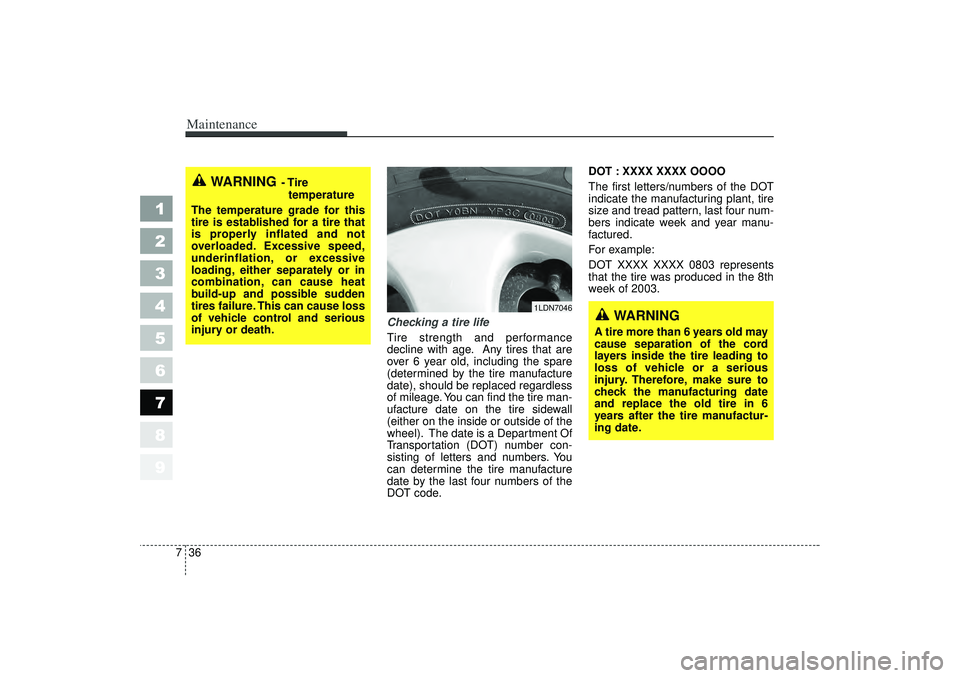
of mileage. You can find the tire man-
ufacture date on the tire sidewall
(either on the inside or outside of the
wheel). The date is a Department Of
Transportation (DOT) number con-
sisting of letters and numbers. You
can determine the tire manufacture
date by the last four numbers of the
DOT code. DOT : XXXX XXXX OOOO
The first letters/numbers of the DOT
indicate the manufacturing plant, tire
size and tread pattern, last four num-
bers indicate week and year manu-
factured.
For example:
DOT XXXX XXXX 0803 represents
that the tire was produced in the 8th
week of 2003.
WARNING
A tire more than 6 years old may
cause separation of the cord
layers inside the tire leading to
loss of vehicle or a serious
injury. Therefore, make sure to
check the manufacturing date
and replace the old tire in 6
years after the tire manufactur-
ing date.
WARNING
- Tire
temperature
The temperature grade for this
tire is established for a tire that
is properly inflated and not
overloaded. Excessive speed,
underinflation, or excessive
loading, either separately or in
combination, can cause heat
build-up and possible sudden
tires failure. This can cause loss
of vehicle control and serious
injury or death.
1LDN7046
LD CAN (ENG) 7.qxd 7/29/05 10:23 AM Page 36