climate control KIA Sportage 2005 JE_ / 2.G User Guide
[x] Cancel search | Manufacturer: KIA, Model Year: 2005, Model line: Sportage, Model: KIA Sportage 2005 JE_ / 2.GPages: 354, PDF Size: 2.78 MB
Page 215 of 354
Driving your vehicle92 4
1
2
3
4
5
6
7
8
9
For maximum defrosting, set the
temperature control to the extreme
right/hot position and the fan speed
control to the highest speed.
If warm air to the floor is desired
while defrosting or defogging, set
the mode to the floor-defrost posi-
tion.
Before driving, clear all snow and
ice from the windshield, rear win-
dow, outside rear view mirrors, and
all side windows.
Clear all snow and ice from the
hood and air inlet in the cowl grill to
improve heater and defroster effi-
ciency and to reduce the probabili-
ty of fogging up inside of the wind-
shield.
Defogging logicManual climate control systemTo reduce the probability of fogging
up the inside of the windshield, the
air intake control is set to the outside
(fresh) air position automatically if
any of following occur.
The mode is selected to the ,
or while the system is
activated.
The ignition switch is turned on
while the mode is selected to the
, or .
The ignition switch is turned off.
The fan is off.
The fan begins to be operated.
Press the air intake control button to
select the recirculated air position
while the ignition switch is on.How to cancel or return defogging
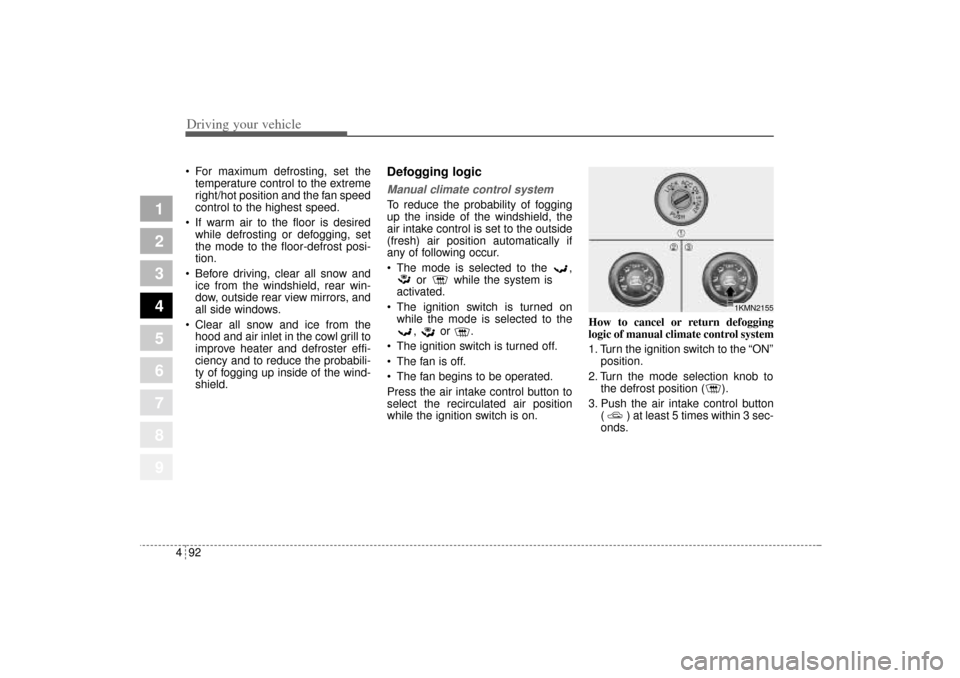
logic of manual climate control system
1. Turn the ignition switch to the “ON”
position.
2. Turn the mode selection knob to
the defrost position ( ).
3. Push the air intake control button
( ) at least 5 times within 3 sec-
onds.
1KMN2155
KM CAN (ENG) 4.qxd 9/13/2004 4:49 PM Page 92
Page 216 of 354
493
Driving your vehicle
1
2
3
4
5
6
7
8
9
The indicator light in the air intake
control button will blink 3 times at 0.5
second intervals. This indicates that
the defogging logic is canceled or
has returned to the programmed
condition.
If the battery has been discharged or
disconnected, the defog logic is reset
to the original condition.
Automatic climate control systemTo reduce the probability of fogging
up inside of the windshield, the air
intake control is set to outside (fresh)
air position automatically if any of fol-
lowing occur.
The ignition switch is turned on
while the mode is selected to the
, , .
The OFF button is pushed.
The mode is selected to the ,
or position.
Press the air intake control button to
select the recirculated air position
while the ignition switch is on.How to cancel or return defogging
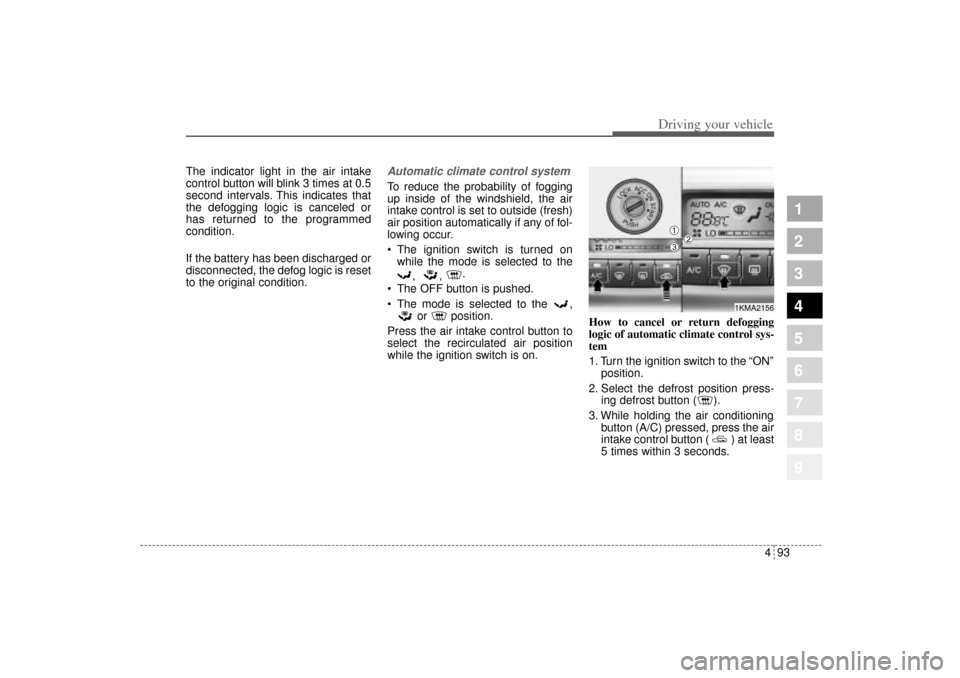
logic of automatic climate control sys-
tem
1. Turn the ignition switch to the “ON”
position.
2. Select the defrost position press-
ing defrost button ( ).
3. While holding the air conditioning
button (A/C) pressed, press the air
intake control button ( ) at least
5 times within 3 seconds.
1KMA2156
➀
➁
➂
KM CAN (ENG) 4.qxd 9/13/2004 4:49 PM Page 93
Page 325 of 354
Maintenance32 7
1
2
3
4
5
6
7
8
9
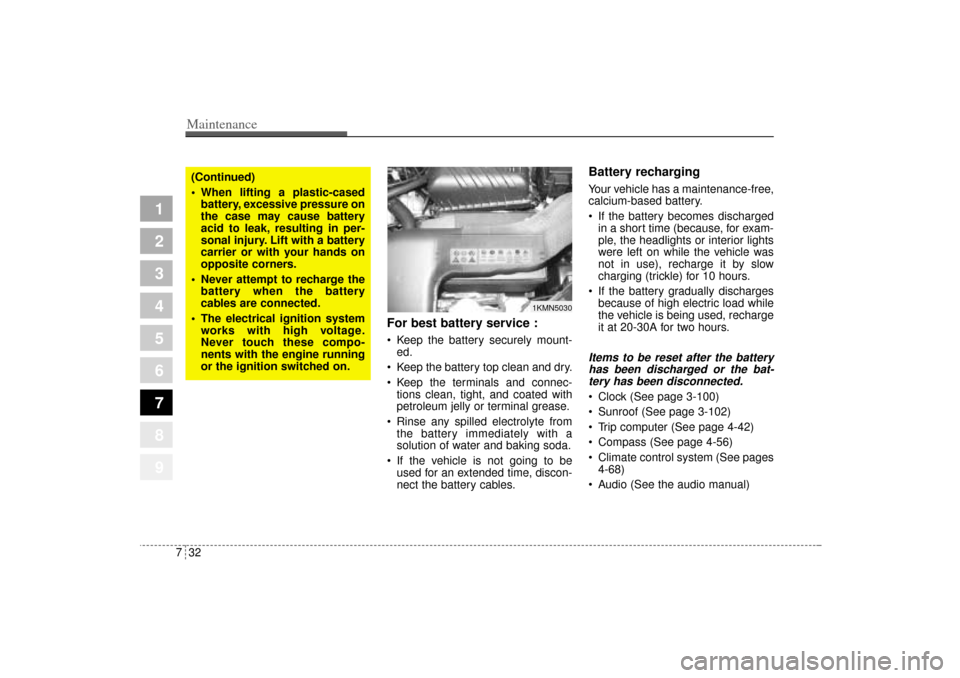
For best battery service : Keep the battery securely mount-
ed.
Keep the battery top clean and dry.
Keep the terminals and connec-
tions clean, tight, and coated with
petroleum jelly or terminal grease.
Rinse any spilled electrolyte from
the battery immediately with a
solution of water and baking soda.
If the vehicle is not going to be
used for an extended time, discon-
nect the battery cables.
Battery recharging Your vehicle has a maintenance-free,
calcium-based battery.
If the battery becomes discharged
in a short time (because, for exam-
ple, the headlights or interior lights
were left on while the vehicle was
not in use), recharge it by slow
charging (trickle) for 10 hours.
If the battery gradually discharges
because of high electric load while
the vehicle is being used, recharge
it at 20-30A for two hours.Items to be reset after the battery
has been discharged or the bat-
tery has been disconnected. Clock (See page 3-100)
Sunroof (See page 3-102)
Trip computer (See page 4-42)
Compass (See page 4-56)
Climate control system (See pages
4-68)
Audio (See the audio manual)
1KMN5030
(Continued)
When lifting a plastic-cased
battery, excessive pressure on
the case may cause battery
acid to leak, resulting in per-
sonal injury. Lift with a battery
carrier or with your hands on
opposite corners.
Never attempt to recharge the
battery when the battery
cables are connected.
The electrical ignition system
works with high voltage.
Never touch these compo-
nents with the engine running
or the ignition switched on.
KM CAN (ENG) 7.qxd 9/13/2004 4:47 PM Page 32
Page 336 of 354
743
Maintenance
1
2
3
4
5
6
7
8
9
Tread wear
The tread wear grade is a compara-
tive rating based on the wear rate of
the tire when tested under controlled
conditions on a specified govern-
ment test course. For example, a tire
graded 150 would wear one-and-a-
half times as well on the government
course as a tire graded 100.
The relative performance of tires
depends upon the actual conditions
of their use. However, performance
may differ from the norm because of
variations in driving habits, service
practices and differences in road
characteristics and climate.
These grades are molded on the
side-walls of passenger vehicle tires.
The tires available as standard or
optional equipment on Kia vehicles
may vary with respect to grade.Traction - A, B & C
The traction grades, from highest to
lowest, are A, B and C. The grades
represent the tires ability to stop on
wet pavement as measured under
controlled conditions on specified
government test surfaces of asphalt
and concrete. A tire marked C may
have poor traction performance.
Temperature -A, B & C
The temperature grades are A (the
highest), B and C. The grades repre-
sent the tire’s resistance to the gener-
ation of heat and its ability to dissipate
heat when tested under controlled
conditions on a specified indoor labo-
ratory test wheel.
Sustained high temperature can
cause the material of the tires to
degenerate and reduce tires life, and
excessive temperature can lead to
sudden tires failure. Grade C corre-
sponds to a level of performance
which all passenger vehicle tires
must meet under the Federal Motor
Vehicle Safety Standard No. 109.
Grades A and B represent higher lev-
els of performance on the laboratory
test wheel than the minimum required
by the law.
WARNING
- Tire
temperature
The temperature grade for this
tire is established for a tire that
is properly inflated and not
overloaded. Excessive speed,
underinflation, or excessive
loading, either separately or in
combination, can cause heat
build-up and possible sudden
tires failure. This can cause loss
of vehicle control and serious
injury or death.
KM CAN (ENG) 7.qxd 9/13/2004 4:47 PM Page 43