key KIA Sportage 2005 JE_ / 2.G User Guide
[x] Cancel search | Manufacturer: KIA, Model Year: 2005, Model line: Sportage, Model: KIA Sportage 2005 JE_ / 2.GPages: 354, PDF Size: 2.78 MB
Page 22 of 354
311
Knowing your vehicle
1
2
3
4
5
6
7
8
9
✽ ✽
NOTICEIf the door is locked/unlocked multi-
ple times in rapid succession with
either the vehicle key or door lock
switch, the system may stop operat-
ing temporarily in order to protect
the circuit and prevent damage to
system components.
Operating door locks from
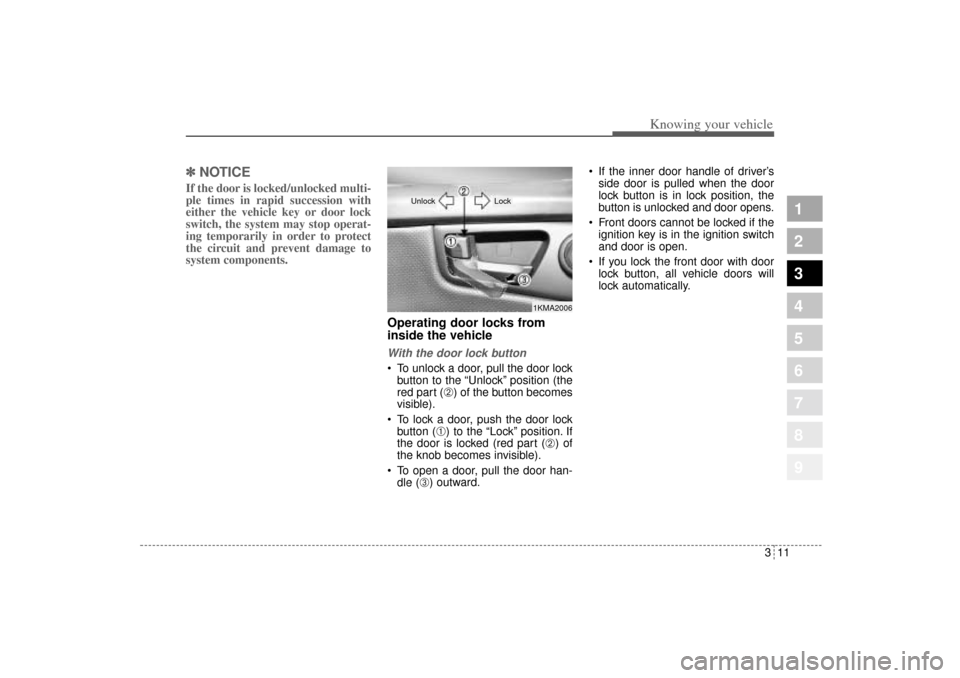
inside the vehicleWith the door lock button To unlock a door, pull the door lock
button to the “Unlock” position (the
red part (
➁) of the button becomes
visible).
To lock a door, push the door lock
button (
➀) to the “Lock” position. If
the door is locked (red part (
➁) of
the knob becomes invisible).
To open a door, pull the door han-
dle (
➂) outward. If the inner door handle of driver’s
side door is pulled when the door
lock button is in lock position, the
button is unlocked and door opens.
Front doors cannot be locked if the
ignition key is in the ignition switch
and door is open.
If you lock the front door with door
lock button, all vehicle doors will
lock automatically.
1KMA2006
Lock
Unlock
KM CAN (ENG) 3 (~57).qxd 9/13/2004 4:49 PM Page 11
Page 23 of 354
Knowing your vehicle12 3
1
2
3
4
5
6
7
8
9
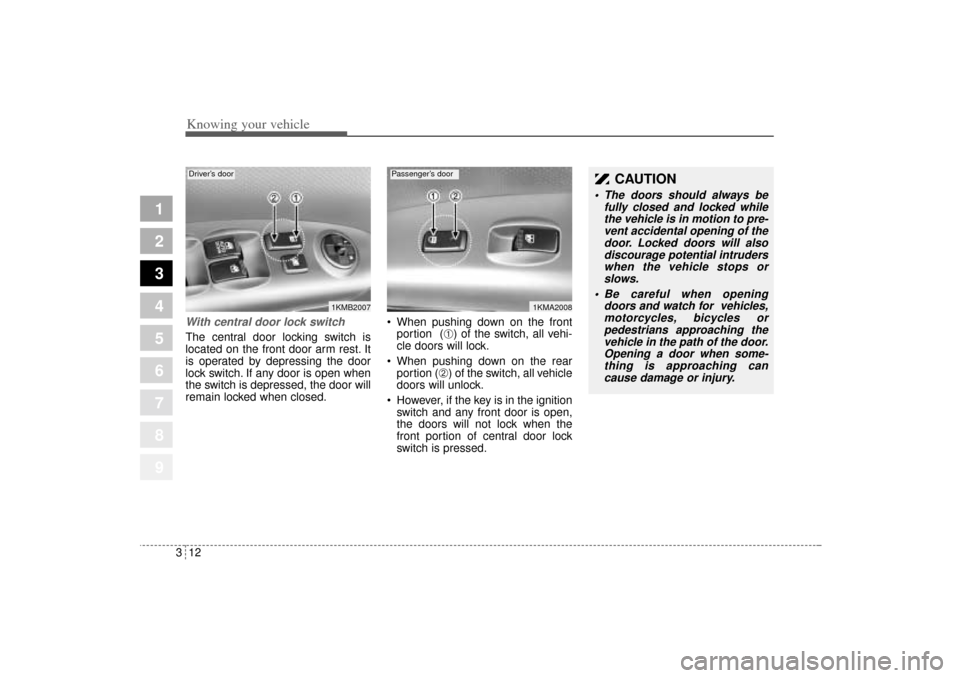
With central door lock switchThe central door locking switch is
located on the front door arm rest. It
is operated by depressing the door
lock switch. If any door is open when
the switch is depressed, the door will
remain locked when closed. When pushing down on the front
portion (
➀) of the switch, all vehi-
cle doors will lock.
When pushing down on the rear
portion (
➁) of the switch, all vehicle
doors will unlock.
However, if the key is in the ignition
switch and any front door is open,
the doors will not lock when the
front portion of central door lock
switch is pressed.
CAUTION
• The doors should always be
fully closed and locked while
the vehicle is in motion to pre-
vent accidental opening of the
door. Locked doors will also
discourage potential intruders
when the vehicle stops or
slows.
Be careful when opening
doors and watch for vehicles,
motorcycles, bicycles or
pedestrians approaching the
vehicle in the path of the door.
Opening a door when some-
thing is approaching can
cause damage or injury.
1KMB2007
1KMA2008
Driver’s door
Passenger’s door
KM CAN (ENG) 3 (~57).qxd 9/13/2004 4:49 PM Page 12
Page 24 of 354
313
Knowing your vehicle
1
2
3
4
5
6
7
8
9
Impact sensing door unlock
system (if equipped)All doors will be automatically
unlocked when the Supplemental
Restraint System (SRS) detects a
collision while the ignition switch is
ON.
However, the doors may not be
unlocked when malfunctions exist in
mechanical door lock system or if
electrical power in the vehicle should
fail.
WARNING
Leaving your vehicle unlocked
can invite theft or possible harm
to you or others from someone
hiding in your vehicle while you
are gone. Always remove the
ignition key, engage the parking
brake, close all windows and
lock all doors when leaving your
vehicle unattended.
WARNING
- Unattended
children
An enclosed vehicle can
become extremely hot, causing
death or severe injury to unat-
tended children or animals who
cannot escape the vehicle.
Furthermore, children might
operate features of the vehicle
that could injure them, or they
could encounter other harm,
possibly from someone gaining
entry to the vehicle. Never leave
children or animals unattended
in your vehicle.
KM CAN (ENG) 3 (~57).qxd 9/13/2004 4:49 PM Page 13
Page 26 of 354
315
Knowing your vehicle
1
2
3
4
5
6
7
8
9
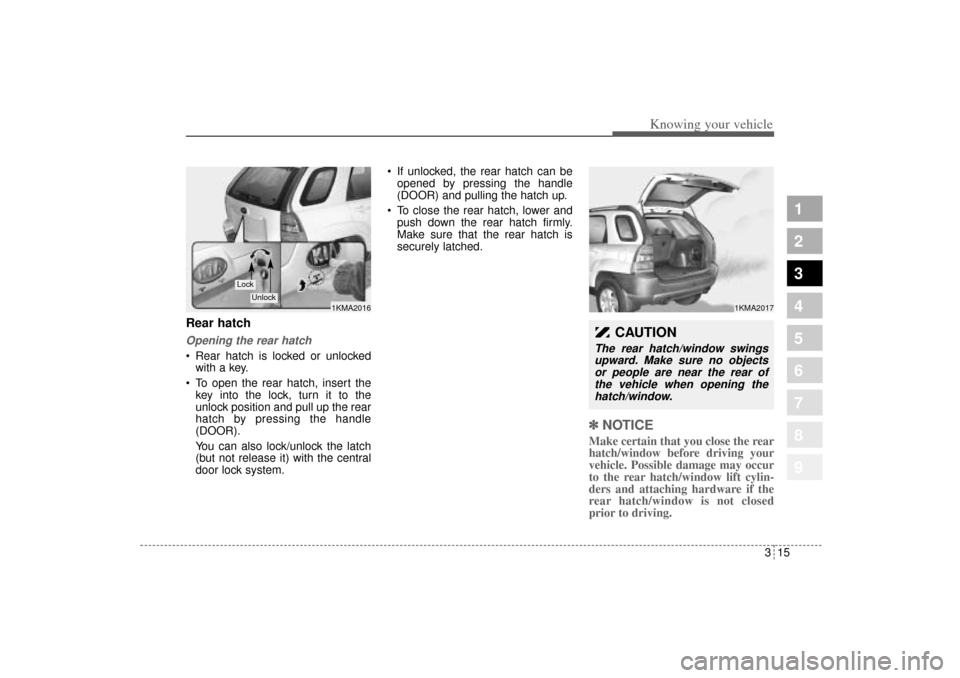
Rear hatchOpening the rear hatch Rear hatch is locked or unlocked
with a key.
To open the rear hatch, insert the
key into the lock, turn it to the
unlock position and pull up the rear
hatch by pressing the handle
(DOOR).
You can also lock/unlock the latch
(but not release it) with the central
door lock system. If unlocked, the rear hatch can be
opened by pressing the handle
(DOOR) and pulling the hatch up.
To close the rear hatch, lower and
push down the rear hatch firmly.
Make sure that the rear hatch is
securely latched.
✽ ✽
NOTICEMake certain that you close the rear
hatch/window before driving your
vehicle. Possible damage may occur
to the rear hatch/window lift cylin-
ders and attaching hardware if the
rear hatch/window is not closed
prior to driving.
1KMA2017
CAUTION
The rear hatch/window swings
upward. Make sure no objects
or people are near the rear of
the vehicle when opening the
hatch/window.
1KMA2016
Lock
Unlock
KM CAN (ENG) 3 (~57).qxd 9/13/2004 4:49 PM Page 15
Page 29 of 354
Knowing your vehicle18 3
1
2
3
4
5
6
7
8
9
The ignition switch must be in the ON
position for power windows to oper-
ate. Each door has a power window
switch that controls that door’s win-
dow. However, the driver has a power
window lock switch which can block
the operation of passenger windows.
The power windows can be operated
for approximately 30 seconds after
the ignition key is removed or turned
to the ACC or LOCK position.
However, if the front doors are
opened, the power windows cannot
be operated even within the 30 sec-
onds after the ignition key removal.
If you notice buffeting and pulsation
(wind shock) with either side window
open, you should open the opposite
window slightly to reduce the condi-
tion.
✽ ✽
NOTICE• To prevent the power window sys-
tem from the possibility of dam-
age, do not open or close two win-
dows at the same time. This will
also ensure the longevity of the
fuse.
• Never try to operate the main
switch on the driver's door and the
individual door window switch in
opposing directions at the same
time. If this is done, the window
will stop and cannot be opened or
closed.
CAUTION
Make sure heads and hands
are safely out of the way
before closing a window.
Do not allow children to play
with the power windows. Keep
the driver’s door power win-
dow lock switch in the LOCK
position (depressed). Serious
injury can result from uninten-
tional window operation by
the child.
Do not extend face or arms
outside through the window
opening while driving.
Always double check to make
sure all arms, hands and other
obstructions are safely out of
the way before closing a win-
dow.
KM CAN (ENG) 3 (~57).qxd 9/13/2004 4:49 PM Page 18
Page 30 of 354
319
Knowing your vehicle
1
2
3
4
5
6
7
8
9
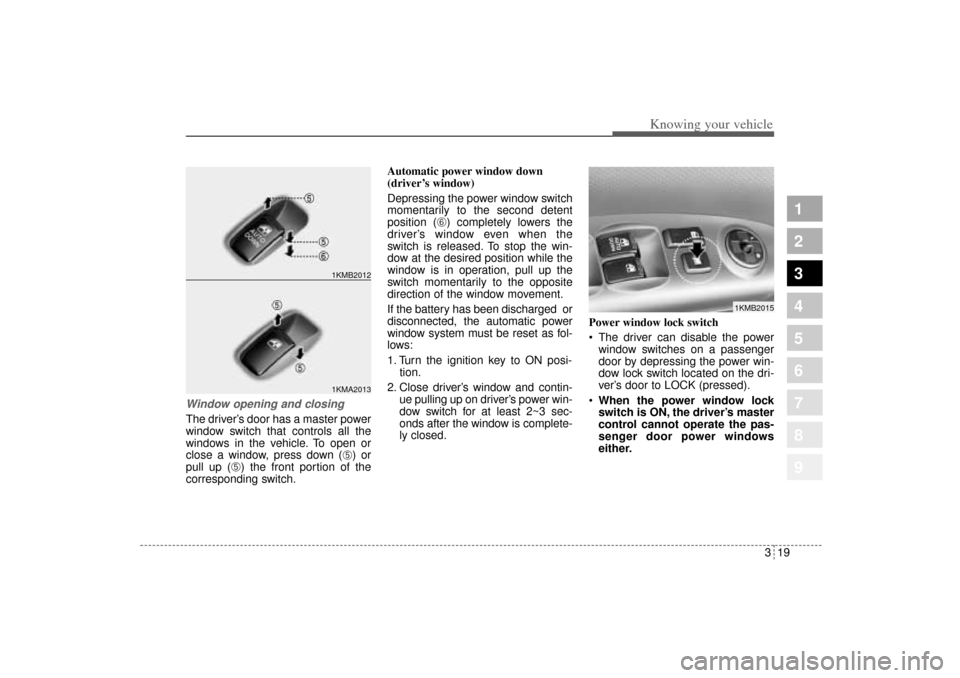
Window opening and closingThe driver’s door has a master power
window switch that controls all the
windows in the vehicle. To open or
close a window, press down (
➄) or
pull up (
➄) the front portion of the
corresponding switch.Automatic power window down
(driver’s window)
Depressing the power window switch
momentarily to the second detent
position (
➅) completely lowers the
driver’s window even when the
switch is released. To stop the win-
dow at the desired position while the
window is in operation, pull up the
switch momentarily to the opposite
direction of the window movement.
If the battery has been discharged or
disconnected, the automatic power
window system must be reset as fol-
lows:
1. Turn the ignition key to ON posi-
tion.
2. Close driver’s window and contin-
ue pulling up on driver’s power win-
dow switch for at least 2~3 sec-
onds after the window is complete-
ly closed.Power window lock switch
The driver can disable the power
window switches on a passenger
door by depressing the power win-
dow lock switch located on the dri-
ver’s door to LOCK (pressed).
When the power window lock
switch is ON, the driver’s master
control cannot operate the pas-
senger door power windows
either.
1KMA20131KMB2012
1KMB2015
KM CAN (ENG) 3 (~57).qxd 9/13/2004 4:49 PM Page 19
Page 43 of 354
Knowing your vehicle32 3
1
2
3
4
5
6
7
8
9
Load limiterWhen the pre-tentioner activates, if
the system senses excessive seat
belt tension on the driver or passen-
ger’s seat belt, the load limiter inside
the pre-tensioner will release some
of the pressure on the affected seat
belt.
WARNING
To obtain maximum benefit from
a pre-tensioner seat belt:
The seat belt must be worn
correctly.
The seat belt must be adjusted
to the correct position.
CAUTION
When the pre-tensioner seat
belts are activated, a loud noise
may be heard and fine dust,
which may appear to be smoke,
may be visible in the passenger
compartment and are not toxic.
Although, it is harmless, the fine
dust may cause skin irritation
and should not be breathed for
prolonged periods. Wash your
hands and face thoroughly after
an accident in which the airbags
and/or pre-tensioner seat belts
were activated.
CAUTION
Because the sensor that acti-
vates the SRS airbag is con-
nected with pre-tensioner seat
belt, the SRS airbag warning
light on the instrument panel
will illuminate for approxi-
mately 6 seconds after the
ignition key has been turned
to the “ON” position, then the
light should go off.
If the pre-tensioner seat belt is
not working properly, this
warning light will illuminate
even if there is no malfunction
of SRS airbag system. If the
SRS airbag warning light does
not illuminate when the igni-
tion key is turned to “ON” , or
if it remains illuminated after
illuminating for approximately
6 seconds, or if it illuminates
while the vehicle is being driv-
en, please have an authorized
Kia dealer inspect the pre-ten-
sioner seat belt or SRS airbag
system as soon as possible.
KM CAN (ENG) 3 (~57).qxd 9/13/2004 4:49 PM Page 32
Page 48 of 354
337
Knowing your vehicle
1
2
3
4
5
6
7
8
9
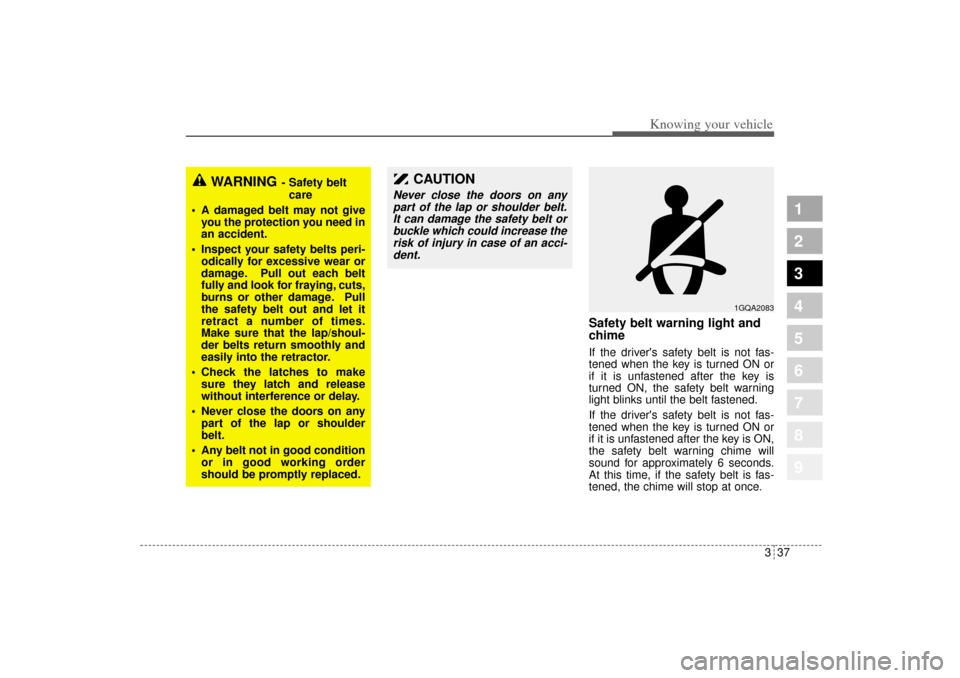
Safety belt warning light and
chimeIf the driver's safety belt is not fas-
tened when the key is turned ON or
if it is unfastened after the key is
turned ON, the safety belt warning
light blinks until the belt fastened.
If the driver's safety belt is not fas-
tened when the key is turned ON or
if it is unfastened after the key is ON,
the safety belt warning chime will
sound for approximately 6 seconds.
At this time, if the safety belt is fas-
tened, the chime will stop at once.
1GQA2083
CAUTION
Never close the doors on any
part of the lap or shoulder belt.
It can damage the safety belt or
buckle which could increase the
risk of injury in case of an acci-
dent.
WARNING
- Safety belt
care
A damaged belt may not give
you the protection you need in
an accident.
Inspect your safety belts peri-
odically for excessive wear or
damage. Pull out each belt
fully and look for fraying, cuts,
burns or other damage. Pull
the safety belt out and let it
retract a number of times.
Make sure that the lap/shoul-
der belts return smoothly and
easily into the retractor.
Check the latches to make
sure they latch and release
without interference or delay.
Never close the doors on any
part of the lap or shoulder
belt.
Any belt not in good condition
or in good working order
should be promptly replaced.
KM CAN (ENG) 3 (~57).qxd 9/13/2004 4:49 PM Page 37
Page 71 of 354
Knowing your vehicle60 3
1
2
3
4
5
6
7
8
9
Airbag system components The main components of your SRS
are:
To indicate that your vehicle is
equipped with airbags, the corre-
sponding airbag covers are
marked with “SRS AIRBAG”.
- Driver’s airbag (see page 3- 61)
- Passenger’s airbag(see page 3- 62)
- Side airbag
(if equipped, see page 3- 69)
- Curtain airbag
(if equipped, see page 3- 69)
A diagnostic system that continual-
ly monitors the system operation.
Airbag warning light to warn you of
a possible problem with the sys-
tem.
Emergency power backup in case
your car’s electrical system is dis-
connected in a crash.The SRS uses a collection of sen-
sors to gather information about the
driver’s and front passenger’s seat
position, the driver’s and front pas-
senger’s safety belt usage and
impact severity.
The driver’s and front passenger’s
seat position sensors, which are
installed on the seat track, determine
if the seats are fore or aft of a refer-
ence position. Similarly, the safety
belt usage sensors determine if the
driver and front passenger’s safety
belts are fastened. These sensors
provide the ability to control the SRS
deployment based on how close the
driver’s seat is to the steering wheel,
how close the passenger’s seat is to
the instrument panel, whether or not
the safety belts are fastened, and the
severity of the impact.
(Continued)
If your vehicle has been sub-
jected to flood conditions (e.g.
soaked carpeting/standing
water on the floor of the vehi-
cle, etc.) or if your vehicle has
become flood damaged in any
way, do not attempt to start
the vehicle or put the key in
the ignition before discon-
necting the battery.
Disregarding this precaution
may cause airbag deployment,
which could result in serious
personal injury or death. If
your vehicle is subjected to
flooded conditions, before
starting the vehicle, have the
vehicle towed to an authorized
Kia dealer for inspection and
necessary repairs.
KM CAN (ENG) 3 (~112).qxd 9/13/2004 4:50 PM Page 60
Page 72 of 354
361
1
2
3
4
5
6
7
8
9
Knowing your vehicle
The advanced SRS offers the ability
to control the airbag inflation with two
levels. A first stage level is provided
for moderate-severity impacts. A sec-
ond stage level is provided for more
severe impacts.
According to the impact severity,
seating position and safety belt
usage, the SRSCM (SRS Control
Module) controls the airbag inflation.
Failure to properly wear safety
belts can increase the risk or
severity of injury in an accident.
Additionally, your SRS is equipped
with an occupant classification sys-
tem in the front passenger’s seat.
The occupant classification system
detects the presence of a passenger
in the front passenger’s seat and will
turn off the front passenger’s airbag
under certain conditions. For more
detail, see “Occupant Classification
System” later in this section.
CAUTION
If the seat position sensor is not
working properly, the SRS
airbag warning light ( ) on the
instrument panel will illuminate
even if there is no malfunction
of the SRS airbag system,
because the SRS airbag warn-
ing light is connected with the
seat position sensor. If the SRS
airbag warning light does not
illuminate when the ignition key
is turned to the "ON" position, if
it remains illuminated after illu-
minating for approximately 6
seconds, or if it illuminates
while the vehicle is being driv-
en, have an authorized Kia deal-
er inspect the seat position sen-
sor and the advanced SRS
airbag system as soon as possi-
ble.
AIR
BAG
WARNING
Modification to the seat struc-
ture can adversely affect the
seat position sensor and
cause the airbag to deploy at a
different level than should be
provided.
Failure to properly wear safety
belts can increase the risk or
severity of injury by causing
the airbags to deploy at a dif-
ferent level than should be
provided.
Do not place any objects
underneath the front seats
which could damage the seat
position sensor or interfere
with the occupant classifica-
tion system.
Do not place any objects that
may cause magnetic fields
near the front seat. These may
cause a malfunction of the
seat position sensor.
(Continued)
KM CAN (ENG) 3 (~112).qxd 9/13/2004 4:50 PM Page 61