warning KIA Sportage 2005 JE_ / 2.G Workshop Manual
[x] Cancel search | Manufacturer: KIA, Model Year: 2005, Model line: Sportage, Model: KIA Sportage 2005 JE_ / 2.GPages: 354, PDF Size: 2.78 MB
Page 84 of 354
373
1
2
3
4
5
6
7
8
9
Knowing your vehicle
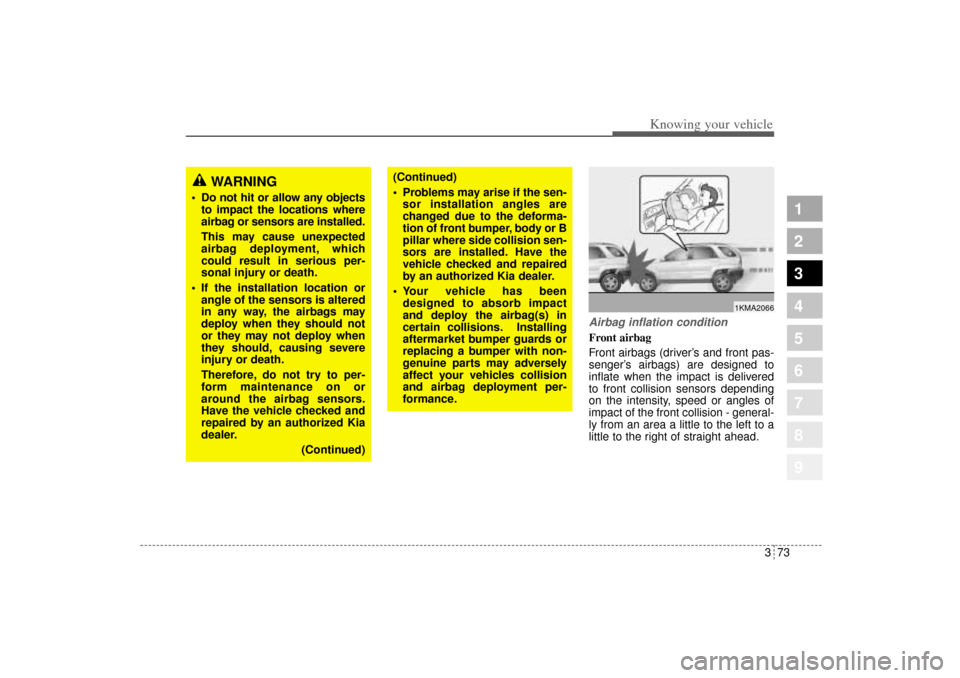
Airbag inflation conditionFront airbag
Front airbags (driver’s and front pas-
senger’s airbags) are designed to
inflate when the impact is delivered
to front collision sensors depending
on the intensity, speed or angles of
impact of the front collision - general-
ly from an area a little to the left to a
little to the right of straight ahead.
WARNING
Do not hit or allow any objects
to impact the locations where
airbag or sensors are installed.
This may cause unexpected
airbag deployment, which
could result in serious per-
sonal injury or death.
If the installation location or
angle of the sensors is altered
in any way, the airbags may
deploy when they should not
or they may not deploy when
they should, causing severe
injury or death.
Therefore, do not try to per-
form maintenance on or
around the airbag sensors.
Have the vehicle checked and
repaired by an authorized Kia
dealer.
(Continued)
(Continued)
Problems may arise if the sen-
sor installation angles are
changed due to the deforma-
tion of front bumper, body or B
pillar where side collision sen-
sors are installed. Have the
vehicle checked and repaired
by an authorized Kia dealer.
Your vehicle has been
designed to absorb impact
and deploy the airbag(s) in
certain collisions. Installing
aftermarket bumper guards or
replacing a bumper with non-
genuine parts may adversely
affect your vehicles collision
and airbag deployment per-
formance.
1KMA2066
KM CAN (ENG) 3 (~112).qxd 9/13/2004 4:50 PM Page 73
Page 89 of 354
Knowing your vehicle78 3
1
2
3
4
5
6
7
8
9
In order to help provide protection
in a severe collision, the airbags
must inflate rapidly. The speed of
airbag inflation has been deter-
mined by the Canadian Motor
Vehicle Safety Standard (CMVSS)
to reduce the likelihood of serious
or life-threatening injuries and is
thus a mandatory part of the airbag
design.
However, airbag inflation can also
cause injuries which normally can
include facial abrasions, bruises
and broken bones, because that
speed also causes the airbags to
expand with a great deal force.
There are even circumstances
under which contact with the
steering wheel airbag can cause
fatal injuries, especially if the
occupant is positioned exces-
sively close to the steering
wheel.
Noise and smokeWhen the airbags inflate, they make
a loud noise and they leave smoke
and powder in the air inside of the
vehicle. This is normal and is a result
of the ignition of the airbag inflator.
After the airbag inflates, you may feel
substantial discomfort in breathing
due to the contact of your chest to
both the safety belt and the airbag,
as well as from breathing the smoke
and powder.We strongly urge you
to open your doors and/or win-
dows as soon as possible after
impact in order to reduce discom-
fort and prevent prolonged expo-
sure to the smoke and powder.
Though smoke and powder are non-
toxic, it may cause irritation to the
skin (eyes, nose and throat etc). If
this is the case, wash and rinse with
cold water immediately and consult
the doctor if the symptom persists.
WARNING
Driver should sit as far back
(at least 10 inches (250 mm)
away) from the steering wheel
airbag as possible to reduce
the risk of injury or death in a
collision. The front passenger
should always move their seat
as far back as possible and sit
back in their seat.
Airbags inflate instantly in an
event of collision and passen-
gers may be injured by the
airbag expansion force if they
are not in proper position.
Airbag inflation may cause
injuries which normally
include facial or bodily abra-
sions, injuries by the broken
eyeglasses or burns by the
explosives.
KM CAN (ENG) 3 (~112).qxd 9/13/2004 4:50 PM Page 78
Page 90 of 354
379
1
2
3
4
5
6
7
8
9
Knowing your vehicle
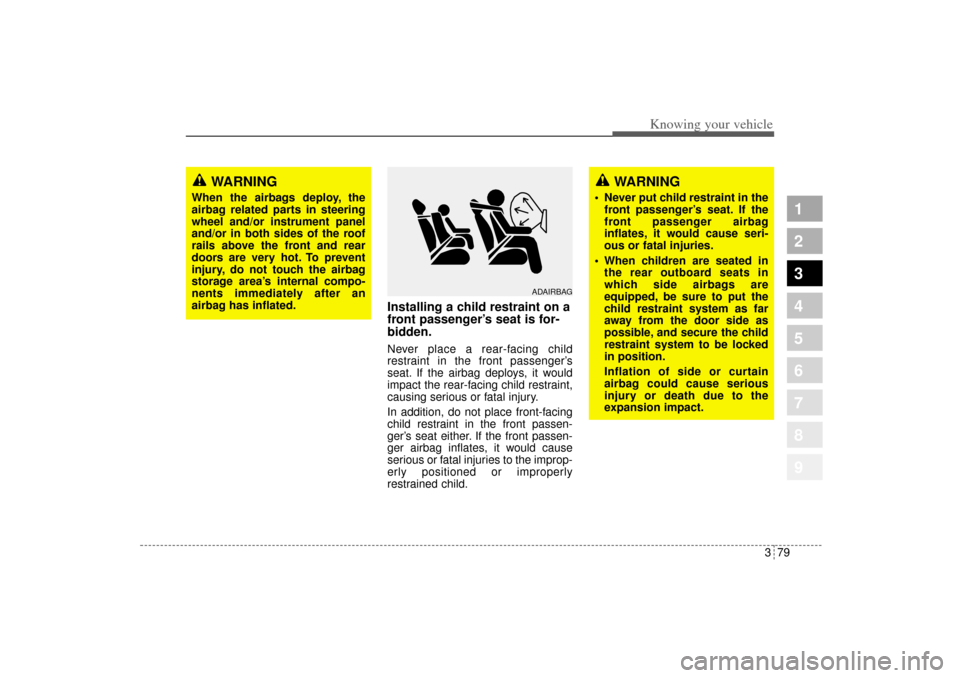
Installing a child restraint on a
front passenger’s seat is for-
bidden.Never place a rear-facing child
restraint in the front passenger’s
seat. If the airbag deploys, it would
impact the rear-facing child restraint,
causing serious or fatal injury.
In addition, do not place front-facing
child restraint in the front passen-
ger’s seat either. If the front passen-
ger airbag inflates, it would cause
serious or fatal injuries to the improp-
erly positioned or improperly
restrained child.
WARNING
Never put child restraint in the
front passenger’s seat. If the
front passenger airbag
inflates, it would cause seri-
ous or fatal injuries.
When children are seated in
the rear outboard seats in
which side airbags are
equipped, be sure to put the
child restraint system as far
away from the door side as
possible, and secure the child
restraint system to be locked
in position.
Inflation of side or curtain
airbag could cause serious
injury or death due to the
expansion impact.
WARNING
When the airbags deploy, the
airbag related parts in steering
wheel and/or instrument panel
and/or in both sides of the roof
rails above the front and rear
doors are very hot. To prevent
injury, do not touch the airbag
storage area’s internal compo-
nents immediately after an
airbag has inflated.
ADAIRBAG
KM CAN (ENG) 3 (~112).qxd 9/13/2004 4:50 PM Page 79
Page 91 of 354
Knowing your vehicle80 3
1
2
3
4
5
6
7
8
9
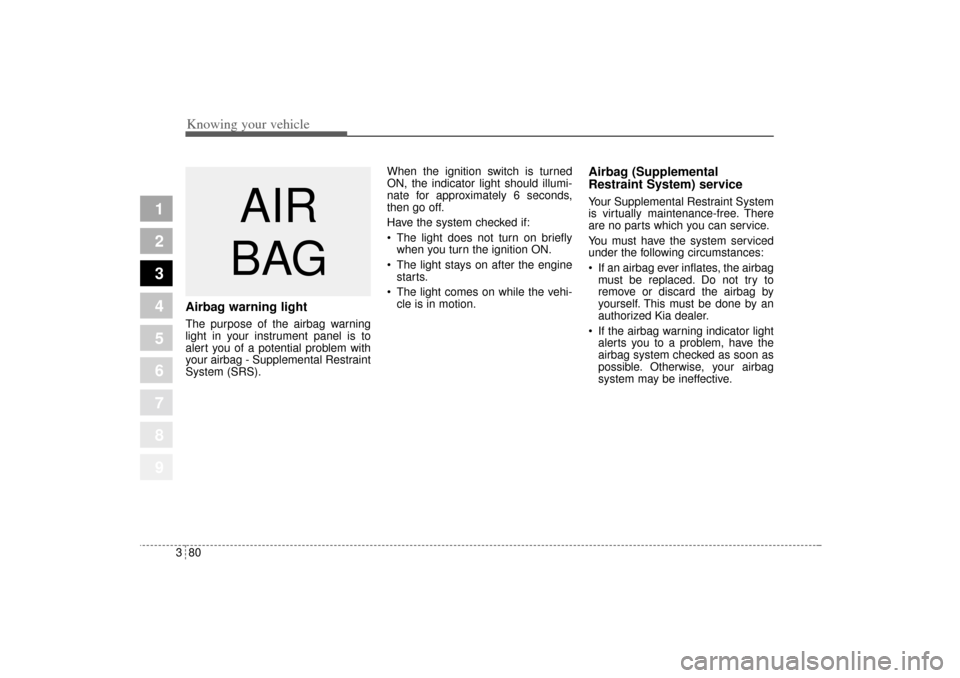
Airbag warning lightThe purpose of the airbag warning
light in your instrument panel is to
alert you of a potential problem with
your airbag - Supplemental Restraint
System (SRS).When the ignition switch is turned
ON, the indicator light should illumi-
nate for approximately 6 seconds,
then go off.
Have the system checked if:
The light does not turn on briefly
when you turn the ignition ON.
The light stays on after the engine
starts.
The light comes on while the vehi-
cle is in motion.
Airbag (Supplemental
Restraint System) service Your Supplemental Restraint System
is virtually maintenance-free. There
are no parts which you can service.
You must have the system serviced
under the following circumstances:
If an airbag ever inflates, the airbag
must be replaced. Do not try to
remove or discard the airbag by
yourself. This must be done by an
authorized Kia dealer.
If the airbag warning indicator light
alerts you to a problem, have the
airbag system checked as soon as
possible. Otherwise, your airbag
system may be ineffective.
AIR
BAG
KM CAN (ENG) 3 (~112).qxd 9/13/2004 4:50 PM Page 80
Page 92 of 354
381
1
2
3
4
5
6
7
8
9
Knowing your vehicle
When repairing or scrapping the
vehicles Repairing steering wheel, instru-
ment panel, center console or
roofs, or installing car audio around
center console or painting front
metal sheet could disable the
airbag system. Have them checked
by an authorized Kia dealer.
When leaving the vehicle at an
authorized Kia dealer, inform the
facility that the vehicle is equipped
with airbag system, and leave the
owner’s manual in the vehicle.
Since airbag system contains
explosive chemical substances,
contact an authorized Kia dealer
when scrapping the vehicle.
CAUTION
Do not modify any part of the
Supplemental Restraint System.
Excessive modification could
make the airbag system ineffec-
tive.
WARNING
Do not modify your steering
wheel, seat or any other part
of the Supplemental Restraint
System. Modification could
make the system inoperable.
Do not work on the system’s
components or wiring. This
could cause the airbags to
inflate inadvertently, possibly
seriously injuring someone.
Working on the system could
also disable the system so
that the airbags would not
deploy in a collision.
Any work on the SRS system,
such as removing, installing,
repairing, or any work on the
steering wheel must be per-
formed by a qualified Kia tech-
nician. Improper handling of
the airbag system may result
in serious personal injury or
death.
KM CAN (ENG) 3 (~112).qxd 9/13/2004 4:50 PM Page 81
Page 93 of 354
Knowing your vehicle82 3
1
2
3
4
5
6
7
8
9
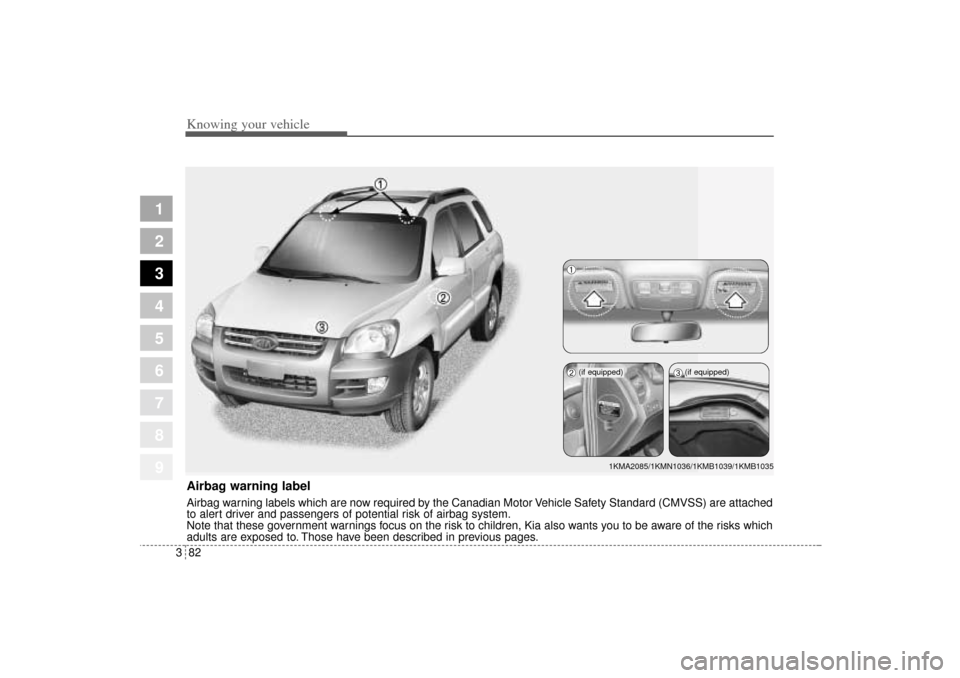
Airbag warning labelAirbag warning labels which are now required by the Canadian Motor Vehicle Safety Standard (CMVSS) are attached
to alert driver and passengers of potential risk of airbag system.
Note that these government warnings focus on the risk to children, Kia also wants you to be aware of the risks which
adults are exposed to. Those have been described in previous pages.
1KMA2085/1KMN1036/1KMB1039/1KMB1035
➀
➂
(if equipped)
➁
(if equipped)
KM CAN (ENG) 3 (~112).qxd 9/13/2004 4:50 PM Page 82
Page 96 of 354
385
1
2
3
4
5
6
7
8
9
Knowing your vehicle
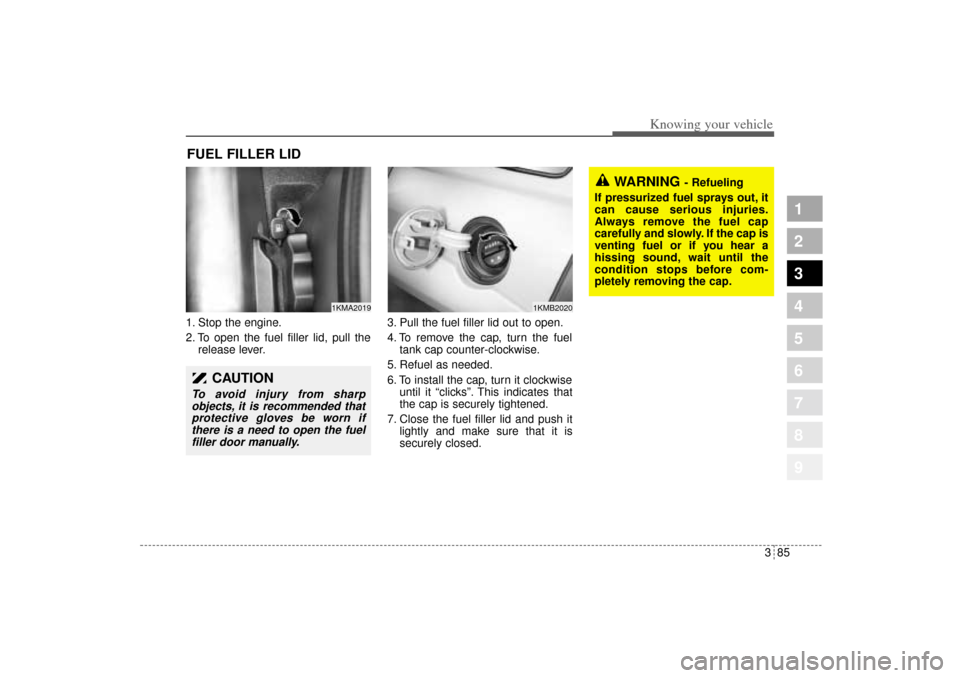
1. Stop the engine.
2. To open the fuel filler lid, pull the
release lever.3. Pull the fuel filler lid out to open.
4. To remove the cap, turn the fuel
tank cap counter-clockwise.
5. Refuel as needed.
6. To install the cap, turn it clockwise
until it “clicks”. This indicates that
the cap is securely tightened.
7. Close the fuel filler lid and push it
lightly and make sure that it is
securely closed.FUEL FILLER LID
1KMA2019
1KMB2020
WARNING
- Refueling
If pressurized fuel sprays out, it
can cause serious injuries.
Always remove the fuel cap
carefully and slowly. If the cap is
venting fuel or if you hear a
hissing sound, wait until the
condition stops before com-
pletely removing the cap.
CAUTION
To avoid injury from sharp
objects, it is recommended that
protective gloves be worn if
there is a need to open the fuel
filler door manually.
KM CAN (ENG) 3 (~112).qxd 9/13/2004 4:50 PM Page 85
Page 97 of 354
Knowing your vehicle86 3
1
2
3
4
5
6
7
8
9
WARNING
Automotive fuels are flamma-
ble/explosive materials. When
refueling, please note the fol-
lowing guidelines carefully.
Failure to follow these guide-
lines may result in severe per-
sonal injury, severe burns or
death by fire or explosion.
Before refueling always note
the location of the Emergency
Gasoline Shut-Off, if available,
at the gas station facility.
Before touching the fuel noz-
zle or fuel filler cap, you
should eliminate potentially
dangerous static electricity
discharge by touching anoth-
er metal part of the front of the
vehicle, a safe distance away
from the fuel filler neck, noz-
zle, or other gas source.
(Continued)
(Continued)
Do not get back into a vehicle
once you have begun refuel-
ing. Do not touch, rub or slide
against any item or fabric
(polyester, satin, nylon, etc.)
capable of producing static
electricity. Static electricity
discharge can ignite fuel
vapors resulting in explosion.
If you must re-enter the vehi-
cle, you should once again
eliminate potentially danger-
ous static electricity dis-
charge by touching a metal
part of the vehicle, away from
the fuel filler neck, nozzle or
other gasoline source.
When using a portable fuel
container be sure to place the
container on the ground prior
to refueling. Static electricity
discharge from the container
can ignite fuel vapors causing
a fire. Once refueling has
begun, contact with the vehi-
cle should be maintained until
the filling is complete.
(Continued)
(Continued)
Use only portable fuel con-
tainers designed to carry and
store gasoline.
Do not use cellular phones
around a gas station or while
refueling any vehicle. Electric
current and/or electronic
interference from cellular
phones can potentially ignite
fuel vapors causing a fire. If
you must use your cellular
phone use it in a place away
from the gas station.
When refueling always shut
the engine off. Sparks pro-
duced by electrical compo-
nents related to the engine
can ignite fuel vapors causing
a fire. Always insure that the
engine is OFF before and dur-
ing refueling. Once refueling
is complete, check to make
sure the fuel filler cap and
door are securely closed,
before starting the engine. You
should hear 3 "clicks" when
closing the fuel cap.
(Continued)
KM CAN (ENG) 3 (~112).qxd 9/13/2004 4:50 PM Page 86
Page 104 of 354
393
1
2
3
4
5
6
7
8
9
Knowing your vehicle
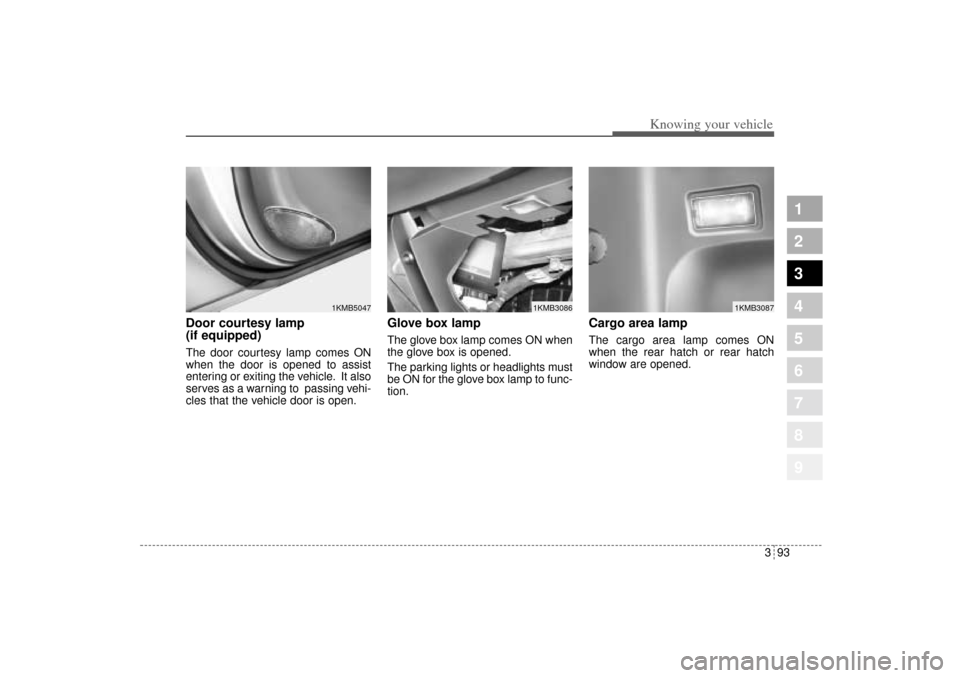
Door courtesy lamp
(if equipped)The door courtesy lamp comes ON
when the door is opened to assist
entering or exiting the vehicle. It also
serves as a warning to passing vehi-
cles that the vehicle door is open.
Glove box lampThe glove box lamp comes ON when
the glove box is opened.
The parking lights or headlights must
be ON for the glove box lamp to func-
tion.
Cargo area lampThe cargo area lamp comes ON
when the rear hatch or rear hatch
window are opened.
1KMB5047
1KMB3086
1KMB3087
KM CAN (ENG) 3 (~112).qxd 9/13/2004 4:51 PM Page 93
Page 105 of 354
Knowing your vehicle94 3
1
2
3
4
5
6
7
8
9
✽ ✽
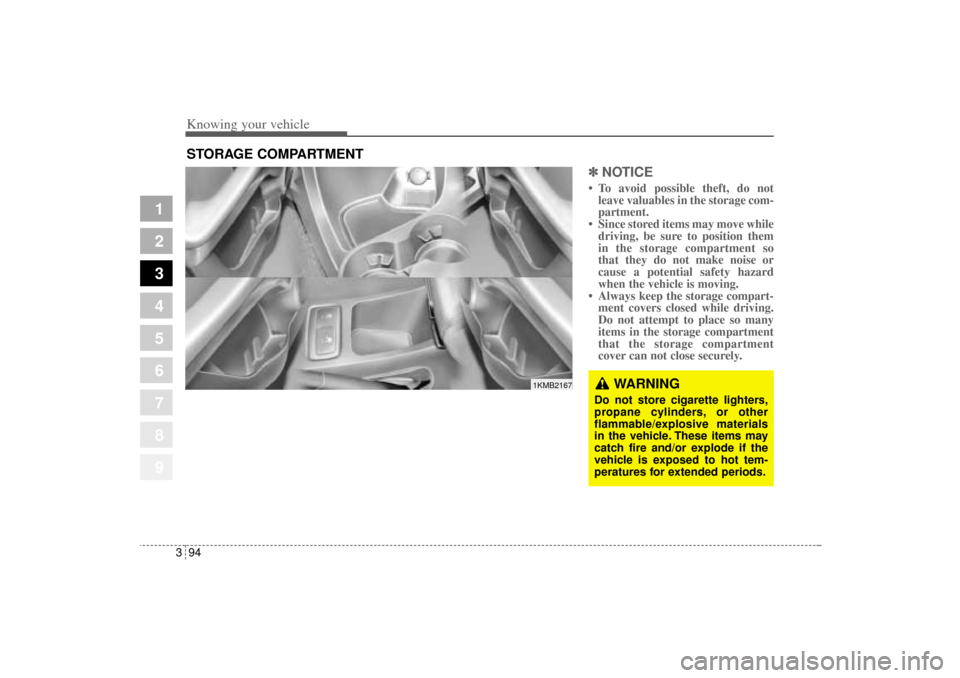
NOTICE• To avoid possible theft, do not
leave valuables in the storage com-
partment.
• Since stored items may move while
driving, be sure to position them
in the storage compartment so
that they do not make noise or
cause a potential safety hazard
when the vehicle is moving.
• Always keep the storage compart-
ment covers closed while driving.
Do not attempt to place so many
items in the storage compartment
that the storage compartment
cover can not close securely.
STORAGE COMPARTMENT
WARNING
Do not store cigarette lighters,
propane cylinders, or other
flammable/explosive materials
in the vehicle. These items may
catch fire and/or explode if the
vehicle is exposed to hot tem-
peratures for extended periods.
1KMB2167
KM CAN (ENG) 3 (~112).qxd 9/13/2004 4:51 PM Page 94