ground clearance KIA Sportage 2005 JE_ / 2.G Owner's Manual
[x] Cancel search | Manufacturer: KIA, Model Year: 2005, Model line: Sportage, Model: KIA Sportage 2005 JE_ / 2.GPages: 354, PDF Size: 2.78 MB
Page 6 of 354

13
1
2
3
4
5
6
7
8
9
Introduction
VEHICLE HANDLING
INSTRUCTIONSAs with other vehicles of this type,
failure to operate this vehicle correct-
ly may result in loss of control, an
accident or vehicle rollover.
Specific design characteristics (high-
er ground clearance, track, etc.) give
this vehicle a higher center of gravity
than other types of vehicles. In other
words they are not designed for cor-
nering at the same speeds as con-
ventional 2-wheel drive vehicles.
Avoid sharp turns or abrupt maneu-
vers. Again, failure to operate this
vehicle correctly may result in loss of
control, an accident or vehicle
rollover. Be sure to read the “on-
pavement” and “off-road” driving
guidelines, in section 5 of this manu-
al.
VEHICLE BREAK-IN
PROCESSNo special break-in period is needed.
By following a few simple precautions
for the first 1,000 km (600 miles) you
may add to the performance, econo-
my and life of your vehicle.
Do not race the engine.
Do not maintain a single speed for
long periods of time, either fast or
slow. Varying engine speed is
needed to properly break-in the
engine.
Avoid hard stops, except in emer-
gencies, to allow the brakes to seat
properly.
Avoid full-throttle starts.
KM CAN (ENG) 1.qxd 9/13/2004 4:10 PM Page 3
Page 85 of 354
Knowing your vehicle74 3
1
2
3
4
5
6
7
8
9
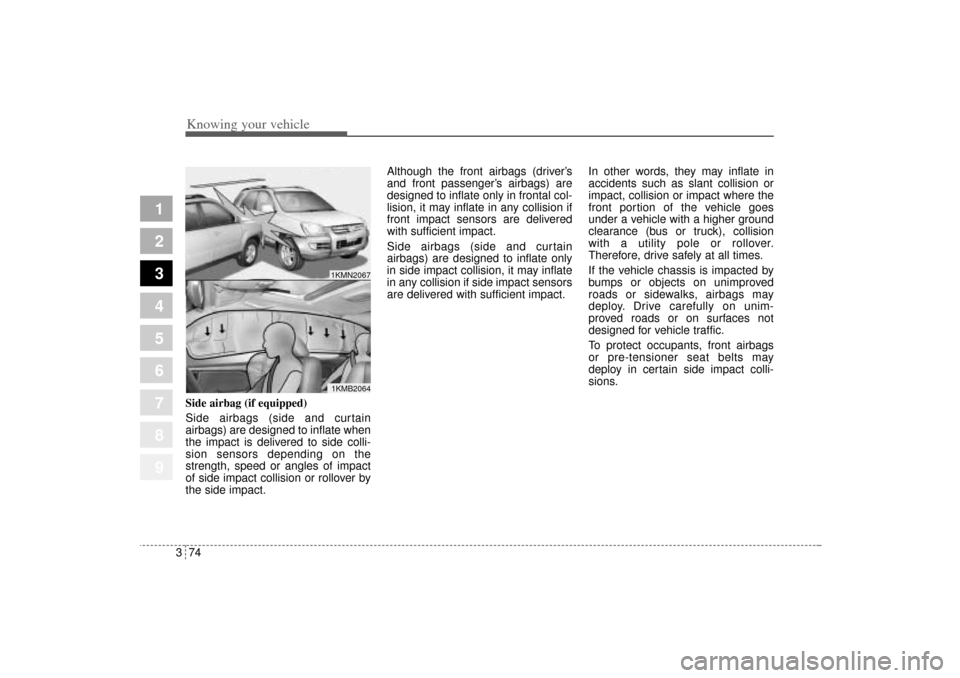
Side airbag (if equipped)
Side airbags (side and curtain
airbags) are designed to inflate when
the impact is delivered to side colli-
sion sensors depending on the
strength, speed or angles of impact
of side impact collision or rollover by
the side impact.Although the front airbags (driver’s
and front passenger’s airbags) are
designed to inflate only in frontal col-
lision, it may inflate in any collision if
front impact sensors are delivered
with sufficient impact.
Side airbags (side and curtain
airbags) are designed to inflate only
in side impact collision, it may inflate
in any collision if side impact sensors
are delivered with sufficient impact.In other words, they may inflate in
accidents such as slant collision or
impact, collision or impact where the
front portion of the vehicle goes
under a vehicle with a higher ground
clearance (bus or truck), collision
with a utility pole or rollover.
Therefore, drive safely at all times.
If the vehicle chassis is impacted by
bumps or objects on unimproved
roads or sidewalks, airbags may
deploy. Drive carefully on unim-
proved roads or on surfaces not
designed for vehicle traffic.
To protect occupants, front airbags
or pre-tensioner seat belts may
deploy in certain side impact colli-
sions.
1KMN20671KMB2064
KM CAN (ENG) 3 (~112).qxd 9/13/2004 4:50 PM Page 74
Page 87 of 354
Knowing your vehicle76 3
1
2
3
4
5
6
7
8
9
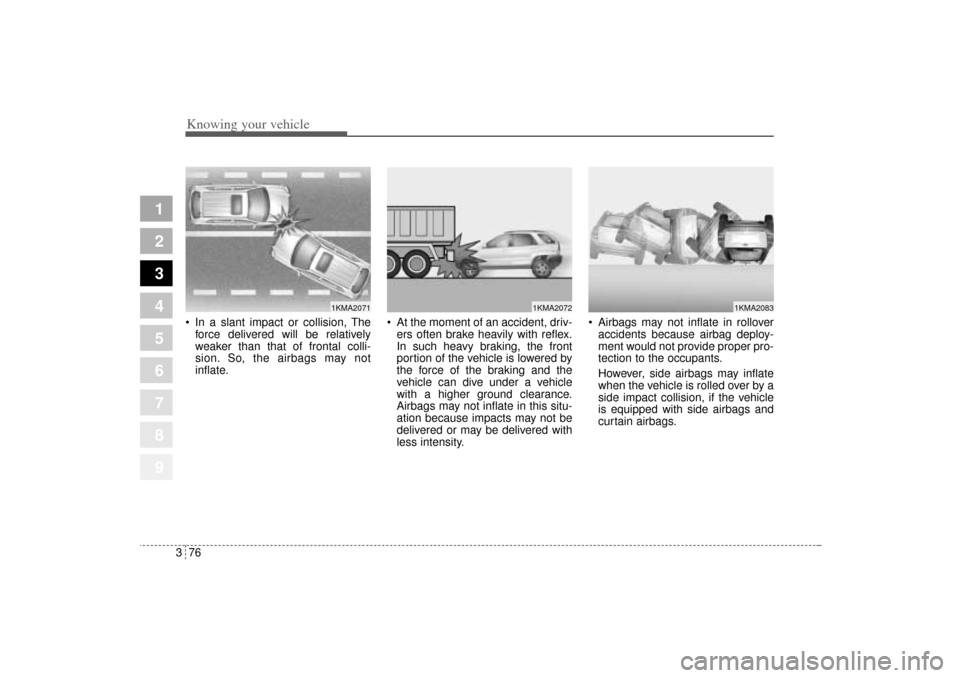
In a slant impact or collision, The
force delivered will be relatively
weaker than that of frontal colli-
sion. So, the airbags may not
inflate. At the moment of an accident, driv-
ers often brake heavily with reflex.
In such heavy braking, the front
portion of the vehicle is lowered by
the force of the braking and the
vehicle can dive under a vehicle
with a higher ground clearance.
Airbags may not inflate in this situ-
ation because impacts may not be
delivered or may be delivered with
less intensity. Airbags may not inflate in rollover
accidents because airbag deploy-
ment would not provide proper pro-
tection to the occupants.
However, side airbags may inflate
when the vehicle is rolled over by a
side impact collision, if the vehicle
is equipped with side airbags and
curtain airbags.
1KMA2071
1KMA2072
1KMA2083
KM CAN (ENG) 3 (~112).qxd 9/13/2004 4:50 PM Page 76
Page 227 of 354
Driving tips10 5Snow tires If you mount snow tires on your Kia,
make sure they are radial tires of the
same size and load range as the
original tires. Mount snow tires on all
four wheels to balance your vehicle’s
handling in all weather conditions.
Keep in mind that the traction provid-
ed by snow tires on dry roads may
not be as high as your vehicle's orig-
inal equipment tires. You should drive
cautiously even when the roads are
clear. Check with the tire dealer for
maximum speed recommendations.Do not install studded tires without
first checking local, state and munic-
ipal regulations for possible restric-
tions against their use.
Driving in flooded areas Avoid driving through flooded areas
unless you are sure the water is no
higher than the bottom of the wheel
hub. Drive through any water slowly.
Allow adequate stopping distance
because brake performance may be
affected.
After driving through water, dry the
brakes by gently applying them sev-
eral times while the vehicle is moving
slowly.
Reducing the risk of a rolloverThis multi-purpose passenger vehi-
cle is defined as a Sports Utility
Vehicle (SUV). SUV’s have higher
ground clearance and a narrower
track to make them capable of per-
forming in a wide variety of off-road
applications. Specific design charac-
teristics give them a higher center of
gravity than ordinary cars. An advan-
tage of the higher ground clearance
is a better view of the road, which
allows you to anticipate problems.
They are not designed for cornering
at the same speeds as conventional
passenger drive vehicles, any more
than low-slung sports cars are
designed to perform satisfactorily in
off-road conditions. Due to this risk,
driver and passengers are strongly
recommended to buckle their seat-
belts. In a rollover crash, an unbelt-
ed person is more likely to die than a
person wearing a seatbelt. There
are steps that a driver can make to
reduce the risk of a rollover. If at all
possible, avoid sharp turns or abrupt
maneuvers, do not load your roof
rack with heavy cargo, and never
modify your vehicle in any way.
1
2
3
4
5
6
7
8
9
WARNING
- Snow tire
size
Snow tires should be equivalent
in size and type to the vehicle's
standard tires. Otherwise, the
safety and handling of your
vehicle may be adversely affect-
ed.
KM CAN (ENG) 5.qxd 9/13/2004 4:48 PM Page 10
Page 228 of 354
511
Driving tips
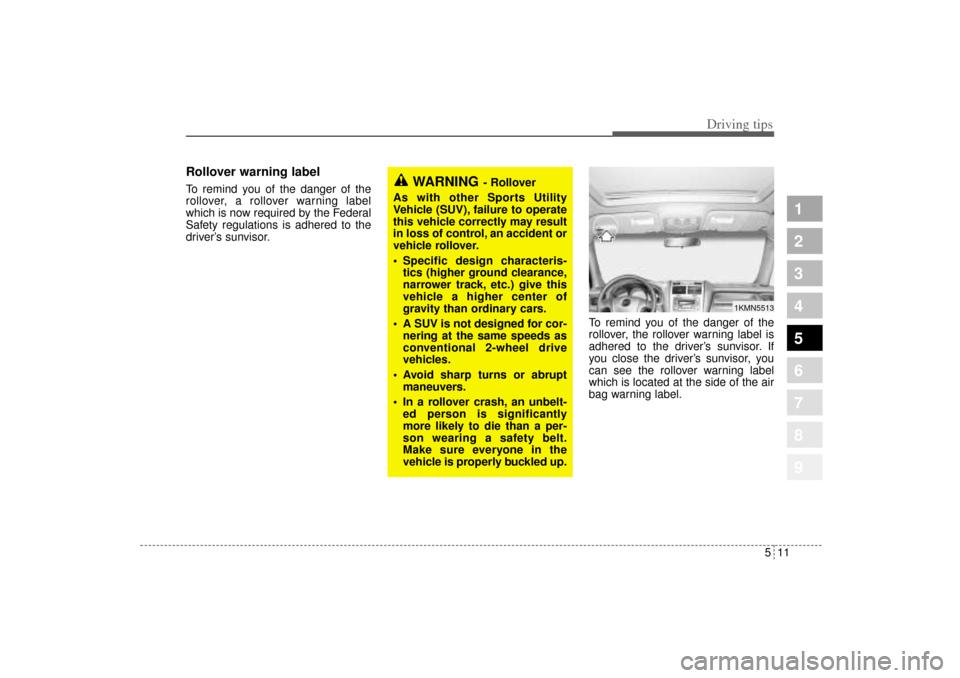
Rollover warning labelTo remind you of the danger of the
rollover, a rollover warning label
which is now required by the Federal
Safety regulations is adhered to the
driver’s sunvisor.
To remind you of the danger of the
rollover, the rollover warning label is
adhered to the driver’s sunvisor. If
you close the driver’s sunvisor, you
can see the rollover warning label
which is located at the side of the air
bag warning label.
1
2
3
4
5
6
7
8
9
WARNING
- Rollover
As with other Sports Utility
Vehicle (SUV), failure to operate
this vehicle correctly may result
in loss of control, an accident or
vehicle rollover.
Specific design characteris-
tics (higher ground clearance,
narrower track, etc.) give this
vehicle a higher center of
gravity than ordinary cars.
A SUV is not designed for cor-
nering at the same speeds as
conventional 2-wheel drive
vehicles.
Avoid sharp turns or abrupt
maneuvers.
In a rollover crash, an unbelt-
ed person is significantly
more likely to die than a per-
son wearing a safety belt.
Make sure everyone in the
vehicle is properly buckled up.
1KMN5513
KM CAN (ENG) 5.qxd 9/13/2004 4:48 PM Page 11
Page 288 of 354
In case of an emergency20 6The compact spare should be inflat-
ed to 420 kPa (60 psi).✽ ✽
NOTICECheck the inflation pressure after
installing the spare tire. Adjust it to
the specified pressure, as necessary.
When using a compact spare tire,
observe the following precautions:
Under no circumstances should
you exceed 80 km/h (50 mph); a
higher speed could damage the
tire.
Ensure that you drive slowly
enough for the road conditions to
avoid all hazards. Any road hazard,
such as a pothole or debris, could
seriously damage the compact
spare.
Any continuous road use of this tire
could result in tire failure, loss of
vehicle control, and possible per-
sonal injury.
Do not exceed the vehicle’s maxi-
mum load rating or the load-carry-
ing capacity shown on the sidewall
of the compact spare tire.
Avoid driving over obstacles. The
compact spare tire diameter is
smaller than the diameter of a con-
ventional tire and reduces the
ground clearance approximately
25 mm (1 inch), which could result
in damage to the vehicle. Do not take this vehicle through an
automatic car wash.
Do not use tire chains on this tire.
Because of the smaller size, a tire
chain will not fit properly. This could
damage the vehicle and result in
loss of the chain.
This tire should not be installed on
the front axle if the vehicle must be
driven in snow or on ice.
Do not use the compact spare tire
on any other vehicle because this
tire has been designed especially
for your vehicle.
The compact spare tire’s tread life
is shorter than a regular tire.
Inspect your compact spare tire
regularly and replace worn com-
pact spare tires with the same size
and design, mounted on the same
wheel.
1
2
3
4
5
6
7
8
9
CAUTION
This spare tire should be used
only for VERY short distances.
Compact spares should NEVER
be used for long drives or
extended distances.
KM CAN (ENG) 6.qxd 9/13/2004 4:47 PM Page 20
Page 331 of 354
Maintenance38 7
1
2
3
4
5
6
7
8
9
Wheel alignment and tire
balance The wheels on your vehicle were
aligned and balanced carefully at the
factory to give you the longest tire life
and best overall performance.
In most cases, you will not need to
have your wheels aligned again.
However, if you notice unusual tire
wear or your vehicle pulling one way
or the other, the alignment may need
to be reset.
If you notice your vehicle vibrating
when driving on a smooth road, your
wheels may need to be rebalanced.✽ ✽
NOTICEImproper wheel weights can dam-
age your vehicle's aluminum wheels.
Use only approved wheel weights.
WARNING
When replacing tires, never
mix radial, bias-belted, and
bias-type tires. All four tires
should be of the same size,
design and construction. Use
only the tire sizes listed on the
Tire Label found below the
door striker on the driver’s
side. Make sure that all tires
and wheels are the same size
and have the same load-carry-
ing capacity. Use only tire and
wheel combinations recom-
mended on the Tire Label or
by an Authorized Kia Dealer.
Failure to follow these precau-
tions can adversely affect the
safety and handling of your
vehicle.
(Continued)
(Continued)
The use of any other tire size
or type may seriously affect
ride, handling, ground clear-
ance, tire clearance, and
speedometer calibration.
Driving on worn-out tires is
very hazardous and will
reduce braking effectiveness,
steering accuracy, and trac-
tion.
It is best to replace all four
tires at the same time. If that is
not possible, or necessary,
then replace the two front or
two rear tires as a pair.
Replacing just one tire can
seriously affect your vehicle’s
handling.
KM CAN (ENG) 7.qxd 9/13/2004 4:47 PM Page 38
Page 332 of 354
739
Maintenance
1
2
3
4
5
6
7
8
9
Wheel replacement When replacing the metal wheels for
any reason, make sure the new
wheels are equivalent to the original
factory units in diameter, rim width
and offset.
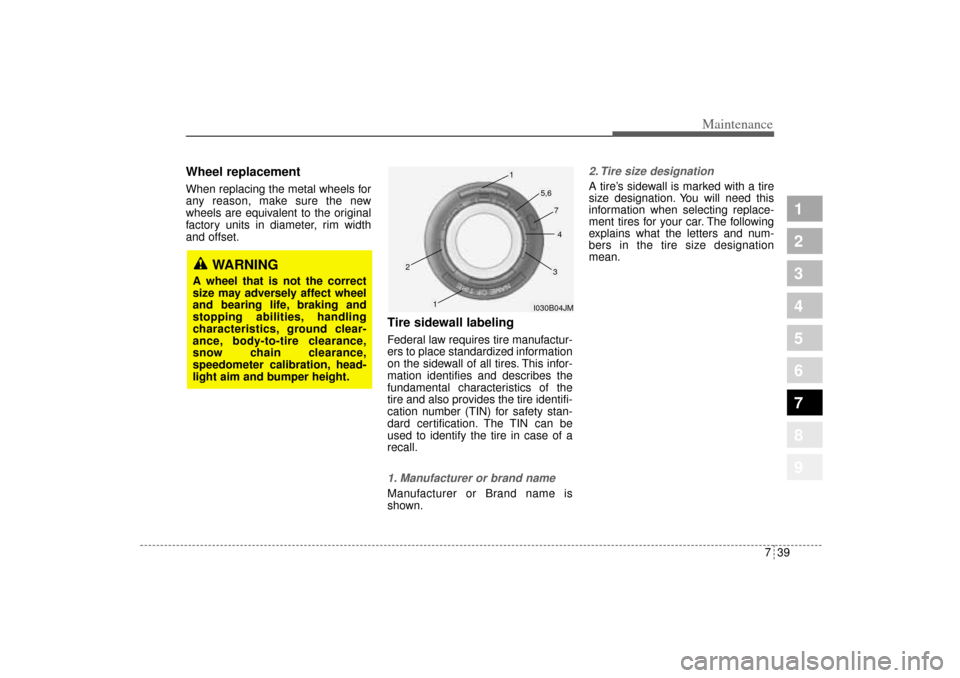
Tire sidewall labelingFederal law requires tire manufactur-
ers to place standardized information
on the sidewall of all tires. This infor-
mation identifies and describes the
fundamental characteristics of the
tire and also provides the tire identifi-
cation number (TIN) for safety stan-
dard certification. The TIN can be
used to identify the tire in case of a
recall.1. Manufacturer or brand nameManufacturer or Brand name is
shown.
2. Tire size designation A tire’s sidewall is marked with a tire
size designation. You will need this
information when selecting replace-
ment tires for your car. The following
explains what the letters and num-
bers in the tire size designation
mean.
WARNING
A wheel that is not the correct
size may adversely affect wheel
and bearing life, braking and
stopping abilities, handling
characteristics, ground clear-
ance, body-to-tire clearance,
snow chain clearance,
speedometer calibration, head-
light aim and bumper height.
I030B04JM
1
1
2
34
5,6
7
KM CAN (ENG) 7.qxd 9/13/2004 4:47 PM Page 39