oil type LAND ROVER DISCOVERY 1999 User Guide
[x] Cancel search | Manufacturer: LAND ROVER, Model Year: 1999, Model line: DISCOVERY, Model: LAND ROVER DISCOVERY 1999Pages: 1529, PDF Size: 34.8 MB
Page 84 of 1529

GENERAL DATA
04-21
Air conditioning
Type CFC free, sealed closed loop
Compressor:
⇒ Displacement 177.7 cm
3/rev (10.84 in3/rev)
⇒ Relief valve operating pressure 34.3 to 41.4 bar (497 to 600 lbf.in
2)
⇒ Refrigerant oil quantity 180ml (6.3 fl.oz)
Dual pressure switch operating pressures (nominal):
⇒ Low pressure switch Opens 2.0 bar (29.0 lbf.in
2), pressure decreasing
⇒ Low pressure switch Closes 2.3 bar (33.4 lbf.in
2), pressure increasing
⇒ High pressure switch Opens 32 bar (464 lbf.in
2), pressure increasing
⇒ High pressure switch Closes 26 bar (377 lbf.in
2), pressure decreasing
Page 119 of 1529
CAPACITIES, FLUIDS, LUBRICANTS AND SEALANTS
09-2
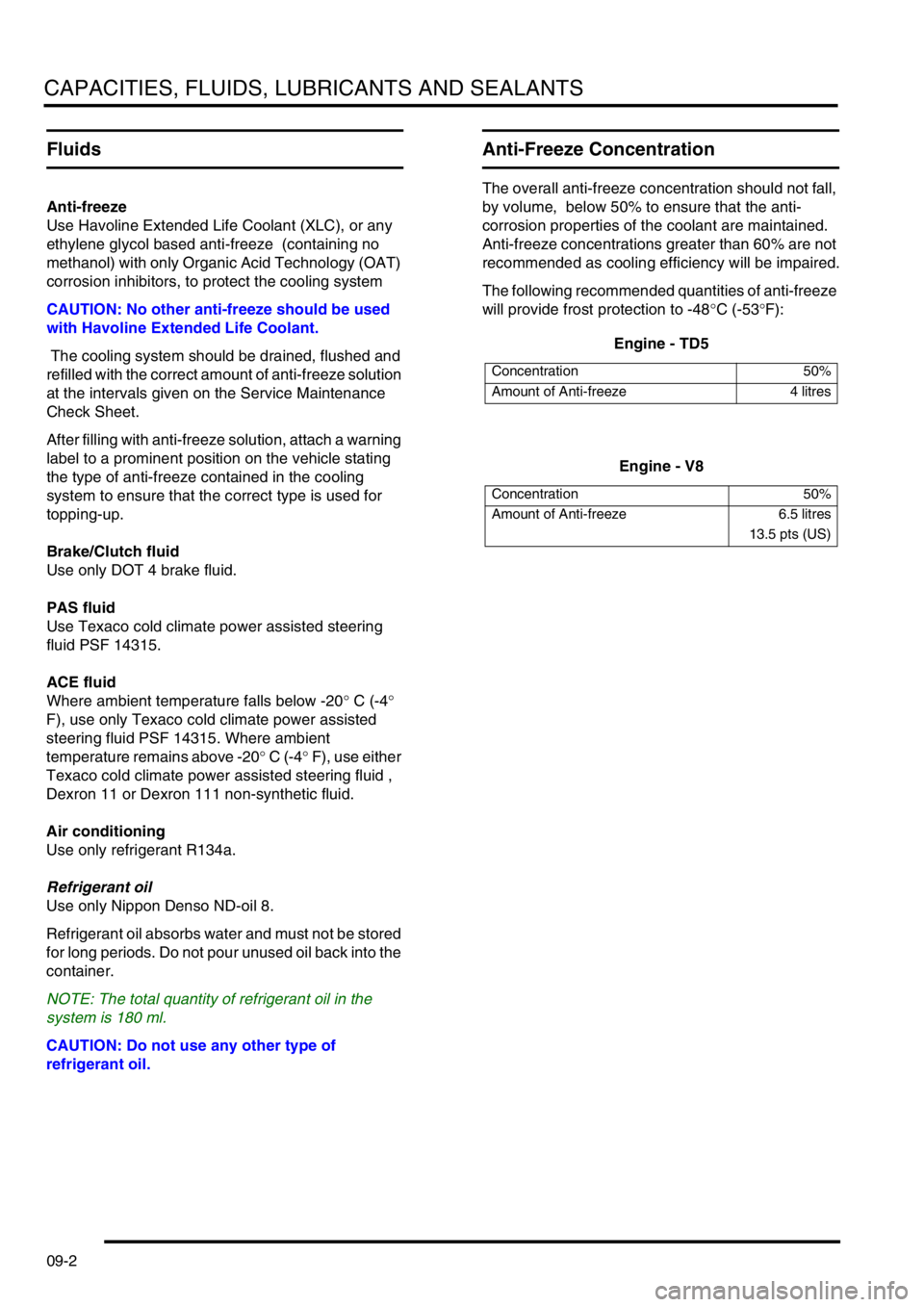
Fluids
Anti-freeze
Use Havoline Extended Life Coolant (XLC), or any
ethylene glycol based anti-freeze (containing no
methanol) with only Organic Acid Technology (OAT)
corrosion inhibitors, to protect the cooling system
CAUTION: No other anti-freeze should be used
with Havoline Extended Life Coolant.
The cooling system should be drained, flushed and
refilled with the correct amount of anti-freeze solution
at the intervals given on the Service Maintenance
Check Sheet.
After filling with anti-freeze solution, attach a warning
label to a prominent position on the vehicle stating
the type of anti-freeze contained in the cooling
system to ensure that the correct type is used for
topping-up.
Brake/Clutch fluid
Use only DOT 4 brake fluid.
PAS fluid
Use Texaco cold climate power assisted steering
fluid PSF 14315.
ACE fluid
Where ambient temperature falls below -20° C (-4°
F), use only Texaco cold climate power assisted
steering fluid PSF 14315. Where ambient
temperature remains above -20° C (-4° F), use either
Texaco cold climate power assisted steering fluid ,
Dexron 11 or Dexron 111 non-synthetic fluid.
Air conditioning
Use only refrigerant R134a.
Refrigerant oil
Use only Nippon Denso ND-oil 8.
Refrigerant oil absorbs water and must not be stored
for long periods. Do not pour unused oil back into the
container.
NOTE: The total quantity of refrigerant oil in the
system is 180 ml.
CAUTION: Do not use any other type of
refrigerant oil.
Anti-Freeze Concentration
The overall anti-freeze concentration should not fall,
by volume, below 50% to ensure that the anti-
corrosion properties of the coolant are maintained.
Anti-freeze concentrations greater than 60% are not
recommended as cooling efficiency will be impaired.
The following recommended quantities of anti-freeze
will provide frost protection to -48°C (-53°F):
Engine - TD5
Engine - V8
Concentration 50%
Amount of Anti-freeze 4 litres
Concentration 50%
Amount of Anti-freeze 6.5 litres
13.5 pts (US)
Page 139 of 1529
MAINTENANCE
10-16 PROCEDURES
Engine oil filter - diesel engine
Replace
1.Replace oil filter.
+ ENGINE - Td5, REPAIRS, Filter - oil.
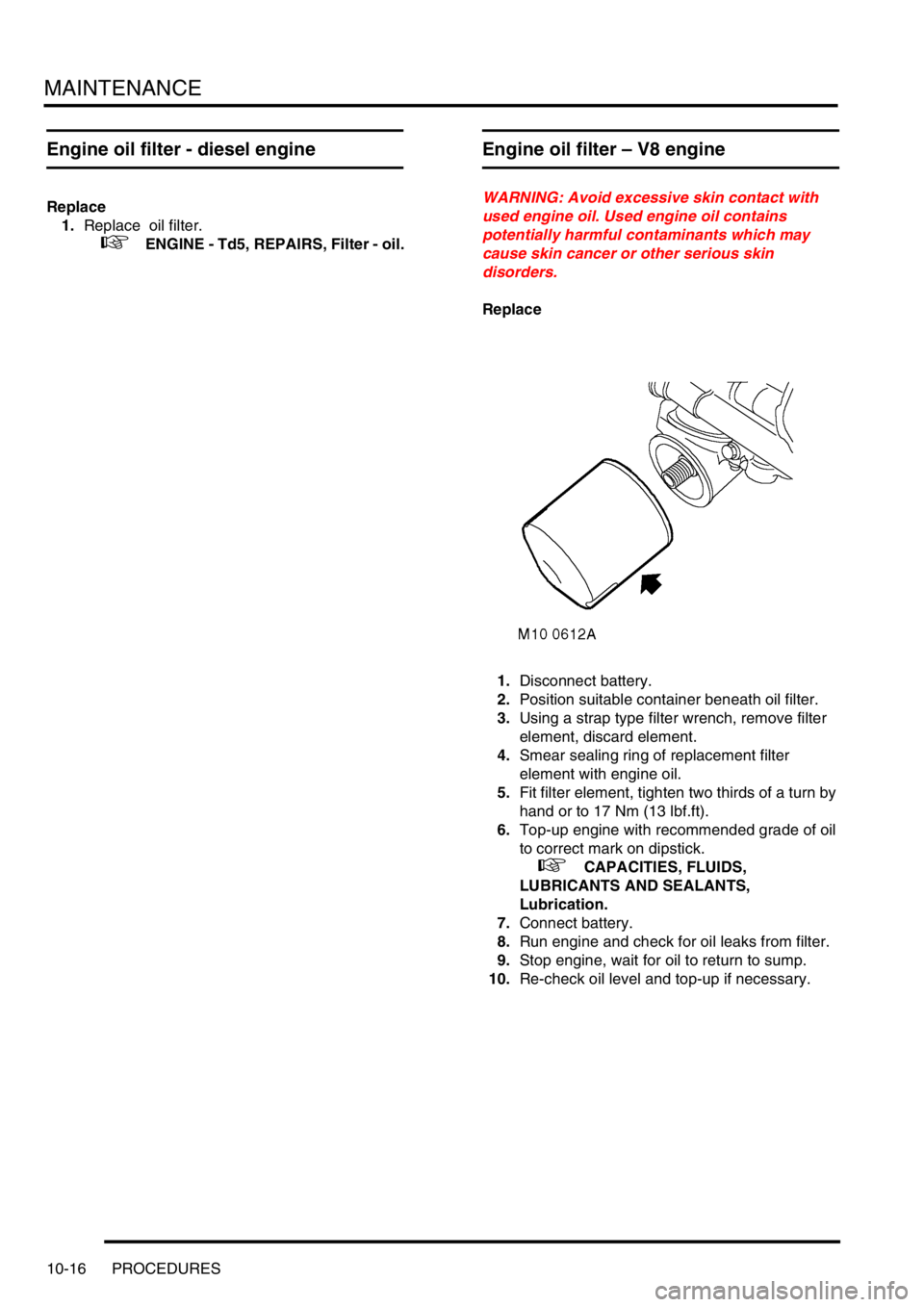
Engine oil filter – V8 engine
WARNING: Avoid excessive skin contact with
used engine oil. Used engine oil contains
potentially harmful contaminants which may
cause skin cancer or other serious skin
disorders.
Replace
1.Disconnect battery.
2.Position suitable container beneath oil filter.
3.Using a strap type filter wrench, remove filter
element, discard element.
4.Smear sealing ring of replacement filter
element with engine oil.
5.Fit filter element, tighten two thirds of a turn by
hand or to 17 Nm (13 lbf.ft).
6.Top-up engine with recommended grade of oil
to correct mark on dipstick.
+ CAPACITIES, FLUIDS,
LUBRICANTS AND SEALANTS,
Lubrication.
7.Connect battery.
8.Run engine and check for oil leaks from filter.
9.Stop engine, wait for oil to return to sump.
10.Re-check oil level and top-up if necessary.
Page 161 of 1529

ENGINE - V8
12-2-6 DESCRIPTION AND OPERATION
Description
General
The V8 petrol engine is an eight cylinder, water cooled unit having two banks of four cylinders positioned at 90 degrees
to each other. The engine comprises five main castings - two cylinder heads, cylinder block, timing cover and the oil
sump, all of which are manufactured from aluminium alloy.
NAS market vehicles from 03 model year receive a 4.6 litre version of the V8 engine to replace the previous 4.0 litre
version.
Cylinder heads
The cylinder heads are fitted with replaceable valve guides and valve seat inserts with the combustion chambers
formed in the head. Each cylinder head is sealed to the cylinder block with a gasket. The exhaust manifolds are bolted
to the outside of each cylinder head whilst the inlet manifolds are located in the centre of the 'Vee' and are bolted to
the inside face of each head. Inlet and exhaust manifolds are sealed to the cylinder heads by means of gaskets.
Each cylinder has a single inlet and exhaust valve. The exhaust valves are of the 'carbon break' type, a recess on the
valve stem prevents a build-up of carbon in the valve guide by dislodging particles of carbon as the valve stem moves
up and down the guide. Inlet and exhaust valve stem oil seals are fitted at the top of each valve guide. Valve operation
is by means of rocker arms, push rods and hydraulic tappets. Each of the rocker arms is located on a rocker shaft
which is supported by means of pedestals bolted to the cylinder heads. A spring, positioned on either side of each
rocker arm, maintains the correct relative position of the arm to its valve stem. The rocker arms are operated directly
by the push rods which pass through drillings in the cylinder heads and cylinder block. The bottom end of each push
rod locates in a hydraulic tappet operated by the single, chain driven camshaft.
The rocker covers are bolted to the cylinder heads and are sealed to the heads by a rubber gasket. Stub pipes for
crankcase ventilation hose connections are fitted to each rocker cover, the pipe in the right hand cover incorporates
an oil separator. The engine oil filler cap is situated in the right hand cover.
Cylinder block and camshaft
The cylinder block is fitted with cast iron cylinder liners which are shrink fitted and locate on stops in the block. The
camshaft is positioned in the centre of the cylinder block and runs in one piece bearing shells which are line bored
after fitting. Camshaft end-float is controlled by a thrust plate bolted to the front of the cylinder block. A timing gear,
chain driven by the crankshaft timing gear is bolted to the front of the camshaft.
Crankshaft and main bearings
The crankshaft is carried in five main bearings. The upper main bearing shell locations are an integral part of the
cylinder block casting. The lower main bearing caps are bolted to the cylinder block on either side of the upper bearing
shell locations with an additional bolt being inserted into each cap from either side of the cylinder block. The rear
main bearing cap carries the crankshaft rear oil seal and is sealed to the cylinder block by means of cruciform shaped
seals in each side of the cap. Number four main bearing cap carries the stud fixing for the oil pick-up pipe. Lower
main bearing shells are plain whilst the upper shells have an oil feed hole and are grooved. Crankshaft end-float is
controlled by the thrust faces of the upper centre shell. The crankshaft timing gear is located on the front of the
crankshaft by means of a Woodruff key which is also used to drive the gear type oil pump. The flywheel/drive plate
carries the crankshaft position sensor reluctor ring and is dowel located and bolted to the flywheel.
Timing cover
The timing cover is bolted to the front of the cylinder block and is sealed to the block with a gasket. The disposable,
full flow oil filter canister is screwed on to the timing cover which also carries the oil pressure switch, oil pressure relief
valve and crankshaft front oil seal. The gear type oil pump is integral with the cover which also has an internal oilway
to direct oil from the oil cooler to the filter.
NOTE: Oil coolers are only fitted to vehicles up to VIN 756821.
Page 261 of 1529
EMISSION CONTROL - V8
17-2-28 DESCRIPTION AND OPERATION
The air delivery pipe is a flexible plastic type, and is connected to the air pump outlet via a plastic quick-fit connector.
The other end of the flexible plastic pipe connects to the fixed metal pipework via a short rubber hose. The part of the
flexible plastic pipe which is most vulnerable to engine generated heat is protected by heat reflective sleeving. The
metal delivery pipe has a fabricated T-piece included where the pressurised air is split for delivery to each exhaust
manifold via the SAI control valves.
The pipes from the T-piece to each of the SAI control valves are approximately the same length, so that the pressure
and mass of the air delivered to each bank will be equal. The ends of the pipes are connected to the inlet port of each
SAI control valve through short rubber hose connections.
The T-piece is mounted at the rear of the engine (by the ignition coils) and features a welded mounting bracket which
is fixed to the engine by two studs and nuts.
The foam filter in the air intake of the SAI pump provides noise reduction and protects the pump from damage due to
particulate contamination. In addition, the pump is fitted on rubber mountings to help prevent noise which is generated
by pump operation from being transmitted through the vehicle body into the passenger compartment.
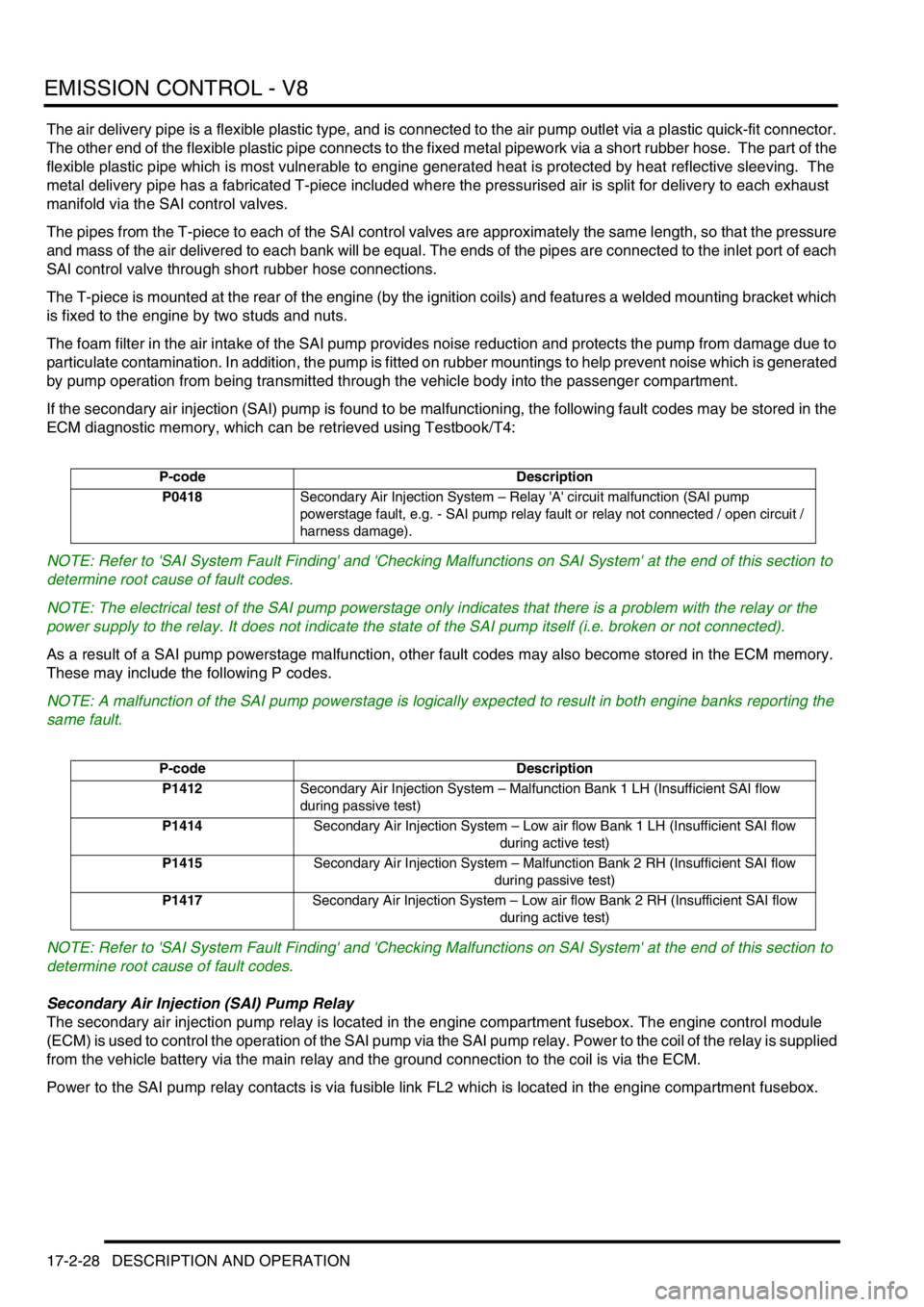
If the secondary air injection (SAI) pump is found to be malfunctioning, the following fault codes may be stored in the
ECM diagnostic memory, which can be retrieved using Testbook/T4:
NOTE: Refer to 'SAI System Fault Finding' and 'Checking Malfunctions on SAI System' at the end of this section to
determine root cause of fault codes.
NOTE: The electrical test of the SAI pump powerstage only indicates that there is a problem with the relay or the
power supply to the relay. It does not indicate the state of the SAI pump itself (i.e. broken or not connected).
As a result of a SAI pump powerstage malfunction, other fault codes may also become stored in the ECM memory.
These may include the following P codes.
NOTE: A malfunction of the SAI pump powerstage is logically expected to result in both engine banks reporting the
same fault.
NOTE: Refer to 'SAI System Fault Finding' and 'Checking Malfunctions on SAI System' at the end of this section to
determine root cause of fault codes.
Secondary Air Injection (SAI) Pump Relay
The secondary air injection pump relay is located in the engine compartment fusebox. The engine control module
(ECM) is used to control the operation of the SAI pump via the SAI pump relay. Power to the coil of the relay is supplied
from the vehicle battery via the main relay and the ground connection to the coil is via the ECM.
Power to the SAI pump relay contacts is via fusible link FL2 which is located in the engine compartment fusebox.
P-code Description
P0418Secondary Air Injection System – Relay 'A' circuit malfunction (SAI pump
powerstage fault, e.g. - SAI pump relay fault or relay not connected / open circuit /
harness damage).
P-code Description
P1412Secondary Air Injection System – Malfunction Bank 1 LH (Insufficient SAI flow
during passive test)
P1414Secondary Air Injection System – Low air flow Bank 1 LH (Insufficient SAI flow
during active test)
P1415Secondary Air Injection System – Malfunction Bank 2 RH (Insufficient SAI flow
during passive test)
P1417Secondary Air Injection System – Low air flow Bank 2 RH (Insufficient SAI flow
during active test)
Page 312 of 1529

ENGINE MANAGEMENT SYSTEM - V8
DESCRIPTION AND OPERATION 18-2-13
Connector 5 (C0638): This connector contains 9 pins and is used to control the ignition system. The ignition coils are
supplied with power and a switching earth completes the circuit.
Pin out details connector C0638
Pin No. Function Signal type Reading
1 Not used - -
2 Ignition , Cylinders 2 and 3 Output Switch to earth
3 Not used - -
4 Not used - -
5 Ignition coil earth Earth 0V
6 Ignition , Cylinders 1 and 6 Output Switch to earth
7 Ignition , Cylinders 4 and 7 Output Switch to earth
8 Ignition , Cylinders 5 and 8 Output Switch to earth
9 Not used - -
Page 421 of 1529

COOLING SYSTEM - V8
26-2-6 DESCRIPTION AND OPERATION
Description
General
The cooling system used on the V8 engine is a pressure relief by-pass type system which allows coolant to circulate
around the cylinder block and the heater circuit when the thermostat is closed. With coolant not passing through the
radiator, this promotes faster heater warm-up which in turn improves passenger comfort.
A coolant pump is located in a housing at the front of the engine and is driven by a drive belt. The pump is connected
into the coolant passages cast in the cylinder block and pumps coolant from the radiator through the cylinder block.
A viscous fan is attached by means of a nut to the coolant pump pulley drive spindle. The fan draws air through the
radiator to assist in cooling when the vehicle is stationary. The fan rotational speed is controlled relative to the running
temperature of the engine by a thermostatic valve regulated by a bi-metallic coil.
The cooling system uses a 50/50 mix of anti-freeze and water.
Thermostat housing
A plastic thermostat housing is located behind the radiator. The housing has three connections which locate the
radiator bottom hose, top hose and coolant pump feed hose. The housing contains a wax element and a spring loaded
by-pass flow valve.
Thermostat - Main valve
The thermostat is used to maintain the coolant at the optimum temperature for efficient combustion and to aid engine
warm-up. The thermostat is closed at temperatures below approximately 82°C (179°F). When the coolant
temperature reaches approximately 82°C the thermostat starts to open and is fully open at approximately 96°C
(204°F). In this condition the full flow of coolant is directed through the radiator.
The thermostat is exposed to 90% hot coolant from the engine on one side and 10% cold coolant returning from the
radiator bottom hose on the other side.
Hot coolant from the engine passes from the by-pass pipe through four sensing holes in the flow valve into a tube
surrounding 90% of the thermostat sensitive area. Cold coolant returning from the engine, cooled by the radiator,
conducts through 10% of the sensitive area.
In cold ambient temperatures, the engine temperature is raised by approximately 10°C (50°F) to compensate for the
heat loss of 10% exposure to the cold coolant returning from the bottom hose.
By-pass flow valve
The by-pass flow valve is held closed by a light spring. It operates to further aid heater warm-up. When the main valve
is closed and the engine speed is at idle, the coolant pump does not produce sufficient flow and pressure to open the
valve. In this condition the valve prevents coolant circulating through the by-pass circuit and forces the coolant through
the heater matrix only. This provides a higher flow of coolant through the heater matrix to improve passenger comfort
in cold conditions.
When the engine speed increases above idle the coolant pump produces a greater flow and pressure than the heater
circuit can take. The pressure acts on the flow valve and overcomes the valve spring pressure, opening the valve and
limiting the pressure in the heater circuit. The valve modulates to provide maximum coolant flow through the heater
matrix and yet allowing excess coolant to flow into the by-pass circuit to provide the engine's cooling needs at higher
engine rev/min.
Page 422 of 1529

COOLING SYSTEM - V8
DESCRIPTION AND OPERATION 26-2-7
Inlet manifold - Cooling connections
Coolant leaves the cylinder block via an outlet pipe attached to the front of the air intake manifold. The pipe is
connected to the thermostat housing and the radiator by a branch hose off the radiator top hose.
Hot coolant from the engine is also directed from the inlet manifold via pipes and hoses into the heater matrix. Coolant
is circulated through the heater matrix at all times when the engine is running.
A further tapping from the inlet manifold supplies coolant to the throttle housing via a hose. The coolant circulates
through a plate attached to the bottom of the housing and is returned through a plastic bleed pipe to an expansion
tank. The hot coolant heats the air intake of the throttle housing preventing ice from forming.
An Engine Coolant Temperature (ECT) sensor is fitted in the inlet manifold adjacent to the manifold outlet pipe. The
sensor monitors coolant temperature emerging from the engine and sends signals to the ECM for engine
management and temperature gauge operation.
+ ENGINE MANAGEMENT SYSTEM - V8, DESCRIPTION AND OPERATION, Description - engine
management.
Expansion tank
The expansion tank is located in the engine compartment. The tank is made from moulded plastic and attached to
brackets on the right hand inner wing. A maximum coolant when cold level is moulded onto the tank.
Excess coolant created by heat expansion is returned to the expansion tank from the radiator bleed pipe at the top of
the radiator. An outlet pipe is connected into the pump feed hose and replaces the coolant displaced by heat
expansion into the system when the engine is cool.
The expansion tank is fitted with a sealed pressure cap. The cap contains a pressure relief valve which opens to allow
excessive pressure and coolant to vent through the overflow pipe. The relief valve opens at a pressure of 1.4 bar (20
lbf.in
2) and above.
Heater matrix
The heater matrix is fitted in the heater assembly inside the passenger compartment. Two pipes pass through the
bulkhead into the engine compartment and provide coolant flow to and from the matrix. The pipes from the bulkhead
are connected to the matrix, sealed with 'O' rings and clamped with circular rings.
The matrix is constructed from aluminium with two end tanks interconnected with tubes. Aluminium fins are located
between the tubes and conduct heat away from the hot coolant flowing through the tubes. Air from the heater
assembly is warmed as it passes through the matrix fins. The warm air is then distributed into the passenger
compartment as required.
+ HEATING AND VENTILATION, DESCRIPTION AND OPERATION, Description.When the engine is
running, coolant from the engine is constantly circulated through the heater matrix.
Radiator
The 45 row radiator is located at the front of the vehicle. The cross-flow type radiator is manufactured from aluminium
with moulded plastic end tanks interconnected with tubes. Aluminium fins are located between the tubes and conduct
heat from the hot coolant flowing through the tubes, reducing the cooling temperature as it flows through the radiator.
Air intake from the front of the vehicle when moving carries heat away from the fins. When the vehicle is stationary,
the viscous fan draws air through the radiator fins to prevent the engine from overheating.
Two connections at the top of the radiator provide for the attachment of the top hose and bleed pipe. A connection at
the bottom of the radiator allows for the attachment of the bottom hose to the thermostat housing.
Two smaller radiators are located in front of the cooling radiator. The lower radiator provides cooling of the gearbox
oil and the upper radiator provides cooling for the engine oil.
+ MANUAL GEARBOX - R380, DESCRIPTION AND OPERATION, Description.
+ AUTOMATIC GEARBOX - ZF4HP22 - 24, DESCRIPTION AND OPERATION, Description.
+ ENGINE - V8, DESCRIPTION AND OPERATION, Description.
Pipes and hoses
The coolant circuit comprises flexible hoses and metal formed pipes which direct coolant into and out of the engine,
radiator and heater matrix. Plastic pipes are used for the bleed and overflow pipes to the expansion tank.
A bleed screw is installed in the radiator top hose and is used to bleed air during system filling. A drain plug is fitted
to each cylinder bank in the cylinder block. These are used to drain the block of coolant.
Page 461 of 1529

CLUTCH - V8
33-2-6 DESCRIPTION AND OPERATION
Description
General
The clutch system is a conventional diaphragm type clutch operated by a hydraulic cylinder. The clutch requires no
adjustment to compensate for wear.
Hydraulic clutch
The hydraulic clutch comprises a master cylinder, slave cylinder and a hydraulic reservoir, which is also shared with
the braking system. The master and slave cylinders are connected to each other hydraulically by plastic and metal
pipes. The plastic section of the pipe allows ease of pipe routing and also absorbs engine movements and vibrations.
The master cylinder comprises a body with a central bore. Two ports in the body connect the bore to the hydraulic
feed pipe to the slave cylinder and the brake/clutch fluid reservoir. A piston is fitted in the bore and has an external
rod which is attached to the clutch pedal with a pin. Two coiled springs on the clutch pedal reduce the effort required
to depress the pedal.
The master cylinder is mounted on the bulkhead in the engine compartment and secured with two bolts. The cylinder
is connected to the shared brake/clutch reservoir on the brake servo by a braided connecting hose.
The slave cylinder is located on the left hand side of the gearbox housing and secured with two bolts. A heat shield
protects the underside of the cylinder from heat generated from the exhaust system. The slave cylinder comprises a
cylinder with a piston and a rod. A port in the cylinder body provides the attachment for the hydraulic feed pipe from
the master cylinder. A second port is fitted with a bleed nipple for removing air from the hydraulic system after
servicing. The piston rod locates on a clutch release lever located in the gearbox housing. The rod is positively
retained on the release lever with a clip.
Clutch mechanism
The clutch mechanism comprises a flywheel, drive plate, pressure plate, release lever and a release bearing. The
clutch mechanism is fully enclosed at the rear of the engine by the gearbox housing.
A clutch release bearing sleeve is attached in the gearbox housing with two bolts and located on two dowels. A spigot
with a ball end is formed on the release bearing sleeve and provides a mounting and pivot point for the clutch release
lever. A dished pivot washer is located on the ball of the spigot. When the release lever is located on the ball, the pivot
washer seats against the rear face of the release lever. A spring clip is located on the lever and the pivot washer and
secures the lever on the spigot. A small bolt retains the spring clip in position.
The release lever is forked at its inner end and locates on the clutch release bearing carrier. The outer end of the
release lever has a nylon seat which locates the slave cylinder piston rod. A second nylon seat, positioned centrally
on the release lever, locates on the ball spigot of the release bearing sleeve and allows the release lever to pivot freely
around the ball.
The clutch release bearing locates on the clutch release lever and the release bearing sleeve. The bearing is retained
on a carrier which has two flats to prevent the carrier rotating on the release lever. A clip retains the release lever on
the carrier. The bearing and carrier are not serviceable individually.
Flywheel
The flywheel is bolted to a flange on the rear of the crankshaft with six bolts. A dowel on the crankshaft flange ensures
that the flywheel is correctly located. A ring gear is fitted on the outside diameter of the flywheel and seats against a
flange. The ring gear is an interference fit on the flywheel and is installed by heating the ring and cooling the flywheel.
The ring gear is a serviceable item and can be replaced if damaged or worn.
The operating face of the flywheel is machined to provide a smooth surface for the drive plate to engage on. Three
dowels and six threaded holes provide for the location and attachment of the pressure plate. The flywheel is balanced
to ensure that it does not produce vibration when rotating. A machined slot, with a series of holes within the slot, is
located on the engine side of the flywheel. The slot accommodates the tip of the crankshaft position sensor which is
used by the Engine Control Module (ECM) for engine management.
+ ENGINE MANAGEMENT SYSTEM - V8, DESCRIPTION AND OPERATION, Description - engine
management.
Page 667 of 1529

REAR AXLE
51-2 DESCRIPTION AND OPERATION
Description
General
The rear axle consists of an axle casing with a differential unit attached to the right of the vehicle centre line. A wheel
hub is installed in each end of the axle casing and connected to the differential unit by a drive shaft.
Axle casing
The axle casing is of welded construction, with brackets on the casing exterior for attachment to the rear suspension.
A differential cover on the rear of the axle casing contains an oil level plug for checking and replenishment of the
differential unit lubricating oil. A magnetic drain plug is installed on the underside of the axle casing.
The interior of the axle casing is ventilated through a breather tube inserted in a red plastic sleeve in the top of the
casing. The open end of the breather tube is located between the chassis and the left rear wheelarch.
Differential unit
The differential unit is of the spiral bevel type, lubricated by splash oil. The unit consists of a differential carrier
attached to a pinion housing. In the pinion housing, the pinion is splined to a pinion flange which is secured with a bolt
and washer. An oil seal prevents leakage past the pinion flange.
Centralising peg
The centralising peg is a press fit in the centre of the pinion flange and provides a positive location for the rear
propellor shaft to ensure it is centralised with the flange.