open gas tank Lexus CT200h 2014 Owner's Manual (in English)
[x] Cancel search | Manufacturer: LEXUS, Model Year: 2014, Model line: CT200h, Model: Lexus CT200h 2014Pages: 622
Page 202 of 622

2024-4. Refueling
CT200h_OM_OM76135E_(EE)
Opening the fuel tank cap
●Close all the doors and windows, and turn the power switch off.
●Confirm the type of fuel.
■Fuel types
EU area:
Unleaded gasoline conforming to European standard EN228, Research Octane Num-
ber of 95 or higher
Except EU area:
Unleaded gasoline, Research octane number 95 or higher
■Use of ethanol blended gasoline in a gasoline engine
Lexus allows the use of ethanol blended gasoline where the ethanol content is up to 10%.
Make sure that the ethanol blended gasoline to be used has a Research Octane Number
that follows the above.
Perform the following steps to open the fuel tank cap:
Before refueling the vehicle
WA R N I N G
■When refueling the vehicle
Observe the following precautions while refueling the vehicle. Failure to do so may
result in death or serious injury.
●After exiting the vehicle and before opening the fuel door, touch an unpainted metal
surface to discharge any static electricity. It is important to discharge static electricity
before refueling because sparks resulting fr om static electricity can cause fuel vapors
to ignite while refueling.
●Always hold the grips on the fuel tank cap and turn it slowly to remove it.
A whooshing sound may be heard when the fuel tank cap is loosened. Wait until the
sound cannot be heard before fully removing the cap. In hot weather, pressurized fuel
may spray out of the filler neck and cause injury.
●Do not allow anyone that has not discharged static electricity from their body to come
close to an open fuel tank.
●Do not inhale vaporized fuel.
Fuel contains substances that are harmful if inhaled.
●Do not smoke while refueling the vehicle.
Doing so may cause the fuel to ignite and cause a fire.
●Do not return to the vehicle or touch any person or object that is statically charged.
This may cause static electricity to build up, resulting in a possible ignition hazard.
CT200h_OM_OM76135E_(EE).book Page 202 Friday, May 30, 2014 1 1:14 AM
Page 587 of 622

5879-1. Specifications
CT200h_OM_OM76135E_(EE)
9
Vehicle specifications
Fuel information
XEU area
Your vehicle must use only unleaded gasoline conforming to European standard
EN228.
For optimum engine performance, select unleaded gasoline with a Research
Octane Number of 95 or higher.
XExcept EU area
Your vehicle must use only unleaded gasoline.
For optimum engine performance, select unleaded gasoline with a Research
Octane Number of 95 or higher.
■Fuel tank opening for unleaded gasoline
To help prevent incorrect fueling, your Lexus has a fuel tank opening that only accommo-
dates the special nozzle on unleaded fuel pumps.
■If your engine knocks
●Consult any authorized Lexus dealer or repairer, or another duly qualified and
equipped professional.
●You may occasionally notice light knocking fo r a short time while accelerating or driv-
ing uphill. This is normal and there is no need for concern.
You must only use unleaded gasoline.
For optimum engine performance, select unleaded gasoline with a Research
Octane Number of 95 or higher.
CT200h_OM_OM76135E_(EE).book Page 587 Friday, May 30, 2014 1 1:14 AM
Page 622 of 622
622
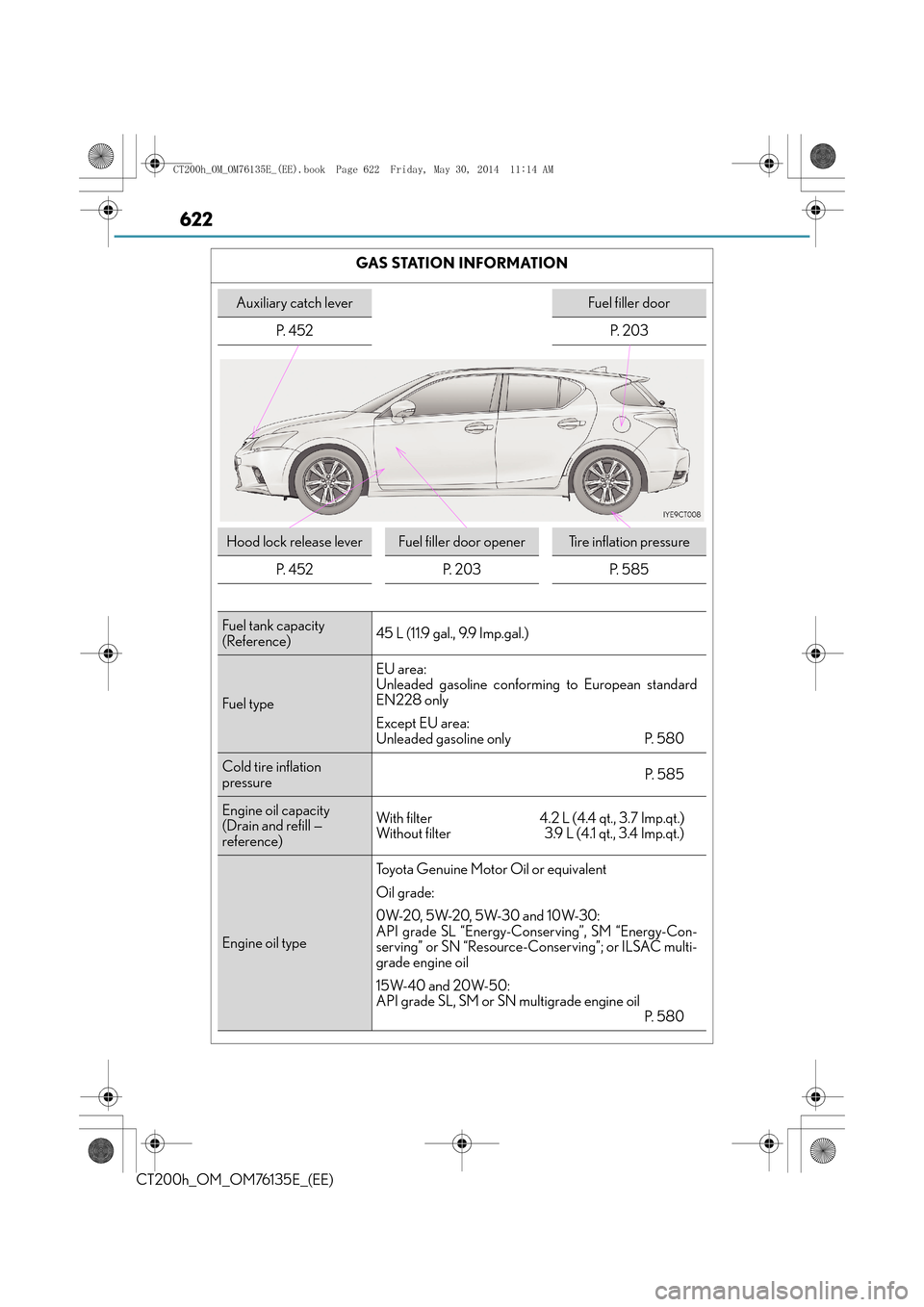
CT200h_OM_OM76135E_(EE)GAS STATION INFORMATION
Auxiliary catch leverFuel filler door
P. 4 5 2 P. 2 0 3
Hood lock release leverFuel filler door openerTi r e i n f l a t i o n p r e s s u r e
P. 452 P. 203 P. 585
Fuel tank capacity
(Reference) 45 L (11.9 gal., 9.9 Imp.gal.)
Fuel typeEU area:
Unleaded gasoline conforming to European standard
EN228 only
Except EU area:
Unleaded gasoline only P. 580
Cold tire inflation
pressure
P. 5 8 5
Engine oil capacity
(Drain and refill —
reference)With filter 4.2 L (4.4 qt., 3.7 Imp.qt.)
Without filter 3.9 L (4.1 qt., 3.4 Imp.qt.)
Engine oil typeToyota Genuine Motor Oil or equivalent
Oil grade:
0W-20, 5W-20, 5W-30 and 10W-30:
API grade SL “Energy-Conserving”, SM “Energy-Con-
serving” or SN “Resource-Conserving”; or ILSAC multi-
grade engine oil
1 5 W- 4 0 a n d 2 0 W- 5 0 :
API grade SL, SM or SN multigrade engine oil
P. 5 8 0
CT200h_OM_OM76135E_(EE).book Page 622 Friday, May 30, 2014 1 1:14 AM