air condition Lexus ES350 2018 s / LEXUS 2018 ES350 (OM06134U) Owner's Guide
[x] Cancel search | Manufacturer: LEXUS, Model Year: 2018, Model line: ES350, Model: Lexus ES350 2018Pages: 580, PDF Size: 10.39 MB
Page 411 of 580

411
ES350_OM_OM06134U_(U)
7Maintenance and care
7-1. Maintenance and careCleaning and protecting the vehicle exterior ..................412
Cleaning and protecting the vehicle interior................... 415
7-2. Maintenance Maintenance requirements ............................. 418
General maintenance................421
Emission inspection and maintenance (I/M)
programs .................................... 424
7-3. Do-it-yourself maintenance Do-it-yourself service precautions................................ 425
Hood ............................................... 427
Positioning a floor jack ............ 428
Engine compartment ............... 429
Tires ................................................. 440
Tire inflation pressure...............450
Wheels ........................................... 453
Air conditioning filter ...............455
Electronic key battery .............. 457
Checking and replacing fuses .............................................. 459
Light bulbs..................................... 462
Page 425 of 580
425
ES350_OM_OM06134U_(U)7-3. Do-it-yourself maintenance
7
Maintenance and care
Do-it-yourself service precautions
If you perform maintenance by yourself, be sure to follow the correct proce-
dure as given in these sections.
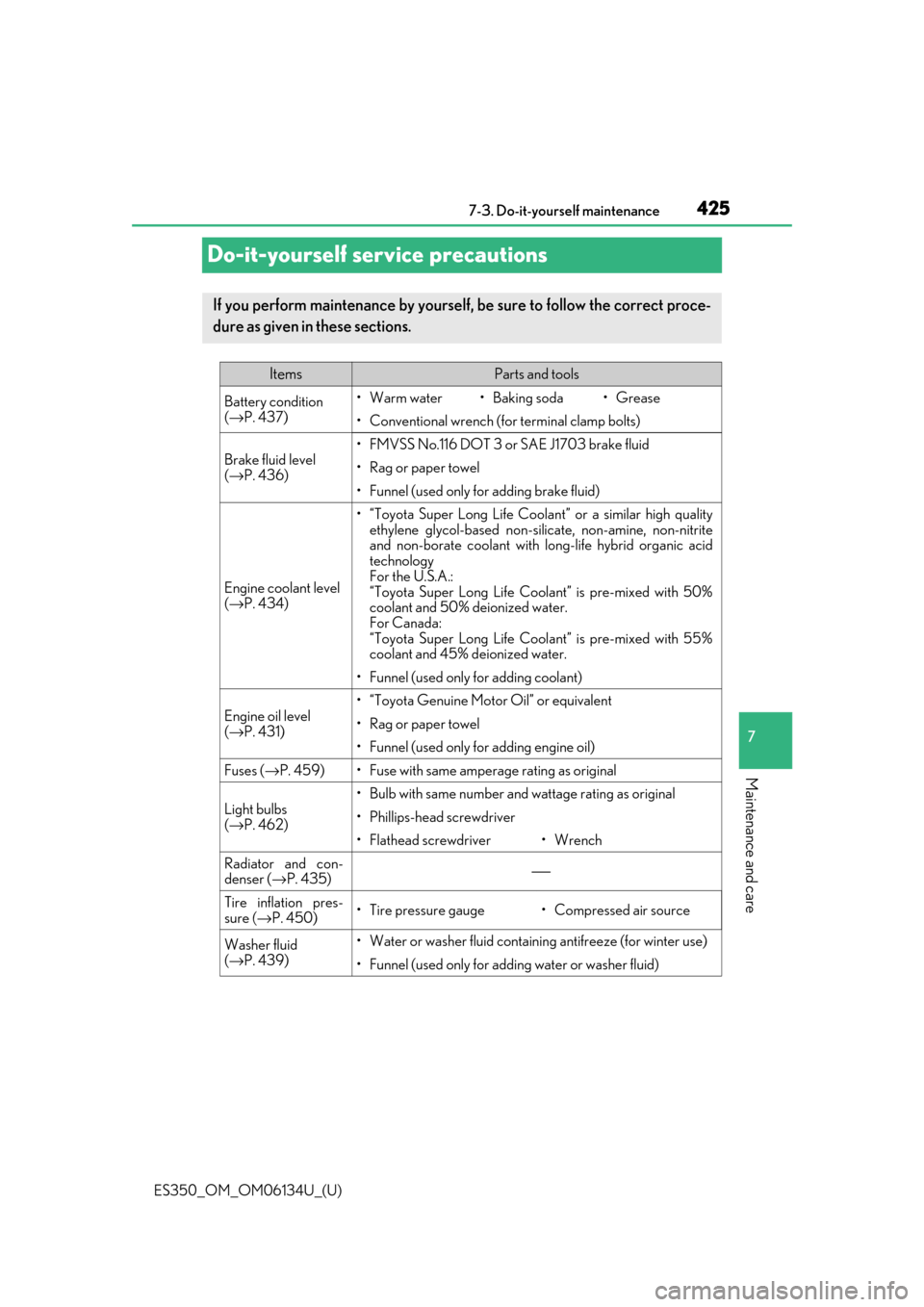
ItemsParts and tools
Battery condition
(
→ P. 437)•Warm water• Baking soda•Grease
• Conventional wrench (for terminal clamp bolts)
Brake fluid level
(→ P. 436)
• FMVSS No.116 DOT 3 or SAE J1703 brake fluid
• Rag or paper towel
• Funnel (used only for adding brake fluid)
Engine coolant level
(→ P. 434)
• “Toyota Super Long Life Coolan t” or a similar high quality
ethylene glycol-based non-silicate, non-amine, non-nitrite
and non-borate coolant with long-life hybrid organic acid
technology
For the U.S.A.:
“Toyota Super Long Life Coolant” is pre-mixed with 50%
coolant and 50% deionized water.
For Canada:
“Toyota Super Long Life Cool ant” is pre-mixed with 55%
coolant and 45% deionized water.
• Funnel (used only for adding coolant)
Engine oil level
( → P. 431)
• “Toyota Genuine Motor Oil” or equivalent
• Rag or paper towel
• Funnel (used only for adding engine oil)
Fuses ( →P. 459)• Fuse with same amperage rating as original
Light bulbs
(→ P. 462)
• Bulb with same number and wattage rating as original
• Phillips-head screwdriver
• Flathead screwdriver•Wrench
Radiator and con-
denser (→ P. 435)⎯
Tire inflation pres-
sure (→P. 450)• Tire pressure gauge• Compressed air source
Washer fluid
(→ P. 439)• Water or washer fluid containing antifreeze (for winter use)
• Funnel (used only for adding water or washer fluid)
Page 426 of 580

426
ES350_OM_OM06134U_(U)7-3. Do-it-yourself maintenance
WARNING
The engine compartment contains many compon
ents and fluids that may move suddenly,
become hot, or become electrically energize d. To avoid death or serious injury, observe
the following precautions.
■When working on the engine compartment
●Keep hands, clothing and tools away from the moving fan and engine drive belt.
●Be careful not to touch the engine, radiator, exhaust manifold, etc. right after driving
as they may be hot. Oil and other fluids may also be hot.
●Do not leave anything that may burn easily, such as paper and rags, in the engine
compartment.
●Do not smoke, cause sparks or expose an open flame to fuel or the battery. Fuel and
battery fumes are flammable.
●Be extremely cautious when working on the battery. It contains poisonous and corro-
sive sulfuric acid.
■When working near the electric cooling fans or radiator grille
Be sure the engine switch is off.
With the engine switch in IGNITION ON mode, the electric cooling fans may auto-
matically start to run if the air conditioning is on and/or the coolant temperature is high.
( → P. 435)
■Safety glasses
Wear safety glasses to prevent flying or falling material, fluid spray, etc. from getting in
your eyes.
NOTICE
■If you remove the air cleaner filter
Driving with the air cleaner f ilter removed may cause excessive engine wear due to dirt
in the air.
Page 443 of 580
ES350_OM_OM06134U_(U)
4437-3. Do-it-yourself maintenance
7
Maintenance and care
■When to replace your vehicle’s tires
Tires should be replaced if:
●The treadwear indicators are showing on a tire.
●You have tire damage such as cuts, splits, cracks deep enough to expose the fabric, and
bulges indicating internal damage
●A tire goes flat repeatedly or cannot be properly repaired due to the size or location of
a cut or other damage
If you are not sure, consult with your Lexus dealer.
■Replacing tires and wheels
If the ID code of the tire pressure warning valve and transmitter is not registered, the tire
pressure warning system will not work proper ly. After driving for about 20 minutes, the
tire pressure warning light blinks for 1 minu te and stays on to indicate a system malfunc-
tion.
■Tire life
Any tire over 6 years old must be checked by a qualified technician even if it has seldom
or never been used or damage is not obvious.
■Routine tire inflation pressure checks
The tire pressure warning syst em does not replace routine tire inflation pressure checks.
Make sure to check tire inflat ion pressure as part of your routine of daily vehicle checks.
■When rotating the tires
Make sure that the engine switch is off. If the tires are rotated while the engine switch is in
IGNITION ON mode, the tire position information will not be updated.
If this accidentally occurs, either turn the engine switch to off and then to IGNITION ON
mode, or initialize the system after checking th at the tire pressure is properly adjusted.
■Low profile tires (P225/45R18 tires)
Generally, low profile tires will wear more rapidly and tire grip performance will be
reduced on snowy and/or icy roads when comp ared to standard tires. Be sure to use
snow tires or tire chains on snowy and/or icy roads and drive carefully at a speed appro-
priate for road and weather conditions.
■Maximum load of tire
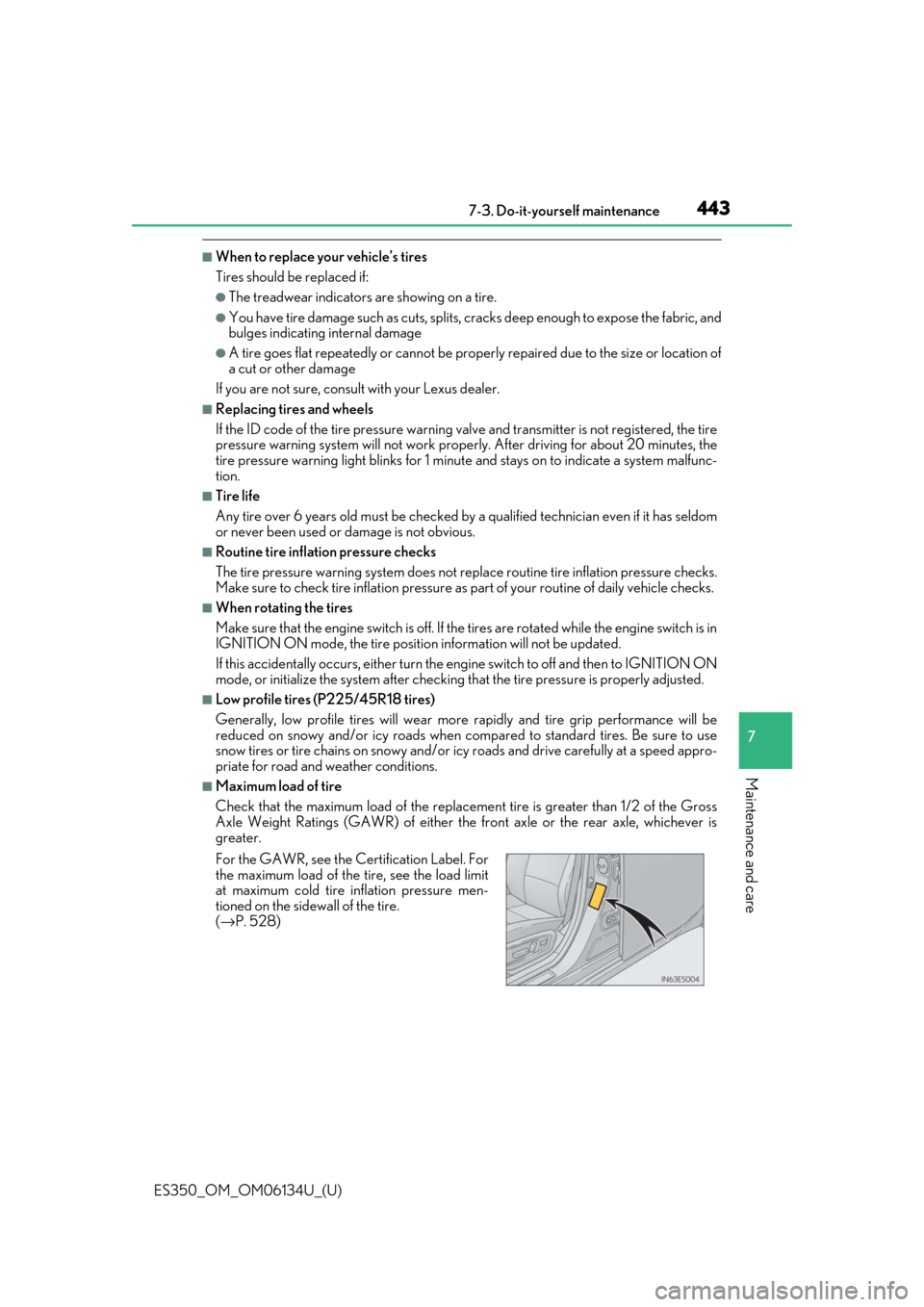
Check that the maximum load of the replacement tire is greater than 1/2 of the Gross
Axle Weight Ratings (GAWR) of either the front axle or the rear axle, whichever is
greater.
For the GAWR, see the Ce rtification Label. For
the maximum load of the tire, see the load limit
at maximum cold tire inflation pressure men-
tioned on the sidewall of the tire.
( → P. 528)
Page 444 of 580

444
ES350_OM_OM06134U_(U)7-3. Do-it-yourself maintenance
■Tire types
●Summer tires
Summer tires are high-speed performance ti
res best suited to highway driving under
dry conditions. Since summer tires do not have the same traction performance as
snow tires, summer tires are inadequate for driving on snow-covered or icy roads. For
driving on snow-covered roads or icy road s, the use of snow tires is recommended.
When installing snow tires, be sure to replace all four tires.
●All season tires
All season tires are designed to provide better traction in snow and to be adequate for
driving in most winter conditions as well as for use year-round. All season tires, how-
ever, do not have adequate traction perfor mance compared with snow tires in heavy
or loose snow. Also, all season tires fall short in acceleration and handling perfor-
mance compared with summer tires in highway driving.
●Snow tires
For driving on snow-covered roads or icy roads, we recommend using snow tires. If
you need snow tires, select ti res of the same size, construction and load capacity as the
originally installed tires. Since your vehicle has radial tires as original equipment, make
sure your snow tires also have radial cons truction. Do not install studded tires without
first checking local regulations for possible restrictions. Snow tires should be installed
on all wheels. ( →P. 262)
■If the tread on snow tires wears down below 0.16 in. (4 mm)
The effectiveness of the tire s as snow tires is lost.
■Situations in which the tire pressure warning system may not operate properly
●In the following cases, the tire pressure warning system may not operate properly.
• If non-genuine Lexus wheels are used.
• A tire has been replaced with a tire that is not an OE (Original Equipment) tire.
• A tire has been replaced with a tire that is not of the specified size.
• Tire chains etc. are equipped.
• An auxiliary-supported run-flat tire is equipped.
• If a window tint that affects th e radio wave signals is installed.
• If there is a lot of snow or ice on the vehi cle, particularly around the wheels or wheel
housings.
• If the tire inflation pressure is extr emely higher than the specified level.
●Performance may be affected in the following situations.
• Near a TV tower, electric power plant, gas station, radio station, large display, air-
port or other facility that generates st rong radio waves or electrical noise
• When carrying a portable radio, cellular phone, cordless phone or other wireless
communication device
If tire position information is not correctl y displayed due to the radio wave conditions,
the display may be corrected by driving and changing the radio wave conditions.
●When the vehicle is parked, the time taken for the warning to start or go off could be
extended.
●When tire inflation pressure declines rapidly for example when a tire has burst, the
warning may not function.
Page 449 of 580

ES350_OM_OM06134U_(U)
4497-3. Do-it-yourself maintenance
7
Maintenance and care
NOTICE
■Repairing or replacing tires, wheels, tire pressure warning valves, transmitters and
tire valve caps
●When removing or fitting the wheels, tires or the tire pressure warning valves and
transmitters, contact your Lexus dealer as the tire pressure warning valves and trans-
mitters may be damaged if not handled correctly.
●Make sure to install the tire valve caps. If the tire valve caps are not installed, water
could enter the tire pressure warning valves and the tire pressure warning valves
could be bound.
●When replacing tire valve caps, do not use tire valve caps other than those specified.
The cap may become stuck.
■To avoid damage to the tire pressu re warning valves and transmitters
When a tire is repaired with liquid sealants, the tire pressure warning valve and trans-
mitter may not operate properly. If a liquid sealant is used, contact your Lexus dealer or
other qualified service shop as soon as possi ble. After use of liquid sealant, make sure
to replace the tire pressure warning valve and transmitter when repairing or replacing
the tire. (→ P. 441)
■Driving on rough roads
Take particular care when driving on roads with loose surfaces or potholes.
These conditions may cause lo sses in tire inflation pressure, reducing the cushioning
ability of the tires. In addition, driving on rough roads may cause damage to the tires
themselves, as well as the vehicle’s wheels and body.
■Low profile tires (P225/45R18 tires)
Low profile tires may cause greater damage than usual to the tire wheel when sustain-
ing impact from the road surface. Ther efore, pay attention to the following:
●Be sure to use proper tire inflation pressu re. If tires are under-inflated, they may be
damaged more severely.
●Avoid potholes, uneven pavement, curbs an d other road hazards. Failure to do so
may lead to severe tire and wheel damage.
■If tire inflation pressure of ea ch tire becomes low while driving
Do not continue driving, or your tires and/or wheels may be ruined.
Page 452 of 580

452
ES350_OM_OM06134U_(U)7-3. Do-it-yourself maintenance
■Instructions for checking tire inflation pressure
When checking tire in
flation pressure, observe the following:
●Check only when the tires are cold.
If your vehicle has been parked for at least 3 hours or has not been driven for more than
1 mile or 1.5 km, you will get an accurate cold tire inflation pressure reading.
●Always use a tire pressure gauge.
It is difficult to judge if a tire is properly inflated based only on its appearance.
●It is normal for the tire inflat ion pressure to be higher after driving as heat is generated
in the tire. Do not reduce tire inflation pressure after driving.
●Never exceed the vehicle capacity weight.
Passengers and luggage weight should be placed so that the vehicle is balanced.
WARNING
■Proper inflation is critical to save tire performance
Keep your tires properly inflated.
If the tires are not properly inflated, the following conditions may occur which could
lead to an accident resulting in death or serious injury:
●Excessive wear
●Uneven wear
●Poor handling
●Possibility of blowouts resu lting from overheated tires
●Air leaking from between tire and wheel
●Wheel deformation and/or tire damage
●Greater possibility of tire damage while driving (due to road hazards, expansion
joints, sharp edges in the road, etc.)
NOTICE
■When inspecting and adjust ing tire inflation pressure
Be sure to put the tire valve caps back on.
If a valve cap is not installed, dirt or moisture may get into the valve and cause an air
leak, resulting in decreased tire inflation pressure.
Page 455 of 580
455
ES350_OM_OM06134U_(U)7-3. Do-it-yourself maintenance
7
Maintenance and care
Air conditioning filter
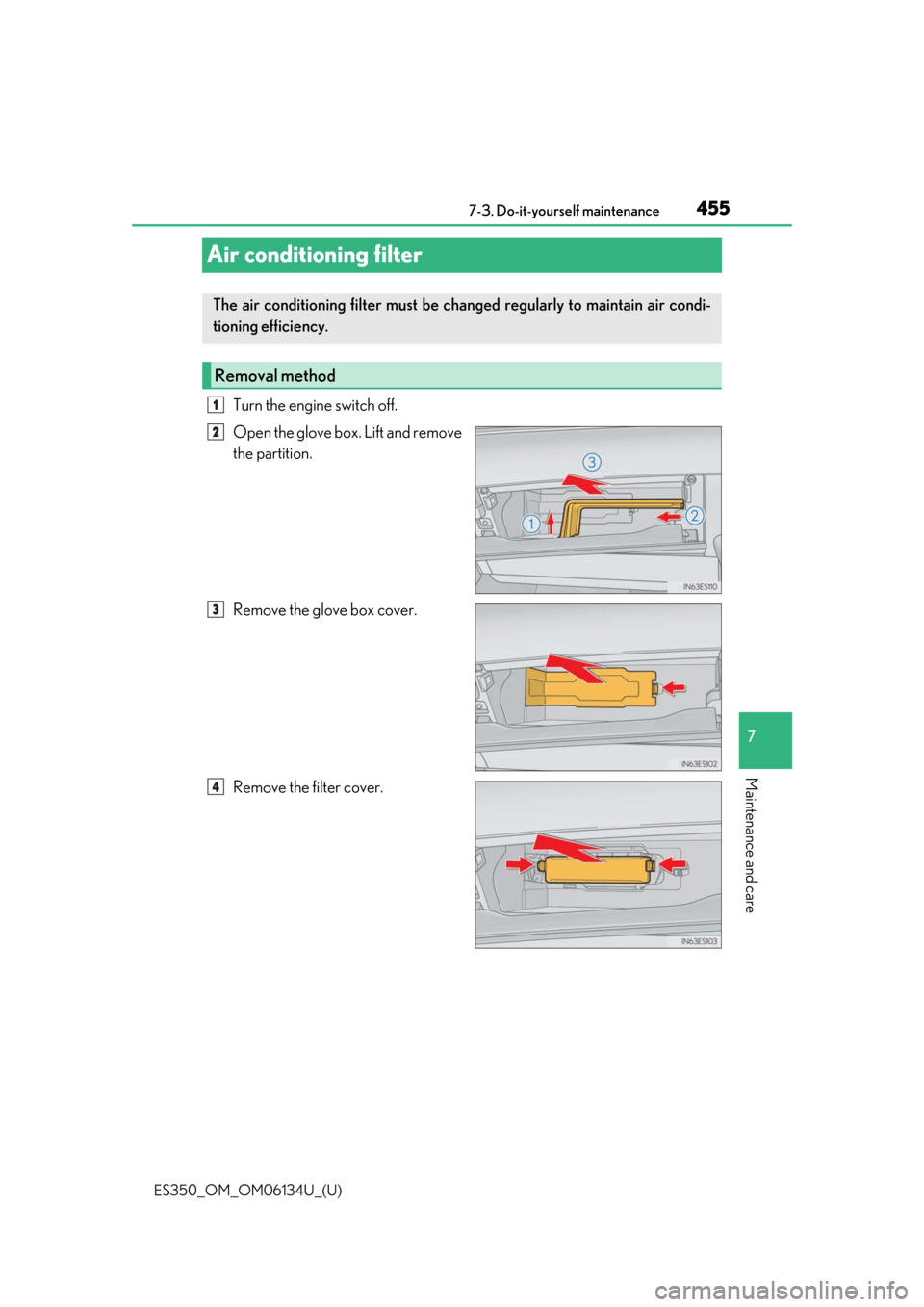
Turn the engine switch off.
Open the glove box. Lift and remove
the partition.
Remove the glove box cover.
Remove the filter cover.
The air conditioning filter must be ch
anged regularly to maintain air condi-
tioning efficiency.
Removal method
1
2
3
4
Page 456 of 580
456
ES350_OM_OM06134U_(U)7-3. Do-it-yourself maintenance
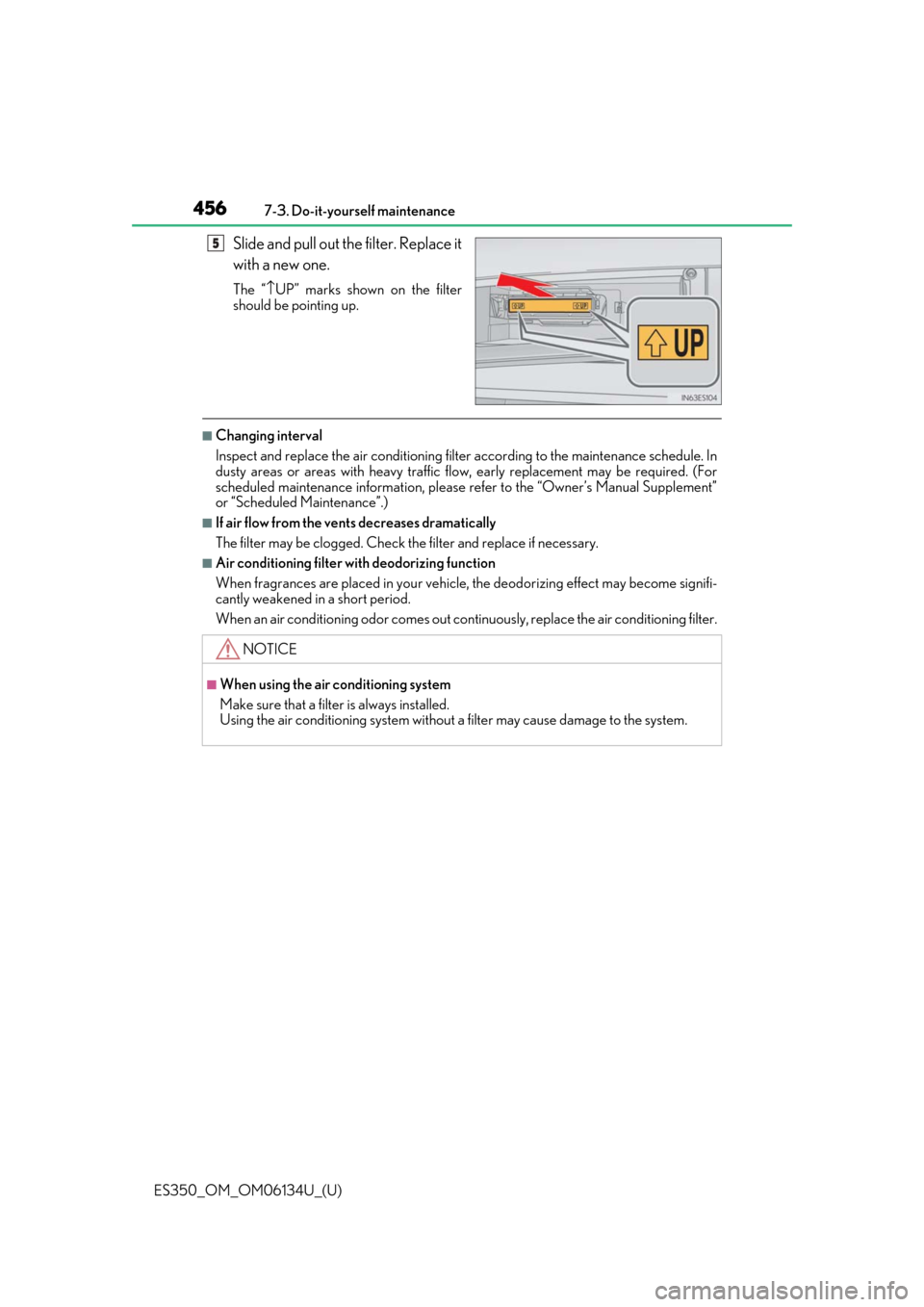
Slide and pull out the filter. Replace it
with a new one.
The “
\bUP” marks shown on the filter
should be pointing up.
■Changing interval
Inspect and replace the air cond itioning filter according to the maintenance schedule. In
dusty areas or areas with heavy traffic fl ow, early replacement may be required. (For
scheduled maintenance informat ion, please refer to the “Owner’s Manual Supplement”
or “Scheduled Maintenance”.)
■If air flow from the vents decreases dramatically
The filter may be clogged. Check the filter and replace if necessary.
■Air conditioning filter with deodorizing function
When fragrances are placed in your vehicle, the deodorizing effect may become signifi-
cantly weakened in a short period.
When an air conditioning odor comes out cont inuously, replace the air conditioning filter.
5
NOTICE
■When using the air conditioning system
Make sure that a filter is always installed.
Using the air conditioning system without a filter may cause damage to the system.
Page 480 of 580
480
ES350_OM_OM06134U_(U)8-2. Steps to take in an emergency
If you think something is wrong
●Fluid leaks under the vehicle.
(Water dripping from the air conditioning after use is normal.)
●Flat-looking tires or uneven tire wear
●Engine coolant temperature gauge needle
continually points higher than nor-
mal.
●Changes in exhaust sound
●Excessive tire squeal when cornering
●Strange noises related to the suspension system
●Pinging or other noises related to the engine
●Engine missing, stumbling or running roughly
●Appreciable loss of power
●Vehicle pulls heavily to one side when braking
●Vehicle pulls heavily to one side when driving on a level road
●Loss of brake effectiveness, spongy feeling, pedal almost touches the floor
If you notice any of the following symptoms, your vehicle probably needs
adjustment or repair. Contact your Lexus dealer as soon as possible.
Visible symptoms
Audible symptoms
Operational symptoms