brake light LEXUS LS430 2003 Factory Owner's Guide
[x] Cancel search | Manufacturer: LEXUS, Model Year: 2003, Model line: LS430, Model: LEXUS LS430 2003Pages: 4500, PDF Size: 87.45 MB
Page 1780 of 4500
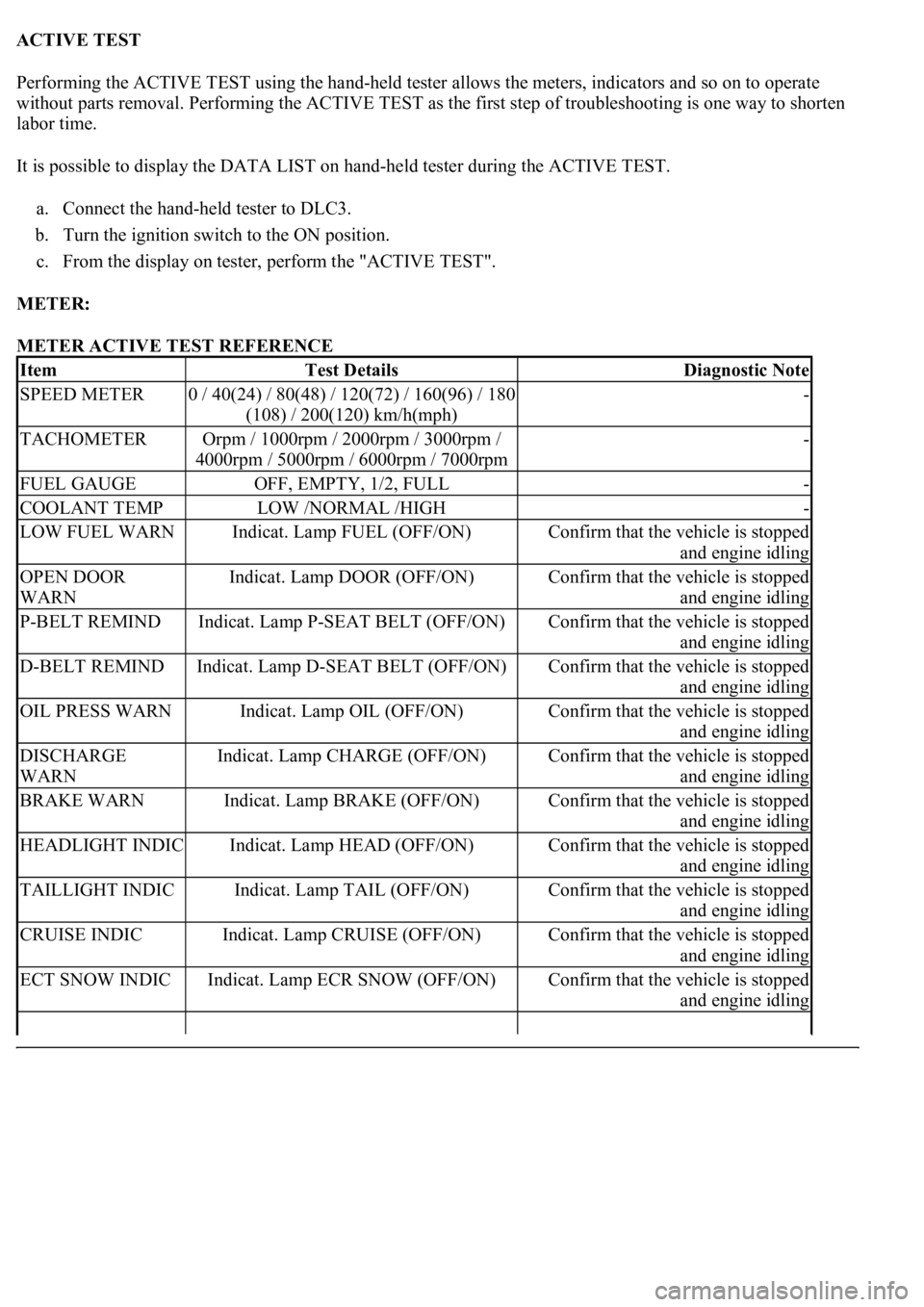
ACTIVE TEST
Performing the ACTIVE TEST using the hand-held tester allows the meters, indicators and so on to operate
without parts removal. Performing the ACTIVE TEST as the first step of troubleshooting is one way to shorten
labor time.
It is possible to display the DATA LIST on hand-held tester during the ACTIVE TEST.
a. Connect the hand-held tester to DLC3.
b. Turn the ignition switch to the ON position.
c. From the display on tester, perform the "ACTIVE TEST".
METER:
METER ACTIVE TEST REFERENCE
ItemTest DetailsDiagnostic Note
SPEED METER0 / 40(24) / 80(48) / 120(72) / 160(96) / 180
(108) / 200(120) km/h(mph)-
TACHOMETEROrpm / 1000rpm / 2000rpm / 3000rpm /
4000rpm / 5000rpm / 6000rpm / 7000rpm-
FUEL GAUGEOFF, EMPTY, 1/2, FULL-
COOLANT TEMPLOW /NORMAL /HIGH-
LOW FUEL WARNIndicat. Lamp FUEL (OFF/ON)Confirm that the vehicle is stopped
and engine idling
OPEN DOOR
WARNIndicat. Lamp DOOR (OFF/ON)Confirm that the vehicle is stopped
and engine idling
P-BELT REMINDIndicat. Lamp P-SEAT BELT (OFF/ON)Confirm that the vehicle is stopped
and engine idling
D-BELT REMINDIndicat. Lamp D-SEAT BELT (OFF/ON)Confirm that the vehicle is stopped
and engine idling
OIL PRESS WARNIndicat. Lamp OIL (OFF/ON)Confirm that the vehicle is stopped
and engine idling
DISCHARGE
WARNIndicat. Lamp CHARGE (OFF/ON)Confirm that the vehicle is stopped
and engine idling
BRAKE WARNIndicat. Lamp BRAKE (OFF/ON)Confirm that the vehicle is stopped
and engine idling
HEADLIGHT INDICIndicat. Lamp HEAD (OFF/ON)Confirm that the vehicle is stopped
and engine idling
TAILLIGHT INDICIndicat. Lamp TAIL (OFF/ON)Confirm that the vehicle is stopped
and engine idling
CRUISE INDICIndicat. Lamp CRUISE (OFF/ON)Confirm that the vehicle is stopped
and engine idling
ECT SNOW INDICIndicat. Lamp ECR SNOW (OFF/ON)Confirm that the vehicle is stopped
and engine idling
Page 1847 of 4500
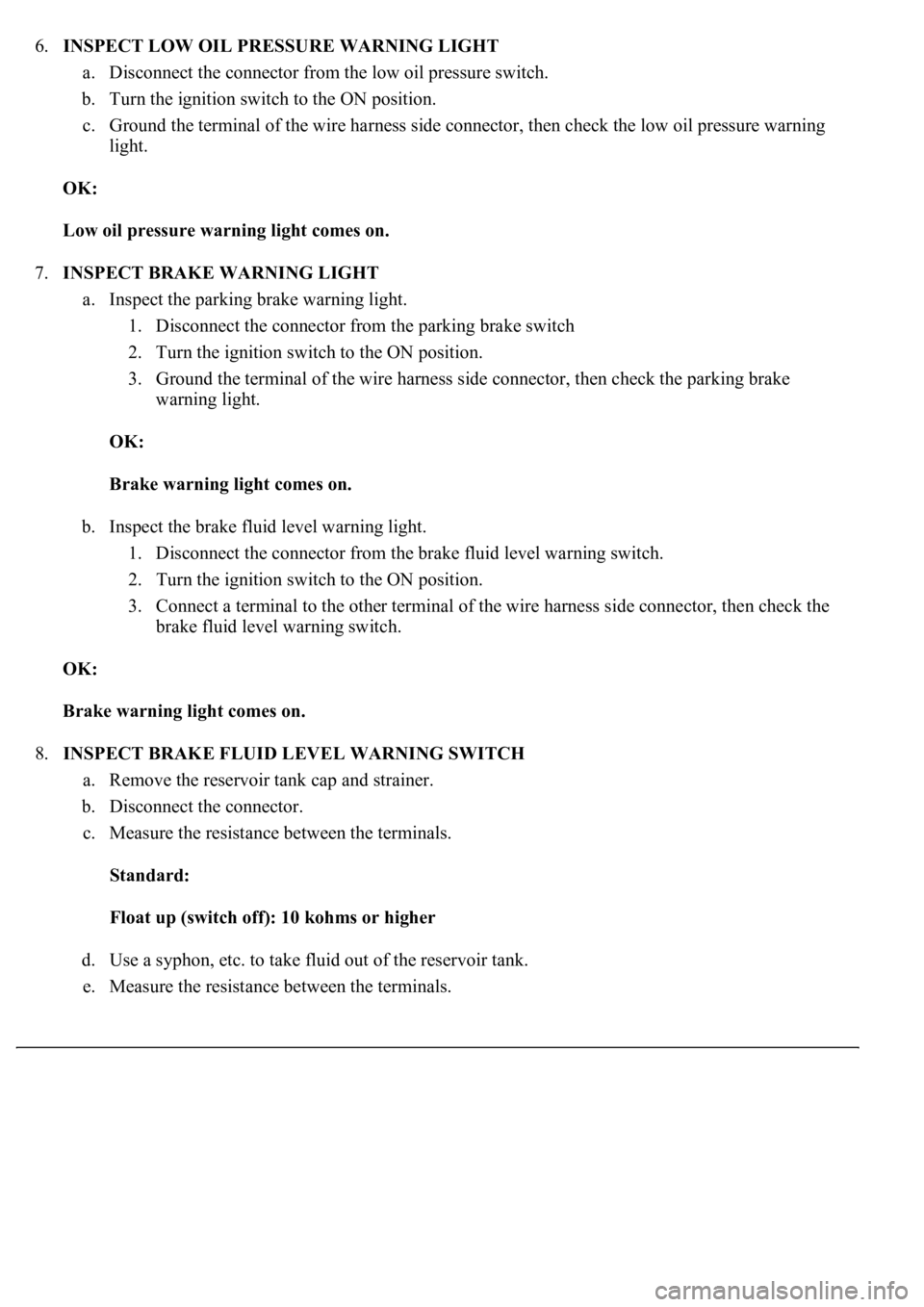
6.INSPECT LOW OIL PRESSURE WARNING LIGHT
a. Disconnect the connector from the low oil pressure switch.
b. Turn the ignition switch to the ON position.
c. Ground the terminal of the wire harness side connector, then check the low oil pressure warning
light.
OK:
Low oil pressure warning light comes on.
7.INSPECT BRAKE WARNING LIGHT
a. Inspect the parking brake warning light.
1. Disconnect the connector from the parking brake switch
2. Turn the ignition switch to the ON position.
3. Ground the terminal of the wire harness side connector, then check the parking brake
warning light.
OK:
Brake warning light comes on.
b. Inspect the brake fluid level warning light.
1. Disconnect the connector from the brake fluid level warning switch.
2. Turn the ignition switch to the ON position.
3. Connect a terminal to the other terminal of the wire harness side connector, then check the
brake fluid level warning switch.
OK:
Brake warning light comes on.
8.INSPECT BRAKE FLUID LEVEL WARNING SWITCH
a. Remove the reservoir tank cap and strainer.
b. Disconnect the connector.
c. Measure the resistance between the terminals.
Standard:
Float up (switch off): 10 kohms or higher
d. Use a syphon, etc. to take fluid out of the reservoir tank.
e. Measure the resistance between the terminals.
Page 1905 of 4500
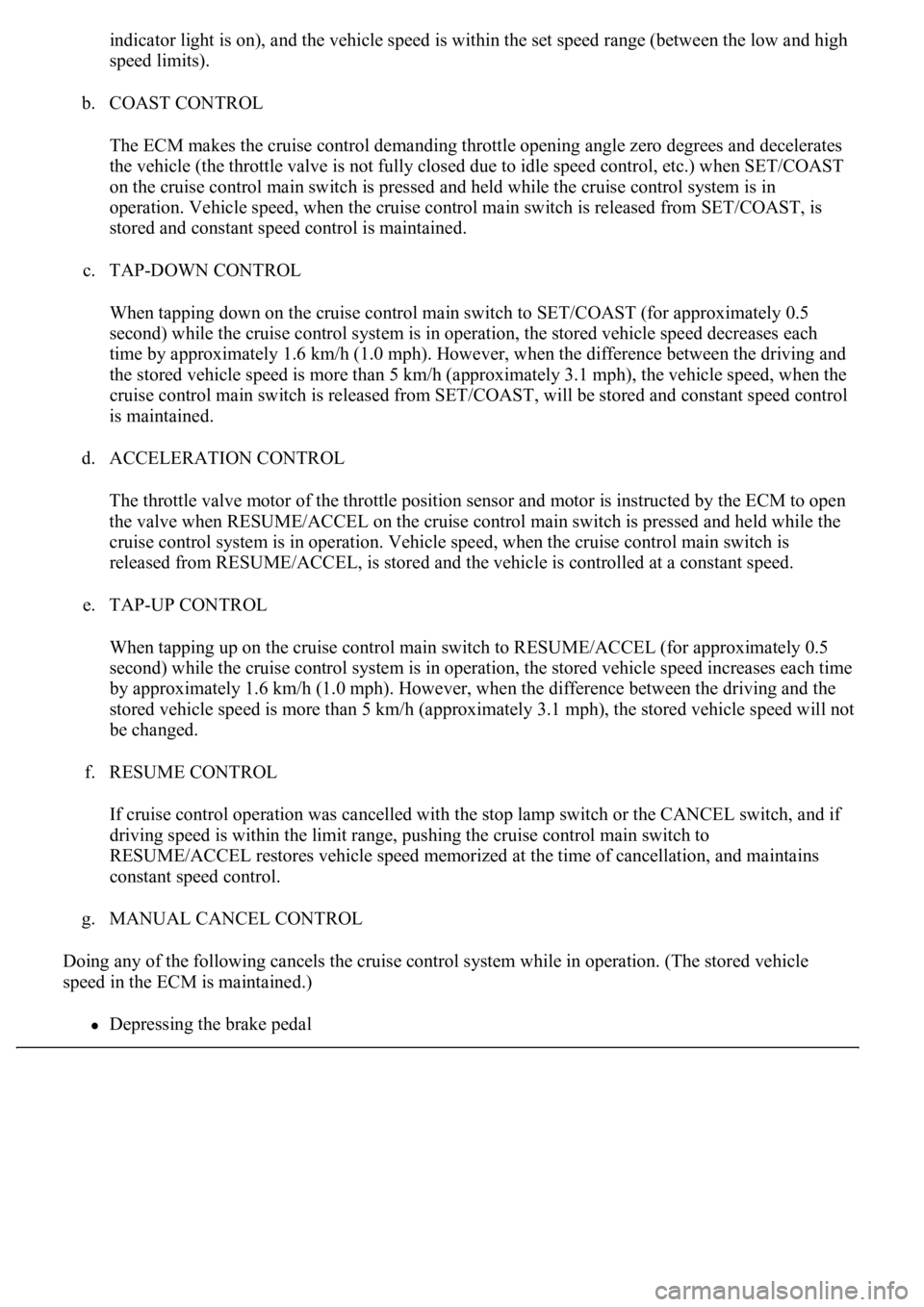
indicator light is on), and the vehicle speed is within the set speed range (between the low and high
speed limits).
b. COAST CONTROL
The ECM makes the cruise control demanding throttle opening angle zero degrees and decelerates
the vehicle (the throttle valve is not fully closed due to idle speed control, etc.) when SET/COAST
on the cruise control main switch is pressed and held while the cruise control system is in
operation. Vehicle speed, when the cruise control main switch is released from SET/COAST, is
stored and constant speed control is maintained.
c. TAP-DOWN CONTROL
When tapping down on the cruise control main switch to SET/COAST (for approximately 0.5
second) while the cruise control system is in operation, the stored vehicle speed decreases each
time by approximately 1.6 km/h (1.0 mph). However, when the difference between the driving and
the stored vehicle speed is more than 5 km/h (approximately 3.1 mph), the vehicle speed, when the
cruise control main switch is released from SET/COAST, will be stored and constant speed control
is maintained.
d. ACCELERATION CONTROL
The throttle valve motor of the throttle position sensor and motor is instructed by the ECM to open
<0057004b0048000300590044004f005900480003005a004b00480051000300350028003600380030002800120024002600260028002f00030052005100030057004b00480003004600550058004c005600480003004600520051005700550052004f000300
500044004c005100030056005a004c00570046004b0003004c[s pressed and held while the
cruise control system is in operation. Vehicle speed, when the cruise control main switch is
released from RESUME/ACCEL, is stored and the vehicle is controlled at a constant speed.
e. TAP-UP CONTROL
When tapping up on the cruise control main switch to RESUME/ACCEL (for approximately 0.5
second) while the cruise control system is in operation, the stored vehicle speed increases each time
by approximately 1.6 km/h (1.0 mph). However, when the difference between the driving and the
stored vehicle speed is more than 5 km/h (approximately 3.1 mph), the stored vehicle speed will not
be changed.
f. RESUME CONTROL
If cruise control operation was cancelled with the stop lamp switch or the CANCEL switch, and if
driving speed is within the limit range, pushing the cruise control main switch to
RESUME/ACCEL restores vehicle speed memorized at the time of cancellation, and maintains
constant speed control.
g. MANUAL CANCEL CONTROL
Doing any of the following cancels the cruise control system while in operation. (The stored vehicle
speed in the ECM is maintained.)
Depressing the brake pedal
Page 1921 of 4500

HINT:
"3" is OK but "1" is NG --> ECM failure
"1" is OK but "2" is NG --> DTC output or ECM failure
"3" is OK but cruise indicator not turn on --> CRUISE MAIN indicator or wire harness or ECM failure
2.ACTIVE TEST
HINT:
Performing the ACTIVE TEST using the hand-held tester allows components such as the relay, VSV, and
actuator to operate without parts removal. Performing the ACTIVE TEST as the first step of
troubleshooting is one way to shorten labor time.
It is possible to display the DATA LIST during the ACTIVE TEST.
a. Connect the hand-held tester to the DLC3.
b. Turn the ignition switch to the ON position.
c. According to the display on the tester, perform the "ACTIVE TEST".
HINT:
CCS READY SCruise control system standby
condition (Sub CPU) / ON or
OFFON --> OFF: Change ON/OFF
each time Main SW is pushed in."1"
CCS INDICATOR
MCruise indicator signal (Main
CPU) /ON or OFFON: "CCS READY" ON OFF:
"CCS READY" OFF"2"
CCS
INDICATORSCruise indicator signal (Sub
CPU) /ON or OFFON: "CCS READY" ON OFF:
"CCS READY" OFF"2"
CANCEL SWCANCEL SW signal / ON or
OFFON: CANCEL SW ON OFF:
CANCEL SW OFF-
SET/COAST SWSET/COAST SW signal / ON or
OFFON: SET/COAST SW ON OFF:
SET/COAST SW OFF-
RES/ACC SWRES/ACC SW signal / ON or
OFFON: RES/ACC SW ON OFF:
RES/ACC SW OFF-
STP LIGHT SW MStop lamp SW signal (Main
CPU) / ON or OFFON: Brake pedal depressed OFF:
Brake pedal released-
STP LIGHT SW
S1Stop lamp SW signal (Sub
CPU) / ON or OFFON: Brake pedal depressed OFF:
Brake pedal released-
STP LIGHT SW
S2Stop light SW signal (Sub
CPU) / ON or OFFON: Brake pedal depressed OFF:
Brake pedal released-
SHIFT D POSPNP SW signal (D position) /
ON or OFFON: Shift D position OFF:
Except shift D position-
Page 1925 of 4500
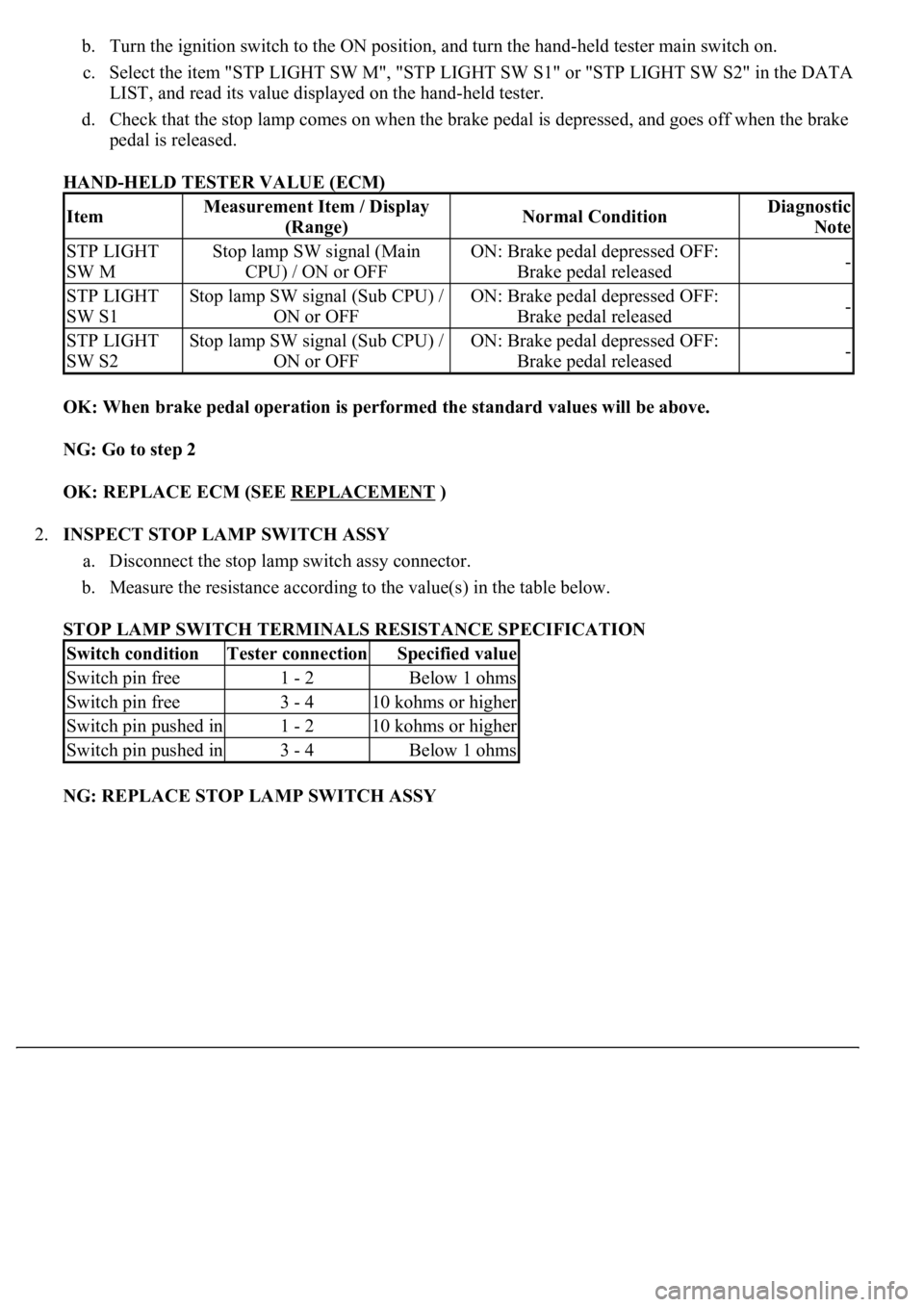
b. Turn the ignition switch to the ON position, and turn the hand-held tester main switch on.
c. Select the item "STP LIGHT SW M", "STP LIGHT SW S1" or "STP LIGHT SW S2" in the DATA
LIST, and read its value displayed on the hand-held tester.
d. Check that the stop lamp comes on when the brake pedal is depressed, and goes off when the brake
pedal is released.
HAND-HELD TESTER VALUE (ECM)
OK: When brake pedal operation is performed the standard values will be above.
NG: Go to step 2
OK: REPLACE ECM (SEE REPLACEMENT
)
2.INSPECT STOP LAMP SWITCH ASSY
a. Disconnect the stop lamp switch assy connector.
b. Measure the resistance according to the value(s) in the table below.
STOP LAMP SWITCH TERMINALS RESISTANCE SPECIFICATION
NG: REPLACE STOP LAMP SWITCH ASSY
ItemMeasurement Item / Display
(Range)Normal ConditionDiagnostic
Note
STP LIGHT
SW MStop lamp SW signal (Main
CPU) / ON or OFFON: Brake pedal depressed OFF:
Brake pedal released-
STP LIGHT
SW S1Stop lamp SW signal (Sub CPU) /
ON or OFFON: Brake pedal depressed OFF:
Brake pedal released-
STP LIGHT
SW S2Stop lamp SW signal (Sub CPU) /
ON or OFFON: Brake pedal depressed OFF:
Brake pedal released-
Switch conditionTester connectionSpecified value
Switch pin free1 - 2Below 1 ohms
Switch pin free3 - 410 kohms or higher
Switch pin pushed in1 - 210 kohms or higher
Switch pin pushed in3 - 4Below 1 ohms
Page 2408 of 4500
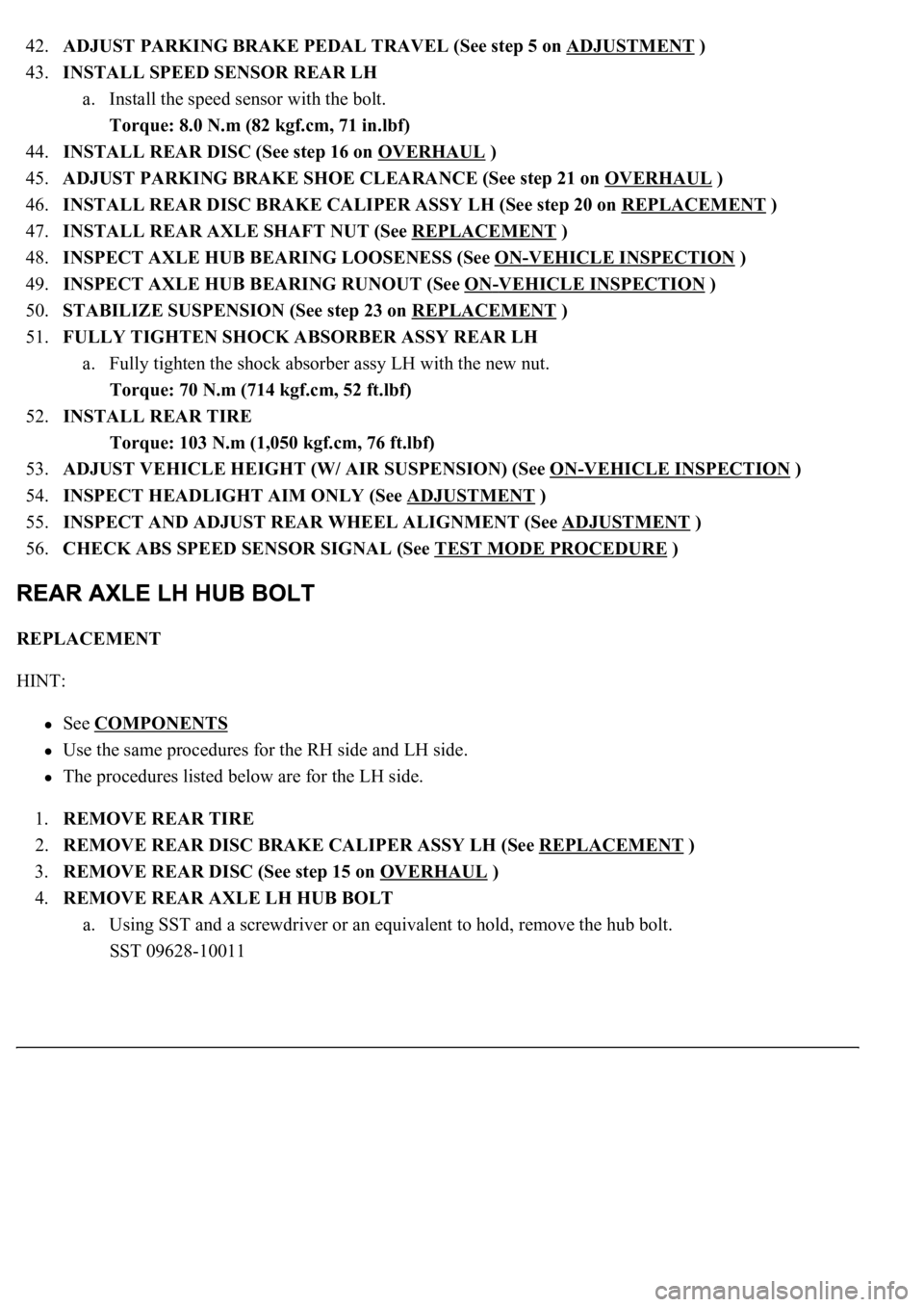
42.ADJUST PARKING BRAKE PEDAL TRAVEL (See step 5 on ADJUSTMENT )
43.INSTALL SPEED SENSOR REAR LH
a. Install the speed sensor with the bolt.
Torque: 8.0 N.m (82 kgf.cm, 71 in.lbf)
44.INSTALL REAR DISC (See step 16 on OVERHAUL
)
45.ADJUST PARKING BRAKE SHOE CLEARANCE (See step 21 on OVERHAUL
)
46.INSTALL REAR DISC BRAKE CALIPER ASSY LH (See step 20 on REPLACEMENT
)
47.INSTALL REAR AXLE SHAFT NUT (See REPLACEMENT
)
48.INSPECT AXLE HUB BEARING LOOSENESS (See ON
-VEHICLE INSPECTION )
49.INSPECT AXLE HUB BEARING RUNOUT (See ON
-VEHICLE INSPECTION )
50.STABILIZE SUSPENSION (See step 23 on REPLACEMENT
)
51.FULLY TIGHTEN SHOCK ABSORBER ASSY REAR LH
a. Fully tighten the shock absorber assy LH with the new nut.
Torque: 70 N.m (714 kgf.cm, 52 ft.lbf)
52.INSTALL REAR TIRE
Torque: 103 N.m (1,050 kgf.cm, 76 ft.lbf)
53.ADJUST VEHICLE HEIGHT (W/ AIR SUSPENSION) (See ON
-VEHICLE INSPECTION )
54.INSPECT HEADLIGHT AIM ONLY (See ADJUSTMENT
)
55.INSPECT AND ADJUST REAR WHEEL ALIGNMENT (See ADJUSTMENT
)
56.CHECK ABS SPEED SENSOR SIGNAL (See TEST MODE PROCEDURE
)
REPLACEMENT
HINT:
See COMPONENTS
Use the same procedures for the RH side and LH side.
The procedures listed below are for the LH side.
1.REMOVE REAR TIRE
2.REMOVE REAR DISC BRAKE CALIPER ASSY LH (See REPLACEMENT
)
3.REMOVE REAR DISC (See step 15 on OVERHAUL
)
4.REMOVE REAR AXLE LH HUB BOLT
a. Using SST and a screwdriver or an equivalent to hold, remove the hub bolt.
SST 09628-10011
Page 2414 of 4500
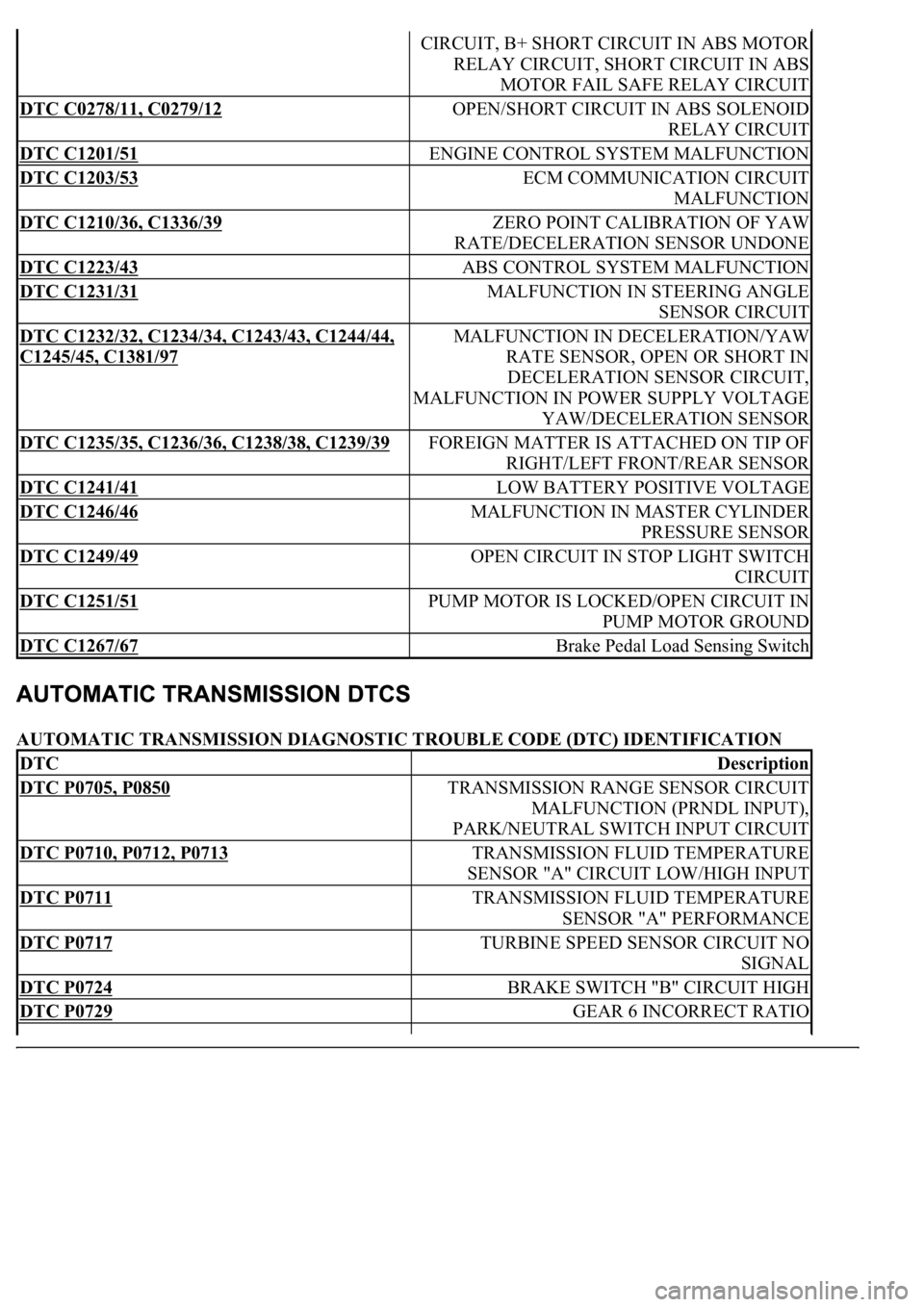
AUTOMATIC TRANSMISSION DIAGNOSTIC TROUBLE CODE (DTC) IDENTIFICATION
CIRCUIT, B+ SHORT CIRCUIT IN ABS MOTOR
RELAY CIRCUIT, SHORT CIRCUIT IN ABS
MOTOR FAIL SAFE RELAY CIRCUIT
DTC C0278/11, C0279/12 OPEN/SHORT CIRCUIT IN ABS SOLENOID
RELAY CIRCUIT
DTC C1201/51 ENGINE CONTROL SYSTEM MALFUNCTION
DTC C1203/53 ECM COMMUNICATION CIRCUIT
MALFUNCTION
DTC C1210/36, C1336/39 ZERO POINT CALIBRATION OF YAW
RATE/DECELERATION SENSOR UNDONE
DTC C1223/43 ABS CONTROL SYSTEM MALFUNCTION
DTC C1231/31 MALFUNCTION IN STEERING ANGLE
SENSOR CIRCUIT
DTC C1232/32, C1234/34, C1243/43, C1244/44,
C1245/45, C1381/97
MALFUNCTION IN DECELERATION/YAW
RATE SENSOR, OPEN OR SHORT IN
DECELERATION SENSOR CIRCUIT,
MALFUNCTION IN POWER SUPPLY VOLTAGE
YAW/DECELERATION SENSOR
DTC C1235/35, C1236/36, C1238/38, C1239/39 FOREIGN MATTER IS ATTACHED ON TIP OF
RIGHT/LEFT FRONT/REAR SENSOR
DTC C1241/41 LOW BATTERY POSITIVE VOLTAGE
DTC C1246/46 MALFUNCTION IN MASTER CYLINDER
PRESSURE SENSOR
DTC C1249/49 OPEN CIRCUIT IN STOP LIGHT SWITCH
CIRCUIT
DTC C1251/51 PUMP MOTOR IS LOCKED/OPEN CIRCUIT IN
PUMP MOTOR GROUND
DTC C1267/67 Brake Pedal Load Sensing Switch
DTCDescription
DTC P0705, P0850 TRANSMISSION RANGE SENSOR CIRCUIT
MALFUNCTION (PRNDL INPUT),
PARK/NEUTRAL SWITCH INPUT CIRCUIT
DTC P0710, P0712, P0713 TRANSMISSION FLUID TEMPERATURE
SENSOR "A" CIRCUIT LOW/HIGH INPUT
DTC P0711 TRANSMISSION FLUID TEMPERATURE
SENSOR "A" PERFORMANCE
DTC P0717 TURBINE SPEED SENSOR CIRCUIT NO
SIGNAL
DTC P0724 BRAKE SWITCH "B" CIRCUIT HIGH
DTC P0729 GEAR 6 INCORRECT RATIO
Page 2416 of 4500
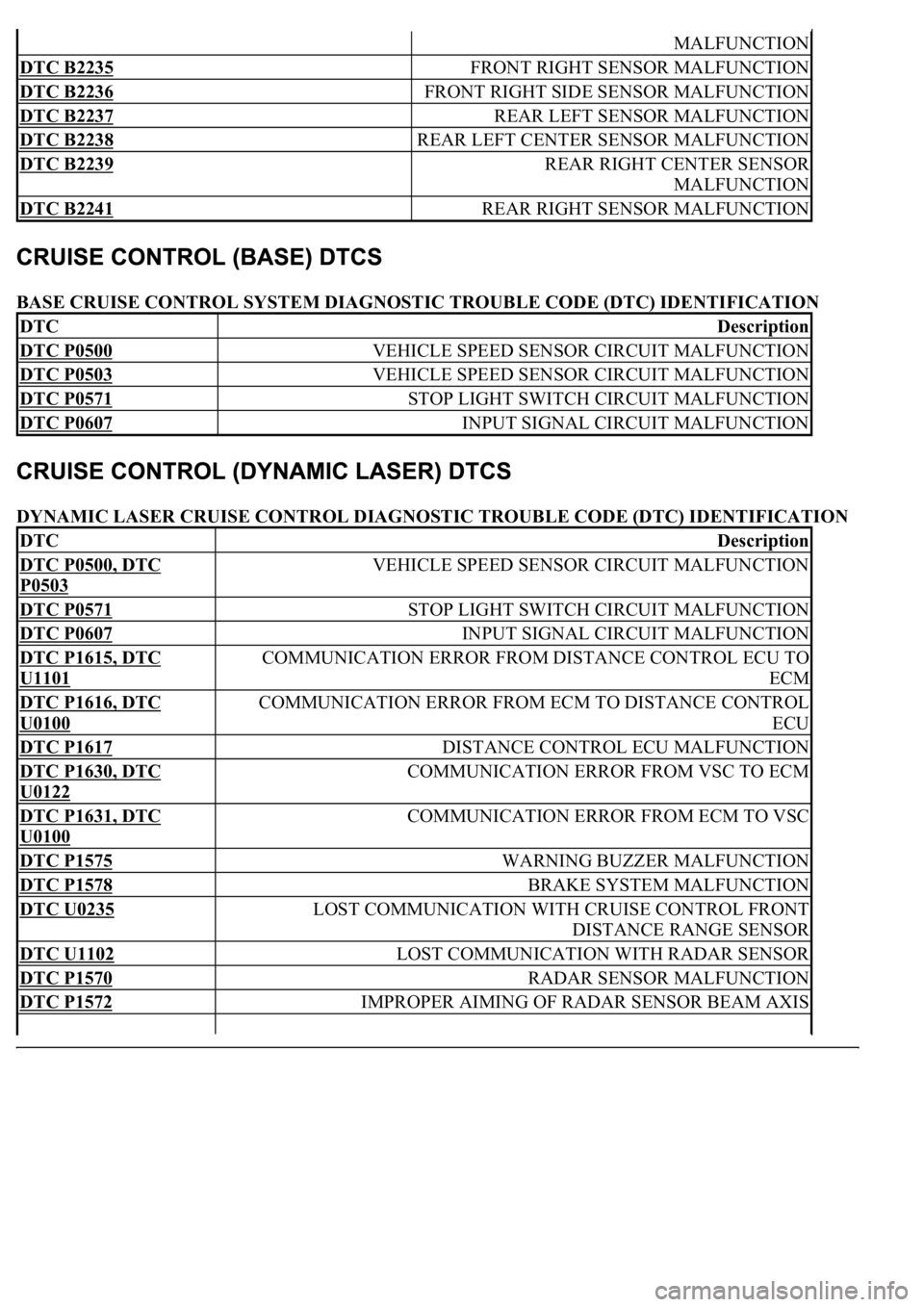
BASE CRUISE CONTROL SYSTEM DIAGNOSTIC TROUBLE CODE (DTC) IDENTIFICATION
DYNAMIC LASER CRUISE CONTROL DIAGNOSTIC TROUBLE CODE (DTC) IDENTIFICATION
MALFUNCTION
DTC B2235 FRONT RIGHT SENSOR MALFUNCTION
DTC B2236 FRONT RIGHT SIDE SENSOR MALFUNCTION
DTC B2237 REAR LEFT SENSOR MALFUNCTION
DTC B2238 REAR LEFT CENTER SENSOR MALFUNCTION
DTC B2239 REAR RIGHT CENTER SENSOR
MALFUNCTION
DTC B2241 REAR RIGHT SENSOR MALFUNCTION
DTCDescription
DTC P0500 VEHICLE SPEED SENSOR CIRCUIT MALFUNCTION
DTC P0503 VEHICLE SPEED SENSOR CIRCUIT MALFUNCTION
DTC P0571 STOP LIGHT SWITCH CIRCUIT MALFUNCTION
DTC P0607 INPUT SIGNAL CIRCUIT MALFUNCTION
DTCDescription
DTC P0500, DTC
P0503
VEHICLE SPEED SENSOR CIRCUIT MALFUNCTION
DTC P0571 STOP LIGHT SWITCH CIRCUIT MALFUNCTION
DTC P0607 INPUT SIGNAL CIRCUIT MALFUNCTION
DTC P1615, DTC
U1101
COMMUNICATION ERROR FROM DISTANCE CONTROL ECU TO
ECM
DTC P1616, DTC
U0100
COMMUNICATION ERROR FROM ECM TO DISTANCE CONTROL
ECU
DTC P1617 DISTANCE CONTROL ECU MALFUNCTION
DTC P1630, DTC
U0122
COMMUNICATION ERROR FROM VSC TO ECM
DTC P1631, DTC
U0100
COMMUNICATION ERROR FROM ECM TO VSC
DTC P1575 WARNING BUZZER MALFUNCTION
DTC P1578 BRAKE SYSTEM MALFUNCTION
DTC U0235 LOST COMMUNICATION WITH CRUISE CONTROL FRONT
DISTANCE RANGE SENSOR
DTC U1102 LOST COMMUNICATION WITH RADAR SENSOR
DTC P1570 RADAR SENSOR MALFUNCTION
DTC P1572 IMPROPER AIMING OF RADAR SENSOR BEAM AXIS
Page 2417 of 4500
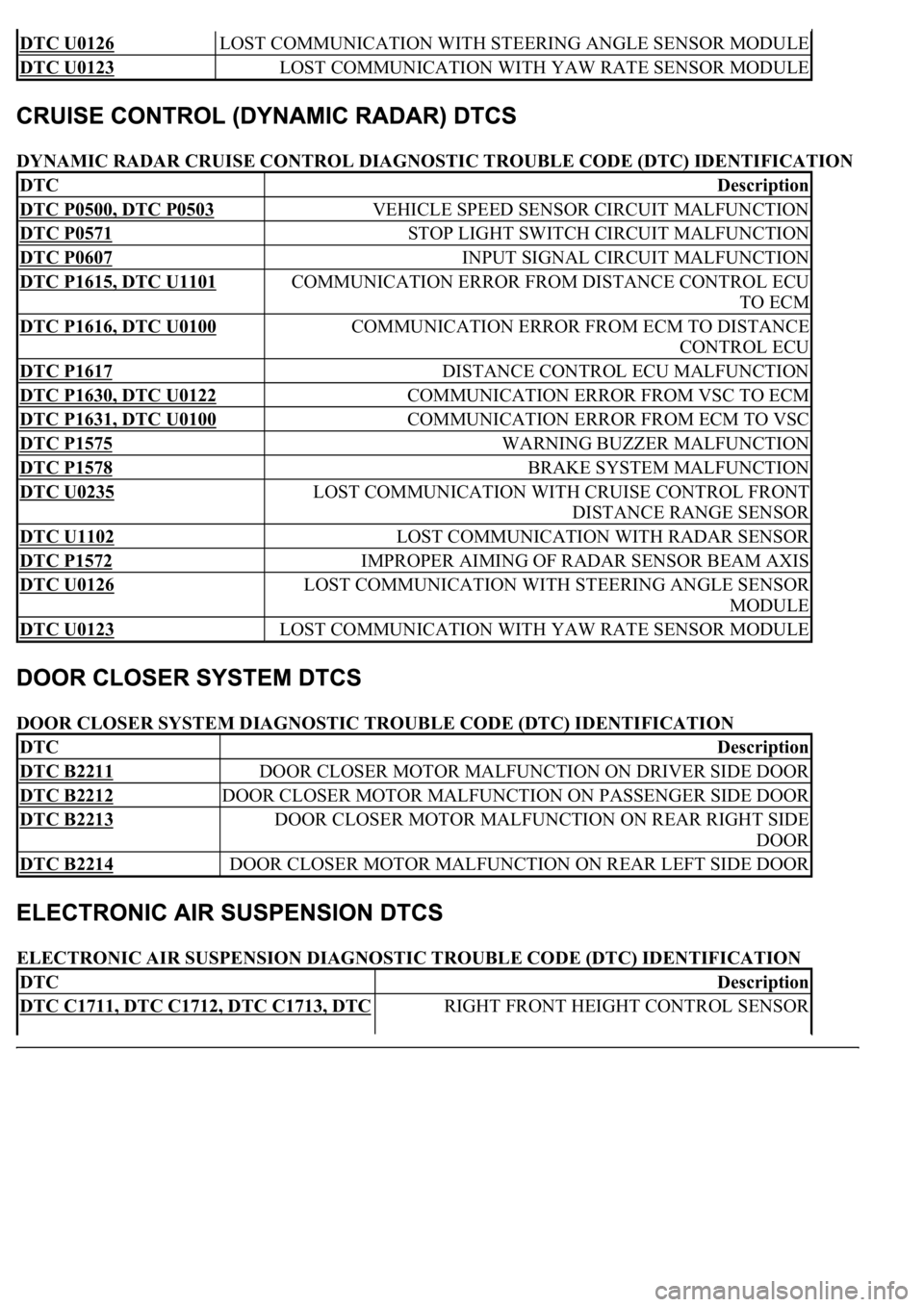
DYNAMIC RADAR CRUISE CONTROL DIAGNOSTIC TROUBLE CODE (DTC) IDENTIFICATION
DOOR CLOSER SYSTEM DIAGNOSTIC TROUBLE CODE (DTC) IDENTIFICATION
ELECTRONIC AIR SUSPENSION DIAGNOSTIC TROUBLE CODE (DTC) IDENTIFICATION
DTC U0126 LOST COMMUNICATION WITH STEERING ANGLE SENSOR MODULE
DTC U0123 LOST COMMUNICATION WITH YAW RATE SENSOR MODULE
DTCDescription
DTC P0500, DTC P0503 VEHICLE SPEED SENSOR CIRCUIT MALFUNCTION
DTC P0571 STOP LIGHT SWITCH CIRCUIT MALFUNCTION
DTC P0607 INPUT SIGNAL CIRCUIT MALFUNCTION
DTC P1615, DTC U1101 COMMUNICATION ERROR FROM DISTANCE CONTROL ECU
TO ECM
DTC P1616, DTC U0100 COMMUNICATION ERROR FROM ECM TO DISTANCE
CONTROL ECU
DTC P1617 DISTANCE CONTROL ECU MALFUNCTION
DTC P1630, DTC U0122 COMMUNICATION ERROR FROM VSC TO ECM
DTC P1631, DTC U0100 COMMUNICATION ERROR FROM ECM TO VSC
DTC P1575 WARNING BUZZER MALFUNCTION
DTC P1578 BRAKE SYSTEM MALFUNCTION
DTC U0235 LOST COMMUNICATION WITH CRUISE CONTROL FRONT
DISTANCE RANGE SENSOR
DTC U1102 LOST COMMUNICATION WITH RADAR SENSOR
DTC P1572 IMPROPER AIMING OF RADAR SENSOR BEAM AXIS
DTC U0126 LOST COMMUNICATION WITH STEERING ANGLE SENSOR
MODULE
DTC U0123 LOST COMMUNICATION WITH YAW RATE SENSOR MODULE
DTCDescription
DTC B2211 DOOR CLOSER MOTOR MALFUNCTION ON DRIVER SIDE DOOR
DTC B2212 DOOR CLOSER MOTOR MALFUNCTION ON PASSENGER SIDE DOOR
DTC B2213 DOOR CLOSER MOTOR MALFUNCTION ON REAR RIGHT SIDE
DOOR
DTC B2214 DOOR CLOSER MOTOR MALFUNCTION ON REAR LEFT SIDE DOOR
DTCDescription
DTC C1711, DTC C1712, DTC C1713, DTC RIGHT FRONT HEIGHT CONTROL SENSOR
Page 2426 of 4500
PRECAUTION
SYSTEM NAME AND PAGE REFERENCE
Keep in mind the following points when inspecting the dynamic laser cruise control system.
As there is a limitation to the vehicle-to-vehicle distance controlling capability, do not overly rely on the
dynamic laser cruise control system.
Do not neglect to pay constant attention to the vehicle-to-vehicle distance and the traffic conditions when
using the dynamic laser cruise control system. Decelerate with the brake pedal, or accelerate with the
accelerator pedal, according to the situation, to keep an appropriate distance with the vehicle in front.
When the vehicle in front decelerates rapidly or another vehicle pulls out in front of the vehicle,
decelerating in time to avoid a collision may not be possible without additional braking.
The dynamic laser cruise control system is designed to assist in maintaining an appropriate distance with
the vehicle in front. However, the system alone is not sufficient. It is imperative that the driver pays
attention at all times.
The laser sensor has functions to automatically detect dirt on the sensor face and inform the driver, but it
is not perfect. Keep the sensor face clean.
The dynamic laser cruise control system does not work, or give vehicle-approaching warning, for vehicles
which are stopped or driving at significantly slower speeds. Always pay attention to those other vehicles.
The laser sensor detection area is narrow at close range, so detection of a vehicle pulling out just in front
may be delayed, or a motorcycle running on the side of the same lane may not be detected. The distance
to the vehicle in front may not be maintained properly due to these reasons.
Even if ACCEL is operated to increase the set vehicle speed, the vehicle does not accelerate because the
speed is controlled in accordance with the speed of the vehicle in front while driving with the vehicle-to-
vehicle distance control mode on (follow-up cruising). However, as the set vehicle speed has been
increased by ACCEL operation, the vehicle keeps accelerating when there is no vehicle in front. Check
the set speed with the set vehicle speed indication on the display.
The controlled vehicle distance may be shorter than the set vehicle distance when cruising on a long
downhill road.
Push the cruise control main switch ON-OFF button off and reset the cruise control if the master warning
light comes on, the CRUISE main indicator light blinks, and the fail indication is shown on the display
with a "pong" sound during dynamic laser cruise control operation.
System NameSee Procedure
Front Power Seat Control SystemINITIALIZATION