brakes LEXUS LS430 2006 Owners Manual
[x] Cancel search | Manufacturer: LEXUS, Model Year: 2006, Model line: LS430, Model: LEXUS LS430 2006Pages: 419, PDF Size: 11.19 MB
Page 105 of 419
89
2-1. Driving procedures
2
When driving
CAUTION
■When driving the vehicle
●Do not drive if you are unfaniliar with the location of the brake and accelerator
pedals to avoid depressing the wrong pedal.
Accidentally depressing the accelerator pedal instead of the brake pedal will
r
esult in sudden acceleration that may lead to an accident that could result in
death or serious injury.
●Do not drive the vehicle over or stop the vehicle near flammable materials.
●Do not let the vehicle roll backwards while the selector lever is in a driving posi -
tion, or roll forward while the selector lever is in R.
Doing so may cause the engine to stall or lea
d to poor brake and steering perfor-
mance, resulting in an accident or damage to the vehicle.
●If you smell exhaust fumes in the vehicle, open the windows and close the trunk lid
to ensure plenty of fresh air enters the vehicle.
If you can smell exhaust fumes even through there are no other vehicle in sur -
rounding area, have your vehicle checke d b
y you Lexus dealer. Continued inhala-
tion of exhaust fumes can lead to death by gas poisoning.
●Do not shift the selector lever to P, R or N while the vehicle is moving under any
circumstances.
Doing so can cause significant damage to the tr
ansmission system and may result
in a loss of vehicle control.
●Do not turn the engine off while driving.
The power steering and brake booster systems will not operate properly if the
eng
ine is not running.
●Use the engine braking (downshift) to maintain a safe speed when driving down a
steep hill.
Using the brakes continuously may cause the brakes to overheat and lose effec -
tiveness. ( P.98 )
●Do not shift the selector lever to N.
Doing so may cause the engine brake to not operate properly and lead to an
acc
ident.
●When stopped on an inclined surface, use the brake pedal and parking brake to
prevent the vehicle from rolling backward or forward and causing an accident.
Page 108 of 419
92
2-1. Driving procedures
CAUTION
■When braking the vehicle
●When the brakes are wet, drive more cautiously.
Braking distance increases when the brakes are wet, and may cause one side of
th
e vehicle to brake differently than the other side. Also the parking brake may
not securely hold the vehicle.
●If the power brake assist function does not operate, do not follow other vehicles
closely and avoid downhill or sharp turns that require making.
Braking is still possible, but it will re quir
e more force on the pedal than usual.
Braking distance may also increase.
●Do not pump the brake pedal if the engine stalls. Each push on the pedal uses up
your reserved brake fluid pressure.
●Even if the power assist is completely lost, the brakes will still work. But you will
have to push the pedal hard, much hard er than normal. And your braking dis-
tance will increase.
●Do not drive your vehicle with only a single brake system. Have your brakes fixed
immediately.
NOTICE
■While driving the vehicle
Do not use the accelerator pedal or depres s acceler
ator and brake pedals together
to hold the vehicle on a hill.
■When parking the vehicle
Always put the selector lever in P. The vehicle may begin to move, or the vehicle
ma
y accelerate suddenly if the accelerat or pedal is accidentally depressed.
Page 147 of 419
131
2-4. Using other driving systems
2
When driving
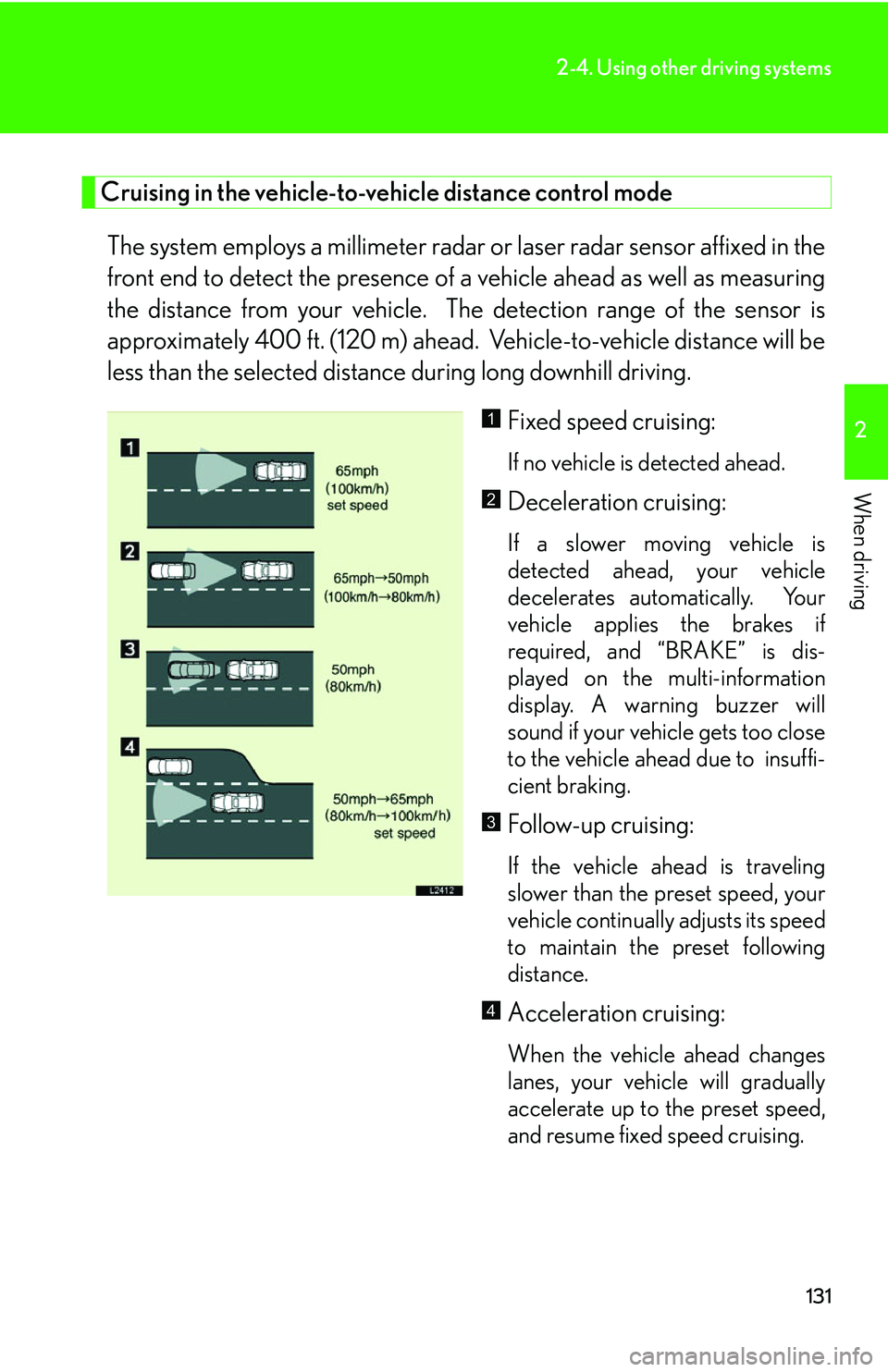
Cruising in the vehicle-to-vehicle distance control mode
The system employs a millimeter radar or laser radar sensor affixed in the
front end to detect the pr esence of a vehicle ahead as well as measuring
the distance from your vehicle. The detection range of the sensor is
approximately 400 ft. (120 m) ahead. Vehicle-to-vehicle distance will be
less than the selected distance during long downhill driving.
Fixed speed cruising:
If no vehicle is detected ahead.
Deceleration cruising:
If a slower moving vehicle is
detected ahead, your vehicle
decelerates automatically. Your
vehicle applies the brakes if
required, and “BRAKE” is dis -
played on the multi-information
displa
y. A warning buzzer will
sound if your vehicle gets too close
to the vehicle ahead due to insuffi -
cient braking.
Follow-up cruising:
If the vehicle ahead is traveling
slower than the preset speed, your
vehicle continually adjusts its speed
to maintain the preset following
distance.
Acceleration cruising:
When the vehicle ahead changes
lanes, your vehicle will gradually
accelerate up to the preset speed,
and resume fixed speed cruising.
1
2
3
4
Page 148 of 419
132
2-4. Using other driving systems
■Setting vehicle speed
Settings can be made when the vehicle
is traveling above 28 mph (45 km/h).
■Unsuitable conditions
You cannot set the speed in the following conditions:
• When the selector lever is in a position other than D, 4, 5, or 6.
• When driving in adverse weather conditions.
■Automatic cruise control cancellation
In the following cases, the preset speed is can ce
lled. If the system is restored, cruise
control enters the ready mode.
• The slip indicator light blinks and a warning tone sounds.
• The anti-lock braking system activates.
• Foreign matter adheres to the sensor.
• The driving pattern selector sw it
ch is set to “SNOW” mode.
• The wipers are operated at high speed (radar), or either high or low speeds (l
aser). This includes high and low speed operation with the wiper lever in the
AUTO position.
• The vehicle’s speed falls below 25 mph (40 km/h). In this case, you must apply th
e brakes manually to slow the vehicle.
If the preset speed automatically cancels out for other than the above reasons, the
sy
stem may have malfunctioned. Do not operate the dynamic radar/laser cruise
control. You may continue driving, howe ver have your vehicle checked by your
Lexus dealer at the earliest opportunity.
Page 152 of 419
136
2-4. Using other driving systems
CAUTION
■Conditions which hinder the laser cruise control’s vehicle detection capability
A delay in detection of a vehicle may occur in the following situations. You must
ap
ply the brakes manually to avoid accidents.
• The vehicle ahead has higher ground clearance, meaning the reflectors are in a higher position
.
• The rear section of the vehicle ahead is extremely dirty.
• Surrounding vehicles are fl in
ging up water or snow.
• Your front view is obscured by excessive exhaust smoke.
• Protective film is attached to the reflectors of the vehicle ahead, or they are d
amaged.
• Reflectors are not installed on the vehicle ahead.
• Heavy luggage in your trunk or on your r
ear seats causes the nose of your vehi-
cle to rise.
• A vehicle cuts in at short range.
• A motorcycle is traveling along the side of the same lane
■To ensure the radar/laser cruise control system functions correctly
●Keep the radar sensor and grille cover/la ser sensor glass clean. When cleaning,
use a soft cloth and be careful not to damage the sensor or grille cover.
●Avoid strong impacts around the sensor, as incorrect sensor alignment will result
in system malfunction. A special device is required to adjust the sensor alignment.
See your Lexus dealer for adjustment.
●Do not disassemble the sensor.
●Do not affix stickers (including transparent stickers), or attach accessories
around the sensor or grille cover/sensor glass.
●Do not modify or paint the grille cover. When replacing the cover, be sure to use
a genuine Lexus cover. *
* Vehicles equipped with the radar cruise control only.
Page 153 of 419
137
2-4. Using other driving systems
2
When driving
CAUTION
■Approach warning
The system warns you to apply the brakes manuall
y to slow down, helping to ensure
that sufficient vehicle-to-vehicle distance is maintained.
Be careful of slow moving or stationary ve hi
cles or objects when traveling at high
speeds, e.g. vehicles at the end of the line in heavy traffic or at tollgates.
■The approach warning may not activate in the following situations
●Your vehicle and the vehicle ahead are cruising at almost the same speed.
●The vehicle ahead is cruising at a faster speed than yours.
●Immediately after setting the speed.
●The accelerator pedal is depressed, or immediately after release of the accelera -
tor pedal.
Page 165 of 419
149
2-5. Driving information
2
When driving
Winter driving tips
Carry out the necessary preparations and inspections before driving the
vehicle in winter. Always drive the vehicle in a manner appropriate for the
prevailing weather and roadway conditions.
■ Pre-winter preparations
●Use fluids appropriate to the p revailing outside temperatures.
• Engine oil
• Engine coolant
• Washer fluid
●Inspect the level and specific gravity of battery electrolyte.
●Have the vehicle fitted with four sno w tires or purchase a set of tire
chains for the rear tires.
Ensure that all tires are the same si
ze and brand, and that chains
match the size of the tires.
■ Befor
e driving the vehicle
Perform the following steps acco r
ding to the driving conditions.
●Do not forcibly try to open a window or move a wiper that has fro-
zen. Pour some warm water over the frozen area to melt the ice.
Wipe away the water immediately to pr
event it from freezing.
●To ensure proper operation of the climate control system fan,
remove any snow that has accumulated on the air inlet vents in front
of the windshield.
●Remove any ice that has accumulated on the vehicle chassis.
●Periodically check for and remove any excess ice or snow that may
accumulate in the wheel well or brakes.
Page 171 of 419
155
2-5. Driving information
2
When driving
CAUTION
■To avoid accident or injury
●The total trailer weight (trailer weight plus the weight of cargo) must not exceed
2000 lb. (907 kg).
●Do not exceed the trailer hitch assembly weight, gross vehicle weight, gross axle
weight and trailer tongue load capacities.
●Never load more weight in the back than in the front of the trailer. About 60% of
the load should be in the front half of the trailer, and the remaining 40% in the
rear.
■Hitches
Trailer hitch assemblies have different weight capacities established by the hitch
ma
nufacturer. Even though the vehicle may be physically capable of towing a
higher weight, the operator must never exceed the maximum weight rating speci -
fied for the trailer hitch.
• If you wish to install a trailer hitch, your Lexus dealer should be consulted.
• Use only a hitch that conforms to the total trailer weight requirement.
• Follow the directions supplied by the hitch manufacturer.
• Lubricate the hitch ball with a light coat of grease.
• Remove the trailer hitch whenever you are not towing a trailer. After r
emoving the hitch, seal any mounting holes in the vehicle body to prevent
entry of any substances into the vehicle.
■When towing a trailer
●If the total trailer weight exceeds 1000 lb . (450 kg), trailer brakes are required.
●Never tap into your vehicle's hydraulic system, as this will lower the vehicle's
braking effectiveness.
●Never tow a trailer without using a safety chain securely attached to both the
trailer and the vehicle. If damage occurs to the coupling unit or hitch ball, there is
danger of the trailer wandering into another lane.
Page 172 of 419
156
2-5. Driving information
Trailer towing tips
Your vehicle will handle differently when towing a trailer. The three main
causes of vehicle-trailer accidents are driver error, excessive speed and
improper trailer loading. Keep these in mind when towing.
• Before starting out, check the tra iler
’s lights and the vehicle-trailer
connections. Recheck after driving a short distance.
• Practice turning, stopping and reversi ng with the tr
ailer attached in an
area away from traffic until you be come accustomed to the feel of the
vehicle.
• Reversing with a trailer attached is dif
ficult and requires practice. Grip
the bottom of the steering wheel and move your hand to the left to
move the trailer to the left. Move yo ur hand to the right to move the
trailer to the right. (This is gene rally opposite to reversing without a
trailer attached.) Avoid sharp or prolonged turning. Have someone
guide you when reversing to redu ce the risk of an accident.
NOTICE
■When installing a trailer hitch
●Use only the position recommended by your Lexus dealer. Do not install the
trailer hitch on the bumper; this may cause body damage.
●Do not use axle-mounted hitches as they can cause damage to the axle housing,
wheel bearings, wheels or tires.
■Brakes
Lexus recommends trailers with brakes that conform to any applicable federal and
sta
te/provincial requlations.
■Do not directly splice trailer lights
Direct splicing may damage your vehicle’s electrical system and cause a malfunc -
tion.
Page 173 of 419
157
2-5. Driving information
2
When driving
• As stopping distance is increased when towing a trailer, vehicle-to-
vehicle distance should be increas ed. For each 10 mph (16 km/h) of
speed, allow at least one vehicle and trailer length.
• Avoid sudden braking as you may sk id, r
esulting in jackknifing and loss
of control. This is especially true on wet or slippery surfaces.
• Avoid jerky starts or sudden acceleration.
• Avoid jerky steering and sharp turn s, and slo
w down before making a
turn.
• Note that when making a turn, the tr ailer wheels will be closer than the
v
ehicle wheels to the inside of th e turn. Compensate by making a
larger than normal turning radius.
• Crosswinds and rough roads will ad v
ersely affect handling of your
vehicle and trailer, causing sway. Peri odically check the rear to prepare
for being passed by large trucks or buses, which may cause your vehi-
cle and trailer to sway. If s
waying occurs, firmly grip the steering wheel,
reduce speed immediately but gradually, and steer straight ahead.
Never increase speed. If you make no extreme correction with the
steering or brakes, your vehi cle and trailer will stabilize.
• Take care when passing other vehicl es. P
assing requires considerable
distance. After passing a vehicle, do not forget the length of your
trailer, and be sure you have plenty of room before changing lanes.
• In order to maintain efficient engine br
aking and electrical charging
performance, do not use overdrive. Transmission shift range position
must be in “4”, in the “S” mode.
• Due to the added load of the traile r
, your vehicle’s engine may overheat
on hot days (at temperatures over 85°F [30°C]) when driving up a
long or steep grade. If the engine coolant temperature gauge indicates
overheating, immediately turn off the air conditioning (if in use), pull
your vehicle off the road and stop in a safe spot. See “If your vehicle
overheats” ( P.359 ).