ESP LEXUS LS600H 2015 Workshop Manual
[x] Cancel search | Manufacturer: LEXUS, Model Year: 2015, Model line: LS600H, Model: LEXUS LS600H 2015Pages: 620, PDF Size: 7.66 MB
Page 427 of 620
425
6
Maintenance and care
LS600hL_U(OM50E41U)
6-2. Maintenance
General maintenance should be performed on a daily basis. This can be
done by yourself or by a Lexus dealer.
Scheduled maintenance should be performed at specified intervals
according to the maintenance schedule.
For details about maintenance items and schedules, refer to the “Warranty and
Service Guide”, “Owner’s Manual Suppl ement” or “Scheduled Maintenance”.
You can perform some maintenance procedures by yourself.
Please be aware that do-it-yourself maintenance may affect warranty cov-
erage.
The use of Lexus repair manuals is recommended.
For details about warranty coverage, refer to the separate “Owner’s Guide”,
“Warranty and Service Guide”, “Owner’s Manual Supplement” or “Warranty
Booklet”.
Maintenance requirements
To ensure safe and economical driving, day-to-day care and regular
maintenance are essential. It is the owner’s responsibility to perform
regular checks. Lexus recommends the following maintenance:
General maintenance
Scheduled maintenance
Do-it-yourself maintenance
Page 463 of 620

4616-3. Do-it-yourself maintenance
6
Maintenance and care
LS600hL_U(OM50E41U)
■Tire pressure warning system certification
For vehicles sold in the U.S.A.
FCC ID: PAXPMVC010
FCC ID: HYQ13BDS
FCC ID: HYQ22AAA
NOTE:
This device complies with part 15 of the FCC Rules. Operation is subject to the fol-
lowing two conditions: (1) This device may not cause harmful interference, and (2)
this device must accept any interference received, including interference that may
cause undesired operation.
FCC WARNING:
Changes or modifications not expressly ap proved by the party responsible for com-
pliance could void the user’s authority to operate the equipment.
For vehicles sold in Canada
Tr a n s m i t t e r :
NOTE:
Operation is subject to the following two conditions: (1) this device may not cause
interference, and (2) this device must acc ept any interference, including interfer-
ence that may cause undesired operation of the device.
Initiator:
NOTE:
This device complies with Industry Cana da licence-exempt RSS standard(s). Oper-
ation is subject to the following two conditio ns: (1) this device may not cause interfer-
ence, and (2) this device must accept any interference, including interference that
may cause undesired operation of the device.
Page 503 of 620

5017-2. Steps to take in an emergency
7
When trouble arises
LS600hL_U(OM50E41U)
CAUTION
■Maintenance of the tires
Each tire, including the spare (if provided), should be checked monthly when cold
and inflated to the inflation pressure re commended by the vehicle manufacturer on
the vehicle placard or tire inflation pressu re label (tire and load information label).
(If your vehicle has tires of a different size than the size indicated on the vehicle
placard or tire inflation pressure label [t ire and load information label], you should
determine the proper tire inflation pressure for those tires.)
As an added safety feature, your vehicle has been equipped with a tire pressure
monitoring system (TPMS-tire pressure wa rning system) that illuminates a low tire
pressure telltale (tire pressure warning light ) when one or more of your tires is sig-
nificantly under-inflated. Accordingly, when the low tire pressure telltale (tire pres-
sure warning light) illuminates, you should stop and check your tires as soon as
possible, and inflate them to the proper pressure. Driving on a significantly under-
inflated tire causes the tire to overheat and can lead to tire failure. Under-inflation
also reduces fuel efficiency and tire trea d life, and may affect the vehicle's handling
and stopping ability.
Please note that the TPMS (tire pressure warning system) is not a substitute for
proper tire maintenance, and it is the driv er's responsibility to maintain correct tire
pressure, even if under-inflation has not re ached the level to trigger illumination of
the TPMS low tire pressure telltale (tire pressure warning light).
Your vehicle has also been equipped with a TPMS (tire pressure warning system)
malfunction indicator to indicate when th e system is not operating properly. The
TPMS (tire pressure warning system) malfunction indicator is combined with the
low tire pressure telltale (tire pressure warning light). When the system detects a
malfunction, the telltale will flash for approximately one minute and then remain
continuously illuminated. This sequence will continue upon subsequent vehicle
start-ups as long as the malfunction exists . When the malfunction indicator is illumi-
nated, the system may not be able to detect or signal low tire pressure as intended.
Page 536 of 620
5347-2. Steps to take in an emergency
LS600hL_U(OM50E41U)
CAUTION
■When inspecting under the hood of your vehicle
Observe the following precautions.
Failure to do so may result in serious injury such as burns.
●If steam is seen coming from under the hood, do not open the hood until the
steam has subsided. The engine compartment may be very hot.
●After the hybrid system has been turned off, check that the indicator on the
power switch and the “READY” indicator are off.
When the hybrid system is operating, the gasoline engine may automatically
start, or the cooling fan may suddenly oper ate even if the gasoline engine stops.
Do not touch or approach rotating parts such as the fan, which may lead to fin-
gers or clothing (especially a tie, a scarf or a muffler) getting caught, resulting in
serious injury.
NOTICE
■When adding engine/power control unit coolant
Add coolant slowly after the hybrid syst em has cooled down sufficiently. Adding
cool coolant to a hot hybrid system too quickly can cause da mage to the hybrid
system.
■To prevent damage to the cooling system
Observe the following precautions:
●Avoid contaminating the coolant with foreign matter (such as sand or dust etc.).
●Do not use any coolant additive.
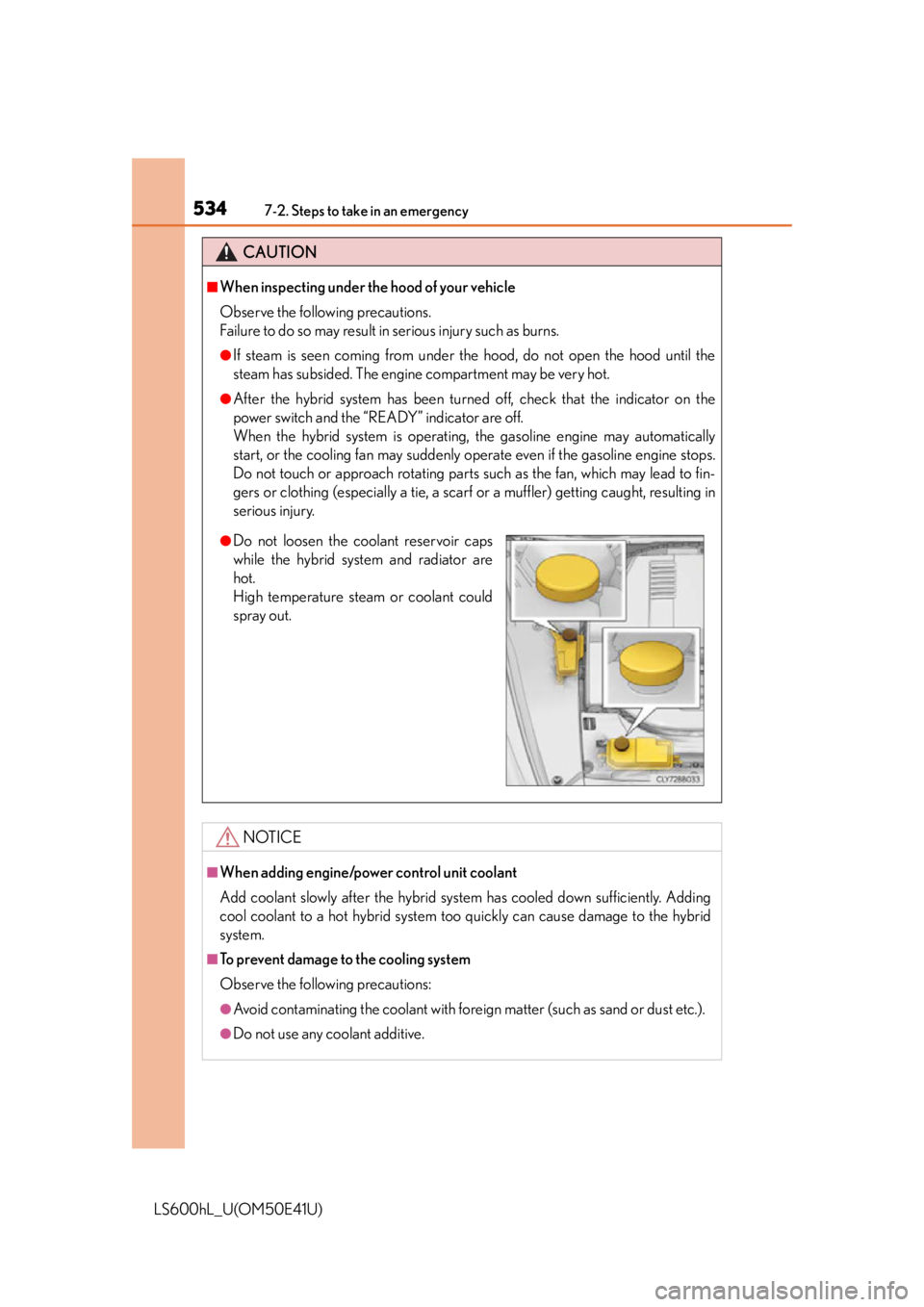
●Do not loosen the coolant reservoir caps
while the hybrid system and radiator are
hot.
High temperature steam or coolant could
spray out.
Page 560 of 620

5588-1. Specifications
LS600hL_U(OM50E41U)
■Temperature A, B, C
The temperature grades are A (the highest), B, and C, representing the
tire’s resistance to the generation of heat and its ability to dissipate heat
when tested under controlled conditio ns on a specified indoor labora-
tory test wheel.
Sustained high temperature can cause th e material of the tire to degenerate
and reduce tire life, and excessive temperature can lead to sudden tire failure.
Grade C corresponds to a level of performance which all passenger car tires
must meet under the Federal Motor Vehicle Safety Standard No. 109.
Grades B and A represent higher levels of performance on the laboratory test
wheel than the minimum required by law.
Warning: The temperature grades of a tire assume that it is properly inflated
and not overloaded.
Excessive speed, underinflation, or excessive loading, either separately or in
combination, can cause heat buildup and possible tire failure.
Page 563 of 620
5618-1. Specifications
8
Vehicle specifications
LS600hL_U(OM50E41U)
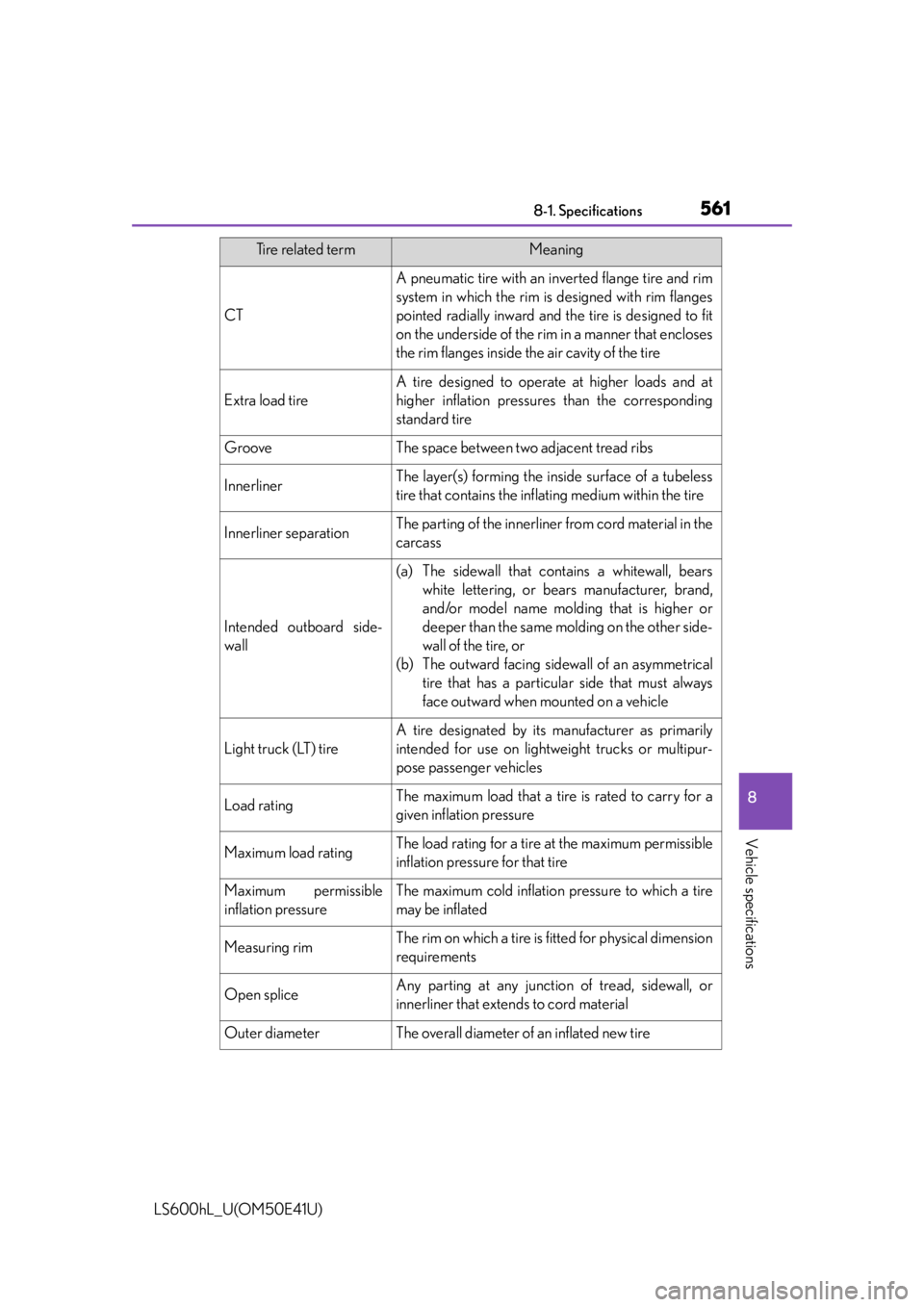
CT
A pneumatic tire with an inverted flange tire and rim
system in which the rim is designed with rim flanges
pointed radially inward and the tire is designed to fit
on the underside of the rim in a manner that encloses
the rim flanges inside the air cavity of the tire
Extra load tire
A tire designed to operate at higher loads and at
higher inflation pressures than the corresponding
standard tire
GrooveThe space between two adjacent tread ribs
InnerlinerThe layer(s) forming the inside surface of a tubeless
tire that contains the inflating medium within the tire
Innerliner separationThe parting of the innerliner from cord material in the
carcass
Intended outboard side-
wall
(a) The sidewall that contains a whitewall, bears
white lettering, or bears manufacturer, brand,
and/or model name molding that is higher or
deeper than the same molding on the other side-
wall of the tire, or
(b) The outward facing sidewall of an asymmetrical tire that has a particular side that must always
face outward when mounted on a vehicle
Light truck (LT) tire
A tire designated by its manufacturer as primarily
intended for use on lightw eight trucks or multipur-
pose passenger vehicles
Load ratingThe maximum load that a tire is rated to carry for a
given inflation pressure
Maximum load ratingThe load rating for a tire at the maximum permissible
inflation pressure for that tire
Maximum permissible
inflation pressureThe maximum cold inflation pressure to which a tire
may be inflated
Measuring rimThe rim on which a tire is fitted for physical dimension
requirements
Open spliceAny parting at any junction of tread, sidewall, or
innerliner that extends to cord material
Outer diameterThe overall diameter of an inflated new tire
Tire related termMeaning
Page 564 of 620
5628-1. Specifications
LS600hL_U(OM50E41U)
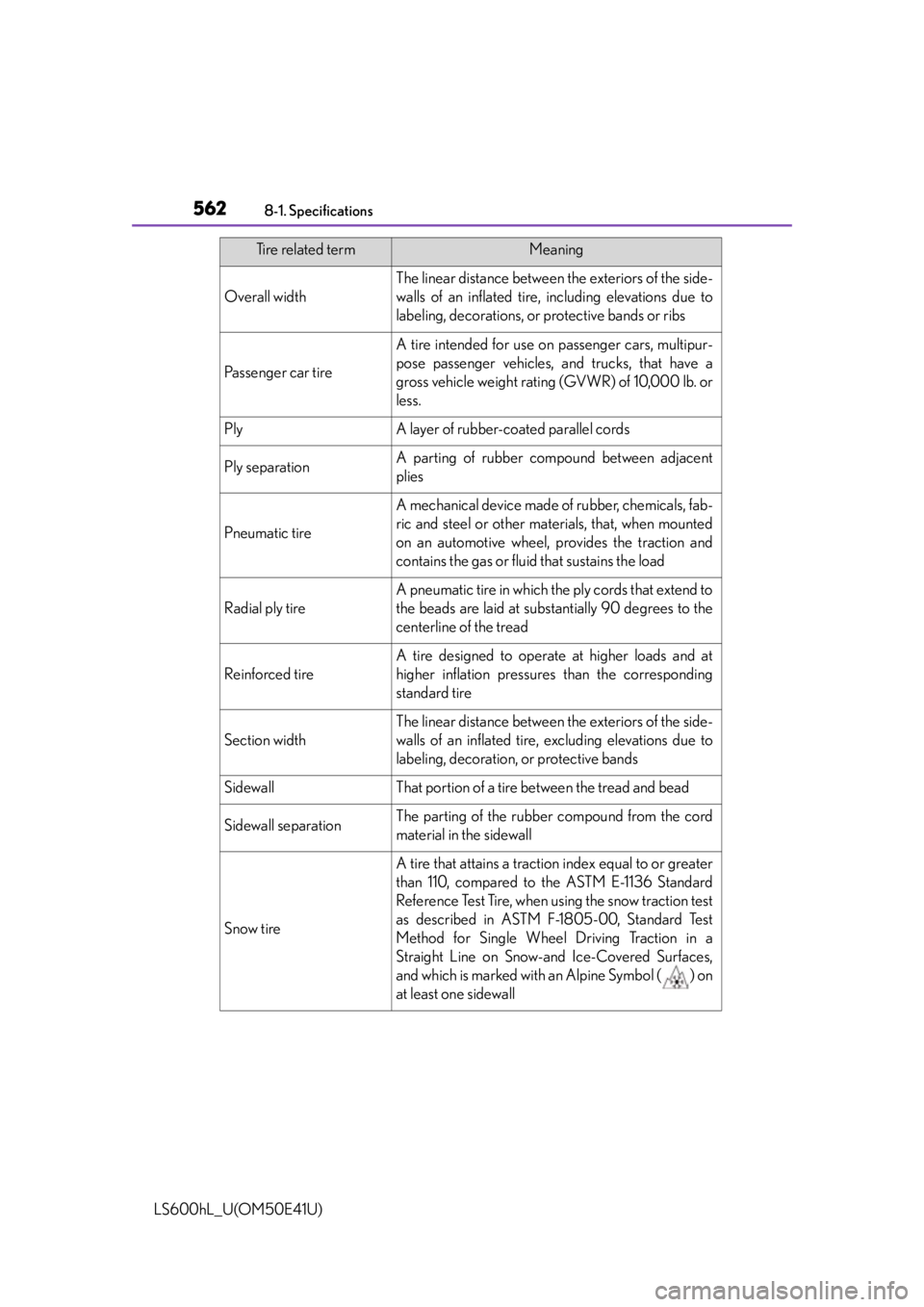
Overall width
The linear distance between the exteriors of the side-
walls of an inflated tire, including elevations due to
labeling, decorations, or protective bands or ribs
Passenger car tire
A tire intended for use on passenger cars, multipur-
pose passenger vehicles, and trucks, that have a
gross vehicle weight rating (GVWR) of 10,000 lb. or
less.
PlyA layer of rubber-coated parallel cords
Ply separationA parting of rubber compound between adjacent
plies
Pneumatic tire
A mechanical device made of rubber, chemicals, fab-
ric and steel or other mate rials, that, when mounted
on an automotive wheel, provides the traction and
contains the gas or flui d that sustains the load
Radial ply tire
A pneumatic tire in which the ply cords that extend to
the beads are laid at substantially 90 degrees to the
centerline of the tread
Reinforced tire
A tire designed to operate at higher loads and at
higher inflation pressures than the corresponding
standard tire
Section width
The linear distance between the exteriors of the side-
walls of an inflated tire, excluding elevations due to
labeling, decoration, or protective bands
SidewallThat portion of a tire between the tread and bead
Sidewall separationThe parting of the rubber compound from the cord
material in the sidewall
Snow tire
A tire that attains a traction index equal to or greater
than 110, compared to the ASTM E-1136 Standard
Reference Test Tire, when using the snow traction test
as described in ASTM F-1805-00, Standard Test
Method for Single Wheel Driving Traction in a
Straight Line on Snow-and Ice-Covered Surfaces,
and which is marked with an Alpine Symbol ( ) on
at least one sidewall
Tire related termMeaning
Page 585 of 620

583
9
For owners
LS600hL_U(OM50E41U)
ATTENTION
■Précautions avec les coussins gonflables SRS
Respectez les précautions suivantes avec les coussins gonflables SRS.
Autrement, des blessures graves, voire mortelles, pourraient s’ensuivre.
●Le conducteur et tous les passagers à bord du véhicule doivent porter leur cein-
ture de sécurité correctement.
Les coussins gonflables SRS sont des di spositifs supplémentaires à utiliser avec
les ceintures de sécurité.
●Le coussin gonflable conducteur SRS se déploie avec une violence considérable,
qui peut être très dangereuse, voire mortelle, si le conducteur se trouve très près
du coussin gonflable. La National Highway Traffic Safety Administration
(NHTSA) recommande:
Sachant que la zone de danger pour le coussin gonflable conducteur se trouve
dans les premiers 2 à 3 in. (50 - 75 mm) de déploiement, vous placer à 10 in.
(250 mm) de votre coussin gonflable co nducteur vous garantit une marge de
sécurité suffisante. Cette di stance est à mesurer entre l’axe du volant et le ster-
num. Si vous êtes assis à moins de 10 in. (250 mm), vous pouvez changer votre
position de conduite de plusieurs façons:
• Reculez votre siège le plus possible, de manière à pouvoir encore atteindre confortablement les pédales.
• Inclinez légèrement le dossier du siège. Bien que les véhicules puissent être différents les uns des autres, la plupart des
conducteurs peuvent s’asse oir à une distance de 10 in. (250 mm), même avec
le siège conducteur complètement avancé, simplement en inclinant un peu le
dossier de siège. Si vous avez des difficultés à voir la route après avoir incliné
votre siège, utilisez un coussin ferme et antidérapant pour vous rehausser ou,
si votre véhicule est équipé du réglage en hauteur du siège, remontez-le.
• Si votre volant est réglable, inclinez-le vers le bas. Cela a pour effet d’orienter le coussin gonflable en direction de votr e poitrine plutôt que de votre tête et
de votre cou.
Réglez votre siège selon ces recommandations de la NHTSA, tout en conser-
vant le contrôle des pédales, du volant et la vue des commandes du tableau de
bord.
Page 588 of 620

586
LS600hL_U(OM50E41U)
ATTENTION
■Précautions avec les coussins gonflables SRS
●Ne suspendez aucun cintre ni objet dur aux crochets à vêtements. En cas de
déploiement des coussins gonflables rideaux SRS, tous ces objets pourraient se
transformer en projectiles et causer des blessures graves, voire mortelles.
●Si un cache en vinyle recouvre la partie où le coussin gonflable de genoux SRS se
déploie, veillez à l’enlever.
●N’utilisez aucun accessoire de siège qui couvrirait les zones de déploiement des
coussins gonflables latéraux SRS et du coussin gonflable d’assise, car il risquerait
de gêner le déploiement. De tels accessoires peuvent empêcher les coussins
gonflables latéraux et le coussin gonflabl e d’assise de fonctionner correctement,
désactiver le dispositif ou entraîner le déploiement accidentel des coussins gon-
flables latéraux et du coussin gonflable d’assise, entraînant la mort ou des
blessures graves.
●Évitez de faire subir des chocs ou des pressions excessives aux zones renfermant
les composants des coussins gonflables SRS. En effet, cela pourrait entraîner un
fonctionnement anormal des coussins gonflables SRS.
●Ne touchez aucun composant du système immédiatement après le déploiement
(gonflage) des coussins gonflables SRS, car ils peuvent être chauds.
●Si vous avez des difficultés à respirer après le déploiement des coussins gon-
flables SRS, ouvrez une porte ou une vitre pour faire entrer de l’air frais, ou bien
descendez du véhicule si cela ne présente pas de danger. Essuyez tout résidu
dès que possible afin d’éviter d’éventuelles irritations de la peau.
●Si les parties renfermant le s coussins gonflables SRS, telles que la garniture du
moyeu de volant et les garnitures de montants avant et arrière, apparaissent
abîmées ou craquelées, faites-les remplacer par votre concessionnaire Lexus.
●Ne placez rien sur le siège du passager avant, comme un coussin par exemple.
Cela a pour conséque nce de répartir le poids du passager sur toute la surface du
siège, ce qui empêche le capteur de détecter correctement le poids du passager.
En conséquence, le coussin gonflable pa ssager avant SRS risque de ne pas se
déployer en cas de choc.