steering LINCOLN CONTINENTAL 1996 Customer Assistance Guide
[x] Cancel search | Manufacturer: LINCOLN, Model Year: 1996, Model line: CONTINENTAL, Model: LINCOLN CONTINENTAL 1996Pages: 320, PDF Size: 1.8 MB
Page 145 of 320
At zero pressure, the Securitires will provide you
with a minimum driving capability of approximately
20 miles (30 kms). How you drive and the actual
amount of air pressure left in your tires will
determine exactly how many miles can be driven.
To extend the mileage and help prevent damage to
low or deflated tires, you should: not exceed 55 mph (90 km/h) and drive at a
reduced rate of speed, if possible avoid excessive hard steering and braking
maneuvers, if possible stop periodically to allow the tires to cool down/! WARNINGIf your vehicle is driven with a low tire, thetire itself may become very hot. Allow thetire and wheel to cool before attempting tochange it.142Pressure Alert System
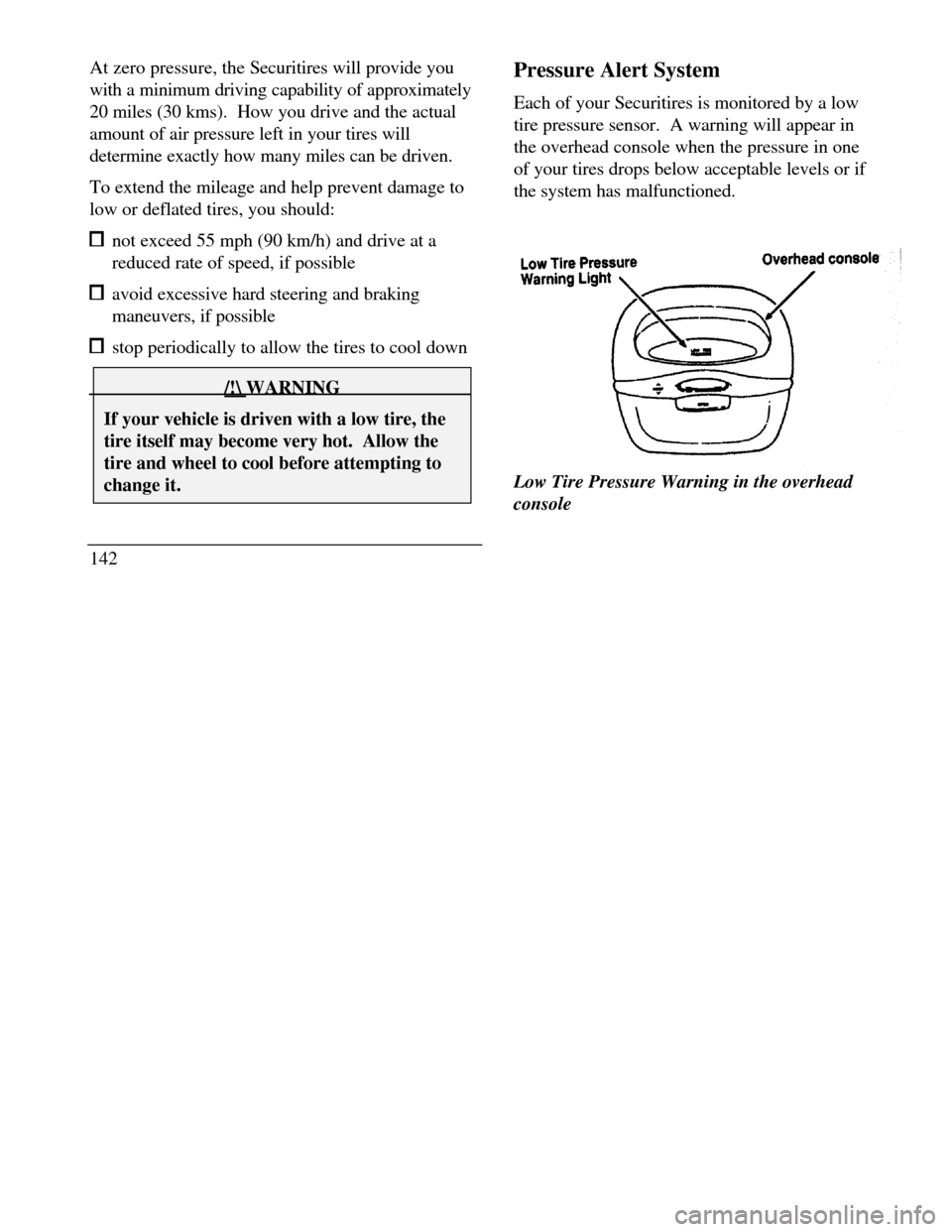
Each of your Securitires is monitored by a low
tire pressure sensor. A warning will appear in
the overhead console when the pressure in one
of your tires drops below acceptable levels or if
the system has malfunctioned.
Low Tire Pressure Warning Light Overhead
consoleLow Tire Pressure Warning in the overhead
console
Page 187 of 320

/!\ WARNINGAlways set the parking brake fully and makesure that the gearshift is securely latched in P(Park). Never leave your vehicle unattendedwhile it is running.You can tell a column-mounted gearshift is securely
latched in P (Park) if the lever is adjacent to the P
(Park) and you cannot move it without pulling it
toward you and rotating it downward.
You can tell a console-mounted gearshift is securely
latched in P (Park) if the lever is adjacent to the P
(Park) and you cannot move it without pushing in the
thumb button.
The gearshift will lock when you turn the key to the
LOCK position. When the gearshift is in any
position except P (Park), the ignition key cannot be
turned to the LOCK position or removed from the
steering column. To remove the key, the gearshift
lever must be in P (Park).
184Traction ControlÔ Ô (If equipped)
Your vehicle may be equipped with the
optional Traction ControlÔ, system. This
system helps prevent wheel spin in order to
improve tire traction and is an especially useful
feature when you drive in hilly areas or on
slippery, icy or snowy roads.
When the Traction Control system is
controlling wheelspin, an electric motor sound
may be heard from the engine compartment and
engine acceleration may seem slower. This is
normal.
Traction ControlÔ works automatically by
rapidly applying and releasing the brakes and
reducing engine torque to prevent one or both
of the front drive wheels from spinning during
acceleration.
During the Traction ControlÔ function, which
most often occurs during low speed
acceleration on slippery surfaces, a noise may
be heard coming from the engine compartment.
This is normal and may last for a few seconds
during the acceleration of the vehicle.
Page 188 of 320

In general, this system improves your vehicle's
stability and acceleration performance when road
conditions warrant. Traction ControlÔ is fully
effective at all vehicle speeds.
If the Traction ControlÔ system is cycled
excessively, the brake portion of the system will shut
down to prevent the front brakes from overheating.
A limited Traction ControlÔ function using engine
torque will still control wheels from spinning. A
cooling down period is required to prevent damage
to the brakes. This time period varies and depends
on brake usage during the cooling down period.
Anti-Lock braking is not affected and will function
normally during the cool down period.
After the cool down period, the full Traction
ControlÔ' function is restored.Steering Your Vehicle
Your vehicle comes with power steering.
Power steering uses energy from the engine to
help steer your vehicle.
If the amount of effort needed to steer your
vehicle changes, check your steering effort
selection in the Message Center. If this is not
the problem, have the power steering system
checked. If the power steering system breaks
down (or if the engine is turned off), you can
steer the vehicle manually but it takes more
effort.
The steering system in your vehicle is speed
sensitive. This means that the steering effort is
light for parking and heavier for highway
driving. However, if you have to swerve
around an object or another vehicle, your
steering will have full power assist.
185
Page 189 of 320
Never hold the steering wheel to the extreme right or
left for more than five seconds if the engine is running.
This can damage the power steering pump.
Air Suspension Adaptive Ride
Control System
Your vehicle has an air suspension system with
automatic load leveling and automatic ride control.
This system keeps your vehicle at a constant level by
adding air or releasing air from the springs. Ride and
handling is enhanced by firming shock absorber
performance during certain road conditions, steering
maneuvers, braking, and accelerations and is
returned to the driver selected ride calibration when
driver or road surface induced motion changes are
completed.
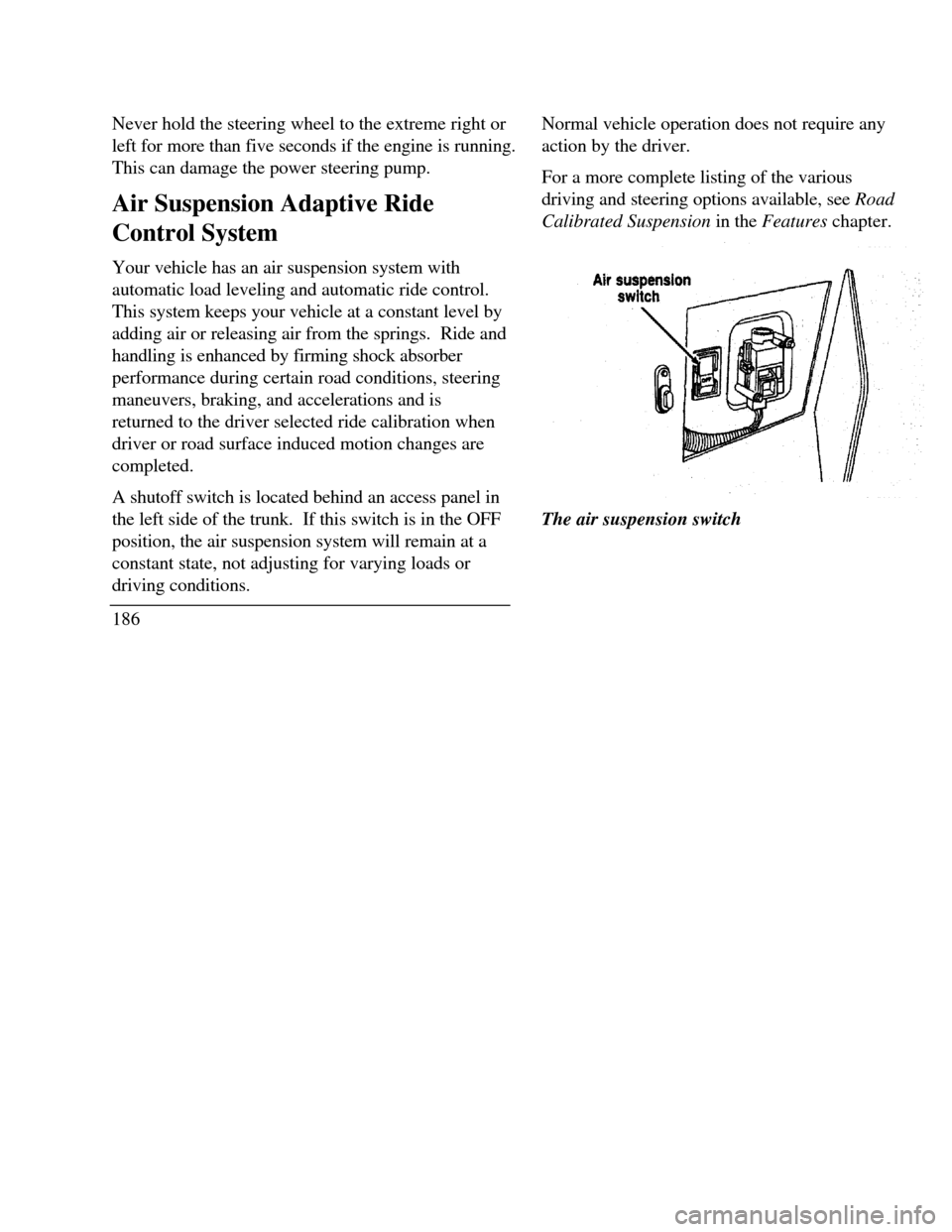
A shutoff switch is located behind an access panel in
the left side of the trunk. If this switch is in the OFF
position, the air suspension system will remain at a
constant state, not adjusting for varying loads or
driving conditions.
186Normal vehicle operation does not require any
action by the driver.
For a more complete listing of the various
driving and steering options available, see Road
Calibrated Suspension in the Features chapter.Air suspension switchThe air suspension switch
Page 194 of 320
Driving in Bad Weather
Slippery roads
On some slippery road surfaces, front-wheel drive
may provide better acceleration than rear-wheel
drive. However, this does not mean that your
vehicle can stop any faster or any better than a
vehicle with rear-wheel drive. Exercise the same
caution while driving on slippery roads with your
front-wheel drive vehicle as you would with a rear-
wheel drive vehicle. Do not quickly move the steering wheel unless
necessary. Drive slower than you normally would. Give your vehicle more distance to stop./!\ WARNINGTo avoid skidding and losing control onslippery roads, do not downshift into First(1) when you are moving faster than 20mph (32 km/h)./!\ WARNINGIf your vehicle has speed control, do notuse it on slippery roads. You could losecontrol of your vehicle and could injuresomeone.If your vehicle gets stuck (for example, in mud
or snow), you may try to "rock" it out of the
spot. Shift, in a steady rhythm, between
forward and reverse gears. While in each gear,
press lightly on the accelerator and release.
191
Page 207 of 320

Changing a Tire
if you get a flat tire while you are driving, do not
apply the brake heavily. Instead, gradually decrease
the speed. Hold the steering wheel firmly and
slowly move to a safe place on the side of the road.
Park on a level spot, turn off the ignition, set the
parking brake, and turn on the hazard flashers.
The Temporary Spare Tire
You may have a high pressure temporary spare tire.
This spare tire is smaller than a regular tire and is
designed for emergency use only. Use it only when
you get a flat tire and replace it as soon as you can.
This spare tire is marked with the words
"TEMPORARY USE ONLY" so that you can easily
identify it.
204/! WARNINGIf you use the temporary spare tirecontinuously or do not follow theseprecautions, the tire could fail, causing you tolose control of the vehicle, possibly injuringyourself or others.When you drive with the temporary spare tire,
DO NOT: exceed 50 mph (80 km/h) under any
circumstances. load your vehicle so that it is heavier than the
maximum vehicle load rating listed on the tire
decal. tow a trailer. try to repair the temporary spare tire or remove it
from its wheel. use the wheel for any other type of vehicle.
Page 239 of 320
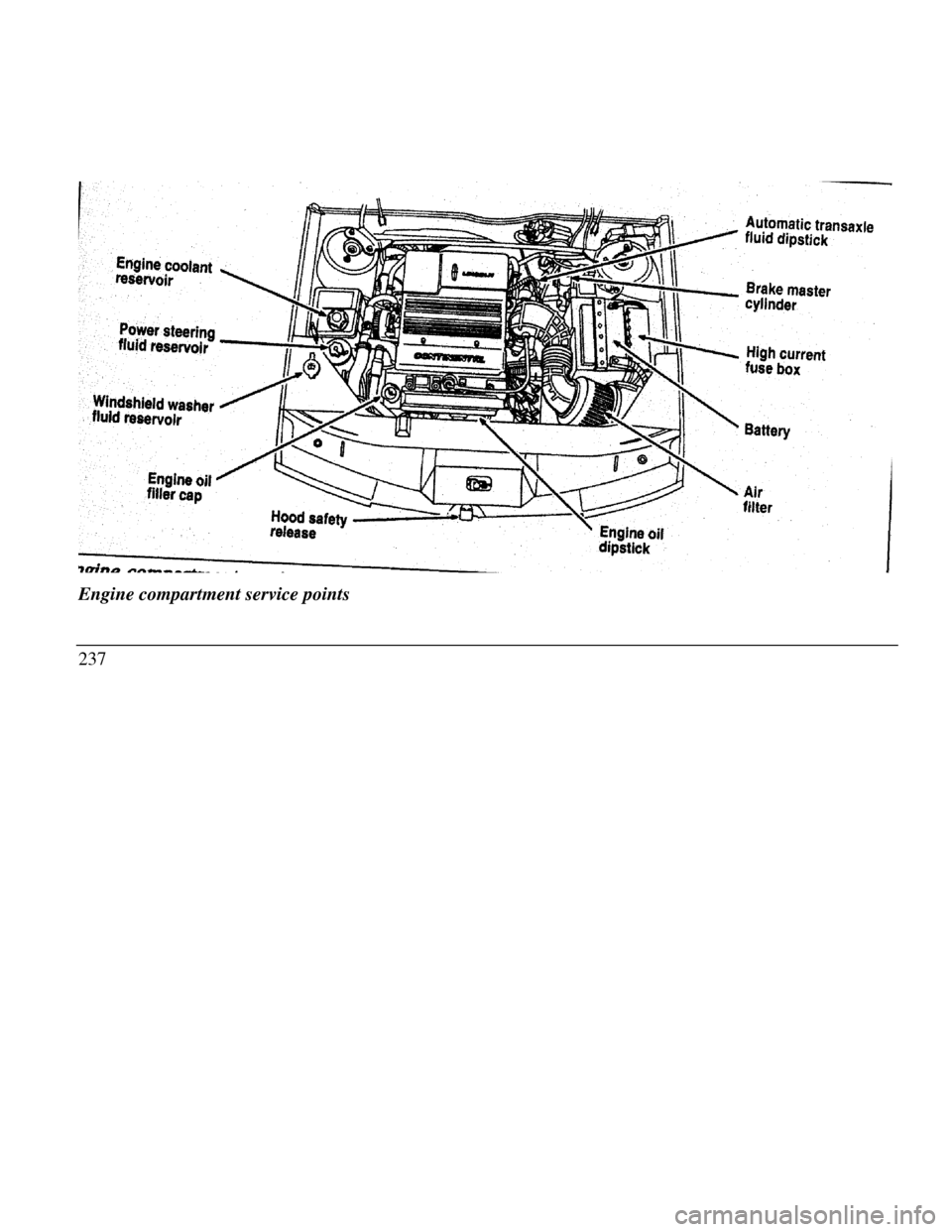
Engine coolant reservoir Power steering fluid reservoir Windshield washer fluid reservoir Engine oil filler cap Hood safety release High current fuse box Engine oil
dipstick Air filterEngine compartment service points
237
Page 266 of 320
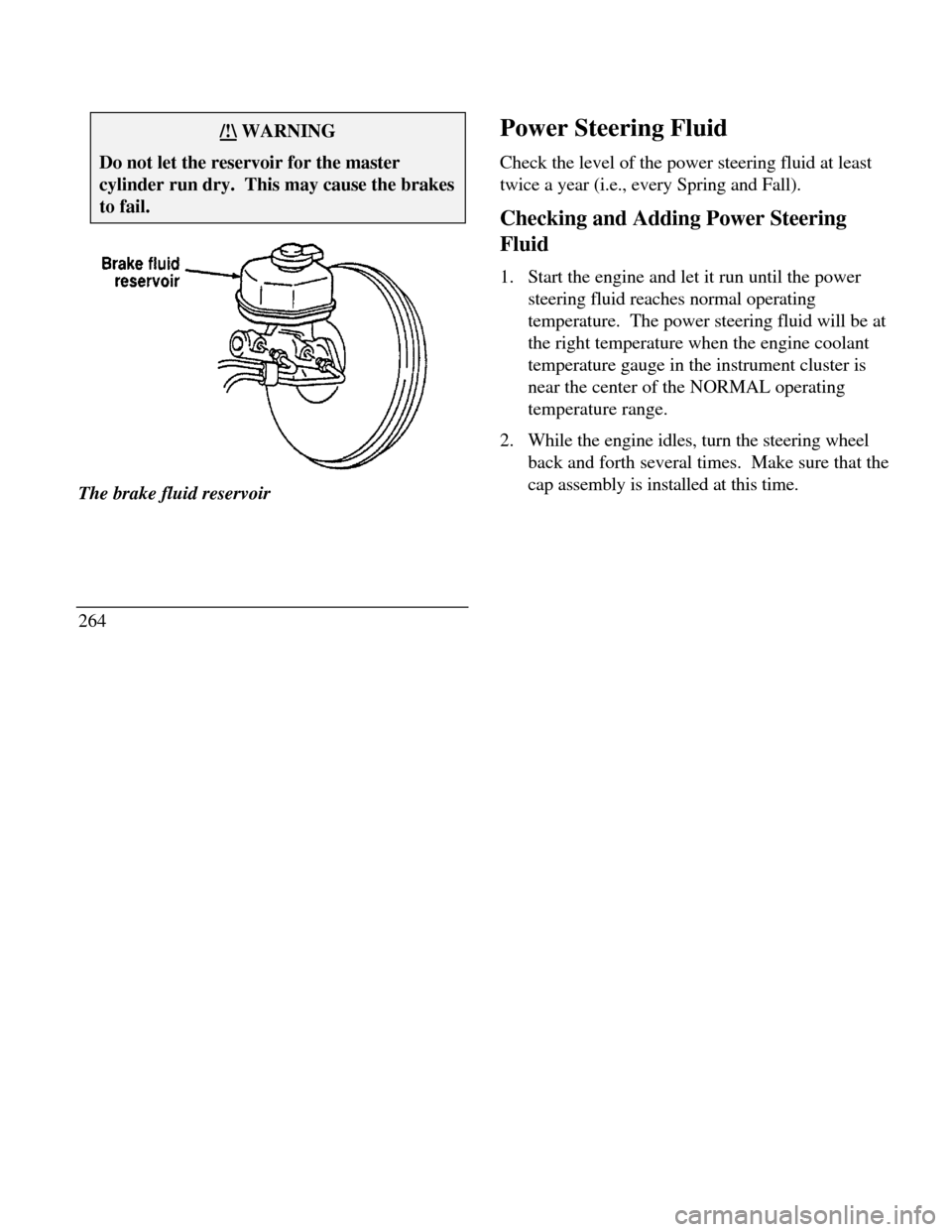
/!\ WARNINGDo not let the reservoir for the mastercylinder run dry. This may cause the brakesto fail.The brake fluid reservoir
264Power Steering Fluid
Check the level of the power steering fluid at least
twice a year (i.e., every Spring and Fall).
Checking and Adding Power Steering
Fluid
1. Start the engine and let it run until the power
steering fluid reaches normal operating
temperature. The power steering fluid will be at
the right temperature when the engine coolant
temperature gauge in the instrument cluster is
near the center of the NORMAL operating
temperature range.
2. While the engine idles, turn the steering wheel
back and forth several times. Make sure that the
cap assembly is installed at this time.
Page 267 of 320
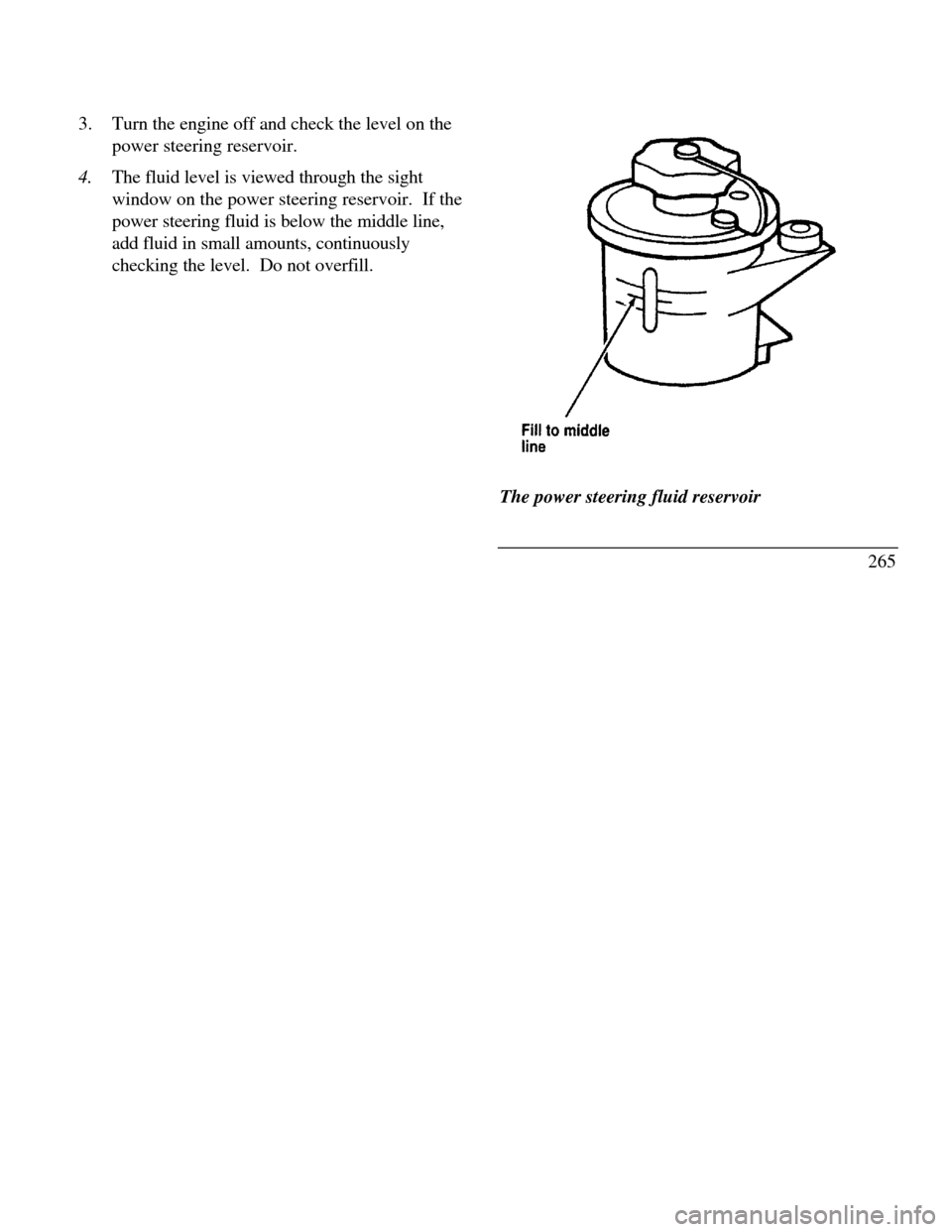
3.Turn the engine off and check the level on the
power steering reservoir.
4.The fluid level is viewed through the sight
window on the power steering reservoir. If the
power steering fluid is below the middle line,
add fluid in small amounts, continuously
checking the level. Do not overfill.The power steering fluid reservoir
265
Page 268 of 320

Use only MERCONÒ ATF power steering fluid.
If the power steering fluid is low, do not drive your
vehicle for a long period of time before adding fluid.
This can damage the power steering pump.
Fuses
Fuses (conventional and high current) protect your
vehicle's electrical system from overloading. If
electrical parts in your vehicle are not working, the
system may have been overloaded and blown a fuse.
Before you replace or repair any electrical parts,
check the appropriate fuses (conventional and high
current).
266The following charts tell you which fuses protect
each electrical part of your vehicle. If a fuse blows,
all the parts of your vehicle that use that circuit will
not work.
Once you have determined which fuses to check,
follow the procedures under Checking and replacing
fuses in this chapter.