trailer LINCOLN MKS 2016 Owner's Manual
[x] Cancel search | Manufacturer: LINCOLN, Model Year: 2016, Model line: MKS, Model: LINCOLN MKS 2016Pages: 382, PDF Size: 3.81 MB
Page 210 of 382
Recreational Towing
Note:
Put your climate control system in
recirculated air mode to prevent exhaust
fumes from entering the vehicle. See Climate
Control (page 105).
Follow these guidelines if you have a need
for recreational (RV) towing. An example of
recreational towing would be towing your
vehicle behind a motorhome or truck. These
guidelines are to make sure you do not
damage your vehicle after it is hooked-up to
the recreational vehicle or tow dolly.
You can tow your front-wheel drive vehicle
with all four wheels on the ground or with the
front wheels off the ground by using a tow
dolly. If you are using a tow dolly, follow the
instructions specified by the equipment
provider. If you are towing with all four wheels
on the ground, see the following instructions.
You can tow your all-wheel drive vehicle with
all four wheels on the ground or with all four
wheels off the ground using a vehicle
transport trailer. Do not tow your all-wheel
drive vehicle with the front wheels off the
ground (by using a tow dolly) and the rear wheels on the ground. This causes damage
to your all-wheel drive system. If you are
using a vehicle transport trailer, follow the
instruction specified by the equipment
provider. If you are towing with all four wheels
on the ground, see the following instructions.
If you tow your vehicle with all four wheels
on the ground:
•
Tow only in the forward direction.
• Release the parking brake.
• Place the transmission in neutral (N).
• Do not exceed 65 mph (105 km/h).
• Start the engine and allow it to run for
five minutes at the beginning of each day
and every six hours thereafter. With the
engine running and your foot on the brake,
shift into drive (D) and then into reverse
(R) before shifting back into neutral (N).
207
MKS (CLE) Canada/United States of America, enUSA, First Printing Towing
Page 214 of 382
ROADSIDE ASSISTANCE
Vehicles Sold in the United States:
Getting Roadside Assistance
If you ever need help on the road, the Lincoln
Motor Company is there for you with
nationwide, 24-hours-a-day,
seven-days-a-week assistance.
The service is available:
•
Throughout the life of the vehicle for
original owners.
• For six years or 70,000 mi
(112,654.08 km) (whichever comes first)
within the extended powertrain warranty
coverage period for subsequent owners.
• For the coverage period listed on the
Roadside Assistance Card included in
your Owner's Manual portfolio.
This complimentary Roadside Assistance
program is separate from the New Vehicle
Limited Warranty, and includes:
• A flat tire change with a good spare
(except vehicles supplied with a tire
inflation kit).
• Battery jump start.
• Lock-out assistance (key replacement
cost is the client's responsibility). •
Fuel delivery — independent service
contractors, if not prohibited by state,
local or municipal law shall deliver up to
2.0 gal (7.5 L)
of gasoline or 5.0 gal
(18.9 L) of diesel fuel to a disabled
vehicle. Roadside Assistance limits fuel
delivery service to two no-charge
occurrences within a 12-month period.
• Winch out — available within
100 ft
(30.48 m) of a paved or county
maintained road, no recoveries.
• Towing — independent service
contractors, if not prohibited by state,
local or municipal law shall tow Lincoln
eligible vehicles to the client's selling or
preferred dealer within
100 mi (161 km)
of the disablement location or to the
nearest Lincoln dealer. If a client requests
a tow to a selling or preferred dealer that
is more than
100 mi (161 km) from the
disablement location, the client shall be
responsible for any mileage costs in
excess of
100 mi (161 km).
Roadside Assistance includes up to $200
coverage for a towed trailer if the disabled
eligible vehicle requires service at the nearest
authorized dealer. If the towing vehicle is
operational but the trailer is not, then the
trailer does not qualify for any roadside
services. Vehicles Sold in the United States:
Using Roadside Assistance
United States Lincoln vehicle clients who
require Roadside Assistance, call
1-800-521-4140.
If you need to arrange roadside assistance
for yourself, Lincoln Motor Company will
reimburse a reasonable amount for towing
to the nearest Lincoln dealership within
100 mi (161 km)
. To obtain reimbursement
information, United States Lincoln vehicle
clients, call 1-800-521-4140. Lincoln Motor
Company will ask you to submit your original
receipts.
Vehicles Sold in Canada: Getting
Roadside Assistance
To fully assist you should you have a vehicle
concern, Lincoln Motor Company offers a
complimentary roadside assistance program.
This program is eligible within Canada or the
continental United States.
This program is separate from the New
Vehicle Limited Warranty, but the coverage
is concurrent with the powertrain coverage
period of your vehicle.
Canadian customers who require roadside
assistance, call 1-800-387-5333.
211
MKS (CLE) Canada/United States of America, enUSA, First Printing Roadside Emergencies
Page 252 of 382
the coolant temperature warning
light will illuminate
the service engine soon indicator
will illuminate.
If the engine reaches a preset
over-temperature condition, the engine
automatically switches to alternating cylinder
operation. Each disabled cylinder acts as an
air pump and cools the engine.
When this occurs, your vehicle will still
operate. However:
• The engine power will be limited.
• This will disable the air conditioning
system.
Continued operation increases the engine
temperature, causing the engine to
completely shut down. Your steering and
braking effort increases in this situation.
When the engine temperature cools, you can
re-start your engine. Take your vehicle to an
authorized dealer as soon as possible to
minimize engine damage. When Fail-Safe Mode Is Activated WARNINGS
Fail-safe mode is for use during
emergencies only. Operate your vehicle
in fail-safe mode only as long as
necessary to bring your vehicle to rest in a
safe location and seek immediate repairs.
When in fail-safe mode, your vehicle will have
limited power, will not be able to maintain
high-speed operation, and may completely
shut down without warning, potentially losing
engine power, power steering assist, and
power brake assist, which may increase the
possibility of a crash resulting in serious injury. Never remove the coolant reservoir cap
while the engine is running or hot.
You have limited engine power when in the
fail-safe mode, so drive your vehicle with
caution. Your vehicle will not maintain
high-speed operation and the engine will
operate poorly.
Remember that the engine is capable of
automatically shutting down to prevent
engine damage. In this situation:
1. Pull off the road as soon as safely
possible and switch off the engine.
2. Tow your vehicle to an authorized dealer. 3. If this is not possible, wait a short period
for the engine to cool.
4. Check the coolant level and add if low.
5. Re-start the engine and drive your vehicle
to an authorized dealer.
Note: Driving your vehicle without repair
increases the chance of engine damage.
Contact an authorized dealer as soon as
possible.
Engine Fluid Temperature Management
(If Equipped) WARNINGS
To reduce the risk of crash and injury,
be prepared that the vehicle speed may
reduce and the vehicle may not be able
to accelerate with full power until the fluid
temperatures reduce. Never remove the coolant reservoir cap
while the engine is running or hot.
Your vehicle can pull a trailer, but because
of the added load, your vehicle
’s engine may
temporarily reach higher temperatures during
severe operating conditions such as
ascending a long or steep grade while pulling
a trailer in high temperatures.
249
MKS (CLE) Canada/United States of America, enUSA, First Printing Maintenance
Page 253 of 382
At this time, you may notice your engine
coolant temperature gauge needle move
toward the H and the POWER REDUCED
TO LOWER TEMP message may appear in
the information display.
You may notice a reduction in vehicle speed
caused by reduced engine power. In order to
manage the engine fluid temperatures, your
vehicle may enter this mode if certain
high-temperature and high-load conditions
take place. The amount of speed reduction
depends on many factors such as vehicle
loading, towing, grade and ambient
temperature. If this occurs, there is no need
to pull off the road. You can continue to drive
your vehicle while this message is active.
The air conditioning may also cycle on and
off during severe operating conditions to
protect overheating of the engine. When the
engine coolant temperature decreases to a
normal operating temperature, the air
conditioning will turn on once again.
If the engine coolant temperature gauge
moves fully into the red (hot) area, or if the
coolant temperature warning or service
engine soon messages appear in your
information display:
1. Pull off the road as soon as safely possible and shift the transmission into
P
. 2.
Leave the engine running until the coolant
temperature gauge needle moves away
from the red (hot) area. After several
minutes, if the temperature does not
drop, follow the remaining steps.
3. Switch the engine off and wait for it to cool before checking the coolant level.
4. If the coolant level is normal, restart your
engine and continue.
5. If the coolant is low, add coolant, and restart the engine. See
Adding Engine
Coolant or How Fail-Safe Cooling
Works in this chapter for more
information.
AUTOMATIC TRANSMISSION
FLUID CHECK
6F50/6F55 Transmission
(If Equipped) WARNINGS
The dipstick cap and surrounding
components may be hot, use gloves.
Use gloves when moving the air filter
assembly. Components will be hot. Note:
Automatic transmission fluid expands
when warmed. To obtain an accurate fluid
check, drive your vehicle until you warm it up,
approximately
20 mi (30 km). If you operate
your vehicle for an extended period at high
speeds, in city traffic during hot weather or
pulling a trailer, switch your vehicle off until it
reaches normal operating temperatures to
allow the fluid to cool before checking.
Depending on vehicle use, cooling times could
take up to 30 minutes or longer.
Refer to your scheduled maintenance
information for scheduled intervals for fluid
checks and changes. Your transmission does
not consume fluid. However, you should
check the fluid level if the transmission is not
working properly. For example, if the
transmission slips or shifts slowly or if you
notice some sign of a fluid leak.
1. Drive your vehicle 20 mi (30 km) or until it reaches normal operating temperature.
2. Park your vehicle on a level surface and engage the parking brake.
3. With the parking brake engaged and your
foot on the brake pedal, start the engine
and move the gearshift lever through all
of the gear ranges. Allow a minimum of
10 seconds for each gear to engage.
4. Put the gearshift lever in park (P) and leave the engine running.
250
MKS (CLE) Canada/United States of America, enUSA, First Printing Maintenance
Page 256 of 382
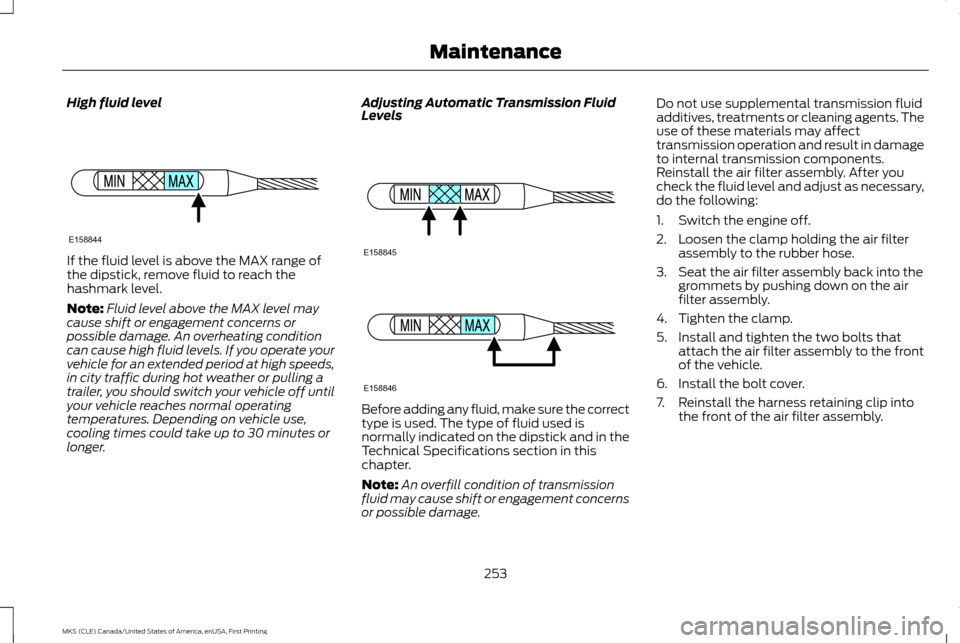
High fluid level
If the fluid level is above the MAX range of
the dipstick, remove fluid to reach the
hashmark level.
Note:
Fluid level above the MAX level may
cause shift or engagement concerns or
possible damage. An overheating condition
can cause high fluid levels. If you operate your
vehicle for an extended period at high speeds,
in city traffic during hot weather or pulling a
trailer, you should switch your vehicle off until
your vehicle reaches normal operating
temperatures. Depending on vehicle use,
cooling times could take up to 30 minutes or
longer. Adjusting Automatic Transmission Fluid
Levels
Before adding any fluid, make sure the correct
type is used. The type of fluid used is
normally indicated on the dipstick and in the
Technical Specifications section in this
chapter.
Note:
An overfill condition of transmission
fluid may cause shift or engagement concerns
or possible damage. Do not use supplemental transmission fluid
additives, treatments or cleaning agents. The
use of these materials may affect
transmission operation and result in damage
to internal transmission components.
Reinstall the air filter assembly. After you
check the fluid level and adjust as necessary,
do the following:
1. Switch the engine off.
2. Loosen the clamp holding the air filter
assembly to the rubber hose.
3. Seat the air filter assembly back into the grommets by pushing down on the air
filter assembly.
4. Tighten the clamp.
5. Install and tighten the two bolts that attach the air filter assembly to the front
of the vehicle.
6. Install the bolt cover.
7. Reinstall the harness retaining clip into the front of the air filter assembly.
253
MKS (CLE) Canada/United States of America, enUSA, First Printing MaintenanceE158844 E158845 E158846
Page 293 of 382
If you have a dissimilar spare wheel and tire,
then it is intended for temporary use only.
This means that if you need to use it, you
should replace it as soon as possible with a
road wheel and tire assembly that is the
same size and type as the road tires and
wheels that were originally provided by Ford.
If the dissimilar spare tire or wheel is
damaged, it should be replaced rather than
repaired.
A dissimilar spare wheel and tire assembly
is defined as a spare wheel and tire assembly
that is different in brand, size or appearance
from the road tires and wheels and can be
one of three types:
1.
T-type mini-spare: This spare tire begins
with the letter T for tire size and may have
Temporary Use Only molded in the sidewall.
2. Full-size dissimilar spare with label on
wheel:
This spare tire has a label on the
wheel that states: THIS WHEEL AND TIRE
ASSEMBLY FOR TEMPORARY USE ONLY.
When driving with one of the dissimilar spare
tires listed above, do not:
• Exceed 50 mph (80 km/h)
• Load the vehicle beyond maximum
vehicle load rating listed on the Safety
Compliance Label.
• Tow a trailer. •
Use snow chains on the end of the vehicle
with the dissimilar spare tire.
• Use more than one dissimilar spare tire
at a time.
• Use commercial car washing equipment.
• Try to repair the dissimilar spare tire.
Use of one of the dissimilar spare tires listed
above at any one wheel location can lead to
impairment of the following:
• Handling, stability and braking
performance.
• Comfort and noise.
• Ground clearance and parking at curbs.
• Winter weather driving capability.
• Wet weather driving capability.
• All-wheel driving capability (if
applicable).
3. Full-size dissimilar spare without label
on wheel
When driving with the full-size dissimilar
spare wheel and tire assembly, do not:
• Exceed 70 mph (113 km/h).
• Use more than one dissimilar spare wheel
and tire assembly at a time. •
Use commercial car washing equipment.
• Use snow chains on the end of the vehicle
with the dissimilar spare wheel and tire
assembly.
The usage of a full-size dissimilar spare
wheel and tire assembly can lead to
impairment of the following:
• Handling, stability and braking
performance.
• Comfort and noise.
• Ground clearance and parking at curbs.
• Winter weather driving capability.
• Wet weather driving capability.
• All-wheel driving capability (if
applicable).
• Load leveling adjustment (if applicable).
When driving with the full-size dissimilar
spare wheel and tire assembly additional
caution should be given to:
• Towing a trailer.
• Driving vehicles equipped with a camper
body.
• Driving vehicles with a load on the cargo
rack.
Drive cautiously when using a full-size
dissimilar spare wheel and tire assembly and
seek service as soon as possible.
290
MKS (CLE) Canada/United States of America, enUSA, First Printing Wheels and Tires
Page 332 of 382
Towing a trailer or using a car-top carrier
Change engine oil and filter as indicated by information display and perform services listed in the Normal
Scheduled Maintenance chart.
As required
Inspect and lubricate U-joints.
Inspect frequently, service
as required
Change PTU and rear axle fluid (AWD only). See axle and PTU maintenance items under Exceptions.
Every 30,000 mi
(48,000 km) Change automatic transmission fluid.
Replace spark plugs.
Every
60,000 mi
(96,000 km) Extensive idling or low-speed driving for long distances, as in heavy commercial use (such as delivery, taxi, patrol car or livery)
Change engine oil and filter as indicated by information display and perform services listed in the Normal
Scheduled Maintenance chart.
As required
Replace cabin air filter.
Inspect frequently, service
as required
Replace engine air filter.
Change automatic transmission fluid.
Every
30,000 mi
(48,000 km) Change PTU and rear axle fluid (AWD only). See axle and PTU maintenance items under
Exceptions.
Replace spark plugs.
Every
60,000 mi
(96,000 km)
329
MKS (CLE) Canada/United States of America, enUSA, First Printing Scheduled Maintenance
Page 376 of 382
D
Data Recording.......................................................9
Event Data Recording................................................. 9
Service Data Recording............................................. 9
Daytime Running Lamps..................................73
Direction Indicators
............................................76
Lane Change................................................................ 76
Drive Control
.......................................................190
LINCOLN DRIVE CONTROL................................. 190
Driver Alert
............................................................174
Using Driver Alert...................................................... 174
Driver and Passenger Airbags........................38 Children and Airbags................................................ 39
Proper Driver and Front Passenger Seating Adjustment............................................................. 38
Driving Aids
..........................................................174
Driving Hints.......................................................208
Driving Through Water...................................208
DRL See: Daytime Running Lamps............................... 73
E
Economical Driving
.........................................208
Emission Control System................................137 On-Board Diagnostics (OBD-II)......................... 138
Readiness for Inspection and Maintenance (I/M) Testing......................................................... 138
End User License Agreement......................352 VEHICLE SOFTWARE END USER LICENSE
AGREEMENT (EULA) ...................................... 352Engine Block Heater.........................................130
Using the Engine Block Heater............................. 131
Engine Coolant Check
.....................................247
Adding Engine Coolant.......................................... 247
Checking the Engine Coolant............................. 247
Recycled Engine Coolant..................................... 248
Severe Climates...................................................... 248
What You Should Know About Fail-Safe Cooling................................................................... 248
Engine Immobilizer See: Passive Anti-Theft System.......................... 63
Engine Oil Check...............................................245 Adding Engine Oil.................................................... 245
Engine Oil Dipstick...........................................245
Engine Specifications - 3.5L Ecoboost™......................................................296
Drivebelt Routing.................................................... 296
Engine Specifications - 3.7L..........................297 Drivebelt Routing..................................................... 297
Environment..........................................................14
Essential Towing Checks..............................204 Before Towing a Trailer......................................... 205
Hitches........................................................................\
204
Launching or Retrieving a Boat or Personal Watercraft (PWC)............................................. 205
Safety Chains........................................................... 204
Trailer Brakes............................................................ 204
Trailer Lamps........................................................... 204
When Towing a Trailer.......................................... 205
Event Data Recording See: Data Recording................................................... 9
Export Unique Options......................................13 Extended Service Plan (ESP).......................319
EXTENDED SERVICE PLANS (CANADA
ONLY)..................................................................... 320
EXTENDED SERVICE PLANS (U.S. Only)........................................................................\
319
Exterior Mirrors.....................................................79 Auto-Dimming Feature........................................... 80
Blind Spot Monitor..................................................... 81
Fold-Away Exterior Mirrors..................................... 79
Heated Exterior Mirrors........................................... 80
Integrated Blind Spot Mirrors............................... 80
Memory Mirrors.......................................................... 80
Power Exterior Mirrors.............................................. 79
F
Fastening the Seatbelts...................................29 Safety Belt Extension Assembly........................... 31
Safety Belt Locking Modes.................................... 30
Using Safety Belts During Pregnancy................29
Floor Mats
...........................................................209
Fog Lamps - Front See: Front Fog Lamps.............................................. 75
Foot Pedals See: Adjusting the Pedals...................................... 68
Front Fog Lamps
.................................................75
Front Parking Aid................................................157
Front Passenger Sensing System.................39
Fuel and Refueling............................................132
Fuel Consumption............................................136 Calculating Fuel Economy................................... 136
Filling the Tank.......................................................... 136
373
MKS (CLE) Canada/United States of America, enUSA, First Printing Index
Page 378 of 382
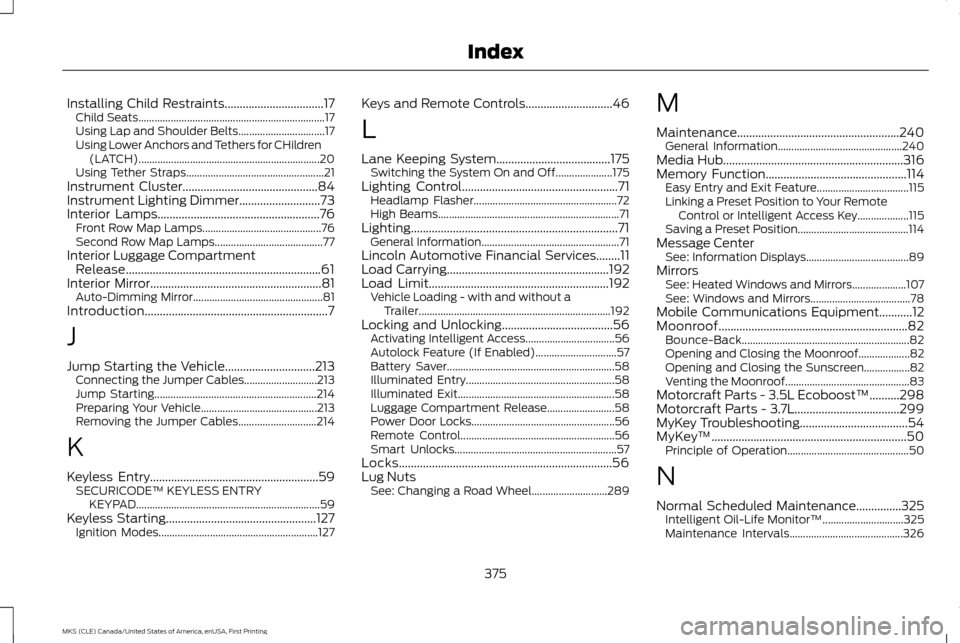
Installing Child Restraints.................................17
Child Seats..................................................................... 17
Using Lap and Shoulder Belts................................ 17
Using Lower Anchors and Tethers for CHildren (LATCH)................................................................... 20
Using Tether Straps................................................... 21
Instrument Cluster
.............................................84
Instrument Lighting Dimmer...........................73
Interior Lamps......................................................76 Front Row Map Lamps............................................ 76
Second Row Map Lamps........................................ 77
Interior Luggage Compartment Release.................................................................61
Interior Mirror
.........................................................81
Auto-Dimming Mirror................................................ 81
Introduction.............................................................7
J
Jump Starting the Vehicle..............................213 Connecting the Jumper Cables........................... 213
Jump Starting............................................................ 214
Preparing Your Vehicle........................................... 213
Removing the Jumper Cables............................. 214
K
Keyless Entry........................................................59 SECURICODE™ KEYLESS ENTRY
KEYPAD.................................................................... 59
Keyless Starting..................................................127 Ignition Modes........................................................... 127Keys and Remote Controls.............................46
L
Lane Keeping System
......................................175
Switching the System On and Off..................... 175
Lighting Control
....................................................71
Headlamp Flasher..................................................... 72
High Beams................................................................... 71
Lighting.....................................................................71 General Information................................................... 71
Lincoln Automotive Financial Services........11
Load Carrying......................................................192
Load Limit............................................................192 Vehicle Loading - with and without a
Trailer....................................................................... 192
Locking and Unlocking.....................................56 Activating Intelligent Access................................. 56
Autolock Feature (If Enabled).............................. 57
Battery Saver.............................................................. 58
Illuminated Entry....................................................... 58
Illuminated Exit.......................................................... 58
Luggage Compartment Release......................... 58
Power Door Locks..................................................... 56
Remote Control......................................................... 56
Smart Unlocks............................................................ 57
Locks.......................................................................56
Lug Nuts See: Changing a Road Wheel............................ 289M
Maintenance......................................................240
General Information.............................................. 240
Media Hub
............................................................316
Memory Function...............................................114
Easy Entry and Exit Feature.................................. 115
Linking a Preset Position to Your Remote Control or Intelligent Access Key................... 115
Saving a Preset Position......................................... 114
Message Center See: Information Displays...................................... 89
Mirrors See: Heated Windows and Mirrors.................... 107
See: Windows and Mirrors..................................... 78
Mobile Communications Equipment...........12
Moonroof...............................................................82 Bounce-Back.............................................................. 82
Opening and Closing the Moonroof................... 82
Opening and Closing the Sunscreen.................82
Venting the Moonroof.............................................. 83
Motorcraft Parts - 3.5L Ecoboost™..........298
Motorcraft Parts - 3.7L...................................299
MyKey Troubleshooting....................................54
MyKey ™
.................................................................50
Principle of Operation............................................. 50
N
Normal Scheduled Maintenance...............325 Intelligent Oil-Life Monitor™.............................. 325
Maintenance Intervals.......................................... 326
375
MKS (CLE) Canada/United States of America, enUSA, First Printing Index
Page 380 of 382
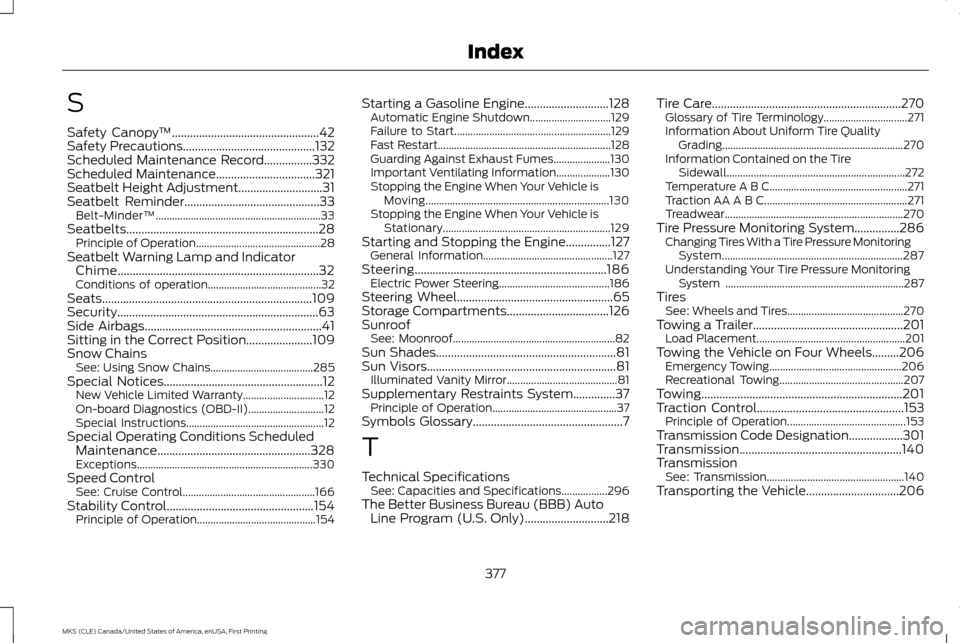
S
Safety Canopy
™.................................................42
Safety Precautions............................................132
Scheduled Maintenance Record................332
Scheduled Maintenance
.................................321
Seatbelt Height Adjustment............................31
Seatbelt Reminder
.............................................33
Belt-Minder™............................................................. 33
Seatbelts................................................................28 Principle of Operation.............................................. 28
Seatbelt Warning Lamp and Indicator Chime...................................................................32
Conditions of operation.......................................... 32
Seats
......................................................................109
Security...................................................................63
Side Airbags...........................................................41
Sitting in the Correct Position......................109
Snow Chains See: Using Snow Chains...................................... 285
Special Notices
.....................................................12
New Vehicle Limited Warranty.............................. 12
On-board Diagnostics (OBD-II)............................ 12
Special Instructions................................................... 12
Special Operating Conditions Scheduled Maintenance...................................................328
Exceptions................................................................. 330
Speed Control See: Cruise Control................................................. 166
Stability Control
.................................................154
Principle of Operation............................................ 154Starting a Gasoline Engine
............................128
Automatic Engine Shutdown.............................. 129
Failure to Start.......................................................... 129
Fast Restart................................................................ 128
Guarding Against Exhaust Fumes..................... 130
Important Ventilating Information.................... 130
Stopping the Engine When Your Vehicle is Moving.................................................................... 130
Stopping the Engine When Your Vehicle is Stationary.............................................................. 129
Starting and Stopping the Engine
...............127
General Information................................................ 127
Steering................................................................186 Electric Power Steering......................................... 186
Steering Wheel....................................................65
Storage Compartments
..................................126
Sunroof See: Moonroof............................................................ 82
Sun Shades
............................................................81
Sun Visors...............................................................81
Illuminated Vanity Mirror......................................... 81
Supplementary Restraints System..............37 Principle of Operation.............................................. 37
Symbols Glossary..................................................7
T
Technical Specifications See: Capacities and Specifications.................296
The Better Business Bureau (BBB) Auto Line Program (U.S. Only)............................218 Tire Care...............................................................270
Glossary of Tire Terminology............................... 271
Information About Uniform Tire Quality Grading................................................................... 270
Information Contained on the Tire Sidewall.................................................................. 272
Temperature A B C................................................... 271
Traction AA A B C..................................................... 271
Treadwear.................................................................. 270
Tire Pressure Monitoring System...............286 Changing Tires With a Tire Pressure Monitoring
System................................................................... 287
Understanding Your Tire Pressure Monitoring System .................................................................. 287
Tires See: Wheels and Tires........................................... 270
Towing a Trailer
..................................................201
Load Placement....................................................... 201
Towing the Vehicle on Four Wheels.........206 Emergency Towing................................................. 206
Recreational Towing.............................................. 207
Towing...................................................................201
Traction Control
.................................................153
Principle of Operation............................................ 153
Transmission Code Designation..................301
Transmission......................................................140
Transmission See: Transmission................................................... 140
Transporting the Vehicle...............................206
377
MKS (CLE) Canada/United States of America, enUSA, First Printing Index