maintenance MASERATI GRANTURISMO CONVERTIBLE 2019 Owner's Manual
[x] Cancel search | Manufacturer: MASERATI, Model Year: 2019, Model line: GRANTURISMO CONVERTIBLE, Model: MASERATI GRANTURISMO CONVERTIBLE 2019Pages: 296, PDF Size: 9.01 MB
Page 198 of 296
NOTE:
TheAuthorized Maserati Dealer can
provide you with all information about
the Maserati Snow Chains, available in
the "Genuine Accessories" range.Tire Pressure Monitoring
System - TPMS
Guidelines
Each tire (including the spare tire, if
provided) should be checked monthly.
Tires should be checked when cold and
inflated to the inflation pressure
recommended by the vehicle
manufacturer indicated on tire
inflation pressure label (applied on the
driver's rear door pillar) and in “Tire
Inflation Pressure” of section “Features
and Specifications”.
If your vehicle has tires of a different
size than the size indicated on the
vehicle placard or tire inflation
pressure label, you should determine
the proper tire inflation pressure for
those tires. As an added safety feature,
your vehicle has been
equipped with a tire pressure
monitoring system (TPMS) that
illuminates a low tire pressure telltale
when one or more of your tires is
significantly under-inflated.
Accordingly, when the low tire
pressure telltale illuminates, you
should stop and check your tires as
soon as possible, and inflate them to
the proper pressure. Driving on a significantly under-inflated tire causes
the tire to overheat and can lead to
tire failure. Under-inflation also
reduces fuel efficiency and tire tread
life, and may affect the vehicle’s
handling and stopping ability.
Please note that the TPMS is not a
substitute for proper tire maintenance,
and it is the driver’s responsibility to
maintain correct tire pressure, even if
under-inflation has not reached the
level to trigger illumination of the
TPMS low tire pressure telltale.
Your vehicle has also been equipped
with a TPMS malfunction indicator to
indicate when the system is not
operating properly.
The TPMS malfunction indicator is
combined with the low tire pressure
telltale. When the system detects a
malfunction, the telltale will flash for
approximately one minute and then
remain continuously illuminated. This
sequence will continue upon
subsequent vehicle start-ups as long as
the malfunction exists. When the
malfunction indicator is illuminated,
the system may not be able to detect
or signal low tire pressure as intended.
TPMS malfunctions may occur for a
variety of reasons, including the
installation of replacement or
alternate tires or wheels on the vehicle
Driving
5
194
Page 200 of 296
(Continued)
style. Aftermarket wheels can cause
sensor damage. Do not use
aftermarket tire sealants or balance
beads, as damage to the sensors may
result.
• The system can temporarily experience radio-electric interference
emitted by devices using similar
frequencies.
• After inspecting or adjusting the tire pressure, always reinstall the valve
stem cap. This will prevent moisture
and dirt from entering the valve
stem and damage the TPMS internal
sensor.
NOTE:
• Driving
on a significantly
underinflated tire causes the tire to
overheat and may lead to tire failure.
Under-inflation also reduces fuel
efficiency and tire tread life, and may
affect the vehicle’s handling and
stopping ability.
• The TPMS is not a substitute for
proper tire maintenance, and it is the
driver’s responsibility to maintain
correct tire pressure using an
accurate tire pressure gage, even if
under-inflation has not reached the level to trigger illumination of the
TPMS light
.
• Seasonal temperature changes will
affect tire pressure, and the TPMS
will monitor the actual tire pressure
in the tire.
Viewing Messages on the
Display
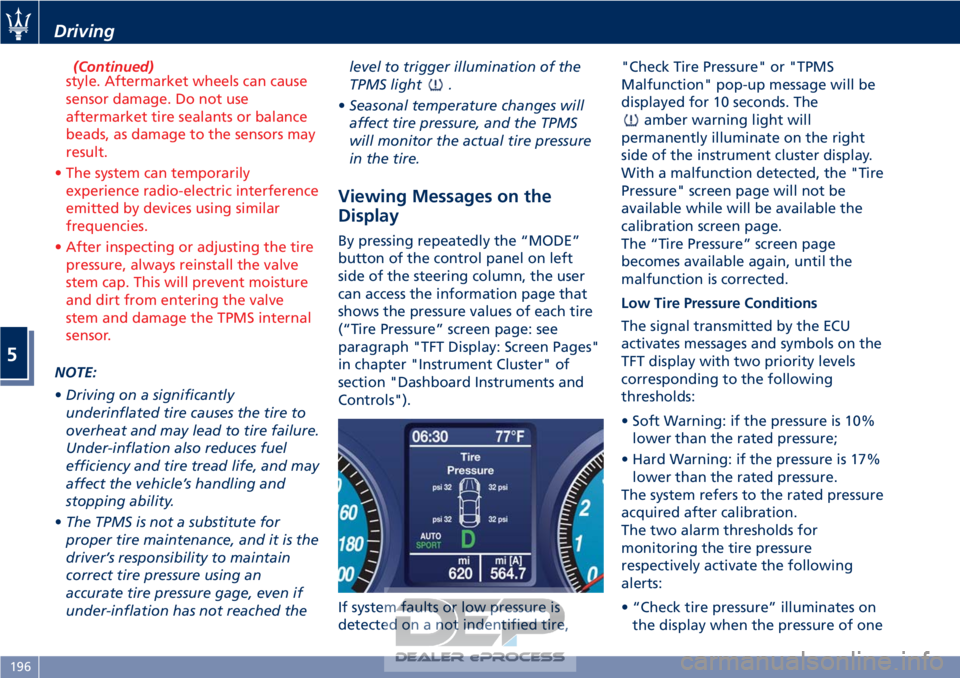
By pressing repeatedly the “MODE”
button of the control panel on left
side of the steering column, the user
can access the information page that
shows the pressure values of each tire
(“Tire Pressure” screen page: see
paragraph "TFT Display: Screen Pages"
in chapter "Instrument Cluster" of
section "Dashboard Instruments and
Controls").
If system faults or low pressure is
detected on a not indentified tire, "Check Tire Pressure" or "TPMS
Malfunction" pop-up message will be
displayed for 10 seconds. The
amber warning light will
permanently illuminate on the right
side of the instrument cluster display.
With a malfunction detected, the "Tire
Pressure" screen page will not be
available while will be available the
calibration screen page.
The “Tire Pressure” screen page
becomes available again, until the
malfunction is corrected.
Low Tire Pressure Conditions
The signal transmitted by the ECU
activates messages and symbols on the
TFT display with two priority levels
corresponding to the following
thresholds:
• Soft Warning: if the pressure is 10% lower than the rated pressure;
• Hard Warning: if the pressure is 17% lower than the rated pressure.
The system refers to the rated pressure
acquired after calibration.
The two alarm thresholds for
monitoring the tire pressure
respectively activate the following
alerts:
• “Check tire pressure” illuminates on the display when the pressure of one
Driving
5
196
Page 205 of 296
Materials Added to Fuel
All gasoline sold in the United States is
required to contain effective
detergent additives. Use of additional
detergents or other additives is not
needed under normal conditions and
they would result in additional cost.
Therefore, you should not have to add
anything to the fuel.
Fuel System Warnings
WARNING!
Follow these guidelines to maintain
your vehicle's performance:
•
The use of leaded gasoline is
prohibited by Federal and Provincial
law. Using leaded gasoline can impair
engine performance and damage the
emissions control system.
• The use of fuel additives, which are
now being sold as octane enhancers,
is not recommended. Most of these
products contain high
concentrations of methanol. Fuel
system damage or vehicle
performance problems resulting
from the use of such fuels or
additives is not the responsibility of
Maserati. NOTE:
Intentional
tampering with the
emissions control system can result in
civil penalties civil penalties and could
void the vehicle warranty.
Carbon Monoxide Warnings
WARNING!
Carbon monoxide (CO) in exhaust
gases is deadly. Follow the
precautions below to prevent carbon
monoxide poisoning:
• Do not inhale exhaust gases. They
contain carbon monoxide, a
colorless and odorless gas, which
can kill. Never run the engine in a
closed area, such as a garage, and
never sit in a parked vehicle with
the engine running for an extended
period. If the vehicle is stopped in
an open area with the engine
running for more than a short
period, adjust the ventilation system
to force fresh, outside air into the
vehicle.
• Guard against carbon monoxide
with proper maintenance. Have the
exhaust system inspected every time
the vehicle is raised. Have any abnormal conditions repaired
promptly. Until repaired, drive with
all side windows fully open.
WARNING!
California Proposition 65
Operating, servicing and maintaining
a passenger vehicle or off-road vehicle
can expose you to chemicals including
such as, engine exhaust, carbon
monoxide, phthalates and lead, that
which are know to the State of
California to cause cancer and birth
defects or other reproductive harm. To
minimize exposure, avoid breathing
exhaust, do not idle the engine except
as necessary, service your vehicle in a
well-ventilated area and wear gloves
or wash your hands frequently when
servicing your vehicle. For more
information go to:
www.P65Warnings.ca.gov/passenger-
vehicle
Driving
5
201
Page 208 of 296
Driving Conditions
Before the Trip
Check the following at regular
intervals and always before long trips:
• tire pressure and condition;
• levels of fluids and lubricants;
• conditions of the windshield wiperblades;
• clean the glass on the external light and all other glass surfaces;
• proper operation of the indicator lights and of the external lights.
CAUTION!
It is however advisable to perform
these checks at least every 500 mi
(800 km) and always following the
maintenance schedule reported in
section “Maintenance and Care”.
Before you drive:
•
adjust seat position, steering wheel
and rearview mirrors in order to have
the best driving position;
• ensure that nothing (mat covers, etc.) is obstructing the pedals movement;
• carefully arrange and secure any objects in the trunk, to prevent them from moving forward in case of
sudden stops;
• avoid heavy meals before a trip. A light snack helps keep your reflexes
sharp. In particular, avoid drinking
alcohol.
WARNING!
Beyond being prohibited by law, it is
extremely dangerous to ride inside the
trunk or on the hood. In the event of
an accident, passengers sitting here
are more exposed to the risk of
serious injury. Passengers must only
travel seated in the vehicle seats, with
the seat belts fastened. Always check
that the driver and all passengers
have the seat belts correctly fastened.
Safe Driving
Although the vehicle is equipped with
active and passive safety devices, the
driver's conduct is always a decisive
factor for road safety.
Some simple rules for traveling safely
in different conditions are listed
below. Some of them will probably
already sound familiar but, in any case,
it would be useful to read them
carefully. Driving at Night
The main guidelines to follow when
driving at night are set out below.
• Drive carefully. Night conditions
demand more focus and attention.
• Reduce your speed, especially on roads with no streetlights.
• Stop at early signs of drowsiness. Continuing to drive would be a risk
for yourself and for others. Have a
rest before continuing your trip.
• Keep the vehicle at a greater distance from vehicles in front of you
than you would during the day: it is
difficult to assess the speed of other
vehicles when you only see the lights.
• Use the high beams only outside of densely-populated areas and when
you are sure that they will not
disturb other drivers.
• When another vehicle is approaching, switch from high
beams (if on) to low beams.
• Keep lights and headlights clean.
• Outside of densely-populated areas, beware of animals crossing the road.
Driving in the Rain
Rain and wet roads are dangerous. On
a wet road all maneuvers are more
difficult since wheel grip on the
Driving
5
204
Page 211 of 296
before driving through the standing
water.
• Do not exceed 5 mph (8 km/h) when driving through standing water. This
will minimize wave effects.
•
Driving through standing water may
cause damage to your vehicle
drivetrain components. After driving
through standing water, do not drive if
you are not sure about drivetrain
condition. Such damage is not covered
by the New Vehicle Warranty.
• Getting water inside your vehicle engine can cause it to lock up and
stall out, and cause serious internal
damage to the engine. Such damage
is not covered by the New Vehicle
Warranty.
• After driving through standing water always have the fluids (engine
oil, transmission oil, etc) checked for
contamination at an Authorized
Maserati Dealer.
WARNING!
• Driving through standing water
limits your vehicle traction
capabilities. Do not exceed 5 mph
(8 km/h) when driving through
standing water. •
Driving through standing water
limits your vehicle braking
capabilities, which increases
stopping distances. Therefore, after
driving through standing water,
drive slowly and lightly press on the
brake pedal several times to
progressively dry the brakes discs
and pads.
• Getting water inside your vehicle
engine can cause it to lock up and
stall out.
• Failure to follow these warnings
may result in injuries that are
serious or fatal to you, your
passengers, and others around you.
Pollution Control Devices
Even if the vehicle is fitted with
antipollution devices, the environment
deserves the greatest respect from
every one of us.
By following a few simple rules, the
driver can avoid damaging the
environment and very often can
reduce fuel consumption as well.
In this regard, some useful
information is listed here below;
please read it carefully.
• The first precaution is to follow the
Scheduled Service Plan scrupulously
(see “Scheduled Service Plan” in
section “Maintenance and Care”.
• The correct operation of the antipollution devices not only helps
respect for the environment, but
also has an impact on vehicle
efficiency. Keeping these devices in
good working conditions is the first
rule for driving both ecologically
sound and economically.
• Always use unleaded fuel.
• If starting is difficult, do not make prolonged attempts. In particular,
avoid push starts, towing or
downhill starts: these are all
maneuvers that can damage the
catalytic converters. For any
Driving
5
207
Page 218 of 296
Engine Overheating
To reduce potentially overheating of
the engine in city traffic, while
stationary, place the transmission in N
(Neutral), but do not increase the
engine idle speed.
NOTE:
There are steps that you can take to
slow down an impending overheat
condition:
•If your air conditioner (A/C) is on,
turn it off. The A/C system adds heat
to the engine cooling system and
turning the A/C off can help remove
this heat.
• You can also turn the temperature
control to maximum heat, the mode
control to floor and the blower
control to high. This allows the
heater core to act as a supplement to
the radiator and aids in removing
heat from the engine cooling system.
CAUTION!
Driving with a hot cooling system
could damage the engine. If the
temperature gauge is positioned on
the red zone (refer to “Instrument
Cluster” in section “Dashboard Instruments and Controls”), pull over
and stop the vehicle. Idle the vehicle
with the air conditioner turned off
until the temperature gauge drops
back into the normal range. If the
temperature gauge remains on the red
zone turn the engine off immediately
and contact the
Authorized Maserati
Dealer.
WARNING!
You or others can be badly burned by
hot engine coolant (antifreeze) or
steam from your radiator. If you see or
hear steam coming from under the
hood, do not open it until the radiator
has had time to cool.
Never try to open a coolant bottle
pressure cap (refer to “Maintenance
Procedures” in section “Maintenance
and Care”) when the radiator is
overheated.
In case of a Punctured Tire
The vehicle can be equipped with a
tire repair kit or with a compact spare
wheel.
Using Tire Repair Kit
Small punctures up to 1⁄4” (6 mm) in
the tire tread can be sealed using the
tire repair kit, fitted beneath the floor
panel of the trunk compartment.
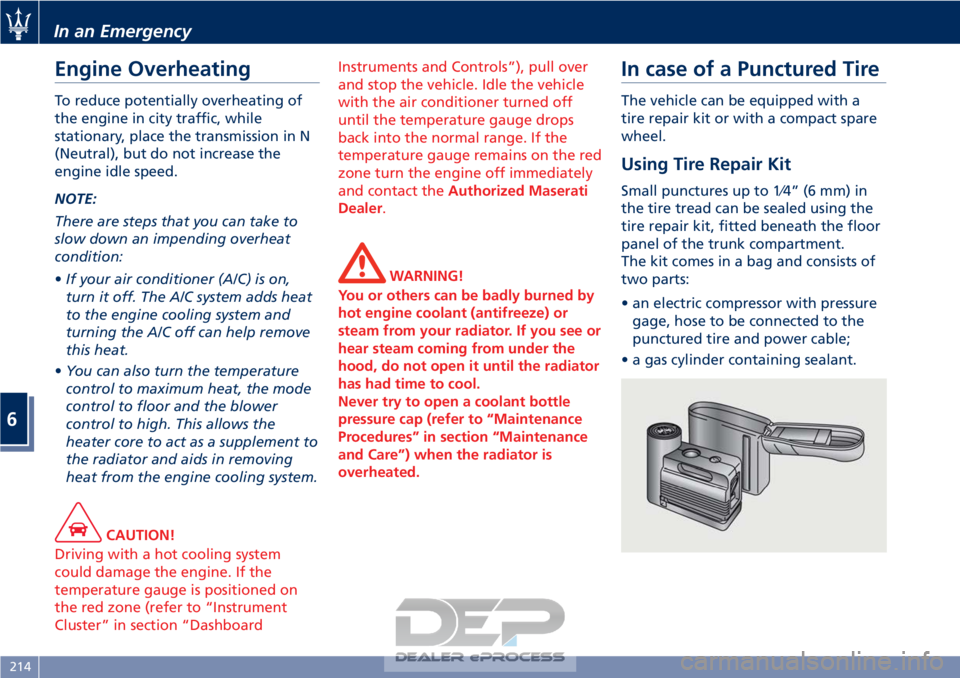
The kit comes in a bag and consists of
two parts:
• an electric compressor with pressure gage, hose to be connected to the
punctured tire and power cable;
• a gas cylinder containing sealant.
In an Emergency
6
214
Page 222 of 296
WARNING!
• Never position yourself under a
jacked vehicle.
• The lifted vehicle may fall and
damage the vehicle's body if the jack
is not positioned correctly. •
Never use the jack to carry out
maintenance or repairs under the
vehicle.
• Turn the jack lever until the wheel is raised
a few centimeters off the
ground.
• Completely unscrew the five bolts and remove the wheel. In case a
“Wheel Security Stud Bolt” is
installed, it can only be removed by using the specific fitting wrench
provided with the “Wheel Security
Stud Bolt Kit”, available in the
Genuine Accessories range.
• Fit the compact spare wheel with the valve stem facing outward, securing
it with the five bolts previously
removed.
• Turn the lever of the jack to lower the vehicle and remove the jack.
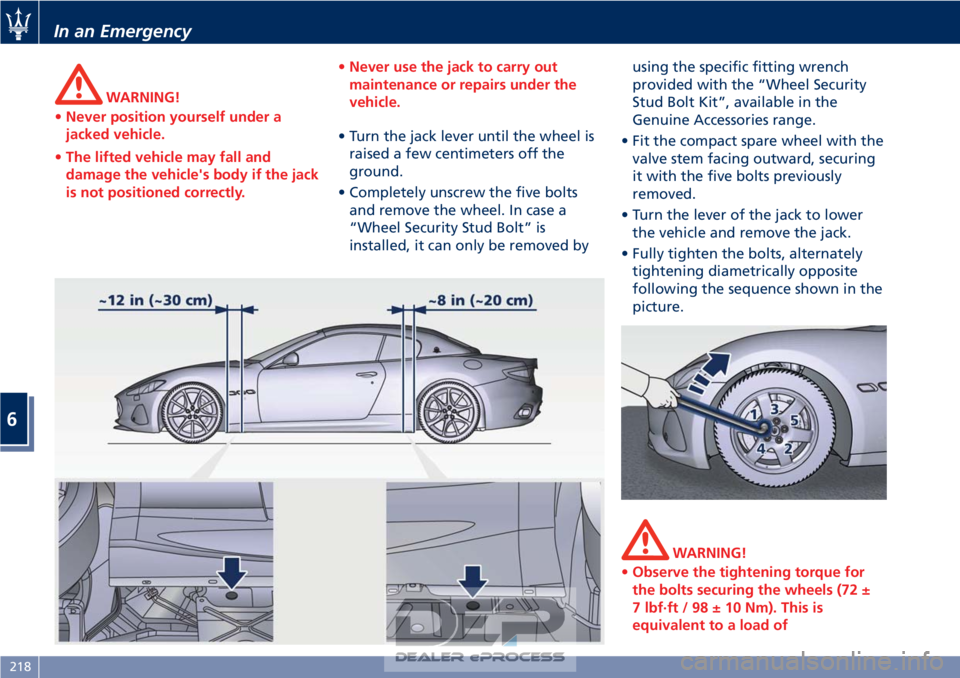
• Fully tighten the bolts, alternately tightening diametrically opposite
following the sequence shown in the
picture.
WARNING!
• Observe the tightening torque for
the bolts securing the wheels (72 ±
7 lbf·ft / 98 ± 10 Nm). This is
equivalent to a load of
In an Emergency
6
218
Page 230 of 296
WARNING!
• Using booster packs that have not
been checked, which could therefore
release a too high charging voltage
(higher than 14 V), in extreme
environmental conditions (for
example: closed areas or without
proper ventilation and temperatures
higher than 122°F/50°C or lower
than -4°F/-20°C) create the right
conditions for ignition which could
then cause the battery to explode.
Therefore you shall always perform
jump-starting operations using the
adequate tools and in the best
environmental conditions, taking all
necessary precautions.
• Do not attempt jump-starting if the
discharged battery is frozen. It could
rupture or explode during jump start
and cause personal injury.
• Do not carry out this procedure if
you have not done it before:
incorrect maneuvers can originate
high electrical discharges and even
cause the battery to explode.
• To avoid the risk of explosion or fire,
do not approach the battery with open flames or cigarettes that could
generate sparks.
NOTE:
If
you need to disconnect the battery
from the vehicle electrical system, see
“Maintenance - Free Battery” in
section “Maintenance and Care”).
Access the Battery
The battery is stored in the trunk.
• Open the trunk lid (see “Open and Close the Trunk Lid” in section
“Before Starting”).
• Remove any luggage from the trunk compartment.
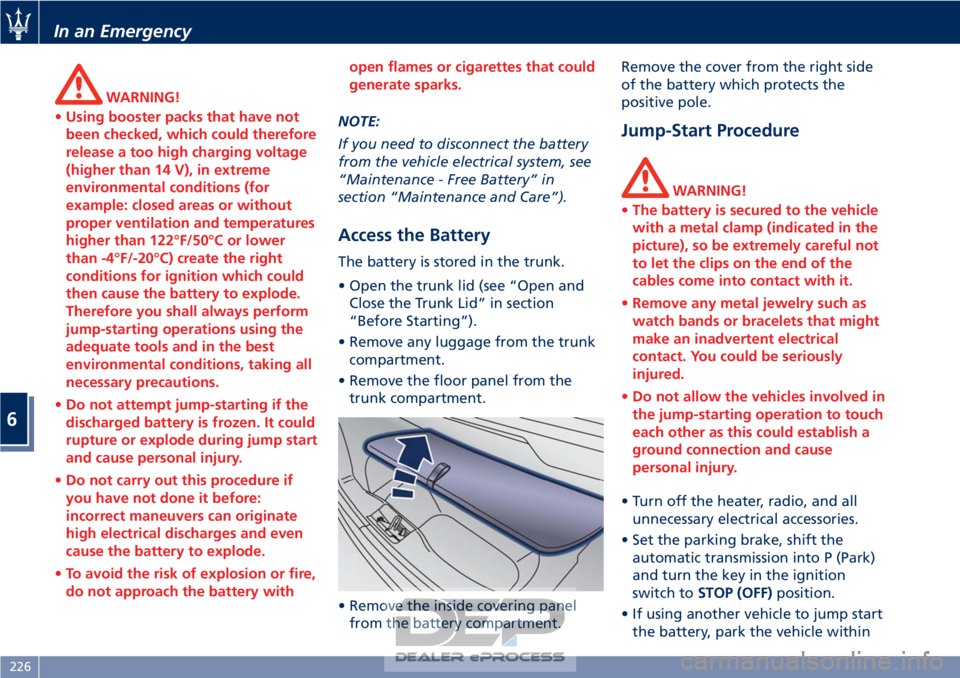
• Remove the floor panel from the trunk compartment.
• Remove the inside covering panel from the battery compartment. Remove the cover from the right side
of the battery which protects the
positive pole.
Jump-Start Procedure
WARNING!
• The battery is secured to the vehicle
with a metal clamp (indicated in the
picture), so be extremely careful not
to let the clips on the end of the
cables come into contact with it.
• Remove any metal jewelry such as
watch bands or bracelets that might
make an inadvertent electrical
contact. You could be seriously
injured.
• Do not allow the vehicles involved in
the jump-starting operation to touch
each other as this could establish a
ground connection and cause
personal injury.
• Turn off the heater, radio, and all unnecessary
electrical accessories.
• Set the parking brake, shift the automatic transmission into P (Park)
and turn the key in the ignition
switch to STOP (OFF) position.
• If using another vehicle to jump start the battery, park the vehicle within
In an Emergency
6
226
Page 235 of 296
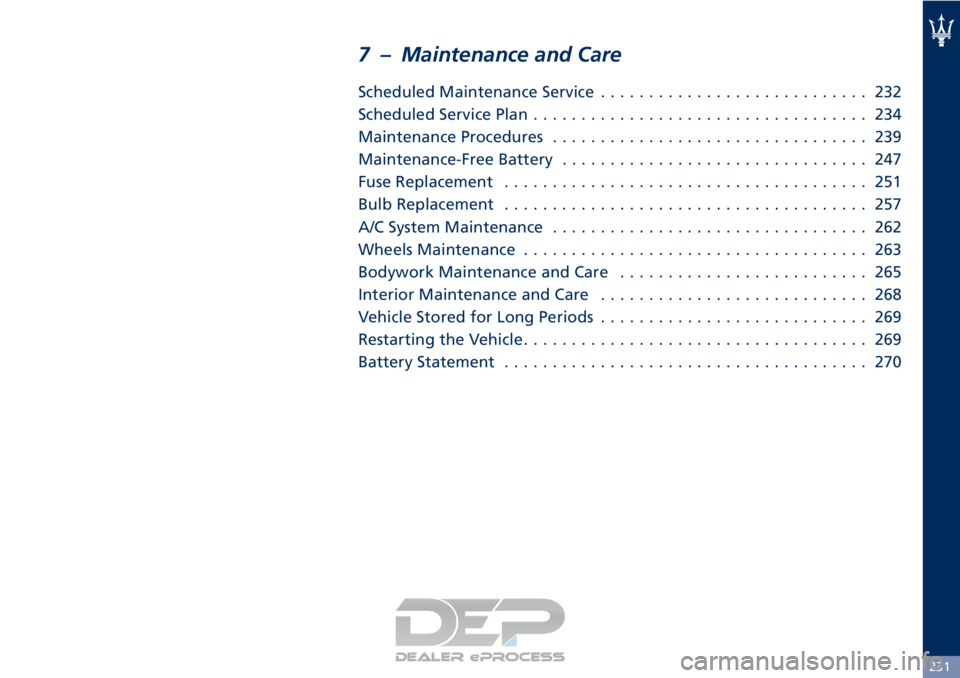
7 – Maintenance and Care
Scheduled Maintenance Service............................ 232
Scheduled Service Plan ................................... 234
Maintenance Procedures ................................. 239
Maintenance-Free Battery ................................ 247
Fuse Replacement ...................................... 251
Bulb Replacement ...................................... 257
A/C System Maintenance ................................. 262
Wheels Maintenance .................................... 263
Bodywork Maintenance and Care .......................... 265
Interior Maintenance and Care ............................ 268
Vehicle Stored for Long Periods ............................ 269
Restarting the Vehicle .................................... 269
Battery Statement ...................................... 270
231
Page 236 of 296
Scheduled Maintenance
Service
Correct maintenance is clearly the best
way to guarantee vehicle performance
and safety features, ensure respect for
the environment and low operating
costs.
NOTE:
Also remember that the scrupulous
observance of the maintenance
procedures is essential for keeping
your vehicle operating properly. Not
adhering to the “Scheduled Service
Plan” can impact your vehicle’s
warranty.
Interval Running Coupons
Maserati has therefore provided for a
series of checks and maintenance
operations involving the 1
stservice
when the vehicle mileage reaches
12500 mi (20000 km) or after 2 years of
the vehicle's life, and subsequently
every 12500 mi (20000 km) or every 2
years.
After the 12
thservice, maintenance
must be restarted with the operations
scheduled for the 1
st,2ndand 3rd
service.
CAUTION!
The Scheduled Maintenance services
are prescribed by the Manufacturer.
Failure to have the services carried out
can affect your warranty.
The Scheduled Maintenance service is
provided
by the whole Authorized
Maserati Dealer. In the event that,
when a service is performed, further
replacements or repairs are found to
be necessary in addition to the
scheduled operations, these can be
carried out only with the specific
consent of the Customer.
CAUTION!
You are advised to notify the
Authorized Maserati Dealer of any
minor operating problem, without
waiting for the next scheduled service.
NOTE:
• Change
your vehicle's oil if it has
been 2 years since your last oil
change.
• Change your engine oil more often if
you drive your vehicle off-road for an
extended period of time or short trips without reaching operation
temperature.
• Under no circumstances should oil
change intervals exceed 12500 mi
(20000 km) or at least after 2 years.
CAUTION!
Failure to perform the required
maintenance items may result in
damage to the vehicle.
Scheduled Maintenance
(Service) Indicator
When the deadlines for maintenance
Scheduled Maintenance services are
approaching, a message on the
instrument cluster display indicates
that service is due. The deadline may
be expressed in miles/Km or days,
whichever comes first.
The message is displayed only once,
upon activating the instrument cluster,
at decreasing intervals expressed in
mi/km (100, 50...... 1800, 1600,) or in
days (27, 24, ....... 6, 3), accompanied
by the
specific symbol.
Maintenance and Care
7
232