battery MAZDA 626 1987 Workshop Manual
[x] Cancel search | Manufacturer: MAZDA, Model Year: 1987, Model line: 626, Model: MAZDA 626 1987Pages: 1865, PDF Size: 94.35 MB
Page 819 of 1865

REMOVAL 7A
RF-N and RF-CX
1. Battery
2. Air cleaner assembly
3. Vacuum hose
4. Intercooler pipe and hose
(RF-CX)
5. Electric fan
6. Speedometer cable
7. Ground(s)
8. Clutch release cylinder
9. Pressure and return hoses
(power steering)
10. Starter
11. Wheel
12. Splash shield
13. Stabilizer
14. Joint shaft
15. Extension bar
16. Control rod
76G07A-011
17. Exhaust pipe bracket
18. Water pipe
19. Gusset plate (rear)
20. Gusset plate (front)
21. Under cover
22. Engine mount No.4
23. Engine mount No.2
24. Crossmember
7 A—13
Page 820 of 1865

7A REMOVAL
1. Remove the battery and battery carrier.
2. Disconnect the main fuse block. (Fl)
3. Disconnect the distributor lead.
4. Remove the air cleaner assembly.
76G07A-012
5. Remove the vacuum hose, the intercooler hose
(RF-CX) and the electric fan. (RF-N and RF-CX)
86U07A-021
8. Remove the front wheels.
9. Remove the splash shields.
10. Drain the transaxle oil.
86U07A-022
7A—14
Page 863 of 1865

INSTALLATION 7A
25. Install the grounds to the transaxle case.
Tightening torque:
8—11 N-m (80—115 cm-kg, 69—100 in-lb)
26. Connect the speedometer cable.
76G07A-067
76G07A-068
76G07A-069
76G07A-070
27. Install the intercooler pipe and hose. (RF-CX)
Tightening torque:
19—26 Nm (1.9—2.6 m-kg, 14—19 ft-lb)
28. Install the brake vacuum pipe. (RF-CX)
Tightening torque:
8—11
N
m (80—110 cm-kg, 69—95 in-lb)
29. Connect the brake vacuum hose. (RF-CX)
30. Install the air cleaner assembly and connect the
air flow meter connector.
Tightening torque:
16—27 Nm (1.6—2.8 m-kg, 12—20 ft-lb)
31. Connect the distributor lead.
32. Connect the main fuse block.
Tightening torque:
8—11 N-m (80—110 cm-kg, 69—95 in-lb)
33. Install the battery carrier and battery.
34. Add the correct quantity of the specified transaxle
oil.
Specified
Type
A.T.F.: DEXRON II
Above 0°F:
API: GL-4 or GL-5
SAE 80W-90 or SAE 90
Capacity:
3.35 liters (3.6 US qt, 3.0 Imp qt)
7A-57
Page 883 of 1865

TROUBLESHOOTING (G4A-EL) 7B
06 4 second period
55 4 second period
63
-*•
4 second period
Repeats above
General Note
1. If there is more than one malfunction, the code
numbers will be displayed on the tester one by one
in a numerical order. In the case of malfunctions,
55, 06, and 63, the code numbers are displayed
in an order of 06, 55, then 63. The display is as
shown.
86U07B-018
When the service connector
is not grounded
Malfunctions YES
NO
Hold indicator YES
flashing NQ
YES
NO
Memory in control unit
2. The hold indicator flashes to indicate the same pat-
tern as the buzzer of the EC-AT Tester when the
EC-AT service connector is grounded.
When the EC-AT service connector is not ground-
ed, the indicator flashes in a constant frequency
while a malfunction is occurring and goes out
if
the
malfunction recovers. However, the warning code
is memorized in the EC-AT control unit.
76G07B-015
Sensors-
Solenoid-valve
Fail-safe program Proces--\Out sing -v puts
The EC-AT control unit has a built-in fail-safe func-
tion for the throttle sensor, the pulse generator, and
the 1-2, 2-3, and 3-4 shift solenoid valves.
If a malfunction occurs, the EC-AT control unit will
control operation of the remaining components ac-
cording to a preset fail-safe program.
The vehicle may still be driven, although the driv-
ing performance will be slightly affected.
79G07C-062
4. The memory of warning codes is canceled by dis-
connecting the negative battery terminal for ap-
prox. five seconds.
79G07C-063
7B-17
Page 885 of 1865

TROUBLESHOOTING (G4A-EL) 7B
79G07C-068
Drive at 50
km/h
(31
mph)
Kick-down
Stop
the
vehicle
79G07C-069
After-repair Procedure
1. Cancel the memory of malfunctions by disconnect-
ing the negative battery terminal for at least five sec-
onds, then reconnect it.
2. Remove the EC-AT tester if it is connected.
3. Drive the vehicle at 50 km/h (31 mph), then de-
press the accelerator pedal fully to activate kick-
down. Stop the vehicle gradually.
KICK goimsv
BRAKE LIGHTS*
CRUISE CONTROL
C V,. DEPRESS FULL*
Ox
azsa
ORUti rpn
"J
i"
•
rm uu
£ZL ofF
4. Reconnect the EC-AT tester to the 6-pin service
connector.
5. Ground the 1 -pin service connector with a jumper
wire.
6. Turn the ignition switch ON.
7. Check that no code numbers are displayed.
79G07C-070
Inspection Procedure
No. 06 code display (Vehicle speed sensor)
76G07B-017
7B-19
Page 935 of 1865

ELECTRICAL SYSTEM COMPONENTS 7B
76G07B-083
EC-AT CONTROL UNIT (G4A-EL)
SOLENOID VALVES (G4A-EL)
Inspection of Resistance
1. Disconnect the negative battery cable.
2. Disconnect the solenoid valve connector.
3. Measure the resistance of the terminals except (A)
terminal, if necessary replace the solenoid valve.
Resistance: 13—271]
Note
1-2 solenoid valve : F
2-3 solenoid valve : C,E
3-4 solenoid valve : B
Lock-up solenoid valve : D
NO LOAD SIGNAL (G4A-EL)
Refer to STEP 3 in Troubleshooting.
MODE, AND HOLD INDICATOR LIGHT (G4A-EL)
Refer to Section 15.
OD OFF INDICATOR LIGHT (G4A-HL)
Refer to Section 15.
/ 1S 10 10 1M X 1G 1E 1C
1A
1T 1R 1P 1N 1L 1J 1H 1F 1D 1B
/—
20 2M 2K X 2E 2C 2A
2P 2N 2L 2J 2H 2F 2D 2B
Terminal Voltage Chart
Terminal Connected to Voltage Condition
1A (Input) Hold switch Approx. 12V Switch depressed 1A (Input) Hold switch Below 1.5 V Switch released
1B (Input) Mode switch (Power side) Below 1.5V POWER mode 1B (Input) Mode switch (Power side) Approx. 12V ECONOMY mode
1C (Input)
Inhibitor
switch
L range Approx. 12V L range 1C (Input)
Inhibitor
switch
L range Below 1.5V Other ranges
1D (Input) Inhibitor
switch
S range Approx. 12 V S range 1D (Input) Inhibitor
switch
S range Below 1,5V Other ranges
1E (Input)
Inhibitor
switch D range Approx. 12V D range 1E (Input)
Inhibitor
switch D range Below 1.5 V Other ranges
1F (Input)
Inhibitor
switch
N and P range
Below 1,5V N or P range 1F (Input)
Inhibitor
switch
N and P range Approx. 12V Other ranges
1G (Input) Water temperature switch Approx. 12V Above 72°C (162°F) 1G (Input) Water temperature switch Below 1,5V Below 65°C (149°F)
1H — —
11 — —
7B-69
Page 936 of 1865

7B ELECTRICAL SYSTEM COMPONENTS
Terminal Connected to Voltage Condition
1J — — —
1K — — —
1L (Input) Idle switch Below 1.5V At idle 1L (Input) Idle switch Approx. 12V Other speeds
1M — — —
1N (Input) Brake light switch Approx. 12V Brake pedal depressed 1N (Input) Brake light switch Below 1.5V Brake pedal released
10 (Input) Throttle sensor
Approx. 5V Ignition switch ON 10 (Input) Throttle sensor Below 1,5V Ignition switch OFF
1P (Input)
Throttle sensor
Approx. 0.5—4.3V Throttle valve fully closed to fully open
1Q (Input) Vehicle speed sensor
Approx. 4.5V During driving
1Q (Input) Vehicle speed sensor Approx. 4.5V or below 1.5V Vehicle stopped
1R (Ground) Throttle sensor Below 1,5V —
1S (Input) Pulse generator Approx. 12V Engine running 1S (Input) Pulse generator Below 1,5V Engine stopped
1S (Ground) Pluse generator Below 1.5V —
2A (Battery power) Battery Approx. 12V Ignition switch ON 2A (Battery power) Battery Below 1,5V Ignition switch OFF
2B (Ground) Body ground Below 1,5V —
2C (Memory power) Battery Approx. 12V —
2D (Ground) Body ground Below 1,5V —
2E (Output) 1-2 shift solenoid valve Approx. 12V
Refer to page 7B—26 of solenoid valve
operation table
2E (Output) 1-2 shift solenoid valve Below 1.5V Refer to page 7B—26 of solenoid valve
operation table
2F (Output) 2-3 shift solenoid valve Approx. 12V
Refer to page 7B—26 of solenoid valve
operation table
2F (Output) 2-3 shift solenoid valve Below 1,5V
Refer to page 7B—26 of solenoid valve
operation table
2G — — —
2H (Output) 3-4 shift solenoid valve Approx. 12V Refer to page 7B—26 of solenoid valve operation table 2H (Output) 3-4 shift solenoid valve Below 1.5V
Refer to page 7B—26 of solenoid valve operation table
21 — — —
2J (Output) Lock-up solenoid valve Approx. 12V Lock-up 2J (Output) Lock-up solenoid valve Below 1,5V Other
2K (Output) Hold indicator Below 1,5V Hold mode 2K (Output) Hold indicator Approx. 12V Other modes
2L (Output) Mode indicator Approx. 12V Hold mode 2L (Output) Mode indicator Below 1,5V Power or economy mode
2M (Output) EC-AT Tester
(malfunction code)
Approx. 12V Normal
2M (Output) EC-AT Tester
(malfunction code) Below 1,5V If malfunction present 2M (Output) EC-AT Tester
(malfunction code) Code signal Self-diagnosis check connector grounded
2N — — —
20 (Input) Fluid temperature switch Below 1,5V Above 150°C (302°F) 20 (Input) Fluid temperature switch Approx. 10—12V Below 143°C (289°F)
2P (Input) EC-AT check connect Approx. 12V —
76G07B-084
7B-70
Page 939 of 1865

ON-VEHICLE MAINTENANCE 7B
76F07B-024
5. Turn locknut A by hand until it just touches the
spacer.
6. Tighten locknut B to the specified torque.
Tightening torque:
8—11 N m (80—110 cm-kg, 67—96 in-lb)
7. Shift the selector lever to N range.
8. With the button on the selector lever knob pressed,
push the selector toward R range with a force of
20 N (2 kg, 4.4 lb) and check the amount of move-
ment (a) at the selector lever knob.
9. Pull the selector lever toward D range in the same
manner and check the amount of movement (b).
10. Verify the stroke difference of (a) and (b) is as
specified.
Stroke difference: 8 mm (0.315 in) max.
Note
If not with in specification, readjust locknuts
A and B.
11. Check the selector lever operation.
(Refer to Inspection section.)
76F07B-025
THROTTLE CABLE
Inspection
1. Check the inner and outer cable for damage.
2. Make sure that the accelerator operates smoothly.
86U07B-066
Removal
1. Remove the battery and battery carrier.
2. Disconnect the main fuse block. (G4A-EL)
76G07B-090
7B—73
Page 941 of 1865
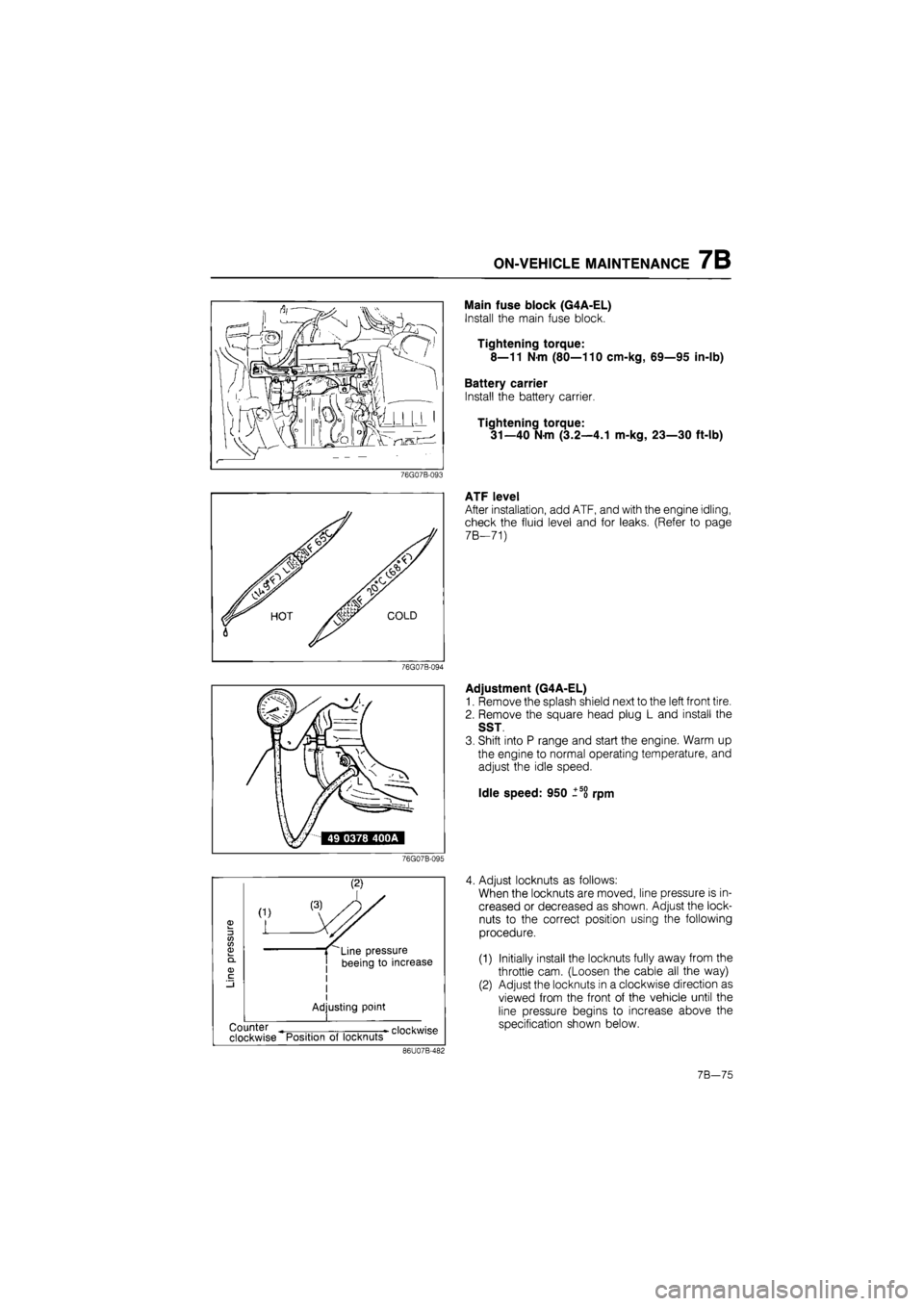
ON-VEHICLE MAINTENANCE 7B
'mfm^i! kfOl iff t—
76G07B-093
76G07B-094
Main fuse block (G4A-EL)
Install the main fuse block.
Tightening torque:
8—11 Nm (80—110 cm-kg, 69—95 in-lb)
Battery carrier
Install the battery carrier.
Tightening torque:
31—40 Nm (3.2—4.1 m-kg, 23—30 ft-lb)
ATF level
After installation, add ATF, and with the engine idling,
check the fluid level and for leaks. (Refer to page
7 B—71)
Adjustment (G4A-EL)
1. Remove the splash shield next to the left front tire.
2. Remove the square head plug L and install the
SST
3. Shift into P range and start the engine. Warm up
the engine to normal operating temperature, and
adjust the idle speed.
Idle speed: 950 ±5o rpm
76G07B-095
3 CO CO 03
(1)
L
Line pressure
beeing to increase
I
Adjusting point
•
clockwise Counter
clockwise Position of locknuts
86U07B-482
4. Adjust locknuts as follows:
When the locknuts are moved, line pressure is in-
creased or decreased as shown. Adjust the lock-
nuts to the correct position using the following
procedure.
(1) Initially install the locknuts fully away from the
throttle cam. (Loosen the cable all the way)
(2) Adjust the locknuts in a clockwise direction as
viewed from the front of the vehicle until the
line pressure begins to increase above the
specification shown below.
7B—75
Page 949 of 1865
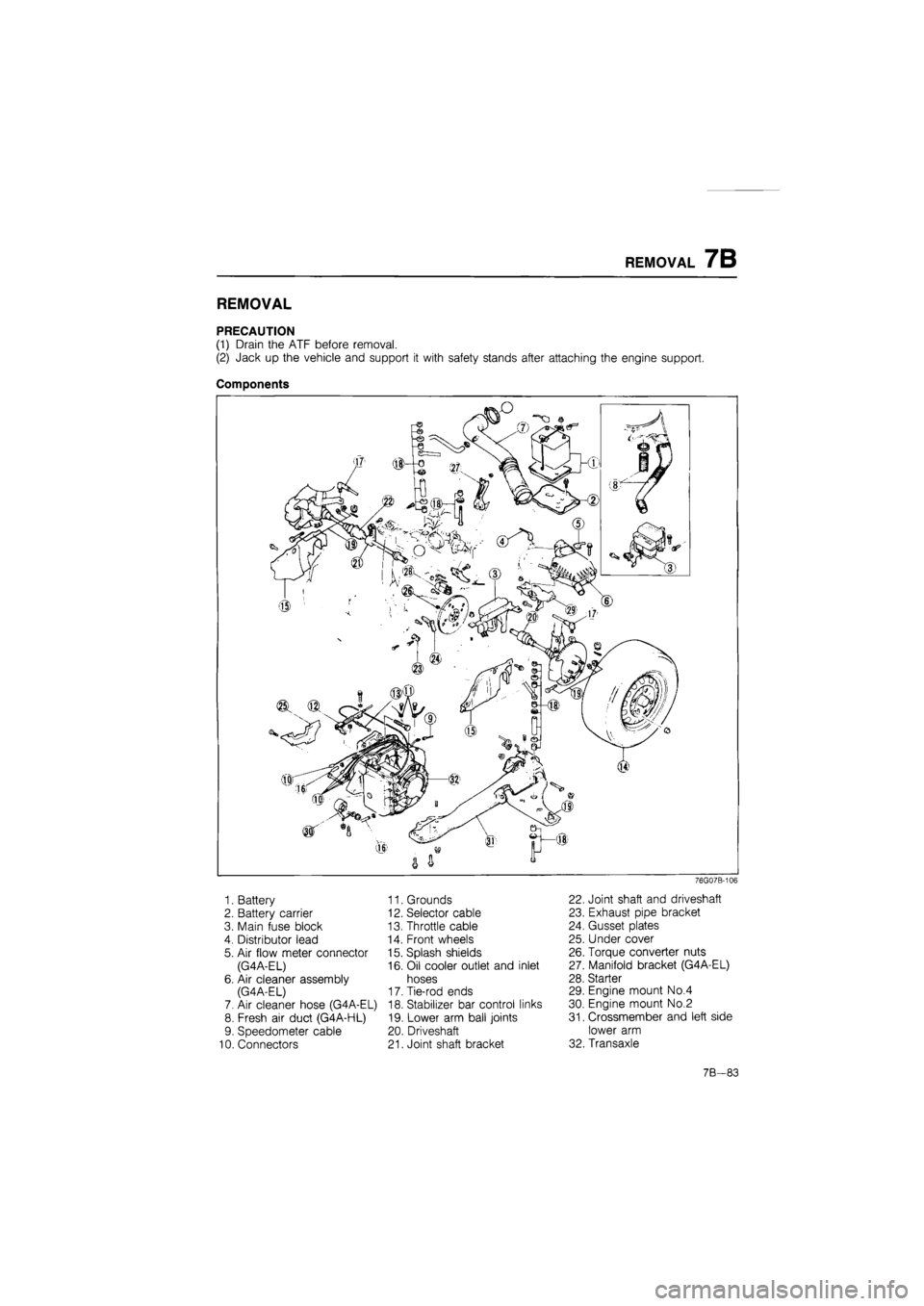
REMOVAL 7B
REMOVAL
PRECAUTION
(1) Drain the ATF before removal.
(2) Jack up the vehicle and support it with safety stands after attaching the engine support.
Components
1. Battery
2. Battery carrier
3. Main fuse block
4. Distributor lead
5. Air flow meter connector
(G4A-EL)
6. Air cleaner assembly
(G4A-EL)
7. Air cleaner hose (G4A-EL)
8. Fresh air duct (G4A-HL)
9. Speedometer cable
10. Connectors
11. Grounds
12. Selector cable
13. Throttle cable
14. Front wheels
15. Splash shields
16. Oil cooler outlet and inlet
hoses
17. Tie-rod ends
18. Stabilizer bar control links
19. Lower arm ball joints
20. Driveshaft
21. Joint shaft bracket
76G07B-106
22. Joint shaft and driveshaft
23. Exhaust pipe bracket
24. Gusset plates
25. Under cover
26. Torque converter nuts
27. Manifold bracket (G4A-EL)
28. Starter
29. Engine mount No.4
30. Engine mount No.2
31. Crossmember and left side
lower arm
32. Transaxle
7B—83