check oil MAZDA 626 1987 Owner's Manual
[x] Cancel search | Manufacturer: MAZDA, Model Year: 1987, Model line: 626, Model: MAZDA 626 1987Pages: 1865, PDF Size: 94.35 MB
Page 98 of 1865
1 A ASSEMBLY (CYLINDER BLOCK)
76G01A-074
86U01X-216
86U01X-127
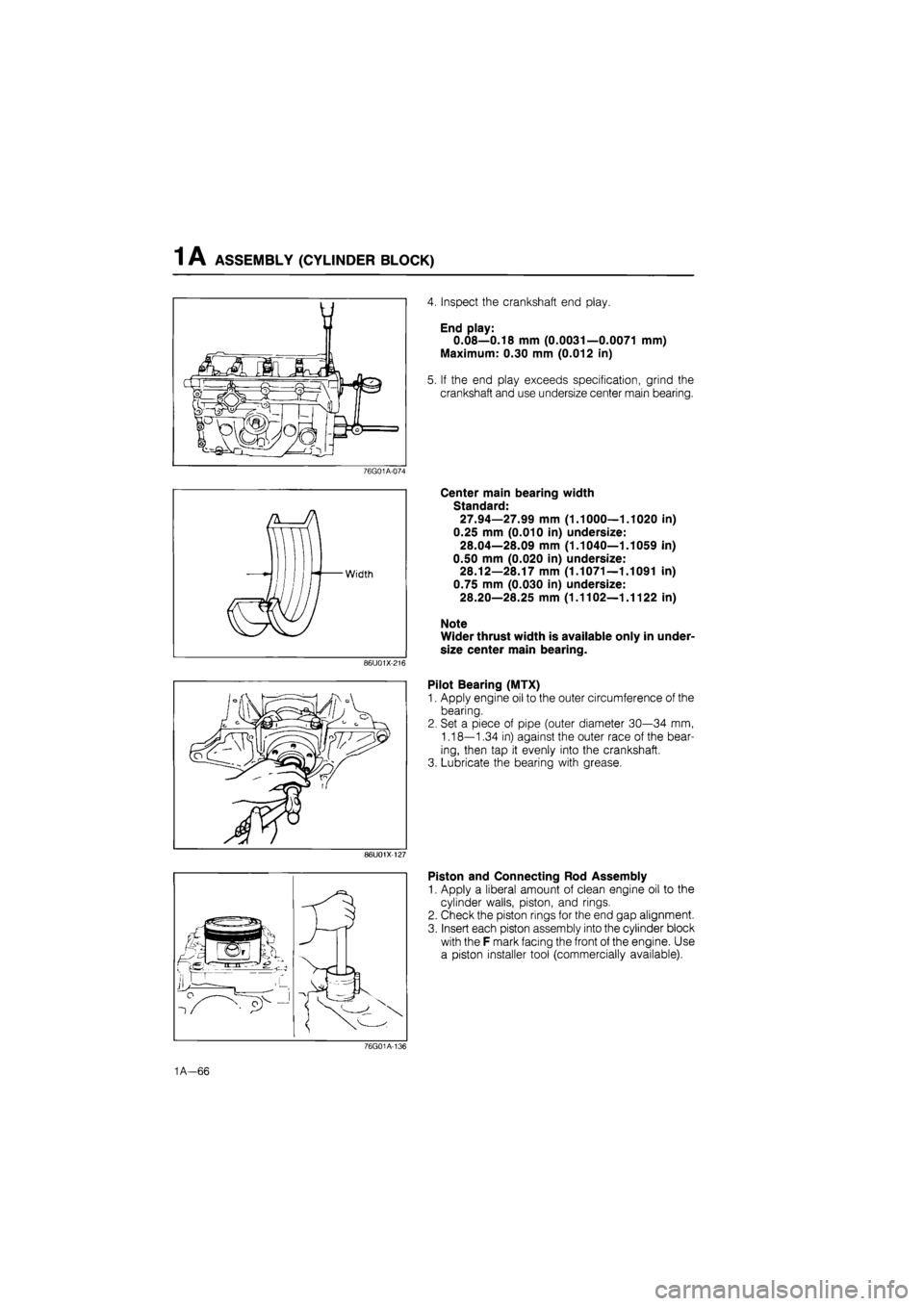
4. Inspect the crankshaft end play.
End play:
0.08—0.18 mm (0.0031—0.0071 mm)
Maximum: 0.30 mm (0.012 in)
5. If the end play exceeds specification, grind the
crankshaft and use undersize center main bearing.
Center main bearing width
Standard:
27.94—27.99 mm (1.1000—1.1020 in)
0.25 mm (0.010 in) undersize:
28.04—28.09 mm (1.1040—1.1059 in)
0.50 mm (0.020 in) undersize:
28.12—28.17 mm (1.1071—1.1091 in)
0.75 mm (0.030 in) undersize:
28.20—28.25 mm (1.1102—1.1122 in)
Note
Wider thrust width is available only in under-
size center main bearing.
Pilot Bearing (MTX)
1. Apply engine oil to the outer circumference of the
bearing.
2. Set a piece of pipe (outer diameter 30—34 mm,
1.18—1.34 in) against the outer race of the bear-
ing, then tap it evenly into the crankshaft.
3. Lubricate the bearing with grease.
Piston and Connecting Rod Assembly
1. Apply a liberal amount of clean engine oil to the
cylinder walls, piston, and rings.
2. Check the piston rings for the end gap alignment.
3. Insert each piston assembly into the cylinder block
with the F mark facing the front of the engine. Use
a piston installer tool (commercially available).
76G01A-136
1A—66
Page 99 of 1865
ASSEMBLY (CYLINDER BLOCK) 1 A
69G01B-137
Matin
76G01A-075
69G01B-139
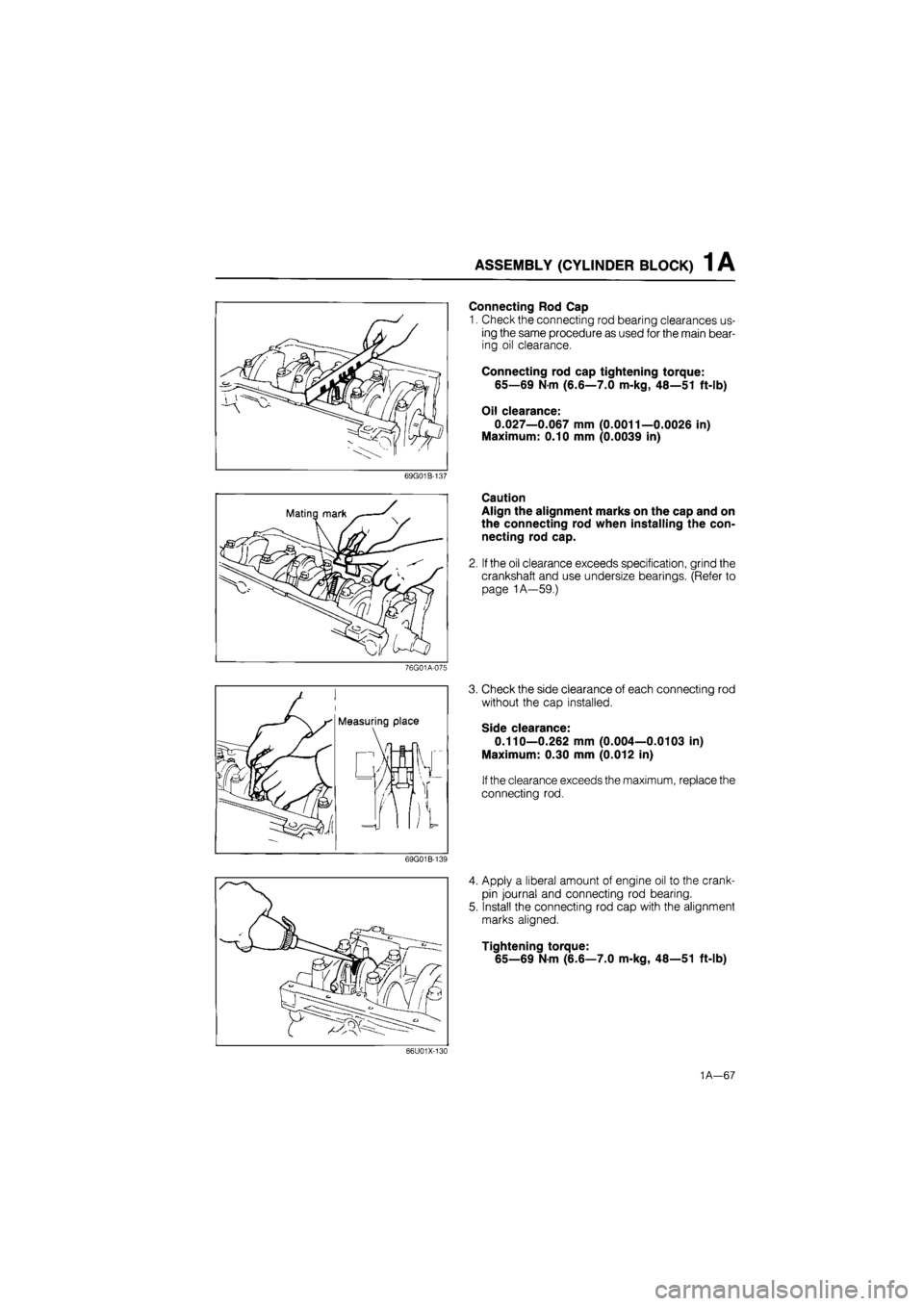
Connecting Rod Cap
1. Check the connecting rod bearing clearances us-
ing the same procedure as used for the main bear-
ing oil clearance.
Connecting rod cap tightening torque:
65—69 Nm (6.6—7.0 m-kg, 48—51 ft-lb)
Oil clearance:
0.027—0.067 mm (0.0011—0.0026 in)
Maximum: 0.10 mm (0.0039 in)
Caution
Align the alignment marks on the cap and on
the connecting rod when installing the con-
necting rod cap.
If the oil clearance exceeds specification, grind the
crankshaft and use undersize bearings. (Refer to
page 1A—59.)
3. Check the side clearance of each connecting rod
without the cap installed.
Side clearance:
0.110—0.262 mm (0.004—0.0103 in)
Maximum: 0.30 mm (0.012 in)
If the clearance exceeds the maximum, replace the
connecting rod.
4. Apply a liberal amount of engine oil to the crank-
pin journal and connecting rod bearing.
5. Install the connecting rod cap with the alignment
marks aligned.
Tightening torque:
65—69 Nm (6.6—7.0 m-kg, 48—51 ft-lb)
86U01X-130
1A—67
Page 116 of 1865

1A ASSEMBLY (TIMING BELT)
Tensioner lock bolt
69G01B-165
76G01A-085
79G01C-097
Timing Belt Idler Pulley
Install the timing belt idler pulley.
Tightening torque:
37—52 Nm (3.8—5.3 m-kg, 27—38 ft-lb)
Timing Belt Tensioner
1. Install the timing belt tensioner and tensioner
spring.
2. Tentatively secure the tensioner with the spring fully
extended.
Timing Belt
1. Install the timing belt, (keep the tension side of belt
as tight as possible.)
Caution
a) If the timing belt is being reused, it must be
reinstalled to rotate in the original direction.
b) Check that there is no oil, grease, or dirt on
the timing belt.
2. Loosen the tensioner lock bolt.
3. Turn the crankshaft twice in the direction of rotation.
4. Check that the mating marks are correctly aligned.
If not aligned, remove the timing belt and tension-
er, and repeat the above-mentioned procedure.
5. Tighten the timing belt tensioner lock bolt.
Tightening torque:
37—52 Nm (3.8—5.3 m-kg, 27—38 ft-lb)
4BGQ1A-186
1A—84
Page 131 of 1865

INSTALLATION 1A
76G01A-099
76G01A-100
Air Cleaner Assembly
1. Install the air cleaner assembly.
Tightening torque:
16—27
N
m (1.6—2.8 m-kg, 12—20 ft-lb)
2. Connect the air flow sensor connector and air in-
take pipe (Fl).
Engine Oil
Add the specified amount and type of engine oil. (Re-
fer to Section 2A.)
Coolant
Close the drain plug, fill the radiator and reservoir tank
with the specified amount and type of coolant. (Re-
fer to Section 3A.)
Check Engine Condition
1. Check for leaks.
2. Perform engine adjustments if necessary.
3. Perform a road test.
4. Recheck the oil and coolant levels.
86U01X-204
1A—99
Page 136 of 1865

TUNE-UP PROCEDURE 1 B
76G01A-102
TUNE-UP PROCEDURE
Tune the engine according to the procedures
described below.
Battery
1. Check for corrosion on the terminals, or loose ca-
ble connections.
If necessary, clean the clamps and tighten firmly.
2. Check that the electrolyte level is between the UP-
PER and LOWER marks.
Add distilled water if necessary.
3. Check the specific gravity by using a hydrometer.
If the specific gravity reading is 1.200 or less,
recharge the battery. (Refer to Section 5.)
76G01A-103
Air Cleaner Element
Visually check the air cleaner element for excessive
dirt, damage, or oil. Clean or replace if necessary.
Caution
When cleaning the air cleaner element, blow
dust off from the inside completely first, then
blow from the outside.
76G01B-005
Engine Oil
Check the engine oil level and condition with the oil
level gauge.
Add oil, or change it, if necessary.
4BG01A-010
1B—5
Page 139 of 1865
TUNE-UP PROCEDURE 1 B
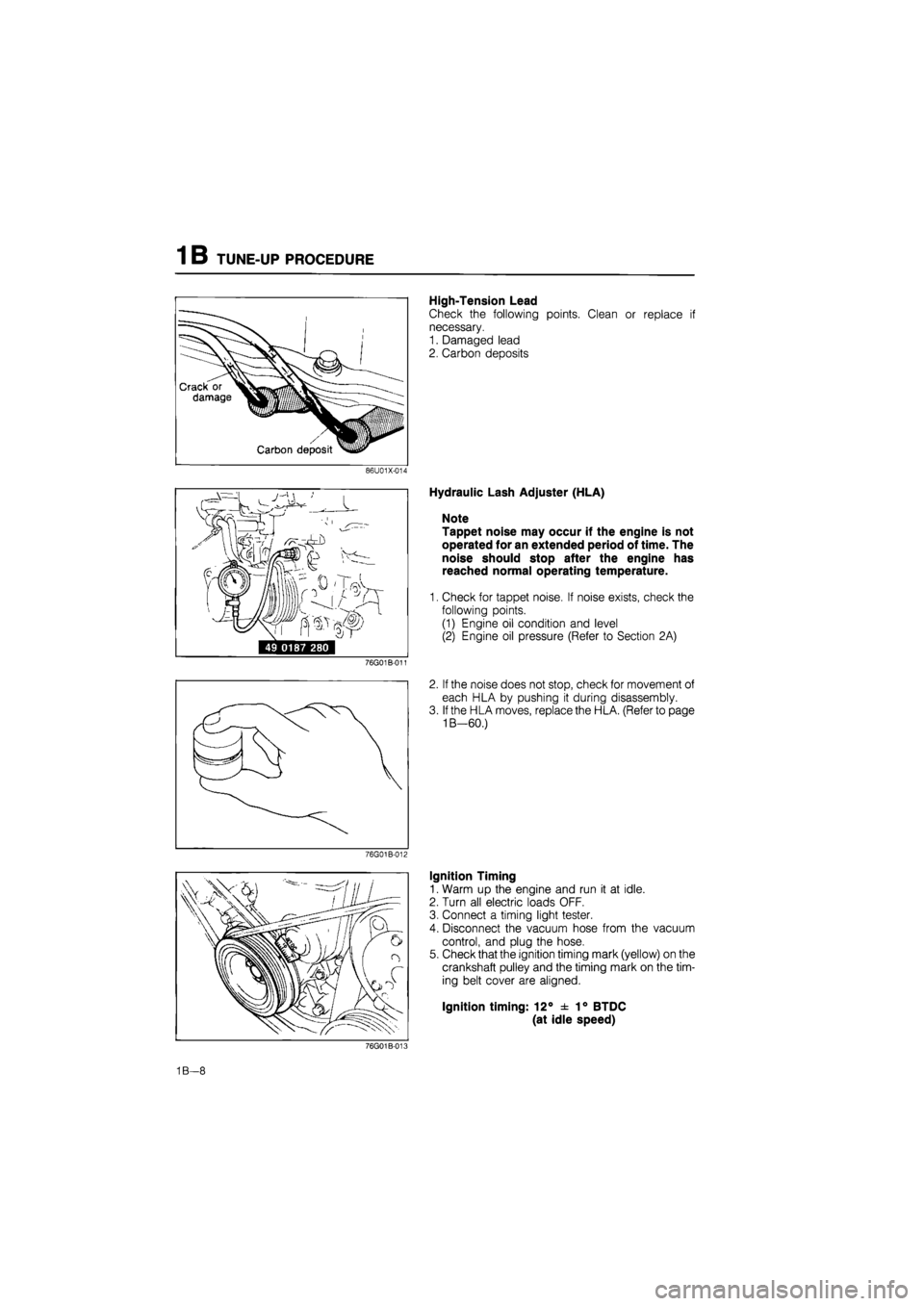
High-Tension Lead
Check the following points. Clean or replace if
necessary.
1. Damaged lead
2. Carbon deposits
86U01X-014
i^rrr ' /
49 0187 280
76G01B-011
76G01B-012
Hydraulic Lash Adjuster (HLA)
Note
Tappet noise may occur if the engine is not
operated for an extended period of time. The
noise should stop after the engine has
reached normal operating temperature.
1. Check for tappet noise. If noise exists, check the
following points.
(1) Engine oil condition and level
(2) Engine oil pressure (Refer to Section 2A)
2. If the noise does not stop, check for movement of
each HLA by pushing it during disassembly.
3. If the HLA moves, replace the HLA. (Refer to page
1B—60.)
Ignition Timing
1. Warm up the engine and run it at idle.
2. Turn all electric loads OFF.
3. Connect a timing light tester.
4. Disconnect the vacuum hose from the vacuum
control, and plug the hose.
5. Check that the ignition timing mark (yellow) on the
crankshaft pulley and the timing mark on the tim-
ing belt cover are aligned.
Ignition timing: 12° ± 1° BTDC
(at idle speed)
76G01B-008
1B—8
Page 141 of 1865
1 B ON-VEHICLE INSPECTION
76G01B-017
86U01X-020
76G01B-018
Possible Cause
ON-VEHICLE INSPECTION
If the engine exhibits low power, poor fuel economy,
or poor idle, check the following points.
1. Ignition system (Refer to Section 5)
2. Compression
3. Fuel system (Refer to Section 4C)
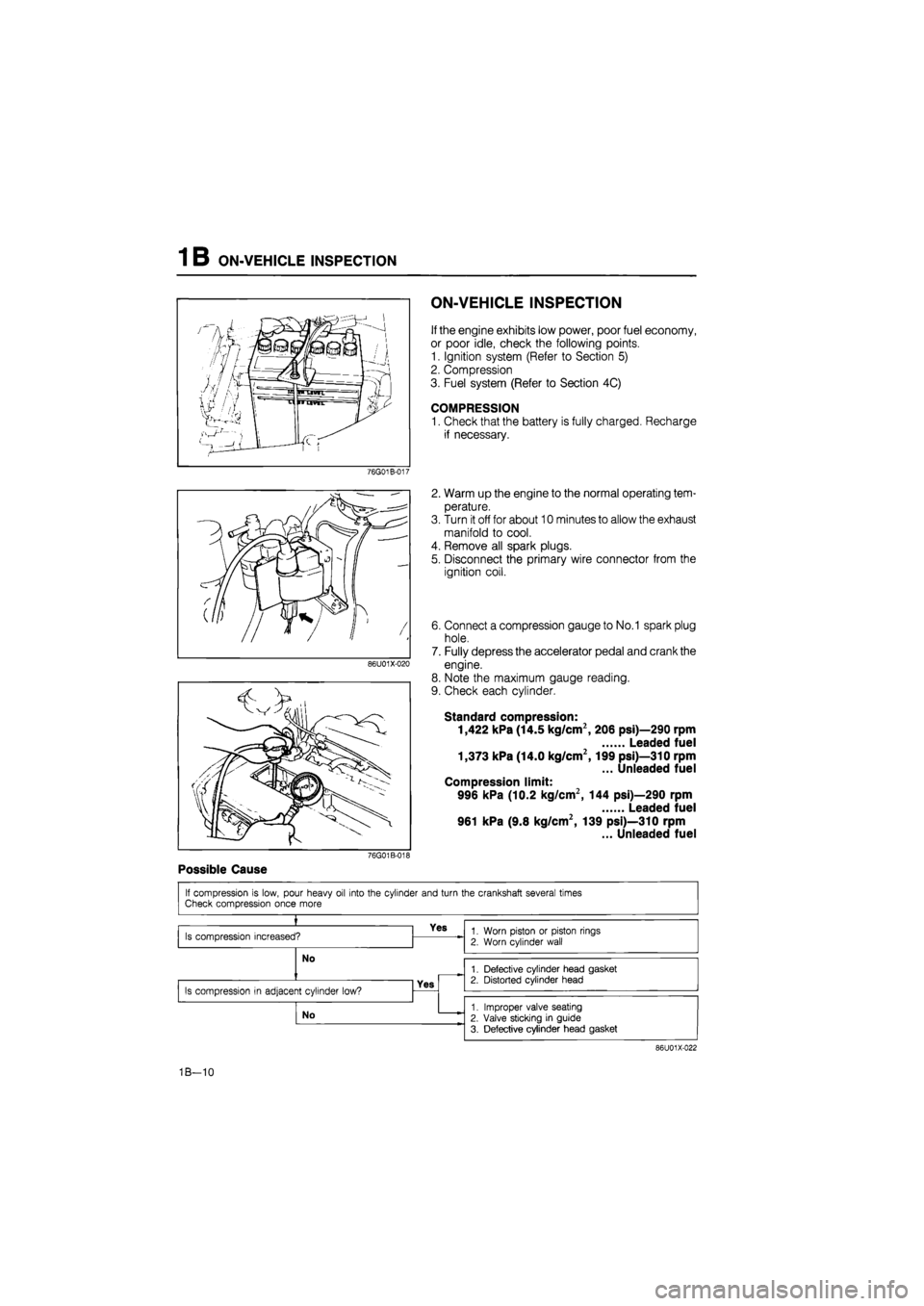
COMPRESSION
1. Check that the battery is fully charged. Recharge
if necessary.
2. Warm up the engine to the normal operating tem-
perature.
3. Turn it off for about 10 minutes to allow the exhaust
manifold to cool.
4. Remove all spark plugs.
5. Disconnect the primary wire connector from the
ignition coil.
6. Connect a compression gauge to No.1 spark plug
hole.
7. Fully depress the accelerator pedal and crank the
engine.
8. Note the maximum gauge reading.
9. Check each cylinder.
Standard compression:
1,422 kPa (14.5 kg/cm2, 206 psi)—290 rpm
Leaded fuel
1,373 kPa (14.0 kg/cm2,199 psi)—310 rpm
... Unleaded fuel
Compression limit:
996 kPa (10.2 kg/cm2, 144 psi)—290 rpm
Leaded fuel
961 kPa (9.8 kg/cm2, 139 psi)—310 rpm
... Unleaded fuel
If compression is low, pour heavy oil into the cylinder and turn the crankshaft several times Check compression once more
»
Is compression increased? Yes 1. Worn piston or piston rings
2. Worn cylinder wall
No
1. Worn piston or piston rings
2. Worn cylinder wall
No 1. Defective cylinder head gasket 2. Distorted cylinder head
Is compression in adjacent cylinder low? Yes
1. Defective cylinder head gasket 2. Distorted cylinder head
Is compression in adjacent cylinder low?
No 1. Improper valve seating
2. Valve sticking in guide
3. Defective cylinder head gasket
86U01X-022
1B—10
Page 145 of 1865

1 B ON-VEHICLE MAINTENANCE (TIMING BELT)
3. Install the timing belt tensioner and spring. Tem-
porarily secure it with the spring fully extended.
Caution
Do not damage the pulleys when securing the
tensioner pulley.
76G01B-024
4. Install the timing belt so that there is no looseness
at the tension side, and at the two camshaft pulleys.
Caution
a) If the timing belt is being reused, it must be
reinstalled to rotate in the original direction.
b) Check that there is no oil, grease, or dirt on
the timing belt.
76G01B-025
5. Loosen the tensioner lock bolt.
6. Turn the crankshaft twice in the direction of rota-
tion, and align the mating marks.
7. Check that the timing marks are correctly aligned.
If not aligned, remove the timing belt tensioner and
timing belt, and repeat steps 1—6.
69G01B-027
8. Turn the crankshaft to align the "S" mark of the
right side camshaft pulley with seal plate mating
mark.
Tighten the timing belt tensioner lock bolt.
Tightening torque:
37—52 Nm (3.8—5.3 m-kg, 27—38 ft-lb)
76G01B-026
1B—14
Page 164 of 1865

DISASSEMBLY (CYLINDER BLOCK) 1 B
76G01B-048
76G01B-049
79G01C-050
Main bearing cap
Before removing the main bearing caps, clean the
bearings, main journals, and caps, and measure the
following points.
1. Crankshaft end play. (Refer to page 1B—52.)
2. Main journal oil clearance. (Refer to page 1B—51.)
Pilot bearing
Remove the pilot bearing from the crankshaft with the
SST
Piston and connecting rod
1. Before disassembling the piston and connecting
rod, check the oscillation torque as shown in the
figure.
If the large end does not drop by its own weight,
replace the piston or the piston pin.
2. Remove the piston pin with the SST.
76G01B-050
1 B—33
Page 165 of 1865

1 B INSPECTION AND REPAIR
INSPECTION AND REPAIR
1. Clean all parts, taking care to remove any gasket fragments, dirt, oil or grease, carbon, moisture
residue, or other foreign materials.
2. Inspect and repair must be performed in the order specified.
Caution
Be careful not to damage the joints or friction surfaces of aluminum alloy components (such
as the cylinder head or pistons).
86U01X-077
79G01C-106
76G01B-051
Cylinder Head
1. Inspect the cylinder head for damage, cracks, and
leakage of water or oil. Replace if necessary.
2. Measure the cylinder head distortion in the six
directions shown in the figure.
Distortion: 0.15 mm (0.006 in) max.
3. If the cylinder head distortion exceeds specifica-
tion, grind the cylinder head surface.
If the cylinder head height is not within specifica-
tion, replace it.
Height:
133.95—134.05 mm (5.274—5.278 in)
Grinding limit: 0.20 mm (0.008 in) max.
Note
Before grinding the cylinder head, first check
the following. Replace if necessary.
• Sinking of valve seat
• Damage of manifold contact surface
• Camshaft oil clearance and end play
4. Measure the manifold contact surface distortion in
the six directions shown in the figure.
Distortion: 0.15 mm (0.006 in) max.
5. If distortion exceeds specification grind the surface
or replace the cylinder head.
79G01C-053
1B-34