seats MAZDA MODEL 6 2005 (in English) Owner's Manual
[x] Cancel search | Manufacturer: MAZDA, Model Year: 2005, Model line: MODEL 6, Model: MAZDA MODEL 6 2005Pages: 340, PDF Size: 3.73 MB
Page 46 of 340
Black plate (46,1)
Installing Child-Restraint
Systems
Accident statistics reveal that a child is
safer in the rear seat. The front passenger's
seat is clearly the worst choice for any
child under 12, and with rear-facing child-
restraint systems it is clearly unsafe due to
air bags.
Some child-restraint systems now come
with tethers and therefore must be
installed on the seats that take tethers to
be effective. In your Mazda, tethered
child-restraint systems can only be
accommodated in the three positions on
the rear seat.
Some child-restraint systems also employ
specially designed LATCH attachments;
refer to“LATCH Child-Restraint
Systems”(page 2-39).
WARNING
Tethered Child-Restraint SystemsWork Only on Tether-Equipped RearSeats:
Installation of a tether equipped child-
restraint system in the front
passenger's seat defeats the safety
design of the system and will result in
an increased chance of serious injury
if the child-restraint system goes
forward without benefit of being
tethered.
Place tether equipped child-restraint
systems where there are tether
anchors.
qRear Outboard Seat Child-
Restraint System Installation
Follow these instructions when using a
child-restraint system, unless you are
attaching a LATCH-equipped child-
restraint system to the rear LATCH lower
anchors. Refer to“LATCH Child-
Restraint Systems”(page 2-39).
NOTE
Follow the child-restraint system
manufacturer's instructions carefully. If
you are not sure whether you have a
LATCH system or tether, check in the
child-restraint system manufacturer's
instructions and follow them
accordingly. Depending on the type of
child-restraint system, it may not
employ seat belts which are in
automatic locking mode.
1. Make sure the seatback is securely
latched by pushing it back until it is
fully locked.
2. Secure the child-restraint system with
the lap portion of the lap/shoulder belt.
See the manufacturer's instructions on
the child-restraint system for belt
routing instructions.
2-32
Essential Safety Equipment
Child Restraint
Mazda6_8T56-EC-04G_Edition2 Page46
Monday, November 15 2004 4:32 PM
Form No.8T56-EC-04G
Page 50 of 340
Black plate (50,1)
qIf You Must Use the Front Seat
for Children
If you cannot put all children in the rear
seat, at least put the smallest children in
the rear and be sure the largest child up
front uses the shoulder belt over the
shoulder.
Do not put rear-facing child-restraint
systems on the front passenger's seat.
This seat is also not set up for tethered
child-restraint systems, put them in one of
the rear seat positions set up with tether
anchors.
Likewise the LATCH child-restraint
system cannot be secured in the front
passenger's seat and should be used in the
rear seat.
Don't allow anyone to sleep against the
right front or rear doors if you have an
optional side and curtain air bag, it could
cause serious injuries to an out of position
occupant. As children more often sleep in
cars, it is better to put them in the rear
seat. If installing the child-restraint system
on the front seat is unavoidable, follow
these instructions when using a front-
facing child-restraint system in the front
passenger's seat.
NOTE
lTo check if your front seats have side
air bags:
Every Mazda side air bag will have a
“SRS AIRBAG”tag on the outboard
shoulder of the front seats.
lTo check if your vehicle has curtain
air bags:
Every Mazda curtain air bag will
have an“SRS AIRBAG”marking on
the front and rear window pillars
along the roof edge.
WARNING
Front Passenger's Seat Position:
As your vehicle has front air bags and
doubly so if your vehicle has side air
bags, a front-facing child-restraint
system should be put on the front seat
only when it is unavoidable.
Always move the seat as far back as
possible, because the force of a
deploying air bag could cause serious
injury or death to the child.
Rear-Facing Child-Restraint System:
Rear-facing child-restraint systems on
the front seat are particularly
dangerous.
The child-restraint system can be hit
by a deploying air bag and moved
violently backward resulting in serious
injury or death to the child. NEVER
use a rear-facing child-restraint
system in the front seat with an air bag
that could deploy even in a moderate
collision.
2-36
Essential Safety Equipment
Child Restraint
Mazda6_8T56-EC-04G_Edition2 Page50
Monday, November 15 2004 4:32 PM
Form No.8T56-EC-04G
Page 54 of 340
Black plate (54,1)
qLATCH Child-Restraint System
Installation Procedure (Rear
Outboard Seats)
1. Make sure the seatback is securely
latched by pushing it back until it is
fully locked.
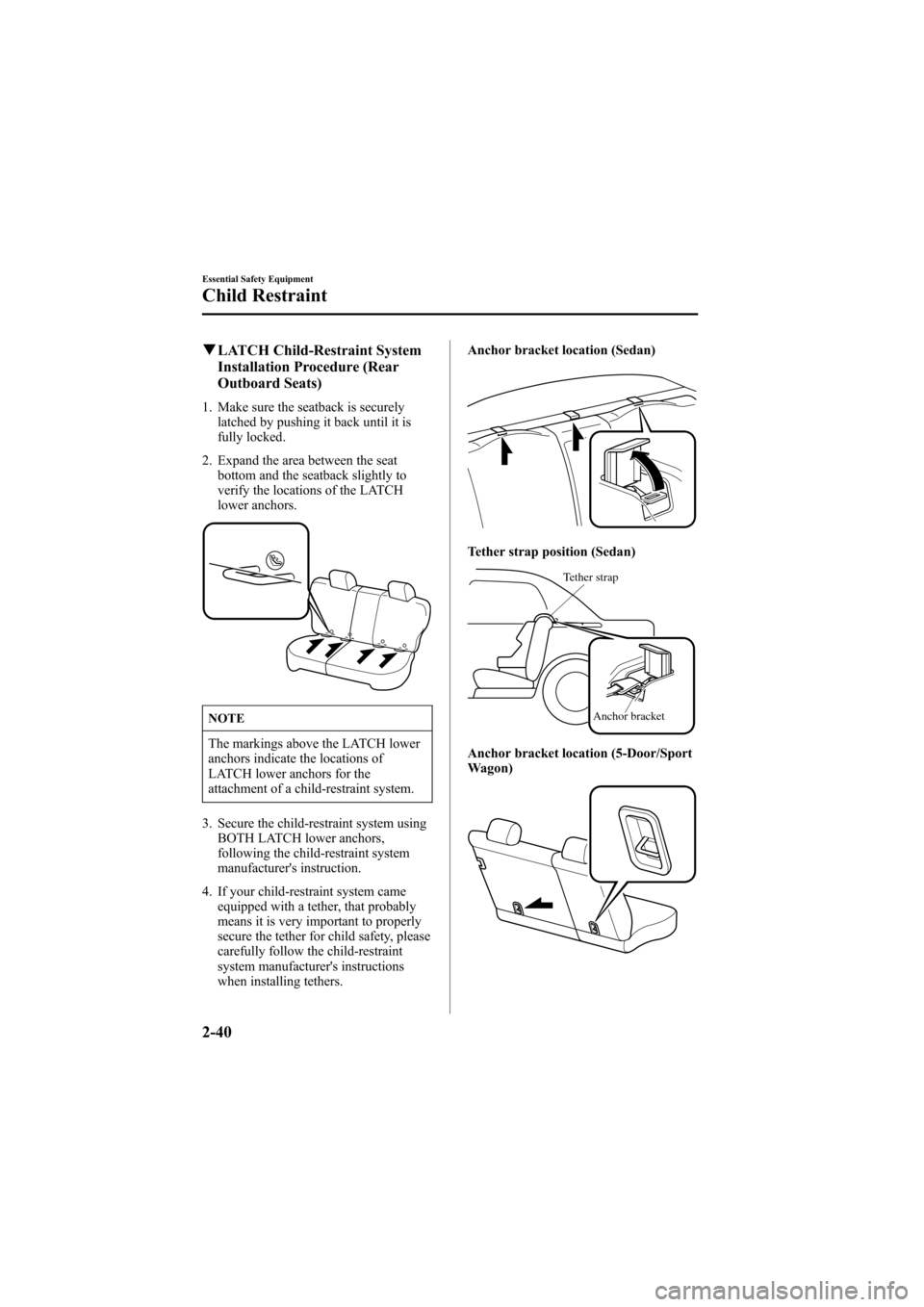
2. Expand the area between the seat
bottom and the seatback slightly to
verify the locations of the LATCH
lower anchors.
NOTE
The markings above the LATCH lower
anchors indicate the locations of
LATCH lower anchors for the
attachment of a child-restraint system.
3. Secure the child-restraint system using
BOTH LATCH lower anchors,
following the child-restraint system
manufacturer's instruction.
4. If your child-restraint system came
equipped with a tether, that probably
means it is very important to properly
secure the tether for child safety, please
carefully follow the child-restraint
system manufacturer's instructions
when installing tethers.Anchor bracket location (Sedan)
Tether strap position (Sedan)
Tether strap
Anchor bracket
Anchor bracket location (5-Door/Sport
Wagon)
2-40
Essential Safety Equipment
Child Restraint
Mazda6_8T56-EC-04G_Edition2 Page54
Monday, November 15 2004 4:32 PM
Form No.8T56-EC-04G
Page 58 of 340
Black plate (58,1)
Supplemental Restraint Systems (SRS) Precautions
The front and side supplemental restraint systems (SRS) include up to 6 air bags (verify
“SRS AIRBAG”location indicator marks).
They are located in:
lThe steering wheel hub (driver air bag)
lThe front passenger dashboard (front passenger air bag)
lThe outboard sides of the front seatbacks (side air bags)í
lThe front and rear window pillars, and the roof edge along both sides (curtain air bags)í
These systems operate independently depending on the type of accident encountered; if
you have side and curtain air bags, the side and curtain air bags are not likely to deploy on
both sides in the same accident because a vehicle is not often hit from both sides. The side
and curtain air bags and the frontal air bag system will not normally deploy during the
same type of accident unless a combination of frontal and side impacts occur.
The air bag supplemental restraint systems are designed to provide supplemental protection
only in the front seats in certain situations and the rear outside passenger positions only in
same-side collisions, so seat belts are always important in the following ways:
Without seat belt usage, the air bags cannot provide adequate protection during an accident.
Seat belt usage is necessary to:
lKeep the occupant from being thrown into an inflating air bag.
lReduce the possibility of injuries during an accident that is not designed for air bag
inflation, such as roll-over or rear impact.
lReduce the possibility of injuries in frontal or side collisions that are not severe enough
to activate the air bags.
lReduce the possibility of being thrown from your vehicle.
lReduce the possibility of injuries to lower body and legs during an accident because the
air bags provide no protection to these parts of the body.
lHold the driver in a position which allows better control of the vehicle.
Children should be protected by a child-restraint system. Laws vary on the size a child
must be to use a child-restraint system (page 2-28).
Carefully consider which child-restraint system is necessary for your child and follow the
installation directions in this Owner's Manual as well as the child-restraint system
manufacturer's instructions.
2-44
Essential Safety Equipment
íSome models.
SRS Air Bags
Mazda6_8T56-EC-04G_Edition2 Page58
Monday, November 15 2004 4:32 PM
Form No.8T56-EC-04G
Page 59 of 340
Black plate (59,1)
WARNING
Air Bags without Seat Belts:
Depending only on the air bags for protection during an accident is dangerous. Alone,
air bags may not prevent serious injuries. The appropriate air bags can be expected to
inflate only in collisions with frontal, near frontal or side forces that are at least
moderate. Vehicle occupants should always wear seat belts.
Child in the Front Seat:
Placing a child, 12 years or under, in the front seat is dangerous. The child could be
hit by a deploying air bag and be seriously injured or even killed. A sleeping child is
more likely to lean against the door and be hit by the side air bag in a moderate, right-
side collision. Whenever possible, always secure a child 12 years and under on the
rear seat with an appropriate child-restraint system for the child's age and size.
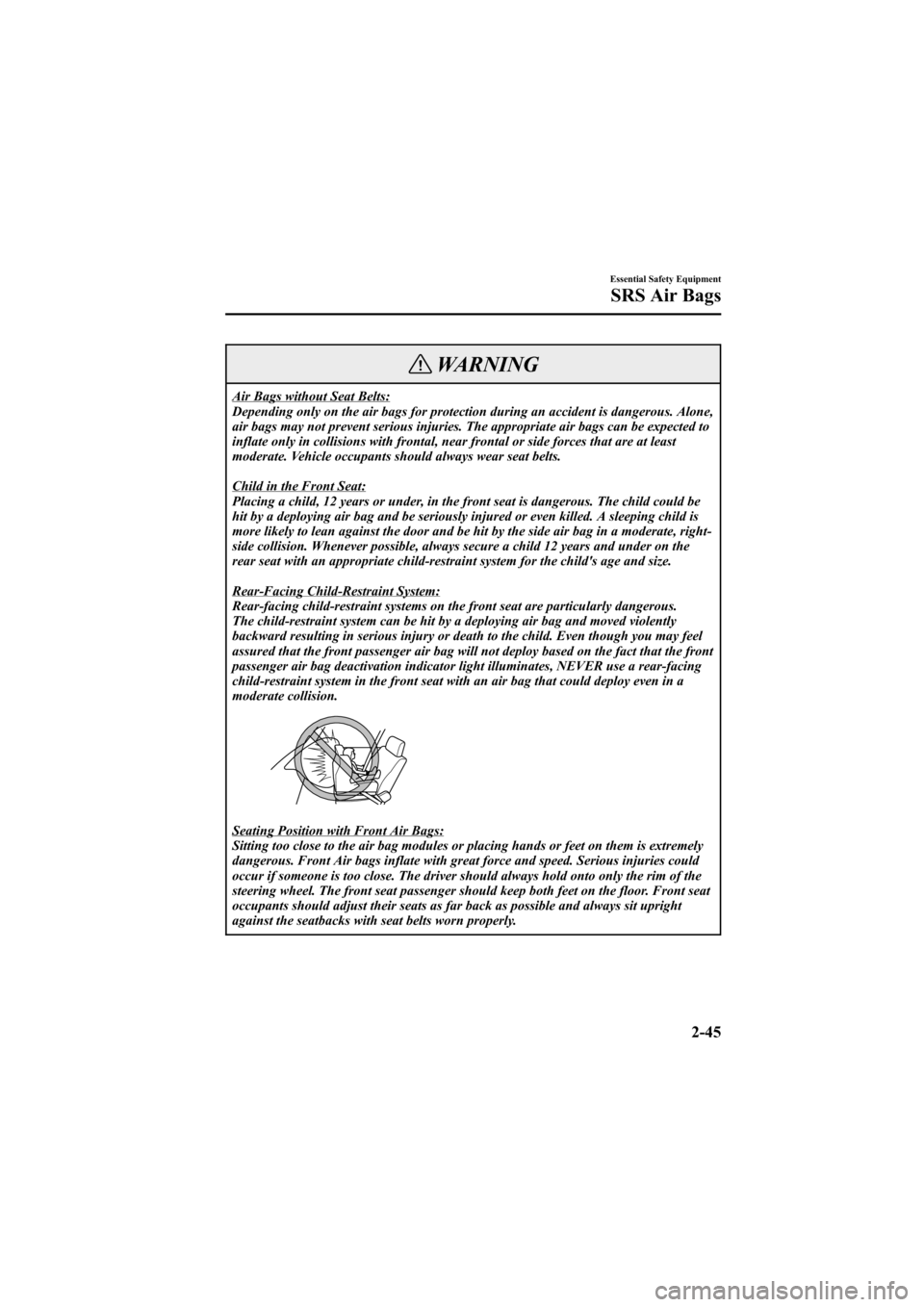
Rear-Facing Child-Restraint System:
Rear-facing child-restraint systems on the front seat are particularly dangerous.
The child-restraint system can be hit by a deploying air bag and moved violently
backward resulting in serious injury or death to the child. Even though you may feel
assured that the front passenger air bag will not deploy based on the fact that the front
passenger air bag deactivation indicator light illuminates, NEVER use a rear-facing
child-restraint system in the front seat with an air bag that could deploy even in a
moderate collision.
Seating Position with Front Air Bags:
Sitting too close to the air bag modules or placing hands or feet on them is extremely
dangerous. Front Air bags inflate with great force and speed. Serious injuries could
occur if someone is too close. The driver should always hold onto only the rim of the
steering wheel. The front seat passenger should keep both feet on the floor. Front seat
occupants should adjust their seats as far back as possible and always sit upright
against the seatbacks with seat belts worn properly.
Essential Safety Equipment
SRS Air Bags
2-45
Mazda6_8T56-EC-04G_Edition2 Page59
Monday, November 15 2004 4:32 PM
Form No.8T56-EC-04G
Page 60 of 340
Black plate (60,1)
WARNING
Seating Position with Side and Curtain Air Bags:
Sitting too close to the side air bag modules or placing hands on them is extremely
dangerous. The side air bags inflate with great force and speed directly out of the
outboard side of the front seat and expand along the front door on the side the car is
hit. Serious injury could occur if someone is sitting too close to the door or leaning
against a window, or if rear seat occupants grab the sides of the front seatbacks.
Furthermore, sleeping up against the door or hanging out the windows in the vehicle
could block the side and curtain air bags and eliminate the advantages of
supplemental protection. Give the side and curtain air bags room to work by sitting in
the center of the seat while the vehicle is moving with seat belts worn properly.
Front Air Bag Modules located in the steering wheel hub and the dashboard:
Attaching an object to the front air bag modules or placing something in front of them
is dangerous. In an accident, the object could interfere with front air bag inflation and
injure the occupants.
Always keep the front air bag modules free of objects.
Side Air Bag Modules:
Attaching things to the front seat in such a way as to cover the outboard side of the
seat in any way is dangerous. In an accident the object could interfere with the side air
bag, which inflates from the outboard side of the front seats, impeding the added
protection of the side air bag system or redirecting the air bag in a way that is
dangerous. Furthermore, the bag could be cut open spewing exhaust.
Do not hang net bags, map pouches or backpacks with side straps on the front seats.
Never use seat covers on the front seats. Always keep the side air bag modules in your
front seats free to deploy in the event of a side collision.
Curtain Air Bag Modules:
Attaching objects to the areas where the curtain air bag activates such as on the
windshield glass, side door glass, front and rear window pillars and along the roof
edge and assist grips is dangerous. In an accident the object could interfere with the
curtain air bag, which inflates from the front and rear window pillars and along the
roof edge, impeding the added protection of the curtain air bag system or redirecting
the air bag in a way that is dangerous. Furthermore, the bag could be cut open
spewing exhaust.
Do not place hangers or any other objects on the assist grips. When hanging clothes,
hang them on the coat hook directly. Always keep the curtain air bag modules free to
deploy in the event of a side collision.
2-46
Essential Safety Equipment
SRS Air Bags
Mazda6_8T56-EC-04G_Edition2 Page60
Monday, November 15 2004 4:32 PM
Form No.8T56-EC-04G
Page 61 of 340
Black plate (61,1)
WARNING
Hot Air Bag Inflators:
Hot air bag inflators are dangerous. Immediately after inflation, the inflators in the
steering wheel, dashboard, seatbacks, or the front and rear window pillars and along
the roof edge are very hot. You could get burned. Don't touch the internal components
of the air bag modules after the bags have inflated.
Installation of Front-End Equipment:
Installation of front-end equipment, such as frontal protection bar (kangaroo bar, bull
bar, push bar, etc.), snowplow, or winches, is dangerous. The air bag crash sensor
system could be affected. This could cause air bags to inflate unexpectedly, or it could
prevent the air bags from inflating during an accident. Front occupants could be
seriously injured. Never install any front-end equipment to your vehicle.
Suspension Adjustment:
Adjusting the vehicle suspension is dangerous. If the vehicle's height or the
suspension is changed, the vehicle will be unable to accurately detect a collision
resulting in incorrect or unexpected air bag deployment and the possibility of serious
injuries.
Modification of the Supplemental Restraint System:
Modifying the components or wiring of the supplemental restraint system is
dangerous. You could accidentally activate it or make it inoperable. Don't make any
modifications to the supplemental restraint system. This includes installing trim,
badges, or anything else over the air bag modules. It also includes installing extra
electrical equipment on or near system components or wiring. An Authorized Mazda
Dealer can provide the special care needed in the removal and installation of front
seats. It is important to protect the side and curtain air bag wiring and connections to
assure that the bags do not accidentally deploy and that the seats retain an
undamaged air bag connection.
CAUTION
To prevent damage to the side and curtain air bag wiring, don't place luggage or other
objects under the front seats.
Essential Safety Equipment
SRS Air Bags
2-47
Mazda6_8T56-EC-04G_Edition2 Page61
Monday, November 15 2004 4:32 PM
Form No.8T56-EC-04G
Page 64 of 340
Black plate (64,1)
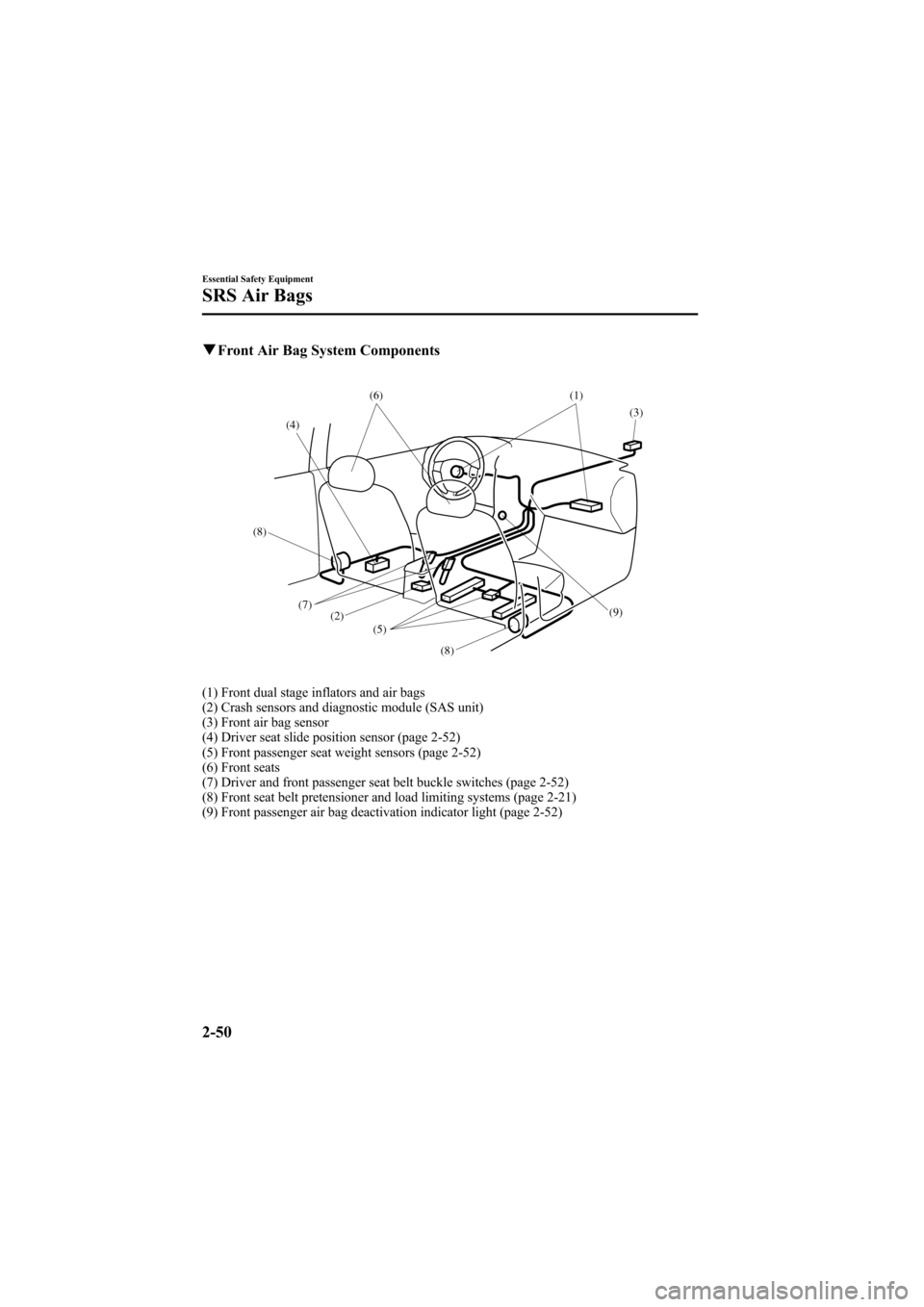
qFront Air Bag System Components
(4)
(8)
(7)
(5)
(8) (2)(9)(3) (1) (6)
(1) Front dual stage inflators and air bags
(2) Crash sensors and diagnostic module (SAS unit)
(3) Front air bag sensor
(4) Driver seat slide position sensor (page 2-52)
(5) Front passenger seat weight sensors (page 2-52)
(6) Front seats
(7) Driver and front passenger seat belt buckle switches (page 2-52)
(8) Front seat belt pretensioner and load limiting systems (page 2-21)
(9) Front passenger air bag deactivation indicator light (page 2-52)
2-50
Essential Safety Equipment
SRS Air Bags
Mazda6_8T56-EC-04G_Edition2 Page64
Monday, November 15 2004 4:32 PM
Form No.8T56-EC-04G
Page 65 of 340
Black plate (65,1)
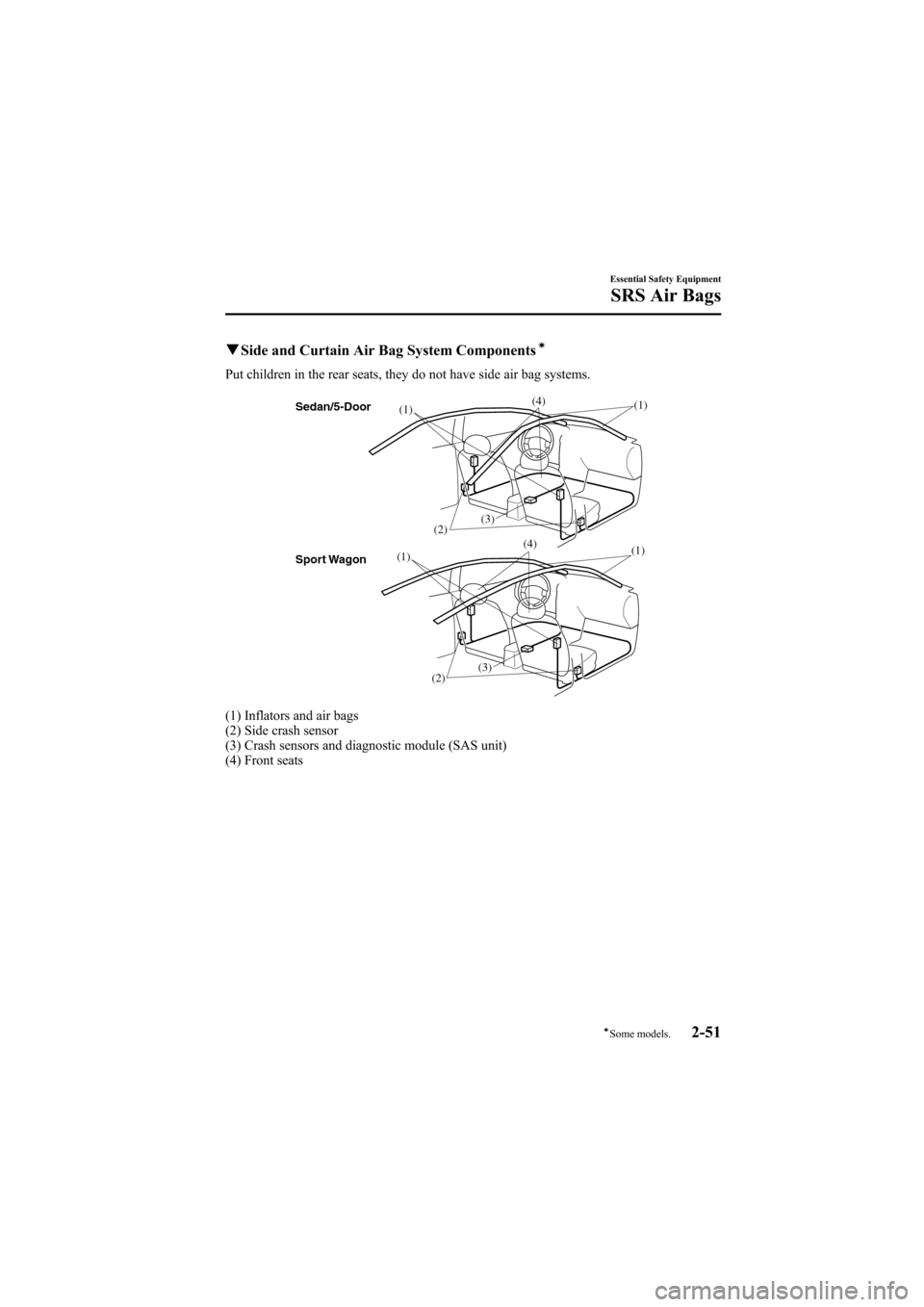
qSide and Curtain Air Bag System Componentsí
Put children in the rear seats, they do not have side air bag systems.
Sedan/5-Door
Sport Wagon
(2) (1)(1)
(3)(4)
(3)
(2) (1)(1) (4)
(1) Inflators and air bags
(2) Side crash sensor
(3) Crash sensors and diagnostic module (SAS unit)
(4) Front seats
Essential Safety Equipment
SRS Air Bags
2-51íSome models. Mazda6_8T56-EC-04G_Edition2 Page65
Monday, November 15 2004 4:32 PM
Form No.8T56-EC-04G
Page 69 of 340
Black plate (69,1)
WARNING
Increasing the Total Seated Weight on the Front Passenger Seat:
When an infant or small child sits on the front passenger seat, increasing the total
seated weight on the front passenger seat from the total seated weight of
approximately 30 kg (66 lb) is dangerous. The front passenger seat weight sensors will
detect the increased total seated weight, which could result in the unexpected
deployment of the front passenger front and side air bags and seat belt pretensioner
system in an accident and serious injury. Increasing the total seated weight on the
front passenger seat from the total seated weight of approximately 30 kg (66 lb) could
result in the front passenger front and side air bags and seat belt pretensioner system
deployment in an accident under the following conditions, for example:
lLuggage or other items are placed on the seat with the child in the child-restraint
system.
lA rear passenger or luggage push or pull down on the front passenger seatback.lA rear passenger steps on the front passenger seat rails with the feet.lLuggage or other items are placed on the seatback or hung on the assist grip, head
restraint.
lThe seat is washed.lLiquids are spilled on the seat.lThe front passenger seat is moved backward, pushing into luggage or other items
placed behind it.
lThe front passenger seatback contacts the rear seat.lLuggage or other items are placed between the front passenger seat and driver seat.lAny accessories which might increase the total seated weight on the front passenger
seat are attached to the front passenger seat.
CAUTION
lTo assure proper deployment of the front air bag and to prevent damage to the sensors
in the front seat bottoms:
lDo not place sharp objects on the front seat bottoms or leave heavy luggage on
them.
lDo not spill any liquids on the front seats or under the front seats.
lTo allow the sensors to function properly, always perform the following:
lAdjust the front seats as far back as possible and always sit upright against the
seatbacks with seat belts worn properly.
lIf you place your child on the front passenger seat, secure the child-restraint system
properly and slide the front passenger seat as far back as possible (page 2-37).
Essential Safety Equipment
SRS Air Bags
2-55
Mazda6_8T56-EC-04G_Edition2 Page69
Monday, November 15 2004 4:32 PM
Form No.8T56-EC-04G