towing capacity MAZDA MODEL B3000 TRUCK 2007 Owners Manual
[x] Cancel search | Manufacturer: MAZDA, Model Year: 2007, Model line: MODEL B3000 TRUCK, Model: MAZDA MODEL B3000 TRUCK 2007Pages: 280, PDF Size: 1.95 MB
Page 137 of 280
WARNING: Exceeding any vehicle weight rating limitation
could result in serious damage to the vehicle and/or personal
injury.
Steps for determining the correct load limit: 1. Locate the statement “The combined weight of occupants and cargo should never exceed XXX kg or XXX lbs.” on your vehicle’s placard.
2. Determine the combined weight of the driver and passengers that will be riding in your vehicle.
3. Subtract the combined weight of the driver and passengers from XXX kg or XXX lbs.
4. The resulting figure equals the available amount of cargo and luggage load capacity. For example, if the “XXX” amount equals
1,400 lbs. and there will be five 150 lb. passengers in your vehicle,
the amount of available cargo and luggage load capacity is 650 lbs.
(1400–750 (5 x 150) = 650 lb.). In metric units (635–340 (5 x 68) =
295 kg.)
5. Determine the combined weight of luggage and cargo being loaded on the vehicle. That weight may not safely exceed the available
cargo and luggage load capacity calculated in Step 4.
6. If your vehicle will be towing a trailer, load from your trailer will be transferred to your vehicle. Consult this manual to determine how
this reduces the available cargo and luggage load capacity of your
vehicle.
The following gives you a few examples on how to calculate the available
amount of cargo and luggage load capacity:
• Another example for your vehicle with 1400 lb. (635 kg) of cargo and
luggage capacity. You decide to go golfing. Is there enough load
capacity to carry you, 4 of your friends and all the golf bags? You and
four friends average 220 lb. (99 kg) each and the golf bags weigh
approximately 30 lb. (13.5 kg) each. The calculation would be: 1400 –
(5 x 220) – (5 x 30) = 1400 – 1100 – 150 = 150 lb. Yes, you have
enough load capacity in your vehicle to transport four friends and
your golf bags. In metric units, the calculation would be: 635 kg — (5
x 99 kg) — (5 x 13.5 kg) = 635 — 495 — 67.5 = 72.5 kg.
• A final example for your vehicle with 1400 lb. (635 kg) of cargo and
luggage capacity. You and one of your friends decide to pick up
cement from the local home improvement store to finish that patio
2007 B-Series (mbs)
Owners Guide (post-2002-fmt)
USA (fus)
Tires, Wheels and Loading
137
Page 138 of 280
you have been planning for the past 2 years. Measuring the inside of
the vehicle with the rear seat folded down, you have room for 12-100
lb. (45 kg) bags of cement. Do you have enough load capacity to
transport the cement to your home? If you and your friend each weigh
220 lb. (99 kg), the calculation would be: 1400 – (2 x 220) – (12 x
100) = 1400 – 440 – 1200 = – 240 lb. No, you do not have enough
cargo capacity to carry that much weight. In metric units, the
calculation would be: 635 kg — (2 x 99 kg) — (12 x 45 kg) = 635 —
198 — 540 = —103 kg. You will need to reduce the load weight by at
least 240 lb. (104 kg). If you remove 3-100 lb. (45 kg) cement bags,
then the load calculation would be:
1400 – (2 x 220) – (9 x 100) = 1400 – 440 – 900 = 60 lb. Now you
have the load capacity to transport the cement and your friend home.
In metric units, the calculation would be: 635 kg — (2 x 99 kg) — (9
x 45 kg) = 635 — 198 — 405 = 32 kg.
The above calculations also assume that the loads are positioned in your
vehicle in a manner that does not overload the Front or the Rear Gross
Axle Weight Rating specified for your vehicle on the Safety Compliance
Certification Label found on the edge of the driver’s door.
Special loading instructions for owners of pickup trucks and
utility-type vehicles
WARNING: For important information regarding safe operation
of this type of vehicle, see the Preparing to drive your vehicle
section in the Drivingchapter of this Owner’s Guide.
WARNING: Loaded vehicles may handle differently than
unloaded vehicles. Extra precautions, such as slower speeds and
increased stopping distance, should be taken when driving a
heavily loaded vehicle.
Your vehicle can haul more cargo and people than most passenger cars.
Depending upon the type and placement of the load, hauling cargo and
people may raise the center of gravity of the vehicle.
TRAILER TOWING
Your vehicle may tow a class I, II or III trailer provided the maximum
trailer weight is less than or equal to the maximum trailer weight listed
for your engine and rear axle ratio on the following charts.
2007 B-Series (mbs)
Owners Guide (post-2002-fmt)
USA (fus)
Tires, Wheels and Loading
138
Page 139 of 280
Your vehicle’s load capacity is designated by weight, not by volume, so
you cannot necessarily use all available space when loading a vehicle.
Towing a trailer places an additional load on your vehicle’s engine,
transmission, axle, brakes, tires and suspension. Inspect these
components carefully after any towing operation.
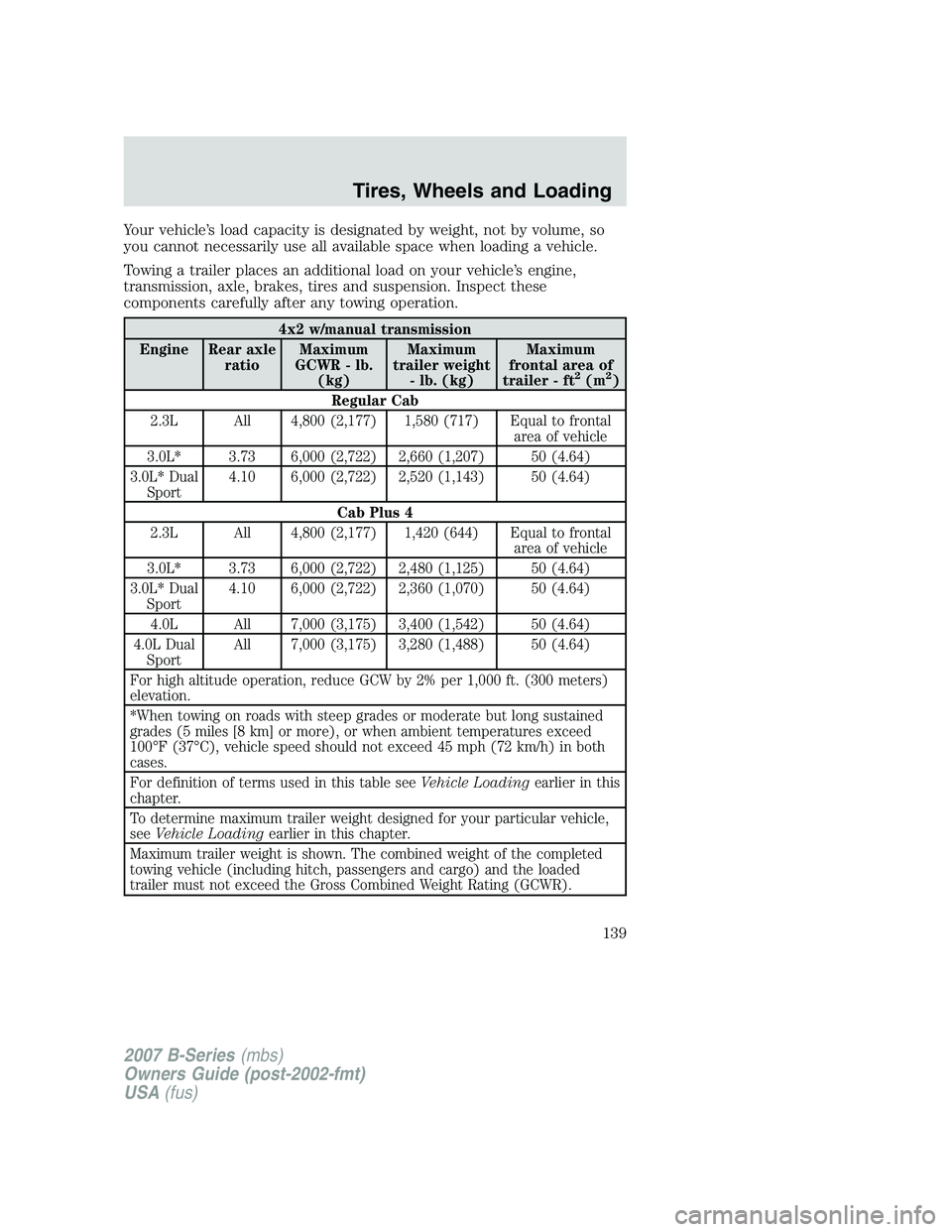
4x2 w/manual transmission
Engine Rear axle ratioMaximum
GCWR - lb. (kg) Maximum
trailer weight - lb. (kg) Maximum
frontal area of
trailer - ft
2(m2)
Regular Cab
2.3L All 4,800 (2,177) 1,580 (717) Equal to frontal area of vehicle
3.0L* 3.73 6,000 (2,722) 2,660 (1,207) 50 (4.64)
3.0L* Dual Sport 4.10 6,000 (2,722) 2,520 (1,143) 50 (4.64)
Cab Plus 4
2.3L All 4,800 (2,177) 1,420 (644) Equal to frontal area of vehicle
3.0L* 3.73 6,000 (2,722) 2,480 (1,125) 50 (4.64)
3.0L* Dual Sport 4.10 6,000 (2,722) 2,360 (1,070) 50 (4.64)
4.0L All 7,000 (3,175) 3,400 (1,542) 50 (4.64)
4.0L Dual Sport All 7,000 (3,175) 3,280 (1,488) 50 (4.64)
For high altitude operation, reduce GCW by 2% per 1,000 ft. (300 meters)
elevation.
*When towing on roads with steep grades or moderate but long sustained
grades (5 miles [8 km] or more), or when ambient temperatures exceed
100°F (37°C), vehicle speed should not exceed 45 mph (72 km/h) in both
cases.
For definition of terms used in this table see Vehicle Loadingearlier in this
chapter.
To determine maximum trailer weight designed for your particular vehicle,
see Vehicle Loading earlier in this chapter.
Maximum trailer weight is shown. The combined weight of the completed
towing vehicle (including hitch, passengers and cargo) and the loaded
trailer must not exceed the Gross Combined Weight Rating (GCWR).
2007 B-Series (mbs)
Owners Guide (post-2002-fmt)
USA (fus)
Tires, Wheels and Loading
139