fuel MAZDA MODEL B4000 2003 Owner's Manual
[x] Cancel search | Manufacturer: MAZDA, Model Year: 2003, Model line: MODEL B4000, Model: MAZDA MODEL B4000 2003Pages: 250, PDF Size: 2.85 MB
Page 146 of 250

Fuse/RelayLocation Fuse Amp
Rating Power Distribution Box
Description
8 20A* Central security module, Power
door locks, Remote entry
9 — Not used
10 — Not used
11 50A** Starter relay, Ignition switch
12 20A* Power windows
13 — Not used
14 — Not used
15 — Not used
16 40A** Blower motor
17 20A** Auxiliary cooling fan
18 — Not used
19 — Not used
20 — Not used
21 10A* PCM memory
22 — Not used
23 20A* Fuel pump motor
24 30A* Headlamps
25 10A* A/C clutch relay
26 — Not used
27 — Not used
28 30A* ABS module
29 — Not used
30 15A* Trailer Tow
31 20A* Foglamp, Daytime Running Lamps
(DRL)
32 — Not used
33 15A* Park lamp, Central security
module
34 — Not used
35 — Not used
Roadside Emergencies
146
Page 147 of 250

Fuse/RelayLocation Fuse Amp
Rating Power Distribution Box
Description
36 — Not used
37 — Not used
38 10A* Left headlamp low beam
39 — Not used
40 — Not used
41 20A* Heated oxygen sensors
42 10A* Right headlamp low beam
43 — (Resistor)
44 — Not used
45A — Wiper HI/LO relay 45B — Wiper park/run relay
46A — Fuel pump relay 46B — Trailer tow relay 47 — Starter relay
48 — Auxiliary cooling fan relay
49 — Not used
50 — Not used
51 — Not used
52 — Not used
53 — PCM Diode
54 — PCM Relay
55 — Blower motor relay
56A — A/C clutch relay 56B — Front washer pump relay
* Mini Fuses ** Maxi Fuses
Roadside Emergencies
147
Page 149 of 250

Fuse/RelayLocation Fuse Amp
Rating Power Distribution Box
Description
14 — Not used
15 — Not used
16 40A** Blower motor
17 — Not used
18 — Not used
19 — Not used
20 — Not used
21 10A* Powertrain Control Module (PCM) memory
22 — Not used
23 20A* Fuel pump motor
24 30A* Headlamps
25 10A* A/C clutch solenoid
26 — Not used
27 — Not used
28 30A* Anti-lock Brake System (ABS) module
29 — Not used
30 15A* Trailer tow
31 20A* Foglamps, Daytime Running Lamps (DRL)
32 — Not used
33 15A* Park lamp
34 — Not used
35 — Not used
36 — Not used
37 — Not used
38 10A* Left headlamp low beam
39 — Not used
40 — Not used
41 20A* Heated oxygen sensors
Roadside Emergencies
149
Page 150 of 250

Fuse/RelayLocation Fuse Amp
Rating Power Distribution Box
Description
42 10A* Right headlamp low beam
43 — Not used
44 — Not used
45A — Wiper HI/LO relay 45B — Wiper park/run relay
46A — Fuel pump relay 46B — Trailer tow relay
47A — A/C clutch solenoid relay 47B — Front washer pump relay
48A — Fog lamps 48B — Fog lamp relay 51 — Not used
52 — Not used
53 — Powertrain Control Module (PCM) Diode
54 — Powertrain Control Module (PCM)
55 — Blower relay
56 — Starter relay
* Mini Fuses ** Maxi Fuses
OVERHEATING
If the temperature gauge indicates overheating and you experience
power loss, you hear a loud knocking or pinging noise, the engine is
probably too hot.
If this happens: 1. Drive safely to the side of the road and park off the right-of-way.
2. Shift the automatic transmission into P (Park) or the manual transmission into the neutral position, and apply the parking brake.
3. Turn off the air conditioner.
WARNING: Steam from an overheated engine is dangerous. The
escaping steam could seriously burn you. Open the hood ONLY
after steam is no longer escaping from the engine.
Roadside Emergencies
150
Page 161 of 250

3. Connect the negative (-) cable to the negative (-) terminal of theassisting battery.
4. Make the final connection of the negative (-) cable to an exposed metal part of the stalled vehicle’s engine, away from the battery and
the carburetor/fuel injection system. Do notuse fuel lines, engine
rocker covers or the intake manifold as groundingpoints.
WARNING: Do not connect the end of the second cable to the
negative (-) terminal of the battery to be jumped. A spark may
cause an explosion of the gases that surround the battery.
5. Ensure that the cables are clear of fan blades, belts, moving parts of both engines, or any fuel delivery system parts.
Jump starting 1. Start the engine of the booster vehicle and run the engine at moderately increased speed.
2. Start the engine of the disabled vehicle.
3. Once the disabled vehicle has been started, run both engines for an additional three minutes before disconnecting the jumper cables.
+–+–
+–+–
2003 Mazda B Series (mbs)
New Owners Guide own2002 (own2002)
USA English (fus)
Roadside Emergencies
161
Page 172 of 250

•California Emission Control Warranty (if applicable)
• Replacement Parts and Accessories Limited Warranty
• Tire Warranty
NOTE: Detailed warranty information is provided with your Mazda
portfolio.
OUTSIDE THE UNITED STATES AND CANADA
Government regulations in the United States require that automobiles
meet specific emission regulations and safety standards. Therefore,
vehicles built for use in the United States, its territories, and Canada may
differ from those sold in other countries.
The differences may make it difficult or even impossible for your vehicle
to receive satisfactory servicing in other countries. We strongly
recommend that you NOT take your Mazda outside these areas.
You may have these problems if you do:
• Recommended fuel may be unavailable. Any kind of leaded fuel or
low-octane fuel will affect vehicle performance and damage the
emission controls and engine.
• Proper repair facilities, tools, testing equipment, and replacement
parts may not be available.
The manufacturer’s warranty applies only to Mazda vehicles registered
and normally operated in the United States, its territories, and Canada.
REPORTING SAFETY DEFECTS
If you believe that your vehicle has a defect which could cause a crash or
could cause injury or death, you should immediately inform the National
Highway Traffic Safety Administration (NHTSA) in addition to notifying
your Mazda importer/distributor.
If NHTSA receives similar complaints, it may open an investigation, and
if it finds that a safety defect exists in a group of vehicles, it may order a
recall and remedy campaign. However NHTSA cannot become involved in
individual problems between you, your dealer, or your Mazda
importer/distributor).
To contact NHTSA, you may either call the Auto Safety Hotline toll-free
at 1 (800) 424–9393 (or 366–0123 in Washington, D.C. area) or write to:
NHTSA, U.S. Department of Transportation. Washington, D.C. 20590. You
can also obtain other information about motor vehicle safety from the
Hotline.
Customer Assistance
172
Page 177 of 250

REPAIRING PAINT CHIPS
Minor scratches or paint damage from road debris may be repaired with
Genuine Mazda Touch-Up Paint. Observe the application instructions on
the products.
Remove particles such as bird droppings, tree sap, insect remains, tar
spots, road salt and industrial fallout immediately.
CLEANING THE WHEELS
Wash with the same detergent as the body of your vehicle. Do not use
acid-based or alcohol-based wheel cleaners, steel wool, fuel or strong
detergents. Never use abrasives that will damage the finish of special
wheel surfaces. Use a tar remover to remove grease and tar.
The brushes used in some automatic car washes may damage the
finish on your wheels. Before going to a car wash, find out if the
brushes are abrasive.
ENGINE
Engines are more efficient when they are clean because grease and dirt
buildup keep the engine warmer than normal. When washing:
•Take care when using a power washer to clean the engine. The
high-pressure fluid could penetrate the sealed parts and cause
damage.
• Never spray the engine or other engine components with water. Water
will damage the engine or other engine components.
• Spray Engine Shampoo and Degreaser, available at your authorized
Mazda dealer, on all parts that require cleaning and pressure rinse
clean.
• Cover the highlighted areas to prevent water damage when cleaning
the engine.
Cleaning
177
Page 179 of 250

•4.0L Engine
• Never wash or rinse the engine while it is running; water in the
running engine may cause internal damage.
CLEANING NON-PAINTED PLASTIC EXTERIOR PARTS
Use vinyl cleaner for routine cleaning. Clean with a tar remover if
necessary. Do not clean plastic parts with thinners, solvents or
petroleum-based cleaners.
CLEANING MIRRORS
Do not clean your mirrors with a dry cloth or abrasive materials. Use a
soft cloth and mild detergent and water. Be careful when removing ice
from outside mirrors because you may damage the reflective surface.
CLEANING THE EXTERIOR LAMPS
Wash with the same detergent as the exterior of your vehicle. If
necessary, use a tar remover.
To avoid scratching the lamps, do not use a dry paper towel, chemical
solvents or abrasive cleaners.
CLEANING THE WIPER BLADES, WINDSHIELD AND REAR
WINDOW
If the wiper blades do not wipe properly, clean the wiper blade rubber
element with undiluted windshield washer solution or a mild detergent.
To avoid damaging the blades, do not use fuel, kerosene, paint thinner or
other solvents.
If the wiper still does not wipe properly, this could be caused by
substances on the windshield or rear window such as tree sap and some
Cleaning
179
Page 184 of 250
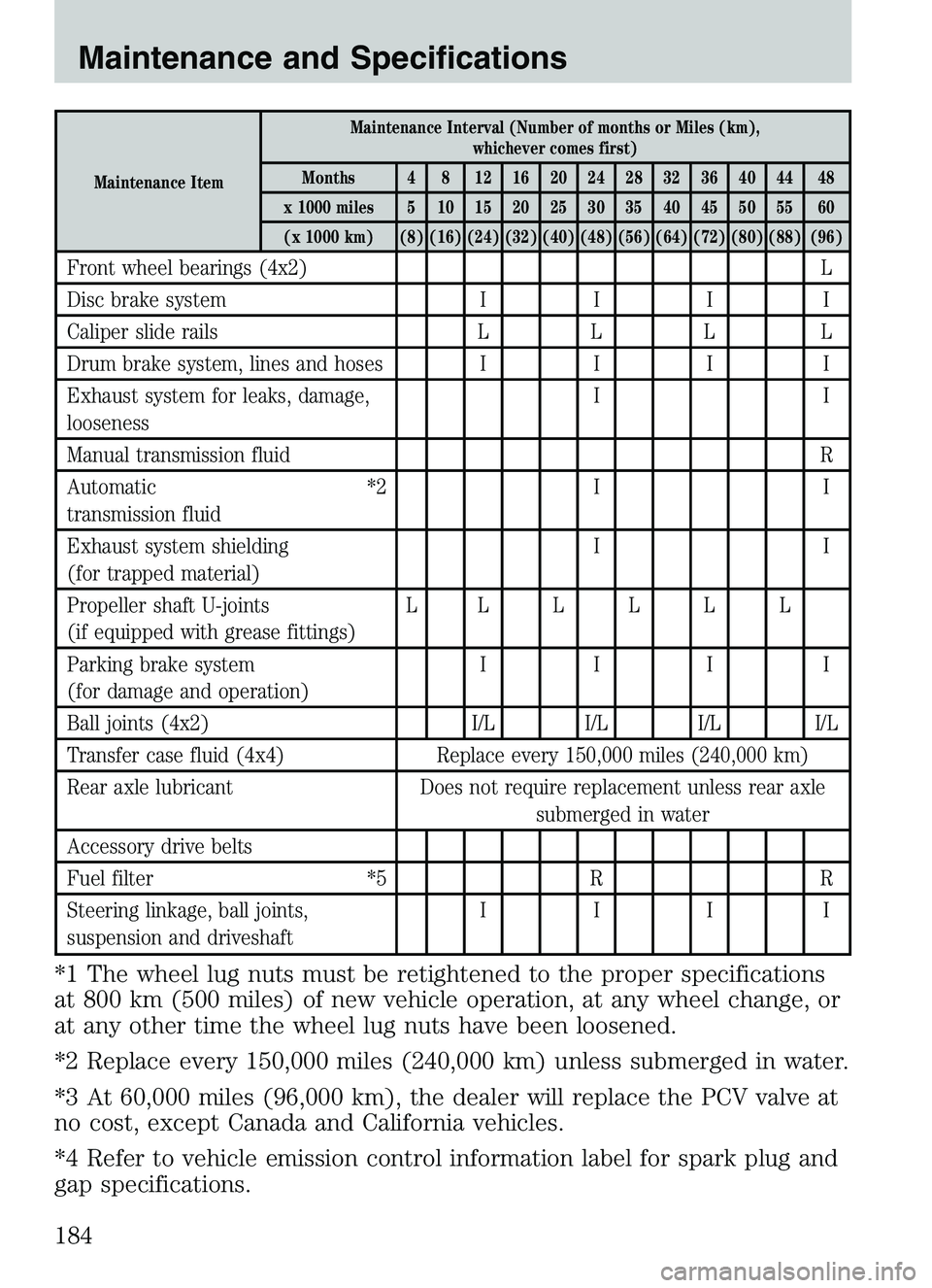
Maintenance ItemMaintenance Interval (Number of months or Miles (km),
whichever comes first)
Months 4 8 12 16 20 24 28 32 36 40 44 48
x 1000 miles 5 10 15 20 25 30 35 40 45 50 55 60 (x 1000 km) (8) (16) (24) (32) (40) (48) (56) (64) (72) (80) (88) (96)
Front wheel bearings (4x2) L
Disc brake system III I
Caliper slide rails LLL L
Drum brake system, lines and hoses I II I
Exhaust system for leaks, damage,
looseness II
Manual transmission fluid R
Automatic
transmission fluid *2
I I
Exhaust system shielding
(for trapped material) II
Propeller shaft U-joints
(if equipped with grease fittings) LLLLLL
Parking brake system
(for damage and operation) III I
Ball joints (4x2) I/L I/L I/L I/L
Transfer case fluid (4x4) Replace every 150,000 miles (240,000 km)
Rear axle lubricant Does not require replacement unless rear axle
submerged in water
Accessory drive belts
Fuel filter *5R R
Steering linkage, ball joints,
suspension and driveshaft III I
*1 The wheel lug nuts must be retightened to the proper specifications
at 800 km (500 miles) of new vehicle operation, at any wheel change, or
at any other time the wheel lug nuts have been loosened.
*2 Replace every 150,000 miles (240,000 km) unless submerged in water.
*3 At 60,000 miles (96,000 km), the dealer will replace the PCV valve at
no cost, except Canada and California vehicles.
*4 Refer to vehicle emission control information label for spark plug and
gap specifications.
Maintenance and Specifications
184
Page 186 of 250
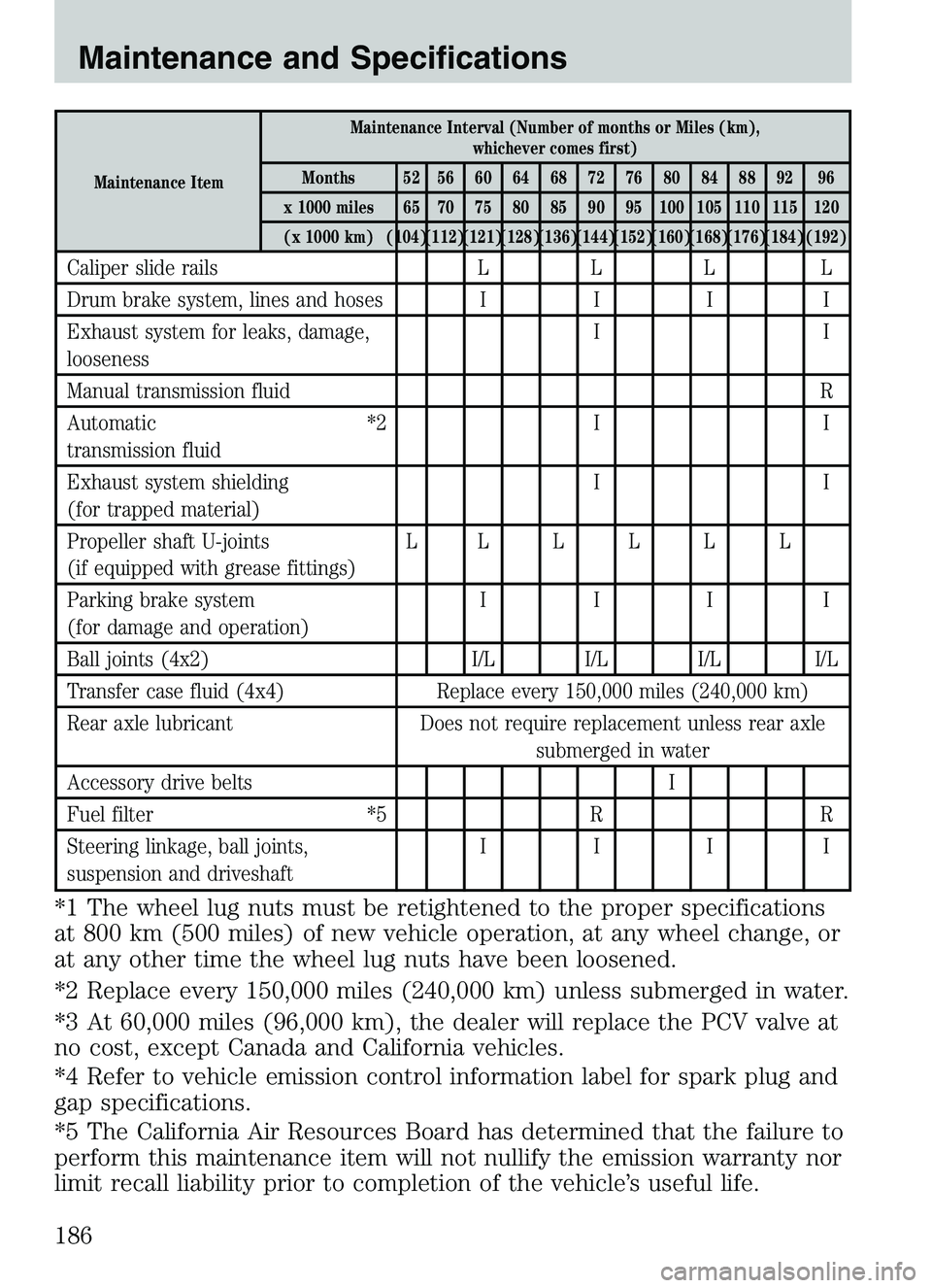
Maintenance ItemMaintenance Interval (Number of months or Miles (km),
whichever comes first)
Months 52 56 60 64 68 72 76 80 84 88 92 96
x 1000 miles 65 70 75 80 85 90 95 100 105 110 115 120 (x 1000 km) (104)(112)(121)(128)(136)(144)(152)(160)(168)(176)(184) (192)
Caliper slide rails LLL L
Drum brake system, lines and hoses I II I
Exhaust system for leaks, damage,
looseness II
Manual transmission fluid R
Automatic
transmission fluid *2
I I
Exhaust system shielding
(for trapped material) II
Propeller shaft U-joints
(if equipped with grease fittings) LLLLLL
Parking brake system
(for damage and operation) III I
Ball joints (4x2) I/L I/L I/L I/L
Transfer case fluid (4x4) Replace every 150,000 miles (240,000 km)
Rear axle lubricant Does not require replacement unless rear axle
submerged in water
Accessory drive belts I
Fuel filter *5R R
Steering linkage, ball joints,
suspension and driveshaft III I
*1 The wheel lug nuts must be retightened to the proper specifications
at 800 km (500 miles) of new vehicle operation, at any wheel change, or
at any other time the wheel lug nuts have been loosened.
*2 Replace every 150,000 miles (240,000 km) unless submerged in water.
*3 At 60,000 miles (96,000 km), the dealer will replace the PCV valve at
no cost, except Canada and California vehicles.
*4 Refer to vehicle emission control information label for spark plug and
gap specifications.
*5 The California Air Resources Board has determined that the failure to
perform this maintenance item will not nullify the emission warranty nor
limit recall liability prior to completion of the vehicle’s useful life.
Maintenance and Specifications
186