MAZDA MODEL B4000 CAB PLUS 4 TRUCK 2009 Owners Manual
Manufacturer: MAZDA, Model Year: 2009, Model line: MODEL B4000 CAB PLUS 4 TRUCK, Model: MAZDA MODEL B4000 CAB PLUS 4 TRUCK 2009Pages: 288, PDF Size: 3.05 MB
Page 131 of 288
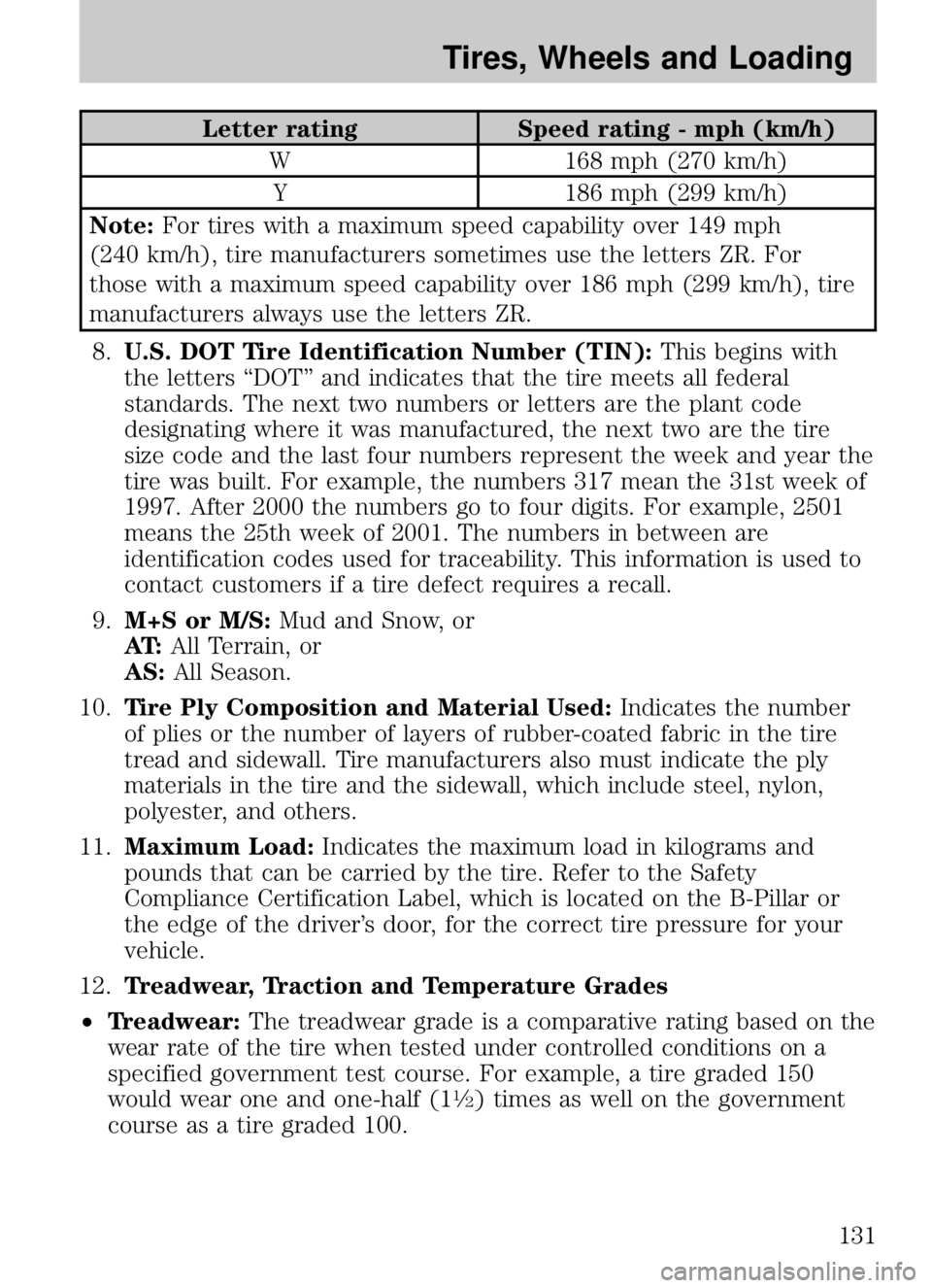
Letter ratingSpeed rating - mph (km/h)
W 168 mph (270 km/h)
Y 186 mph (299 km/h)
Note: For tires with a maximum speed capability over 149 mph
(240 km/h), tire manufacturers sometimes use the letters ZR. For
those with a maximum speed capability over 186 mph (299 km/h), tire
manufacturers always use the letters ZR.
8. U.S. DOT Tire Identification Number (TIN): This begins with
the letters “DOT” and indicates that the tire meets all federal
standards. The next two numbers or letters are the plant code
designating where it was manufactured, the next two are the tire
size code and the last four numbers represent the week and year the
tire was built. For example, the numbers 317 mean the 31st week of
1997. After 2000 the numbers go to four digits. For example, 2501
means the 25th week of 2001. The numbers in between are
identification codes used for traceability. This information is used to
contact customers if a tire defect requires a recall.
9. M+S or M/S: Mud and Snow, or
AT: All Terrain, or
AS: All Season.
10. Tire Ply Composition and Material Used: Indicates the number
of plies or the number of layers of rubber-coated fabric in the tire
tread and sidewall. Tire manufacturers also must indicate the ply
materials in the tire and the sidewall, which include steel, nylon,
polyester, and others.
11. Maximum Load: Indicates the maximum load in kilograms and
pounds that can be carried by the tire. Refer to the Safety
Compliance Certification Label, which is located on the B-Pillar or
the edge of the driver’s door, for the correct tire pressure for your
vehicle.
12. Treadwear, Traction and Temperature Grades
• Treadwear: The treadwear grade is a comparative rating based on the
wear rate of the tire when tested under controlled conditions on a
specified government test course. For example, a tire graded 150
would wear one and one-half (1
12) times as well on the government
course as a tire graded 100.
2009 B-Series (mbs)
Owners Guide, 1st Printing
USA (fus)
Tires, Wheels and Loading
131
Page 132 of 288
Page 133 of 288

Page 134 of 288

Page 135 of 288
following two conditions: (1) This device may not cause harmful
interference, and (2) This device must accept any interference received,
including interference that may cause undesired operation.
WARNING:The Tire Pressure Monitoring System is NOT a
substitute for manually checking tire pressure. The tire pressure
should be checked periodically (at least monthly) using a tire gauge,
see Inflating your tires in this chapter. Failure to properly
maintain your tire pressure could increase the risk of tire
failure, loss of control, vehicle rollover and personal injury.
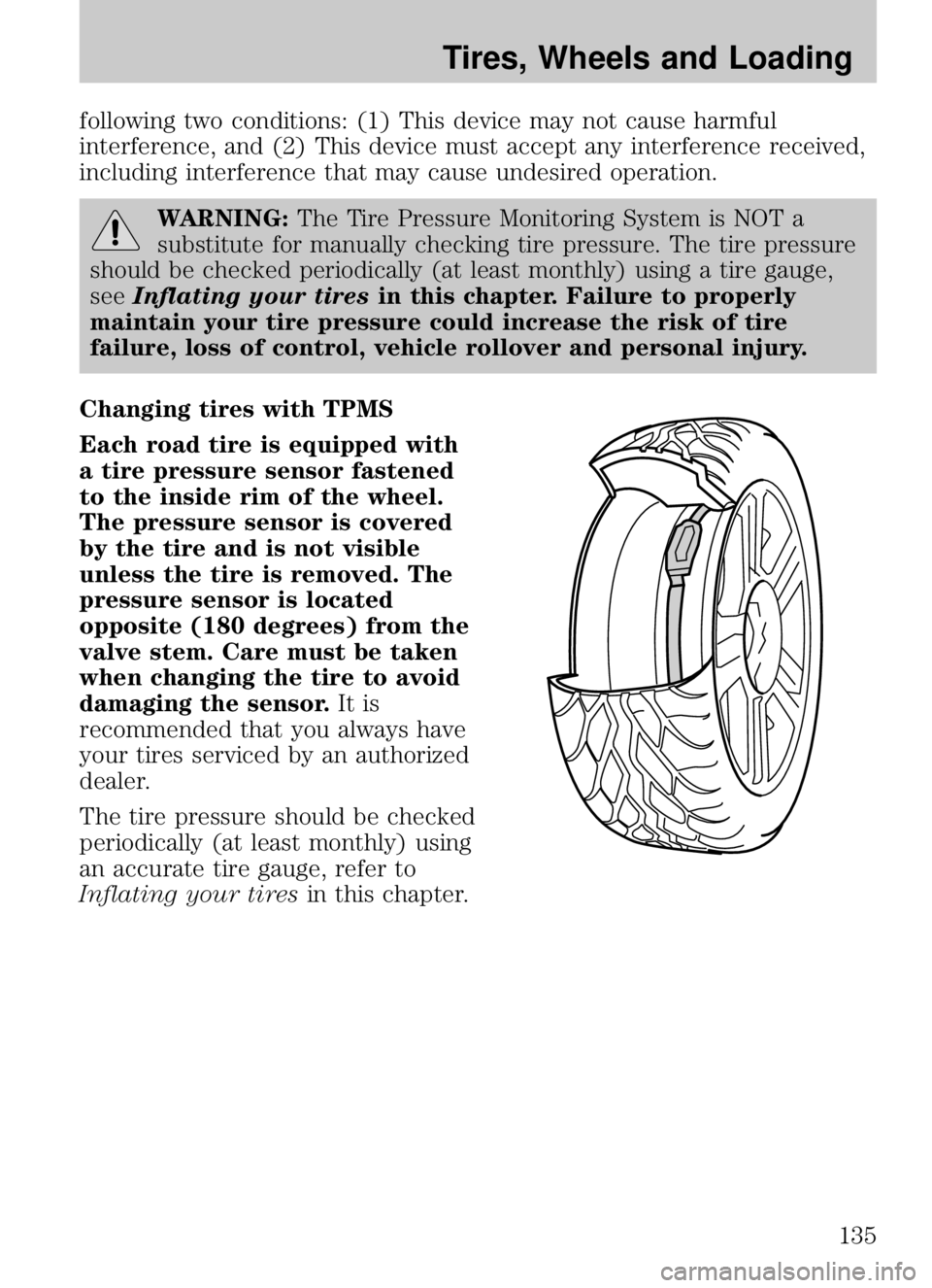
Changing tires with TPMS
Each road tire is equipped with
a tire pressure sensor fastened
to the inside rim of the wheel.
The pressure sensor is covered
by the tire and is not visible
unless the tire is removed. The
pressure sensor is located
opposite (180 degrees) from the
valve stem. Care must be taken
when changing the tire to avoid
damaging the sensor. It is
recommended that you always have
your tires serviced by an authorized
dealer.
The tire pressure should be checked
periodically (at least monthly) using
an accurate tire gauge, refer to
Inflating your tires in this chapter.
2009 B-Series(mbs)
Owners Guide, 1st Printing
USA (fus)
Tires, Wheels and Loading
135
Page 136 of 288

Page 137 of 288
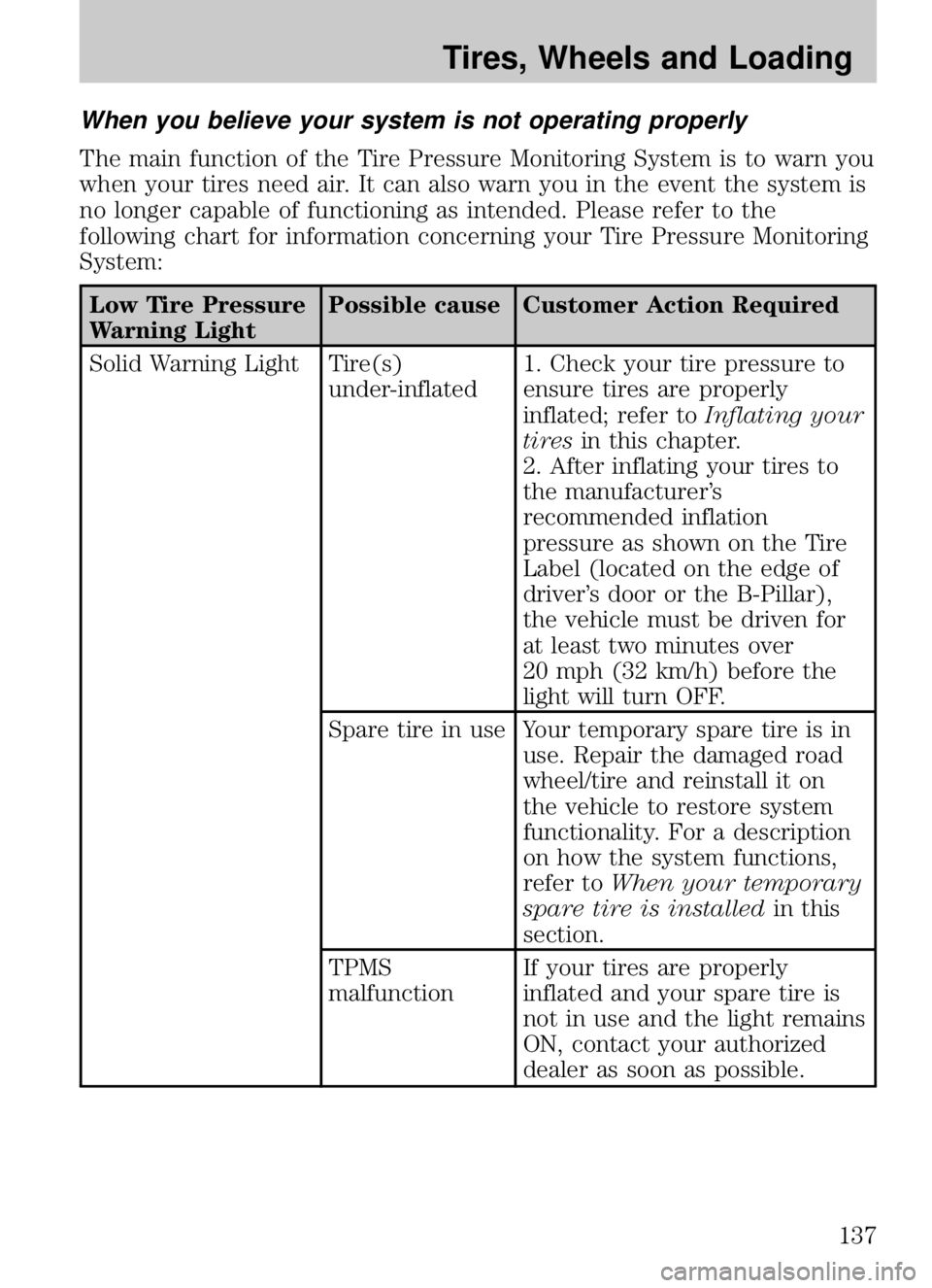
When you believe your system is not operating properly
The main function of the Tire Pressure Monitoring System is to warn you
when your tires need air. It can also warn you in the event the system is
no longer capable of functioning as intended. Please refer to the
following chart for information concerning your Tire Pressure Monitoring
System:
Low Tire Pressure
Warning LightPossible cause Customer Action Required
Solid Warning Light Tire(s) under-inflated1. Check your tire pressure to
ensure tires are properly
inflated; refer to
Inflating your
tires in this chapter.
2. After inflating your tires to
the manufacturer’s
recommended inflation
pressure as shown on the Tire
Label (located on the edge of
driver’s door or the B-Pillar),
the vehicle must be driven for
at least two minutes over
20 mph (32 km/h) before the
light will turn OFF.
Spare tire in use Your temporary spare tire is in use. Repair the damaged road
wheel/tire and reinstall it on
the vehicle to restore system
functionality. For a description
on how the system functions,
refer toWhen your temporary
spare tire is installed in this
section.
TPMS
malfunction If your tires are properly
inflated and your spare tire is
not in use and the light remains
ON, contact your authorized
dealer as soon as possible.
2009 B-Series
(mbs)
Owners Guide, 1st Printing
USA (fus)
Tires, Wheels and Loading
137
Page 138 of 288

Low Tire Pressure
Warning LightPossible cause Customer Action Required
Flashing Warning
Light Spare tire in use Your temporary spare tire is in
use. Repair the damaged road
wheel and re-mount it on the
vehicle to restore system
functionality. For a description
of how the system functions
under these conditions, refer to
When your temporary spare
tire is installedin this section.
TPMS
malfunction If your tires are properly
inflated and your spare tire is
not in use and the TPMS
warning light still flashes,
contact your authorized dealer
as soon as possible.
When inflating your tires
When putting air into your tires (such as at a gas station or in your
garage), the Tire Pressure Monitoring System may not respond
immediately to the air added to your tires.
It may take up to two minutes of driving over 20 mph (32 km/h) for the
light to turn OFF after you have filled your tires to the recommended
inflation pressure.
How temperature affects your tire pressure
The Tire Pressure Monitoring System (TPMS) monitors tire pressure in
each pneumatic tire. While driving in a normal manner, a typical
passenger tire inflation pressure may increase approximately 2 to 4 psi
(14 to 28 kPa) from a cold start situation. If the vehicle is stationary
over night with the outside temperature significantly lower than the
daytime temperature, the tire pressure may decrease approximately 3 psi
(20.7 kPa) for a drop of 30° F (16.6°C) in ambient temperature. This
lower pressure value may be detected by the TPMS as being significantly
lower than the recommended inflation pressure and activate the TPMS
warning for low tire pressure. If the low tire pressure warning light is
ON, visually check each tire to verify that no tire is flat. (If one or more
tires are flat, repair as necessary.) Check air pressure in the road tires. If
any tire is under-inflated, carefully drive the vehicle to the nearest
location where air can be added to the tires. Inflate all the tires to the
recommended inflation pressure.
2009 B-Series
(mbs)
Owners Guide, 1st Printing
USA (fus)
Tires, Wheels and Loading
138
Page 139 of 288
SNOW TIRES AND CHAINS
WARNING:Driving too fast for conditions creates the possibility
of loss of vehicle control. Driving at very high speeds for
extended periods of time may result in damage to vehicle components.
WARNING: Snow tires must be the same size, load index, speed
rating as those originally provided by Mazda. Use of any tire or
wheel not recommended by Mazda can affect the safety and
performance of your vehicle, which could result in an increased risk of
loss of vehicle control, vehicle rollover, personal injury and death.
Additionally, the use of non-recommended tires and wheels could
cause steering, suspension, axle or transfer case/power transfer unit
failure.
The tires on your vehicle have all weather treads to provide traction in
rain and snow. However, in some climates, you may need to use snow
tires and chains. If you need to use snow tires and chains, it is
recommended that steel wheels are used of the same size and
specifications as those originally installed.
Follow these guidelines when using snow tires and chains:
• Do not use tire chains on aluminum wheels. Chains may chip the
wheels.
• Use only SAE Class S chains.
• Install chains securely, verifying that the chains do not touch any
wiring, brake lines or fuel lines.
Drive cautiously. Ensure you obtain the proper cables or chains
for you vehicle. Test fit the cables or chains before using them in
snow and/or ice. If you hear the cables or chains rub or bang
against the vehicle, stop and retighten them. If this does not
work, remove the cables or chains to prevent vehicle damage.
Have the cables or chains fitted by a professional before
proceeding.
• If possible, avoid fully loading your vehicle.
• Remove the tire chains when they are no longer needed. Do not use
tire chains on dry roads.
• The suspension insulation and bumpers will help prevent vehicle
damage. Do not remove these components from your vehicle when
using snow tires and chains.
2009 B-Series (mbs)
Owners Guide, 1st Printing
USA (fus)
Tires, Wheels and Loading
139
Page 140 of 288