ECU MERCEDES-BENZ B-CLASS HATCHBACK 2014 User Guide
[x] Cancel search | Manufacturer: MERCEDES-BENZ, Model Year: 2014, Model line: B-CLASS HATCHBACK, Model: MERCEDES-BENZ B-CLASS HATCHBACK 2014Pages: 405, PDF Size: 12.24 MB
Page 50 of 405
the door or side window. You may other-
wise be in the deployment area of the air-
bags.
R Always keep your feet in the footwell in
front of the seat. Do not put your feet on the
dashboard, for example. Your feet may oth-
erwise be in the deployment area of the
airbag.
R Always secure persons less than 1.50 mtall
in suitable restraint systems. Up to this
height, the seat belt cannot be worn cor-
rectly.
If a child is travelling in your vehicle, also
observe the following notes:
R Always secure children under 12 years of
age and less than 1.50 m tall in suitable
child restraint systems.
R Child restraint systems should be fitted to
the rear seats.
R Only secure a child to the front-passenger
seat when the front-passenger front airbag
is disabled, and only then in a rearward-
facing child restraint system. If the
PASSENGER AIR BAG OFF indicator lamp is
permanently lit, the front-passenger front
airbag is disabled (Y page 41).
R Always observe the instructions and safety
notes on the automatic front-passenger
front airbag deactivation system
(Y page 49) and on "Children in the vehi-
cle" (Y page 57) in addition to the child
restraint system manufacturer's installa-
tion instructions.
Objects in the vehicle interior may pre-
vent the airbag from functioning cor-
rectly. Before starting your journey and to
avoid risks resulting from the speed of the
airbag as it deploys, make sure that:
R there are no people, animals or objects
between the vehicle occupants and an air-
bag.
R there are no objects between the seat, door
and B-pillar.
R no hard objects, e.g. coat hangers, are
hanging on the grab handles or coat hooks. R
no accessories, such as cup holders, are
attached to the vehicle within the deploy-
ment area of an airbag, e.g. to doors, side
windows, rear side trim or side walls.
R no heavy, sharp-edged or fragile objects
are in the pockets of your clothing. Store
such objects in a suitable place. G
WARNING
If you modify an airbag cover or affix objects
such as stickers to it, the airbag can no longer function correctly. There is an increased risk
of injury.
Never modify an airbag cover or affix objects
to it. G
WARNING
Sensors to control the airbags are located in
the doors. Modifications or work not per-
formed correctly to the doors or door panel-
ling, as well as damaged doors, can lead to the function of the sensors being impaired. The
airbags might therefore not function properly any more. Consequently, the airbags cannot
protect vehicle occupants as they are
designed to do. This poses an increased risk
of injury.
Never modify the doors or parts of the doors.
Always have work on the doors or door pan-
elling carried out at a qualified specialist
workshop.
Front airbags !
Do not place heavy objects on the front-
passenger seat. This could cause the sys-
tem to identify the seat as being occupied.
In the event of an accident, the restraint
systems on the front-passenger side may
be triggered and have to be replaced. Occupant safety
47Safety Z
Page 54 of 405
bled in accordance with the person in the
front-passenger seat.
R the front-passenger seat has been moved
back as far back as possible.
R the person is seated correctly.
Make sure, both before and during the jour-
ney, that the status of the front-passenger
front airbag is correct. G
WARNING
If you secure a child on the co-driver's seat in a rearward-facing child restraint system and
the PASSENGER AIR BAG ON indicator lamp
lights up, the co-driver's airbag could be
deployed in the event of an accident. The childcould be struck by the airbag. There is an
increased risk of injury, possibly even fatal.
In this case, always ensure that the co-driver's
airbag is disabled. The PASSENGER AIRBAG
OFF indicator lamp must light up.
If the PASSENGER AIR BAG OFF indicator
lamp remains off and/or the PASSENGER AIR BAG ON indicator lamp lights up, do not install
a rearward-facing child restraint system on
the front-passenger seat. Further information can be found under "Problems with the auto-matic front-passenger front airbag deactiva-
tion system" (Y page 54). G
WARNING
If you secure a child in a forward-facing child
restraint system on the front-passenger seat
and you position the front-passenger seat too close to the dashboard, in the event of an
accident, the child could:
R come into contact with the vehicle's inte-
rior if the PASSENGER AIR BAG OFF indi-
cator lamp is lit, for example
R be struck by the airbag if the PASSENGER
AIR BAG ON is lit up
This poses an increased risk of injury or even fatal injury.
Move the front-passenger seat as far back as
possible. Always make sure that the shoulder belt strap is correctly routed from the vehicle belt outlet to the shoulder belt guide on the
child restraint system. The shoulder belt strap
must be routed forwards and downwards
from the vehicle belt outlet. If necessary,
adjust the vehicle belt outlet and the front-
passenger seat accordingly. Always observe
the information in this Owner's Manual on
suitable positioning of the child restraint sys-
tem in addition to the child restraint system
manufacturer's installation instructions.
If the automatic front-passenger front airbag
deactivation system detects that: R the front-passenger seat is unoccupied, the
PASSENGER AIR BAG OFF indicator lamp
lights up after the system self-test and
remains lit. This indicates that the front-
passenger front airbag is disabled.
R the front-passenger seat is occupied by a
child in a rearward-facing child restraint
system, the PASSENGER AIR BAG OFF indi-
cator lamp lights up after the system self-
test and remains lit. This indicates that the
front-passenger front airbag is disabled.
But in the case of a child in a rearward-
facing child restraint, the PASSENGER AIR
BAG ON indicator lamp can light up after
the system self-test and remain lit. This
indicates that the front-passenger front air- bag is enabled. The result of the classifica-
tion is dependent on, among other factors, the child restraint system and the child's
build. It is recommended that you fit the
child restraint system to a suitable rear
seat.
R the front-passenger seat is occupied by a
child in a forward-facing child restraint sys-
tem, either the PASSENGER AIR BAG ON or
PASSENGER AIR BAG OFF indicator lamp
lights up and remains lit after the system
self-test depending on the result of the
classification. The result of the classifica-
tion is dependent on, among other factors,
the child restraint system and the child's
build.
Move the front-passenger seat as far back
as possible. Always observe the informa- Occupant safety
51Safety Z
Page 60 of 405
Function
PRE-SAFE
®
intervenes:
R in emergency braking situations, e.g. when
BAS is activated
R in critical driving situations, e.g. when phys-
ical limits are exceeded and the vehicle
understeers or oversteers severely
R on vehicles with DISTRONIC PLUS: if adap-
tive Brake Assist intervenes powerfully
PRE-SAFE ®
takes the following measures
depending on the hazardous situation detec-
ted:
R the front seat belts are pre-tensioned.
R if the vehicle skids, the side windows are
closed so that only a small gap remains.
The panorama sliding sunroof is completely
closed.
R vehicles with the memory function: the
front-passenger seat is adjusted if it is in an
unfavourable position.
If the hazardous situation passes without
resulting in an accident, PRE-SAFE ®
slackens
the belt pre-tensioning. All settings made by
PRE-SAFE ®
can then be reversed.
If the seat belt pre-tensioning is not reduced:
X Move the seat backrest or seat back
slightly when the vehicle is stationary.
Seat belt pre-tensioning is reduced and the
locking mechanism is released.
The seat-belt adjustment is an integral part of
the PRE-SAFE ®
convenience function. Infor-
mation about the convenience function can
be found under "Belt adjustment"
(Y page 45). Automatic measures after an acci-
dent
Immediately after an accident, the following
measures are implemented, depending on
the type and severity of the impact: R the hazard warning lamps are activated
R the emergency lighting is activated R
the vehicle doors are unlocked
R the front side windows are lowered
R the engine is switched off and the fuel sup-
ply is cut off
R vehicles with the Mercedes-Benz emer-
gency call system: automatic emergency
call Children in the vehicle
Important safety notes
Accident statistics show that children
secured in the rear seats are safer than chil-
dren secured in the front-passenger seat. For this reason, Mercedes-Benz strongly advises
that you install a child restraint system on a
rear seat. Children are generally better pro-
tected there.
If a child younger than 12 years old and under 1.50 m in height is travelling in the vehicle:
R always secure the child in a child restraint
system suitable for Mercedes-Benz vehi-
cles. The child restraint system must be
appropriate to the age, weight and size of
the child.
R be sure to observe the instructions and
safety notes in this section in addition to
the child restraint system manufacturer's
installation instructions.
R always pay attention to the instructions
and safety notes on the automatic front-
passenger front airbag deactivation system
(Y page 49). G
WARNING
If you leave children unattended in the vehi-
cle, they may be able to set the vehicle in
motion if, for example, they:
R release the parking brake
R shift the automatic transmission out of park
position Por shift manual transmission into
neutral
R start the engine Children in the vehicle
57Safety
Z
Page 61 of 405
In addition, they may operate vehicle equip-
ment and become trapped. There is a risk of
an accident and injury.
When leaving the vehicle, always take the key with you and lock the vehicle. Never leave
children unattended in the vehicle. G
WARNING
If persons (particularly children) are exposed
to heat or cold for a prolonged period, there is a risk of serious or even fatal injuries. Never
leave persons (particularly children) unatten-
ded in the vehicle. G
WARNING
If the child restraint system is placed in direct sunlight, the parts could become very hot.
Children could be suffer burns by touching
these parts, in particular on the metallic parts
of the child restraint system. There is a risk of injury.
If you and your child leave the vehicle, always
make sure that the child restraint system is
not in direct sunlight. Cover it with a blanket, for example. If the child restraint system has
been exposed to direct sunlight, leave it to
cool down before securing the child in it.
Never leave children unattended in the vehi-
cle.
Always ensure that all vehicle occupants have their seat belts fastened correctly and are sit-
ting properly. Particular attention must be
paid to children.
Observe the safety notes on the seat belt
(Y page 42) and the information on the cor-
rect use of the seat belt (Y page 43).Child restraint system
If you fit a rearward-facing child restraint sys- tem to the centre rear seat, the rear arm restmust be folded back as far as possible.
Observe the instructions for correct use of
the child restraint system (Y page 66).For safety reasons, Mercedes-Benz recom-
mends that you only use a child restraint sys-
tem recommended by Mercedes-Benz
(Y page 70). G
WARNING
If the child restraint system is incorrectly fit-
ted on the seat position suitable for this pur-
pose, it cannot perform its intended protec-
tive function. In the event of an accident,
sharp braking or a sudden change in direction, the child may not be held securely. There is an
increased risk of serious or even fatal injuries.
Observe the manufacturer's installation
instructions and the correct use for the child
restraint system. Make sure that the entire
surface of the child restraint system is resting
on the seat surface. Never place objects
under or behind the child restraint system,
e.g. cushions. Only use child restraint sys-
tems with the original cover designed for
them. Only replace damaged covers with gen- uine covers. G
WARNING
If the child restraint system is fitted incor-
rectly or is not secured, it can come loose in
the event of an accident, heavy braking or a
sudden change in direction. The child
restraint system could be thrown about, strik- ing vehicle occupants. There is an increased
risk of injury, possibly even fatal.
Always fit child restraint systems properly,
even if they are not being used. Make sure
that you observe the child restraint system
manufacturer's installation instructions.
You will find further information on stowing
objects, luggage and loads securely under
"Loading guidelines" (Y page 298). G
WARNING
Child restraint systems or their securing sys-
tems that have been damaged or subjected to a load in an accident cannot perform their
intended protective function. In the event of
an accident, sharp braking or a sudden
change in direction, the child may not be held 58
Children in the vehicleSafety
Page 62 of 405
securely. There is an increased risk of serious
or even fatal injuries.
Immediately replace child restraint systems
that have been damaged or subjected to a
load in an accident. Have the child restraint
securing systems checked in a qualified spe-
cialist workshop before fitting a child restraint
system again.
The securing systems of child restraint sys-
tems are: R the seat belt system
R the ISOFIX securing rings
R the Top Tether anchorages
If it is absolutely necessary to carry a child on
the front-passenger seat, be sure to observe
the information on "Child restraint systems
on the front-passenger seat" (Y page 64).
Observe the warning labels in the vehicle inte-
rior and on the child restraint system.
i It is advisable to use Mercedes-Benz care
products to clean child restraint systems
recommended by Mercedes-Benz. You can obtain information about this at any
Mercedes-Benz Service Centre. ISOFIX child seat securing system
G
WARNING
ISOFIX child restraint systems do not offer
sufficient protective effect for children whose weight is greater than 22 kg who are securedusing the safety belt integrated in the child
restraint system. The child could, for example,not be restrained correctly in the event of an
accident. This poses an increased risk of
injury or even fatal injury.
If the child weighs more than 22 kg, only use
ISOFIX child restraint systems with which the child is also secured with the vehicle seat belt. Also secure the child restraint system with the
Top Tether belt, if available.
When fitting a child restraint system, be sure to observe the manufacturer's installation and operating instructions and the instruc-
tions for correct use of the child restraint sys-
tem (Y page 66).
Before every trip, make sure that the ISOFIX
child restraint system is engaged correctly in both ISOFIX securing rings.
! When fitting the child restraint system,
make sure that the seat belt for the centre seat does not get trapped. Otherwise, the
seat belt could be damaged. :
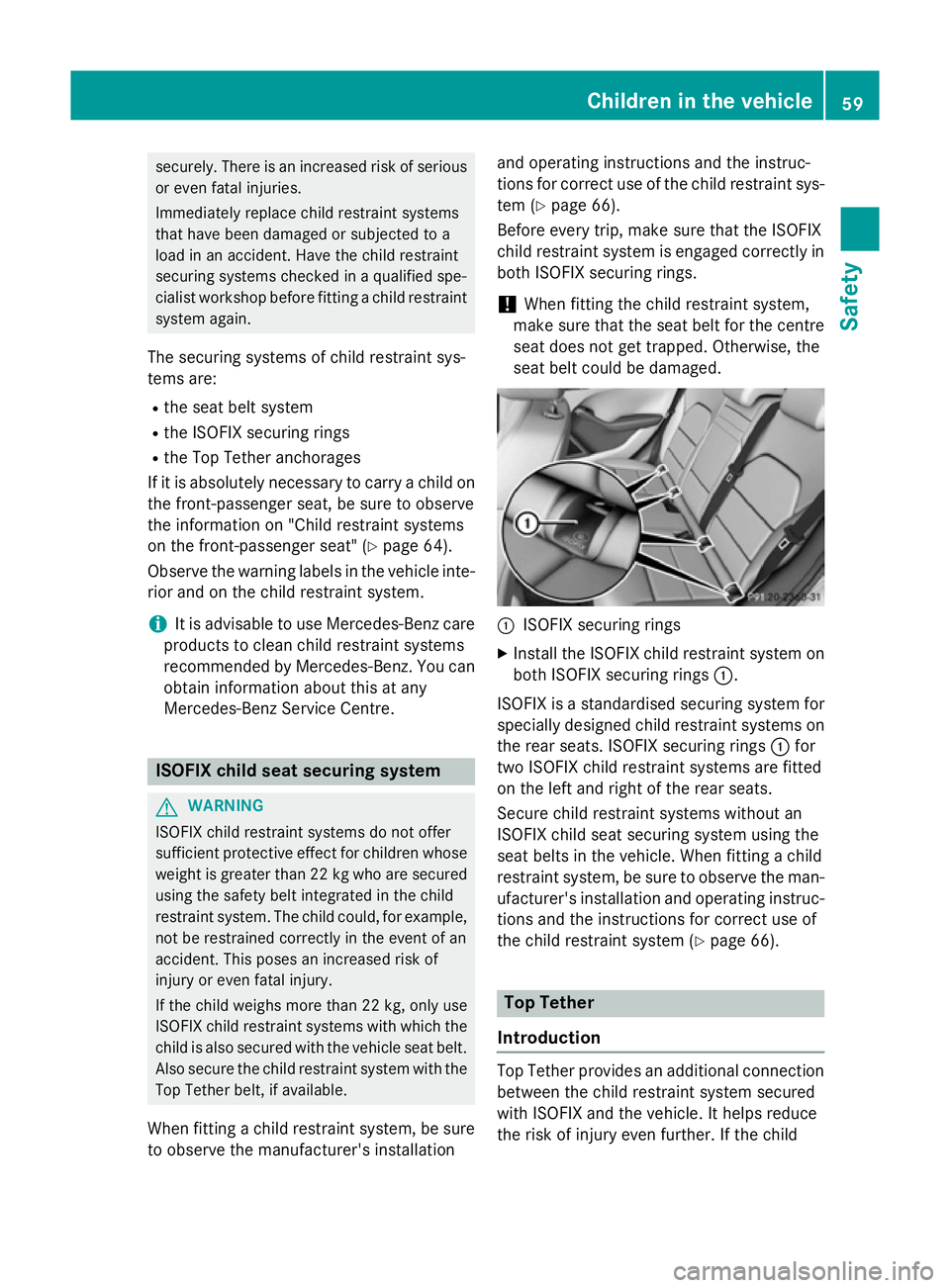
ISOFIX securing rings
X Install the ISOFIX child restraint system on
both ISOFIX securing rings :.
ISOFIX is a standardised securing system for
specially designed child restraint systems on
the rear seats. ISOFIX securing rings :for
two ISOFIX child restraint systems are fitted
on the left and right of the rear seats.
Secure child restraint systems without an
ISOFIX child seat securing system using the
seat belts in the vehicle. When fitting a child
restraint system, be sure to observe the man-
ufacturer's installation and operating instruc-
tions and the instructions for correct use of
the child restraint system (Y page 66). Top Tether
Introduction Top Tether provides an additional connection
between the child restraint system secured
with ISOFIX and the vehicle. It helps reduce
the risk of injury even further. If the child Children in the vehicle
59Safety Z
Page 64 of 405
Integrated child seat
Important safety notes G
WARNING
If the integrated child seat or the ICS padded play table is modified, damaged or subjected
to a load in an accident, it cannot perform its
intended protective function. A child there-
fore cannot be restrained in the event of an
accident, heavy braking or a sudden change of direction. This poses an increased risk of
injury or even fatal injury.
Immediately replace an integrated child seat
or ICS padded play table that has been modi- fied, damaged or subjected to a heavy load as
the result of an accident. Only use the ICS
padded play table with its original cover or
with a cover that has been approved by the
manufacturer, and do not used a protective
cover. G
WARNING
If the ICS padded play table is exposed to
direct sunlight or heat, parts could heat up.
Children could suffer burns on these parts,
particularly on metallic parts. There is a risk of
injury.
If you and your child leave the vehicle, cover
the ICS padded play table so that it is not
exposed to direct sunlight and heat. If the ICS padded play table has been exposed to direct sunlight, allow it to cool before securing a
child to it. Never leave children unattended in
the vehicle.
Observe the notes on the ICS padded play
table (Y page 62).
The integrated child seats are integrated into the seat cushions of the outer rear seats. In
conjunction with the components listed in the
following table, they comply with the legal
requirements of ECE-R44.04. Recommen-
ded for weight category I: from 24 months
up to 18 kg Weight category I: 9 to 18 kg Integrated
child seat ICS padded
play table Side head
restraints
Folded out Mandatory Mandatory
Weight category II: 15 to 25 kg
Integrated
child seat ICS padded
play table Side head
restraints
Folded out Not permis-
sible Mandatory
Weight category III: 22 to 36 kg
Integrated
child seat ICS padded
play table Side head
restraints
Folded out Not permis-
sible Recommen-
ded
Mercedes-Benz recommends using the inte-
grated child seat for children from the age of
24 month swho weigh up to 36 kg.
For children from the age of 24 months who
weigh up to 18 kg: an ICS padded play table
and a side head restraint which have been
specially approved for the integrated child
seat must also be used.
Note that children younger than 24 months
old require a different child restraint system.
Drive with the head restraints in the correct
position when the integrated child seat is
occupied. If the head restraint is correctly
adjusted, the back of the head is supported by the centre of the head restraint at about eye
level. G
WARNING
The head restraints cannot provide the inten-
ded protection unless they are fitted and
adjusted correctly. There is an increased risk of injury to the head and neck in the event of
an accident or sudden braking, for example.
Always drive with the head restraints fitted.
Ensure that the centre of the head restraints Children in the vehicle
61Safety
Z
Page 66 of 405
and be thrown around, endangering vehicle
occupants. This poses an increased risk of
injury or even fatal injury.
Fit the ICS padded play table as described.
After fitting the ICS padded play table, make
sure that it is secured correctly. For safety
reasons, only use the ICS padded play table
that has been tested and approved for your
vehicle.
The ICS padded play table is only suitable for
use with the folded-out integrated child seat.
On the rear seats with an integrated child
seat, only use the ICS padded play table that
is recommended for Mercedes-Benz vehicles. Only use the ICS padded play table with its
original cover. Without the original cover, the
official approval is invalidated.
Use the ICS padded play table in accordance
with the instructions in the table in the "Inte-
grated child seat (ICS)" section (Y page 61).
Note that children under two years old and
children who weigh less than 12.5 kg require a different and suitable child restraint system.
Information about other child restraint sys-
tems is available at any Mercedes-Benz Ser-
vice Centre.
You must not use the integrated child seat
with ICS padded play table as a direct attach- ment to a baby car seat for which a body
weight of up to 10 kg is permissible. Note that
children younger than 24 month sold require
a different child restraint system
(Y page 70).
If you are not using the ICS padded play table, stow it in an appropriate place, e.g. in the lug-
gage compartment. You will find further infor-
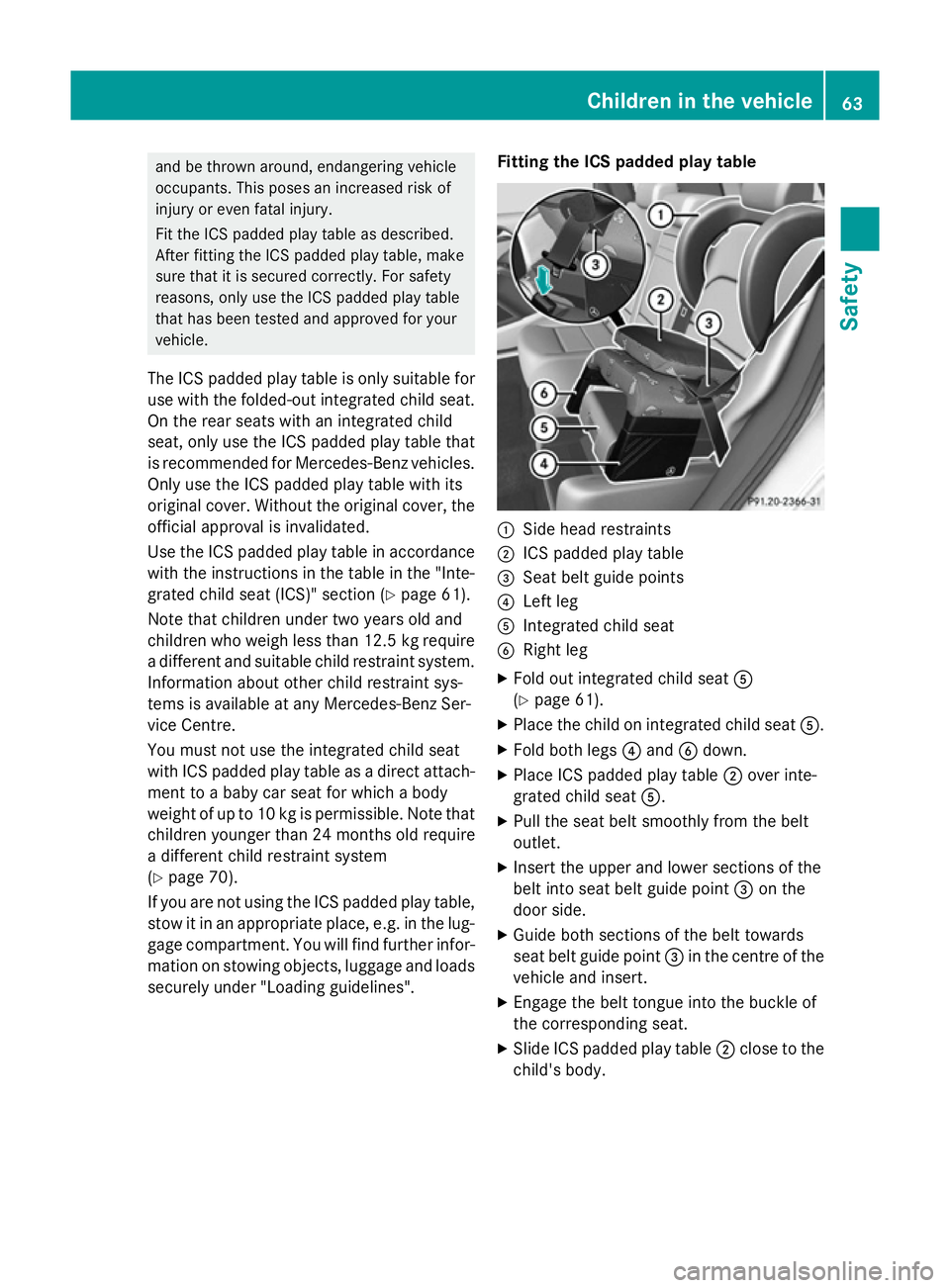
mation on stowing objects, luggage and loads securely under "Loading guidelines". Fitting the ICS padded play table
:
Side head restraints
; ICS padded play table
= Seat belt guide points
? Left leg
A Integrated child seat
B Right leg
X Fold out integrated child seat A
(Y page 61).
X Place the child on integrated child seat A.
X Fold both legs ?and Bdown.
X Place ICS padded play table ;over inte-
grated child seat A.
X Pull the seat belt smoothly from the belt
outlet.
X Insert the upper and lower sections of the
belt into seat belt guide point =on the
door side.
X Guide both sections of the belt towards
seat belt guide point =in the centre of the
vehicle and insert.
X Engage the belt tongue into the buckle of
the corresponding seat.
X Slide ICS padded play table ;close to the
child's body. Children in the vehicle
63Safety Z
Page 67 of 405
X
Pull both parts of the belt tight. Make sure
that the seat belt is not twisted.
X Adjust the head restraint if necessary; see
(Y page 111).
Side head restraints G
WARNING
If the side head restraint has been fitted incor-
rectly, it cannot perform its intended protec-
tive function. A child's head therefore cannot be supported in the event of an accident,
heavy braking or a sudden change of direc-
tion. In addition, the side head restraint could become loose and be thrown around, endan-
gering vehicle occupants. This poses an
increased risk of injury or even fatal injury.
Only fasten the side head restraint to the spe-
cially designed securing points on the rear
head restraint. For safety reasons, only use
side head restraints that have been tested
and approved for your vehicle. Use the side head restraints in accordance
with the instructions in table (Y
page 61).
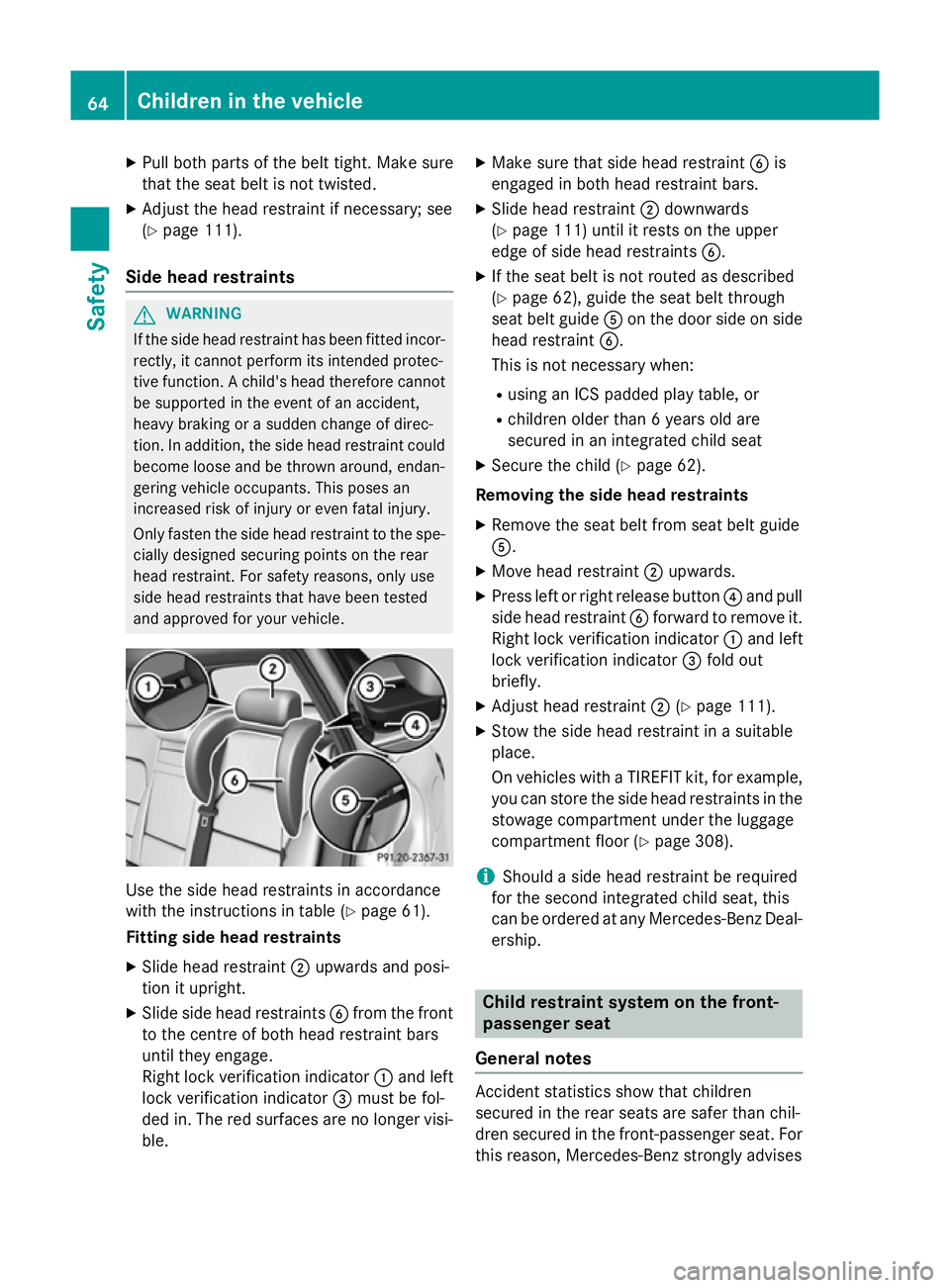
Fitting side head restraints
X Slide head restraint ;upwards and posi-
tion it upright.
X Slide side head restraints Bfrom the front
to the centre of both head restraint bars
until they engage.
Right lock verification indicator :and left
lock verification indicator =must be fol-
ded in. The red surfaces are no longer visi-
ble. X
Make sure that side head restraint Bis
engaged in both head restraint bars.
X Slide head restraint ;downwards
(Y page 111) until it rests on the upper
edge of side head restraints B.
X If the seat belt is not routed as described
(Y page 62), guide the seat belt through
seat belt guide Aon the door side on side
head restraint B.
This is not necessary when:
R using an ICS padded play table, or
R children older than 6 years old are
secured in an integrated child seat
X Secure the child (Y page 62).
Removing the side head restraints X Remove the seat belt from seat belt guide
A.
X Move head restraint ;upwards.
X Press left or right release button ?and pull
side head restraint Bforward to remove it.
Right lock verification indicator :and left
lock verification indicator =fold out
briefly.
X Adjust head restraint ;(Ypage 111).
X Stow the side head restraint in a suitable
place.
On vehicles with a TIREFIT kit, for example,
you can store the side head restraints in thestowage compartment under the luggage
compartment floor (Y page 308).
i Should a side head restraint be required
for the second integrated child seat, this
can be ordered at any Mercedes-Benz Deal- ership. Child restraint system on the front-
passenger seat
General notes Accident statistics show that children
secured in the rear seats are safer than chil-
dren secured in the front-passenger seat. For
this reason, Mercedes-Benz strongly advises 64
Children in the vehicleSafety
Page 68 of 405
that you install a child restraint system on a
rear seat.
Vehicles with the automatic front-passenger
front airbag deactivation system: if it is abso- lutely necessary to fit a child restraint systemto the front-passenger seat, always observe
the information on the "Automatic front-
passenger front airbag deactivation system"
(Y page 49).
You can thus avoid the risks that could arise
as a result of:
R a child restraint system that is not detected
by the automatic front-passenger front air- bag deactivation system
R the unintentional disabling of the front-
passenger front airbag
R the unsuitable positioning of the child
restraint system, e.g. too close to the dash-
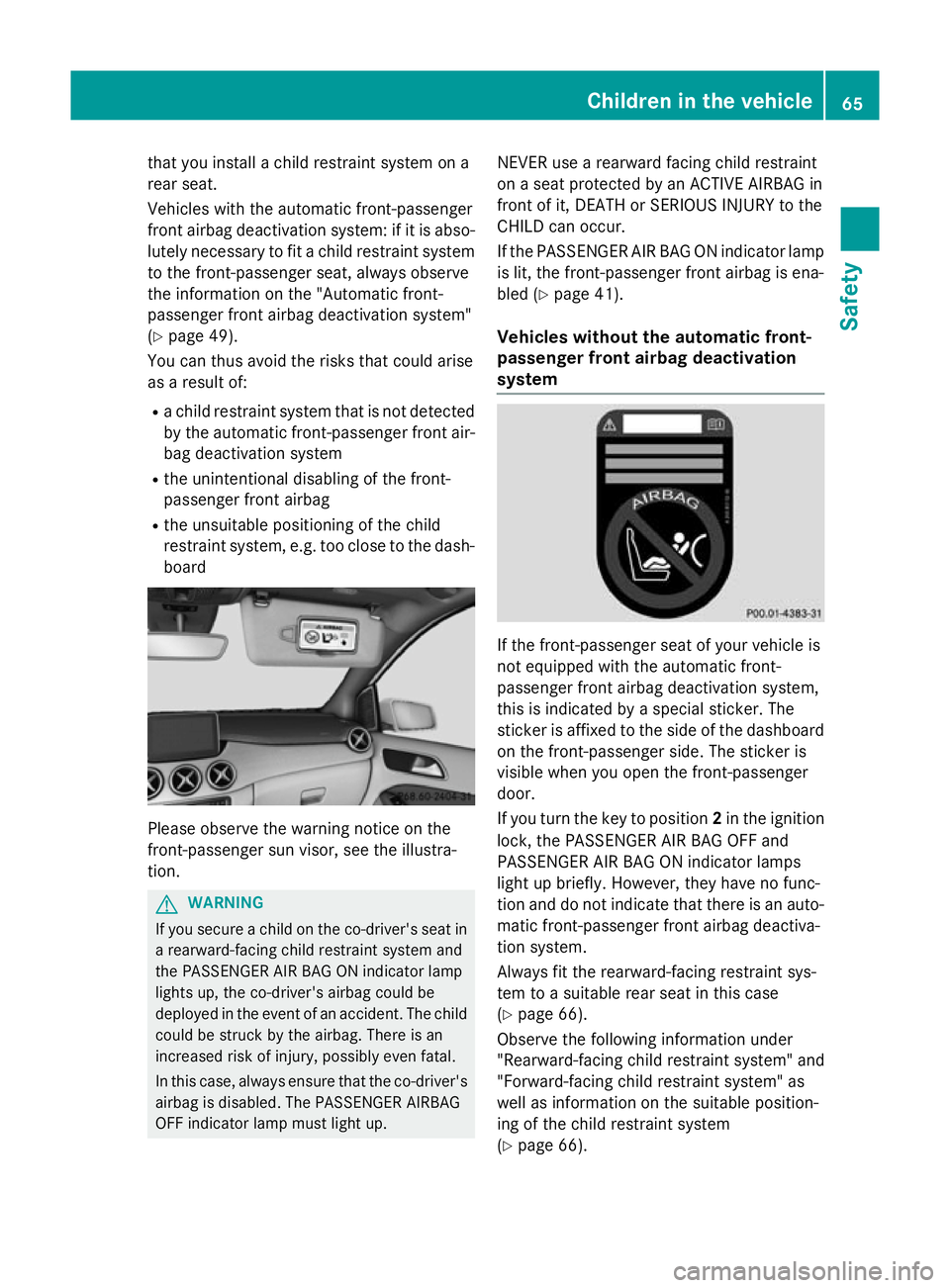
board Please observe the warning notice on the
front-passenger sun visor, see the illustra-
tion. G
WARNING
If you secure a child on the co-driver's seat in a rearward-facing child restraint system and
the PASSENGER AIR BAG ON indicator lamp
lights up, the co-driver's airbag could be
deployed in the event of an accident. The childcould be struck by the airbag. There is an
increased risk of injury, possibly even fatal.
In this case, always ensure that the co-driver's
airbag is disabled. The PASSENGER AIRBAG
OFF indicator lamp must light up. NEVER use a rearward facing child restraint
on a seat protected by an ACTIVE AIRBAG in
front of it, DEATH or SERIOUS INJURY to the
CHILD can occur.
If the PASSENGER AIR BAG ON indicator lamp
is lit, the front-passenger front airbag is ena-
bled (Y page 41).
Vehicles without the automatic front-
passenger front airbag deactivation
system If the front-passenger seat of your vehicle is
not equipped with the automatic front-
passenger front airbag deactivation system,
this is indicated by a special sticker. The
sticker is affixed to the side of the dashboard
on the front-passenger side. The sticker is
visible when you open the front-passenger
door.
If you turn the key to position 2in the ignition
lock, the PASSENGER AIR BAG OFF and
PASSENGER AIR BAG ON indicator lamps
light up briefly. However, they have no func-
tion and do not indicate that there is an auto- matic front-passenger front airbag deactiva-
tion system.
Always fit the rearward-facing restraint sys-
tem to a suitable rear seat in this case
(Y page 66).
Observe the following information under
"Rearward-facing child restraint system" and
"Forward-facing child restraint system" as
well as information on the suitable position-
ing of the child restraint system
(Y page 66). Children in the vehicle
65Safety Z
Page 70 of 405
Child restraint system on the front-
passenger seat – if it is absolutely necessary
to secure a child in a child restraint system on the front-passenger seat:
X Always pay attention to the instructions
under "Child restraint system on the front-
passenger seat" (Y page 64).
There you will find instructions on how to
correctly route the shoulder belt strap from
the vehicle belt outlet to the shoulder belt
guide on the child restraint system
(Y page 66).
X Move the front-passenger seat as far back
as possible.
If you secure a child in a forward-facing
child restraint system on the front-
passenger seat, you must also move the
front-passenger seat to the highest posi-
tion.
X Move the backrest to an almost vertical
position.
The entire base of the child restraint sys-
tem must always rest on the seat cushion of the front-passenger seat. The backrest of
the forward-facing child restraint system
must, as far as possible, be resting on the
backrest of the front-passenger seat. The
child restraint system must not touch the
roof or be put under strain by the head
restraint. Adjust the angle of the seat back- rest and the head restraint position accord-
ingly. Also observe the child restraint sys-
tem manufacturer's installation instruc-
tions.
X If possible, move the seat cushion angle to
the highest, most vertical position
(Y page 110).
Installing a child restraint system on a
rear seat
X Move the backrest of the rear seat to an
almost vertical position (Y page 304). Children in the vehicle
67Safety Z