tire pressure MERCEDES-BENZ C-Class COUPE 2017 CL205 User Guide
[x] Cancel search | Manufacturer: MERCEDES-BENZ, Model Year: 2017, Model line: C-Class COUPE, Model: MERCEDES-BENZ C-Class COUPE 2017 CL205Pages: 354, PDF Size: 8.66 MB
Page 244 of 354
Display messagesPossible causes/consequences andMSolutions
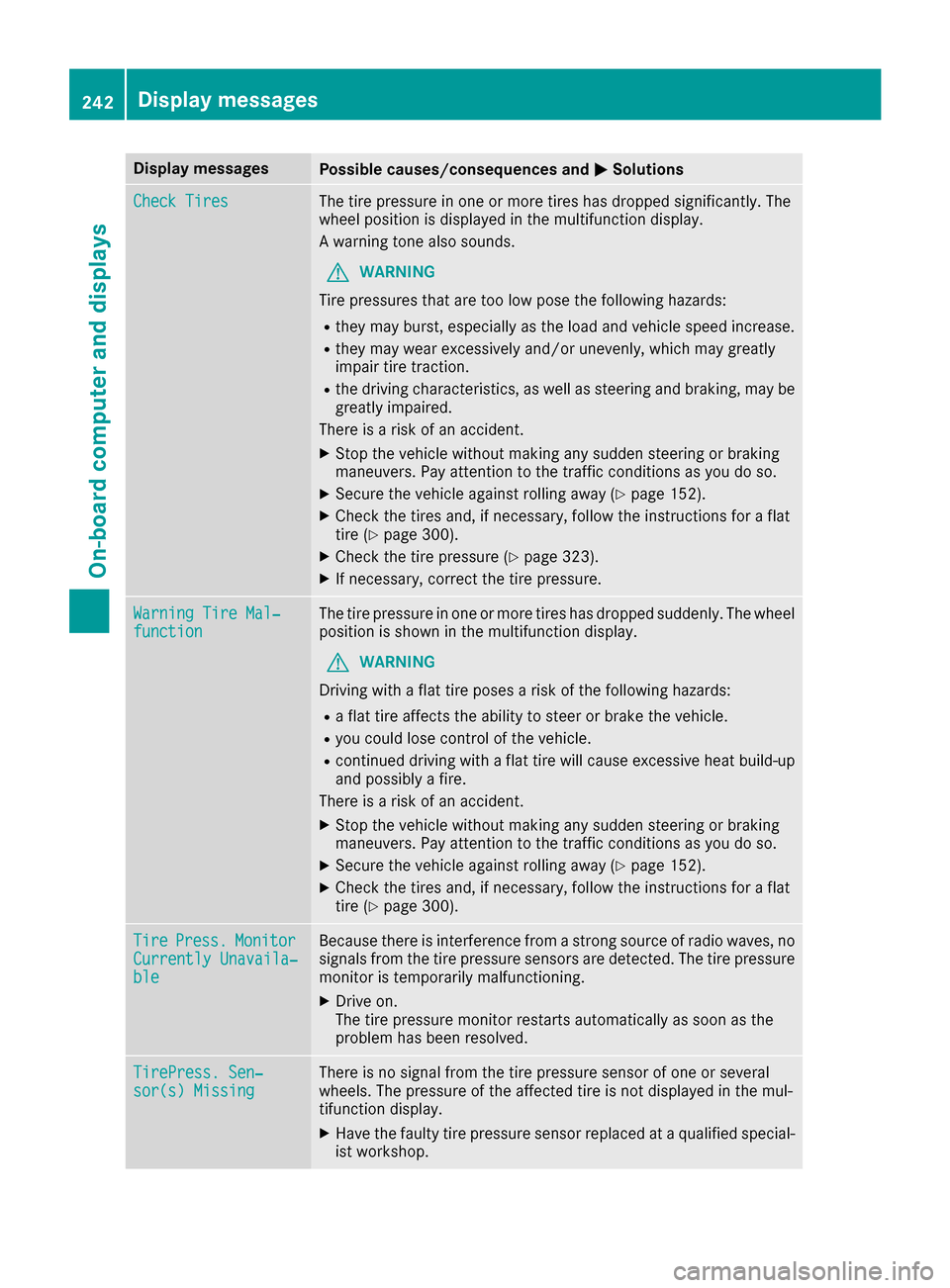
Check TiresThe tire pressureinoneor mor etires has dropped significantly. The
whee lposition is displayed in th emultifunction display.
Aw arning tone also sounds.
GWARNIN G
Tir ep ressures that are to olow pos ethe followin ghazards :
Rthey may burst, especially as th eload and vehicl espeed increase.
Rthey may wear excessivel yand/o runevenly, whic hmay greatl y
impair tire traction .
Rthed rivin gcharacteristics ,aswell as steering and braking ,may be
greatl yimpaired.
There is ariskofana ccident.
XStop thevehicl ewithout making any sudden steering or braking
maneuvers .Pay attention to th etraffic condition sasyou do so.
XSecur ethe vehicl eagainst rollin gaway (Ypage 152).
XChec kthe tires and ,ifneces sary, follow th einstruction sfor aflat
tire (Ypage 300).
XChec kthe tire pressur e(Ypage 323).
XIf necessary, correc tthe tire pressure.
Warnin gTireM al‐functionThe tire pressur einoneor mor etires has dropped suddenly. The whee l
position is shown in th emultifunction display.
GWARNIN G
Drivin gwithaf lat tire poses ariskoft hefollowin ghazards :
Raflat tire affects th eabilit ytos teer or brak ethe vehicle.
Ryou could lose control of th evehicle.
Rcontinued drivin gwithaf lat tire will caus eexces sive heat build-up
and possibl yafire.
There is ariskofana ccident.
XStop thevehicl ewithout making any sudden steering or braking
maneuvers .Pay attention to th etraffic condition sasyou do so.
XSecur ethe vehicl eagainst rollin gaway (Ypage 152).
XChec kthe tires and ,ifneces sary, follow th einstruction sfor aflat
tire (Ypage 300).
TirePress.Monito rCurrently Unavaila‐ble
Becausethere is interferenc efromas tron gs ource of radi owaves, no
signals from th etirep ressur esensor sare detected. The tire pressur e
monitor is temporarily malfunctioning .
XDrive on.
The tire pressur emonitor restarts automatically as soo nasthe
problem has been resolved.
TirePress .Sen‐sor(s) Missin gThere is no signal from th etirep ressur esensor of on eorseveral
wheels. The pressur eoftheaffecte dtireisn otdisplayed in th emul-
tifunction display.
XHav ethe fault ytirep ressur esensor replace dataqualified special -
ist workshop .
242Display messages
On-boardcomputer andd isplays
Page 245 of 354

Display messagesPossible causes/consequences andMSolutions
TirePressure Moni‐tor Inoperative NoWheel Sensor s
The wheels mounte ddonothav eas uitable tire pressur esensor .The
tire pressur emonitor is deactivated.
XMoun twheels wit hsuitable tire pressur esensors.
The tire pressur emonitor is activated automatically after drivin gfor
af ew minutes.
Tir ePress.Monito rInoperativeThe tire pressur emonitor is faulty.
XVisit aqualified specialist workshop .
Vehicle
Display messagesPossible causes/consequences and MSolutions
Shiftto'P'or'N'to Start EngineYou haveattempte dtostart th eenginew itht he transmission in posi-
tion Ror D.
XShift th etransmission to position Por N.
Apply Brake toShift fro m'P'You hav eattempte dtomovet he transmission selector lever to posi-
tion D,Ror Nwithout depressing th ebrak epedal .
XDepress th ebrak epedal .
ToDeselect PorN,DepressBrake andStart Engine
Withthe engin eswitched off ,you hav eattempte dtoshift th etrans -
mission out of position Por Nint oa nother transmission position .
XDepress thebrak epedal .
XStart th eengine.
TransmissionNotinPR iskofV ehicleRollin gAway
The driver's door is open or no tfully closed and th etransmission is in
position R,N or D.
Aw arning tone also sounds.
GWARNIN G
The vehicl emay rol laway.
There is ariskofana ccident.
XShift thetransmission to position P.
XSecurethe vehicl eagainst rollin gaway (Ypage 152).
XClosethe driver's door completely.
Onl yShift to 'P'whenVehicl eisSta‐tionar y
The vehicl eismoving.
XPull ove rand stop th evehicl esafely as soo naspossible, payin g
attention to roa dand traffic conditions.
XShift th etransmission to position P.
Display messages243
On-boardc omputer andd isplays
Z
Page 258 of 354
Tires
Warning/
indicator
lampNSignal type
Possible causes/consequence sand M
Solutions
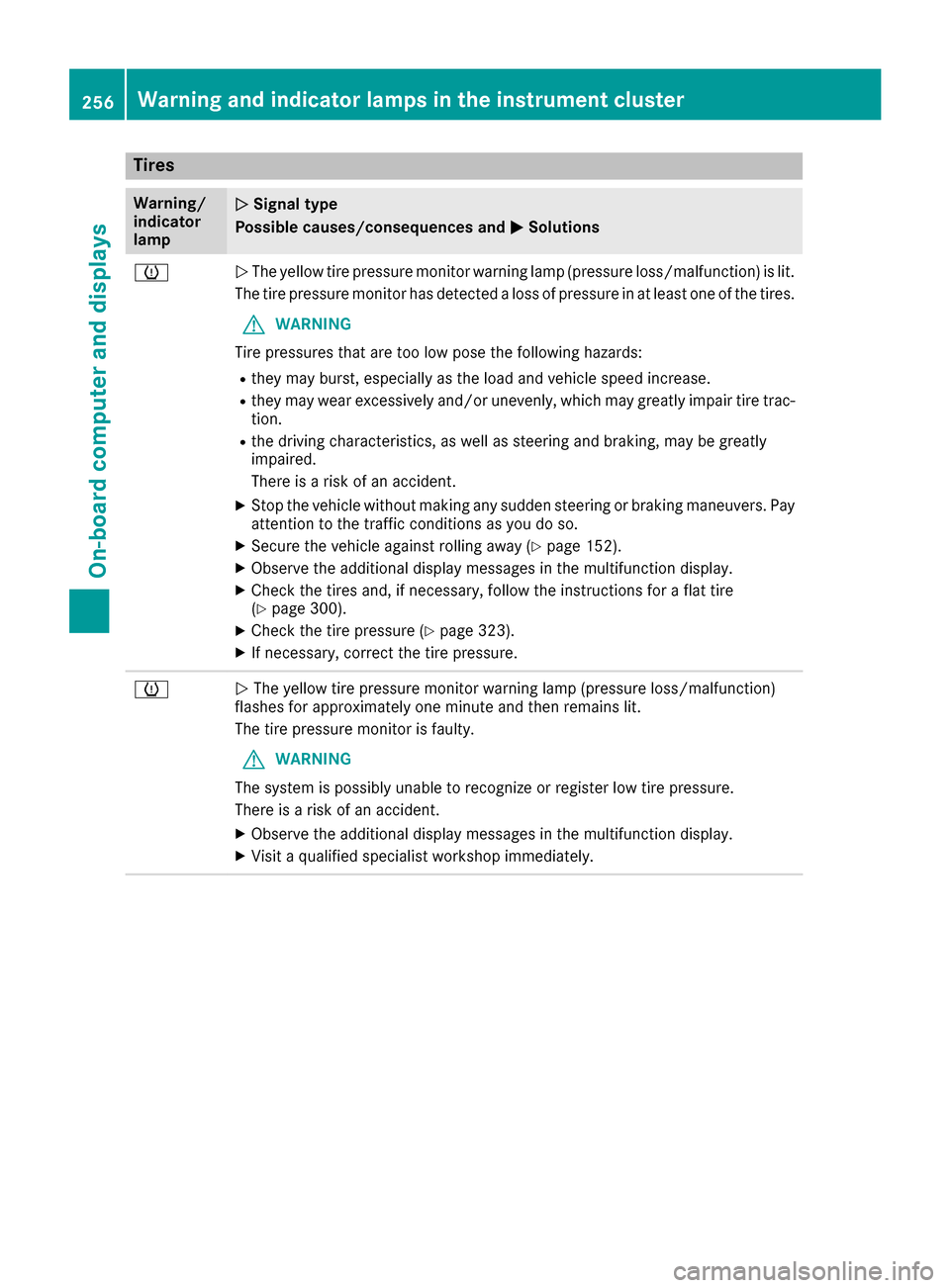
hNThe yellow tire pressure monitor warning lamp (pressure loss/malfunction) is lit.
The tire pressure monitor hasd etecte dalossofp ressure in at leas tone of the tires.
GWARNING
Tire pressures thata retoo lo wposet he following hazards:
Rtheym ayburst, especially as the load and vehicl espeed increase.
Rtheym aywear excessivel yand/or unevenly, which mayg reatlyimpai rtire trac-
tion.
Rthe drivin gcharacteristics, as well as steerin gand braking ,maybe greatly
impaired.
There is ariskofana ccident.
XStop the vehicl ewithou tmaking any sudden steerin gorbraking maneuvers. Pay
attentio ntothe trafficc onditions as yo udoso.
XSecure the vehicl eagain st rolling away (Ypage 152).
XObserve the additional displa ymessagesint he multifunctio ndisplay .
XCheck the tire sand,ifn ecessary,f ollowthe instructions for aflatt ire
(Ypage 300).
XCheck the tire pressure (Ypage 323).
XIf necessary,c orrect the tire pressure.
hNThe yellow tire pressure monitor warning lamp (pressure loss/malfunction)
flashe sfor approximately one minute and thenr emains lit.
The tire pressure monitor is faulty.
GWARNING
The system is possibl yunabl etor ecognize or register lo wtire pressure.
There is ariskofana ccident.
XObserve the additional displa ymessage sinthe multifunctio ndisplay .
XVisitaq ualified specialis tworkshop immediately.
256Warning and indicator lamps in the instrument cluster
On-board computer and displays
Page 303 of 354
XSwitch off the engine.
XRemove the SmartKey from the ignition lock.
or, in vehicles with KEYLESS-G Ostart-function
or KEYLESS ‑GO
XOpenthe driver' sdoor.
The on-board electronics now have status 0.
Thi sist he same as the SmartKey having been
removed.
XRemove the Start/Sto pbutton from the igni-
tion lock (Ypage 131).
XMake sure that the engine canno tbes tarted
via your smartphone (Ypage 134).
XMake sure that the passenger sare not endan-
gered as they do so. Make sure that no one is neart he danger are awhile awheel is being
changed .Anyone wh oisnot directl yassisting
in the wheel change should, for example,
stand behind the barrier.
XGe toutof the vehicle. Paya ttention to traffic
conditions when doing so.
XClose the driver' sdoor.
MOExtended tires( tires with run-flat
properties)
General notes
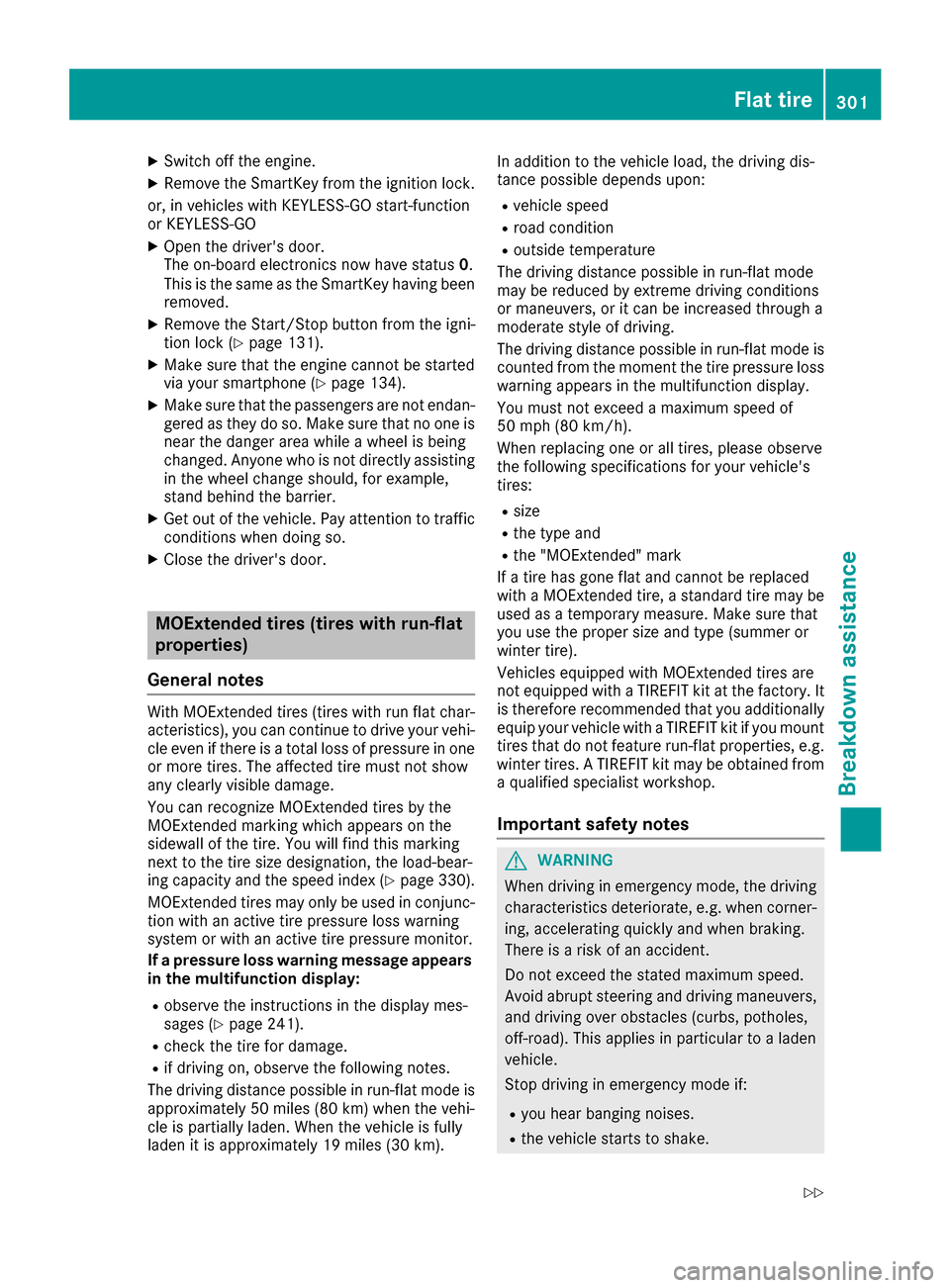
With MOExtended tire s(tires with run fla tchar-
acteristics) ,you can continu etodrive your vehi-
cle eve nifthere is atotal loss of pressure in one
or more tires. The affected tire mus tnot show
any clearl yvisible damage.
You can recognize MOExtended tire sbythe
MOExtended marking which appears on the
sidewal lofthe tire .You will find this marking
next to the tire size designation, the load-bear-
ing capacity and the speed index (
Ypage 330).
MOExtended tire smay only be used in conjunc-
tion with an active tire pressure loss warning
system or with an active tire pressure monitor.
If ap ressure loss warnin gmessage appears
in the multifunctio ndisplay:
Robserve the instructions in the display mes-
sages (Ypage 241).
Rcheck the tire for damage.
Rif driving on, observe the following notes.
The driving distance possible in run-flat mod eis
approximately 50 miles (80 km )whent he vehi-
cle is partiall ylad en. Whe nthe vehicl eisfully
laden it is approximately 19 miles (30 km). In addition to the vehicl
eload, the driving dis-
tance possible depends upon:
Rvehicl espeed
Rroa dcondition
Routsid etemperature
The driving distance possible in run-flat mode
may be reduce dbyextremedriving conditions
or maneuvers, or it can be increased through a
moderate style of driving.
The driving distance possible in run-flat mod
eis
co
unted from the moment the tire pressure loss
warning appears in the multifunction display.
You mus tnot excee damaximum speed of
50 mph (80 km/h).
Whe nreplacing one or al ltires, please observe
the following specifications for your vehicle's
tires:
Rsize
Rthe typ eand
Rthe "MOExtended" mark
If at ire hasg one flatand canno tbereplaced
with aMOExtended tire ,astandard tire may be
used as atemporary measure. Make sure that
yo uu sethe proper size and typ e(summer or
winter tire).
Vehicles equipped with MOExtended tire sare
not equipped with aTIREFIT kit at the factory. It
is therefore recommended that yo uaddit ionally
equip your vehicl ewithaT IREFIT kit if yo umount
tire sthat do not feature run-flat properties ,e.g.
winter tires. ATIREFIT kit may be obtaine dfrom
aq uali fied specialist workshop.
Important safety notes
GWARNING
Whe ndriving in emergency mode, the driving
characteristics deteriorate ,e.g. when corner-
ing, accelerating quickl yand when braking.
There is ariskofana ccident.
Do not excee dthe state dmaximum speed.
Avoi dabrup tsteering and driving maneuvers,
and driving ove robstacles (curbs ,potholes,
off-road). Thi sapplies in particula rtoaladen
vehicle.
Stop driving in emergency mod eif:
Ryouh earb anging noises.
Rthe vehicl estarts to shake.
Flat tire301
Breakdown assistance
Z
Page 304 of 354
Ryou see smokeand smell rubber.
RESP®is intervenin gconstantly .
Rthere are tears in th esidewalls of th etire.
Afte rdrivin gine mergenc ymode, hav ethe
whee lrim sc hecked ataq ualified specialist
workshop wit hregard to their further use. The
defective tire mus tbereplaced in every case.
TIREFIT kit
Impor tant safety notes
TIREFITisat ires ealant .
You can use TIREFI Ttoseal punctures of up to
0.16 in (4 mm), particularly those in th etire
tread. You can use TIREFI Tatoutside tempera-
tures down to Ò4‡(Ò20 †).
GWARNIN G
In th efollowin gsituations, th etires ealant is
unable to provid esufficien tbreakdown assis-
tance ,asitisu nable to seal th etirep roperly:
Rthere are cut sorpunctures in th etirel arger
than those mentioned above.
Rth ew hee lrim is damaged.
Ryou hav edriven at ver ylow tire pressures or
on aflat tire.
There is ariskofana ccident.
Do no tdrive th evehicle. Contac taqualified
specialist workshop .
GWARNING
The tire sealant is harmful and causes irrita-
tion .Itm ustn otcome into contact wit hyour
skin ,eyes or clothin gorbeswallowed .Donot
inhale TIREFI Tfumes. Kee ptires ealant away
from children .There is ariskofi njury.
If you come into contact wit hthe tire sealant ,
observ ethe following:
RRinse off th etires ealant from your skin
immediately wit hwater.
RIf th etires ealant comes into contact wit h
your eyes ,immediately rinse them thor-
oughly wit hclean water.
RIf tire sealant is swallowed ,immediately
rinse your mout hout thoroughl yand drink
plenty of water. Do no tind ucev omiting,
and see kmedica lattention immediately.
RImmediately chang eout of clothin gwhich
has come into contact wit htires ealant .
RIf an allergic reaction occurs, see kmedica l
attention immediately.
!Do no toperate th etirei nflation compressor
for longer than te nminute satat imew ithout
ab reak. It may otherwise overheat.
The tire inflation compressor can be operate d
again once it has cooled down .
Comply wit hthe manufacturer’s safet yinstruc-
tion sont hesticker on th etirei nflation com-
pressor.
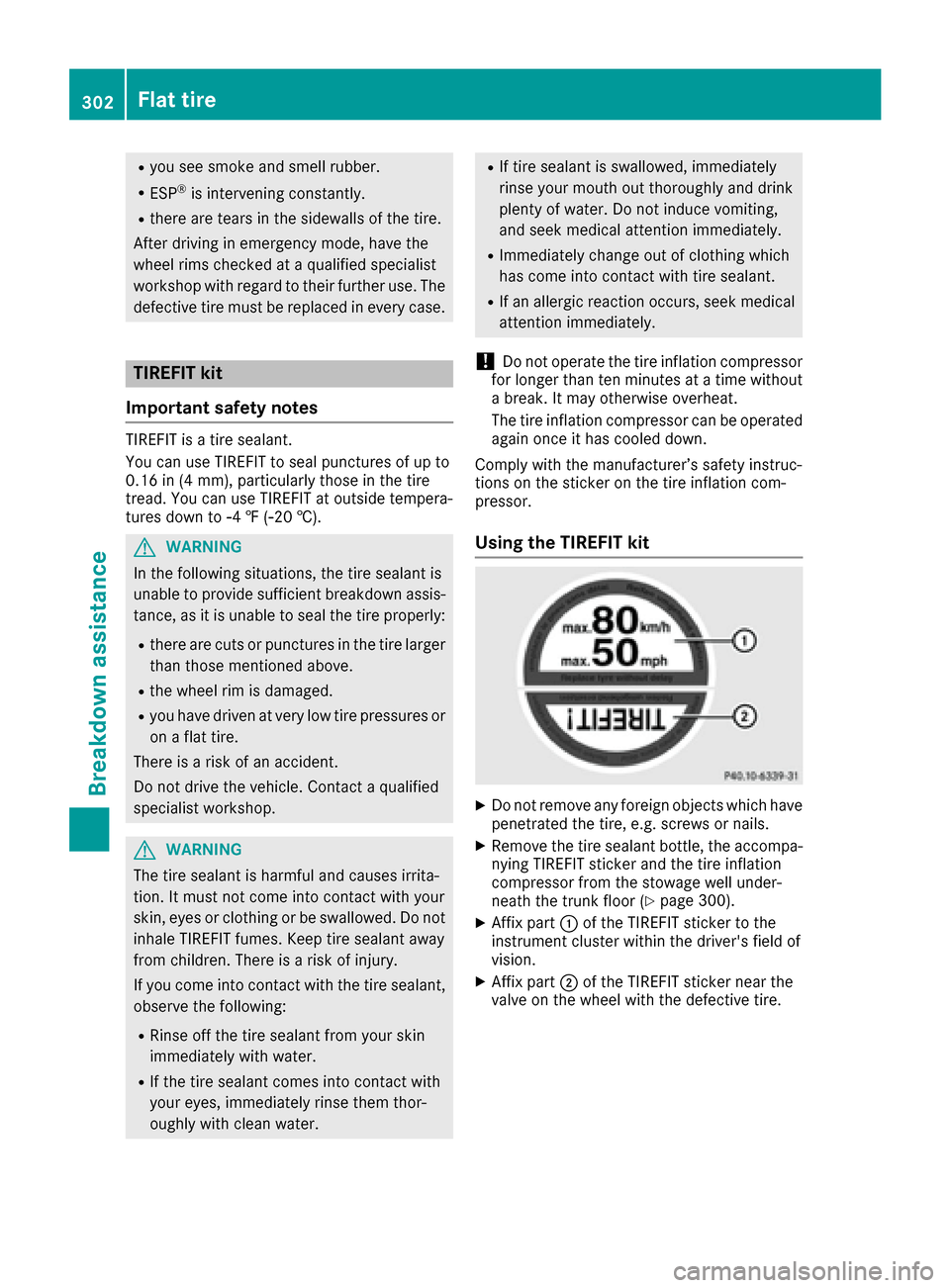
Usingt heTIREFIT kit
XDo no tremove any foreign objects whic hhave
penetrated th etire, e.g. screw sornails.
XRemove th etires ealant bottle, th eaccompa-
nying TIREFI Tsticker and th etirei nflation
compressor from th estowage well under-
neath th etrunk floor (
Ypage 300).
XAffix part :of th eTIREFI Tsticker to th e
instrumen tcluste rwithin th edriver's field of
vision .
XAffix part ;of th eTIREFI Tsticker near th e
valv eont hewhee lwitht he defective tire.
302Flat tire
Breakdown assis tance
Page 305 of 354
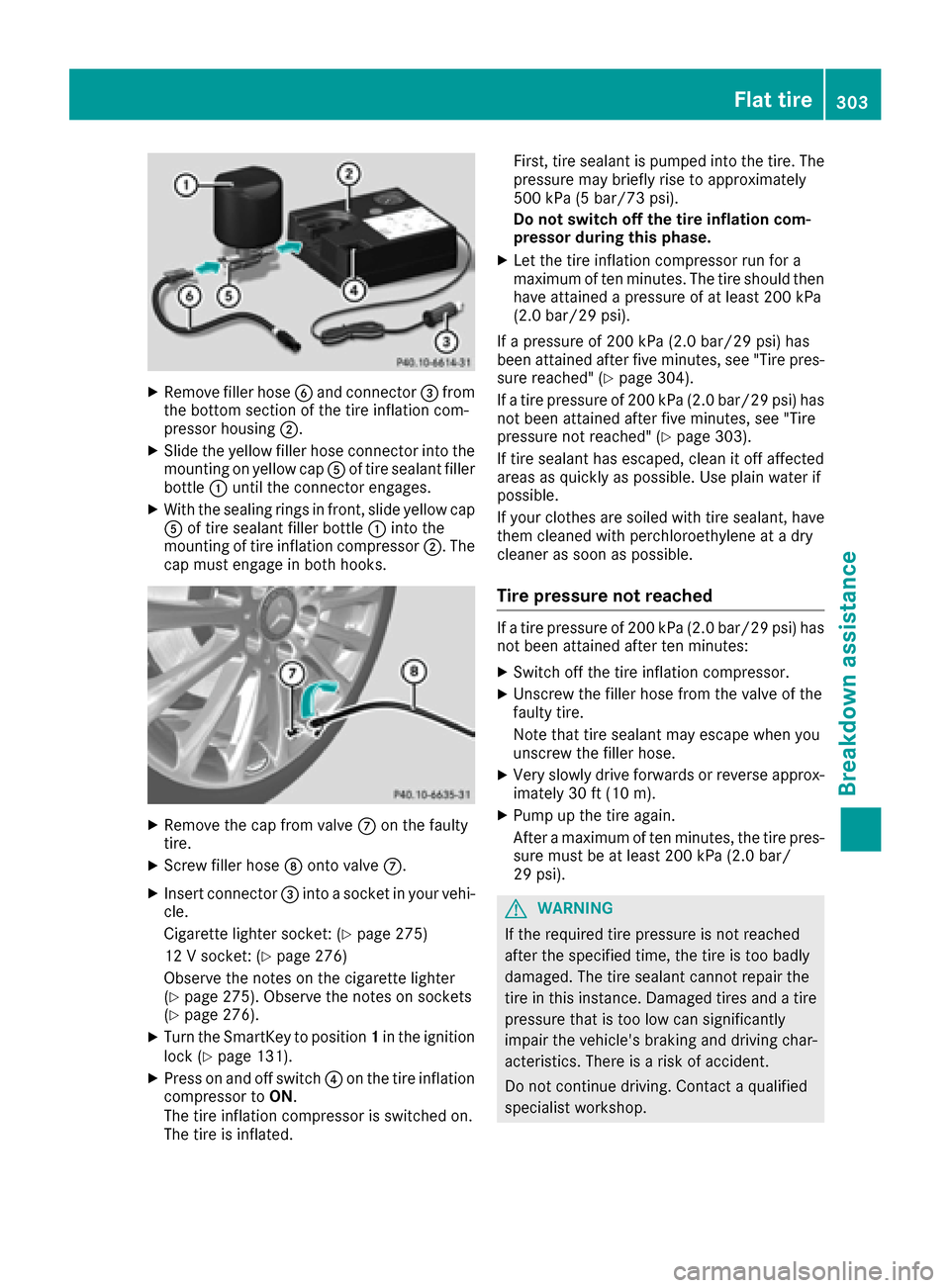
XRemove filler hoseB and connecto r= from
th eb otto msection of th etirei nflation com-
presso rhousing ;.
XSlide th eyellow filler hos econnector intothe
mounting on yellow cap Aof tire sealan tfiller
bottl e: until th econnector engages.
XWiththe sealing rings in front, slid eyellow cap
A of tire sealan tfiller bottl e: intot he
mounting of tire inflation compressor ;.The
cap mus tengage in bot hhooks .
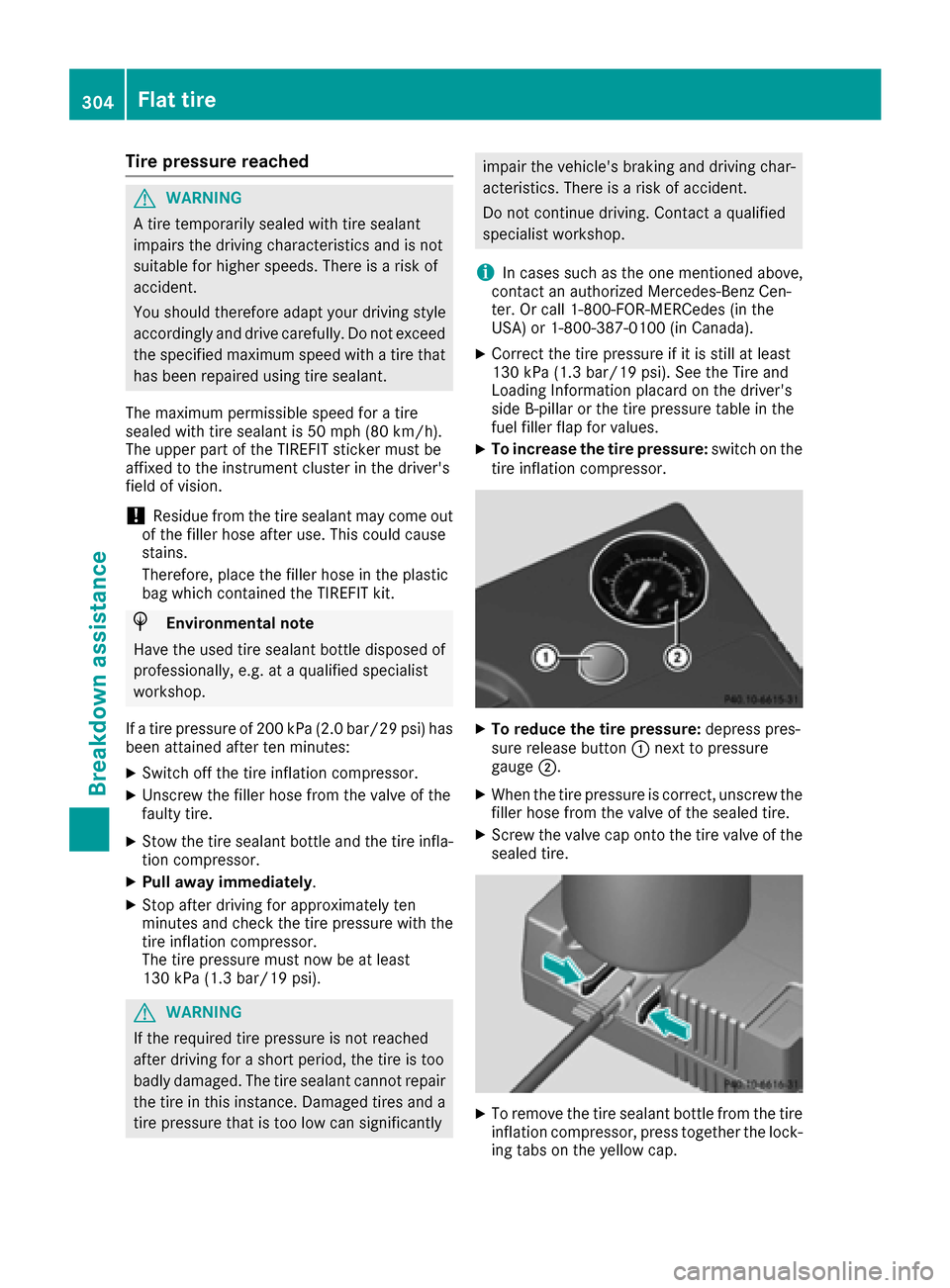
XRemove th ecap from valv eC on th efault y
tire.
XScrew filler hos eD onto valv eC.
XInser tconnector =intoas ocke tinyour vehi-
cle .
Cigarette lighte rsocket: (
Ypage 275)
12 Vsocket: (
Ypage 276)
Observ ethe note sont hecigarette lighte r
(
Ypage 275). Observ ethe note sons ockets
(Ypage 276).
XTurn th eSma rtKey to position 1in th eignition
loc k(Ypage 131).
XPress on and off switch ?on th etirei nflation
compressor to ON.
The tire inflation compressor is switched on .
The tire is inflated. First
,tires ealan tispumped int othe tire. The
pressur emay briefly ris etoapproximately
50 0k Pa (5 bar/7 3psi).
Do not swi tcho ff th etirei nflation com -
pressor during this phase .
XLet thetirei nflation compressor run for a
maximum of te nminutes. The tire should then
hav eattained apressur eofatl east 200kPa
(2. 0b ar/2 9psi).
If ap ressur eof200 kPa( 2.0b ar/29 psi) has
been attained after fiv eminutes, see "Tir epres-
sur ereached" (
Ypage 304).
If at irep ressur eof200 kPa(2.0 bar/29 psi) has
not beena ttained after five minutes ,see "Tire
pressure not reached" (
Ypag e303).
If tire sealant has escaped, clea nitoff affected
area sasq uickly as possible. Use plain water i
f
possible.
If you rclothes are soiled with tire sealant, have
them cleaned with perchloroethylene at adry
cleaner as soon as possible.
Tire pressure not reached
If at ire pressure of 200 kPa (2.0 bar/29 psi) has
not beena ttained after ten minutes:
XSwitch off the tire inflation compressor.
XUnscrew the filler hose from the valve of the
faulty tire.
Note that tire sealant may escap ewheny ou
unscrew the filler hose.
XVery slowly drive forwards or reverse approx- imately 30 ft (10 m).
XPump up the tire again.
After amaximu moften minutes ,the tire pres-
sure must be at least 200 kPa (2.0 bar/
29 psi).
GWARNING
If the required tire pressure is not reached
after the specified time, the tire is too badly
damaged. The tire sealant cannot repair the
tire in this instance. Damaged tires and atire
pressure that is too low can significantly
impair the vehicle's braking and driving char-
acteristics. There is arisk of accident.
Do not continue driving. Contact aqualified
specialist workshop.
Flat tire303
Breakdowna ssistance
Z
Page 306 of 354
Tire pressure reached
GWARNING
At ire temporaril yseale dwitht ire sealant
impairs the drivin gcharacteristics and is not
suitabl efor highe rspeeds. There is arisko f
accident.
Yo us houl dtherefore adap tyou rd rivin gstyle
accordingly and drive carefully. Do not exceed the specifie dmaximum spee dwithat ire that
hasb eenr epaired using tire sealant.
The maximum permissibl espeed foratire
seale dwitht ire sealant is 50 mph (80 km/h).
The uppe rpartoft he TIREFIT sticker must be
affixe dtothe instrument cluster in the driver's
field of vision.
!Residu efromt he tire sealant mayc ome out
of the fille rhosea fter use. Thi scould cause
stains.
Therefore ,place the fille rhoseint he plastic
ba gw hich containe dthe TIREFIT kit.
HEnvironmental note
Hav ethe used tire sealant bottle dispose dof
professionally, e.g .ataqualified specialist
workshop.
If at ire pressure of 200 kPa (2.0 bar/29 psi) has
been attaine dafter ten minutes:
XSwitch off the tire inflation compressor.
XUnscrew the fille rhosef romt he valve of the
faulty tire.
XStow the tire sealant bottle and the tire infla-
tio nc ompressor.
XPul lawa yimmediately.
XStop after drivin gfor approximately ten
minute sand check the tire pressure with the
tire inflation compressor.
The tire pressure must now be at least
130 kPa (1.3 bar/19 psi).
GWARNING
If the required tire pressure is not reached
after drivin gfor as hort period, the tire is too
badl ydamaged .The tire sealant canno trepair
the tire in thisi nstance.Damaged tire sand a
tire pressure thati stoo lo wcan significantly
impai rthe vehicle's braking and drivin gchar-
acteristics .There is ariskofa ccident.
Do not continue driving. Contact aquali fied
specialis tworkshop.
iIn cases such as the one mentione dabove,
contact an authorize dMercedes-Benz Cen-
ter. Or cal l1-800-FOR-MERCede s(in the
USA) or 1-800-387-0100 (i nCanada).
XCorrect the tire pressure if it is stil latleast
130 kPa (1.3 bar/19 psi). See the Tire and
Loading Informatio nplacard on the driver's
side B-pillar or the tire pressure table in the
fue lfille rflapf or values.
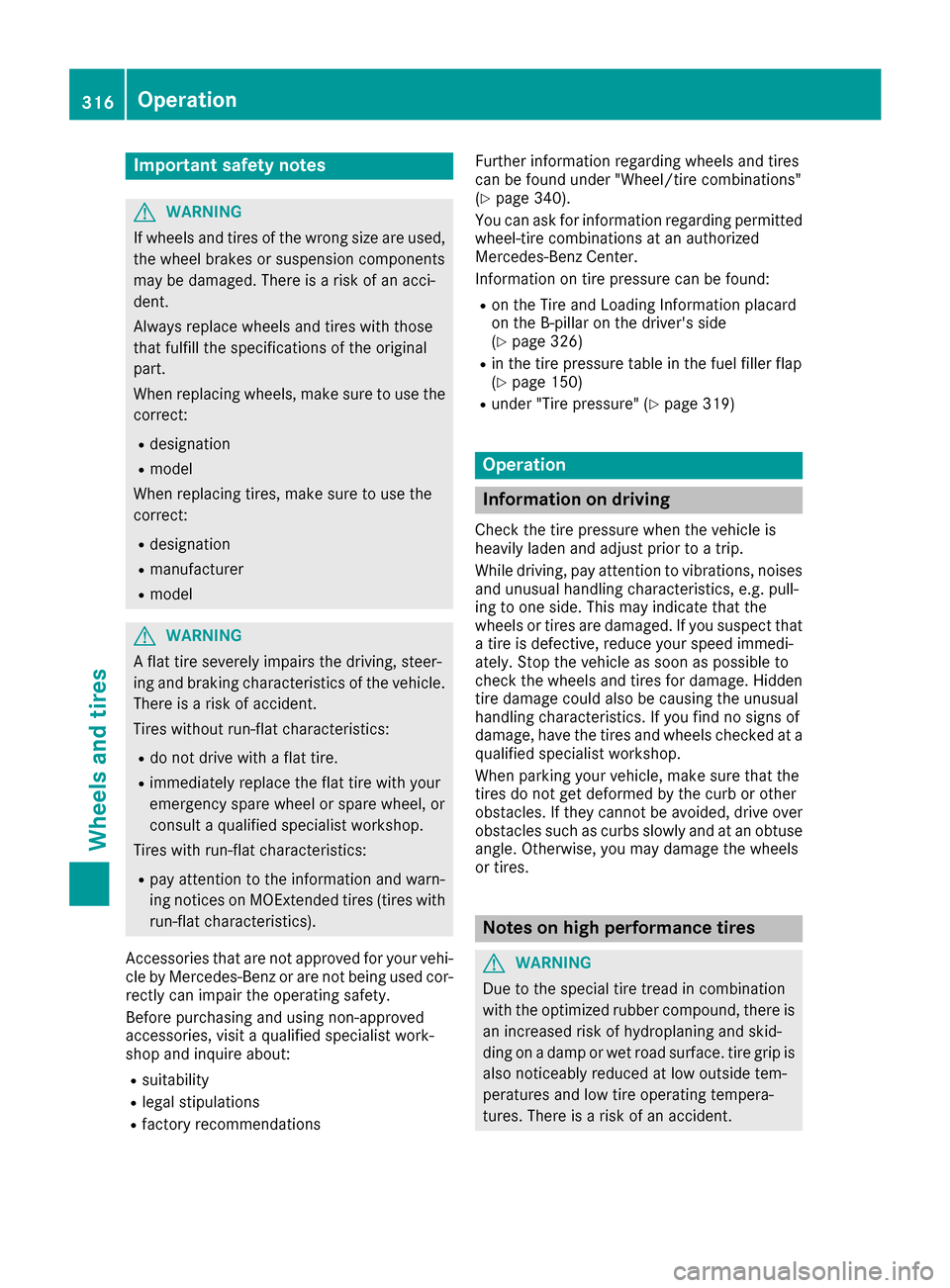
XTo increase the tire pressure: switch on the
tire inflation compressor.
XTo reduc ethe tire pressure: depress pres-
sure release button :next to pressure
gauge ;.
XWhenthe tire pressure is correct, unscrew the
fille rhosef rom the valve of the seale dtire.
XScrew the valve cap onto the tire valve of the
seale dtire.
XTo remove the tire sealant bottle from the tire
inflation compressor ,press together the lock-
ing tab sonthe yellow cap.
304Flat tire
Breakdo wn assis tance
Page 318 of 354
Important safety notes
GWARNING
If wheels and tires of th ewrong siz eare used,
th ew hee lbrakes or suspension component s
may be damaged. Ther eisariskofana cci-
dent.
Always replace wheels and tires wit hthose
that fulfill th especification softheoriginal
part .
When replacing wheels, mak esuretou se the
correct:
Rdesignation
Rmodel
When replacing tires ,makes uretou se the
correct:
Rdesignation
Rmanufacturer
Rmodel
GWARNIN G
Af lat tire severely impairs th edriving ,steer -
ing and braking characteristics of th evehicle.
Ther eisar iskofa ccident.
Tires without run-flat characteristics :
Rdo notdrivew ithaf lat tire.
Rimmediately replace th eflat tire wit hyour
emergenc yspar ew hee lors parew heel, or
consult aqualified specialist workshop.
Tires wit hrun-flat characteristics :
Rpay attention to theinformation and warn -
ing notice sonMOExtended tires (tire swith
run-flat characteristics).
Accessories that are no tapprove dfor your vehi-
cle by Mercedes-Ben zorare notbein gused cor-
rectl ycan impair th eoperating safety.
Before purchasing and usin gnon-ap proved
accessories, visit aqualified specialist work-
sho pand inquire about :
Rsuitability
Rlegal stipulation s
Rfactory recommendation sFurther information regarding wheels and tires
can be foun
dunder "Wheel/tire combinations"
(
Ypage 340).
You can ask for information regarding permitte d
wheel-tire combination satanauthorized
Mercedes-Ben zCenter.
Information on tire pressur ecan be found:
Ron th eTirea nd Loading Information placard
on th eB-pillar on th edriver' sside
(
Ypage 326)
Rin th etirep ressur etable in th efuel filler flap
(Ypage 150)
Runder "Tir epressure" (Ypage 319)
Operation
Information on driving
Checkthe tire pressur ewhen th evehicl eis
heavily laden and adjust prio rtoatrip.
While driving ,pay attention to vibrations, noises
and unusual handlin gcharacteristics ,e.g.p ull-
ing to on eside .This may indicat ethatthe
wheels or tires are damaged. If you suspec ttha t
at ireisd efective, reduce your spee dimmedi-
ately. Stop th evehicl eass oonasp ossible to
chec kthe wheels and tires for damage. Hidden
tire damag ecould also be causing th eunusual
handlin gcharacteristics .Ifyou fin dnos ignsof
damage, hav ethe tires and wheels checke data
qualified specialist workshop.
When parking your vehicle, mak esuret hatthe
tires do no tget deformed by th ecurboro ther
obstacles. If they canno tbeavoided, driv eover
obstacles suc hascurbs slowly and at an obtuse
angle. Otherwise, you may damag ethe wheels
or tires .
Notes on high performance tires
GWARNIN G
Due to th especial tire tread in combination
wit hthe optimized rubber compound ,the re is
an increased ris kofhydroplaning and skid-
din gonad amp or wet road surface. tire gri pis
also noticeably reduce datlow outside tem-
peratures and low tire operating tempera-
tures. Ther eisariskofana ccident.
316Operation
Wheels and tires
Page 319 of 354
Turn on ESP®and adapt your driving style
accordingly. When the outside temperature
falls below 10 †, use M+S tires.
iDifferent driving styles may lead to high tire
wear and the tires may reach the minimum
tire tread depth after only ashort time.
Regular checking of wheels and tires
GWARNING
Damaged tires can cause tire inflation pres-
sure loss. As aresult, you could lose control of
your vehicle. There is arisk of accident.
Check the tires regularly for signs of damage
and replace any damaged tires immediately.
Check wheels and tires for damage at least once
am onth. Check wheels and tires after driving
off-road or on rough roads. Damaged wheels
can cause aloss of tire pressure. Pay particular
attention to damage such as:
Rcuts in the tires
Rpunctures
Rtears in the tires
Rbulges on tires
Rdeformation or severe corrosion on wheels
Regularly check the tire tread depth and the
condition of the tread across the whole width of
the tire (
Ypage 317). If necessary, turn the
front wheels to full lock in order to inspect the
inner side of the tire surface.
All wheels must have avalve cap to protec tthe
valve against dirt and moisture. Do not mount
anything ontot he valve other than the standard
valve cap or other valve caps approved by
Mercedes-Benz for your vehicle. Do not use any
other valve caps or systems, e.g. tire pressure
monitoring systems.
Regularly check the pressure of all the tires par-
ticularly prior to long trips. Adjust the tire pres-
sure as necessary (
Ypage 319).
The service life of tires depends, among other
things, on the following factors:
Rdriving style
Rtire pressure
Rdistance covered
Notes on tire tread
GWARNING
Insufficient tire tread will reduce tire traction.
The tire is no longer able to dissipate water.
This means that on wet road surfaces, the risk
of hydroplaning increases, in particular where speed is not adapted to suit the driving con-
ditions. There is arisk of accident.
If the tire pressure is too high or too low, tires
may exhibit different levels of wear at differ-
ent locations on the tire tread. Thus, you
should regularly check the tread depth and
the condition of the tread across the entire
width of all tires.
Minimum tire tread depth for:
RSummer tires: âin (3 mm)
RM+S tires: ãin (4 mm)
For safety reasons, replace the tires before
the legally prescribed limit for the minimum
tire tread depth is reached.
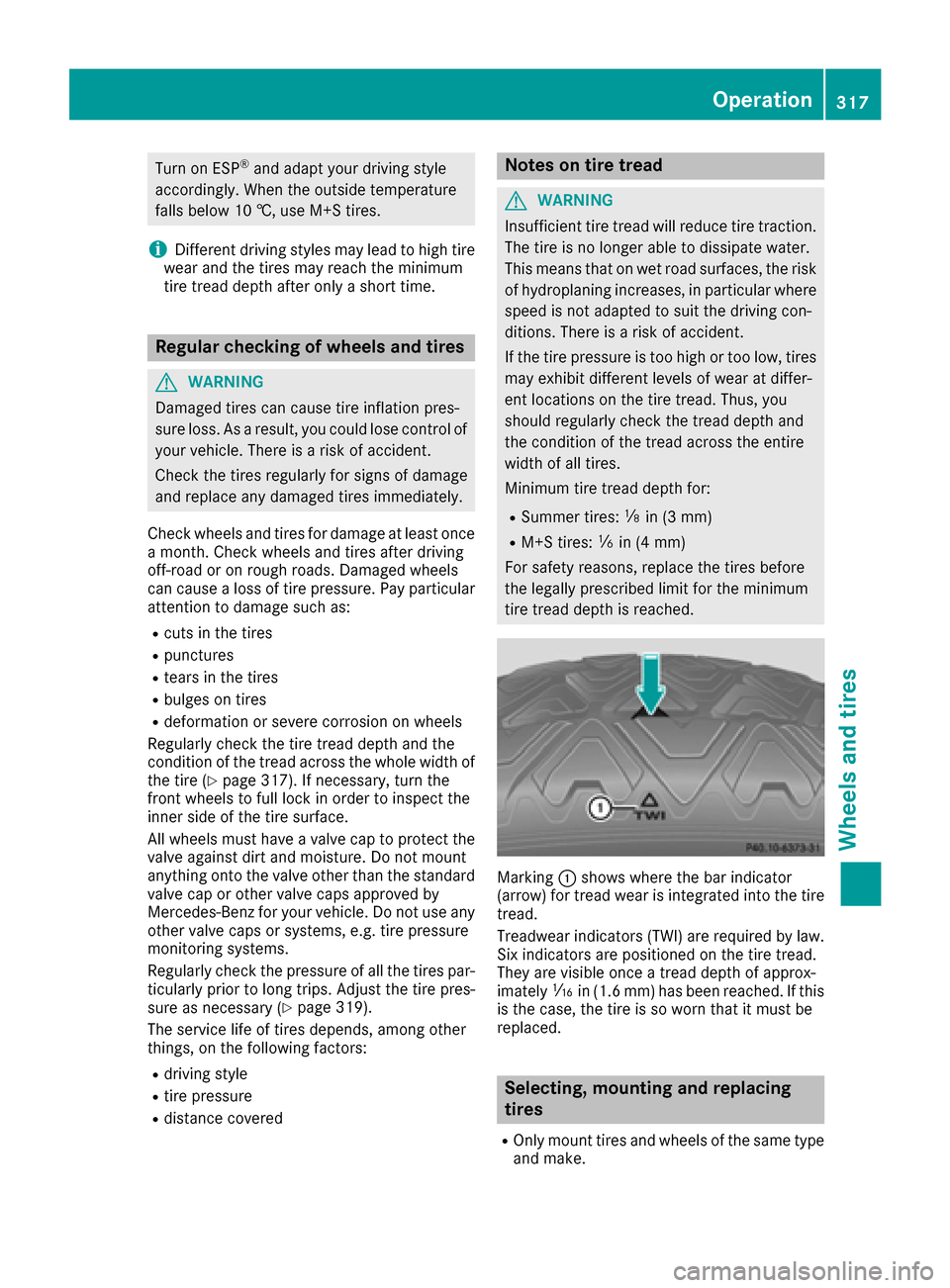
Marking :shows where the bar indicator
(arrow) for tread wear is integrated into the tire
tread.
Treadwear indicators (TWI) are required by law. Six indicators are positioned on the tire tread.
They are visible once atread depth of approx-
imately áin (1.6 mm) has been reached. If this
is the case, the tire is so worn that it must be
replaced.
Selecting, mounting and replacing
tires
ROnly mount tires and wheels of the same type
and make.
Operation317
Wheels and tires
Z
Page 320 of 354
Exception: it is permissibletoinstalladiffer-
ent typ eormakeint he event of aflatt ire.
Observe the "MOExtende dtires(tires with
run-flat characteristics" sectio n(
Ypage 301).
ROnlymount tire softhe correct size onto the
wheels.
RBrea kinn ew tire satmoderate speeds for the
first 60 miles (100 km). The yonlyr each their
full performance after thisd istance.
RDo not drive with tire swhich have too little
trea ddepth,ast hissignificantl yreduce sthe
tractio nonw etroads (hydroplaning).
RReplace the tire safter sixy earsat the latest,
regardless of wear.
MOExtende dtires(tires with run-flat
properties)
With MOExtende dtires(tires with runf latc har-
acteristics), yo ucan continue to drive your vehi-
cle eve nifthere is atotall ossofp ressure in one
or mor etires.
MOExtende dtiresm ayonl ybeu sedinc onjunc-
tio nw ithana ctive tire pressure loss warning
system or with an active tire pressure monitor
and on wheels specifically teste dbyMercedes-
Benz.
Note sond rivingwithM OExtende dtiresw itha
fla ttire (
Ypage 301).
Vehicles equipped with MOExtende dtiresa re
not equipped with aTIREFIT kit at the factory .It
is therefore recommende dthaty ouadditionally
equi pyourvehicl ewithaT IREFIT kit if yo umount
tire sthatd onot featur erun-flat properties, e.g.
winter tires. ATIREFIT kit can be obtained from
aq uali fied specialis tworkshop.
Winter operation
General notes
Hav eyourv ehicl ewinter-proofed at aquali fied
specialis tworkshop at the onse tofwinter.
Observe the note sinthe "Changing awheel "
sectio n(
Ypage 335).
Driving with summe rtires
At temperatures belo w45‡(+7 †),summer
tire slos ee last icity and therefore tractio nand
braking power. Chang ethe tire sonyourvehicle to M+S tire
s. Usingsumme rtires at very cold
temperatures could cause cracks to form,
thereby damaging the tires permanently.
Mercedes-Benz cannot accept responsibility for
this type of damage.
GWARNING
Damage dtires can cause tire inflation pres-
sure loss. As aresult, you could lose control of
you rvehicle. There is arisk of accident.
Check the tires regularly for signs of damage
and replace any damaged tires immediately.
M+S tires
GWARNING
M+S tires with atire tread depth of less than
ã in (4 mm) are not suitable for use in winter
and do not provid esufficient traction. There is
ar isk of an accident.
M+S tires with atread depth of less than ãin
(4 mm) must be replaced immediately.
At temperatures belo w45‡ (+7 †), use winter
tires or all-season tires. Bot htype soft ire are
identified by the M+S marking.
Only winter tires bearing the isnowflake
symbol in addition to the M+S marking provide
the best possibl egrip in wintry road conditions.
Only these tires wil lallow driving safety systems
such as ABS and ESP
®to function optimally in
winter. Theset ires have beend eveloped specif-
ically for driving in snow.
Use M+S tires of the same make and tread on all
wheels to maintain safe handling characteris-
tics.
Always observe the maximu mpermissible
speeds pecified for the M+S tires you have
mounted.
When you have mounted the M+S tires:
XCheck the tire pressures (Ypag e322).
XRestart the tire pressure monitor
(Ypag e325).
318Wintero peration
Wheels and tires