ABS MERCEDES-BENZ CLK430 2001 C208 Owner's Manual
[x] Cancel search | Manufacturer: MERCEDES-BENZ, Model Year: 2001, Model line: CLK430, Model: MERCEDES-BENZ CLK430 2001 C208Pages: 329, PDF Size: 11.53 MB
Page 6 of 329

3 Contents
DrivingControl and operation of
radio transmitters ..................... 176
The first 1 000 miles
(1 500 km) ................................. 177
Maintenance ................................... 177
Catalytic converter ........................ 178
Emission control ............................ 179
Tele Aid ........................................... 180
Steering lock ................................... 190
Starting and turning off
the engine .................................. 192
Automatic transmission ............... 193
Parking brake .................................202
Driving instructions ......................203
Drive sensibly – save fuel .........203
Drinking and driving .................203
Pedals ...........................................203
Power assistance ........................204
Brakes ..........................................204Driving off ................................... 205
Parking ........................................ 205
Tires ............................................. 206
Snow chains ............................... 209
Winter driving
instructions ................................ 209
Deep water ...................................210
Passenger compartment ............ 211
Traveling abroad ......................... 211
Cruise control .................................212
Brake assist system
(BAS) ...........................................215
Antilock brake system
(ABS) ...........................................217
Electronic stability program
(ESP) ............................................ 219
What you should know
at the gas station ...................... 223
Check regularly and
before a long trip ...................... 225
Instrument cluster displayMalfunction and indicator
lamps in the
instrument cluster ....................228
On-board diagnostic system
Check engine malfunction
indicator lamp .............................228
Brake warning lamp ..................229
Supplemental restraint
system (SRS)
indicator lamp .............................230
Fuel reserve and fuel cap
placement warning ....................230
Electronic stability program
(ESP) — warning lamp ............... 231
BAS/ESP malfunction
indicator lamp ............................. 231
ABS malfunction
indicator lamp ............................. 231
Telescoping steering column –
indicator lamp .............................232
Seat belt warning lamp .............232
Page 7 of 329

4 Contents
Malfunction and indicator lamps
in the center console ................232
AIRBAG OFF
indicator lamp .............................232
Malfunction and warning
messages in the
multifunction display ...............233
DISPLAY DEFECTIVE
(engine control unit) ..................234
DISPLAY DEFECTIVE
(several systems) ........................234
BATTERY/ALTERNATOR ...........235
ABS-SYSTEM ...............................236
BRAKE ASSIST ...........................236
BRAKE LINING WEAR ..............237
BRAKE FLUID .............................237
PARKING BRAKE .......................238
ENGINE FAN ...............................238
COOLANT
(coolant level) .............................239
COOLANT TEMP.
(coolant temperature) ................240
LIGHTING SYSTEM .................... 241LIGHT SENSOR .......................... 242
STEER. WHEEL ADJUST. .......... 242
ENGINE OIL LEVEL ................... 243
ELEC. STABIL. PROGRAM.
(Electronic stability
program) ..................................... 244
REMOVE KEY ............................. 244
WASHER FLUID ......................... 245
TELE AID ..................................... 246
Practical hintsFirst aid kit ..................................... 248
Shelf below rear window .............. 248
Stowing things in
the vehicle ................................. 248
Fuses ............................................... 249
Hood ................................................ 251
Checking engine oil level ............. 253
Automatic transmission
fluid level ................................... 254
Coolant level ................................... 254
Adding coolant ........................... 255Windshield washer / headlamp
cleaning system ........................256
Windshield and
headlamp washer
fluid mixing ratio .......................256
Spare wheel, vehicle tools,
storage compartment ................257
Vehicle jack .....................................258
Wheels .............................................259
Tire replacement ........................259
Rotating wheels ..........................260
Spare wheel .................................... 261
Changing wheels ...........................262
Tire inflation pressure ..................267
Battery .............................................268
Jump starting ..................................270
Towing the vehicle .........................272
Transmission selector lever,
manually unlocking ................... 274
Exterior lamps ................................275
Headlamp assembly ................... 276
Taillamp assemblies ..................278
Adjusting headlamp aim ...............280
Page 27 of 329
24 Central locking system
Te ch n ica l
data Instruments
and controlsOperationDrivingInstrument
cluster displayPractical hints Car care Index
Ve h i c l e k ey s
Included with your vehicle are:
•2 electronic main keys with integrated radio
frequency and infrared remote controls plus
removable mechanical key.
The locking tabs for the mechanical key portion of
the two electronic main keys are a different color to
help distinguish it.
•1 electronic reserve key without remote control
functions, plus removable mechanical key.
Wa r n i n g !
When leaving the vehicle always remove the
electronic key from the steering lock, and lock your
vehicle. Do not leave children unattended in the
vehicle, or with access to an unlocked vehicle.
Unsupervised use of vehicle equipment may cause
serious personal injury.
Page 89 of 329
86 Instrument cluster
Te ch n ica l
data Instruments
and controlsOperationDrivingInstrument
cluster displayPractical hints Car care Index
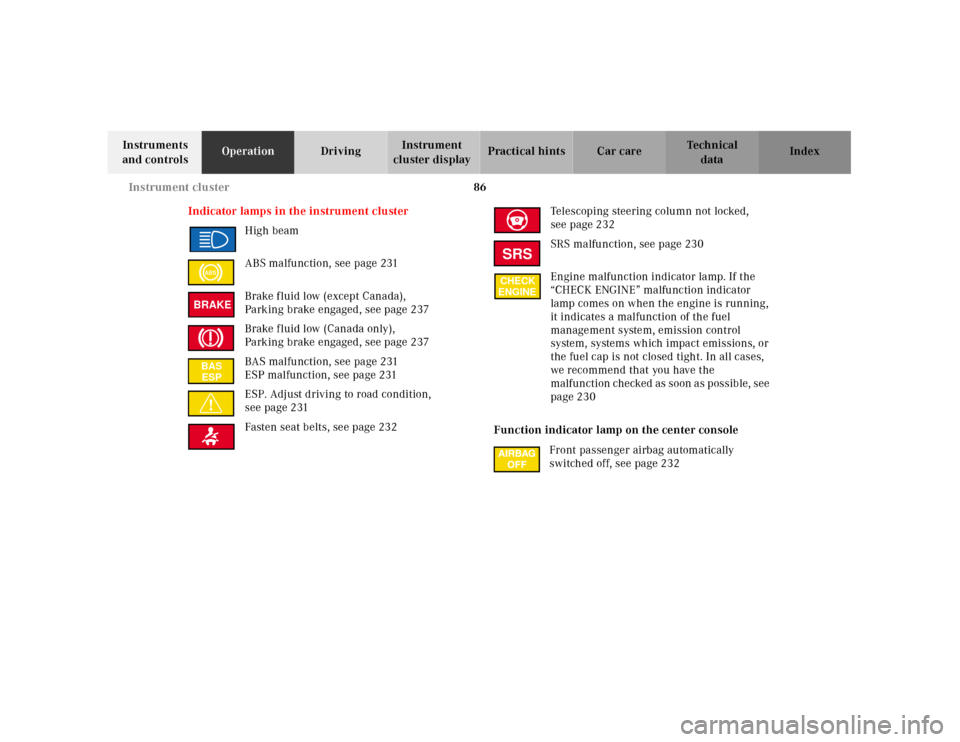
Indicator lamps in the instrument cluster
High beam
ABS malfunction, see page 231
Brake fluid low (except Canada),
Parking brake engaged, see page 237
Brake fluid low (Canada only),
Parking brake engaged, see page 237
BAS malfunction, see page 231
ESP malfunction, see page 231
ESP. Adjust driving to road condition,
see page 231
Fasten seat belts, see page 232Telescoping steering column not locked,
see page 232
SRS malfunction, see page 230
Engine malfunction indicator lamp. If the
“CHECK ENGINE” malfunction indicator
lamp comes on when the engine is running,
it indicates a malfunction of the fuel
management system, emission control
system, systems which impact emissions, or
the fuel cap is not closed tight. In all cases,
we recommend that you have the
malfunction checked as soon as possible, see
page 230
Function indicator lamp on the center console
Front passenger airbag automatically
switched off, see page 232
ABSBRAKEBAS
ESP
SRSCHECK
ENGINE
Page 175 of 329
172 Ski sack
Te ch n ica l
data Instruments
and controlsOperationDrivingInstrument
cluster displayPractical hints Car care Index
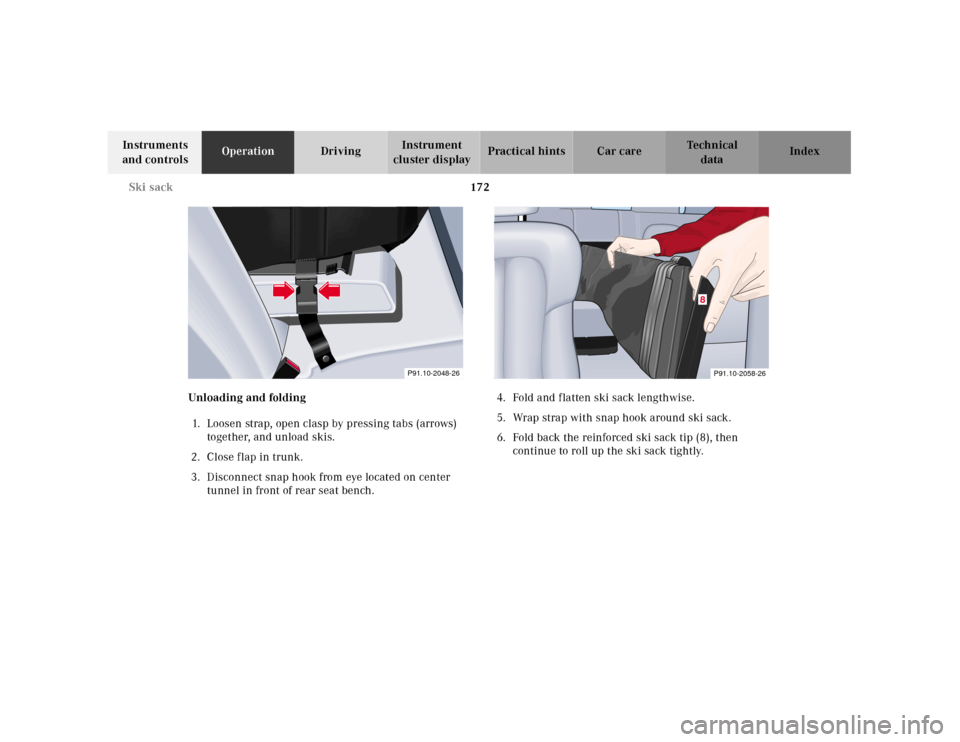
Unloading and folding
1. Loosen strap, open clasp by pressing tabs (arrows)
together, and unload skis.
2. Close flap in trunk.
3. Disconnect snap hook from eye located on center
tunnel in front of rear seat bench.4. Fold and f latten ski sack lengthwise.
5. Wrap strap with snap hook around ski sack.
6. Fold back the reinforced ski sack tip (8), then
continue to roll up the ski sack tightly.
P91.10-2048-26
8
P91.10-2058-26
Page 178 of 329

175 Contents – Driving
Te ch n ica l
data Instruments
and controlsOperationDrivingInstrument
cluster displayPractical hints Car care Index
DrivingControl and operation of
radio transmitters ..................... 176
The first 1 000 miles
(1 500 km) ................................. 177
Maintenance ................................... 177
Catalytic converter ........................ 178
Emission control ............................ 179
Tele Aid ........................................... 180
Steering lock ................................... 190
Starting and turning off
the engine .................................. 192
Automatic transmission ............... 193
Parking brake .................................202Driving instructions ...................... 203
Drive sensibly – save fuel ........ 203
Drinking and driving ................ 203
Pedals .......................................... 203
Power assistance ........................ 204
Brakes .......................................... 204
Driving off ................................... 205
Parking ........................................ 205
Tires ............................................. 206
Snow chains ............................... 209
Winter driving
instructions ................................ 209
Deep water ...................................210
Passenger compartment ............ 211
Traveling abroad ......................... 211Cruise control ................................. 212
Brake assist system
(BAS) ........................................... 215
Antilock brake system
(ABS) ........................................... 217
Electronic stability program
(ESP) ........................................... 219
What you should know
at the gas station .......................223
Check regularly and
before a long trip ......................225
Page 198 of 329
195 Automatic transmission
Te ch n ica l
data Instruments
and controlsOperationDrivingInstrument
cluster displayPractical hints Car care Index Stopping
For brief stops, e.g. at traffic lights, leave the
transmission in gear and hold vehicle with the service
brake.
For longer stops with the engine idling, shift into “N”
or “P” and hold the vehicle with the service brake.
When stopping the vehicle on an uphill gradient, do not
hold it with the accelerator, use the brake. This avoids
unnecessary transmission heat build up.
Maneuvering
To maneuver in tight areas, e.g. when pulling into a
parking space, control the vehicle speed by gradually
releasing the brakes. Accelerate gently and never
abruptly step on the accelerator.
To rock a vehicle out of soft ground (mud or snow),
alternately shift from forward to reverse, while applying
slight partial throttle.Rocking a vehicle free in this manner may cause the
ABS or traction system malfunction indicator lamp to
come on. Turn off and restart the engine to clear the
malfunction indication.
Wa r n i n g !
Getting out of your vehicle with the selector lever
not fully engaged in position “P” is dangerous.
Also, when parked on an incline, posi tion “P” alone
may not prevent your vehicle from moving,
possibly hitting people or objects.Always set t he parki ng brake in addi tion to sh ifting
to position “P”, see page 202 for parking brake. When parked on an incline, also turn front wheel
against curb.Wa r n i n g !
When leaving the vehicle, always remove the
electronic key from the steering lock, and lock the
vehicle. Do not leave children unattended in the
vehicle, or with access to an unlocked vehicle.
Children could move the gear selector lever from
position “P”, which could result in an accident or
serious personal injury.
Page 201 of 329
198 Automatic transmission
Te ch n ica l
data Instruments
and controlsOperationDrivingInstrument
cluster displayPractical hints Car care Index
Press and hold selector lever in the æ direction:
The transmission will shift from the current gear
directly to gear range “D”.
Important!
With transmission in gear range “D”, “4” or “3”,
upshifting from 1st to 2nd to 3rd gear is delayed
depending on vehicle speed and engine temperature.
This allows the catalytic converter to heat up more
q uickly to operating temperatures.During the brief warm-up period this delayed upshift
and increased engine noise might be perceived as a
malfunction. However, neither the engine nor
transmission are negatively affected by this mode of
operation.
The delayed upshift is effective with vehicle speeds
below 31 mph (50 km/h) at partial throttle and engine
temperatures below 95°F (35°C).
To avoid overrevving the engine when the selector lever
is moved to a lower gear range, the transmission will not
shift to a lower gear, if the engine’s revolutions per
minute limit would be exceeded. In this case there will
be no downshift, even when the vehicle speed reaches
the engine’s RPM limit of that gear, e.g. by applying the
service brakes.
To prevent the engine from laboring at low RPM when
driving uphill gradients or with your vehicle heavily
loaded, the automatic transmission will downshift when
necessary to maintain engine RPM within the best
torque range.
Wa r n i n g !
On slippery road surfaces, never downshift in order
to obtain braking action. This could result in drive
wheel slip and reduced vehicle control. Your
vehicle’s ABS will not prevent this type of loss of
control.
Page 213 of 329
210 Driving instructions
Te ch n ica l
data Instruments
and controlsOperationDrivingInstrument
cluster displayPractical hints Car care Index
Winter driving
Have your vehicle winterized at your authorized
Mercedes-Benz Center before the onset of winter.
•Change the engine oil if the engine contains an oil
which is not approved for winter operation. For
viscosity (SAE/CCMC class) and filling quantity,
see page 305.
•Check engine coolant anticorrosion/antifreeze
concentration.
•Additive for the windshield washer and headlamp
cleaning system: Add MB Concentrate “S” to a
premixed windshield washer solvent/antifreeze
which is formulated for below freezing
temperatures, see page 256.
•Test battery: Battery capacity drops with decreasing
ambient temperature. A well charged battery helps
to ensure that the engine can be started, even at low
ambient temperatures.
•Tires: We recommend M+S rated radial-ply tires on
all four wheels for the winter season. Observe
permissible maximum speed for M+S rated
radial-ply tires and the legal speed limit.In winter operation, the maximum effectiveness of the
antilock brake system (ABS) or of the electronic stability
program (ESP) can only be achieved with M+S rated
radial-ply tires and / or snow chains recommended by
Mercedes-Benz. Snow chains maximize performance.
For driving instructions with snow chains see page 209.
Deep water
Caution!
Do not drive t hrou gh f lood ed a rea s or water of u nk nown
depth.
If you must drive through deep water, drive slowly to
prevent water from entering the engine compartment or
passenger compartment, being ingested by the air
intake, possibly causing damage to electrical
components or wiring, to engine or transmission that is
not covered by the Mercedes-Benz Limited Warranty.
Page 218 of 329
215 Driving systems
Te ch n ica l
data Instruments
and controlsOperationDrivingInstrument
cluster displayPractical hints Car care Index Brake assist system (BAS)The BAS is designed to maximize the vehicle’s braking
capability during emergency braking maneuvers by
having maximum power boost applied to the brakes
more quickly in emergency braking conditions than
might otherwise be afforded solely by the driver’s
braking style. This can help reduce braking distances
over what ordinary driving and braking style might do.
The BAS complements the antilock brake system (ABS).
Applying the brakes very quickly results in maximum
BA S a ssistance.
To receive the benefit of the system you must apply
continuous full braking power during the stopping
sequence. Do not reduce brake pedal pressure.
Once the brake pedal is released, the BAS is deactivated.
The malfunction indicator lamp for the electronic
stability program (ESP) is combined with the BAS
malfunction indicator lamp.
Wa r n i n g !
BAS cannot prevent the natural laws of physics
from acting on the vehicle, nor can it increase
braking efficiency beyond that afforded by the
condition of the vehicle brakes and tires or the
traction afforded. The BAS cannot prevent
accidents, including those resulting from excessive
speed in turns, following another vehicle too
closely, or aquaplaning. Only a safe, attentive, and
skillful driver can prevent accidents. The
capabilities of a BAS equipped vehicle must never
be exploited in a reckless or dangerous manner
which could jeopardize the user’s safety or the
safety of others.