fuel cap MERCEDES-BENZ CLS-Class 2013 W218 User Guide
[x] Cancel search | Manufacturer: MERCEDES-BENZ, Model Year: 2013, Model line: CLS-Class, Model: MERCEDES-BENZ CLS-Class 2013 W218Pages: 376, PDF Size: 13.45 MB
Page 370 of 376
All of these mix fuels must fulfill the fuel
requirements, e.g.:
R
knock resistance
R boiling point
R vapor pressure
You
will usually find information about the fuel
grade on the pump. If you cannot find the
label on the pump, ask the staff for
assistance.
i For further information, consult an
authorized Mercedes-Benz Center or on
the Internet at http://www.mbusa.com
(USA only).
Information on refueling (Y page 155).
Additives
! Do not refuel with low-grade fuel and do
not use fuel additives that are not tested
and approved for Mercedes-Benz vehicles.
Damage to or malfunctions of the fuel
system may otherwise occur.
One of the main problems of poor fuel quality
is the forming of deposits that are created
during the gasoline combustion process.
Mercedes-Benz recommends that you use
branded fuels that have additives.
If you use fuels without these additives over
a longer period of time, carbon deposits may
build up. These deposits form at the inlet
valves and in the combustion chamber in
particular.
This could lead to engine problems, e.g.:
R longer engine warm-up phase
R uneven idle
R engine noise
R misfiring
R loss of power
Carbon deposits may form if the availability
of gasoline with relevant additives is
insufficient (in certain regions). In this case,
Mercedes-Benz recommends additives
approved for use in Mercedes-Benz vehicles;
see http://bevo.mercedes-benz.com. For a list of approved products, consult an
authorized Mercedes-Benz Center. Comply
with the instructions for use on the product
label.
Do
not mix other fuel additives with fuel. This
causes unnecessary costs and could damage
the engine. Engine oil
General notes !
Never use engine oil or an oil filter of a
specification other than is necessary to
fulfill the prescribed service intervals. Do
not change the engine oil or oil filter in
order to achieve longer replacement
intervals than those prescribed. You could
otherwise
cause engine damage or damage
to the exhaust gas aftertreatment.
Follow the instructions in the service
interval display regarding the oil change.
Otherwise, you may damage the engine and
the exhaust gas aftertreatment.
The engine oils are matched to the
performance of Mercedes-Benz engines and
service intervals. You should therefore only
use engine oils and oil filters that are
approved for vehicles with maintenance
systems.
For a list of approved engine oils and oil filters,
consult an authorized Mercedes-Benz
Center. Or visit the website
http://bevo.mercedes-benz.com.
The table shows which engine oils have been
approved for your vehicle. Model Engine
model MB
Approval
CLS 550
BlueEFFICIENCY
CLS 550 4MATIC
BlueEFFICIENCY
278 229.5
CLS 63 AMG
157 229.5368
Service products and filling capacities
Technical data
Page 371 of 376
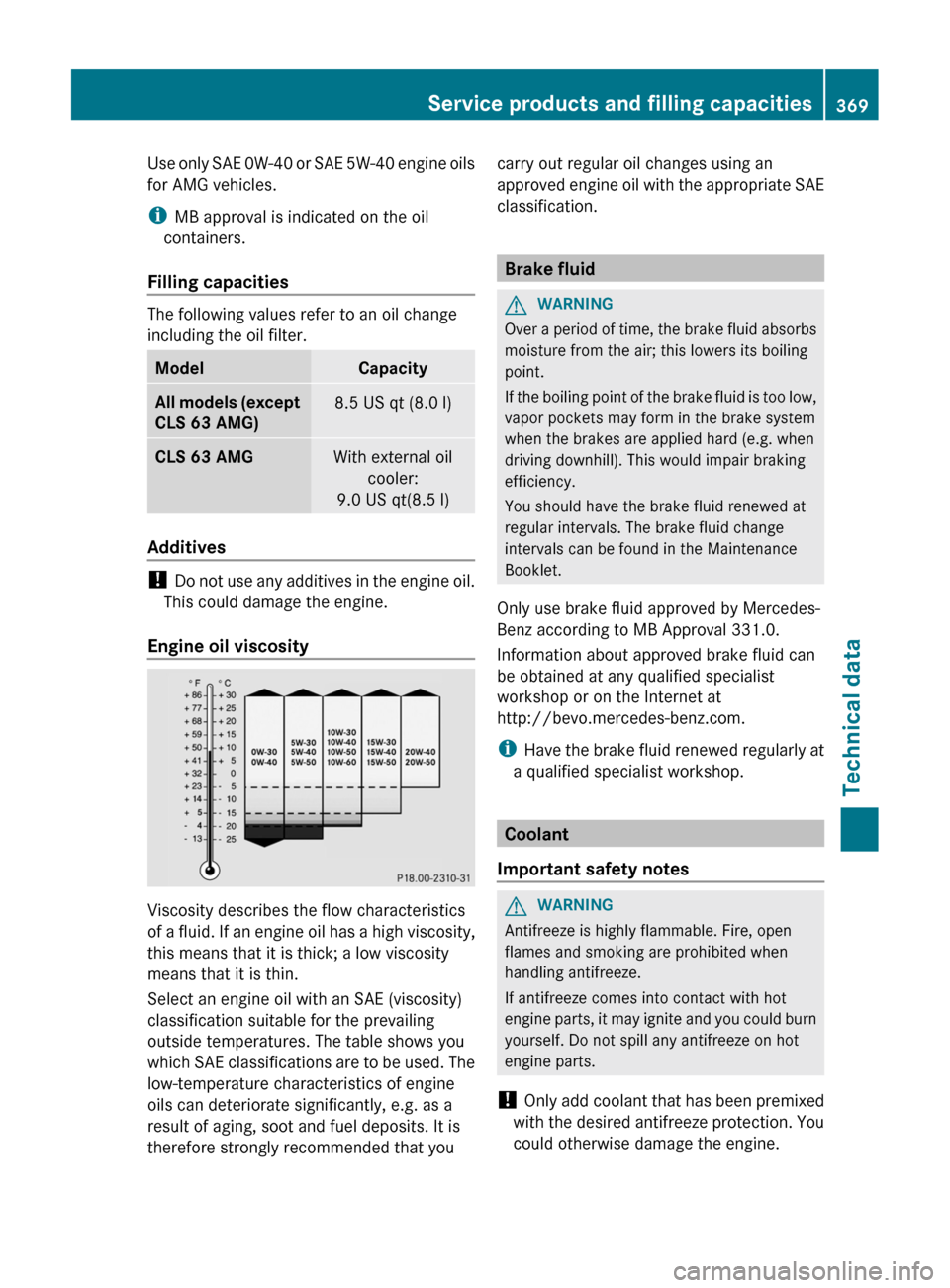
Use only SAE 0W-40 or SAE 5W-40 engine oils
for AMG vehicles.
i
MB approval is indicated on the oil
containers.
Filling capacities The following values refer to an oil change
including the oil filter.
Model Capacity
All models (except
CLS 63 AMG)
8.5 US qt (8.0 l)
CLS 63 AMG
With external oil
cooler:
9.0 US qt
(8.5 l) Additives
!
Do
not use any additives in the engine oil.
This could damage the engine.
Engine oil viscosity Viscosity describes the flow characteristics
of
a fluid. If an engine oil has a high viscosity,
this means that it is thick; a low viscosity
means that it is thin.
Select an engine oil with an SAE (viscosity)
classification suitable for the prevailing
outside temperatures. The table shows you
which SAE classifications are to be used. The
low-temperature characteristics of engine
oils can deteriorate significantly, e.g. as a
result of aging, soot and fuel deposits. It is
therefore strongly recommended that you carry out regular oil changes using an
approved
engine oil with the appropriate SAE
classification. Brake fluid
G
WARNING
Over a period of time, the brake fluid absorbs
moisture from the air; this lowers its boiling
point.
If
the boiling point of the brake fluid is too low,
vapor pockets may form in the brake system
when the brakes are applied hard (e.g. when
driving downhill). This would impair braking
efficiency.
You should have the brake fluid renewed at
regular intervals. The brake fluid change
intervals can be found in the Maintenance
Booklet.
Only use brake fluid approved by Mercedes-
Benz according to MB Approval 331.0.
Information about approved brake fluid can
be obtained at any qualified specialist
workshop or on the Internet at
http://bevo.mercedes-benz.com.
i Have the brake fluid renewed regularly at
a qualified specialist workshop. Coolant
Important safety notes G
WARNING
Antifreeze is highly flammable. Fire, open
flames and smoking are prohibited when
handling antifreeze.
If antifreeze comes into contact with hot
engine
parts, it may ignite and you could burn
yourself. Do not spill any antifreeze on hot
engine parts.
! Only add coolant that has been premixed
with the desired antifreeze protection. You
could otherwise damage the engine. Service products and filling capacities
369
Technical data Z