Parking MERCEDES-BENZ CLS-Class 2014 W218 Owner's Manual
[x] Cancel search | Manufacturer: MERCEDES-BENZ, Model Year: 2014, Model line: CLS-Class, Model: MERCEDES-BENZ CLS-Class 2014 W218Pages: 382, PDF Size: 5.36 MB
Page 274 of 382
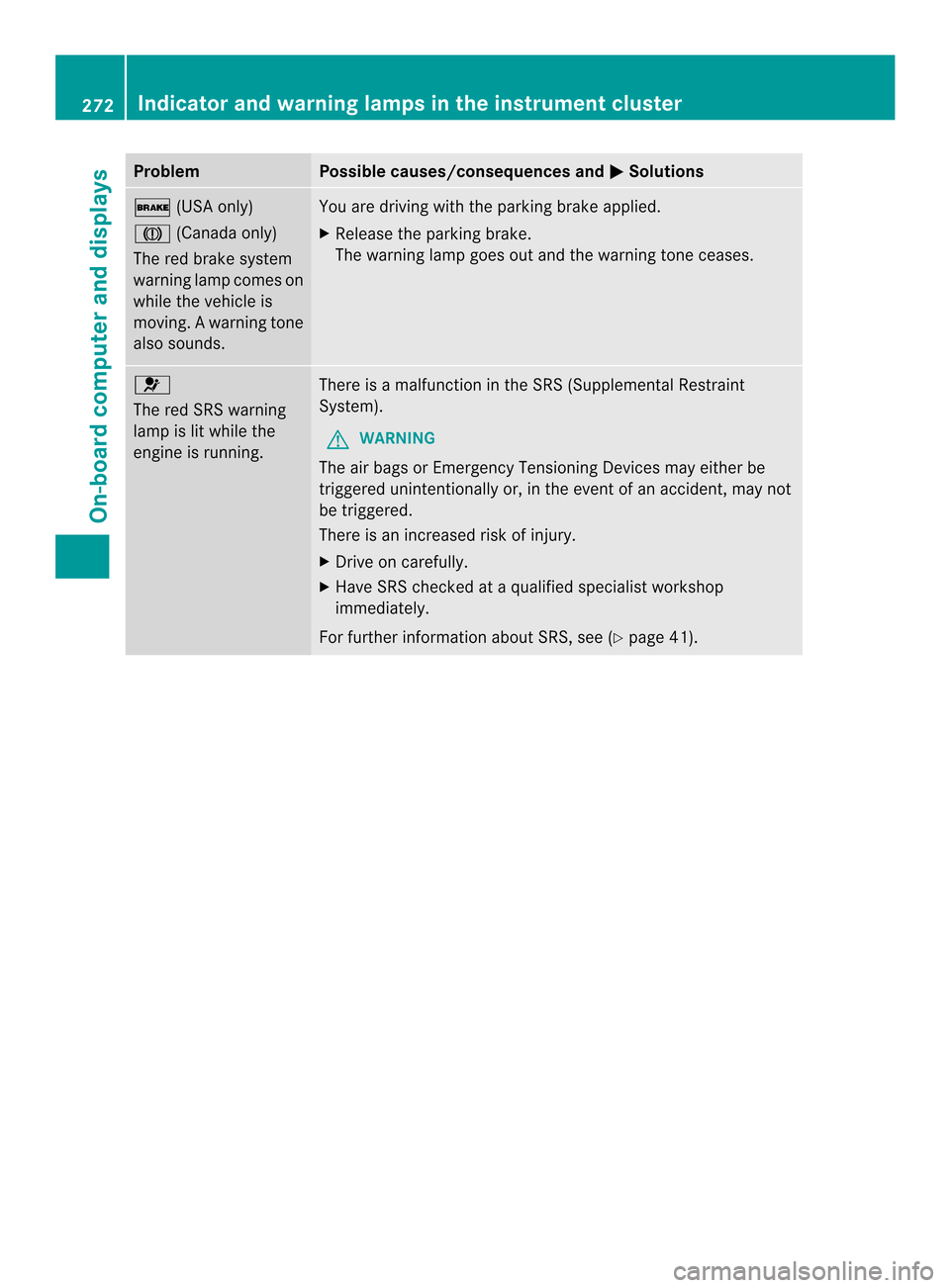
Problem Possible causes/consequences and
000B Solutions
0004
(USA only)
0001 (Canada only)
The red brake system
warning lamp comes on
while the vehicle is
moving. Awarning tone
also sounds. You are driving with the parking brake applied.
X
Release the parking brake.
The warning lamp goes out and the warning tone ceases. 0012
The red SRS warning
lamp is lit while the
engine is running.
There is
amalfunction in the SRS (Supplemental Restraint
System).
G WARNING
The air bags or Emergency Tensioning Devices may either be
triggered unintentionally or, in the event of an accident, may not
be triggered.
There is an increased risk of injury.
X Drive on carefully.
X Have SRS checked at aqualified specialist workshop
immediately.
For further information about SRS, see (Y page 41).272
Indicator and warning lampsint
he instrument clusterOn-board computer and displays
Page 314 of 382
Do not remove the SmartKe
yfromt he
ignition lock. Do not open the driver's
door or front-passenge rdoor when the
engine is switched off. Otherwise, the
automatic transmission selects park
position Pautomatically and locks the
wheels. You can prevent this by shifting
the automatic transmission to N
beforehand.
R Vehicles with KEYLESS-GO:
Do not open the driver's door or front-
passenger door when the engine is
switched off. Otherwise, the automatic
transmission selects park position P
automatically and locks the wheels.
Observe the following to make sure that the
automatic transmission stays in position N:
X Make sure the vehicle is stationary and the
ignition is switched off.
X Turn the SmartKey to position 2in the
ignition lock (Y page 147).
Use the SmartKey instead of the Start/
Stop button on vehicles with KEYLESS-GO.
X Depress and hold the brake pedal.
X Shift the automatic transmission to
position N.
X Release the brake pedal.
X Release the electric parking brake.
X Switch off the ignition and leave the
SmartKey in the ignition lock.
You can wash the vehicle in an automatic car
wash from the very start.
If the vehicle is very dirty, pre-wash it before
cleaning it in an automatic car wash.
After using an automatic car wash, wipe off
wax from the windshield and the wiper
blades. This will prevent smears and reduce
wiping noises caused by residue on the
windshield.
Washing by hand In some countries, washing by hand is only
allowe
datspecially equipped washing bays. Observe the legal requirements in all
countries concerned.
X
Do not use hot water and do not wash the
vehicle in direct sunlight.
X Use asoft sponge to clean.
X Use amild cleaning agent, such as acar
shampoo approved by Mercedes-Benz.
X Thoroughly hose down the vehicle with a
gentle jet of water.
X Do not point the water jet directly towards
the air inlet.
X Use plenty of water and rinse out the
sponge frequently.
X Rinse the vehicle with clean water and dry
thoroughly with achamois.
X Do not let the cleaning agent dry on the
paintwork.
When using the vehicle in winter, remove all
traces of road salt deposits carefully and as
soon as possible.
Power washers G
WARNING
The water jet from acircular jet nozzle (dirt
blasters) can cause invisible exterior damage
to the tires or chassis components.
Component sdamaged in this way may fail
unexpectedly. There is arisk of an accident.
Do not use power washers with circular jet
nozzles to clean the vehicle. Have damaged
tires or chassis components replaced
immediately.
! Always maintain adistance of at least
11.8in( 30 cm) between the vehicl eand the
powe rwasher nozzle. Information about
th ec orrec tdistanc eisavailabl efromt he
equipmen tmanufacturer.
Mov ethe power washe rnozzle around
when cleaning your vehicle.
Do not aim directly at any of the following:
R tires
R door gaps, roof gaps, joints, etc.
R electrical components 312
CareMaintenance and care
Page 329 of 382

R
Only jump-start from batteries with a12Vvoltage rating.
R Only use jumper cables which have asufficient cross-section and insulated terminal clamps.
R If the battery is fully discharged, leave the battery that is being used to jump-start connected
for afew minutes before attempting to start. This charges the battery slightly.
R Make sure that the two vehicles do not touch.
Make sure that:
R the jumper cables are not damaged.
R when the jumper cables are connected to the battery, uninsulated sections of the terminal
clamp do not come into contact with other metal sections.
R the jumper cables cannot come into contact with parts which can move when the engine
is running, such as the V-belt pulley or the fan.
X Apply the parking brake firmly.
X Shift the transmission to position P.
X Switch off all electrical consumers (e.g. radio, blower, etc.).
X Open the hood.
Position number 0025identifies the charged battery of the other vehicle or an equivalent jump-
starting device. X
Slide cover 001Aof positive terminal 0010in the direction of the arrow.
X Connect positive terminal 0010on your vehicle to positive terminal 0024of donor battery 0025
using the jumper cable, always begin with positive terminal 0010on your own vehicle first.
X Start the engine of the donor vehicle and run it at idling speed.
X Connect negative terminal 0021of donor battery 0025to ground point 001Eof your vehicle using
the jumper cable, connecting the jumper cable to battery of other vehicle 0025first.
X Start the engine.
X Before disconnecting the jumper cables, let the engine run for several minutes. Jump-starting
327Breakdown assistance Z
Page 332 of 382
X
Take cover 0010off the opening.
X Screw in and tighten the towing eye
clockwise to the stop.
Removing the towing eye X
Unscrew and remove the towing eye.
X Position the top of cover 001Ain the bumper
and press it in at the bottom until it
engages.
X Attach cover 0010to the bumper and press
until it engages.
X Place the towing eye in the vehicle tool kit. Towing the vehicle with the rear axle
raised
! The ignition must be switched off if you
are towing the vehicle with the rear axle
raised. Intervention by ESP ®
could
otherwise damage the brake system.
Only possible for vehicles without
4MATIC.
X Switc hont he hazard warning lamps
(Y page 120).
X Turn the SmartKey to position 0in the
ignition lock and remove the SmartKey
from the ignition lock.
X When leaving the vehicle, take the
SmartKey or the KEYLESS-GO key with you.
When towing your vehicle with the rear axle
raised, it is importan tthat you observe the
safety instructions (Y page 328).Towing
avehicle with both axles on
th eg round
It is importan tthat you observe the safety
instructions when towing away your vehicle
(Y page 328). The automatic transmission automatically
shifts to position
Pwhen you open the driver's
or front-passenger door or when you remove
the SmartKey from the ignition lock. In order
to ensure that the automatic transmission
stays in position Nwhen towing the vehicle,
you must observe the following points:
X Make sure that the vehicle is stationary and
the SmartKey in the ignition lock is in
position 0.
X Turn the SmartKey to position 2in the
ignition lock.
On vehicles with KEYLESS-GO, use the
SmartKey instead of the Start/Stop button
(Y page 147).
X Depress and hold the brake pedal.
X Shift the automatic transmission to
position N.
X Release the brake pedal.
X Release the parking brake.
X Switch on the hazard warning lamps
(Y page 120).
X Leave the SmartKey in position 2in the
ignition lock.
i When towing with the hazard warning
lamps switched on, use the combination
switch as usualtos ignalachange of
direction. In this case, only the indicator
lamps for the direction of travel flash. After
resetting the combination switch, the
hazard warning lamp starts flashing again. Transporting the vehicle
! Only lash the vehicle down by the wheels
or wheel rims, not by parts of the vehicle
such as axle or steering components.
Otherwise, the vehicle could be damaged.
The towing eye can be used to pull the vehicle
onto atrailer or transporter for transporting
purposes. 330
Towing and tow-startingBreakdown assistance
Page 333 of 382
X
Turn the SmartKey to position 2in the
ignition lock.
X Shift the automatic transmission to
position N.
As soon as the vehicle is loaded:
X Prevent the vehicle from rolling away by
applying the parking brake.
X Shift the automatic transmission to
position P.
X Turn the SmartKey to position 0in the
ignition lock and remove the SmartKey
from the ignition lock.
X Secure the vehicle. Notes on 4MATIC vehicles
! Vehicles with 4MATI Cmust not be towed
with either the frontort he rear axle raised,
as doing so will damage the transmission.
If the vehicle has transmission damage or
damage to the front or rear axle, have it
transported on atransporter or trailer.
In the event of damage to the electrical
system
If the battery is defective, the automatic
transmission will be locked in position P.To
shift the automatic transmission to position
N,y ou must provide power to the vehicle's
electrical system in the same way as when
jump-starting (Y page 326).
Have the vehicle transported on atransporter
or trailer. Tow-starting (emergency engine
starting)
! Vehicles with automatic transmission
must not be started by tow-starting. This
could otherwise damage the transmission.
You can find information on "Jump-starting"
at (Y page 326). Fuses
Important safety notes
G
WARNING
If you manipulate or bridge afaulty fuse or if
you replace it with afuse with ahigher
amperage, the electric cables could be
overloaded. This could result in afire. There
is ar isk of an accident and injury.
Always replace faulty fuses with the specified
new fuses having the correct amperage.
! Only use fuses that have been approved
for Mercedes-Ben zvehicles and which
have the correct fuse ratin gfor the system
concerned. Otherwise, componentsor
systems could be damaged.
The fuses in your vehicle serve to close down
faulty circuits. If afuse blows ,all the
component sonthecircuit and their functions
stop operating.
Blown fuse smust be replace dwith fuses of
the same rating, which you can recognize by
the color and value. The fuse ratings are listed
in the fuse allocation chart.
If an ewly inserted fuse also blows, have the
cause traced and rectified at aqualified
specialist workshop, e.g. an authorized
Mercedes-Ben zCenter. Befor
echanging afuse
X Secure the vehicle against rolling away
(Y page 167).
X Switc hoff all electrical consumers.
X Turn the SmartKey to position 0in the
ignition lock and remove it (Y page 147).
or
X On vehicles with KEYLESS-GO, make sure
the ignition is switched off (Y page 147).
All indicator lamps in the instrument cluster
must be off. Fuses
331Breakdown assistance Z
Page 337 of 382

and wheels checked at
aqualified specialist
workshop.
When parking your vehicle ,makes ure that
th et ires do no tget deformed by the curb or
other obstacles. If it is necessary to drive over
curbs, speed humps or similar elevations, try
to do so slowly and at an obtuse angle.
Otherwise, the tires, particularly the
sidewalls, may be damaged. Regular checking of wheels and tires
G
WARNING
Damaged tires can cause tire inflation
pressure loss. As aresult, you could lose
control of your vehicle. There is arisk of
accident.
Check the tires regularly for signs of damage
and replace any damaged tires immediately.
Regularly chec kthe wheels and tires of your
vehicle for damage at least once amonth, as
well as after driving off-road or on rough
roads. Damaged wheels can cause aloss of
tire pressure. Pay particular attention to
damage such as:
R cuts in the tires
R punctures
R tears in the tires
R bulges on tires
R deformation or severe corrosion on wheels
Regularly check the tire tread depth and the
condition of the tread across the whole width
of the tire (Y page 335). If necessary, turn
the front wheels to full lock in order to inspect
the inner side of the tire surface.
All wheels must have avalve cap to protect
the valve against dirt and moisture. Do not
mount anything onto the valve other than the
standard valve cap or other valve caps
approved by Mercedes-Ben zfor your vehicle.
Do not use any other valve caps or systems,
e.g. tire pressure monitoring systems. Regularly check the pressure of all the tires
particularly prior to long trips. Adjust the tire
pressure as necessary (Y
page 338).
Observe the notes on the emergenc yspare
wheel (Y page 367).
The service life of tires depends, among other
things, on the following factors:
R Drivin gstyle
R Tire pressure
R Distance covered Important safety notes on the tire
tread
G
WARNING
Insufficient tire tread will reduce tire traction.
The tire is no longer able to dissipate water.
This means that on wet road surfaces, the risk
of hydroplaning increases, in particular where
speed is not adapted to suit the driving
conditions. There is arisk of accident.
If the tire pressure is too high or too low, tires
may exhibit different levels of wear at
different locations on the tire tread. Thus, you
should regularly check the tread depth and
the condition of the tread across the entire
width of all tires.
Minimum tire tread depth for:
R Summer tires: 0015in (3 mm)
R M+S tires: 001Fin (4 mm)
For safety reasons, replace the tires before
the legally prescribed limit for the minimum
tire tread depth is reached. Operation
335Wheels and tires Z
Page 360 of 382

to the tire
sorchassiscomponents.
Components damage dinthisw ayma yfail
unexpectedly .There is arisk of an accident.
Do not use power washers with circular jet
nozzles to clean the vehicle. Have damaged
tires or chassis components replaced
immediately. Mounting
awheel
Preparing the vehicle X
Stop the vehicle on solid, non-slippery and
leve lground.
X Apply the parking brake.
X Bring the front wheels into the straight-
ahead position.
X Shift the transmission to position P.
X Vehicles with AIRMATIC :make sure that
"normal" leve lisselecte d(Ypage 189).
X Switch off th eengine.
X Vehicles without KEYLESS-GO: remove
th eS martKey from th eignition lock.
X Vehicles with KEYLESS-GO: open the
driver' sdoor.
The on-board electronics no whave status
0.T his is the same as the SmartKey having
been removed.
X Vehicles with KEYLESS-GO: remove the
Start/Stop button from the ignition lock
(Y page 147).
X If included in the vehicle equipment,
remove the tire-change tool kit from the
vehicle (Y page 320).
X Secure the vehicle to prevent it from rolling
away. Securing the vehicle to prevent it from
rolling away If your vehicle is equipped with
awheel chock,
it can be found in the tire-change tool kit
(Y page 320).
The folding wheel chock is an additional
safety measure to prevent the vehicle from
rolling away,f or example when changing a
wheel.
X Fold both plates upwards 001A.
X Fold out lower plate 0010.
X Guidet he lugs on the lower plate fully into
the openings in base plate 0024. Securing the vehicle on level ground
X
On level ground: place chocksorother
suitable items under the front and rear of
the wheel that is diagonallyo pposite the
wheel you wish to change. 358
Changing
awheelWheels and tires
Page 361 of 382

Securing the vehicle on slight downhil
lgradients
X On light downhill gradients: place
chocks or othe rsuitabl eitem sinf ront of
the wheel softhe front and rea raxle.
Raisin gthe vehicle G
WARNING
If yo udon ot positio nthe jack correctly at the
appropriate jackingp oint of the vehicle, the
jack could tip over with the vehicle raised.
There is arisk of injury.
Only position the jack at the appropriate
jackingp oint of the vehicle. The base of the
jack must be positioned vertically, directly
under the jackingp oint of the vehicle.
! The jack is designed exclusively for
jackingupt he vehicle at the jackingp oints.
Otherwise, your vehicle could be damaged.
The following must be observed when raising
the vehicle:
R to raise the vehicle, only use the vehicle-
specific jack that has been tested and
approved by Mercedes-Benz. If used
incorrectly, the jack could tip over with the
vehicle raised.
R the jack is designed only to raise and hold
the vehicle for ashort time while awheel
is being changed. It is not suited for
performing maintenancew ork under the
vehicle.
R avoid changing the wheel on uphill and
downhill slopes. R
before raising the vehicle, secure it from
rolling away by applying the parking brake
and insertingw heel chocks. Never
disengage the parking brake while the
vehicle is raised.
R the jack must be placed on afirm, flat and
non-slip surface. On aloose surface, a
large, load-bearing underlay must be used.
On aslippery surface, anon-slip underlay
must be used, e.g. rubber mats.
R do not use wooden blocks or similar
objectsasaj ack underlay.O therwise, the
jac kw ill not be able to achiev eits load-
bearin gcapacity due to the restricted
height.
R mak esure that the distanc ebetween the
underside of the tires and the groun ddoes
not exceed 1. 2in(3cm).
R never place your hands and feet under the
raised vehicle.
R never lie under the raised vehicle.
R never start the engine when the vehicle is
raised.
R never open or clos eadoor or the trunk lid
when the vehicle is raised.
R mak esure that no persons are present in
the vehicle when the vehicle is raised. X
Usin glug wrench 001A,loosen the bolt son
the wheel you wish to change by about one
full turn. Do not unscrew the bolts
completely. Changin
gawheel
359Wheels and tires Z