tire size MERCEDES-BENZ CLS-Class 2014 W218 Owner's Manual
[x] Cancel search | Manufacturer: MERCEDES-BENZ, Model Year: 2014, Model line: CLS-Class, Model: MERCEDES-BENZ CLS-Class 2014 W218Pages: 382, PDF Size: 5.36 MB
Page 20 of 382
Characteristics
.............................. 354
Checking ........................................ 335
Definition of terms .........................354
Direction of rotatio n...................... 357
Display message ............................ 258
Distributio nofthe vehicle
occupants (definition) ....................357
DOT, Tire Identification Number
(TIN) .............................................. .354
DOT (Department of
Transportation) (definition) ............355
GAWR (Gross Axle Weight Rating)
(definition) ..................................... 355
GVW (Gross Vehicle Weight)
(definition) ..................................... 355
GVW R(Gross Vehicle Weight
Rating) (definition) .........................355
Important safety notes ..................334
Increase dvehicle weight due to
optional equipment (definition) ......355
Kilopascal (kPa )(definition) ...........355
Labeling (overview )........................ 351
Load bearing index (definition) ......356
Load index ..................................... 353
Load index (definition) ...................355
Maximum loaded vehicle weight
(definition) ..................................... 355
Maximum loa donatire
(definition) ..................................... 356
Maximum permissible tire
pressure (definition) ....................... 356
Maximum tire loa d......................... 353
Maximum tire loa d(definition) .......356
MOExtended tires ..........................336
Optional equipment weight
(definition) ..................................... 356
PSI (pounds per square inch)
(definition) ..................................... 356
Replacing ....................................... 357
Service life ..................................... 336
Sidewall (definition) .......................356
Speed rating (definition) ................355
Storing ........................................... 357
Structure and characteristics
(definition) ..................................... 354
Temperature .................................. 350
TIN (Tire Identification Number)
(definition) ..................................... 356Tire bea
d(definition) ...................... 356
Tire pressure (definition) ................356
Tire pressure s(recommended )...... 355
Tire size (data) ............................... 362
Tire size designation, load-bearing
capacity, spee drating .................... 351
Tire tread ....................................... 335
Tire tread (definition) .....................356
Total loa dlimit (definition) .............357
Traction ......................................... 350
Traction (definition) .......................356
Trea dwear ..................................... 350
Uniform Tire Quality Grading
Standard s...................................... 349
Uniform Tire Quality Grading
Standard s(definition) .................... 355
Unladen weight (definition) ............356
Wea rindicato r(definition) .............356
Whee lrim (definition ).................... 355
see Flat tire
Top Tether ............................................ 64
Towing Important safety guidelines ...........328
Installing the towing eye. ...............329
Removing the towing eye. ..............330
With the rear axle raised ................330
Towing away
With both axle sonthe ground .......330
Tow-starting
Emergency engine starting ............331
Important safety notes ..................328
Transmission
see Automatic transmission
Transmission position display .........156
Transmission position display
(DIRECT SELECTl ever)...................... 156
Transporting the vehicle ..................330
Trim pieces (cleaning instructions) .316
Trip computer (on-board
computer) .......................................... 222
Trip odometer Calling up ....................................... 222
Resetting (on-board computer) ......223
Trunk
Emergency release ..........................87
Important safety notes ....................84
Opening/closing (automatically
from inside) ...................................... 86 18
Index
Page 22 of 382
Tightenin
gtorque ........................... 361
Wheel size/tire size .......................362
Windo wcurtain air bag
Operation ........................................ .47
Windows
see Side windows
Windshield
Defrosting ...................................... 139
Windshiel dwasher fluid
see Windshield washer system
Windshield washer system
Adding washer fluid .......................309
Notes ............................................. 378
Windshiel dwipers
Problem (malfunction) ...................128
Replacing the wiper blades ............126
Switching on/off ........................... 125
Winte rdriving
Important safety note s.................. 336
Slippery road surfaces ...................174
Snow chains .................................. 337
Winte rtires
M+S tires ....................................... 336
Wiper blades
Cleaning ......................................... 314
Important safety notes ..................126
Replacing ....................................... 126
Wooden trim (cleaning
instructions) ...................................... 316Z
ZONE function Switching on/off ........................... 13920
Index
Page 71 of 382
If ESP
®
detects that the vehicle is deviating
from the direction desire dbythe driver, one
or more wheels are braked to stabilize the
vehicle .The engine output is also modified to
keep the vehicle on the desired course within
physical limits. ESP ®
assists the driver when
pulling away on wet or slippery roads. ESP ®
can also stabilize the vehicle during braking.
If ESP ®
intervenes, the 0011ESP®
warning
lamp flashes in the instrumentc luster.
If ESP ®
intervenes:
X Do not deactivat eESP®
under any
circumstances.
X Only depres sthe accelerator pedal as far
as necessary when pulling away.
X Adapt your drivin gstyle to suit the
prevailing road and weathe rconditions.
i Only use wheels with the recommended
tire sizes. Only then will ESP ®
function
properly.
ETS/4ETS (Electronic Traction System) ETS/4ETS traction control is part of ESP
®
.
Traction control brakes the drive wheels
individuall yifthey spin. This enables you to
pull away and accelerate on slippery surfaces,
for example if the road surface is slippery on
one side. In addition, more drive torque is
transferred to the wheel or wheels with
traction.
Traction control remains active, even if you
deactivate ESP ®
.
Deactivating/activating ESP ®
(except
AMG vehicles) G
WARNING
If you deactivate ESP ®
,E SP ®
no longer
stabilizes the vehicle. There is an increased
risk of skidding and an accident.
Only deactivate ESP ®
in the situations
described in the following. !
Avoid spinnin gthe driven wheels for an
extended period with ESP ®
deactivated.
You could otherwise damage the drivetrain.
X To deactivate:(Y page 227).
The 0009 ESP®
OFF warning lamp in the
instrument cluster lights up.
X To activate: (Ypage 227).
The 0009 ESP®
OFF warning lamp in the
instrument cluster goes out.
ESP ®
is activated automatically when the
engine is started.
The ECO start/stop function switches the
engine off automatically when the vehicle
stops moving. The engine starts
automatically when the driver wants to pull
away again. ESP ®
remains in its previously
selected status. Example: if ESP ®
was
deactivated before the engine was switched
off, ESP ®
remains deactivated when the
engine is switched on again.
If ESP ®
is deactivated and one or more wheels
start to spin, the 0011ESP®
warning lamp in
the instrument cluster flashes. In such
situations, ESP ®
will not stabilize the vehicle.
It may be best to deactivate ESP ®
in the
following situations:
R when using snow chains
R in deep snow
R on sand or gravel
If you deactivate ESP ®
:
R ESP ®
no longer improves driving stability.
R traction control is still activated.
R ESP ®
still provides support when you
brake.
R engine torque is not limited and the drive
wheels are able to spin. The spinning
wheels produce acutting effect for better
traction. Driving safety systems
69Safety Z
Page 323 of 382
001E
Alignment bolt
0025 Sheet for faulty wheel
0009 Tire inflation compressor
0016 Lugw rench
001D Fusealloc ation chart
X Ope nthe trunk lid.
X Lift the trunk floor upwards (Y page 283).Flat tire
Preparing the vehicle
Your vehicle may be equipped with:
R MOExtended tires (tires with run-flat
properties) (Y page 321)
Vehicle preparation is not necessary on
vehicles with MOExtended tires.
R an emergency spare wheel(Y page 367)
Information on changing/mounting awheel
(Y page 357).
X Stop the vehicle on solid, non-slippery and
level ground, as far away as possible from
traffic.
X Switch on the hazard warning lamps.
X Secure the vehicle against rolling away
(Y page 167).
X If possible, bring the front wheels into the
straight-ahead position.
X Vehicles with AIRMATIC: make sure that
"normal" level is selected (Y page 189).
X Switch off the engine.
X Vehicles without KEYLESS-GO: remove
the SmartKey from the ignition lock.
X Vehicles with KEYLESS-GO: open the
driver's door.
The on-board electronicsn ow have status
0.T his is the same as the SmartKey having
been removed.
X Vehicles with KEYLESS-GO: remove the
Start/Stop button from the ignition lock
(Y page 147). X
All occupants must get out of the vehicle.
Make sure that they are not endangered as
they do so.
X Make sure that no one is near the danger
area while awheel is being changed.
Anyone who is not directly assisting in the
wheel change should, for example, stand
behind the barrier.
X Get out of the vehicle. Pay attention to
traffic conditionsw hen doing so.
X Close the driver's door. MOExtended tires (tires with run-flat
properties)
General notes With MOExtended tires (tires with run flat
characteristics), you can continue to drive
your vehicle even if there is
atotal loss of
pressure in one or more tires. The affected
tire must not show any clearly visible damage.
You can recognizeM OExtended tires by the
MOExtended marking which appears on the
sidewall of the tire. You will find this marking
next to the tire size designation, the load-
bearing capacity and the speed index
(Y page 351).
MOExtended tires may only be used in
conjunction with an active tire pressure loss
warning system or with an active tire pressure
monitor.
If the pressurel oss warning message
appearsint he multifunction display:
R Observe the instructions in the display
messages (Y page 258).
R Check the tire for damage.
R If driving on, observe the following notes.
The maximum driving distance is
approximately 50 miles (80 km) when the
vehicle is partially laden and approximately
18 miles (30 km) when the vehicle is fully
laden. Flat tire
321Breakdown assistance
Page 324 of 382
In addition to the vehicle load, the driving
distance possible depends upon:
R
Speed
R Roadc ondition
R Outside temperature
The driving distance possible in run-flat mode
may be reduced by extreme driving
conditions/maneuvers, or it can be increased
through amoderate style of driving.
The maximum permissible distance which
can be driven in run-flat mode is counted from
the moment the tire pressure loss warning
appears in the multifunction display.
You must not exceed amaximum speed of
50 mph (80 km/h).
i When replacing one or all tires, make sure
that you use only tires:
R of the size specified for the vehicle and
R marked "MOExtended"
If at ire has gone flat and cannot be
replaced with aMOExtended tire, a
standard tire may be used as atemporary
measure. Make sure that you use the
proper size and type (summe rorwinter
tire).
Important safety notes G
WARNING
When drivin ginemergenc ymode, the driving
characteristics deteriorate, e.g. when
cornering, accelerating quickly and when
braking. There is arisk of an accident.
Do not exceed the stated maximum speed.
Avoid abrupt steerin gand drivin gmaneuvers,
and drivin gover obstacles (curbs, potholes,
off-road). This applies in particular to aladen
vehicle.
Stop drivin ginemergenc ymode if:
R you hear bangin gnoises.
R the vehicle starts to shake.
R you see smok eand smell rubber. R
ESP ®
is intervenin gconstantly.
R there are tear sinthe sidewalls of the tire.
After drivin ginemergency mode, have the
wheel rims checked at aqualified specialist
workshop with regar dtotheir further use. The
defectiv etirem ust be replaced in ever ycase. Battery (vehicle)
Important safety notes
Special tools and expert knowledge are
require dwhen working on the battery, e.g.
removal and installing. You should therefore
have all work involvin gthe battery carried out
at aq ualified specialist workshop. G
WARNING
Work carried out incorrectly on the battery
can lead, for example, to ashor tcircuit and
thus damage the vehicle electronics. This can
lead to function restriction sapplying to
safety-relevan tsystems ,e.g.t he lighting
system, AB S(anti-loc kbrakin gsystem) or
ESP ®
(Electronic Stabilit yProgram). The
operating safet yofyour vehicl emay be
restricted. You could lose control of the
vehicle, for example:
R braking
R in th eevent of abrup tsteerin gmaneuver
and/o rwhen the vehicle's speed is not
adapted to the road conditions
There is arisk of an accident.
In the event of ashort circuit or asimilar
incident, contact aqualified specialist
workshop immediately. Do not drive any
further. You should have all work involving the
battery carried out at aqualifie dspecialist
workshop. G
WARNING
Electrostatic build-up can lead to th ecreation
of sparks ,whic hc ould ignite th ehighly
explosive gases of abattery. Ther eisariskof
an explosion. 322
Battery (vehicle)Breakdown assistance
Page 336 of 382
Useful information
i This Operator's Manual describes all
models and all standard and optional
equipment of your vehicle available at the
time of publication of the Operator's
Manual. Country-specific differences are
possible. Please not ethat your vehicle may
not be equipped with all features
described. This also applies to safety-
related system sand functions.
i Read the information on qualified
specialist workshops: (Y page 26).Important safet
ynotes G
WARNING
If wheels and tires of the wrong size are used,
the wheel brakes or suspension components
may be damaged. There is arisk of an
accident.
Always replac ewheels and tires with those
that fulfill the specifications of the original
part.
When replacing wheels, make sure to use the
correct:
R designation
R model
When replacing tires, make sure to use the
correct:
R designation
R manufacturer
R model G
WARNING
Af lat tir eseverely impairs the driving,
steerin gand braking characteristics of the
vehicle. There is arisk of accident.
Tires without run-flat characteristics:
R do not drive with aflat tire.
R immediately replac ethe flat tir ewith your
emergenc yspare wheel or spare wheel, or
consult aqualified specialist workshop. Tires with run-flat characteristics:
R
pay attention to the information and
warnin gnotices on MOExtended tires (tires
with run-flat characteristics).
Accessories that are not approved for your
vehicle by Mercedes-Ben zorthat are not
being used correctly can impair the operating
safety.
Before purchasing and using non-approved
accessories, visit aqualified specialist
workshop and inquire about:
R suitability
R legal stipulations
R factory recommendations
Information on the dimensions and types of
wheels and tires for your vehicle can be found
in the "Wheel/tire combinations" section
(Y page 362).
Information on air pressure for the tires on
your vehicle can be found:
R on the vehicle's Tire and Loading
Information placard on the B-pillar
(Y page 345)
R on the tire pressure label on the fuel filler
flap (Y page 165)
R under "Tire pressure" (Y page 338) Operation
Information on driving
If the vehicle is heavily loaded, check the tire
pressures and correct them if necessary.
While driving, pay attention to vibrations,
noises and unusual handling characteristics,
e.g. pulling to one side. This may indicate that
the wheels or tires are damaged. If you
suspect that atire is defective, reduce your
speed immediately. Stop the vehicle as soon
as possible to check the wheels and tires for
damage. Hidden tire damage could also be
causing the unusual handling characteristics.
If you find no signs of damage, have the tires 334
OperationWheels and tires
Page 338 of 382
Bar indicator
001Afor trea dwearisi ntegrated
into the tire tread.
Treadwear indicator s(TWI) are required by
law. Six indicator sare positioned on the tire
tread. The yare visible once the trea ddepth
is approximately 0014in (1.6 mm). If this is the
case ,the tire is so worn that it mus tbe
replaced. Selecting, mounting and replacing
tires
R Only mount tires and wheels of the same
type and make.
Exception: it is permissible to install a
different type or make in the event of aflat
tire. Observe the "MOExtended tires (tires
with run-flat characteristics" section
(Y page3 21).
R Only mount tires of the correct size onto
the wheels.
R Break in new tires at moderate speeds for
the first 60 mile s(100 km) .They only reach
their full performance after this distance.
R Do not drive with tires which have too little
tread depth, as this significantly reduces
the traction on wet roads (hydroplaning).
R Replace the tires after six years at the
latest, regardless of wear.
Observe the notes on the emergency spare
wheel (Y page 367). MOExtended tires (tires with run-flat
properties)
With MOExtended tires (tires with run flat
characteristics), you can continue to drive
your vehicle even if there is atotal loss of
pressure in one or more tires.
MOExtended tires may only be used in
conjunction with an active tire pressure loss
warning system or with an active tire pressure
monitor and on wheels specifically tested by
Mercedes-Benz. Notes on driving with MOExtended tires with
af
lat tire (Y page 321).
i Vehicles equipped with MOExtended tires
are not equipped with aTIREFIT kit at the
factory. It is therefore recommended that
you additionall yequip your vehicle with a
TIREFIT kit if you mount tires that do not
feature run-flat properties, e.g. winter tires.
AT IREFIT kit can be obtained from a
qualified specialist workshop. Winter operation
General notes
Have your vehicle winterproofed at aqualified
specialist workshop at the onset of winter.
Observe the notes in the "Changing awheel"
section (Y page 357). Driving with summer tires
At temperatures below 45 ‡(+7 †), summer
tires lose elasticity significantly ,and
therefore traction and braking power as well.
Change the tires on you rvehicle to
M+S tires. Using summer tires at very cold
temperatures could cause crack stoform,
thereby damaging the tires permanently.
Mercedes-Benz cannot accept responsibility
for this type of damage. M+S tires
G
WARNING
M+S tires with atiret read dept hofless than
001F in (4 mm )are no tsuitable for use in winter
and do no tprovide sufficient traction .There
is ar iskofana ccident.
M+S tires wit hatread dept hofless than 001F
in (4 mm )must be replace dimmediately.
At temperatures below 45 ‡(+7 †), use
winter tires or all-weather tires. Both type sof
tir ea re identified by th eM+S marking. 336
Winte
roperationWheels and tires
Page 339 of 382
Only winter tires bearing the
0012snowflake
symbol in addition to the M+S marking
provide the best possibleg rip in wintry road
conditions.
Only these tires will allowd riving safety
systems such as ABS and ESP ®
to function
optimally in winter. These tires have been
developeds pecificallyfor driving in snow.
Use M+S tires of the same make and tread on
all wheels to maintain safe handling
characteristics.
Alwayso bserve the maximum permissible
speed specified for the M+S tires you have
mounted.
Once the winter tires are mounted:
X Check the tire pressures (Y page 341).
X Vehiclesf or Canada: restart the tire
pressure loss warning system
(Y page 342).
X Restart the tire pressure monitor
(Y page 342).
For more information on driving with the
emergency spare wheel, see (Y page 367).Snow chains
G
WARNING
If snow chains are installed to the front
wheels, they may drag against the vehicle
body or chassis components. This could
cause damage to the vehicle or the tires.
There is arisk of an accident.
To avoid hazardous situations:
R never install snow chains to the front
wheels
R always install snow chains in pairs to the
rear wheels.
! On vehicles with AIRMATIC, you must
drive at raised vehicle level if snow chains
have been mounted. The vehicle may
otherwise be damaged.
! On some tire sizes there is not enough
space for snow chains. To avoid damage to the vehicle or tires, observe the "Wheel and
tire combinations" section under "Tires and
wheels".
For safety reasons, Mercedes-Benz
recommends that you only use snow chains
that have been speciallya pproved for your
vehicle by Mercedes-Benz,ora re of a
corresponding standard of quality.
If you intend to mount snow chains, please
bear the following points in mind:
R Snow chains may not be mounted on all
wheel/tire combinations. Permissible
wheel-tire combinations (Y page 362).
R Only use snow chains when driving on
roads completely covered by snow.
Remove the snow chains as soon as
possiblew hen you come to aroad that is
not snow-covered.
R Local regulations may restrict the use of
snow chains. Observe the appropriate
regulations if you wish to mount snow
chains.
R Do not exceed the maximum permissible
speed of 30 mph (50 km/h).
i You may wish to deactivate ESP ®
when
pulling away with snow chains installed
(Y page 69). This way you can allow the
wheels to spin in acontrolled manner,
achieving an increased driving force
(cutting action).
For more information on driving with the
emergenc yspare wheel, see (Y page 367). Winter operation
337Wheels and tires Z
Page 341 of 382
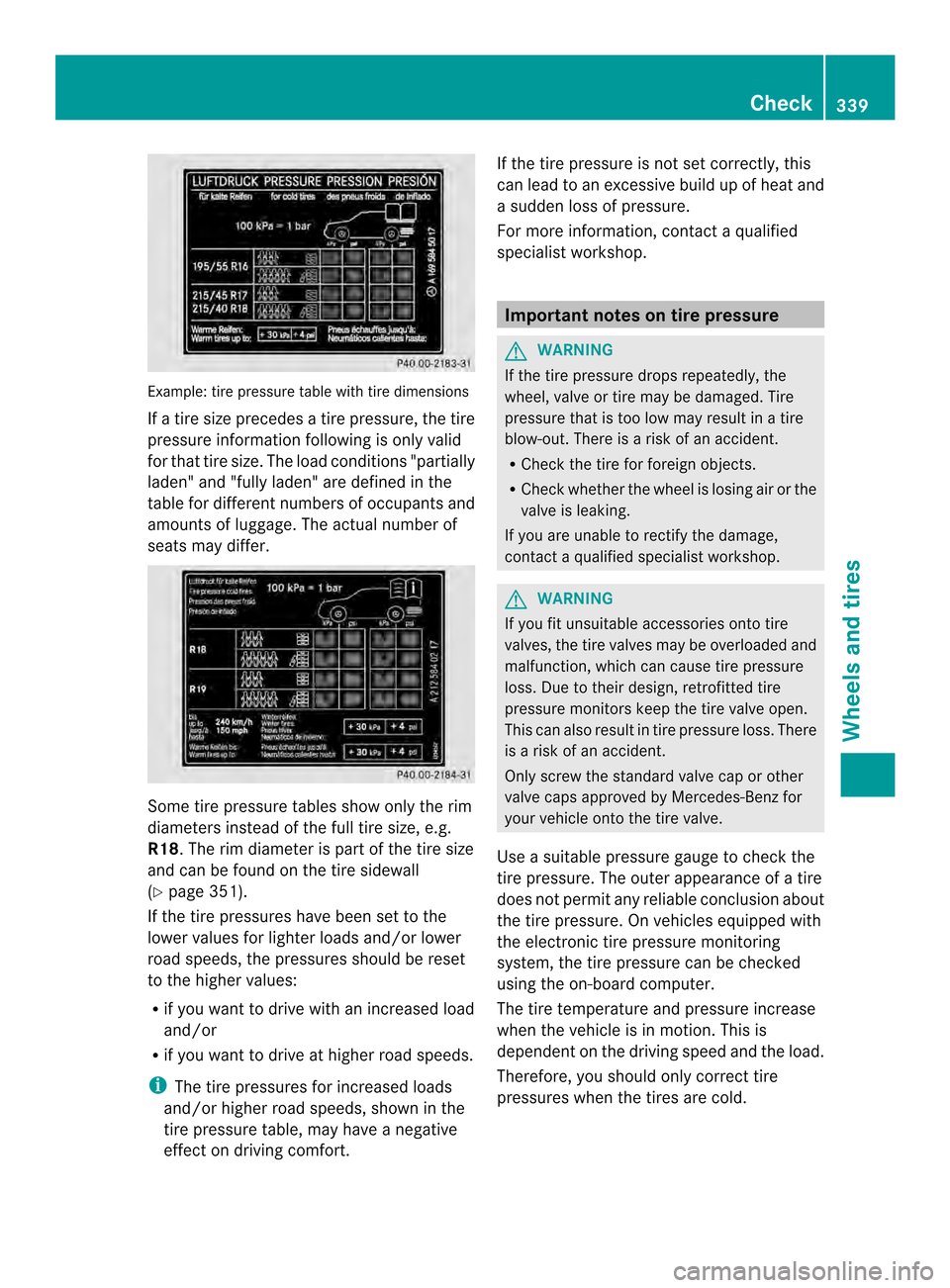
Example: tire pressure table with tire dimensions
If at ire size precedes atire pressure, the tire
pressure informatio nfollowing is only valid
for that tire size. The load conditions "partially
laden" and "fully laden" are defined in the
table for different numbers of occupant sand
amounts of luggage. The actual number of
seats may differ. Some tire pressure tables show only the rim
diameters instead of the full tire size, e.g.
R18.T he rim diameter is part of the tire size
and can be found on the tire sidewall
(Y page 351).
If the tire pressures have been set to the
lower values for lighter loads and/or lower
road speeds, the pressures should be reset
to the higher values:
R if you want to drive with an increased load
and/or
R if you want to drive at higher road speeds.
i The tire pressures for increased loads
and/or higher road speeds, shown in the
tire pressure table, may have anegative
effect on driving comfort. If the tire pressure is not set correctly, this
can lead to an excessive build up of heat and
as
udden loss of pressure.
For more information, contact aqualified
specialist workshop. Important notes on tire pressure
G
WARNING
If the tire pressure drops repeatedly, the
wheel, valve or tire may be damaged. Tire
pressure that is too low may result in atire
blow-out. There is arisk of an accident.
R Check the tire for foreign objects.
R Check whether the wheel is losing air or the
valve is leaking.
If you are unable to rectify the damage,
contact aqualified specialist workshop. G
WARNING
If you fit unsuitable accessories onto tire
valves, the tire valves may be overloaded and
malfunction, which can cause tire pressure
loss. Due to their design, retrofitted tire
pressure monitors keep the tire valve open.
This can also result in tire pressure loss. There
is ar isk of an accident.
Only screw the standard valve cap or other
valve caps approved by Mercedes-Benz for
your vehicle onto the tire valve.
Use asuitable pressure gauge to check the
tire pressure. The outer appearance of atire
does not permit any reliable conclusion about
the tire pressure. On vehicles equipped with
the electronic tire pressure monitoring
system, the tire pressure can be checked
using the on-board computer.
The tire temperature and pressure increase
when the vehicle is in motion .This is
dependent on the driving speed and the load.
Therefore, you should only correct tire
pressures when the tires are cold. Check
339Wheels and tires Z
Page 345 of 382
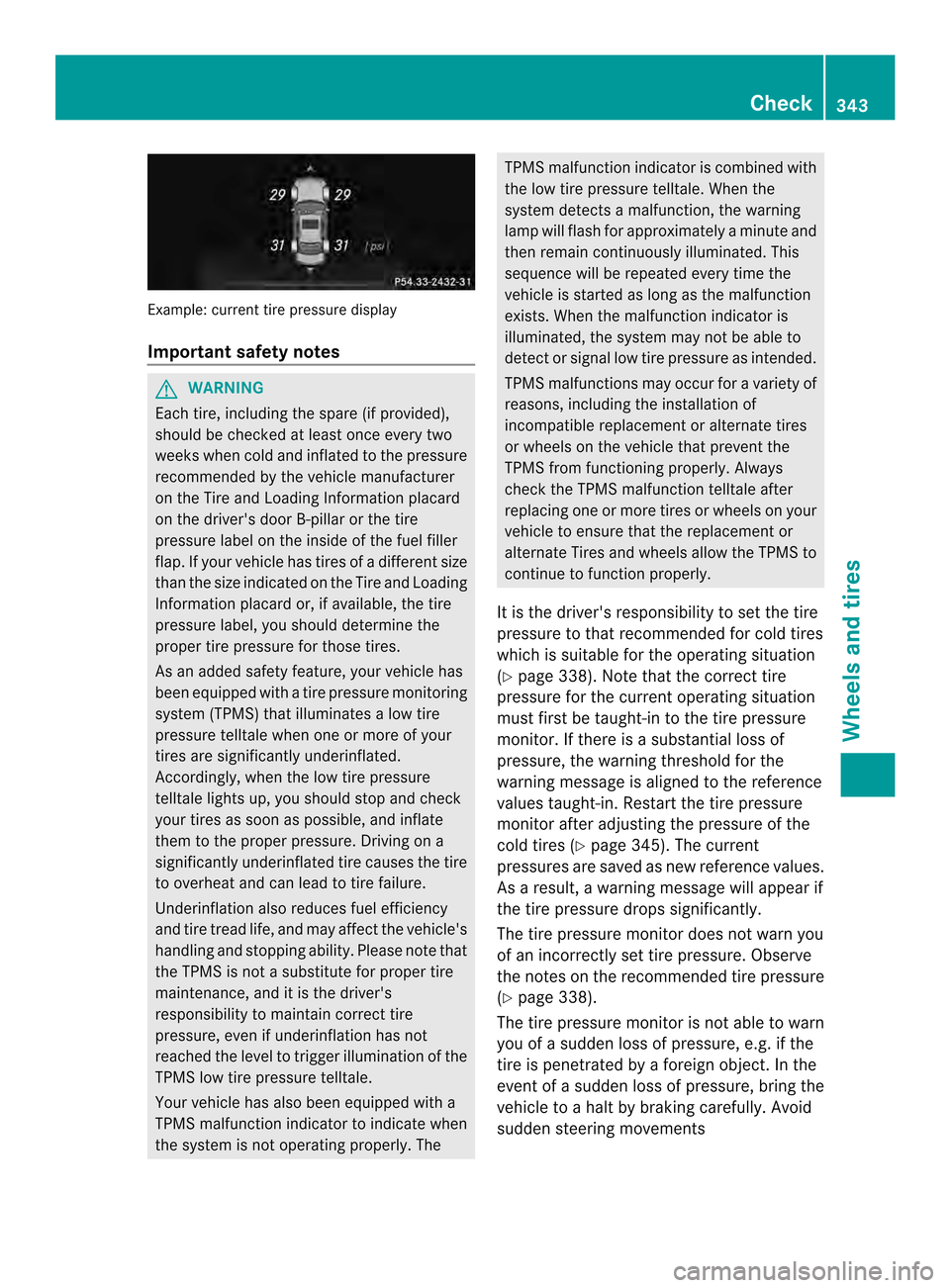
Example: current tire pressure display
Important safety notes
G
WARNING
Each tire ,including the spare (i fprovided),
should be checked at least once every two
weeks when cold and inflated to the pressure
recommended by the vehicl emanufacturer
on the Tire and Loading Information placard
on the driver' sdoor B-pillar or the tire
pressure label on the inside of the fuel filler
flap .Ify our vehicle has tires of adifferent size
than the size indicated on the Tire and Loading
Information placard or, if available, the tire
pressure label, you should determin ethe
proper tire pressure for those tires.
As an added safety feature, your vehicle has
been equipped with atire pressure monitoring
system (TPMS) that illuminates alow tire
pressure telltale when one or more of your
tires are significantly underinflated.
Accordingly, when the low tire pressure
telltale lights up, you should stop and check
your tires as soon as possible, and inflate
them to the proper pressure. Drivin gona
significantly underinflated tire causes the tire
to overheat and can lead to tire failure.
Underinflation also reduces fuel efficiency
and tire tread life, and may affect the vehicle's
handling and stopping ability. Please note that
the TPMS is not asubstitute for proper tire
maintenance, and it is the driver's
responsibility to maintain correc ttire
pressure, even if underinflation has not
reached the level to trigger illumination of the
TPMS low tire pressure telltale.
Your vehicle has also been equipped with a
TPMS malfunction indicator to indicate when
the system is not operating properly. The TPMS malfunction indicator is combined with
the low tire pressure telltale. When the
system detect
samalfunction, the warning
lamp will flash for approximately aminute and
then remain continuously illuminated. This
sequence will be repeated every time the
vehicle is started as long as the malfunction
exists. When the malfunction indicator is
illuminated, the system may not be able to
detect or signal low tire pressure as intended.
TPMS malfunctions may occur for avariety of
reasons, including the installation of
incompatible replacement or alternate tires
or wheels on the vehicle that prevent the
TPMS from functioning properly. Always
check the TPMS malfunction telltale after
replacing one or more tires or wheels on your
vehicle to ensure that the replacement or
alternate Tires and wheels allow the TPMS to
continue to function properly.
It is the driver's responsibility to set the tire
pressure to that recommended for cold tires
which is suitable for the operating situation
(Y page 338). Note that the correc ttire
pressure for the current operating situation
must first be taught-in to the tire pressure
monitor. If there is asubstantial loss of
pressure, the warning threshold for the
warning message is aligned to the reference
values taught-in .Restart the tire pressure
monitor after adjustin gthe pressure of the
cold tires (Y page 345). The current
pressures are saved as new reference values.
As aresult, awarning message will appear if
the tire pressure drops significantly.
The tire pressure monitor does not warn you
of an incorrectly set tire pressure. Observe
the notes on the recommended tire pressure
(Y page 338).
The tire pressure monitor is not able to warn
you of asudden loss of pressure, e.g. if the
tire is penetrated by aforeign object. In the
event of asudden loss of pressure, bring the
vehicle to ahalt by brakin gcarefully. Avoid
sudden steering movements Check
343Wheels and tires Z