light MERCEDES-BENZ E-CLASS COUPE 2009 User Guide
[x] Cancel search | Manufacturer: MERCEDES-BENZ, Model Year: 2009, Model line: E-CLASS COUPE, Model: MERCEDES-BENZ E-CLASS COUPE 2009Pages: 313, PDF Size: 7.76 MB
Page 29 of 313
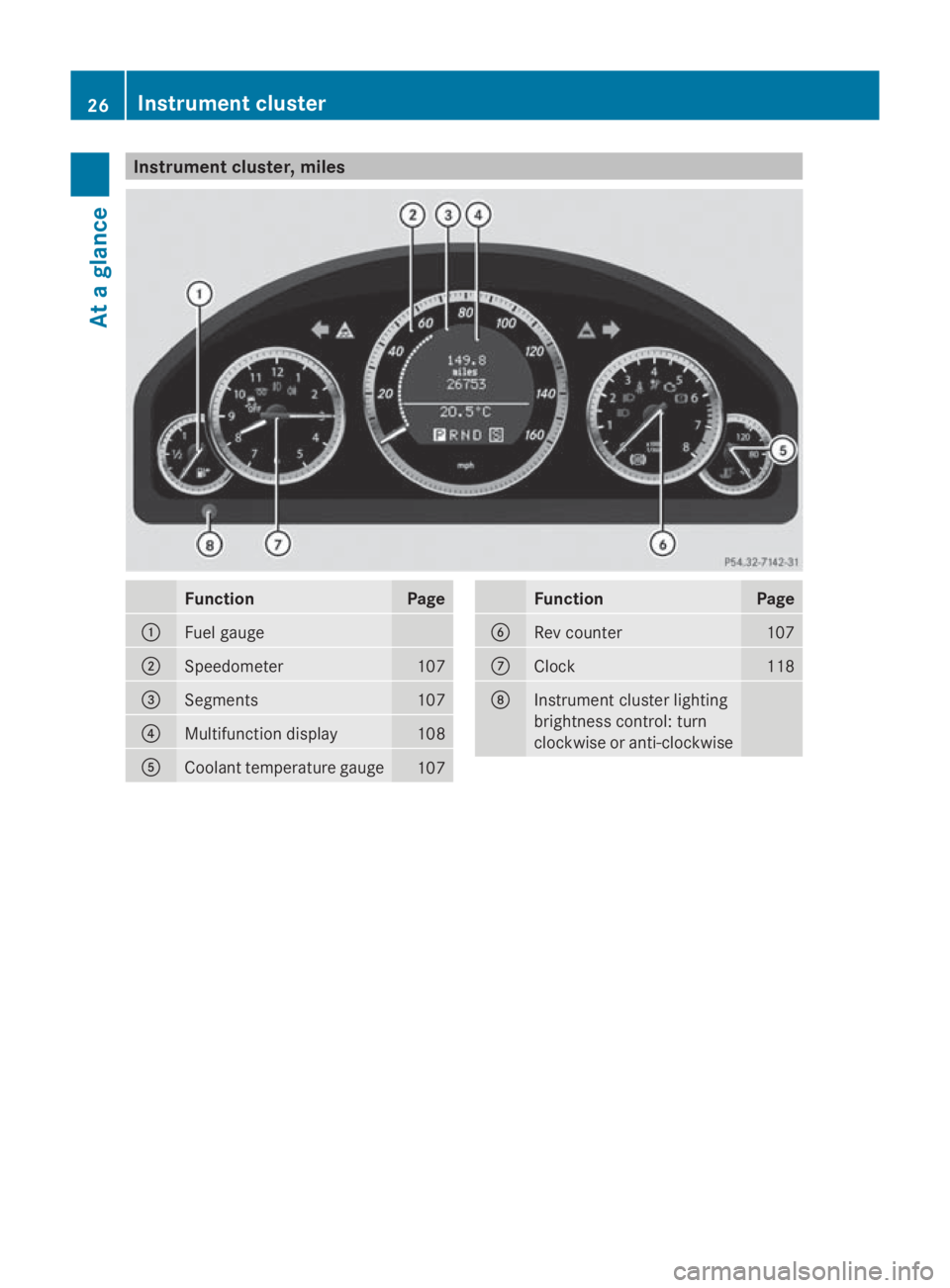
Instrumen
tcluster ,miles Function Page
0046
Fuel gauge
0047
Speedometer 107
008A
Segments 107
0088
Multifunction display 108
0086
Coolan
ttem perature gauge 107 Function Page
0087
Rev counter 107
006E
Clock 118
006F
Instrumen
tcluste rlighting
brightness control :turn
clockwise or anti-clockwise 26
Instrumen
tclusterAt ag lance
207_AKB ;2;3,en-GB
mkalafa, Version:2.11.8.1
2009-07-23T10:23:49+02:00
-Seite 26
Page 32 of 313
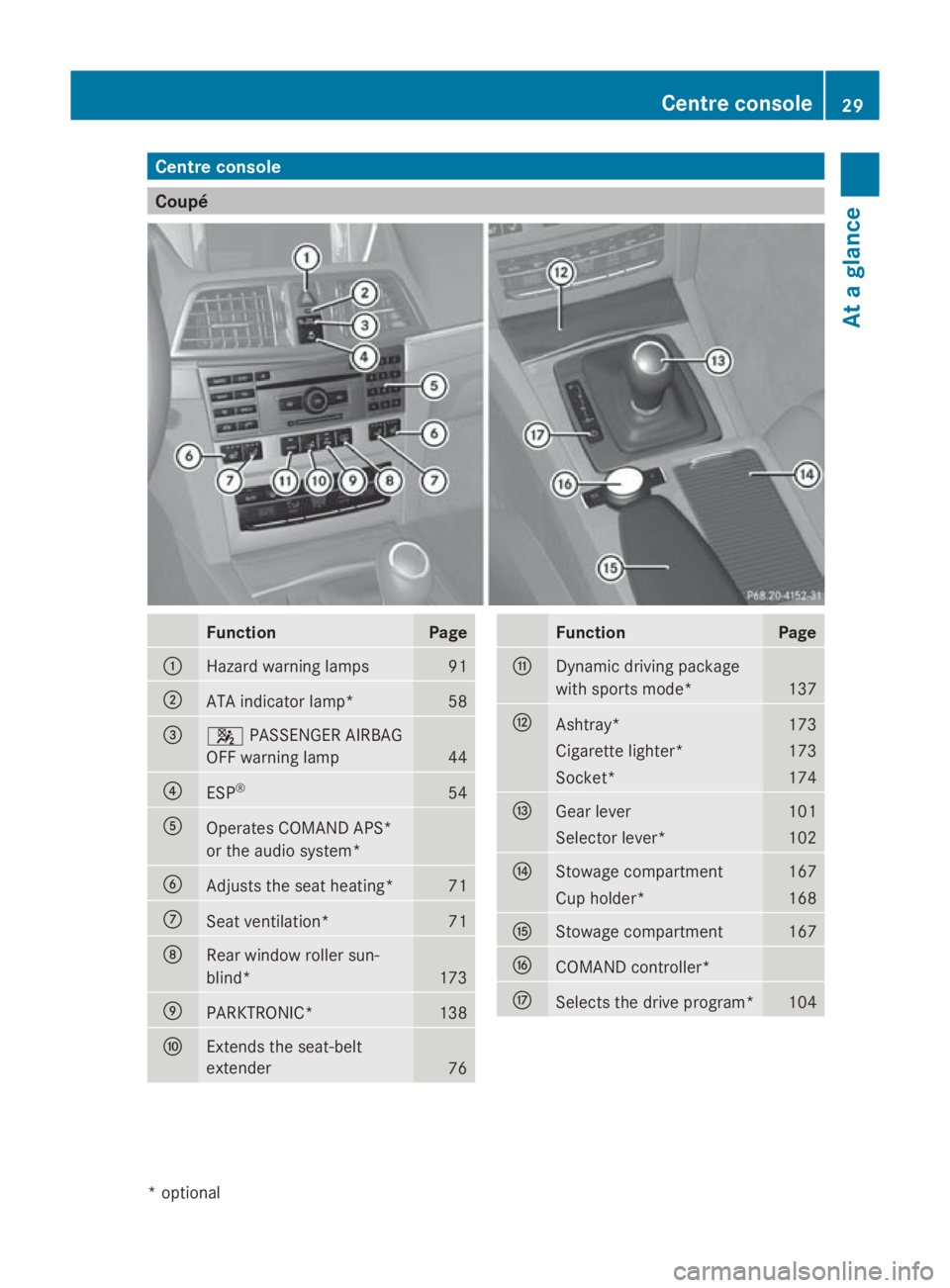
Centre console
Coupé
Function Page
0046
Hazard warning lamps 91
0047
AT
Ai ndicator lamp* 58
008A
007F
PASSENGER AIRBAG
OF Fw arning lamp 44
0088
ESP
® 54
0086
Operate
sCOMAND APS*
or th eaudio system* 0087
Adjusts th
eseat heating* 71
006E
Seat ventilation* 71
006F
Rear window roller sun-
blind*
173
0070
PARKTRONIC* 138
0071
Extends th
eseat-belt
extender 76 Function Page
0072
Dynamic driving package
wit
hsports mode* 137
0073
Ashtray* 173
Cigarett
elighter* 173
Socket* 174
0074
Gear lever 101
Selector lever* 102
0075
Stowage compartment 167
Cup holder* 168
0076
Stowage compartment 167
0077
COMAND controller*
0078
Select
sthe driv eprogram* 104Centre console
29Atag lance
*optional
207_AKB
;2;3,en-GB
mkalafa ,V ersion: 2.11.8.1
2009-07-23T10:23:49+02:00
-Seite 29 Z
Page 33 of 313
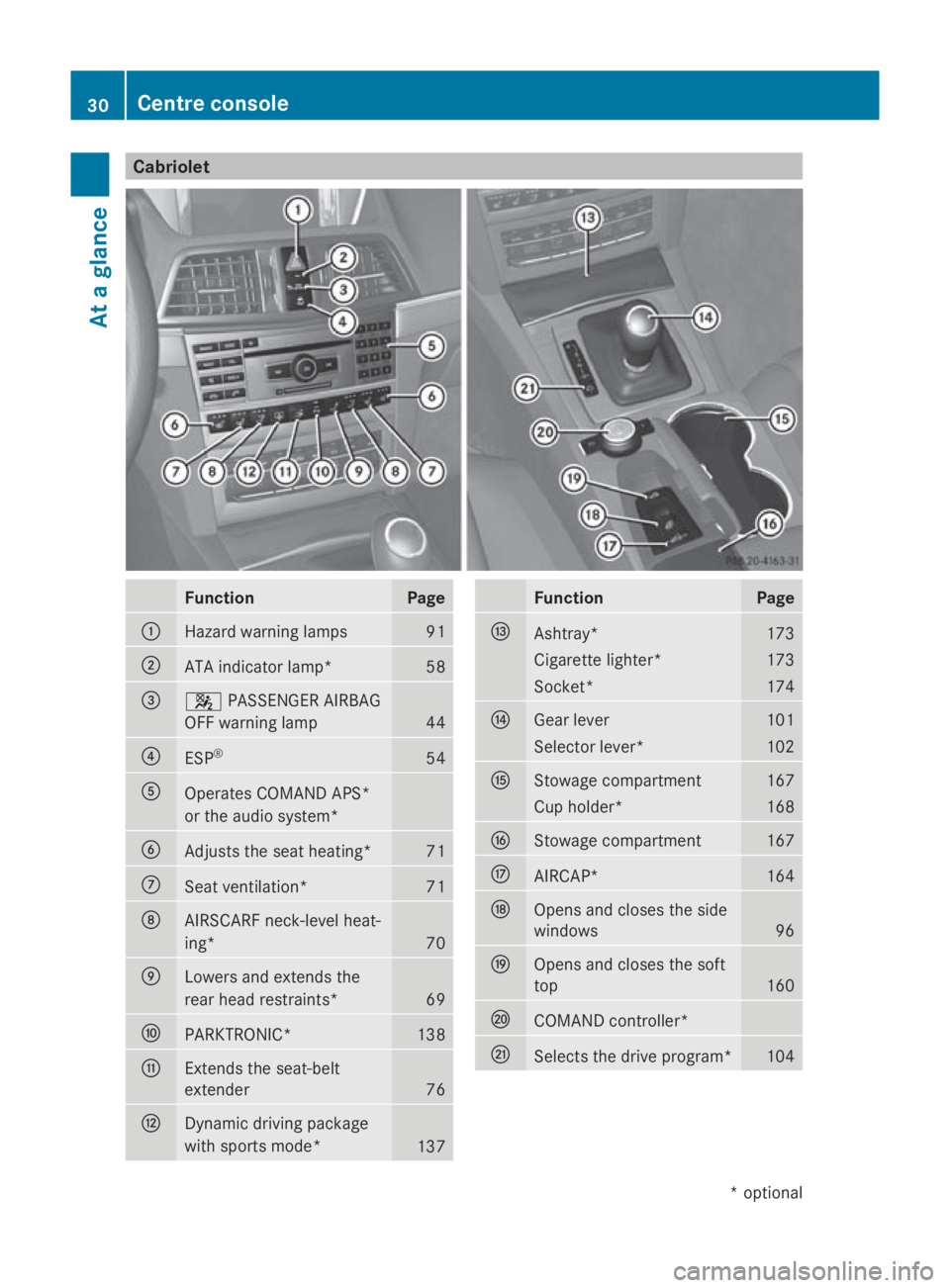
Cabriolet
Function Page
0046
Hazard warning lamps 91
0047
AT
Ai ndicator lamp* 58
008A
007F
PASSENGER AIRBAG
OF Fw arning lamp 44
0088
ESP
® 54
0086
Operate
sCOMAND APS*
or th eaudio system* 0087
Adjusts th
eseat heating* 71
006E
Seat ventilation* 71
006F
AIRSCARF neck-level heat-
ing*
70
0070
Lowers and extend
sthe
rear head restraints* 69
0071
PARKTRONIC* 138
0072
Extends th
eseat-belt
extender 76
0073
Dynamic driving package
wit
hsports mode* 137 Function Page
0074
Ashtray* 173
Cigarett
elighter* 173
Socket* 174
0075
Gear lever 101
Selector lever* 102
0076
Stowage compartment 167
Cup holder* 168
0077
Stowage compartment 167
0078
AIRCAP* 164
0079
Open
sand closes th eside
windows 96
007A
Open
sand closes th esoft
top 160
007B
COMAND controller*
007C
Select
sthe driv eprogram* 10430
Centre consoleAt
ag lance
*optional
207_AKB
;2;3,en-GB
mkalafa ,V ersion: 2.11.8.1
2009-07-23T10:23:49+02:00
-Seite 30
Page 34 of 313
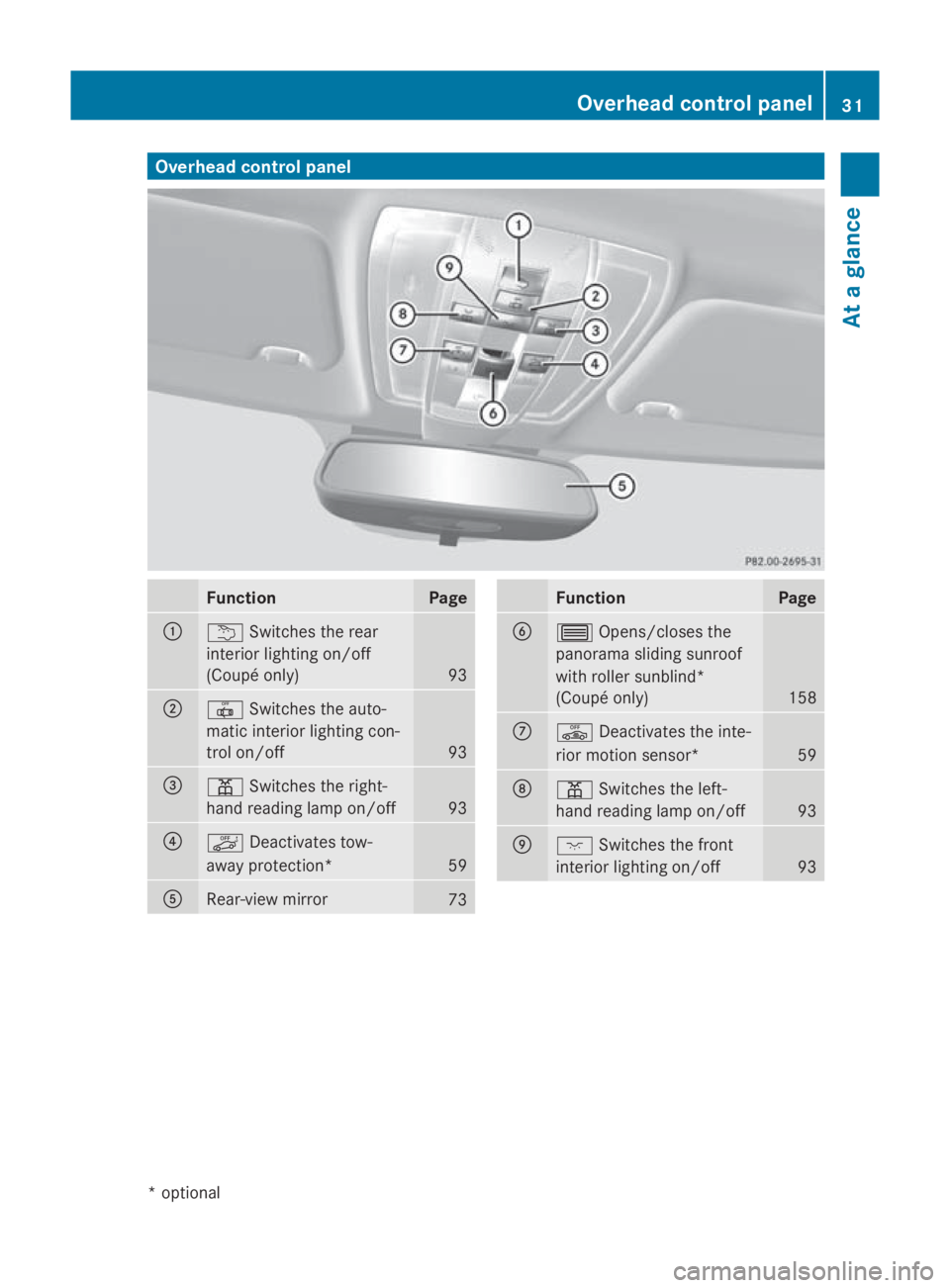
Overhea
dcontrol panel Function Page
0046
004E
Switches the rear
interior lighting on/off
(Coupé only) 93
0047
003F
Switches the auto-
matic interior lighting con-
trol on/off 93
008A
0049
Switches the right-
hand reading lamp on/off 93
0088
00D4
Deactivates tow-
away protection* 59
0086
Rear-view mirror
73 Function Page
0087
0068
Opens/closes the
panorama sliding sunroof
with roller sunblind*
(Coupé only) 158
006E
00D3
Deactivates the inte-
rior motion sensor* 59
006F
0049
Switches the left-
hand reading lamp on/off 93
0070
0056
Switches the front
interior lighting on/off 93Overhea
dcontrol panel
31Atag lance
*optional
207_AKB
;2;3,en-GB
mkalafa, Version:2.11.8.1
2009-07-23T10:23:49+02:00
-Seite 31 Z
Page 38 of 313
Never tamper with electronic components
and their software.
SRS (Supplemental Restraint System)
SRS reduces the risk of occupants coming
into contact with the vehicle's interior in the
event of an accident. It can also reduce the
forces to which occupants are subjected dur-
ing an accident.
SRS consists of:
R the 0081 SRS warning lamp
R belt tensioners
R belt force limiters
R airbags
The 0081
0081 SRS warning lamp The SRS functions are checked regularly
when you turn on the ignition and when the
engine is running. Therefore, malfunctions
can be detected in good time.
The 0081 SRS warning lamp in the instrument
cluster lights up when the ignition is switched
on. It goes out no later than afew seconds
after the engine is started. G
Risk of injury
If SRS is malfunctioning, individual systems
may be activated unintentionally or not be
deployed in the event of an accident with
heavy braking.
Am alfunction has occurred if the 0081SRS
warning lamp:
R does not light up when you switch on the
ignition
R does not go out after the engine has been
running for afew seconds
R lights up again once the engine is running
In this case, have SRS checked immediately
at aq ualifieds pecialist workshop. Triggering of belt tensioners, belt force
limiters and airbags In the event of
acollision, the airbagc ontrol
unit evaluates important physical data such
as duration, direction and force of the vehicle
deceleration or acceleration. Based on the
evaluation of this data and in the event of lon-
gitudinal deceleration, in acollision, and
depending on the rate of deceleration, the
airbagc ontrol unit pre-emptively triggers the
belt tensioners in the first stage.
i The belt tensioners can only be triggered
if the belt tongue is correctly engaged in the
seat belt buckle.
The front airbags are only deployed if there is
an even higher rate of vehicle deceleration in
al ongitudinal direction.
Your vehicle has adaptive, duals tage front
airbags. When the first activation threshold is
reached, the front airbagisf illedwith enough
propellant gas to reduce the risk of injuries.
The front airbagiso nly fullydeployed if asec-
ond threshold is reached within afew milli-
seconds, due to the control unit having detec-
ted further deceleration.
Criteria for triggering belt tensioners and
airbags
In the first stage of acollision, the airbagc on-
trol unit evaluates the duration and direction
of vehicle acceleration or deceleration, in
order to determine whether it is necessary to
trigger abelt tensioner or an airbag.
The belt tensioner and airbagt riggering
thresholds are variable and are adapted to the
rate of deceleration of the vehicle. This proc-
ess is pre-emptive in nature as the airbag
must be deployed during –and not at the end
of –t he collision.
i Airbags are not deployed in all types of
accidents. They are controlled by complex
sensor technology and evaluation logic.
This process is pre-emptive in nature as
airbagd eployment must take place during
the impact and must be adapted to provide Occupant safety
35Safety
207_AKB; 2; 3, en-GB
mkalafa, Version: 2.11.8.1 2009-07-23T10:23:49+02:00-Seite 35 Z
Page 39 of 313
calculated, additiona
lprotectio nfor the
vehicle occupants. Not al lairbags are
deploye dinana ccident.
The different airba gsystems work inde-
pendently of each other. However, the
deployment of each individual system
depends on the typ eofaccident as deter-
mine dbyt he control system in the first
stages of the collisio n(head-on collision,
sid eimpact and rea rcollision) and the
severity of the accident (i nparticular, the
vehicle's rate of deceleration or accelera-
tion).
The rate of vehicle deceleration or accelera-
tion and the direction of the force are essen-
tiall ydetermine dby:
R the distribution of force sduring the colli-
sion
R the collisio nangle
R the deformation characteristics of the vehi-
cle
R the characteristics of the object with which
the vehicle collides ,e.g. the othe rvehicle
Factors which can only be see nand measured
afte rac ollisio nhasoccurred do not play a
decisiv eroleint he deployment of an airbag,
nor do they provid eanindication of it.
The vehicle may be deforme dsignificantly,
e.g. on the bonne torthe wing, withou tanair-
ba gb eing deployed. Thi sisthe cas eifonly
parts which are relativel yeasilyd eforme dare
affected and the deployment threshol disnot
reached .Conversely, airbags may be
deploye devent hough the vehicle suffers only
mino rdeformations .For example, this is the
cas eifv ery rigid vehicle parts such as longi-
tudina lbod ym embers are affected and suf-
ficient deceleration occurs as aresult.
Bel ttensioners, belt forc elim iters The sea
tbelts are fitted with bel ttensioners.
! Do not engage the sea tbeltt ongu einthe
buckle on the front-passenger sea tifthe
sea tisn ot occupied. The bel ttensioners could otherwise be triggered in the event
of an accident.
If the sea tbelti sa lsoe quipped with abelt
force limiter, the force exerted by the seat
bel tont he sea toccupant is reduced.
Bel ttensioners tighten the sea tbelts in an
accident, pulling them close against the body.
i Belttensioners do not correct incorrect
sea tpositions or incorrectl yfastened seat
belts.
Bel ttensioners do not pull occupants back
towards the backrest.
The front bel tforce limiters are synchronised
with the front airbags, which distribute apro-
portion of the deceleration force sexerted on
the occupant ove ragreate rarea.
Whe nthe ignition is switched on, the bel tten-
sioners cannot be triggered unless:
R the restraint systems are operational; see
the 0081 SRS warning lamp.
R the bel ttongu eise ngaged in the buckle on
each lap-shoulder bel tinthe front of the
vehicle.
Depending on the typ eand severity of an
accident, the bel ttensioners may be trig-
gered:
R in the event of ahead-on or rear-end colli-
sio nift he vehicle decelerate soracceler-
ate srapidly in alon gitudinal direction dur-
ing the initia lstages of impact
R in the event of asidei mpact if the vehicle
is subjecte dtohighl atera lacceleration/
deceleration
If the airbags are deployed, yo uwillh eara
bang and asmall amount of powder may also
be released .Only in rar ecases will the bang
affect your hearing .The powder that escapes
doe snot generally constitute ahealth hazard.
The 0081 SRS warning lamp lights up. G
Risk of injury
If the sea tbeltt ensioners have bee ntrig-
gered, they provid enoadditiona lprotection
in the event of another accident. Therefore, 36
Occupan
tsafetySafety
207_AKB; 2; 3, en-GB
mkalafa ,V ersion: 2.11.8.1
2009-07-23T10:23:49+02:00
-Seite 36
Page 40 of 313
have belt tensionersw
hich have been trig-
gered replaced at aqualified specialist work-
shop.
Comply with safety regulations when dispos-
ing of belt tensioners. Any Mercedes-Benz
Service Centre can provide details of these
regulations.
Airbags Airbag deployment slows down and restricts
the movement of the vehicle occupant.
If the airbags are deployed, you will hear a
bang and asmall amount of powder may also
be released. Only in rare cases will the bang
affect your hearing. The powder that escapes
does not generally constitute ahealth hazard.
The 0081 SRS warning lamp lights up.
The AIRBAG label indicates the location of the
airbags. G
Risk of injury
Airbags provide additional protection; they
are not, however, asubstitute for seat belts.
Observe the following notes to reduce the risk
of serious or even fatal injury caused by airbag
deployment:
R All vehicle occupants ―inparticular, preg-
nant women ―must wear their seat belt
correctly at all times and lean back against
the backrest, which should be positioned
as close to the vertical as possible. The
head restraint must support the back of the
head at about eye level.
R Always secure children less than 1.50 mtall
and under 12 years of age in suitable child
restraint systems.
R All vehicle occupants must select aseat
position that is as far away from the airbag
as possible. The driver's seat position must
allow the vehicle to be driven safely. The
driver's chest should be as far away from
the centre of the driver's front airbag cover
as possible. R
Move the front-passenger seat as far back
as possible. This is especially important if
you have secured achild in achild restraint
system on the front-passenger seat.
R Coupé: vehicle occupants —inparticular,
children —must not lean their head into the
area of the window in which the sidebag/
windowbag is deployed.
R Cabriolet: vehicle occupants —inparticular,
children —must not lean their head into the
area of the window in which the sidebag/
headbagisd eployed.
R Rearward-facing child restraint systems
must not be fitted to the front-passenger
seat unless the front-passenger front air-
bag has been disabled. On the front-
passenger seat, the front-passenger front
airbag is only disabledifac hild restraint
system with automatic child seat recogni-
tion is fitted to the front-passenger seat*.
The 007F PASSENGER AIRBAG OFF warn-
ing lamp must be continuously lit.
If the front-passenger seat of your vehicle
does not have automatic child seat recog-
nition*, or your rearward-facing child
restraint system does not have automatic
child seat recognition, children must be
secured in achild restraint system on a
suitable seat in the rear. If you secure a
forward-facing child restraint system to the
front-passenger seat, you must move the
front-passenger seat as far back as possi-
ble.
R Make sure there are no heavy or sharp-
edged objectsinp ockets of clothing.
R Do not lean forwards, e.g. over the cover of
the driver's/front-passenger front airbag,
particularly when the vehicle is in motion.
R Do not put your feet on the dashboard.
R Only hold the steering wheel by the rim.
This allowst he airbag to deploy fully.Y ou
could be injured if the airbag is deployed Occupant safety
37Safety
*optional
207_AKB; 2; 3, en-GB
mkalafa,
Version: 2.11.8.1 2009-07-23T10:23:49+02:00-Seite 37 Z
Page 44 of 313
side windows so that only
asmall gap
remains.
R Cabriolet: if the vehicle skids, it closes the
front side windows so that only asmall gap
remains.
if the hazardous situation passes without
resulting in an accident, PRE-SAFE ®
slackens
the belt pretensioning. You can then reverse
all settings made by PRE-SAFE ®
.Onv ehicles
with amulticontour seat*, the air pressure in
the side bolsters is reduced.
If the seat belts are not released:
X Move the backrest or the seat back slightly
until the belt tension is reduced.
The locking mechanism releases. G
Risk of injury
When adjusting the seat, make sure that
nobody can become trapped.
! Make sure that there are no objects in the
footwell or behind the seats when adjusting
the seats. You could otherwise damage the
seats and the objects. Roll bar (Cabriolet)
The roll bars are located under the rear head
restraints. They are extended if systems
detect that the vehicle is in danger of over-
turning. G
Risk of injury
Make sure the roll bars and head restraints
can move freely in order to prevent injuries
when the roll bars extend.
When the roll bars are extended, the rear
head restraints also extend automatically.
Once the roll bars are extended, you can no
longer lower the rear head restraints or oper-
ate the soft top. In this case, visit the nearest
qualified specialist workshop. G
Risk of injury
If the roll bar is malfunctioning, the 0073
Malfunction Consult workshop message
appears in the multifunction display. The roll
bars will then not be extended in the event of
an accident. This could result in severe or
even fatal injuries to you and other occupants.
In this case, visit aqualified specialist work-
shop immediately and have the roll bar
checked. NECK-PRO head restraints
NECK-PRO head restraints are designed to
increase protection to the driver's and front-
passenger's head and neck.Tot his end, the
head restraints on the driver's and front-
passenger seats are moved forwards and
upwards in the event of arear-end collision of
ac ertain severity when viewed in the direc-
tion of travel. This provides better head sup-
port. G
Risk of injury
Head restraint covers prevent the NECK-PRO
head restraints from triggering correctly. Con-
sequently, the NECK-PRO head restraints
cannot provide the intended level of protec-
tion. Do not use head restraint covers.
If the NECK-PRO head restraints are triggered
in an accident, you must reset the head
restraints on the driver's and front-passenger
seats (Y page 257). Head restraints that have
been triggered are tilted forwards. Children in the vehicle
If ac hild is travelling in your vehicle, secure
the child using achild restraint system which
is appropriate to the size and age of the child
and is recommended for Mercedes-Benz
vehicles. You should fit the restraint system
to as uitabler ear seat. Ensure that the child
is secured throughout the trip. Occupant safety
41Safety
*optional
207_AKB;2;3,e
n-GB
mkalafa, Version: 2.11.8.1 2009-07-23T10:23:49+02:00-Seite 41 Z
Page 45 of 313
You can obtain information about the correct
child restraint system fro
many Mercedes-
Ben zService Centre.
i It is advisable to use Mercedes-Ben zcare
products to clean child restraint systems.
Informatio nabout this can be obtained
fro ma ny Mercedes-Ben zService Centre. G
Risk of injury
Do not leave children unsupervised in the
vehicle, even if the yare secured in achild
restraint system. Children could injure them-
selves on part softhe vehicle. They could also
be seriously or even fatally injured by pro-
longed exposure to extreme heat or cold.
Do not expose the child restraint system to
direc tsunlight. Part softhe child restraint sys-
tem could heat up and the child could burn
herself/himself on them.
If ac hild open sadoor, the child or other per-
son scould be injured as aresult .The child
could get out and be injured in the process or
be injured by apassin gvehicle. G
Risk of injury
An unsecured or an incorrectly positioned
load increases the risk of injury for the child
and all other occupants, during:
R an accident
R ab raking manoeuvre
R as udden change of direction
Do not carr yheavy or hard object sinside the
vehicle unless the yare secured. You will find
further information under "Loadin gguide-
lines "int he index.
Child restraint systems Mercedes-Ben
zrecommends that you only
use the child restraint systems liste don
( Ypage 47). G
Risk of injury
To reduc ethe risk of serious or even fatal
injury to the child in the even tofasudden
change in direction ,braking or an accident:
R children less than 1.50 mtall and under
twelv eyears of age must always be secured
in special child restraint systems on asuit-
able vehicle seat. This is necessary
because the seat belts are not designed for
children of this size.
R do not secur echildren less than 1.50 mtall
or under twelv eyears of age on the front-
passenger seat. Exception: the child is
secured in avehicle with automatic child
seat recognition on the front-passenger
seat* and is secured in achild restraint
system with automatic child seat recogni-
tion.
R if you secur eaforward-facin gchild
restraint system to the front-passenger
seat, you must move the front-passenger
seat as far back as possible.
R children must never travel sitting on the lap
of another occupant .Due to the forces
occurrin ginthe even tofasudden change
of direction ,heavy braking or an accident,
it would not be possible to restrain the
child. The child could be thrown against
part soft he vehicle interior and be seriously
or even fatally injured. G
Risk of injury
The child restraint system cannot perform its
protective function if it is not correctly fitted
to as uitable vehicle seat. The child cannot be
restraine dinthe even tofana ccident,heavy
braking or sudden changes of direction .The
child could be seriously or even fatally injured.
For this reason ,when fittin gachild restraint
system, observe the manufacturer' sinstalla-
tion instructions and the correc tuse of the
child restraint system. 42
Occupant safetySafety
*o
ptional
207_AKB; 2; 3, en-GB
mkalafa,
Version: 2.11.8.1 2009-07-23T10:23:49+02:00-Seite42
Page 47 of 313
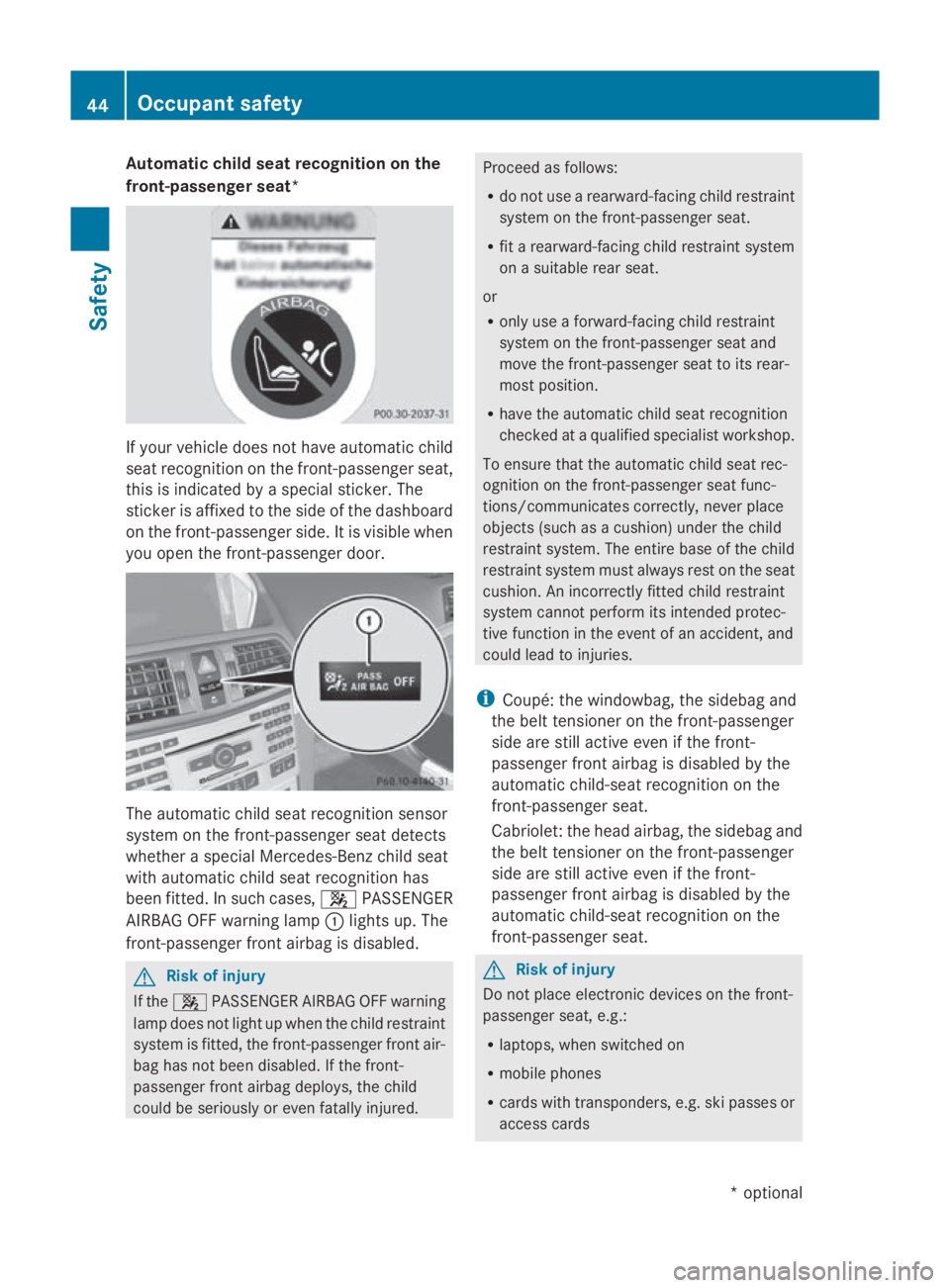
Automatic child seat recognition on the
front-passenger seat*
If your vehicle does no
thave automatic child
seat recognition on th efront-pa ssenger seat,
this is indicated by aspecial sticker. The
sticker is affixe dtotheside of th edashboard
on th efront-pa ssenger side .Itisvisible when
you open th efront-pa ssenger door. The automatic child seat recognition sensor
system on th
efront-pa ssenger seat detects
whether aspecial Mercedes-Ben zchild seat
wit ha utomatic child seat recognition has
been fitted. In suc hcases, 007F PASSENGER
AIRBA GOFFwarning lamp 0046light sup. The
front-passenger fron tairbag is disabled. G
Ris
kofi njury
If the 007F PASSENGER AIRBA GOFFwarning
lamp does no tligh tupw hen th echild restraint
system is fitted, th efront-pa ssenger fron tair-
bag has no tbeen disabled. If th efront-
passenger fron tairba gdeploys, th echild
could be seriousl yorevenf atally injured. Procee
dasfollows:
R do no tuse arearward-facing child restraint
system on th efront-pa ssenger seat.
R fit arearward-facing child restraint system
on asuitable rear seat.
or
R only use aforward-facing child restraint
system on th efront-pa ssenger seat and
mov ethe front-passenger seat to its rear-
mos tposition.
R have th eautomatic child seat recognition
checked at aqualified specialist workshop.
To ensure that th eautomatic child seat rec-
ognition on th efront-pa ssenger seat func-
tions/communicate scorrectly ,never place
object s(suc hasac ushion)under th echild
restraint system. The entir ebase of th echild
restraint system must always res tontheseat
cushion .Anincorrectly fitte dchild restraint
system canno tperfor mits intended protec-
tiv ef unction in th eevent of an accident, and
could lead to injuries.
i Coupé: th ewindowbag ,the sidebag and
th eb elt tensioner on th efront-pa ssenger
side are still active eve nifthefront-
passenger fron tairbag is disabled by the
automatic child-seat recognition on the
front-passenger seat.
Cabriolet :the head airbag ,the sidebag and
th eb elt tensioner on th efront-pa ssenger
side are still active eve nifthefront-
passenger fron tairbag is disabled by the
automatic child-seat recognition on the
front-passenger seat. G
Ris
kofi njury
Do no tplac ee lectronic device sonthefront-
passenger seat ,e.g.:
R laptops, when switched on
R mobile phones
R cards wit htransponders, e.g. sk ipasses or
access cards 44
Occupant safetySafety
*o
ptional
207_AKB
;2;3,en-GB
mkalafa, Version:2.11.8.1
2009-07-23T10:23:49+02:00
-Seite 44