fuel MERCEDES-BENZ E-CLASS SALOON 2009 Service Manual
[x] Cancel search | Manufacturer: MERCEDES-BENZ, Model Year: 2009, Model line: E-CLASS SALOON, Model: MERCEDES-BENZ E-CLASS SALOON 2009Pages: 373, PDF Size: 12.37 MB
Page 245 of 373
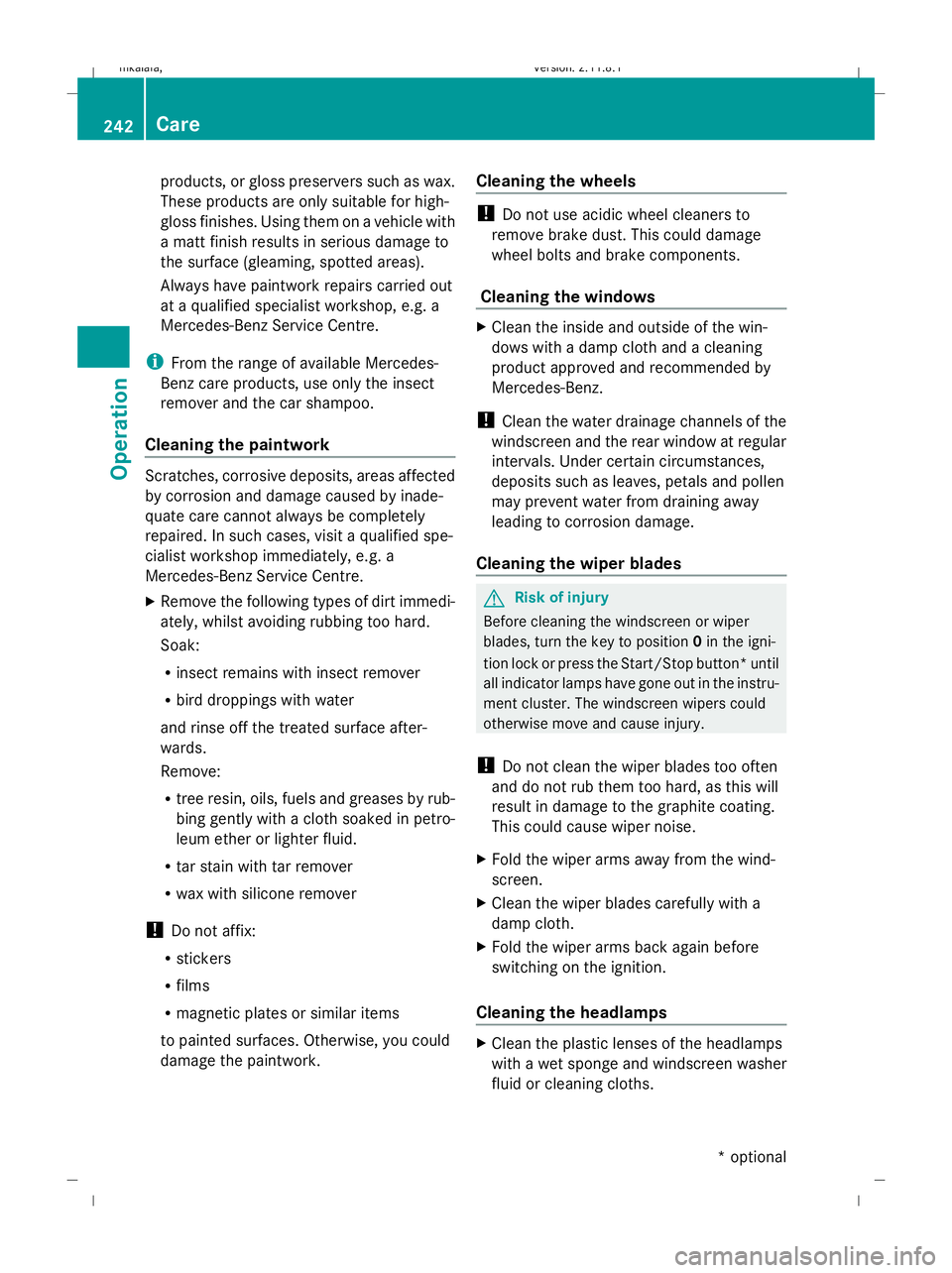
products, or gloss preservers such as wax.
These products are only suitable for high-
gloss finishes. Using them on a vehicle with
a matt finish results in serious damage to
the surface (gleaming, spotted areas).
Always have paintwork repairs carried out
at a qualified specialist workshop, e.g. a
Mercedes-Benz Service Centre.
i From the range of available Mercedes-
Benz care products, use only the insect
remover and the car shampoo.
Cleaning the paintwork Scratches, corrosive deposits, areas affected
by corrosion and damage caused by inade-
quate care cannot always be completely
repaired. In such cases, visit a qualified spe-
cialist workshop immediately, e.g. a
Mercedes-Benz Service Centre.
X Remove the following types of dirt immedi-
ately, whilst avoiding rubbing too hard.
Soak:
R insect remains with insect remover
R bird droppings with water
and rinse off the treated surface after-
wards.
Remove:
R tree resin, oils, fuels and greases by rub-
bing gently with a cloth soaked in petro-
leum ether or lighter fluid.
R tar stain with tar remover
R wax with silicone remover
! Do not affix:
R stickers
R films
R magnetic plates or similar items
to painted surfaces. Otherwise, you could
damage the paintwork. Cleaning the wheels !
Do not use acidic wheel cleaners to
remove brake dust. This could damage
wheel bolts and brake components.
Cleaning the windows X
Clean the inside and outside of the win-
dows with a damp cloth and a cleaning
product approved and recommended by
Mercedes-Benz.
! Clean the water drainage channels of the
windscreen and the rear window at regular
intervals. Under certain circumstances,
deposits such as leaves, petals and pollen
may prevent water from draining away
leading to corrosion damage.
Cleaning the wiper blades G
Risk of injury
Before cleaning the windscreen or wiper
blades, turn the key to position 0in the igni-
tion lock or press the Start/Stop button* until
all indicator lamps have gone out in the instru-
ment cluster. The windscreen wipers could
otherwise move and cause injury.
! Do not clean the wiper blades too often
and do not rub them too hard, as this will
result in damage to the graphite coating.
This could cause wiper noise.
X Fold the wiper arms away from the wind-
screen.
X Clean the wiper blades carefully with a
damp cloth.
X Fold the wiper arms back again before
switching on the ignition.
Cleaning the headlamps X
Clean the plastic lenses of the headlamps
with a wet sponge and windscreen washer
fluid or cleaning cloths. 242
CareOperation
* optional
212_AKB; 2; 4, en-GB
mkalafa,
Version: 2.11.8.1 2009-05-05T14:17:16+02:00 - Seite 242
Dateiname: 6515346702_buchblock.pdf; erzeugt am 07. May 2009 14:17:01; WK
Page 272 of 373
Display messages
Possible causes/consequences and
X
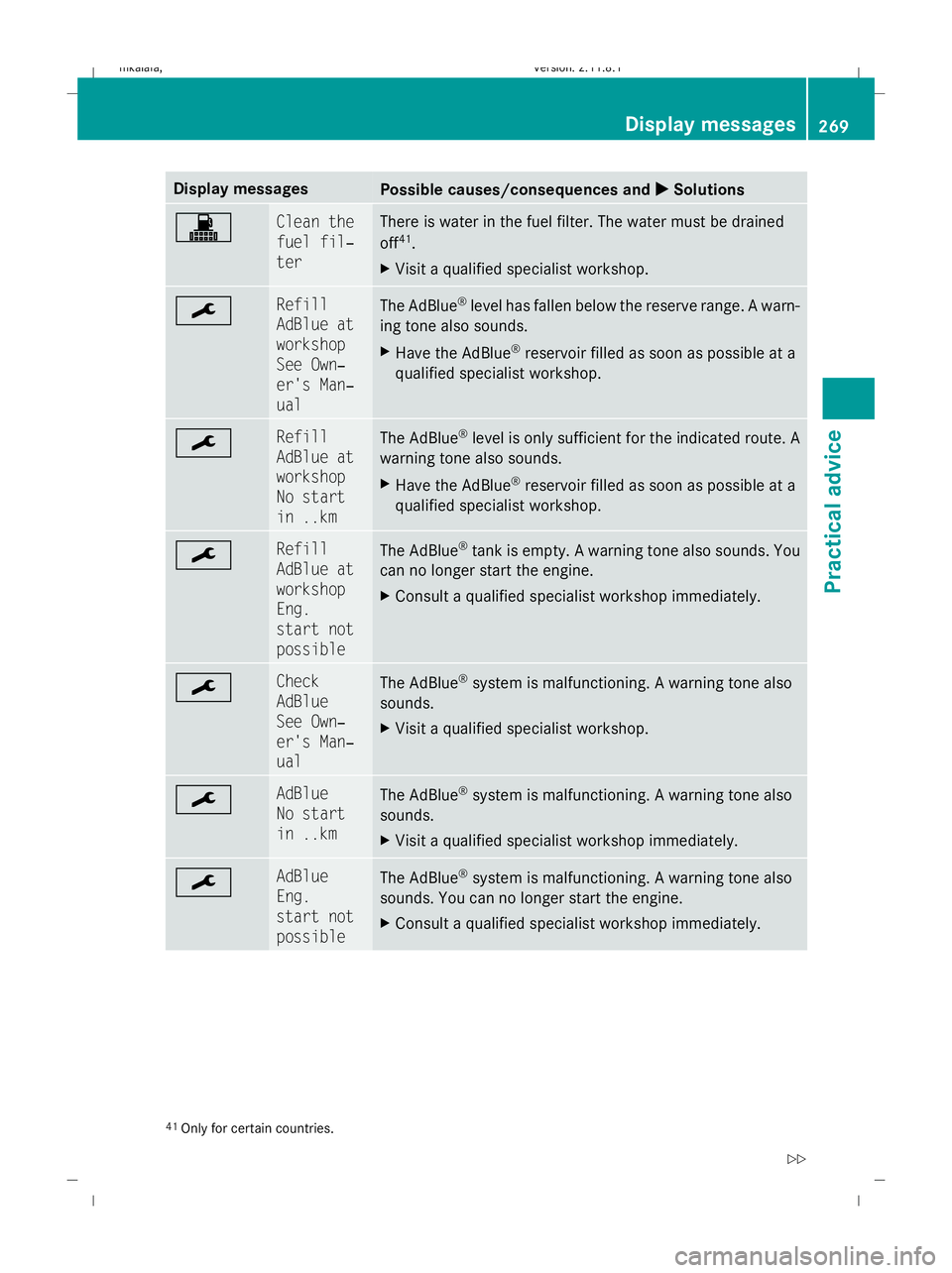
X Solutions ! Clean the
fuel fil‐
ter There is water in the fuel filter. The water must be drained
off
41
.
X Visit a qualified specialist workshop. ¯ Refill
AdBlue at
workshop
See Own‐
er's Man‐
ual
The AdBlue
®
level has fallen below the reserve range. A warn-
ing tone also sounds.
X Have the AdBlue ®
reservoir filled as soon as possible at a
qualified specialist workshop. ¯ Refill
AdBlue at
workshop
No start
in ..km
The AdBlue
®
level is only sufficient for the indicated route. A
warning tone also sounds.
X Have the AdBlue ®
reservoir filled as soon as possible at a
qualified specialist workshop. ¯ Refill
AdBlue at
workshop
Eng.
start not
possible
The AdBlue
®
tank is empty. A warning tone also sounds. You
can no longer start the engine.
X Consult a qualified specialist workshop immediately. ¯ Check
AdBlue
See Own‐
er's Man‐
ual
The AdBlue
®
system is malfunctioning. A warning tone also
sounds.
X Visit a qualified specialist workshop. ¯ AdBlue
No start
in ..km
The AdBlue
®
system is malfunctioning. A warning tone also
sounds.
X Visit a qualified specialist workshop immediately. ¯ AdBlue
Eng.
start not
possible
The AdBlue
®
system is malfunctioning. A warning tone also
sounds. You can no longer start the engine.
X Consult a qualified specialist workshop immediately. 41
Only for certain countries. Display
messages
269Practical advice
212_AKB; 2; 4, en-GB
mkalafa,V ersion: 2.11.8.1
2009-05-05T14:17:16+02:00 - Seite 269 Z
Dateiname: 6515346702_buchblock.pdf; erzeugt am 07. May 2009 14:17:10; WK
Page 279 of 373
Display messages
Possible causes/consequences and
X
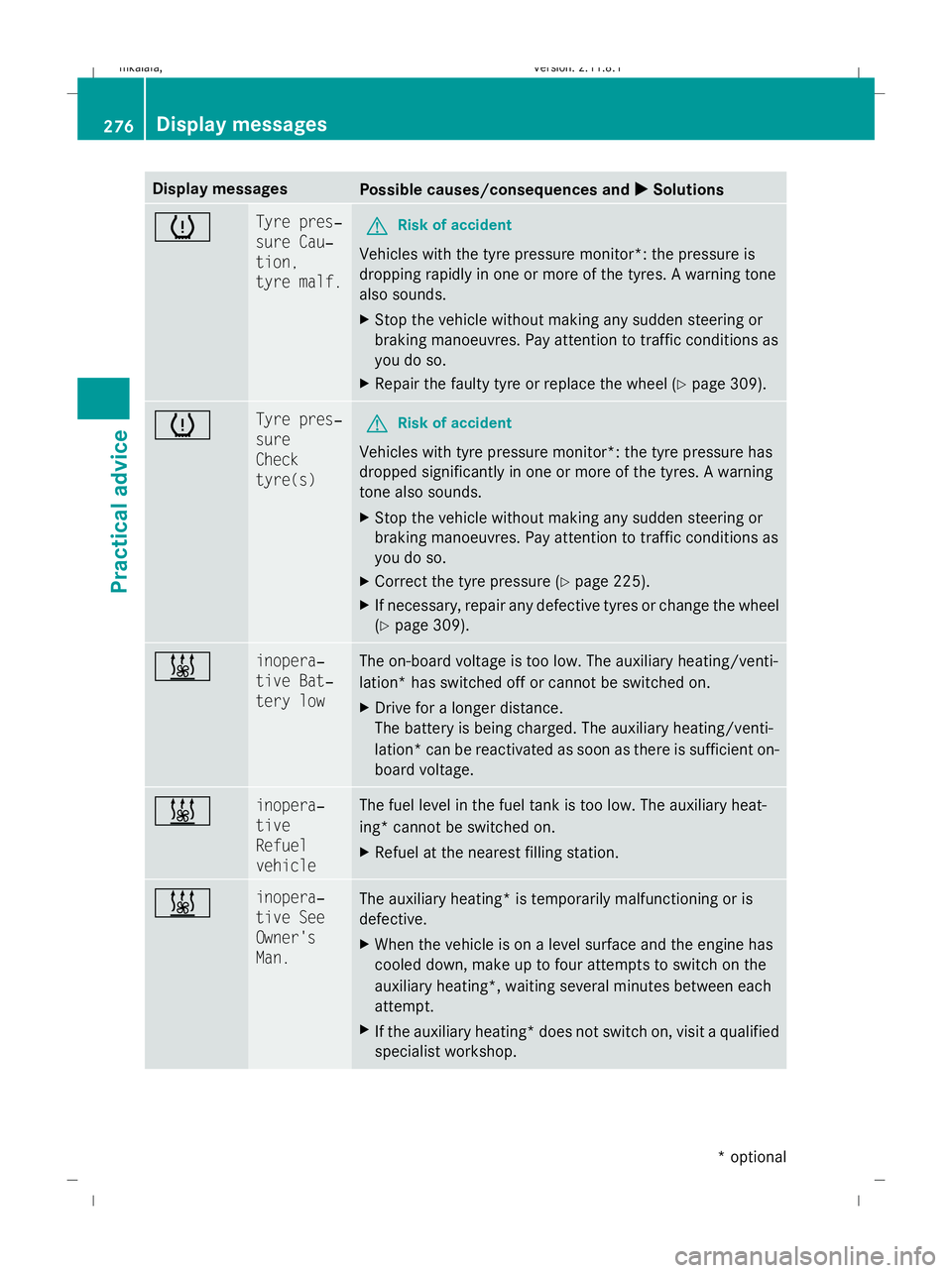
X Solutions h Tyre pres‐
sure Cau‐
tion,
tyre malf.
G
Risk of accident
Vehicles with the tyre pressure monitor*: the pressure is
dropping rapidly in one or more of the tyres. A warning tone
also sounds.
X Stop the vehicle without making any sudden steering or
braking manoeuvres. Pay attention to traffic conditions as
you do so.
X Repair the faulty tyre or replace the wheel ( Ypage 309). h Tyre pres‐
sure
Check
tyre(s)
G
Risk of accident
Vehicles with tyre pressure monitor*: the tyre pressure has
dropped significantly in one or more of the tyres. A warning
tone also sounds.
X Stop the vehicle without making any sudden steering or
braking manoeuvres. Pay attention to traffic conditions as
you do so.
X Correct the tyre pressure (Y page 225).
X If necessary, repair any defective tyres or change the wheel
(Y page 309). & inopera‐
tive Bat‐
tery low The on-board voltage is too low. The auxiliary heating/venti-
lation* has switched off or cannot be switched on.
X
Drive for a longer distance.
The battery is being charged. The auxiliary heating/venti-
lation *can be reactivated as soon as there is sufficient on-
board voltage. & inopera‐
tive
Refuel
vehicle The fuel level in the fuel tank is too low. The auxiliary heat-
ing* cannot be switched on.
X
Refuel at the nearest filling station. & inopera‐
tive See
Owner's
Man.
The auxiliary heating
*is temporarily malfunctioning or is
defective.
X When the vehicle is on a level surface and the engine has
cooled down, make up to four attempts to switch on the
auxiliary heating*, waiting several minutes between each
attempt.
X If the auxiliary heating* does not switch on, visit a qualified
specialist workshop. 276
Display messagesPractical advice
* optional
212_AKB; 2; 4, en-GB
mkalafa,
Version: 2.11.8.1 2009-05-05T14:17:16+02:00 - Seite 276
Dateiname: 6515346702_buchblock.pdf; erzeugt am 07. May 2009 14:17:11; WK
Page 281 of 373
Display messages
Possible causes/consequences and
X
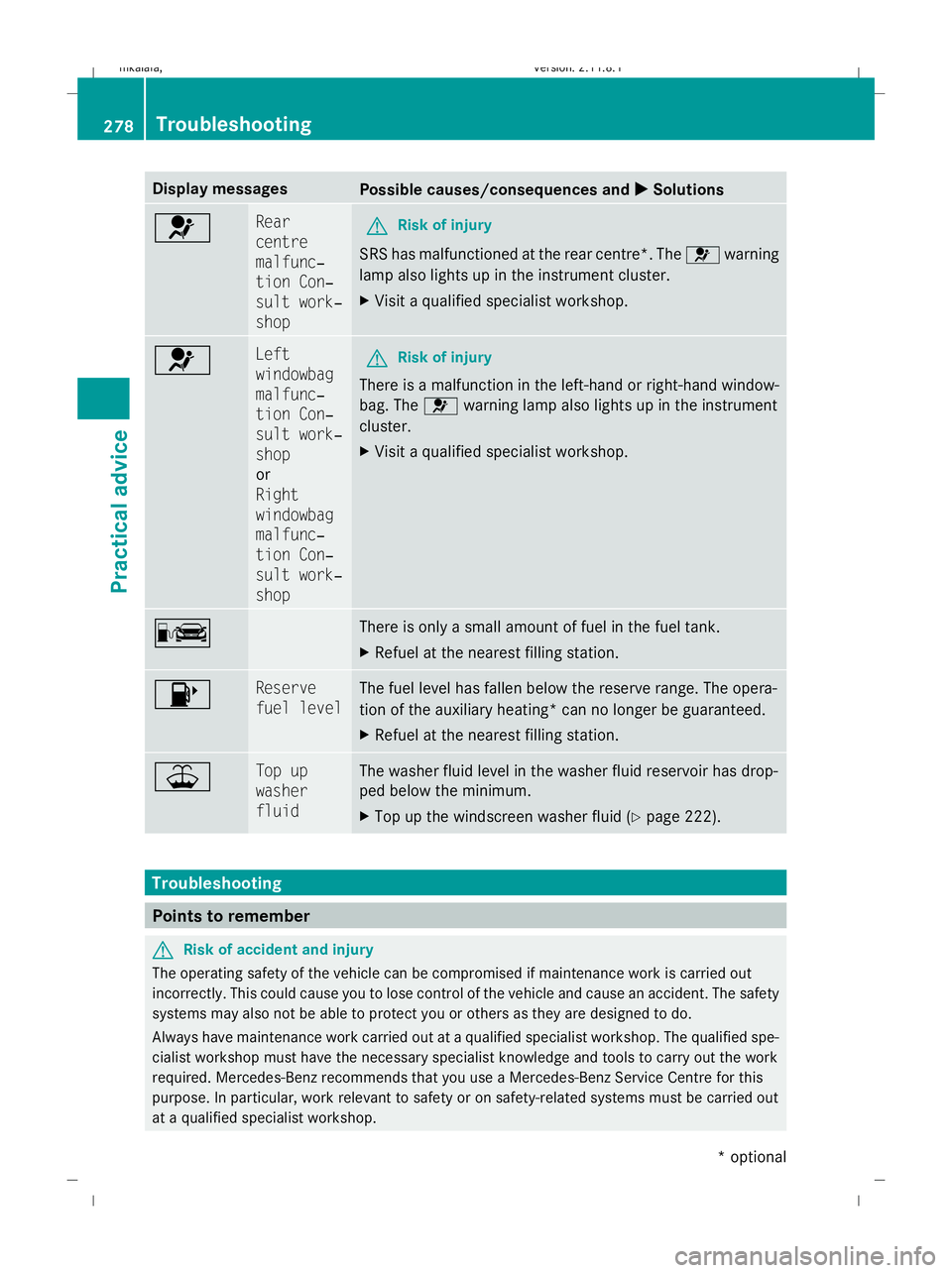
X Solutions 6 Rear
centre
malfunc‐
tion Con‐
sult work‐
shop
G
Risk of injury
SRS has malfunctioned at the rear centre*. The 6warning
lamp also lights up in the instrument cluster.
X Visit a qualified specialist workshop. 6 Left
windowbag
malfunc‐
tion Con‐
sult work‐
shop
or
Right
windowbag
malfunc‐
tion Con‐
sult work‐
shop
G
Risk of injury
There is a malfunction in the left-hand or right-hand window-
bag. The 6warning lamp also lights up in the instrument
cluster.
X Visit a qualified specialist workshop. C There is only a small amount of fuel in the fuel tank.
X
Refuel at the nearest filling station. 8 Reserve
fuel level The fuel level has fallen below the reserve range. The opera-
tion of the auxiliary heating* can no longer be guaranteed.
X
Refuel at the nearest filling station. ¥ Top up
washer
fluid The washer fluid level in the washer fluid reservoir has drop-
ped below the minimum.
X
Top up the windscreen washer fluid (Y page 222).Troubleshooting
Points to remember
G
Risk of accident and injury
The operating safety of the vehicle can be compromised if maintenance work is carried out
incorrectly. This could cause you to lose control of the vehicle and cause an accident. The safety
systems may also not be able to protect you or others as they are designed to do.
Always have maintenance work carried out at a qualified specialist workshop. The qualified spe-
cialist workshop must have the necessary specialist knowledge and tools to carry out the work
required. Mercedes-Benz recommends that you use a Mercedes-Benz Service Centre for this
purpose. In particular, work relevant to safety or on safety-related systems must be carried out
at a qualified specialist workshop. 278
TroubleshootingPractical advice
* optional
212_AKB; 2; 4, en-GB
mkalafa,
Version: 2.11.8.1 2009-05-05T14:17:16+02:00 - Seite 278
Dateiname: 6515346702_buchblock.pdf; erzeugt am 07. May 2009 14:17:11; WK
Page 286 of 373
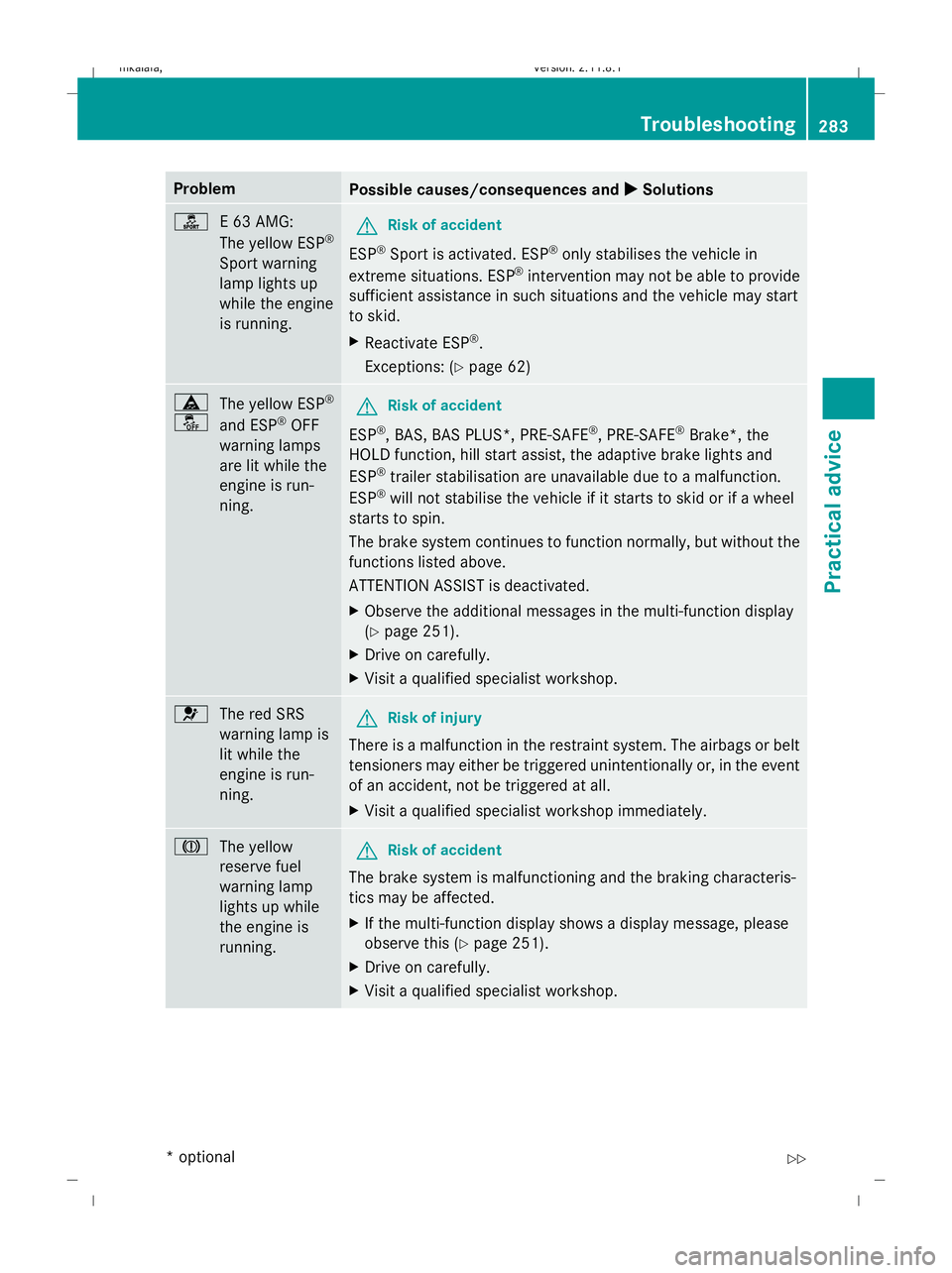
Problem
Possible causes/consequences and
X
X Solutions ì
E 63 AMG:
The yellow ESP ®
Sport warning
lamp lights up
while the engine
is running. G
Risk of accident
ESP ®
Sport is activated. ESP ®
only stabilises the vehicle in
extreme situations. ESP ®
intervention may not be able to provide
sufficient assistance in such situations and the vehicle may start
to skid.
X Reactivate ESP ®
.
Exceptions: (Y page 62) ä
å
The yellow ESP
®
and ESP ®
OFF
warning lamps
are lit while the
engine is run-
ning. G
Risk of accident
ESP ®
, BAS, BAS PLUS*, PRE-SAFE ®
, PRE-SAFE ®
Brake*, the
HOLD function, hill start assist, the adaptive brake lights and
ESP ®
trailer stabilisation are unavailable due to a malfunction.
ESP ®
will not stabilise the vehicle if it starts to skid or if a wheel
starts to spin.
The brake system continues to function normally, but without the
functions listed above.
ATTENTION ASSIST is deactivated.
X Observe the additional messages in the multi-function display
(Y page 251).
X Drive on carefully.
X Visit a qualified specialist workshop. 6
The red SRS
warning lamp is
lit while the
engine is run-
ning. G
Risk of injury
There is a malfunction in the restraint system. The airbags or belt
tensioners may either be triggered unintentionally or, in the event
of an accident, not be triggered at all.
X Visit a qualified specialist workshop immediately. J
The yellow
reserve fuel
warning lamp
lights up while
the engine is
running. G
Risk of accident
The brake system is malfunctioning and the braking characteris-
tics may be affected.
X If the multi-function display shows a display message, please
observe this (Y page 251).
X Drive on carefully.
X Visit a qualified specialist workshop. Troubleshooting
283Practical advice
* optional
212_AKB; 2; 4, en-GB
mkalafa,
Version: 2.11.8.1 2009-05-05T14:17:16+02:00 - Seite 283 Z
Dateiname: 6515346702_buchblock.pdf; erzeugt am 07. May 2009 14:17:12; WK
Page 288 of 373
Problem
Possible causes/consequences and
X
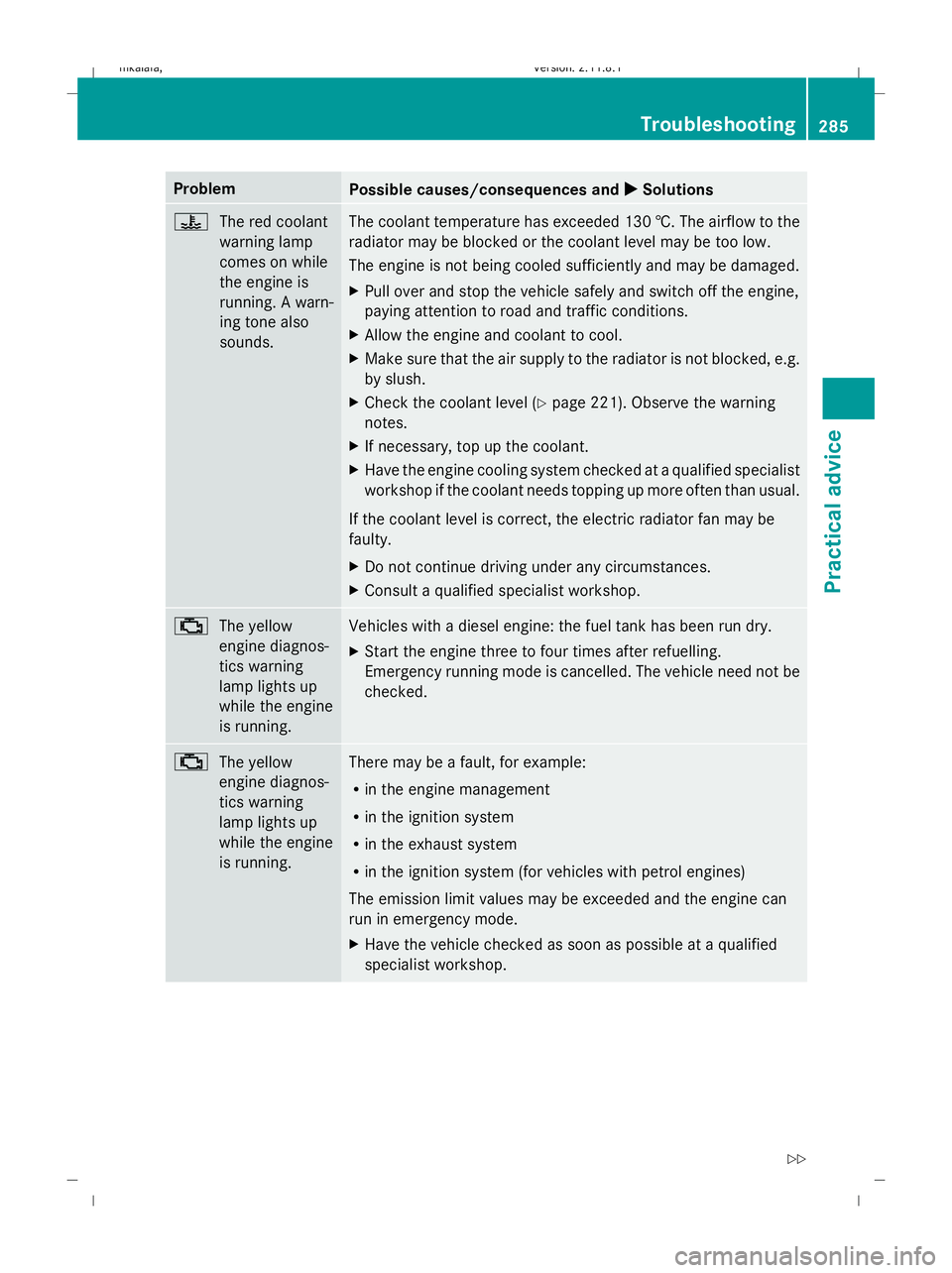
X Solutions ?
The red coolant
warning lamp
comes on while
the engine is
running. A warn-
ing tone also
sounds. The coolant temperature has exceeded 130 †. The airflow to the
radiator may be blocked or the coolant level may be too low.
The engine is not being cooled sufficiently and may be damaged.
X
Pull over and stop the vehicle safely and switch off the engine,
paying attention to road and traffic conditions.
X Allow the engine and coolant to cool.
X Make sure that the air supply to the radiator is not blocked, e.g.
by slush.
X Check the coolant level (Y page 221). Observe the warning
notes.
X If necessary, top up the coolant.
X Have the engine cooling system checked at a qualified specialist
workshop if the coolant needs topping up more often than usual.
If the coolant level is correct, the electric radiator fan may be
faulty.
X Do not continue driving under any circumstances.
X Consult a qualified specialist workshop. ;
The yellow
engine diagnos-
tics warning
lamp lights up
while the engine
is running. Vehicles with a diesel engine: the fuel tank has been run dry.
X
Start the engine three to four times after refuelling.
Emergency running mode is cancelled. The vehicle need not be
checked. ;
The yellow
engine diagnos-
tics warning
lamp lights up
while the engine
is running. There may be a fault, for example:
R
in the engine management
R in the ignition system
R in the exhaust system
R in the ignition system (for vehicles with petrol engines)
The emission limit values may be exceeded and the engine can
run in emergency mode.
X Have the vehicle checked as soon as possible at a qualified
specialist workshop. Troubleshooting
285Practical advice
212_AKB; 2; 4, en-GB
mkalafa, Version: 2.11.8.1 2009-05-05T14:17:16+02:00 - Seite 285 Z
Dateiname: 6515346702_buchblock.pdf; erzeugt am 07. May 2009 14:17:12; WK
Page 290 of 373
Problem
Possible causes/consequences and
X
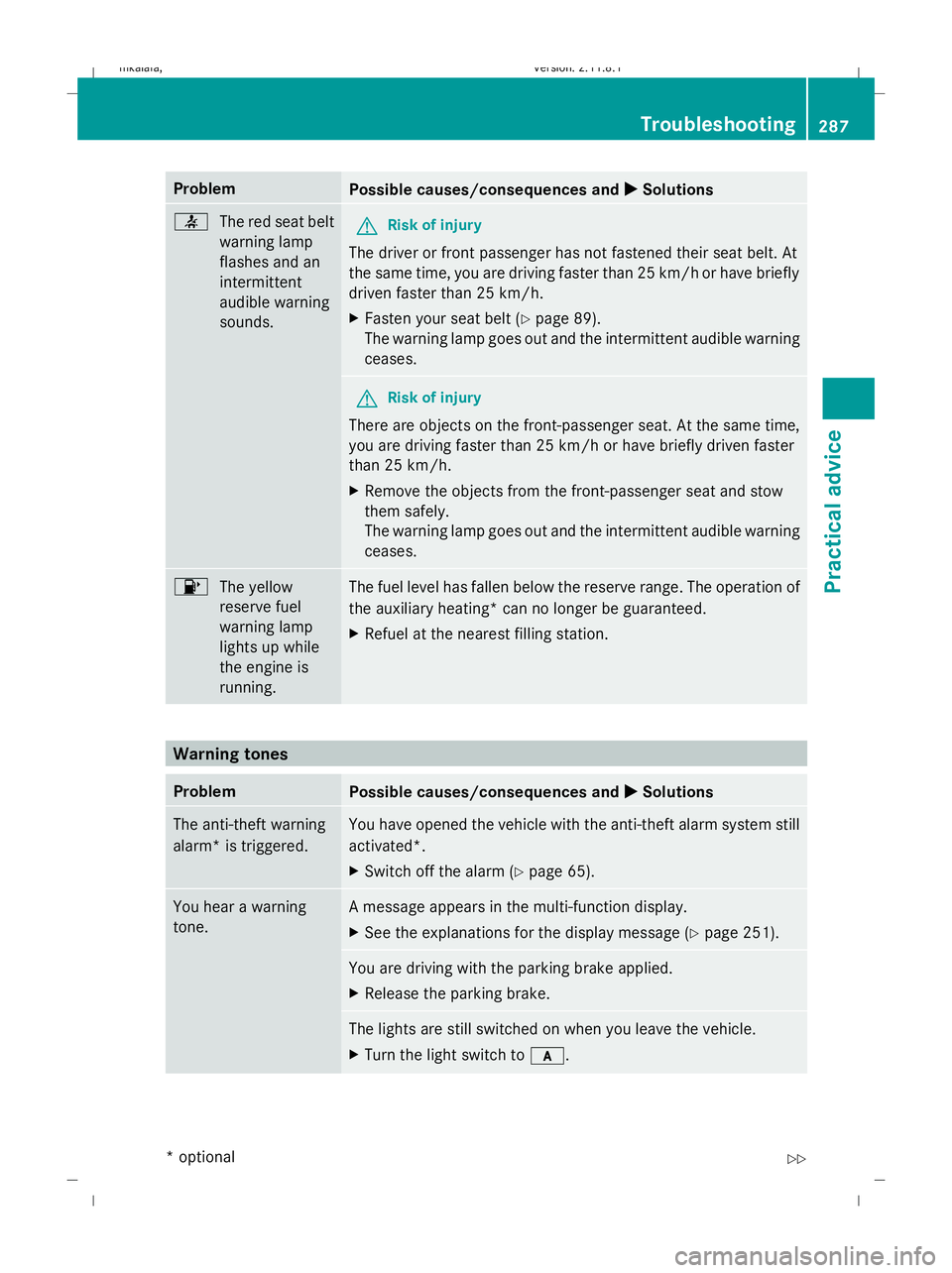
X Solutions 7
The red seat belt
warning lamp
flashes and an
intermittent
audible warning
sounds. G
Risk of injury
The driver or front passenger has not fastened their seat belt. At
the same time, you are driving faster than 25 km/ho r have briefly
driven faster than 25 km/h.
X Fasten your seat belt (Y page 89).
The warning lamp goes out and the intermittent audible warning
ceases. G
Risk of injury
There are objects on the front-passenger seat. At the same time,
you are driving faster than 25 km/h or have briefly driven faster
than 25 km/h.
X Remove the objects from the front-passenger seat and stow
them safely.
The warning lamp goes out and the intermittent audible warning
ceases. 8
The yellow
reserve fuel
warning lamp
lights up while
the engine is
running. The fuel level has fallen below the reserve range. The operation of
the auxiliary heating* can no longer be guaranteed.
X
Refuel at the nearest filling station. Warning tones
Problem
Possible causes/consequences and
X
X Solutions The anti-theft warning
alarm* is triggered. You have opened the vehicle with the anti-theft alarm system still
activated*.
X Switch off the alarm (Y page 65). You hear a warning
tone. A message appears in the multi-function display.
X
See the explanations for the display message (Y page 251). You are driving with the parking brake applied.
X
Release the parking brake. The lights are still switched on when you leave the vehicle.
X
Turn the light switch to c. Troubleshooting
287Practical advice
* optional
212_AKB; 2; 4, en-GB
mkalafa,
Version: 2.11.8.1 2009-05-05T14:17:16+02:00 - Seite 287 Z
Dateiname: 6515346702_buchblock.pdf; erzeugt am 07. May 2009 14:17:12; WK
Page 291 of 373
Problem
Possible causes/consequences and
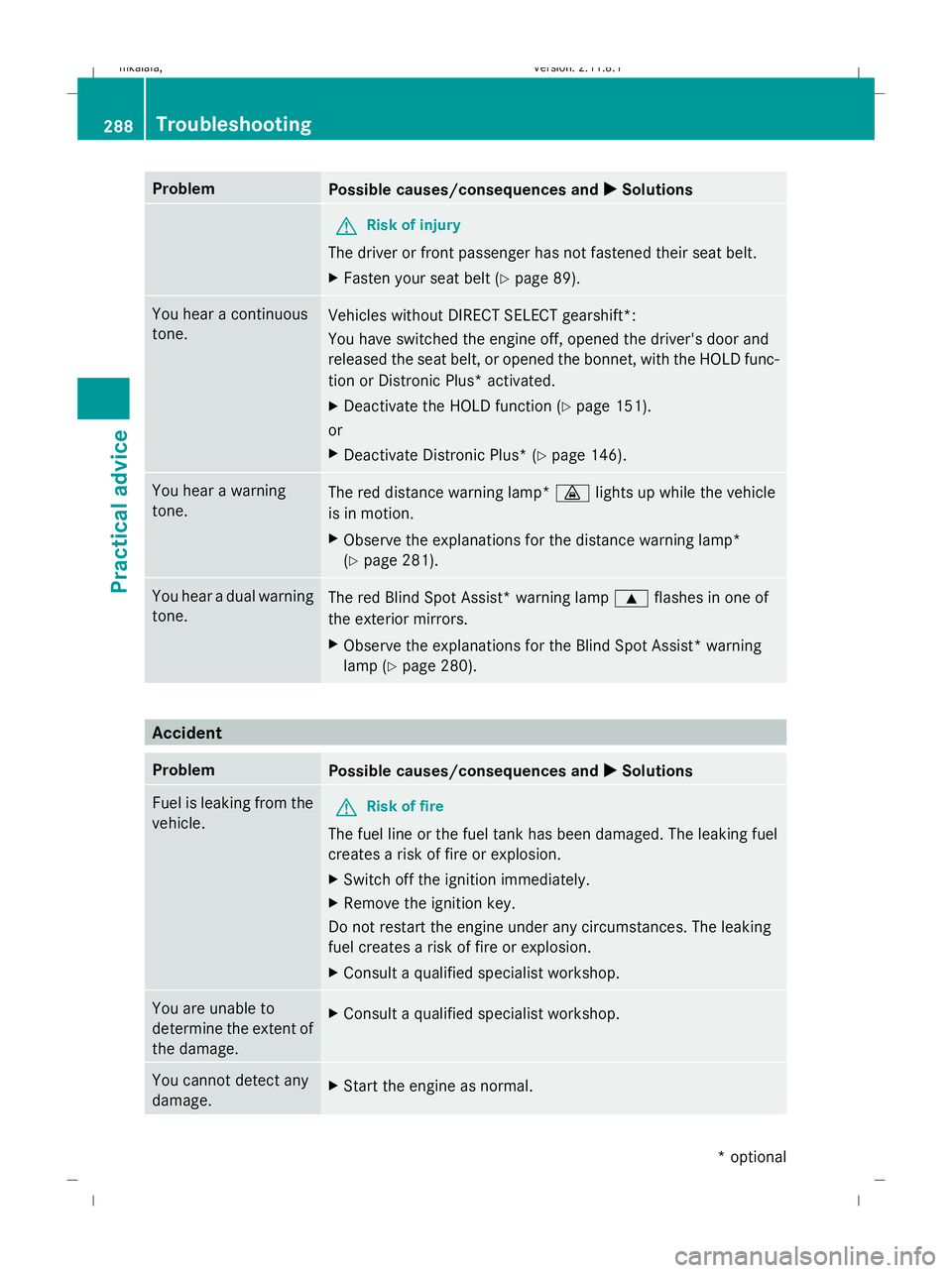
X XSolutions G
Risk of injury
The driver or front passenger has not fastened their seat belt.
X Fasten your seat belt (Y page 89).You hear a continuous
tone.
Vehicles without DIRECT SELECT gearshift*:
You have switched the engine off, opened the driver's door and
released the seat belt, or opened the bonnet, with the HOLD func-
tion or Distronic Plus* activated.
X
Deactivate the HOLD function (Y page 151).
or
X Deactivate Distronic Plus* (Y page 146).You hear a warning
tone.
The red distance warning lamp*
·lights up while the vehicle
is in motion.
X Observe the explanations for the distance warning lamp*
(Y page 281). You hear a dual warning
tone.
The red Blind Spot Assist* warning lamp
9flashes in one of
the exterior mirrors.
X Observe the explanations for the Blind Spot Assist* warning
lamp (Y page 280). Accident
Problem
Possible causes/consequences and
X XSolutions Fuel is leaking from the
vehicle.
G
Risk of fire
The fuel line or the fuel tank has been damaged. The leaking fuel
creates a risk of fire or explosion.
X Switch off the ignition immediately.
X Remove the ignition key.
Do not restart the engine under any circumstances. The leaking
fuel creates a risk of fire or explosion.
X Consult a qualified specialist workshop. You are unable to
determine the extent of
the damage.
X
Consult a qualified specialist workshop. You cannot detect any
damage.
X
Start the engine as normal. 288
TroubleshootingPractical advice
* optional
212_AKB; 2; 4, en-GB
mkalafa,
Version: 2.11.8.1 2009-05-05T14:17:16+02:00 - Seite 288
Dateiname: 6515346702_buchblock.pdf; erzeugt am 07. May 2009 14:17:13; WK
Page 292 of 373
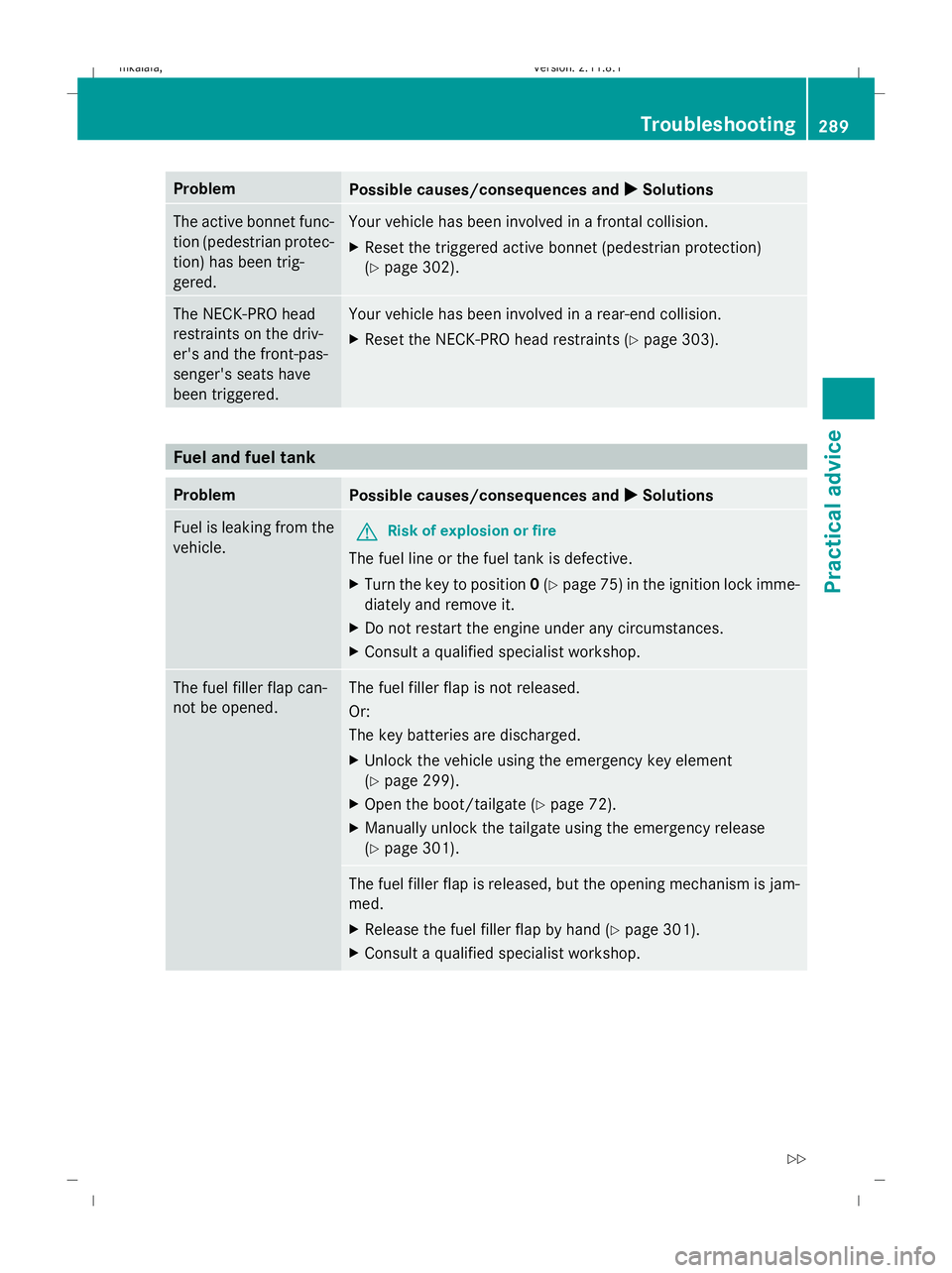
Problem
Possible causes/consequences and
X
X Solutions The active bonnet func-
tion (pedestrian protec-
tion) has been trig-
gered. Your vehicle has been involved in a frontal collision.
X
Reset the triggered active bonnet (pedestrian protection)
(Y page 302). The NECK-PRO head
restraints on the driv-
er's and the front-pas-
senger's seats have
been triggered. Your vehicle has been involved in a rear-end collision.
X
Reset the NECK-PRO head restraints (Y page 303).Fuel and fuel tank
Problem
Possible causes/consequences and
X
X Solutions Fuel is leaking from the
vehicle.
G
Risk of explosion or fire
The fuel line or the fuel tank is defective.
X Turn the key to position 0(Y page 75) in the ignition lock imme-
diately and remove it.
X Do not restart the engine under any circumstances.
X Consult a qualified specialist workshop. The fuel filler flap can-
not be opened. The fuel filler flap is not released.
Or:
The key batteries are discharged.
X
Unlock the vehicle using the emergency key element
(Y page 299).
X Open the boot/tailgate (Y page 72).
X Manually unlock the tailgate using the emergency release
(Y page 301). The fuel filler flap is released, but the opening mechanism is jam-
med.
X
Release the fuel filler flap by hand (Y page 301).
X Consult a qualified specialist workshop. Troubleshooting
289Practical advice
212_AKB; 2; 4, en-GB
mkalafa, Version: 2.11.8.1 2009-05-05T14:17:16+02:00 - Seite 289 Z
Dateiname: 6515346702_buchblock.pdf; erzeugt am 07. May 2009 14:17:13; WK
Page 293 of 373
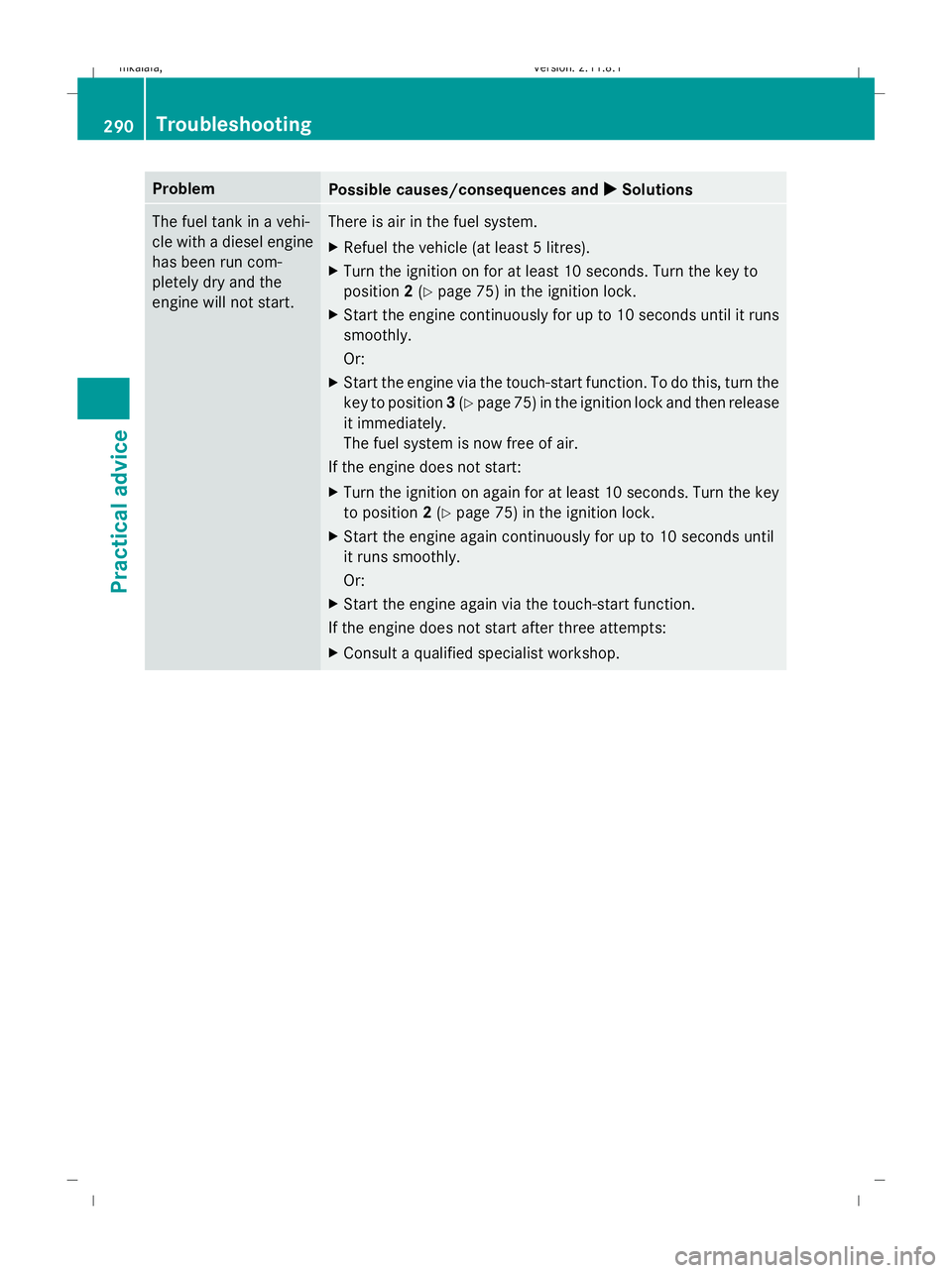
Problem
Possible causes/consequences and
X XSolutions The fuel tank in a vehi-
cle with a diesel engine
has been run com-
pletely dry and the
engine will not start. There is air in the fuel system.
X
Refuel the vehicle (at least 5 litres).
X Turn the ignition on for at least 10 seconds. Turn the key to
position 2(Y page 75) in the ignition lock.
X Start the engine continuously for up to 10 seconds until it runs
smoothly.
Or:
X Start the engine via the touch-start function. To do this, turn the
key to position 3(Y page 75) in the ignition lock and then release
it immediately.
The fuel system is now free of air.
If the engine does not start:
X Turn the ignition on again for at least 10 seconds. Turn the key
to position 2(Y page 75) in the ignition lock.
X Start the engine again continuously for up to 10 seconds until
it runs smoothly.
Or:
X Start the engine again via the touch-start function.
If the engine does not start after three attempts:
X Consult a qualified specialist workshop. 290
TroubleshootingPractical advice
212_AKB; 2; 4, en-GB
mkalafa,
Version: 2.11.8.1 2009-05-05T14:17:16+02:00 - Seite 290
Dateiname: 6515346702_buchblock.pdf; erzeugt am 07. May 2009 14:17:13; WK