tow bar MERCEDES-BENZ G-CLASS SUV 2014 Owners Manual
[x] Cancel search | Manufacturer: MERCEDES-BENZ, Model Year: 2014, Model line: G-CLASS SUV, Model: MERCEDES-BENZ G-CLASS SUV 2014Pages: 272, PDF Size: 39.13 MB
Page 20 of 272
Technical data
............................... 253
Temperature .................................. 242
TIN (Tire Identification Number)
(definition) ..................................... 249
Tire bead (definition) ......................249
Tire pressure (definition) ................248
Tire pressures (recommended )...... 247
Tire size (data) ............................... 253
Tire size designation, load-bearing
capacity, speed rating .................... 243
Tire tread ....................................... 229
Tire tread (definition) .....................248
Total load limit (definition) .............249
Traction ......................................... 242
Traction (definition) .......................249
Tread wea r..................................... 242
TWR (permissible trailer drawbar
noseweight) (definition) .................249
Uniform Tire Quality Grading
Standards ...................................... 241
Uniform Tire Quality Grading
Standards (definition) ....................247
Unladen weight (definition) ............248
Wear indicator (definition) .............249
Wheel rim (definition) ....................247
see Flat tire
Top Tether ............................................ 57
Towing Important safety guidelines ...........221
In the event of malfunctions ..........224
Towing a trailer
7-pin connector ............................. 140
Axle load, permissible ....................266
Bulb failure indicator for LED lamps 140
Cleaning the trailer tow hitch ......... 206
Coupling up a trailer ......................138
Decoupling a trailer .......................139
Driving tips .................................... 134
Installing the ball coupling .............137
Lights display message ..................144
Mounting dimensions ....................265
Power supply ................................. 140
Trailer loads ................................... 266
Trailer tow hitch ............................. 265
Towing away
With both axles on the ground .......223 Towing eye
Front .............................................. 222
Rear ............................................... 222
Tow-starting
Emergency engine starting ............224
Important safety notes ..................221
Traffic reports
see also Digital Operator's Manual 170
Trailer
Display message ............................ 144
Trailer coupling
see Towing a trailer
Trailer loads
Technical data ............................... 266
Trailer loads and drawbar
noseweights ...................................... 140
Trailer tow hitch Ball position ................................... 266
Trailer towing
ESP ®
................................................ 63
PARKTRONIC ................................. 127
Permissible trailer loads and
drawbar noseweights .....................140
Transfer case
General notes ................................ 129
Shifting .......................................... 130
Shifting (general notes) .................. 130
Shifting (important safety notes) ...130
Shifting to neutral ..........................131
Shift range ..................................... 129
Switching off the off-road gear
ratio ............................................... 130
Switching on the off-road gear
ratio ............................................... 130
Transmission
see Automatic transmission
Transmission positions ....................101
Transporting the vehicle ..................223
Traveling uphill Brow of hill ..................................... 106
Driving downhill ............................. 106
Maximum gradient-climbing
capability ....................................... 106
Trim pieces (cleaning instructions) .210
Trip computer (on-board computer) 144
Trip odometer Calling up ....................................... 144 18
Index
Page 110 of 272
Off-road driving
Important safety notes G
WARNING
Do not load items on the basic carrier bars. It
may cause instability during some maneuvers
which could result in an accident.
Drive slowly in unknown terrain. This will
make it easier to recognize unexpected
obstacles and avoid damage to the vehicle.
To help avoid the vehicle rolling over, never
turn it around on steep inclines. If the vehicle
cannot complete the attempted climb, back it
down in reverse gear.
Do not drive along the side of a slope. The
vehicle might otherwise rollover. If in doing so
the vehicle begins to show a tendency to roll,
immediately steer into a line of gravity
(straight up or downhill).
Never let the vehicle roll backwards in idle.
You may lose control of the vehicle if you use
only the service brake. For information on
driving downhill, see "Driving downhill".
When driving off-road, sand, mud and water,
possibly mixed with oil, for example, could get
into the brakes. This could result in a reduced
braking effect or in total brake failure and also
in increased wear and tear. The braking
characteristics change depending on the
material ingressing the brakes. Clean the
brakes after driving off-road. If you detect a
reduced braking effect or grinding noises,
have the brake system checked in a qualified
specialist workshop as soon as possible.
Adapt your driving style to the different
braking characteristics.
Driving off-road increases the likelihood of
damage to the vehicle, which, in turn, can lead
to failure of the mechanical assembly or
systems. Adapt your driving style to suit the
terrain conditions. Drive carefully. Have
damage to the vehicle rectified immediately
at a qualified specialist workshop. Checklist before driving off-road !
If the engine oil warning lamp lights up
while the vehicle is in motion, stop the
vehicle in a safe place as soon as possible.
Check the engine oil level. The engine oil
warning lamp warning must not be ignored.
Continuing the journey while the symbol is
displayed could lead to engine damage.
X Engine oil level: check the engine oil level
and add oil if necessary.
Only then does the engine receive enough
oil when the vehicle is standing on a steep
incline.
X Tire-changing tool kit: check that the jack
is working and make sure you have the lug
wrench, a robust tow cable and a folding
spade in the vehicle.
X Wheels and tires: check the tire tread
depth and tire pressure.
X Check for damage and remove any foreign
objects, e.g. small stones, from the
wheels/tires.
X Replace any missing valve caps.
X Replace dented or damaged wheels.
X Carry a sound spare wheel.
Checklist after driving off-road Driving over rough terrain places greater
demands on your vehicle than driving on
normal roads. After driving off-road, check
the vehicle. This allows you to detect damage
promptly and reduce the risk of an accident
to yourself and other road users.
X Shift the transfer case to HIGH
RANGE(Y page 130).
X Disengage the differential locks
(Y page 134).
X Clean the headlamps and rear lights and
check for damage.
X Clean the front and rear license plates.
X Clean the wheels and tires with a water jet
and remove any foreign objects. 108
Driving tipsDriving and parking
Page 137 of 272
Couple and uncouple the trailer carefully. If
you do not couple the trailer to the towing
vehicle correctly, the trailer could become
detached.
Make sure that the following values are not
exceeded:
R the permissible trailer drawbar noseweight
R the permissible trailer load
R the permissible rear axle load of the towing
vehicle
R the maximum permissible gross vehicle
weight of both the towing vehicle and the
trailer
When towing a trailer, your vehicle's handling
characteristics will be different in comparison
with when driving without a trailer.
The vehicle/trailer combination:
R is heavier
R is restricted in its acceleration and
gradient-climbing capability
R has an increased braking distance
R is affected more by strong crosswinds
R demands more sensitive steering
R has a larger turning circle
This could impair the handling
characteristics.
When towing a trailer, always adjust your
speed to the current road and weather
conditions. Do not exceed the maximum
permissible speed for your vehicle/trailer
combination.
Driving tips X
On long and steep downhill gradients,
select shift range 1,2or 3(Y page 101) in
good time.
i This also applies if you have activated
cruise control or SPEEDTRONIC.
X If necessary, shift the transfer case to LOW
RANGE(Y page 130).
This will use the braking effect of the
engine, so that less braking will be required
to maintain the speed. This relieves the load on the brake system and prevents the
brakes from overheating and wearing too
quickly. If you need additional braking,
depress the brake pedal repeatedly rather
than continuously.
The maximum permissible speed for vehicle/
trailer combinations depends on the type of
trailer. Before beginning the journey, check
the trailer's documents to see what the
maximum permissible speed is. Observe the
legally prescribed maximum speed in the
relevant country.
For certain Mercedes-Benz vehicles, the
maximum permissible rear axle load is
increased when towing a trailer. Refer to the
"Technical data" section to find out whether
this applies to your vehicle. If you utilize any
of the added maximum rear axle load when
towing a trailer, the vehicle/trailer
combination may not exceed a maximum
speed of 60 mph (100 km/h) for reasons
concerning the operating permit. This also
applies in countries in which the permissible
maximum speed for vehicle/trailer
combinations is above 60 mph (100 km/h).
When towing a trailer, your vehicle's handling
characteristics will be different in comparison
to when driving without a trailer and it will
consume more fuel.
On long and steep downhill gradients, you
must select shift range 1,2or 3in good time.
i This also applies if you have activated
cruise control or DISTRONIC PLUS.
This will use the braking effect of the engine,
so that less braking will be required to
maintain the speed. This relieves the load on
the brake system and prevents the brakes
from overheating and wearing too quickly. If
you need additional braking, depress the
brake pedal repeatedly rather than
continuously. Towing a trailer
135Driving and parking Z
Page 140 of 272
X
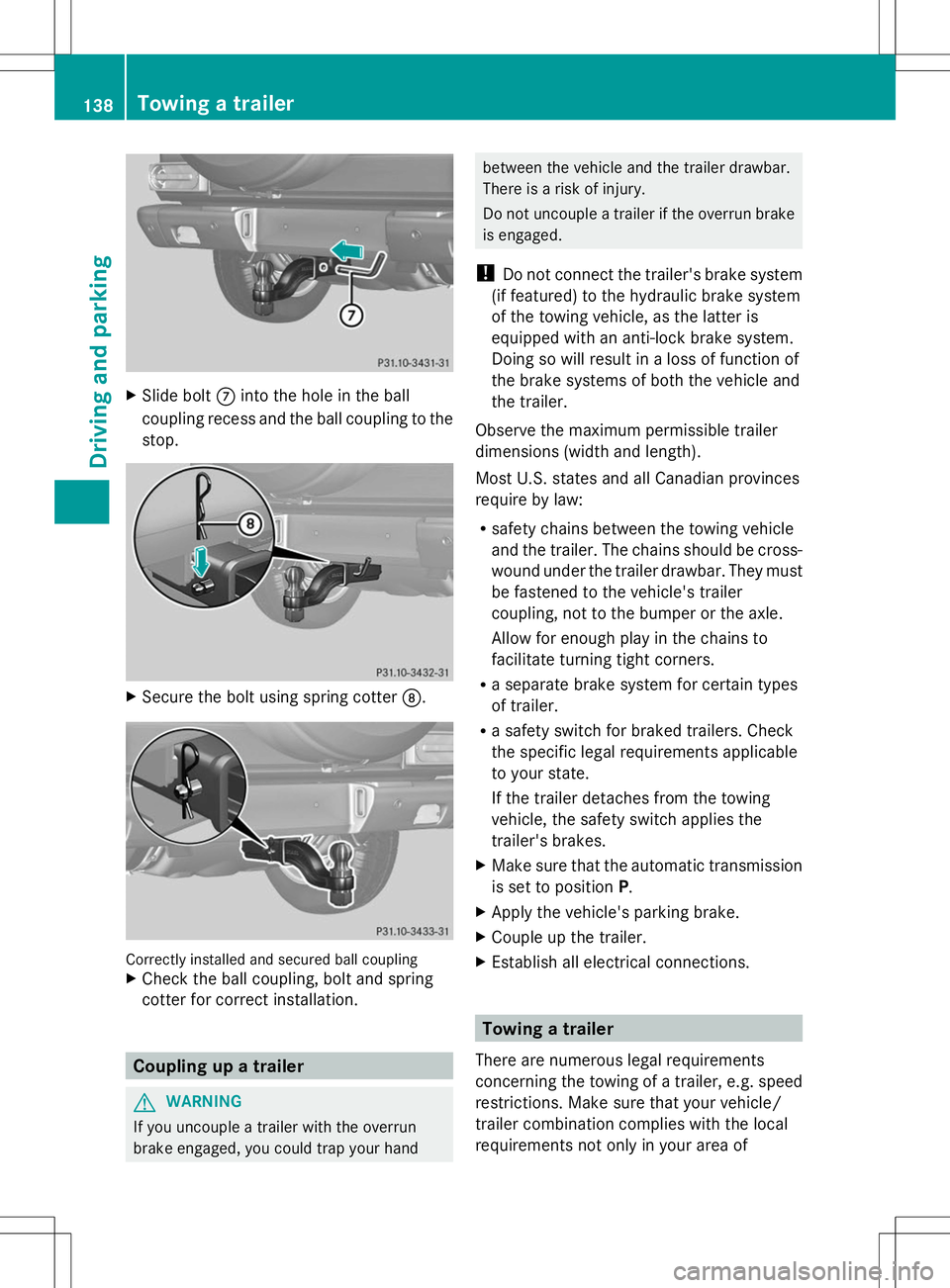
Slide bolt Cinto the hole in the ball
coupling recess and the ball coupling to the
stop. X
Secure the bolt using spring cotter D.Correctly installed and secured ball coupling
X Check the ball coupling, bolt and spring
cotter for correct installation. Coupling up a trailer
G
WARNING
If you uncouple a trailer with the overrun
brake engaged, you could trap your hand between the vehicle and the trailer drawbar.
There is a risk of injury.
Do not uncouple a trailer if the overrun brake
is engaged.
! Do not connect the trailer's brake system
(if featured) to the hydraulic brake system
of the towing vehicle, as the latter is
equipped with an anti-lock brake system.
Doing so will result in a loss of function of
the brake systems of both the vehicle and
the trailer.
Observe the maximum permissible trailer
dimensions (width and length).
Most U.S. states and all Canadian provinces
require by law:
R safety chains between the towing vehicle
and the trailer. The chains should be cross-
wound under the trailer drawbar. They must
be fastened to the vehicle's trailer
coupling, not to the bumper or the axle.
Allow for enough play in the chains to
facilitate turning tight corners.
R a separate brake system for certain types
of trailer.
R a safety switch for braked trailers. Check
the specific legal requirements applicable
to your state.
If the trailer detaches from the towing
vehicle, the safety switch applies the
trailer's brakes.
X Make sure that the automatic transmission
is set to position P.
X Apply the vehicle's parking brake.
X Couple up the trailer.
X Establish all electrical connections. Towing a trailer
There are numerous legal requirements
concerning the towing of a trailer, e.g. speed
restrictions. Make sure that your vehicle/
trailer combination complies with the local
requirements not only in your area of 138
Towing a trailerDriving and parking
Page 142 of 272
X
Close all doors and the tailgate (G-Class
Cabriolet).
X Apply the trailer's parking brake.
X Remove the trailer cable and decouple the
trailer.
X Switch off the engine. Permissible trailer and drawbar loads
Weight specifications The gross trailer weight is calculated by
adding the weight of the trailer to the weight
of the load and equipment on the trailer.
Missing values for model G 63 AMG and
G 65 AMG were not available at the time of
going to print.
The maximum permissible trailer drawbar
noseweight is the maximum weight with
which the trailer drawbar can be loaded:
562 lbs (255 kg). Limit for Mercedes-Benz-
approved trailer couplings.
Loading a trailer R
When loading the trailer, make sure that
neither the permissible gross weight of the
trailer nor the gross vehicle weight is
exceeded. The permissible gross vehicle
weight is indicated on the identification
plate on the B-pillar on the driver's side of
the vehicle.
You can find the maximum permissible
values on the type plates of your vehicle
and the trailer. Always observe the lowest
respective value when determining the
maximum weight with which you can load
the vehicle and the trailer.
R The trailer drawbar load on the ball coupling
must be added to the rear axle load to avoid
exceeding the permissible gross axle
weight. The permissible gross vehicle
weight is indicated on the identification
plate on the B-pillar on the driver's side of
the vehicle. i
Mercedes-Benz recommends a trailer
load where the trailer drawbar noseweight
accounts for 8% to 15% of the trailer's
permissible gross weight.
i The weight of additional accessories,
passengers, and cargo reduces the
permissible trailer load and drawbar load
for your vehicle.
Checking the vehicle and trailer weight R
Determine the maximum permissible gross
vehicle weight of the vehicle. Weigh the
car/trailer combination, including the
driver, passenger, trailer and load on a
calibrated weighing machine.
R Check the gross axle weight rating of the
front and rear axles, the gross weight of the
trailer and trailer drawbar load. Information in the Digital Operator's
Manual
In the Digital Operator's Manual you will find
information on the following topics:
R Trailer power supply
R Bulb failure indicator for LED lamps
R Trailer with 7-pin connector 140
Towing a trailerDriving and pa
rking
Page 224 of 272
If the vehicle has to be towed more than
30 miles (50km), the entire vehicle must be
raised and transported.
! Only secure the tow cable or tow bar to
the towing eyes. You could otherwise
damage the vehicle.
! Do not tow with sling-type equipment.
This could damage the vehicle.
! Do not use the towing eyes for recovery
purposes as this could damage the vehicle.
If in doubt, recover the vehicle with a crane.
! When towing, pull away slowly and
smoothly. If the tractive power is too high,
the vehicles could be damaged.
! Your vehicles is equipped with an
automatic transmission. Therefore, you
must not have the vehicle tow-started. The
transmission may otherwise be damaged. G
WARNING
If the weight of the vehicle to be towed or tow-
started is greater than the permissible gross
weight of your vehicle:
R the towing eye could detach itself
R the vehicle/trailer combination could
rollover.
There is a risk of an accident.
When towing or tow-starting another vehicle,
its weight should not be greater than the
permissible gross weight of your vehicle.
Information on your vehicle's gross vehicle
weight rating can be found on the vehicle
identification plate (Y page 258).
It is better to have the vehicle transported
than to have it towed.
If the transfer case can be shifted into neutral
N, you can tow the vehicle. If the transfer case cannot be shifted into
neutral
N, you can tow the vehicle with one
axle raised. Please bear the following in mind:
R remove the propeller shaft between the
transfer case and the rolling axle.
R turn the SmartKey to position 1in the
ignition lock (Y page 97).
The battery must be connected and charged.
Otherwise, you:
R cannot turn the SmartKey in the ignition
lock to position 2(Ypage 97)
R cannot shift the automatic transmission to
position N
i Deactivate the automatic locking feature
(Y page 69). You could otherwise be locked
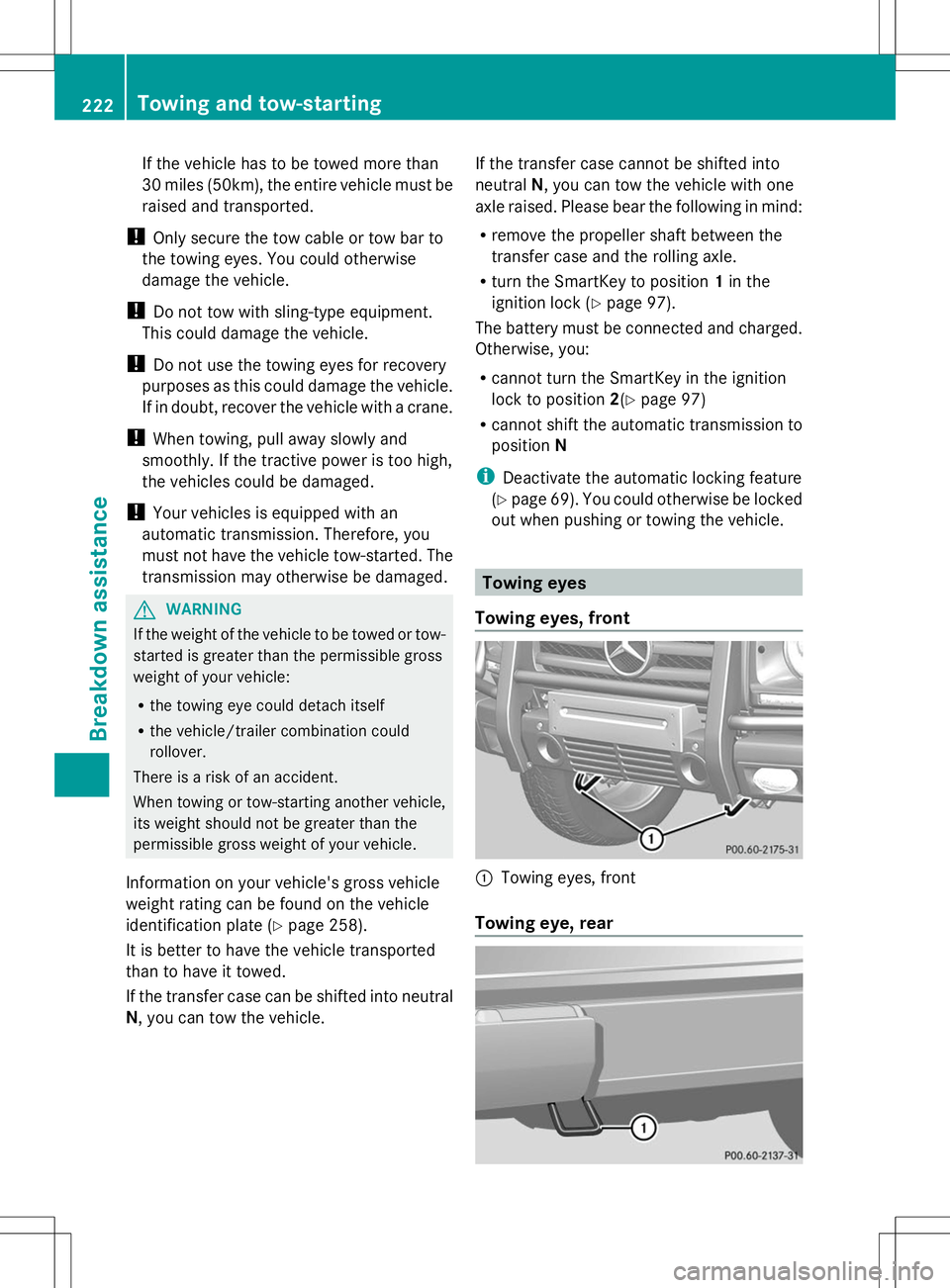
out when pushing or towing the vehicle. Towing eyes
Towing eyes, front :
Towing eyes, front
Towing eye, rear 222
Towing and tow-startingBreakdown assistance
Page 251 of 272
Bead
The tire bead ensures that the tire sits
securely on the wheel. There are several steel
wires in the bead to prevent the tire from
coming loose from the wheel rim.
Sidewall The part of the tire between the tread and the
bead.
Weight of optional extras The combined weight of those optional extras
that weigh more than the replaced standard
parts and more than 2.3 kg (5 lbs). These
optional extras, such as high-performance
brakes, level control, a roof rack or a high-
performance battery, are not included in the
curb weight and the weight of the
accessories.
TIN (Tire Identification Number) This is a unique identifier which can be used
by a tire manufacturer to identify tires, for
example for a product recall, and thus identify
the purchasers. The TIN is made up of the
manufacturer's identity code, tire size, tire
type code and the manufacturing date.
Load bearing index The load bearing index (also load index) is a
code that contains the maximum load bearing
capacity of a tire.
Traction Traction is the result of friction between the
tires and the road surface.
TWR (Tongue Weight Rating)
The TWR specifies the maximum permissible
weight that the ball coupling of the trailer tow
hitch can support. Treadwear indicators Narrow bars (tread wear bars) that are
distributed over the tire tread. If the tire tread
is level with the bars, the wear limit of
áin
(1.6 mm) has been reached.
Occupant distribution The distribution of occupants in a vehicle at
their designated seating positions.
Total load limit
Nominal load and luggage load plus 150 lbs
(68 kg) multiplied by the number of seats in
the vehicle.
Changing a wheel
Flat tire
The "Breakdown assistance" section
(Y page 214) contains information and notes
on how to deal with a flat tire. Rotating the wheels
G
WARNING
Rotate front and rear wheels only if the tires
are of the same dimension.
If your vehicle is equipped with mixed-size
tires (different tire dimensions front vs. rear),
tire rotation is not possible. G
WARNING
Have the tightening torque checked after
changing a wheel. The wheels could come
loose if they are not tightened to a torque of
96 lb-ft (130 Nm).
Only use genuine Mercedes-Benz wheel bolts
specified for your vehicle's rims.
! On vehicles equipped with a tire pressure
monitor, electronic components are
located in the wheel. Changing a wheel
249Wheels and tires Z
Page 268 of 272
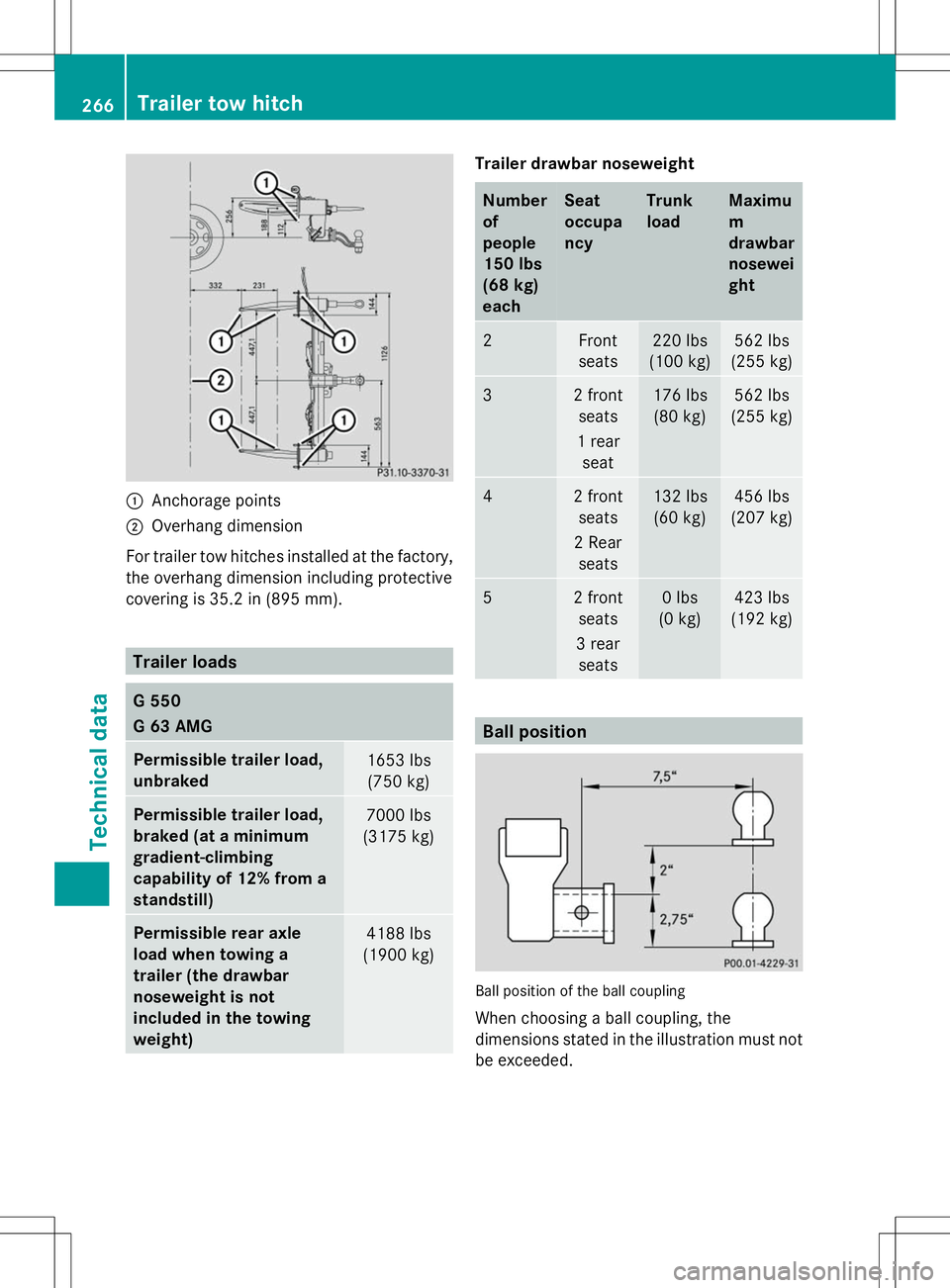
:
Anchorage points
; Overhang dimension
For trailer tow hitches installed at the factory,
the overhang dimension including protective
covering is 35.2 in (895 mm). Trailer loads
G 550
G 63 AMG
Permissible trailer load,
unbraked
1653 lbs
(750 kg) Permissible trailer load,
braked (at a minimum
gradient-climbing
capability of 12% from a
standstill)
7000 lbs
(3175 kg) Permissible rear axle
load when towing a
trailer (the drawbar
noseweight is not
included in the towing
weight)
4188 lbs
(1900 kg) Trailer drawbar noseweight
Number
of
people
150 lbs
(68 kg)
each Seat
occupa
ncy Trunk
load Maximu
m
drawbar
nosewei
ght
2 Front
seats 220 lbs
(100 kg) 562 lbs
(255 kg) 3 2 front
seats
1 rear seat 176 lbs
(80 kg) 562 lbs
(255 kg) 4 2 front
seats
2 Rear seats 132 lbs
(60 kg) 456 lbs
(207 kg) 5 2 front
seats
3 rear seats 0 lbs
(0 kg) 423 lbs
(192 kg) Ball position
Ball position of the ball coupling
When choosing a ball coupling, the
dimensions stated in the illustration must not
be exceeded.266
Trailer tow hitchTechnical data