ESP MERCEDES-BENZ M-CLASS SUV 2011 User Guide
[x] Cancel search | Manufacturer: MERCEDES-BENZ, Model Year: 2011, Model line: M-CLASS SUV, Model: MERCEDES-BENZ M-CLASS SUV 2011Pages: 389, PDF Size: 9.22 MB
Page 25 of 389
Protection of th
eenvironment Notes
H
Environmental note
Daimler's declared polic yisone of integrated
environmental protection.
The objectives are for the natural resources
which form the basis of our existence on this
plane ttobeu sed sparingl yand in amanner
which takes the requirements of both nature
and humanity into account.
You too can help to protect the environment
by operating your vehicle in an environmen-
tally responsible manner.
Fuel consumption and the rate of engine,
transmission, brake and tyre wear depend on
the following factors:
R operating conditions of your vehicle
R your personal driving style
You can influence both factors. You should
bear the following in mind:
Operating conditions:
R avoid short trips as these increase fuel con-
sumption.
R make sure that the tyre pressures are
always correct.
R do not carr yany unnecessary weight.
R keep an eye on the vehicle's fuel consump-
tion.
R remove roof racks once you no longer need
them.
R ar egularly serviced vehicle will contribute
to environmental protec tion. You should
therefor eadhere to the service inter vals.
R always have maintenance work carried out
at aq ualified specialist workshop ,e.g. a
Mercedes-Benz Service Centre.
Personal driving style:
R do not depress the accelerator pedal when
starti ngthe engine.
R do not warm up the engine with the vehicle
stationary. R
drive carefully and maintain asafe distance
from the vehicle in front.
R avoid frequent, sudden acceleration.
R change gear in good time and use each gear
only up to Ôof its maximum engine speed.
R switch off the engine in stationary traffic. Returning end-of-life vehicles
Mercedes-Benz will take back your
Mercedes-Benz to dispose of it in an environ-
mentally responsible manner, in accordance
with the European Union (EU) End of Life
Vehicles Directive.
The End of Life Vehicles Directive applies to
vehicles with agros svehicle weight of up to
3. 5t ,ina ccordance with national regulations.
For several years ,Mercedes-Benz has been
meeting all the legal requirements for a
design which allows for recycling and reuse.
There is anetwor kofreturnpoint sand dis-
assembly plants which can recycle your vehi-
cle in an environmentally responsible man-
ner. The options for recycling vehicles and
parts are constantly being develope dand
improved .This means that your Mercedes-
Ben zwill also continue to meet even the
increased recycling quotas in the futur ein
good time. You can obtai nfurther information
from your national Mercedes-Benz homepage
or your national hotline number. Vehicle equipment
This Owner's Manual describes all models
and all standard and optional equipment of
your vehicle available at the time of publica-
tion of the Owner's Manual. Country-specific
differences are possible. Pleas enote that
your vehicle ma ynot be equipped with all fea-
tures described. This also applies to safety-
relevant system sand functions .The equip-
men tiny our vehicle ma ytherefore differ from
that shown in the descriptions and illustra-
tions. All the system sfound in your vehicle 22
Introduction
Page 27 of 389
The equipment conform
stothe relevant
equipment -specific EMC specification sin
accordanc ewith the following European
standards:
R EN 550 13
R EN 55020
Therefore, adherence to the relevant specifi-
cations for electromagnetic compatibility is
guarantee dfor this device.
As aresult, interferenc ecaused by your
equipment to other electrical/electronic
equipment and interferenc etoyour equip-
men tcaused by other electrical/electronic
equipment can be largely prevented. On-board diagnostic interface
G
WARNING
If you connect equipment to the on-board
diagnostic interface, it can affect the opera-
tion of the vehicle systems. This can impair
the operating safety of your vehicle while driv-
ing. There is arisk of accident.
Do not connect any equipment to the on-
board diagnostic interface. G
WARNING
Loose equipment or equipment cables which
are connected to the on-board diagnostic
interface may infringe on the space around
the pedals. The equipment or the cables could
get between the pedals in the event of sudden
braking or acceleration .You may then no lon-
ger be able to brake, operate the clutch or
accelerate as intended. There is arisk of acci-
dent.
Do not attach any equipment or cables in the
driver footwell.
Connecting equipment to the on-board diag-
nostic interface can lead to emissions moni-
torin ginformation being reset. Thi smay lead
to the vehicle failing to meet the require-
ment satthe nex temissions con trol test or
main inspec tion. If the engin
eisswitched off and equipment
on the on-board diagnostic interface is used,
the starter battery may discharge.
The on-board diagnostic interface is intended
for the connection of diagnostic equipment at
aq ualified specialist workshop. Qualified specialist workshop
Aq ualified specialist workshop has the nec-
essary specialist knowledge, tools and quali-
fication stocorrectlyc arry out the work
required on your vehicle. This is especially the
cas efor work releva ntto safety.
Observ ethe information in th eServic eBook-
let.
Alway shave th efollowin gwork carried out at
aq ualified specialist workshop:
R work relevan ttosafety
R servic eand maintenance work
R repair work
R alterations, installation work and modifica-
tions
R work on ele ctroniccomponen ts
Mercedes-Ben zrecom mends that you use a
Mercedes-Benz Service Centre. Vehicle registration
Mercedes-Benz may ask its Service Centres
to carry out technical inspectio nson certain
ve hicles to improv etheir quality or safety.
If you did not purchase your vehicle from an
authorised specialist dealer and your vehicle
has never been inspected at aMercedes-
Ben zService Cent re,itisp ossible that your
vehicle is not registered in your nam ewith
Mercedes-Benz. Mercedes-Ben zcan only
infor myou about vehicle chec ksif it has your
registration data.
It is advisable to register your vehicle with a
Mercedes-Benz Servic eCentre. 24
Introduction
Page 28 of 389
Inform Mercedes-Benz as soon as poss
ible
abou tany change in address or vehicl eown-
ership. Correct use
G
WARNING
Variou swarning stickers are affixed to your
vehicle. Their purpose is to draw your atten-
tion, and the attention of others, to various
dangers. Therefore, do not remove any warn-
ing stic kers unles sthe stic kerc learly states
that you may do so.
If you remov ethe warnin gstickers, you or
others could be injured by failing to recognise
certain dangers.
Observe the following information whe nusing
your vehicle:
R the safety notes in this manual
R the "Technical data" section in this manual
R national roa dtraffic regulations
R national roa dtraffic licensing regulations Implie
dwarranty
! Follo wthe instructions in this manual
about the proper operation of your vehicle
as well as about possible vehicle damage.
Damage to your vehicle that arises from
culpable contravention sagainst these
instructions ar enot covered either by
Mercedes-Ben zimplie dwarrant yorbythe
New or Used-Vehicle Warrant yof
Daimler AG. Data stored in the vehicle
Fault data
Compone ntsc ritical for vehicl eoperation are
equipped with fault data memories as stand-
ard. There are also data storage devices
which recor dthe technical reactions of vehi-
cle component stocertain driving situations (e.g. airbag deployment or ESP
®
interven-
tion).
This data is used exclusivel yto:
R assist in the rec tificatio noffaults and
defects
R help Mercedes -Benz optimise and develop
vehicle fun ctions
The data cannot be used to trac ethe vehicle's
movements.
When your vehicle is serviced by Mercedes-
Ben z,this technical information can be read
out from the fault memory. Thi sisperformed
by authorised employees of the Mercedes-
Benz service network using special diagnos-
tic computers.
Af teraf ault has been rectified, the informa-
tion is deleted from the memory. Other mem-
ory data is constantly overwritten. Other devices tha
tstore data
Depe nding on the equipment level, your vehi-
cle may featur ecommunication sand/or
entertainment systems (e.g .navigation devi-
ces, telephone systems). Thes eallow you to
save and edit data required for the operation
of the respective device.
Fur ther information on operation (e.g. on
deletin gdata) can be found in the separate
operating instructions. Introduction
25 Z
Page 35 of 389
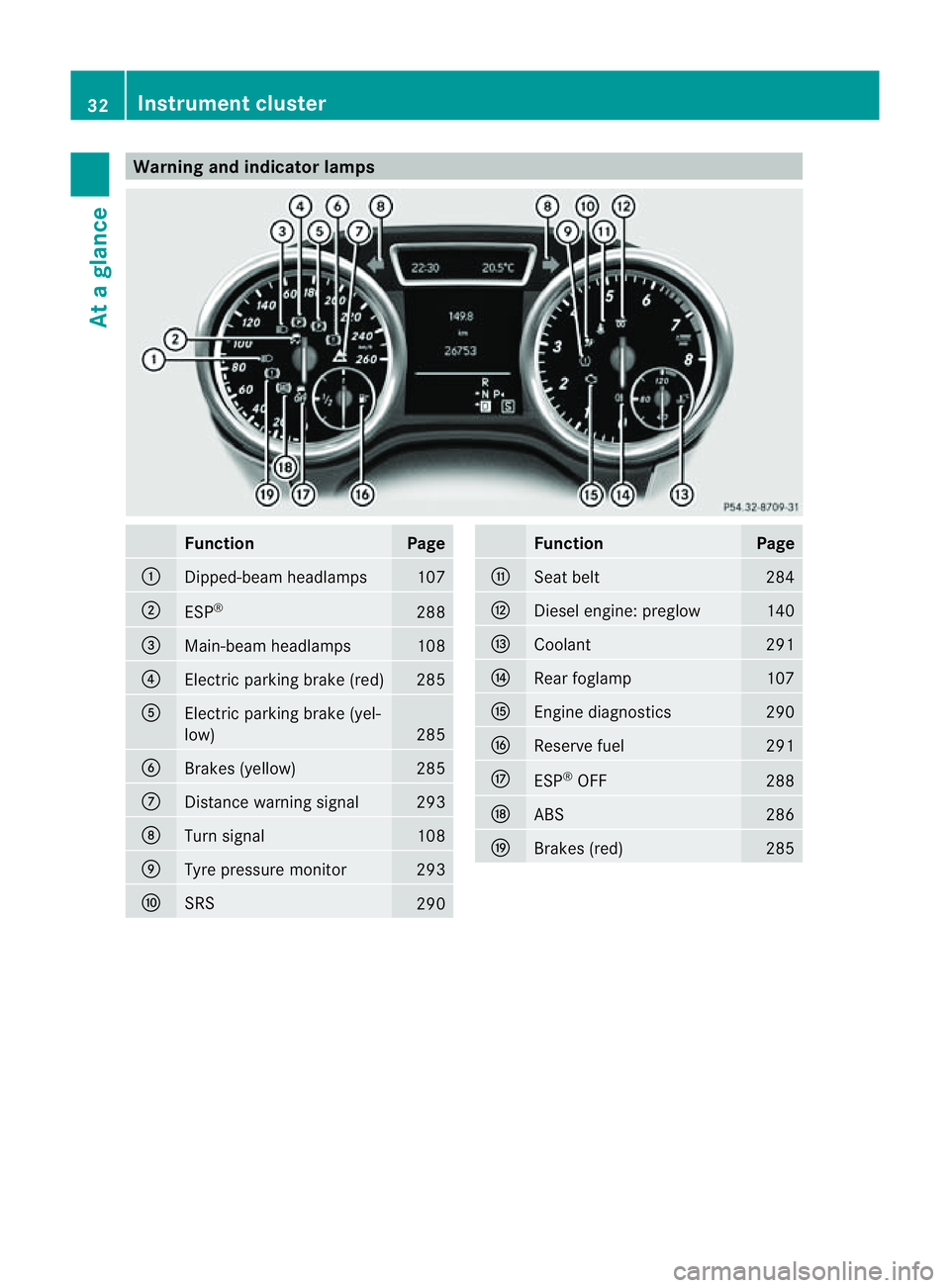
Warnin
gand indicator lamps Fun
ction Page
:
Dipped-bea
mheadlamps 107
;
ESP
® 288
=
Main-beam headlamps 108
?
Electric parkin
gbrake (red) 285
A
Electric parking brake (yel-
low)
285
B
Brakes (yellow) 285
C
Distance warning signal 293
D
Turn signal 108
E
Tyre pressure moni
tor 293
F
SRS
290 Function Page
G
Sea
tbelt 284
H
Diesel engine: preglow 140
I
Coolant 291
J
Rear foglamp 107
K
Engine diagnostics 290
L
Reserv
efuel 291
M
ESP
®
OFF 288
N
ABS 286
O
Brakes (red) 28532
Instrument clusterAt
ag lance
Page 37 of 389
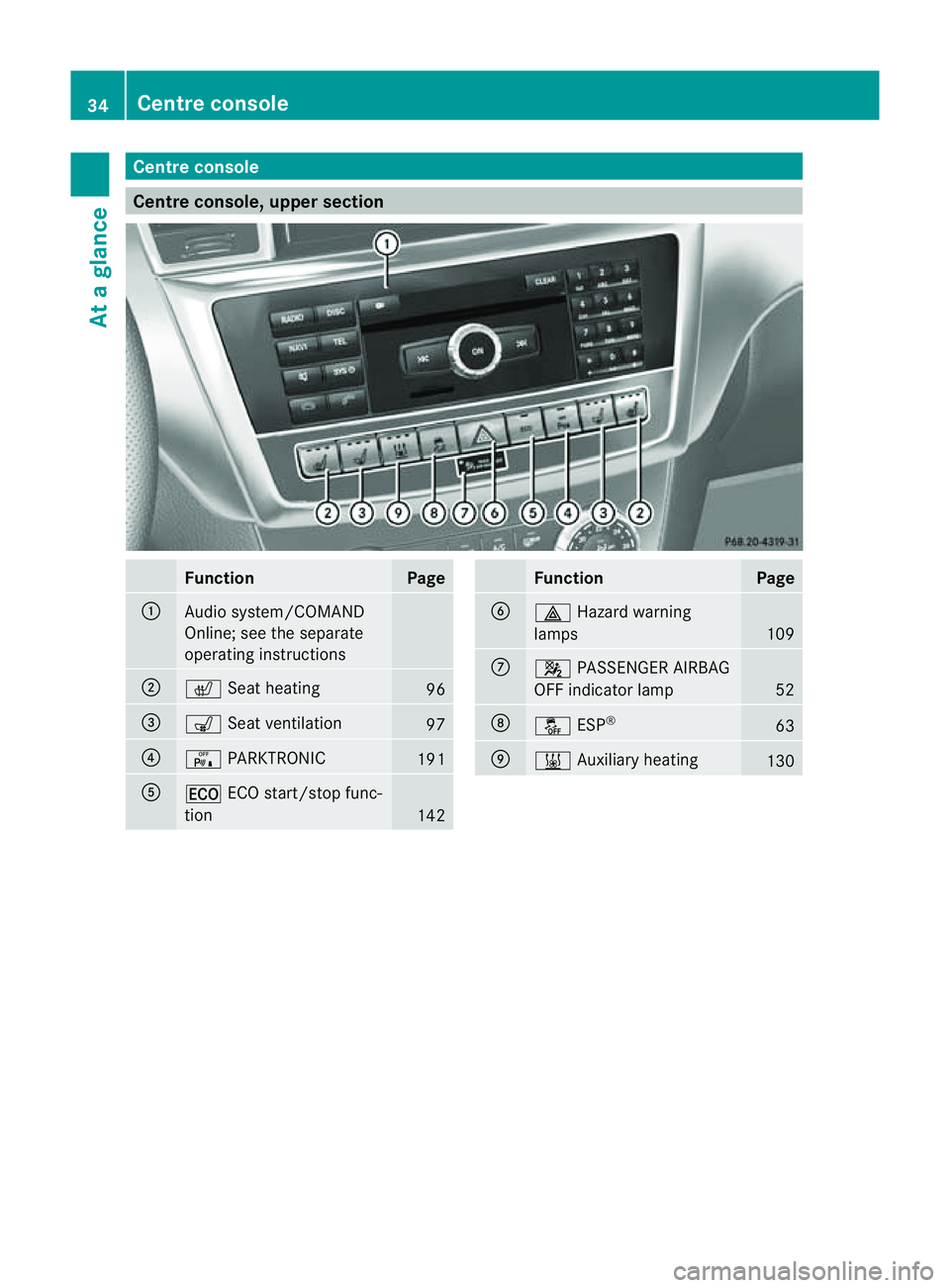
Centre console
Centr
econsole, upper section Function Page
:
Audi
osystem/COMAND
Online; see the separate
ope ratin ginstructions ;
c
Seat hea ting 96
=
s
Seat ventilation 97
?
c
PARKTRONIC 191
A
¤
ECO start/sto pfunc-
tion 142 Function Page
B
£
Hazard warning
lamps 109
C
4
PASSENG ER AIRBAG
OFF indicator lamp 52
D
å
ESP® 63
E
&
Auxiliary heating 13034
Centre consoleAt
ag lance
Page 44 of 389
G
WARNING
Modifications to or work performe dincor-
rectly on the following parts can result in the
restraint systems not functioning as intended:
R the restraint system, consisting of seat
belts and thei ranchorage points, bel tten-
sioners, belt for celimiter sand airbags
R the wiring
R networked electronic systems
Airbags and belt tensioners could fail to
deploy or be trigge redinana ccident despite
the deceleration force being sufficient to trig-
ger the systems, or could be triggered unin-
tentionally. For this reason, never make any
modifications to the restrain tsystems.
Therefore, you must not tamper with elec-
tronic components or their software. SRS (Supplemen
talRestraint System)
Introduction SRS consists of:
R
the 6 SRS warning lamp
R airbags
R airba gcontrol unit (with crash sensors)
R belt tensioner sfor the front seat belts and
the outer seat belts in the rear
R belt force limiters
SRS reduces the risk of occupan ts coming
into contact with the vehicle's interio rinthe
even tofana ccident. It can als oreduce the
effect of the forces to which occupant sare
subjected during an accident.
SRS warnin glamp SRS functions are checked regularly when
you switch on the ignition and when the
engine is running. Therefore ,malfunctions
can be detected in good time.
The 6 SRS warning lamp in the instrument
cluster lights up when the ignition is switched
on. It goes out no later than afew seconds
after the engine is star ted. G
WARNING
If SRS is malfunctioning, individual systems
may be activated unintentionally or may not
be triggered in the even tofanaccident with
ah igh rate of vehicle deceleration.
Am alfunction has occurred if:
R the 6 SRS warning lamp does not light
up when the ignition is switched on.
R the engine is runnin gand the 6SRS
warning lamp doe snot go out after afew
seconds.
R the engine is runnin gand the 6SRS
warning lamp lights up again.
In this case, have SRS checked immediately
at aq ualified specialist workshop .Mercedes-
Benz recommends that you use aMercedes-
Benz Servic eCentr efor this purpose.
In particular ,work relevant to safet yoron
safety-related systems must be carried out at
aq ualified specialist workshop.
Triggering of belt tensioners, belt force
limiters and airbags During the first stage of
acollision ,the airbag
con trol unit evaluates important physical
data relatin gtovehicle deceleration or accel-
eration, such as:
R duration
R direction
R magnitude
Based on the evaluation of this data, the air-
bag control unit pre-emptively triggers the
belt tensioner sinthe first stage.
i The front belt tensioner scan only be trig-
gered if the seat belt tongues on the front
seats are correctly engaged in the seat belt
buckles.
If there is an even higher rate of vehicle decel-
eration or acceleration in alongitudinal direc-
tion ,the front airbags ar ealso deployed.
Your vehicle has adaptive, two-stage front air-
bags. The airbag control unit evaluates vehi-
cle deceleration or acceleration in the event Occupant safety
41Safety Z
Page 45 of 389
of
ac ollision .Inthe first deploymen tstage,
the front airbag is filled with enoug hpropel-
lan tgas to reduce the risk of injuries. The
front airbag is fully deployed if asecond
deployment threshold is exceeded within a
few milliseconds.
The belt tensioner and airbag triggering
thresholds are variable and are adapted to the
rat eofd eceleration or acceleration of the
vehicle. This process is pre-emptive in nature.
The triggerin gprocess mus ttake place in
good time at the start of the collision.
i Airbags are not deployed in all types of
accidents. Also, not all airbags are
deployed together in an accident .The dif-
ferent airbag system swork independently
of each other.
How the airbag system work sisdeter-
mined by the severity of the collision detec-
ted, especially the vehicle deceleration or
acceleration, and the apparent type of acci-
dent:
R head-on collision
R side impact
R overturn
The rat eofvehicle deceleration or accelera-
tion and the direction of the force are essen-
tially determined by:
R the distribution of forces during the colli-
sion
R the collision angle
R the deformation characteristics of the vehi-
cle
R the characteristics of the object with which
the vehicle has collided
Factors which can only be seen and measured
after acollision has occurred do not play a
decisive role in the deployment of an airbag,
nor do they provide an indication of airbag
deployment.
The vehicle ma ybedeformed significantly,
e.g. the bonnet or the wing, without an airbag
being deployed. This is the case if only parts
which are relatively easily deformed are affec- ted and the rat
eofdeceleration is not high.
Conversely, airbags may be deployed even
though the vehicle suffers only minor defor-
mation. This is the case if, for example, very
rigid vehicle part ssuch as longitudinal body
members are hit, and sufficient deceleration
occurs as aresult. Airbags
Important safety notes Airbag deployment slows down and restricts
the movemen
tofthe vehicle occupant.
If the airbags ar edeployed, you will hear a
bang and asmall amount of powder may also
be released. Only in rare cases will th ebang
affect your hearing. The powde rthat is
released generally does not constitute a
healt hhazard. The 6SRS warning lamp
lights up.
The airbag installation locations are identified
by the AIRBA Gsymbol. G
WARNING
Airbags provide additional protection; they
are not, however, asubstitute for seat belts.
Observe the following notes to reduce the risk
of serious or even fatal injury caused by airbag
deployment:
R all vehicle occupants –inparticular ,preg-
nant women –must wear their seat belt
correctly at all times and lean back against
the backrest, which should be positioned
as close to the vertical as possible. The
head restraint must support the back of the
head at about eye level.
R always secur echildren less than 1.50 mtall
and under 12 years of age in suitable child
restraint systems.
R all vehicle occupant smust select aseat
position that is as far away from the airbag
as possible. The driver' sseat position must
allow the vehicle to be driven safely .The
driver's chest should be as fa raway from 42
Occupant safetySafety
Page 46 of 389
the centre of the driver's airba
gcover as
possible.
R move the fr ont-passenge rseatasf ar back
as possible. Thi sisespecially important if
yo uh aves ecure dac hild in achild restraint
syste mont he front-passenger seat.
R vehicle occupants –inparticular ,children
–m ust not lean their heads into the area of
the window in which the sidebag/window-
bag is deployed.
R rearward-facing child restraint systems
must not be fit tedtot he front-passenger
seat unless the front-passenger airbag has
been disabled. On the front-passenger
seat, the front-passenger airbag is disabled
if ac hild rest raint system with atrans-
ponde rfor automatic child seat recognition
is fit tedtot he front-passenger seat in a
vehicle equipped with automatic chil dseat
recognition. The 4PASSENGE RAIRBAG
OF Findicator lamp must be continuously
lit.
If the front-passenger sea tofyour vehicle
does not have automatic child seat recog-
nition ,oryour rearward-facing child
rest raint system does not have automatic
child seat recognition, children must be
secured in achild rest raint system on a
suitable seat in the rear. If you secure a
forward-facing child restraint system to the
front-passenger seat, you must move the
front-passenger seat as far back as possi-
ble.
R make sure there are no heavy or sharp-
edged objects in the pockets of clothing.
R do not lean forwards, e.g. over the cover of
the driver's/front-passenger airbag, partic-
ularly when the vehicle is in motion.
R do not put your feet on the dashboard.
R only hold the steerin gwheel on the outside.
This allow sthe airbag to be fully deployed.
You coul dbeinjured if the airbag is
deploye dand you are holding the inside of
the steerin gwheel. R
do not lean on the doors from insid ethe
vehicle.
R make sur ethat ther eare no people ,ani-
mals or obje ctsb etween the vehicle occu-
pants and the area where the airbags are
deployed.
R do not place any objects between the seat
back rest and the door.
R do not hang any har dobjects, for example,
coat hangers, on the grab handles or coat
hooks.
R do not atta chaccessories, e.g. cup holders,
to the doors.
It is not possible to rule out arisk of injury
being caused by an airbag, due to the high
speed at which the airbag must be deployed. G
WARNING
Airbag functionality can only be assured if the
following parts are not covered and no badges
or stickers are attached to them:
R padded steerin gwheel boss
R kneebag cover below the steerin gcolumn
R front-passenger airbag cover
R outer side of seat bolsters G
WAR
NING
As mall amo untofp owder is released when
an air bagisd eployed. The powder could
cause short-term breathing difficulties in peo-
ple with asthma or other respirator yprob-
lems.
In order to prevent bre athing difficulties ,you
should leave the vehicle as soon as it is safe
to do so. You can also open the window to
allow fresh air to enter the interior .The pow-
der does not constitute ahealth hazar dand
doe snot indicat ethat ther eisaf ire in the
vehicle. G
WARNING
The airbag parts are hot after the airbag has
been deployed. Do not touch them as you
could burn yourself. Occupant safety
43Safety
Z
Page 49 of 389
PRE-
SAFE®
inte rvenes:
R in emergenc ybraking situations ,e.g. if BAS
is activated or for vehicles with DISTRONIC
PLUS, BAS PLUS intervenes powerfully
R if the radar senso rsystem detects an immi-
nent dange rofcollision in cer tain situa-
tions (on vehicles with DISTRONIC PLUS)
R in critical drivin gsituations, e.g. when phys-
ical limits are exceed and the vehicle under-
steers or oversteers severely
PRE-SAFE ®
takes the following measures
depending on the hazardous situation detec-
ted:
R the fron tseat belts are pre- tensio ned.
R vehicles with the memory fun ction :it
adjust sthe front-pas senger seat if it is in
an unfavourable position.
R if th evehicle skids, th eslidin gsunroof/
panoram aslidin gsunroof and th eside win-
dows are closed so tha tonly asmall gap
remains.
If th ehazardous situatio npasses without
resulting in an accident ,PRE-SAFE ®
slackens
the belt pretensioning. All settings made by
PRE-SAFE ®
can then be reversed.
If the seat belts are not released:
X Move the backrest or seat back sligh tly, but
only when the vehicle is stationary.
The belt pretensionin gisreduced and the
locking mechanis misreleased. G
WARNING
When adjusting the seat, mak esure that
nobody can become trapped.
! Make sure that there are no objects in the
footwell or behind the seats when moving
the seat back. There is arisk that the seats
and/or the objects could be damaged.
More information abou tseat-belt adjust-
men t,ac onvenienc efunction integrated into
PRE-SAFE ®
,c an be found in the "Seat-belt
adjustment" section (Y page 48). Seat belts
Important safety notes Seat belts are the most effective means of
restraining the movemen
tofvehicle occu-
pant sint he even tofana ccident. This
reduce sthe risk of vehicle occupan ts coming
into contact with parts of the vehicl einterior. G
WARNING
As eat belt which is not worn correctly, or
which has not been engaged in the seat belt
buckle correctly, can notp erform its intended
protectiv efunction. Under certain circum-
stances, this could cause severe or even fatal
injuries in the event of an accident.
Make sure that all occupant s–inparticular,
pregnan twome n–w ear their seat belt cor-
rectly at all times.
R The seat belt must fit snugly on your body
and must no tbetwisted. Therefore, avoid
wearing bulky clothing, e.g. awinter coat.
The shoulder belt section must be routed
across the centre of your shoulder –onno
account across your neck or under your
arm –and pulled tight against your upper
body .The lap belt must always pass across
your lap as low down as possible, i.e. over
your hip join ts–n ot across your abdomen.
If necessary ,push down the belt strap
slightly and then retighten it in the roll-up
direction.
R Do not route the belt strap across sharp
edge sorfragil eobjects, especially if these
are located on or in your clothing, e.g. spec-
tacles, pens, keys, etc. The seat belt strap
could be damaged and tear in an accident,
and you or other vehicl eoccupants could
be injured.
R Onl yone person should use each sea tbelt
at any one time. Children must never travel
sittin gont he lap of other occupan ts.It
would not be possible to restrain the child
in the event of asudden change in direc-
tion, braking or an accident .This could 46
Occupant safetySafety
Page 54 of 389
You can obtain informa
tion about this at
any Mercedes-Ben zServic eCentre. G
WAR
NING
Do not leave child renu nsupe rvised in the
vehicle, even if they are secured in achild
restraint system. They coul dinjure them-
selves on parts of the vehicle. The ycould also
be seriou slyor even fatally injure dbypro-
longed exposure to extreme heat or cold.
Do not expose th echild restraint system to
direc tsunlight .Part soft he child restraint sys-
te mc ould heat up and the child coul dburn
herself/himself on them.
If ac hild opens adoor, the child or other per-
sons coul dbeinjured as aresult. They could
get out and injure themselves or be injured by
ap assing vehicle.
Also observe the notes on HOLD .Relevant
information can be foun dinthe index. G
WARNING
Unsecured or incorrec tlyp ositioned loads
inc rease the risk of injury for children and all
other occupant sinthe even tof:
R an accident
R ab raking manoeuvre
R as udden change of direction
Do not carry heavy or hard objects in the vehi-
cle interior unless they are secured. You will
find further information under "Loading guide-
lines" in the index.
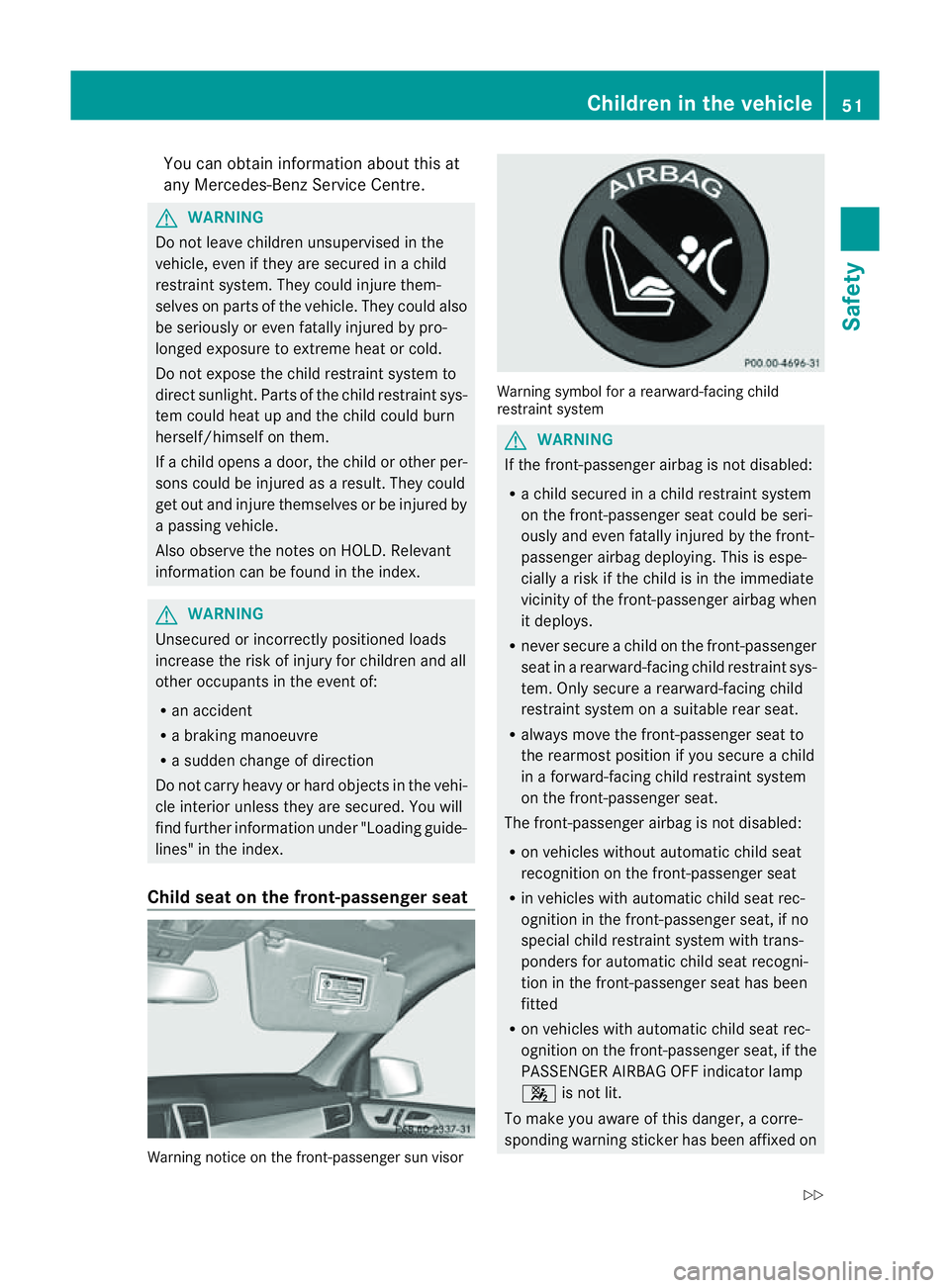
Child seat on the front-passenger seat Warning notice on the front-passenger sun visor Warning symbol for
arearward-facin gchild
rest raint system G
WARNING
If the front-passenger airbag is not disabled:
R ac hild secured in achild rest raint system
on the front-passenger seat could be seri-
ously and even fatally injured by the front-
passenger airbag deploying. This is espe-
cially arisk if the child is in the immediate
vicinit yofthe front-passenger airbag when
it deploys.
R never secur eachild on the front-passenger
seat in arearward-facing child restraint sys-
tem. Only secur earearward-facing child
restraint system on asuitable rear seat.
R alway smove the front-passenger seat to
the rearmost position if you secur eachild
in af orward-facing child rest raint system
on the front-passenger seat.
The front-passenger airbag is not disabled:
R on vehicles without automatic child seat
recognition on the front-passenger seat
R in vehicles with automatic child seat rec-
ognition in the front-passenger seat, if no
special child restraint system with trans-
ponders for automatic child seat recogni-
tion in the front-passenger seat has been
fitted
R on vehicles with automatic child seat rec-
ognition on the front-passenger seat, if the
PASSENGER AIRB AGOFF indicator lamp
4 is not lit.
To make you aware of this danger, acorre-
spondin gwarning sticker has been affixed on Children in th
evehicle
51Safety
Z