roof MERCEDES-BENZ METRIS 2020 MY20 Operator’s Manual
[x] Cancel search | Manufacturer: MERCEDES-BENZ, Model Year: 2020, Model line: METRIS, Model: MERCEDES-BENZ METRIS 2020Pages: 320, PDF Size: 26.38 MB
Page 68 of 320
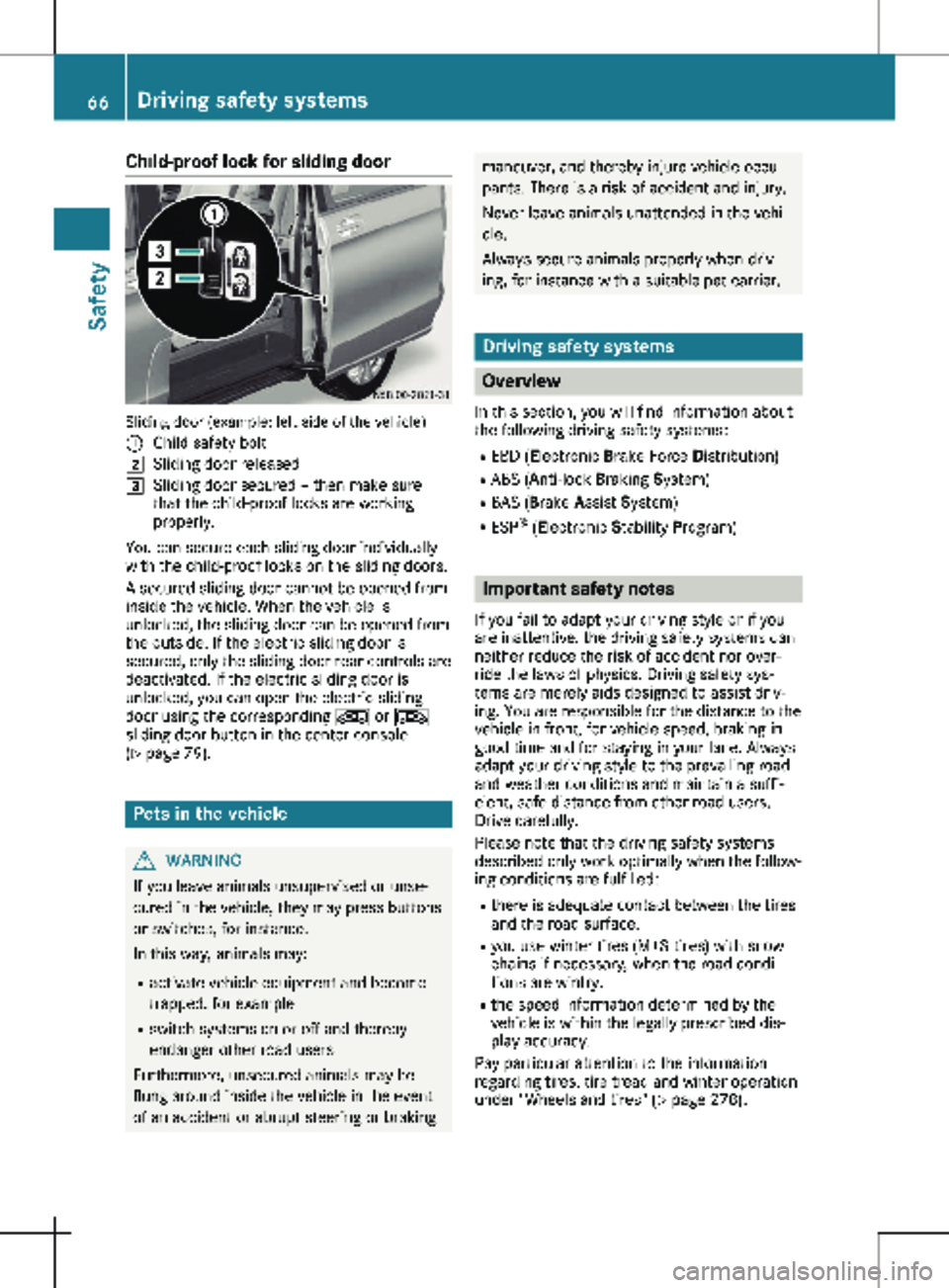
Child-proof lock for sliding door
Sliding door (example: left side of the vehicle)
: Child safety bolt
2 Sliding door released
3 Sliding door secured – then make sure
that the child-proof locks are working
properly.
You can secure each sliding door individually
with the child-proof locks on the sliding doors.
A secured sliding door cannot be opened from
inside the vehicle. When the vehicle is
unlocked, the sliding door can be opened from
the outside. If the electric sliding door is
secured, only the sliding door rear controls are
deactivated. If the electric sliding door is
unlocked, you can open the electric sliding
door using the corresponding Å or Æ
sliding door button in the center console
(Y page
79). Pets in the vehicle
G
WARNING
If you leave animals unsupervised or unse-
cured in the vehicle, they may press buttons
or switches, for instance.
In this way, animals may:
R activate vehicle equipment and become
trapped, for example
R switch systems on or off and thereby
endanger other road users
Furthermore, unsecured animals may be
flung around inside the vehicle in the event
of an accident or abrupt steering or braking maneuver, and thereby injure vehicle occu-
pants. There is a risk of accident and injury.
Never leave animals unattended in the vehi-
cle.
Always secure animals properly when driv-
ing, for instance with a suitable pet carrier. Driving safety systems
Overview
In this section, you will find information about
the following driving safety systems:
R EBD ( Electronic Brake Force Distribution)
R ABS ( Anti-lock Braking System)
R BAS ( Brake A ssist System)
R ESP ®
(Electronic Stability Program) Important safety notes
If you fail to adapt your driving style or if you
are inattentive, the driving safety systems can
neither reduce the risk of accident nor over-
ride the laws of physics. Driving safety sys-
tems are merely aids designed to assist driv-
ing. You are responsible for the distance to the
vehicle in front, for vehicle speed, braking in
good time and for staying in your lane. Always
adapt your driving style to the prevailing road
and weather conditions and maintain a suffi-
cient, safe distance from other road users.
Drive carefully.
Please note that the driving safety systems
described only work optimally when the follow-
ing conditions are fulfilled:
R there is adequate contact between the tires
and the road surface.
R you use winter tires
(M+S tires) with snow
chains if necessary, when the road condi-
tions are wintry.
R the speed information determined by the
vehicle is within the legally prescribed dis-
play accuracy.
Pay particular attention to the information
regarding tires, tire tread and winter operation
under "Wheels and tires" (Y page 278). 66
Driving safety systems
Safety
Page 78 of 320
G
WARNING
If persons, particularly children are subjec-
ted to prolonged exposure to extreme heat
or cold, there is a risk of injury, possibly
even fatal. Never leave children unattended
in the vehicle.
You can open a locked door from the inside at
any time. For the sliding doors, the child-proof
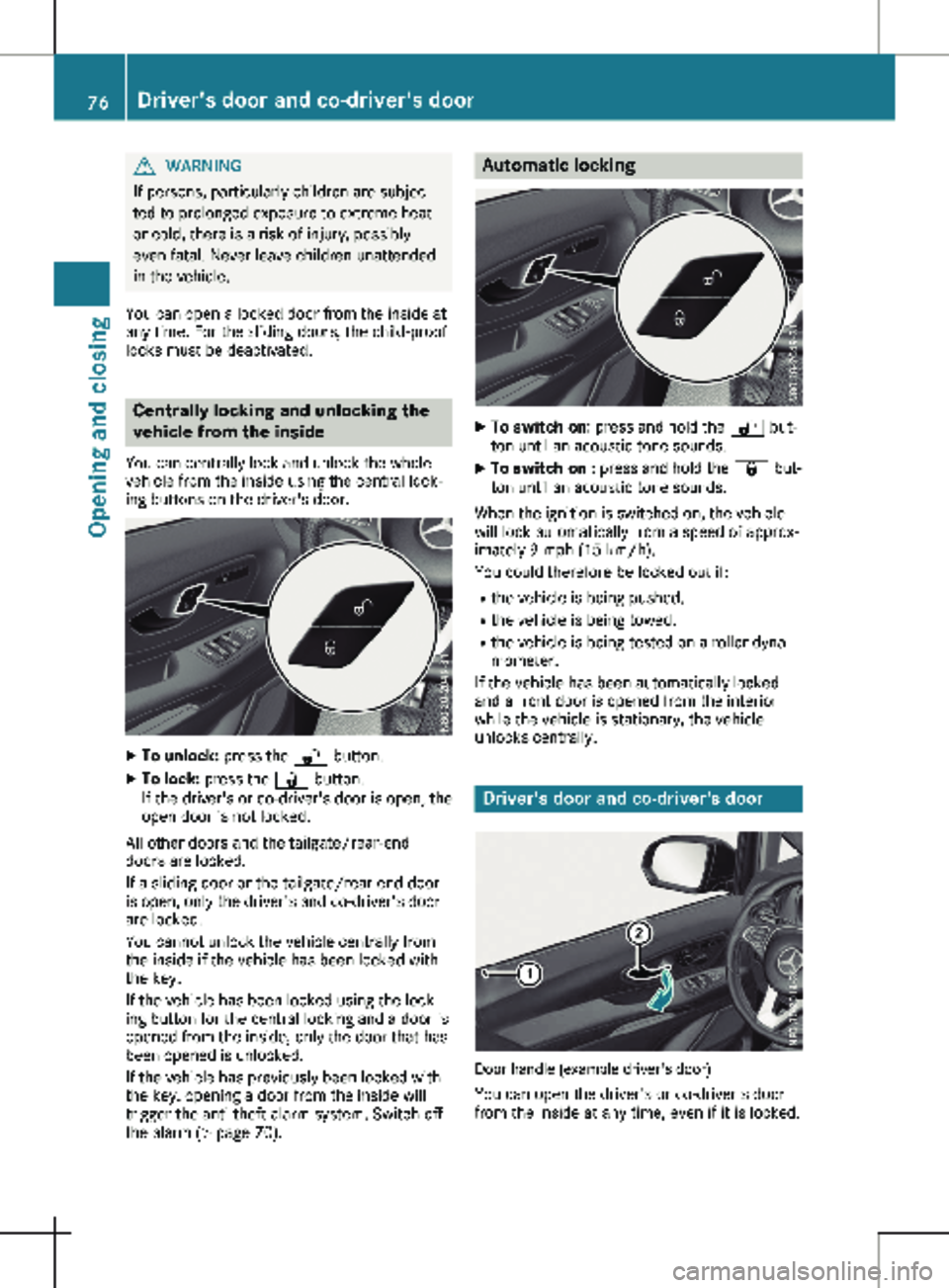
locks must be deactivated. Centrally locking and unlocking the
vehicle from the inside
You can centrally lock and unlock the whole
vehicle from the inside using the central lock-
ing buttons on the driver's door. X
To unlock: press the % button.
X To lock: press the & button.
If the driver's or co-driver's door is open, the
open door is not locked.
All other doors and the tailgate/rear-end
doors are locked.
If a sliding door or the tailgate/rear-end door
is open, only the driver's and co-driver's door
are locked.
You cannot unlock the vehicle centrally from
the inside if the vehicle has been locked with
the key.
If the vehicle has been locked using the lock-
ing button for the central locking and a door is
opened from the inside, only the door that has
been opened is unlocked.
If the vehicle has previously been locked with
the key, opening a door from the inside will
trigger the anti-theft alarm system. Switch off
the alarm
(Y page 70). Automatic locking
X
To switch on: press and hold the % but-
ton until an acoustic tone sounds.
X To switch on : press and hold the & but-
ton until an acoustic tone sounds.
When the ignition is switched on, the vehicle
will lock automatically from a speed of approx-
imately
9 mph (15 km/h).
You could therefore be locked out if:
R the vehicle is being pushed.
R the vehicle is being towed.
R the vehicle is being tested on a roller dyna-
mometer.
If the vehicle has been automatically locked
and a front door is opened from the interior
while the vehicle is stationary, the vehicle
unlocks centrally. Driver's door and co-driver's door
Door handle (example driver's door)
You can open the driver's or co-driver's door
from the inside at any time, even if it is locked. 76
Driver's door and co-driver's door
Opening and closing
Page 80 of 320
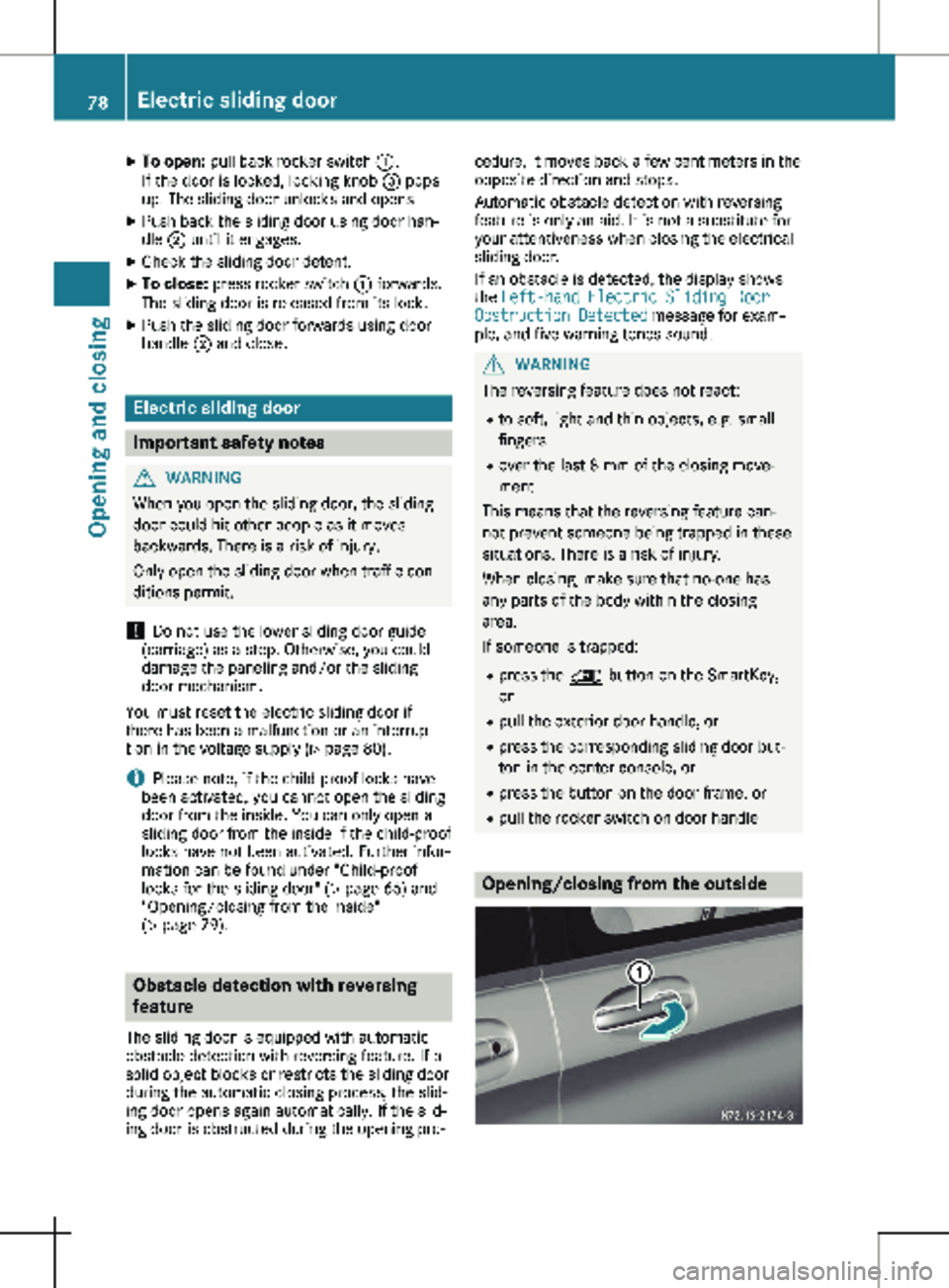
X
To open: pull back rocker switch :.
If the door is locked, locking knob = pops
up. The sliding door unlocks and opens.
X Push back the sliding door using door han-
dle ; until it engages.
X Check the sliding door detent.
X To close: press rocker switch : forwards.
The sliding door is released from its lock.
X Push the sliding door forwards using door
handle ; and close. Electric sliding door
Important safety notes
G
WARNING
When you open the sliding door, the sliding
door could hit other people as it moves
backwards. There is a risk of injury.
Only open the sliding door when traffic con-
ditions permit.
! Do not use the lower sliding door guide
(carriage) as a step. Otherwise, you could
damage the paneling and/or the sliding
door mechanism.
You must reset the electric sliding door if
there has been a malfunction or an interrup-
tion in the voltage supply
(Y page 80).
i Please note, if the child-proof locks have
been activated, you cannot open the sliding
door from the inside. You can only open a
sliding door from the inside if the child-proof
locks have not been activated. Further infor-
mation can be found under "Child-proof
locks for the sliding door" (Y page 66) and
"Opening/closing from the inside"
(Y page 79). Obstacle detection with reversing
feature
The sliding door is equipped with automatic
obstacle detection with reversing feature. If a
solid object blocks or restricts the sliding door
during the automatic closing process, the slid-
ing door opens again automatically. If the slid-
ing door is obstructed during the opening pro- cedure, it moves back a few centimeters in the
opposite direction and stops.
Automatic obstacle detection with reversing
feature is only an aid. It is not a substitute for
your attentiveness when closing the electrical
sliding door.
If an obstacle is detected, the display shows
the Left-hand Electric Sliding Door
Obstruction Detected message for exam-
ple, and five warning tones sound. G
WARNING
The reversing feature does not react:
R to soft, light and thin objects, e.g. small
fingers
R over the last 8 mm of the closing move-
ment
This means that the reversing feature can-
not prevent someone being trapped in these
situations. There is a risk of injury.
When closing, make sure that no-one has
any parts of the body within the closing
area.
If someone is trapped:
R press the 5 button on the SmartKey,
or
R pull the exterior door handle, or
R press the corresponding sliding door but-
ton in the center console, or
R press the button on the door frame, or
R pull the rocker switch on door handle Opening/closing from the outside78
Electric sliding door
Opening and closing
Page 81 of 320
The sliding door is equipped with an active
retainer, which engages the door at the end
stop when opened.
If the vehicle is equipped with two electric slid-
ing doors; the 5 button on the SmartKey
can only be used to open or close one of the
two sliding doors
(Y page 80).
X To open: pull door handle : in the direc-
tion of the arrow.
or X Press the 5 button on the SmartKey for
longer than
0.5 seconds.
The sliding door unlocks, automatic opera-
tion is started and the sliding door opens. In
addition, you will hear two warning signals.
X To close: pull door handle : in the direc-
tion of the arrow.
or X Press the 5 button on the SmartKey for
longer than
0.5 seconds.
The sliding door is released from its lock
and automatic operation is started. The slid-
ing door closes.
If you press the 5 button on the Smart-
Key, you will hear two warning signals while
the doors close.
X To interrupt automatic operation: pull
door handle : again.
or
X Press the 5 button on the SmartKey
again.
i In unfavorable operating conditions, e.g.
frost, ice or heavy soiling, you can press and
hold the relevant sliding door button. The
electric sliding door moves with increased
force. Observe that, in such circumstances,
the obstacle detection is less sensitive. To
stop the movement, release the sliding door
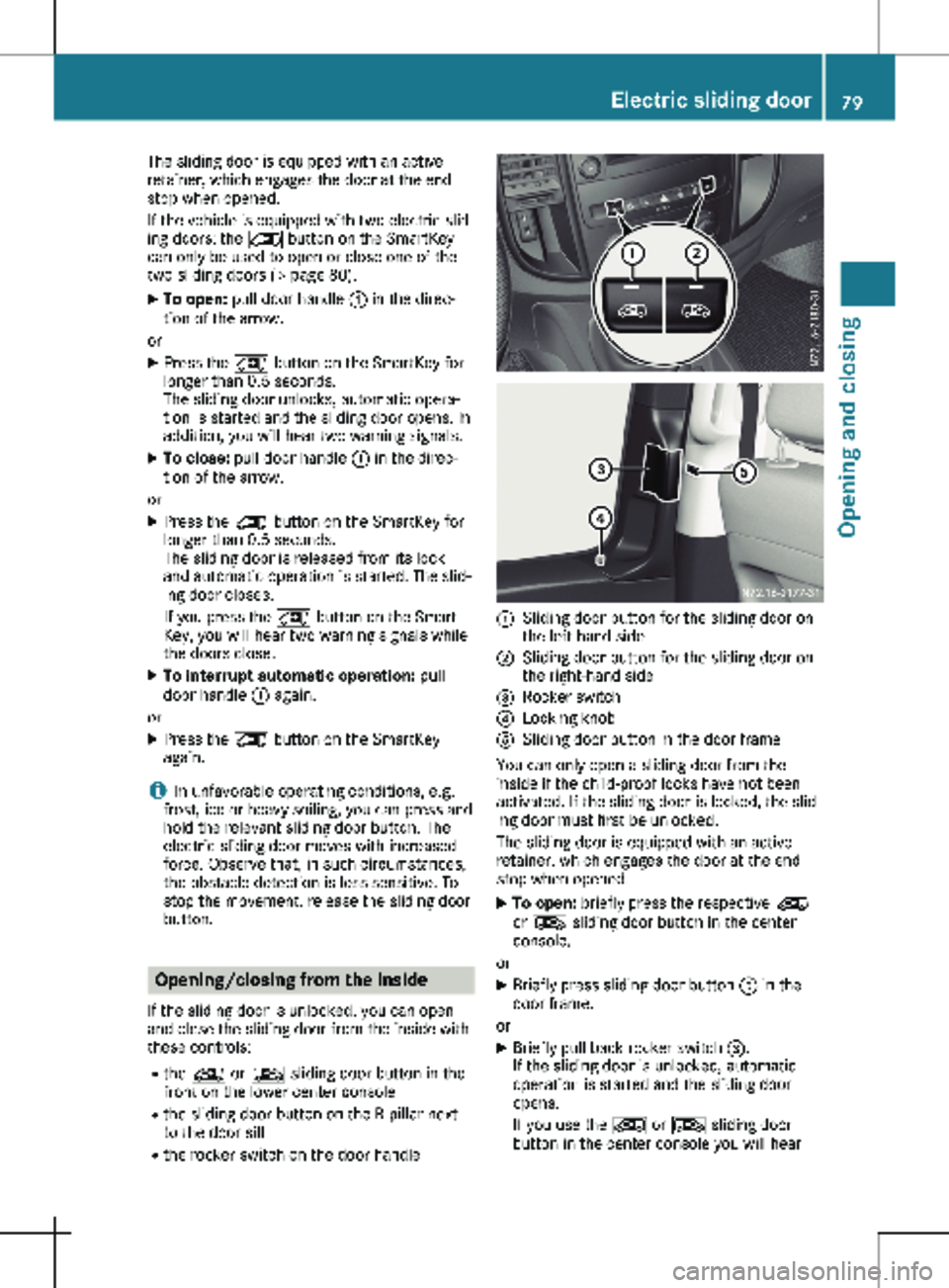
button. Opening/closing from the inside
If the sliding door is unlocked, you can open
and close the sliding door from the inside with
these controls:
R the Å or Æ sliding door button in the
front on the lower center console
R the sliding door button on the B-pillar next
to the door sill
R the rocker switch on the door handle :
Sliding door button for the sliding door on
the left-hand side
; Sliding door button for the sliding door on
the right-hand side
= Rocker switch
? Locking knob
A Sliding door button in the door frame
You can only open a sliding door from the
inside if the child-proof locks have not been
activated. If the sliding door is locked, the slid-
ing door must first be unlocked.
The sliding door is equipped with an active
retainer, which engages the door at the end
stop when opened. X To open: briefly press the respective Å
or Æ sliding door button in the center
console.
or X Briefly press sliding door button A in the
door frame.
or X Briefly pull back rocker switch =.
If the sliding door is unlocked, automatic
operation is started and the sliding door
opens.
If you use the Å or Æ sliding door
button in the center console you will hear Electric sliding door
79Opening and closing Z
Page 85 of 320
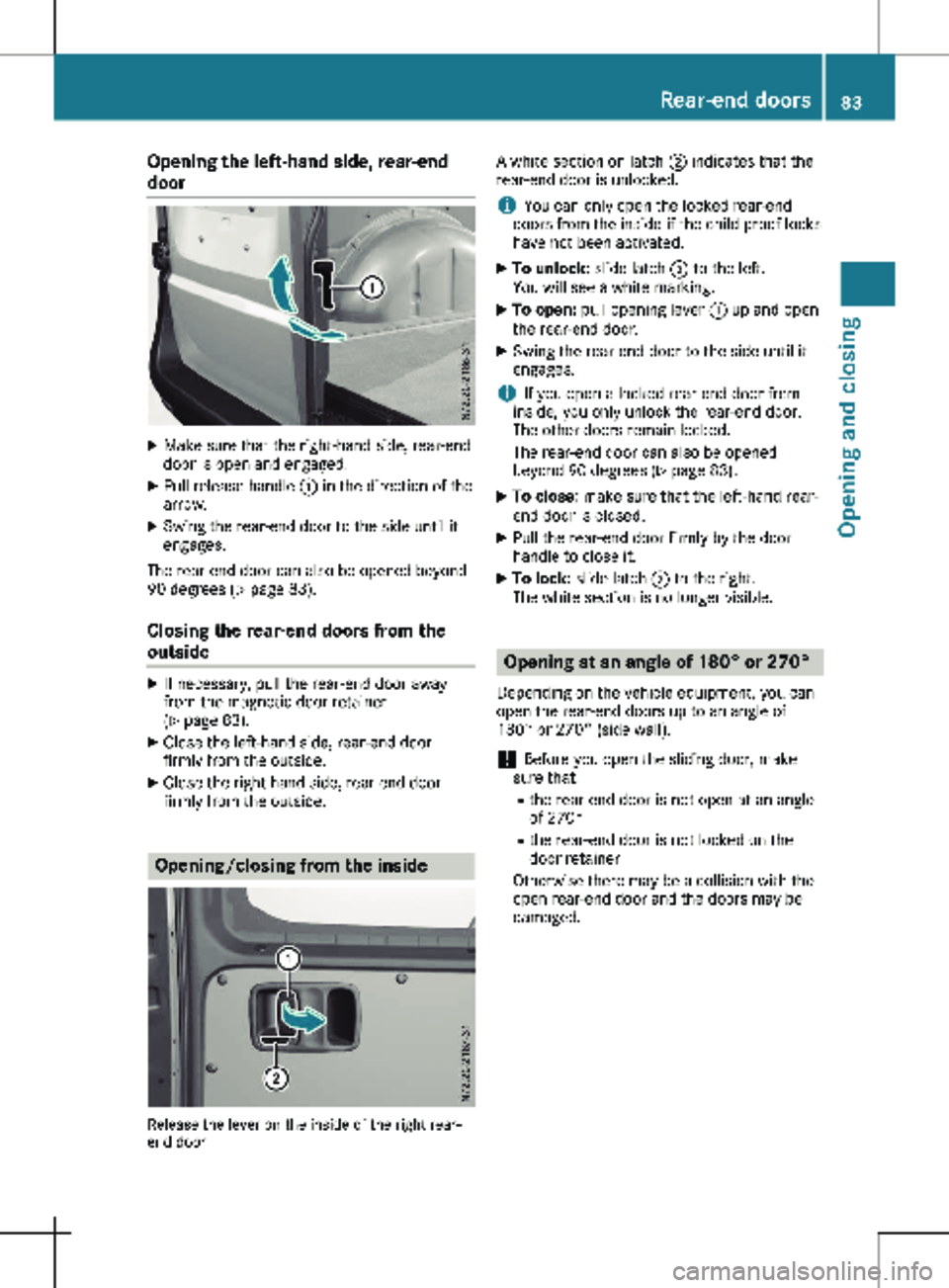
Opening the left-hand side, rear-end
door
X
Make sure that the right-hand side, rear-end
door is open and engaged.
X Pull release handle : in the direction of the
arrow.
X Swing the rear-end door to the side until it
engages.
The rear-end door can also be opened beyond
90 degrees (Y page 83).
Closing the rear-end doors from the
outside X
If necessary, pull the rear-end door away
from the magnetic door retainer
(Y page
83).
X Close the left-hand side, rear-end door
firmly from the outside.
X Close the right-hand side, rear-end door
firmly from the outside. Opening/closing from the inside
Release the lever on the inside of the right rear-
end door A white section on latch
; indicates that the
rear-end door is unlocked.
i You can only open the locked rear-end
doors from the inside if the child-proof locks
have not been activated.
X To unlock: slide latch ; to the left.
You will see a white marking.
X To open: pull opening lever : up and open
the rear-end door.
X Swing the rear-end door to the side until it
engages.
i If you open a locked rear-end door from
inside, you only unlock the rear-end door.
The other doors remain locked.
The rear-end door can also be opened
beyond 90 degrees
(Y page 83).
X To close: make sure that the left-hand rear-
end door is closed.
X Pull the rear-end door firmly by the door
handle to close it.
X To lock: slide latch ; to the right.
The white section is no longer visible. Opening at an angle of 180° or 270°
Depending on the vehicle equipment, you can
open the rear-end doors up to an angle of
180° or
270° (side wall).
! Before you open the sliding door, make
sure that:
R the rear-end door is not open at an angle
of 270°
R the rear-end door is not locked on the
door retainer
Otherwise there may be a collision with the
open rear-end door and the doors may be
damaged. Rear-end doors
83
Opening and closing Z
Page 88 of 320
Resetting the side windows
You must reset the side windows if there has
been a malfunction or an interruption in the
voltage supply.
X Turn the SmartKey to position 2 in the igni-
tion lock.
X Pull the two power window switches and
hold for approximately one second after
closing the side window.
X If the side windows remain closed after the
button has been released, they have been
reset correctly. If this is not the case, repeat
the steps above for the open window. Problems with the side windows
G
WARNING
If you close a side window again immediately after it has been blocked, the side window closes
with increased or maximum force. The reversing function is then not active. Parts of the body
could be trapped in the closing area in the process. This poses an increased risk of injury or
even fatal injury.
Make sure that no parts of the body are in the closing area. To stop the closing process,
release the switch or push the switch again to reopen the side window. Problem
Possible causes/consequences and
M SolutionsYou cannot completely
open or close a side
window. If there are no objects or leaves in the window guide that prevent
the sliding sunroof from closing, there has been a malfunction or
the on-board voltage has been interrupted.
X Reset the side window ( Y page 86).86
Side windows
Opening and closing
Page 127 of 320
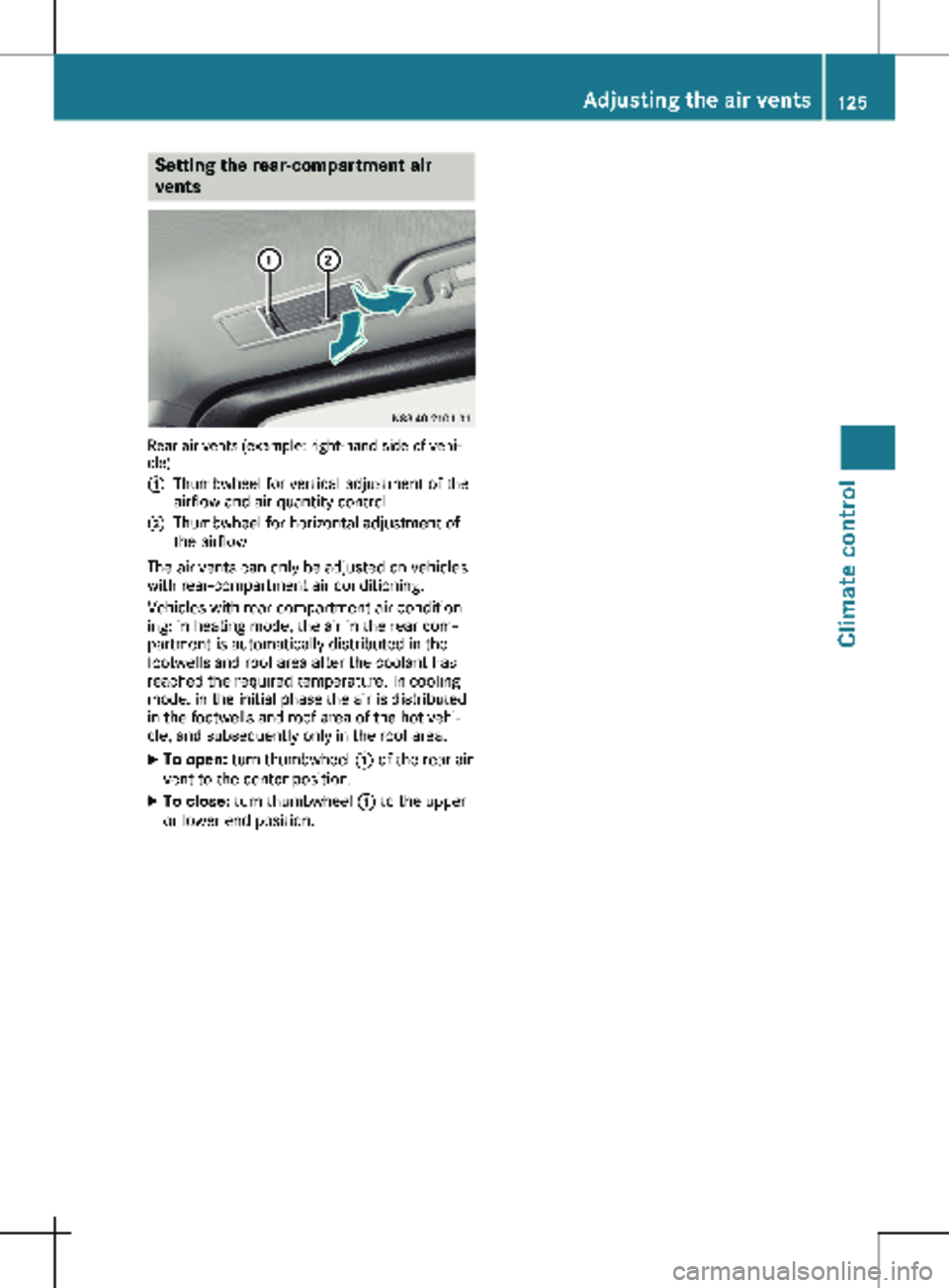
Setting the rear-compartment air
vents
Rear air vents (example: right-hand side of vehi-
cle)
:
Thumbwheel for vertical adjustment of the
airflow and air quantity control
; Thumbwheel for horizontal adjustment of
the airflow
The air vents can only be adjusted on vehicles
with rear-compartment air conditioning.
Vehicles with rear-compartment air condition-
ing: in heating mode, the air in the rear com-
partment is automatically distributed in the
footwells and roof area after the coolant has
reached the required temperature. In cooling
mode, in the initial phase the air is distributed
in the footwells and roof area of the hot vehi-
cle, and subsequently only in the roof area.
X To open: turn thumbwheel : of the rear air
vent to the center position.
X To close: turn thumbwheel : to the upper
or lower end position. Adjusting the air vents
125Climate control Z
Page 142 of 320
Parking the vehicle for a long period
If you leave the vehicle parked for longer than
four weeks, the battery may be damaged by
exhaustive discharging.
X Disconnect the battery (Y page 260).
or X Connect the battery to a trickle charger.
Be sure to observe the notes on charging
the batteries
(Y page 262).
You can obtain information about trickle
chargers from a qualified specialist work-
shop.
If you leave the vehicle parked for longer than
6 weeks, the vehicle may suffer damage as a
result of lack of use.
X Visit a qualified specialist workshop and
seek advice. Driving tips
General notes
Important safety notes G
WARNING
If you switch off the ignition while driving,
safety-relevant functions are only available
with limitations, or not at all. This could
affect, for example, the power steering and
the brake boosting effect. You will require
considerably more effort to steer and brake.
There is a risk of an accident.
Do not switch off the ignition while driving. G
WARNING
Mobile communications equipment distracts
the driver from traffic conditions. In addi-
tion, the driver could lose control of the
vehicle. There is a risk of an accident.
As a driver, use mobile communications
equipment only when the vehicle is at a
standstill.
As a vehicle occupant, use mobile communi-
cations equipment only in the designated
area, e.g. the rear passenger compartment. Observe the legal requirements of the country
in which you are driving. Some jurisdictions
prohibit the driver from using a mobile phone
while driving a vehicle.
Always use the hands-free system for tele-
phoning while driving. Only use the telephone
if road traffic conditions permit. If this is not
the case, pull over to a safe location before
using the telephone.
Bear in mind that at a speed of just 30 mph
(approximately
50 km/h), your vehicle is cov-
ering a distance of 44 feet (approximately
14 m) every second.
Drive sensibly – save fuel In order to save fuel, observe the following
tips:
X The tires should always be inflated to the
recommended tire pressure.
X Remove unnecessary loads.
X Remove roof carriers when they are not nee-
ded.
X Warm up the engine at low engine speeds.
X Avoid frequent acceleration or braking.
X Have all maintenance work carried out as
indicated by the service intervals in the
Maintenance Booklet or by the service inter-
val display.
Fuel consumption also increases when driving
in cold weather, in stop-start traffic and in
mountainous terrain.
Overrun cutoff If you are in overrun mode and take your foot
off the accelerator pedal, the fuel supply is cut
off when the engine speed is out of the idle
speed control range.
Drinking and driving G
WARNING
Drinking and driving and/or taking drugs
and driving are very dangerous combina-
tions. Even a small amount of alcohol or
drugs can affect your reflexes, perceptions
and judgment.
The possibility of a serious or even fatal
accident is greatly increased when you drink
or take drugs and drive. 140
Driving tips
Driving and parking
Page 244 of 320
Useful information
This Operator's Manual describes all models
as well as standard and optional equipment of
your vehicle that were available at the time of
going to print. Country-specific variations are
possible. Note that your vehicle may not be
equipped with all of the described functions.
This also applies to systems and functions rel-
evant to safety.
Read the information on qualified specialist
workshops (Y page
32).Loading guidelines
Important safety notes
G
WARNING
When objects are unsecured or inadequately
secured, they can slip, turn over or be
thrown about, striking vehicle occupants.
This also applies to:
R luggage or loads
R seats which have been removed and are
being transported in the vehicle in an
exceptional case.
There is a risk of injury, particularly in the
event of a braking maneuver or abrupt
change in direction.
Always stow objects in such a way that they
cannot be tossed about. Before traveling,
secure objects, luggage or loads to prevent
them slipping or tipping over. If you remove
a seat, store it preferably outside the vehi-
cle. G
WARNING
As a result of improperly placed or unevenly
distributed loads, the center of gravity of the
load being transported may be too high or
too far back. This can significantly impair
handling as well as steering and braking
characteristics. There is a risk of an acci-
dent. Always make sure that the center of gravity
of the load is:
R between the axles
and
R as low as possible, near the rear axle. G
WARNING
When the permissible wheel loads, axle
loads and/or the maximum permissible
gross vehicle weight are exceeded, driving
safety is compromised. The handling as well
as steering and braking characteristics may
be significantly impaired. Overloaded tires
may overheat, causing them to burst. There
is a risk of an accident.
When transporting a load, always observe
the permissible wheel loads, axle loads and
the maximum permissible gross vehicle
weight for the vehicle (including occupants).
! If you are using a roof carrier, observe the
maximum roof load and maximum roof car-
rier load.
R Do not stack luggage or loads higher than
the backrests.
R Objects to be transported should preferably
be stowed in the cargo compartment.
R When transporting luggage, always use the
cargo tie-down rings for securing loads and
a cargo net, if installed.
R Use cargo tie-down rings and fasteners
which are suitable for the weight and size of
the load.
When using suitable load securing aids and tie
downs, always follow the manufacturer's oper-
ating instructions, in particular the notes on
discard criteria contained therein.
Load securing aids or tie downs must not be
used if:
R identification marks are missing or illegible
R there are yarn breakages, damage to bear-
ing seams or other signs of tearing
R there are signs of shearing, deformation,
pinching or other damage
R there is damage to clamping or connecting
elements
Load securing aids and tie downs in this condi-
tion are ready for discard and must be 242
Loading guidelines
Transporting loads
Page 245 of 320
replaced. If you use load securing aids or tie
downs which are worn out, the load may not
be sufficiently secured and could cause dam-
age to property.
In the event of an accident, have a damaged
cargo compartment floor or loading area, the
cargo tie-down rings and the tie down checked
at a specialist workshop. Otherwise, the load
may not be correctly secured the next time
anything is stowed.
Even if you follow all loading guidelines, the
load increases the risk of injury in the event of
an accident. Observe the information in the
"Securing a load"
(Y page 244) and "Load dis-
tribution" (Y page 243) sections.
You will find information about the maximum
roof load under "Cargo tie-down points and
carrier systems" (Y page 313). You will find
information about roof carriers under "Carrier
systems" (Y page 249). Before loading
! The anti-slip mats cannot be used for
securing goods and must be replaced when
they show signs of:
R Permanent deformation and crushing
R Crack formation
R Cuts
X Tire pressure: check the tire pressure and
correct if necessary
(Y page 282).
X Cargo compartment floor: clean the cargo
compartment floor.
The cargo compartment floor must be free
from oil and dust, dry and swept clean to
prevent the load from slipping.
X Place non-slip mats (anti-slip mats) on the
cargo compartment floor if necessary. During loading
X Observe the gross axle weight rating and
permissible gross vehicle weight for your
vehicle.
Take into account that your vehicle's curb
weight is increased if accessories or optional equipment are installed. The maxi-
mum payload is thus reduced.
X Observe the notes on load distribution
(Y page
243).
The overall center of gravity of the load
should always be as low as possible, cen-
tered and between the axles near the rear
axle.
X Secure the load (Y page
244).
Observe the legal requirements of the coun-
try in which you are currently driving. Checks after loading
G
DANGER
Combustion engines emit poisonous
exhaust gases, such as carbon monoxide.
Exhaust gases can enter the vehicle interior
if the tailgate/rear-end door is open when
the engine is running, especially if the vehi-
cle is in motion. There is a risk of poisoning.
Always switch off the engine before opening
the tailgate/rear-end door. Never drive the
vehicle when the tailgate/rear-end door is
open.
X Securing luggage/loads: make sure that
the luggage and/or load is secure before
every journey and at regular intervals during
a long journey, and correct it if necessary.
X Doors/tailgate: close the sliding doors and
tailgate/door.
X Tire pressure: adjust the tire pressure
according to the vehicle load
(Y page 282).
X Driving style: adapt your driving style
according to the vehicle load. Load distribution
General notes
! Excessive loads on individual points of the
cargo floor or on the load surface impair
vehicle handling characteristics and could
cause damage to the floor covering.
The overall center of gravity of the load should
always be as low as possible, centered and
between the axles near the rear axle. Load distribution
243
Transporting loads Z