transmission oil MERCEDES-BENZ ML320 1997 Complete Workshop Manual
[x] Cancel search | Manufacturer: MERCEDES-BENZ, Model Year: 1997, Model line: ML320, Model: MERCEDES-BENZ ML320 1997Pages: 4133, PDF Size: 88.89 MB
Page 1333 of 4133
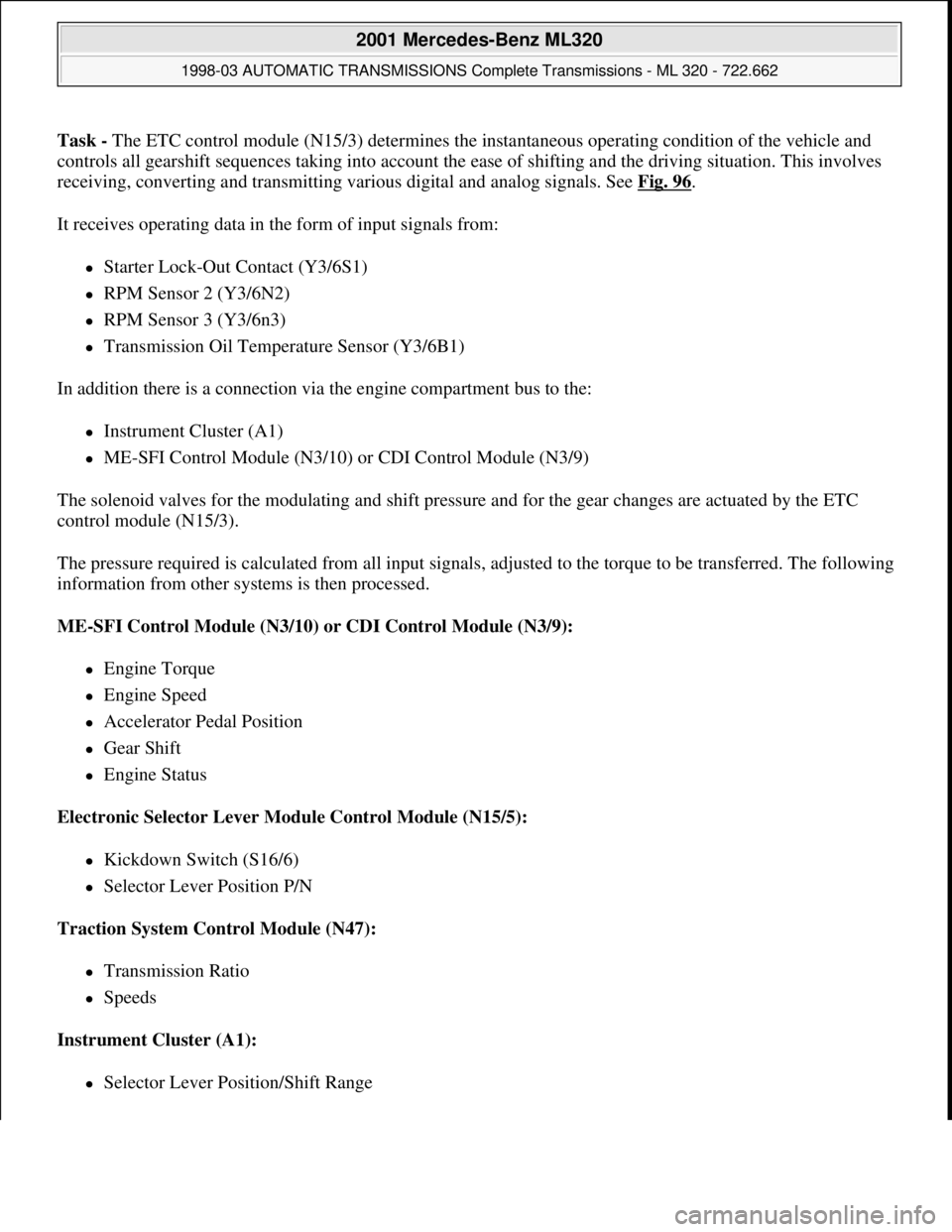
Task - The ETC control module (N15/3) determines the instantaneous operating condition of the vehicle and
controls all gearshift sequences taking into account the ease of shifting and the driving situation. This involves
receiving, converting and transmitting various digital and analog signals. See Fig. 96
.
It receives operating data in the form of input signals from:
Starter Lock-Out Contact (Y3/6S1)
RPM Sensor 2 (Y3/6N2)
RPM Sensor 3 (Y3/6n3)
Transmission Oil Temperature Sensor (Y3/6B1)
In addition there is a connection via the engine compartment bus to the:
Instrument Cluster (A1)
ME-SFI Control Module (N3/10) or CDI Control Module (N3/9)
The solenoid valves for the modulating and shift pressure and for the gear changes are actuated by the ETC
control module (N15/3).
The pressure required is calculated from all input signals, adjusted to the torque to be transferred. The following
information from other systems is then processed.
ME-SFI Control Module (N3/10) or CDI Control Module (N3/9):
Engine Torque
Engine Speed
Accelerator Pedal Position
Gear Shift
Engine Status
Electronic Selector Lever Module Control Module (N15/5):
Kickdown Switch (S16/6)
Selector Lever Position P/N
Traction System Control Module (N47):
Transmission Ratio
Speeds
Instrument Cluster (A1):
Selector Lever Position/Shift Range
2001 Mercedes-Benz ML320
1998-03 AUTOMATIC TRANSMISSIONS Complete Transmissions - ML 320 - 722.662
me
Saturday, October 02, 2010 3:15:27 PMPage 164 © 2006 Mitchell Repair Information Company, LLC.
Page 1335 of 4133
Courtesy of MERCEDES-BENZ OF NORTH AMERICA.
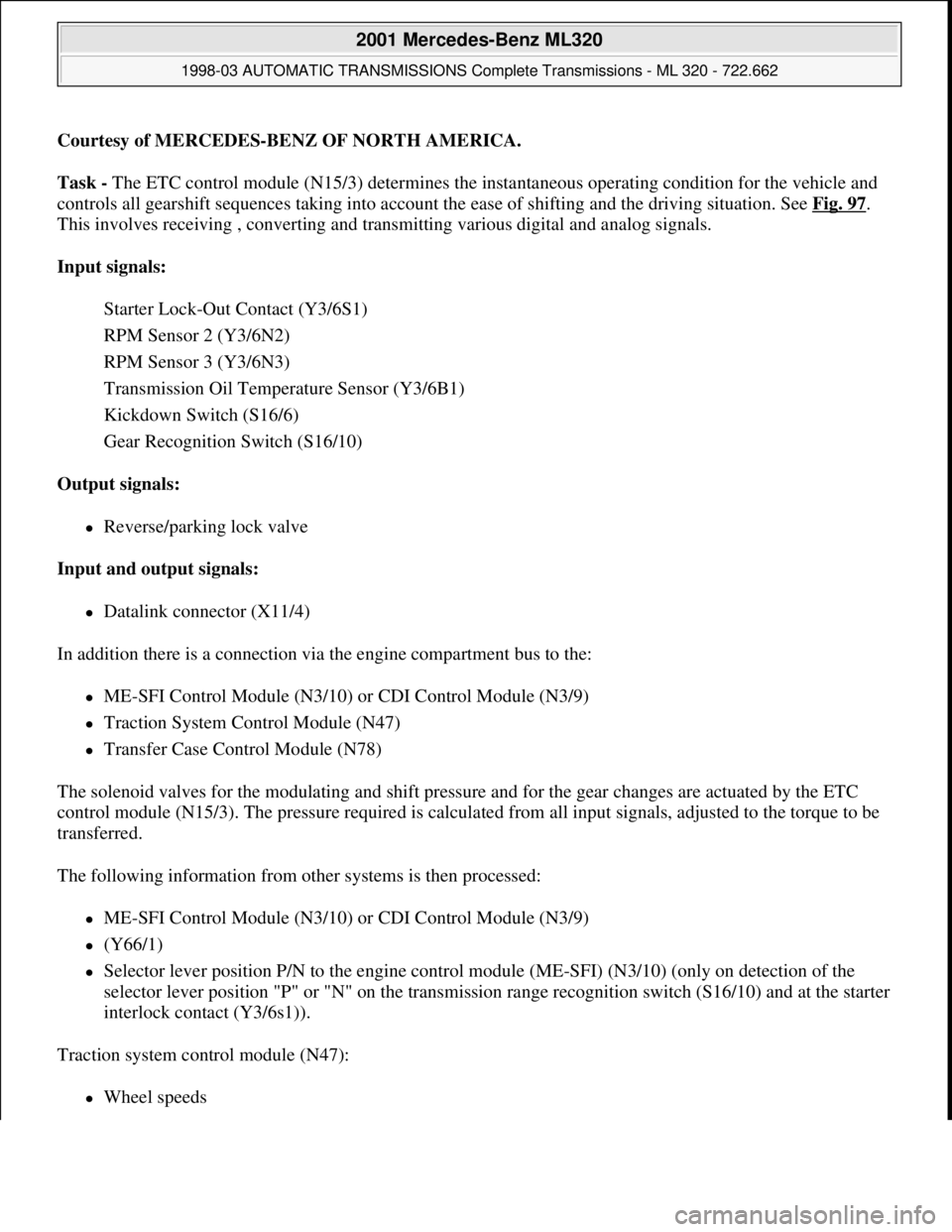
Task - The ETC control module (N15/3) determines the instantaneous operating condition for the vehicle and
controls all gearshift sequences taking into account the ease of shifting and the driving situation. See Fig. 97
.
This involves receiving , converting and transmitting various digital and analog signals.
Input signals:
Starter Lock-Out Contact (Y3/6S1)
RPM Sensor 2 (Y3/6N2)
RPM Sensor 3 (Y3/6N3)
Transmission Oil Temperature Sensor (Y3/6B1)
Kickdown Switch (S16/6)
Gear Recognition Switch (S16/10)
Output signals:
Reverse/parking lock valve
Input and output signals:
Datalink connector (X11/4)
In addition there is a connection via the engine compartment bus to the:
ME-SFI Control Module (N3/10) or CDI Control Module (N3/9)
Traction System Control Module (N47)
Transfer Case Control Module (N78)
The solenoid valves for the modulating and shift pressure and for the gear changes are actuated by the ETC
control module (N15/3). The pressure required is calculated from all input signals, adjusted to the torque to be
transferred.
The following information from other systems is then processed:
ME-SFI Control Module (N3/10) or CDI Control Module (N3/9)
(Y66/1)
Selector lever position P/N to the engine control module (ME-SFI) (N3/10) (only on detection of the
selector lever position "P" or "N" on the transmission range recognition switch (S16/10) and at the starter
interlock contact (Y3/6s1)).
Traction system control module (N47):
Wheel speeds
2001 Mercedes-Benz ML320
1998-03 AUTOMATIC TRANSMISSIONS Complete Transmissions - ML 320 - 722.662
me
Saturday, October 02, 2010 3:15:27 PMPage 166 © 2006 Mitchell Repair Information Company, LLC.
Page 1346 of 4133
Courtesy of MECHANICS MONTHLY MAGAZINE
Temperature Sensor, Location
The transmission oil temperature sensor (Y3/6bl) is located in the electrical control unit (Y3/6) and is
permanently connected to the conductor tracks. See Fig. 102
.
Temperature Sensor, Task
To measure the temperature of the transmission oil and pass the temperature to the ETC control unit
(N15/3) as an input signal.
Temperature Sensor, Design
Temperature-dependent resistor (PTC).
Temperature Sensor, Function
See TEMPERATURE SENSOR, FUNCTION
.
Temperature Sensor, Function
2001 Mercedes-Benz ML320
1998-03 AUTOMATIC TRANSMISSIONS Complete Transmissions - ML 320 - 722.662
me
Saturday, October 02, 2010 3:15:28 PMPage 177 © 2006 Mitchell Repair Information Company, LLC.
Page 1347 of 4133
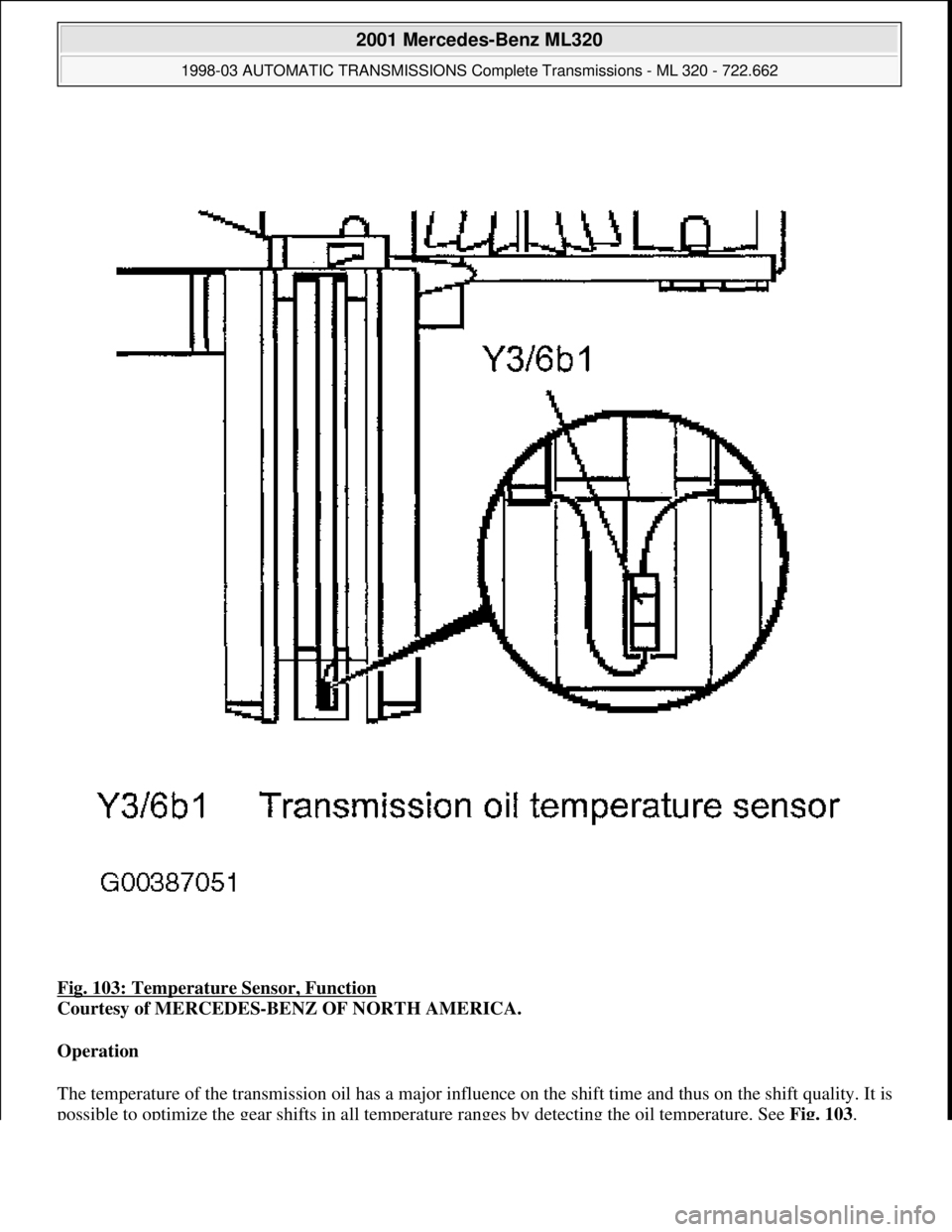
Fig. 103: Temperature Sensor, Function
Courtesy of MERCEDES-BENZ OF NORTH AMERICA.
Operation
The temperature of the transmission oil has a major influence on the shift time and thus on the shift quality. It is
possible to optimize the gear shifts in all temperature ranges by detecting the oil temperature. See Fig. 103.
2001 Mercedes-Benz ML320
1998-03 AUTOMATIC TRANSMISSIONS Complete Transmissions - ML 320 - 722.662
me
Saturday, October 02, 2010 3:15:28 PMPage 178 © 2006 Mitchell Repair Information Company, LLC.
Page 1348 of 4133
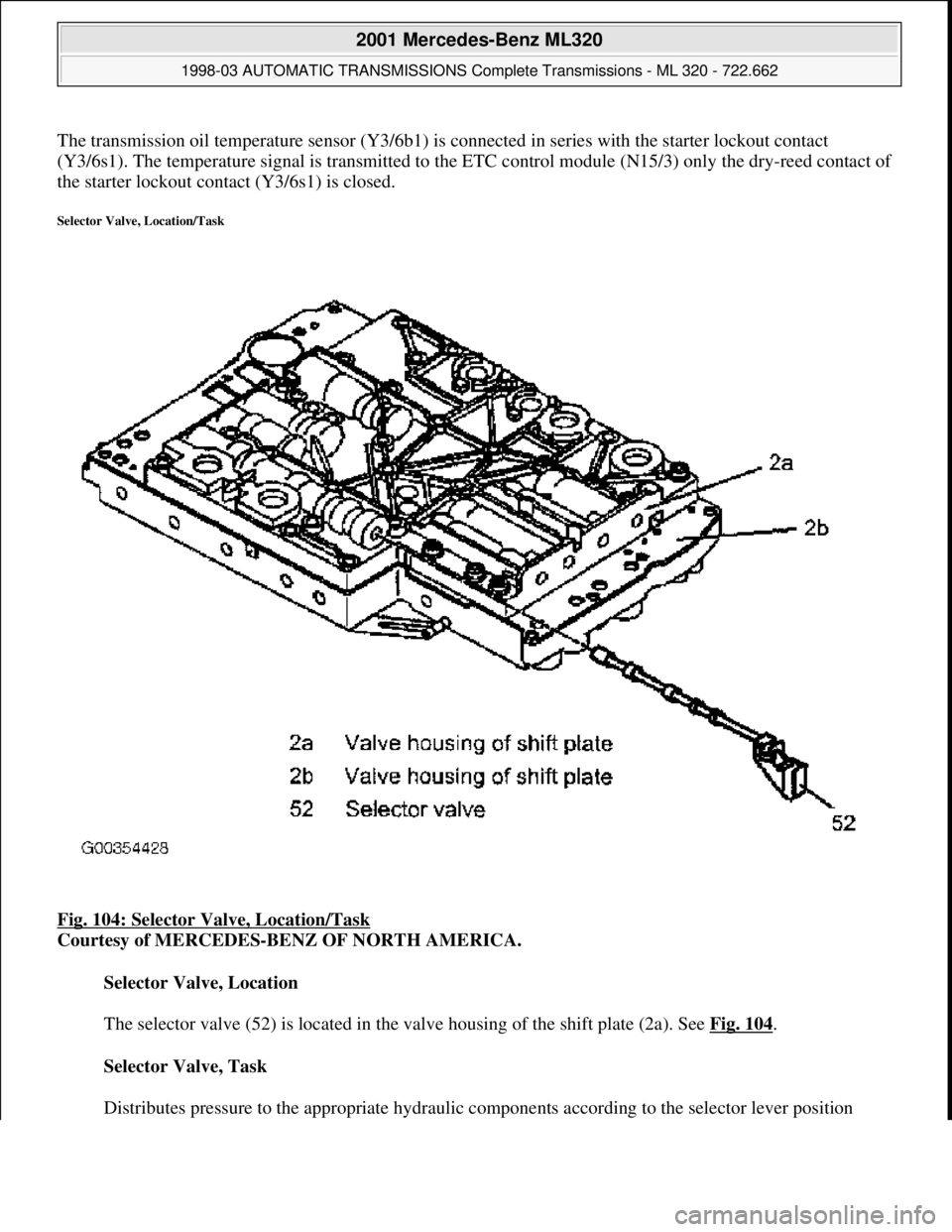
The transmission oil temperature sens or (Y3/6b1) is connected in series with the starter lockout contact
(Y3/6s1). The temperature signal is tr ansmitted to the ETC control module (N 15/3) only the dry-reed contact of
the starter lockout contact (Y3/6s1) is closed.
Selector Valve, Location/Task
Fig. 104: Selector Valve, Location/Task
Courtesy of MERCEDES-BENZ OF NORTH AMERICA.
Selector Valve, Location
The selector valve (52) is located in th e valve housing of the shift plate (2a). See Fig. 104
.
Selector Valve, Task
Distributes pressure to the appropriate h
ydraulic components according to the selector lever position
2001 Mercedes-Benz ML320
1998-03 AUTOMATIC TRANSMI SSIONS Complete Transmissions - ML 320 - 722.662
me
Saturday, October 02, 2010 3:15:28 PMPage 179 © 2006 Mitchell Repair Information Company, LLC.
Page 1352 of 4133
Fig. 106: Torque Converter Lockup Clutch, Function
Courtesy of MERCEDES-BENZ OF NORTH AMERICA.
Operation
When actuated by the ETC control module (N15/3), oil pressure controlled by the torque converter lockup
PWM solenoid Valve (Y3/6y6) is directed through the input shaft (1) to the pressure chamber behind the piston
(16d). See Fig. 106
. The piston presses the clutch pack (16c) together and allows torque to be transferred
directly between the impeller (P) and turbine wheel (T). The torque converter lockup clutch is activated in 5th,
4th and 3rd gears in relation to the engine speed and engine load.
AUTOMATIC TRANSMISSION, FUNCTION
Transmission without touch shift. 722.6 in MODEL 163, 170, 202, 208, 210.
Transmission 722.6 in MODEL 129, 140.
Automatic transmission 722.6 is an electronically controlled 5-speed transmission with a lockup clutch in the
torque converter.
The ratios for the gear stages are achieved by three planetary gear sets. The 5th gear is designed with a step-up
ratio as an overdrive.
Shifting is initiated electronically. The gears are shifted by the corresponding combination of three
hydraulically actuated multi-plate brakes, three hydraulically actuated multi-disc clutches and two mechanical
freewheels.
Basically automatic transmission 722.6 with electronic control offers the following advantages:
Reduced fuel consumption
Improved shift comfort
More favorable gear steps as a result of 5 gears
Enhanced life and reliability
Reduced servicing costs
The electrohydraulic control unit is bolted onto the bottom of the transmission housing. The end of the
transmission is formed by an oil pan made of sheet steel.
The oil pressure for the converter lockup clutch and center multiple disc clutch is supplied via holes in the input
shaft. The oil pressure to the rear multiple-disc clutch is routed through the output shaft. The lubricating oil is
supplied and distributed by additional bore holes in both shafts. All bearing points of the gear sets as well as
freewheels and shift elements are supplied with lubricating oil.
The parking lock gear and drive flange are connected to the output shaft by gearing.
Freewheels F1 and F2 optimize shiftin
g. The front freewheel (F1) rests against the stator shaft extension on the
2001 Mercedes-Benz ML320
1998-03 AUTOMATIC TRANSMISSIONS Complete Transmissions - ML 320 - 722.662
me
Saturday, October 02, 2010 3:15:28 PMPage 183 © 2006 Mitchell Repair Information Company, LLC.
Page 1353 of 4133
transmission side and connects the sun gear of the front planetary gear set to the transmission housing in the
locking direction.
The torque converter housing and transmission housing are made of a metal alloy. They are bolted together and
centered via the outer multiple-disc carrier of the multiple-disc brake B1. A coated intermediate panel seals the
two components.
The oil pump and outer multiple-disc carrier of the front multiple-disc brake are bolted to the converter housing.
The mechanical part consists of the propeller shaft, output shaft, a sun gear shaft and three planetary gearsets
which are coupled together.
In transmissions for powerful engines, the planetary gearsets have 4 planetary gears, while for less powerful
engines the front and rear planetary gear system has three planetary gear wheels. The stator shaft is pressed into
this and is secured against turning by a spline.
The rear freewheel (F2) connects the sun gear of the center planetary gear set to the sun gear of the rear
planetary gearset in the locking direction.
The electrohydraulic control unit consists of the shift plate made of light alloy for hydraulic control and an
electronic control unit.
The electrical control unit consists of a supporting body made of plastic in which the electrical components are
combined. The shell is screwed to the shift plate. Conductor tracks which are integrated into the shell, connect
the electric components to a plug connector. This 13-pin plug connector forms the connection with the vehicle-
side wiring harness and with the ETC 5 (electronic transmission control) control module (N15/5) via a bayonet
lock.
Automatic Transmission, Location Of Mechanical Components
See AUTOMATIC TRANSMISSION, LOCATION OF MECHANICAL PARTS
.
Automatic Transmission, Location Of Electrical/Electronic Components
See AUTOMATIC TRANSMISSION, LOCATION OF ELECTRIC/ELECTRONIC
COMPONENTS.
Automatic Transmission, Location Of Hydraulic Components
See AUTOMATIC TRANSMISSION, POSITION OF HYDRAULIC COMPONENTS
.
Automatic Transmission, Location of Components, Floor Shift
See AUTOMATIC TRANSMISSION, LOCATION OF COMPONENTS, FLOOR SHIFT
.
Automatic Transmission, Selector Lever Positions
2001 Mercedes-Benz ML320
1998-03 AUTOMATIC TRANSMISSIONS Complete Transmissions - ML 320 - 722.662
me
Saturday, October 02, 2010 3:15:28 PMPage 184 © 2006 Mitchell Repair Information Company, LLC.
Page 1358 of 4133
Fig. 108: Selector Lever Positions
Courtesy of MERCEDES-BENZ OF NORTH AMERICA.
AUTOMATIC TRANSMISSION, FUNCTION
Transmission With Touch Shift 722.6 In Model 163
Transmission 722.6 is an electronically controlled 5-speed transmission with a lockup clutch in the torque
converter.
The ratios for the gear stages are achieved by 3 planetary gearsets. The 5th gear is designed as a low-rev gear
with an overdrive ratio.
Shifting is initiated electronically. The gears are shifted by the corresponding combination of 3 hydraulically
actuated multi-disk brakes, 3 hydraulically actuated multi-disk clutches and 2 mechanical freewheels.
The oil pump as well as the external plate carrier of the front multi-disk brake are bolted to the torque converter
housing.
The mechanical part of the transmission 722.6 consists of a drive shaft, output shaft, a sun gear shaft and 3
planetary sets which are coupled to each other.
The electrohydraulic control unit is screwed onto the transmission housing from below. The end of the
transmission if formed by an oil pan made of sheet steel.
The oil pressure of the torque converter lockup clutch and center multi-disk clutch is supplied via bore holes in
the drive shaft. The oil pressure to the rear multi-disk clutch is supplied via the output shaft. The lubricating oil
is supplied and distributed by additional bore holes in both shafts. Oil is supplied to all bearing points of the
gearsets as well as to the freewheels and shifting elements.
The parking lock gear and drive flange are connected to the output shaft by gearing.
Basically transmission 722.6 with electronic control offers the following advantages:
Reduced fuel consumption.
Greater ease of shifting.
Favorable spacing by 5 gears.
Long service life and high reliability.
Low maintenance costs.
The torque converter housing and transmission housing consist of a light-metal alloy. Both housings are bolted
together and are centered via the external plate carrier of the multi-disk brake at the front. A coated intermediate
panel seals the two components.
Freewheels F1 and F2 optimize shifting. The front freewheel F1 is supported on the extension of the stator shaft
on the transmission end and connects in the lockin
g direction the sun gear of the front planetary gearset with the
2001 Mercedes-Benz ML320
1998-03 AUTOMATIC TRANSMISSIONS Complete Transmissions - ML 320 - 722.662
me
Saturday, October 02, 2010 3:15:28 PMPage 189 © 2006 Mitchell Repair Information Company, LLC.
Page 1393 of 4133
Location/Task/Design/Function Of Freewheel
See LOCATION/TASK/DESIGN/FUNCTION OF FREEWHEEL
.
Function Of Gear Shift (With Touch Shift)
Transmission with touch shift.
On transmission 722.6 the electrohydraulic control unit converts the electric signals going out from the
electronic transmission control (EGS) into hydraulic signals.
Faults occurring in the ETC control unit (N15/3) are handled by the limp-home system. The limp-home system
is designed so that the driver can reach a Service Operation even under extreme conditions.
Selector lever position "P", "R", "N" and "D" are transmitted by the electronic selector lever module control unit
(N15/5) on the Controller Area Network bus class C (engine compartment) (CAN-C) and in parallel to this by
means of a shift rod to the range selector lever at the transmission end. By touching or holding the selector lever
towards "+" or "-" the shift range is pre-selected and displayed in the instrument cluster (A1) until an upshift of
transmission 722.6 is possible.
Function Of Gear Change
See FUNCTION OF GEAR CHANGE
.
Emergency Default Mode, Function
See LIMP
-HOME MODE, FUNCTION.
Function Of Manual Drive Mode Selection
Oil Level Control, Function
See OIL LEVEL CONTROL, FUNCTION
.
Torque Converter Lockup Clutch Control, Function
See FUNCTION OF TORQUE CONVERTER LOCKUP CLUTCH CONTROL
.
Function Of Gear Shift (Without Touch Shift)
On transmission 722.6 the electrohydraulic control unit converts the electric signals going out from the
electronic transmission control (EGS) into hydraulic signals.
Faults occurring in the ETC control unit (N15/3) are handled by the limp-home system. The limp-home system
is designed so that the driver can reach a Service Operation even under extreme conditions.
Selector lever position "P", "R", "N" and "D" are transmitted by the electronic selector lever module control unit
2001 Mercedes-Benz ML320
1998-03 AUTOMATIC TRANSMISSIONS Complete Transmissions - ML 320 - 722.662
me
Saturday, October 02, 2010 3:15:28 PMPage 224 © 2006 Mitchell Repair Information Company, LLC.
Page 1394 of 4133
(N15/5) on the Controller Area Network bus class C (engine compartment) (CAN-C) and in parallel to this by
means of a shift rod to the range selector lever at the transmission end. By touching or holding the selector lever
towards "+" or "-" the shift range is pre-selected and displayed in the instrument cluster (A1) until an upshift of
transmission 722.6 is possible.
Function Of Gear Change
See FUNCTION OF GEAR CHANGE
.
Emergency Default Mode, Function
See LIMP
-HOME MODE, FUNCTION.
Oil Level Control, Function
See OIL LEVEL CONTROL, FUNCTION
.
Torque Converter Lockup Clutch Control, Function
See FUNCTION OF TORQUE CONVERTER LOCKUP CLUTCH CONTROL
.
Function Of Gear Change
Operation
Every gear change is triggered by the electronic transmission control (ECT). Each shift sequence is assigned a
control block. Each of these contains one overlap regulating valve, one holding pressure shift valve, one shift
pressure shift valve, one common command valve and one electromagnetically actuated switchover valve
(upshift/downshift solenoid valve).
Actuation of the solenoid valve switches over from stationary mode to the shift phase.
When the gear change is complete the solenoid valves are no longer actuated as the different gears are subject to
a self-hold function in stationary mode.
Shifting "N" To "D" (1st Gear), Function
See SHIFTING N TO D (1ST GEAR), FUNCTION
.
Shifting N To D (1st Gear), Function
Transmission 722.6 As Of 1.7.96
2001 Mercedes-Benz ML320
1998-03 AUTOMATIC TRANSMISSIONS Complete Transmissions - ML 320 - 722.662
me
Saturday, October 02, 2010 3:15:28 PMPage 225 © 2006 Mitchell Repair Information Company, LLC.