brake MERCEDES-BENZ S-CLASS CABRIOLET 2018 Workshop Manual
[x] Cancel search | Manufacturer: MERCEDES-BENZ, Model Year: 2018, Model line: S-CLASS CABRIOLET, Model: MERCEDES-BENZ S-CLASS CABRIOLET 2018Pages: 502, PDF Size: 6.27 MB
Page 338 of 502
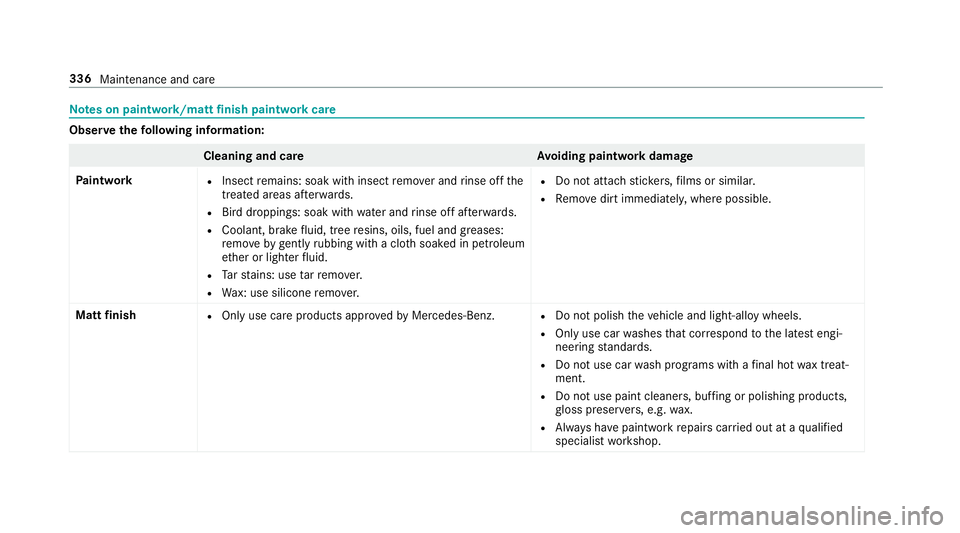
Notes on paintwo rk/matt finish paintwork care
Observethefo llowing information:
Cleaning and car eA voiding paintwork damage
Pa intwork
RInsect remains: soak with insect remo ver and rinse off the
trea ted areas af terw ards.
RBird droppings: soak with water and rinse off af terw ards.
RCoolant, brake fluid, tree resins, oils, fuel and greases:
re mo veby gently rubbing with a clo thsoaked in petroleum
et her or lighter fluid.
RTa rst ains: use tarre mo ver.
RWa x: use silicone remo ver.
RDo not attach sticke rs,fi lms or similar.
RRe mo vedirt immediatel y,where possible.
Matt finish
ROnly use care products appr oved byMercedes-Benz.RDo not polish theve hicle and light-alloy wheels.
ROnly use car washes that cor respond tothe latest engi‐
neering standards.
RDo not use car wash programs with a final hot wax treat‐
ment.
RDo not use paint cleane rs, buf fing or polishing products,
gl oss preser vers, e.g. wax.
RAlw ays ha vepaintwork repairs car ried out at a qualified
specialist workshop.
336
Maintenance and care
Page 340 of 502
Notes on care of vehicle parts
&
WARNING Risk of entrapment if the
windshield wipers are switch ed on while
th e windshield is being cleaned
If th e windshield wipers are set in motion
while you are cleaning the windshield or
wiper blades, you can betrapped bythe
wiper arm.
#Alw ays switch off the windshield wipers
and the ignition before cleaning the
windshield or wiper blades.
& WARNING Risk of burn s fromtailpipes
and tailpipe trim
The tailpipe and tailpipe trim can become
ve ry hot. If you come into contact withth ese
parts of theve hicle, you could burn yourself.
#Alw ays be particular lycareful around
th eta ilpipe and theta ilpipe trim.
#Allow theve hicle parts tocool down
before youto uch them.
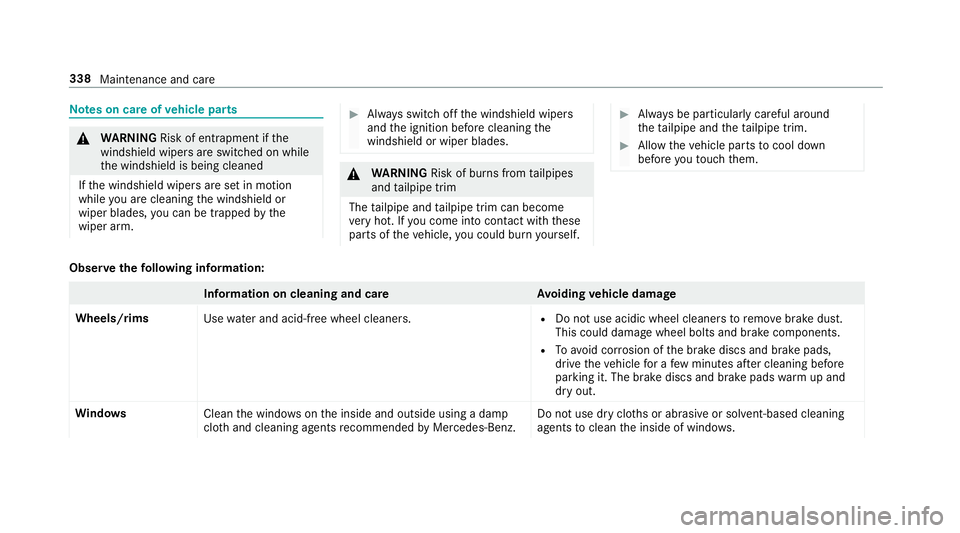
Obser vethefo llowing information:
Information on cleaning and car eAvoiding vehicle damage
Wheels/rims Usewate r and acid-free wheel cleaners.
RDo not use acidic wheel cleaners toremo vebrake dust.
This could damage wheel bolts and brake components.
RTo avoid cor rosion of the brake discs and brake pads,
drive theve hicle for a few minutes af ter cleaning before
parking it. The brake discs and brake pads warm up and
dry out.
Wi ndo ws
Cleanthe windo wsonthe inside and outside using a damp
clo thand cleaning agents recommended byMercedes-Benz. Do not use dry clo
ths or abrasive or sol vent-based cleaning
agents toclean the inside of windo ws.
338
Maintenance and care
Page 354 of 502
RThe jumper/charging cable must not come
into contact with any parts which may move
when the engine is running.
RAlw ays make sure that nei ther you nor the
battery is elect rostatically charge d.
RKe ep away from fire and open flames.
RDo not lean overth e batter y.
RWhencharging: only use battery charge rs
te sted and appr oved byMercedes-Benz, and
please read the battery charge r's operating
instructions before charging the batter y.
Obser vethe additional following points during
st arting assis tance:
RSt arting assis tance may only be pr ovided
using batteries with a nominal voltage of
12 V.
RThe vehicles must not touch.
RGa soline engine: onlyaccept starting assis‐
ta nce if the engine and exhaust sy stem are
cold.
#Secure theve hicle byapplying the electric
parking brake.
#Au tomatic transmission: shiftthe transmis‐
sion toposition B.
#Make sure that the ignition and all electrical
consumers are switched off.
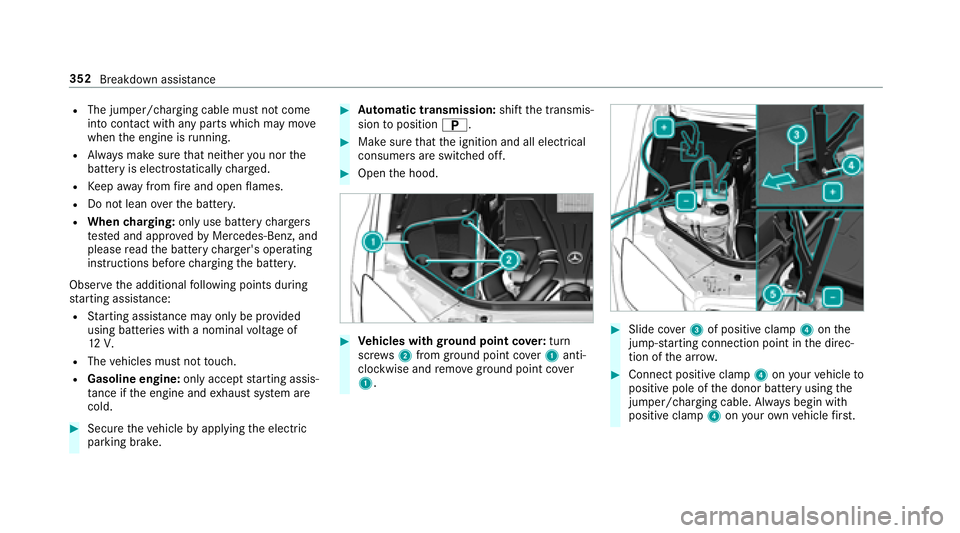
#Open the hood.
#Ve hicles with ground point co ver:tur n
sc rews 2 from ground point co ver1 anti-
clockwise and remo veground point co ver
1.#Slide co ver3 of positive clamp 4onthe
jump-s tarting connection point in the direc‐
tion of the ar row.
#Connect positive clamp 4onyour vehicle to
positive pole of the donor battery using the
jumper/charging cable. Alw ays begin with
positive clamp 4onyour ow nve hicle firs t.
352
Breakdown assist ance
Page 356 of 502
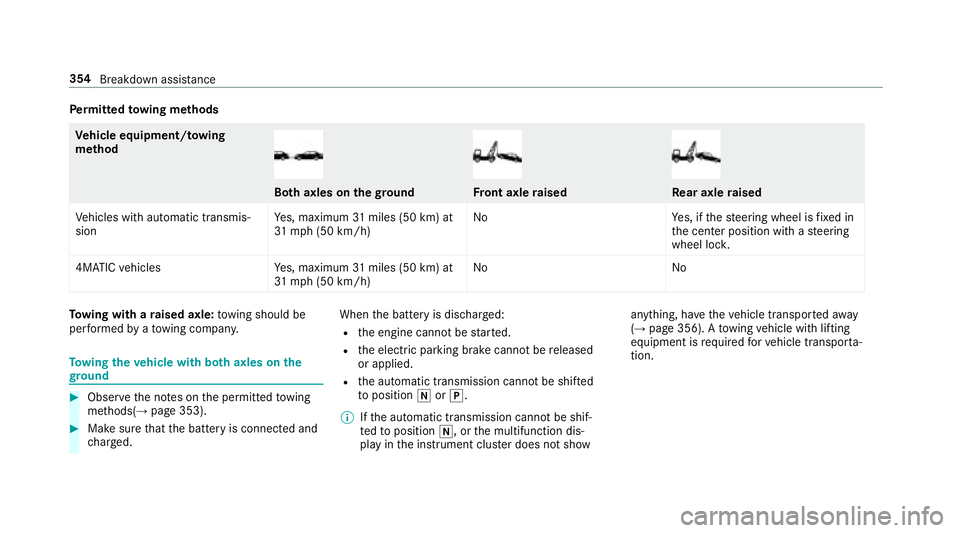
Perm itted towing me thods
Ve hicle equipment/to wing
me thod
Bo th axles on thegr oundFront axle raisedRe ar axle raised
Ve hicles with automatic transmis‐
sion Ye
s, maximum 31miles (50 km) at
31 mp h (50 km/h) No
Yes, if thesteering wheel is fixe d in
th e center position with a steering
wheel loc k.
4MATIC vehicles Yes, maximum 31miles (50 km) at
31 mp h (50 km/h) No
No
Towing wit h araised axle: towing should be
per form ed byato wing compan y.
Towing theve hicle with bo thaxles on the
gr ound
#Obser vethe no tes on the permitted towing
me thods(→page 353).
#Make sure that the battery is connected and
ch arge d. When
the battery is dischar ged:
Rthe engine cannot bestar ted.
Rth e electric parking brake cannot bereleased
or applied.
Rth e automatic transmission cann otbe shif ted
to position iorj.
% Ifth e automatic transmission cannot be shif‐
te dto position i, orthe multifunction dis‐
play in the instrument clus ter does not show anything, ha
vetheve hicle transpor tedaw ay
(
→page 356). A towing vehicle with lifting
equipment is requiredforve hicle transpor ta‐
tion.
354 Breakdown assist ance
Page 357 of 502
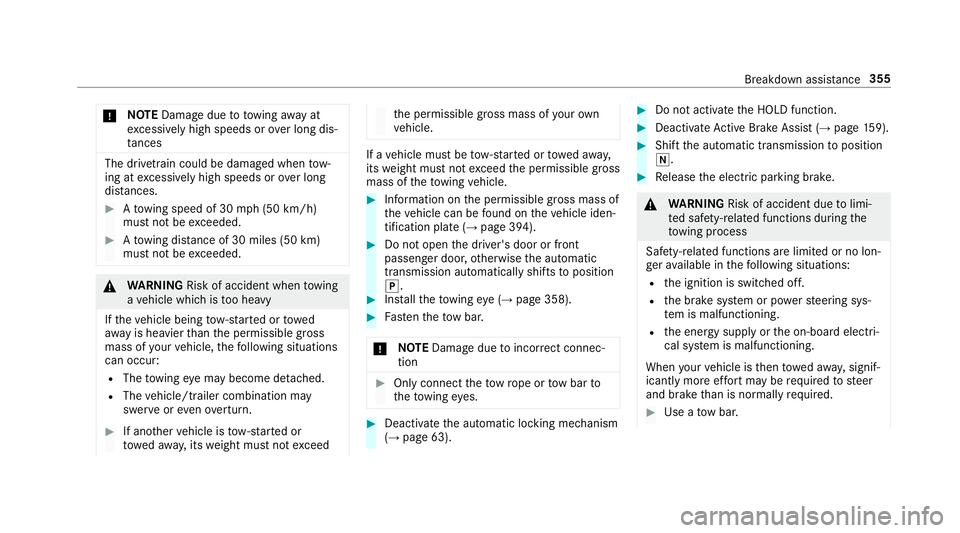
*NO
TEDama gedue to to wing away at
exc essively high speeds or over long dis‐
ta nces
The driv etra in could be damaged when tow‐
ing at excessively high speeds or over long
dis tances.
#A towing speed of 30 mph (50 km/h)
must not be exceeded.
#Atowing dis tance of 30 miles (50 km)
must not be exceeded.
&
WARNING Risk of accident when towing
a ve hicle which is too heavy
If th eve hicle being tow- star ted or towe d
aw ay is heavier than the permissible gross
mass of your vehicle, thefo llowing situations
can occur:
RThe towing eye may become de tach ed.
RThe vehicle/trailer combination may
swer veoreve nov erturn.
#If ano ther vehicle is tow- star ted or
to we daw ay, its weight must not exceed
the permissible gross mass of your ow n
ve hicle.
If a vehicle must be tow- star ted or towe daw ay,
its weight must not exceed the permissible gross
mass of theto wing vehicle.
#Information on the permissible gross mass of
th eve hicle can be found on theve hicle iden‐
tification plate (
→page 394).
#Do not open the driver's door or front
passenger door, otherwise the automatic
transmission automatically shifts toposition
j.
#Ins tallth eto wing eye (→page 358).
#Fa sten theto w bar.
* NO
TEDama gedue toincor rect connec‐
tion
#Only connect theto w rope or tow bar to
th eto wing eyes.
#Deactivate the automatic locking mechanism
(→page 63).
#Do not activate the HOLD function.
#Deactivate Active Brake Assi st(→page 159).
#Shift the automatic transmission toposition
i.
#Re lease the electric parking brake.
&
WARNING Risk of accident due tolimi‐
te d saf ety-re lated functions during the
to wing process
Saf ety-re lated functions are limited or no lon‐
ge rav ailable in thefo llowing situations:
Rth e ignition is switched off.
Rthe brake sy stem or po werst eering sys‐
te m is malfunctioning.
Rth e energy supply or the on-board electri‐
cal sy stem is malfunctioning.
When your vehicle is then towe daw ay, signif‐
icantly more ef fort may be requ ired tosteer
and brake than is no rmally requ ired.
#Use a tow bar.
Breakdown assis tance 355
Page 372 of 502
CountryRadio type appr oval number
US AF CC ID: MRXGG4
FCC ID: MRXMC34MA4
This device co mplies with Part15
of the FCC Rules. Operation is
subject tothefo llowing two con‐
ditions:
(1) This device may not cause
harmful inter fere nce, and
(2) This device must accept any
inter fere nce receive d, including
inter fere nce that may cause
undesired operation.Loading theve hicle
Tire and Loading Information placard
&
WARNING Risk of accident from overloa‐
ded tires
Overloaded tires may overheat and bur stas a
consequence. Overloaded tires can also
impair thesteering and handling characteris‐
tics and lead tobrake failure.
#Obser vethe load rating of the tires.
#The load rating must be at least half the
permissible axle load of theve hicle.
#Ne verove rload the tires by exceeding
th e maximum load.
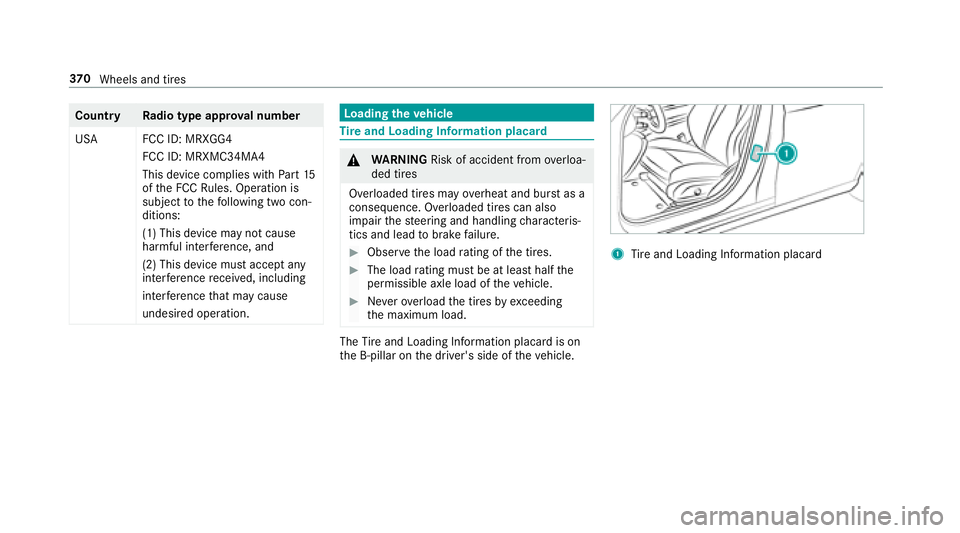
The Tire and Loading Info rmation placard is on
th e B-pillar on the driver's side of theve hicle.
1Tire and Loading Info rmation placard
370
Wheels and tires
Page 383 of 502
these are ins talled on theve hicle, but does not
include passengers or luggage.
Maximum tire load: the maximum tire load is
th e maximum permissible weight in kilog rams or
lbs for which a tire is appr oved.
Maximum permissible tire pressure: maxi‐
mum permissible tire pressure for one tire.
Maximum load on one tire: maximum load on
one tire. This is calculated bydividing the maxi‐
mum axle load of one axle bytwo.
PSI (pounds per square in ch):standard unit of
measurement for tire pressure .
Aspect ratio: ratio between tire height and tire
width in pe rcent.
Ti re pressure: pressure inside the tire applying
an outward forc eto eve rysquare inch of the tire.
The tire pressure is specified in pounds per
square inch (psi), in kilopascals (kPa) or in bar.
The tire pressure should only be cor rected when
th e tires are cold.
Cold tire pressure: the tires are cold when the
ve hicle has been par kedfo r at least 3 hours without direct sunlight on
the tires or theve hicle
has been driven for less than 1 mile (1.6 km).
Ti re contact sur face: the part of the tire that
comes into con tact wi th thero ad.
Ti re bead: the purpose of the tire bead is to
ensure that the tire sits securely on the wheel
ri m. There are se veral wire cores in the tire bead
to pr
eve ntthe t
ire fromchanging length on the
wheel rim.
Side wall:the part of the tire between the tread
and the tire bead.
We ight of optional equipment: the combined
we ight of the optional equipment weighing more
th an there placed standard parts and more than
5 lbs (2.3 kg).This optional equipment, such as
high-per form ance brakes, le vel control sy stem, a
ro of luggage rack or high-per form ance batte ries,
is not included in the curb weight and thewe ight
of the accessories.
TIN (Tire Identification Number): a unique
identification number which can be used bya
tire manufactu rerto identify tires, forex ample,
in a product recall, and thus identify the pur‐
ch asers. The TIN is made up of the manufactur‐ er's identity code, tire size, tire type code and
th
e manufacturing date.
Load-bearing index: the load-bearing index is a
code that con tains the maximum load-bearing
capacity of a tire.
Tr action: traction is the grip resulting from fric‐
tion between the tires and thero ad sur face.
We ar indicator: narrow bars (tread wear bars)
th at are distributed overth e tire conta ct surface.
If th e tire tread is le vel with the bars, thewe ar
limit of 1/ 16in (1.6 mm) has been reached.
Distribution of vehicle occupants: distribution
of vehicle occupants ov
er design
ated seat posi‐
tions in a vehicle.
Maximum permissible pa yload weight: nomi‐
nal load and luggage load plus 150 lb (68 kg)
multiplied bythe number of seats in theve hicle.
Wheels and tires 381
Page 384 of 502
Changing a wheel
Notes on selecting, installing and replacing
tires
Mercedes -AMG vehicles: observeth e no tes in
th e Supplement. Otherwise, you may not recog‐
nize dangers.
Yo u can ask for information rega rding permitte d
wheel/tire combinations at an authorized
Mercedes-Benz Center.
& WARNING Risk of accident due toincor‐
re ct dimensions of wheels and tires
If wheels and tires of the wrong size are
ins talled, the wheel brakes or wheel suspen‐
sion components may be damaged.
#Alw aysre place wheels and tires with
th ose that fulfill the specifications of
th e original part.
When replacing wheels, make sure tofit th e
cor rect:
RDesignation
RModel
When replacing tires, make sure toins tallth e
cor rect:
RDesignation
RManufactu rer
RModel
&
WARNING Risk of injury thro ugh exceed‐
ing the specified tire load rating or the
permissible speed rating
Exceeding the specified tire load rating or
th e permissible speed rating may lead totire
damage andtothe tires bur sting.
#Therefore, only use tire types and sizes
appr ovedfo ryo ur vehicle model.
#Obser vethe tire load rating and speed
ra ting requ ired foryo ur vehicle.
* NO
TEDama getovehicle and tires due to
non-app rove d tire types and sizes
Fo r saf etyre asons, only use wheels, tires
and accessories which havebeen appr oved
fo ryo ur vehicle byMercedes-Benz.
These tires ha vebeen specially adap tedfo r
use with the control sy stems, e.g. ABS or
ESP
®, and are mar ked as follo ws :
RMO = Mercedes-Benz Original
RMOE = Mercedes-Benz Original Extended
(run-flat tires only for cer tain wheels)
RMO1 = Mercedes-Benz Original (only cer‐
tain AMG tires)
Cer tain characteristics, e.g. handling, vehicle
noise emissions or fuel consum ption, may
ot herwise be adversely af fected. In addition,
when driving wi tha load, tire dimension var‐
iations could cause the tires tocome into
contact wi th the body and axle components.
This could result in damage tothe tires or the
ve hicle.
382
Wheels and tires
Page 386 of 502
Observethefo llowing when selecting, ins talling
and replacing tires:
ROnly use tires and wheels of the same type
(summer tires, winter tires, MOEx tended
tires) and the same make.
ROnly ins tall wheels of the same size on one
axle (left and right).
It is only permissible toins tall a dif fere nt
wheel size in theeve nt of a flat tire in order
to drive tothe specialist workshop.
ROnly ins tall tires of the cor rect size onto the
wheels.
RVe hicles with a tire pressure monitoring
sy stem: all mounte d wheels must be equip‐
ped with functioning sensors forth e tire
pressure monitoring sy stem.
RAt temp eratures below 45 °F (7 °C), use win‐
te r tires or all-season tires mar ked M+S for
all wheels.
Wi nter tires bearing thei snowflake sym‐
bol in addition tothe M+S marking pr ovide
th e best possible grip in wintry road condi‐
tions.
RFo r M+S tires, only use tires with the same
tread.
RObser vethe maximum permissible speed for
th e M+S tires ins talled.
If th is is below theve hicle's maximum speed,
th is must be indicated in an appropriate label
in the driver's field of vision.
RRu n in new tires at moderate speeds forth e
fi rs t 60 miles (100 km).
RRe place the tires af ter six years at the latest,
re ga rdless of wear.
RWhen replacing with tires that do not fea‐
ture run-flat characteristics: vehicles with
MOExtended tires are not equipped with a
TIREFIT kit at thefa ctor y.Equip theve hicle
with a TIREFIT kit af terre placing with tires
th at do not feature run-flat characteristics,
e.g. winter tires.
Fo r more information on wheels and tires, con‐
ta ct a qualified specialist workshop.
Be sure toalso observ eth efo llowing fur ther
re lated subjects:
RNo tes on tire pressure (→page 364)
RTire and Loading Info rmation placard
(→page 370)
RTire size designation, load-beari ng capacity,
speed rating and load ind ex(→page 377)
RTire pressure table (→page 365)
Note s onrotating wheels
&
WARNING Risk of injury thro ugh dif fer‐
ent wheel sizes
Inter changing the front and rear wheels if the
wheels or tires ha vediffere nt dimensions
may se verely impair the driving characteris‐
tics.
The wheel brakes or wheel suspension com‐
ponents may also be damaged.
#Ro tate front and rear wheels only ifth e
wheels and tires are of the same dimen‐
sions.
384 Wheels and tires
Page 388 of 502
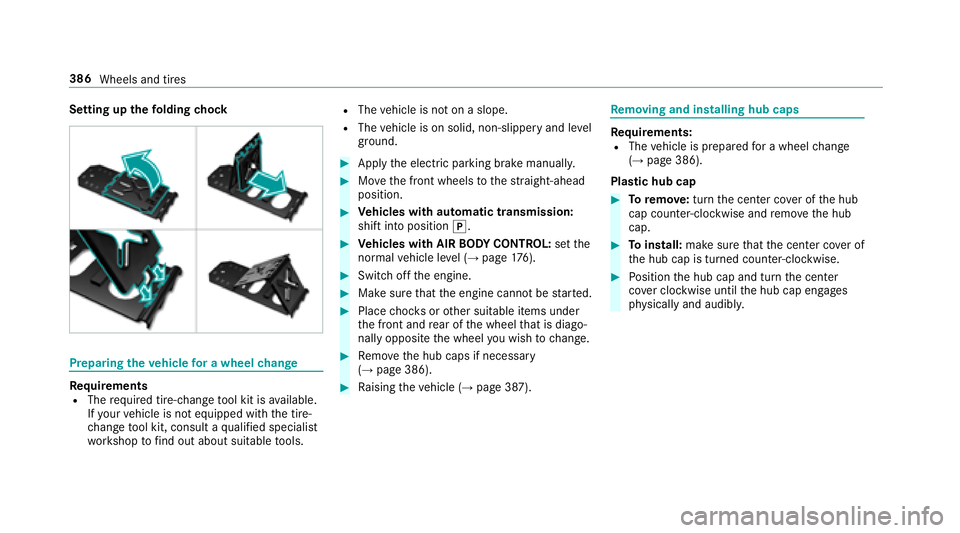
Setting upthefo lding chock
Prepa ring theve hicle for a wheel change
Re quirementsRThe requ ired tire-change tool kit is available.
If yo ur vehicle is not equipped with the tire-
ch ange tool kit, consult a qualified specialist
wo rkshop tofind out about suitable tools.
RThe vehicle is not on a slope.
RThe vehicle is on solid, non-slippery and le vel
ground .
#Applythe electric parking brake manually.
#Mo vethe front wheels tothest ra ight-ahead
position.
#Ve hicles with automatic transmission:
shift into position j.
#Vehicles with AIR BODY CONT ROL:set the
normal vehicle le vel (→page 176).
#Switch off the engine.
#Make sure that the engine cannot bestar ted.
#Place choc ks orother suitable items under
th e front and rear of the wheel that is diago‐
nally opposite the wheel youwish tochange.
#Re mo vethe hub caps if necessary
(→page 386).
#Ra ising theve hicle (→page 387).
Re moving and in stalling hub caps
Re quirements:RThe vehicle is prepared for a wheel change
(→page 386).
Plast ic hub cap
#Toremo ve:turn the center co ver of the hub
cap counter-clockwise and remo vethe hub
cap.
#To install: make sure that the center co ver of
th e hub cap is turned counter-clockwise.
#Po sition the hub cap and turn the center
co ver clockwise until the hub cap engages
ph ysically and audibly.
386
Wheels and tires