tow MERCEDES-BENZ S-CLASS CABRIOLET 2018 Repair Manual
[x] Cancel search | Manufacturer: MERCEDES-BENZ, Model Year: 2018, Model line: S-CLASS CABRIOLET, Model: MERCEDES-BENZ S-CLASS CABRIOLET 2018Pages: 502, PDF Size: 6.27 MB
Page 355 of 502
#Duringthest arting assist ance proce‐
dure: start the engine of the donor vehicle
and run at idle speed.
#Connect the negative pole of the donor bat‐
te ry and ground po int5 ofyour ow nve hicle
by using the jumper/charging cable. Begin
with the donor battery firs t.
#Du ring starting assist ance:start the
engine of your ow nve hicle.
#During thech arging process: start the
ch arging process.
#During starting assist ance:letthe engines
ru nfo r se veral minutes.
#During starting assist ance:before discon‐
necting the jumper cable, switch on an elec‐
trical consumer in your ow nve hicle, e.g. the
re ar wind owheater or lighting.
When thest arting assis tance/charging process
is compl ete:
#Fir st,re mo vethe jumper/charging cable
from ground point 5and negative pole of
th e donor batter y,then from positive clamp
4 and positive pole of the donor batter y.
Begin eachtime with the conta cts onyour
ow nve hicle firs t.
#Af terre moving the jumper/charging cable,
close co ver3 of positive clamp 4.
#Vehicles with ground point co ver:replace
ground point co ver1 and turn scr ews2
clockwise.
Yo u can obtain fur ther information on starting
assis tance at any qualified specialist workshop.
Re placing the 12V battery
#Obser vethe no tes on the12 V battery
(→page 348).
Mercedes-Benz recommends that you ha vethe
12 V battery replaced at a qualified specialist
wo rkshop, e.g. at an authorized Mercedes-Benz
Center.
Obser vethefo llowing no tes if youwa ntto
re place the battery yourself:
RAlw aysre place a defective battery with a bat‐
te ry which meets the specific vehicle require‐
ments.
RCar ryove r de tach able parts, such as vent
hoses, elbow fitting or term inal co vers from
th e battery being replaced.
RMake sure that theve nt hose is al ways con‐
nected tothe original opening on the side of
th e batter y.
Ins tall any existing or supplied cell caps.
Otherwise, gases or battery acid could
escape.
RMake sure that de tach able parts are recon‐
nected in the same way.
Tow starting or towing away
Perm itted towing me thods
Mercedes-Benz recommends transporting your
ve hicle in the case of a breakdown, rath er than
to wing it away.
* NO
TEDama getotheve hicle due to tow‐
ing away incor rectly
#Obser vethe instructions and no tes on
to wing away.
Breakdown assis tance 353
Page 356 of 502
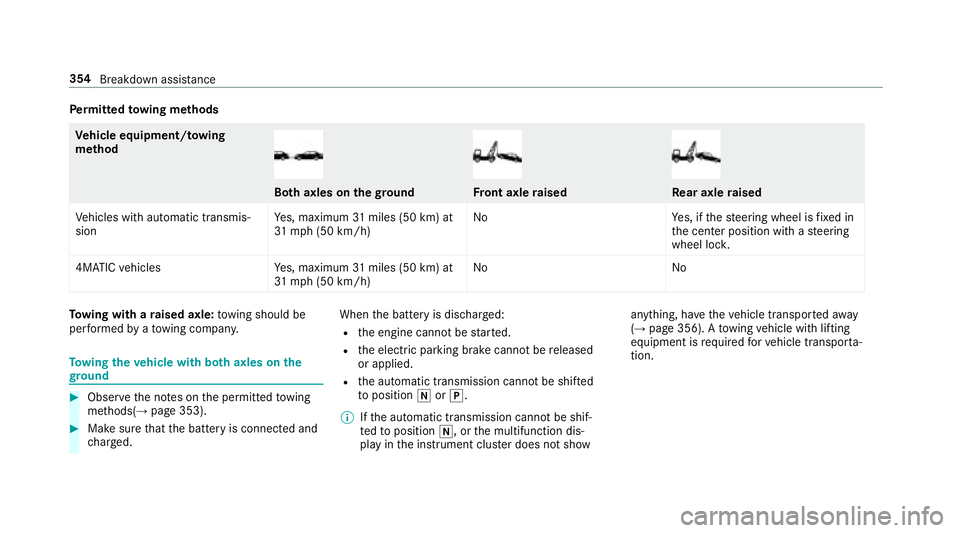
Perm itted towing me thods
Ve hicle equipment/to wing
me thod
Bo th axles on thegr oundFront axle raisedRe ar axle raised
Ve hicles with automatic transmis‐
sion Ye
s, maximum 31miles (50 km) at
31 mp h (50 km/h) No
Yes, if thesteering wheel is fixe d in
th e center position with a steering
wheel loc k.
4MATIC vehicles Yes, maximum 31miles (50 km) at
31 mp h (50 km/h) No
No
Towing wit h araised axle: towing should be
per form ed byato wing compan y.
Towing theve hicle with bo thaxles on the
gr ound
#Obser vethe no tes on the permitted towing
me thods(→page 353).
#Make sure that the battery is connected and
ch arge d. When
the battery is dischar ged:
Rthe engine cannot bestar ted.
Rth e electric parking brake cannot bereleased
or applied.
Rth e automatic transmission cann otbe shif ted
to position iorj.
% Ifth e automatic transmission cannot be shif‐
te dto position i, orthe multifunction dis‐
play in the instrument clus ter does not show anything, ha
vetheve hicle transpor tedaw ay
(
→page 356). A towing vehicle with lifting
equipment is requiredforve hicle transpor ta‐
tion.
354 Breakdown assist ance
Page 357 of 502
*NO
TEDama gedue to to wing away at
exc essively high speeds or over long dis‐
ta nces
The driv etra in could be damaged when tow‐
ing at excessively high speeds or over long
dis tances.
#A towing speed of 30 mph (50 km/h)
must not be exceeded.
#Atowing dis tance of 30 miles (50 km)
must not be exceeded.
&
WARNING Risk of accident when towing
a ve hicle which is too heavy
If th eve hicle being tow- star ted or towe d
aw ay is heavier than the permissible gross
mass of your vehicle, thefo llowing situations
can occur:
RThe towing eye may become de tach ed.
RThe vehicle/trailer combination may
swer veoreve nov erturn.
#If ano ther vehicle is tow- star ted or
to we daw ay, its weight must not exceed
the permissible gross mass of your ow n
ve hicle.
If a vehicle must be tow- star ted or towe daw ay,
its weight must not exceed the permissible gross
mass of theto wing vehicle.
#Information on the permissible gross mass of
th eve hicle can be found on theve hicle iden‐
tification plate (
→page 394).
#Do not open the driver's door or front
passenger door, otherwise the automatic
transmission automatically shifts toposition
j.
#Ins tallth eto wing eye (→page 358).
#Fa sten theto w bar.
* NO
TEDama gedue toincor rect connec‐
tion
#Only connect theto w rope or tow bar to
th eto wing eyes.
#Deactivate the automatic locking mechanism
(→page 63).
#Do not activate the HOLD function.
#Deactivate Active Brake Assi st(→page 159).
#Shift the automatic transmission toposition
i.
#Re lease the electric parking brake.
&
WARNING Risk of accident due tolimi‐
te d saf ety-re lated functions during the
to wing process
Saf ety-re lated functions are limited or no lon‐
ge rav ailable in thefo llowing situations:
Rth e ignition is switched off.
Rthe brake sy stem or po werst eering sys‐
te m is malfunctioning.
Rth e energy supply or the on-board electri‐
cal sy stem is malfunctioning.
When your vehicle is then towe daw ay, signif‐
icantly more ef fort may be requ ired tosteer
and brake than is no rmally requ ired.
#Use a tow bar.
Breakdown assis tance 355
Page 358 of 502
#Make surethat thesteering wheel can
mo vefreely, before towing theve hicle
aw ay.
* NO
TEDama gedue toexcessive tracti ve
po we r
Ifyo upull away sharpl y,the tractive po wer
may be too high and theve hicles could be
damaged.
#Pull away slowly and smoo thly.
Loading the vehicle for transport
#Obser vethe no tes on towing away
(→page 354).
#Connect theto w bar totheto wing eyeto
load theve hicle.
#Shift the automatic transmission toposition
i.
% The automatic transmission may be loc ked
in position jintheeve nt of damage tothe
electrics. Toshift toi, pr ovide the on- board electrical sy
stem with po wer
(
→page 350).
#Load theve hicle onto the transpor ter.
#Shift the automatic transmission toposition
j.
#Only secure theve hicle bythe wheels.
Ve hicles with ADS PLUS (Adaptive Damping
Sy stem PLUS)
&
WARNING Risk of an accident when
transporting vehicles with Adaptive
Damping Sy stem PLUS
The reduced damping forc es on theve hicle
being transpor ted can cause theve hicle/
trailer combination tostart toswing.
As a result, when transporting vehicles with
th eAd aptive Damping Sy stem PLUS, the
ve hicle/trailer combination may start toskid.
Consequentl y,yo u could lose cont rol of your
ve hicle.
#When transporting, ensure that:RThe vehicle has been loaded onto
th e transpor ter cor rectly
RThe vehicle is secured at all four
wheels with suitable tensioning
st ra ps
RThe maximum permissible speed of
35 mph(6 0 km/h) is not exceeded
when transporting
* NO
TEDama getotheve hicle from secur‐
ing it incor rectly
#Af ter loading, theve hicle must be
secured on all four wheels. Otherwise,
th eve hicle could be damaged.
#A minimum dis tance of 4 in (10 cm)
up wa rds and 8 in (20 cm) down wards
must be kept tothe transport platform.
%
Transport le vel is not available forth efo llow‐
ing vehicles:
RMercedes‑AMG vehicles
RVe hicles with MAGIC BODY CONTROL
356
Breakdown assis tance
Page 360 of 502
*NO
TEDama getothe driv etra in due to
incor rect positioning
#Do not position theve hicle abo vethe
connection point of the transport vehi‐
cle.
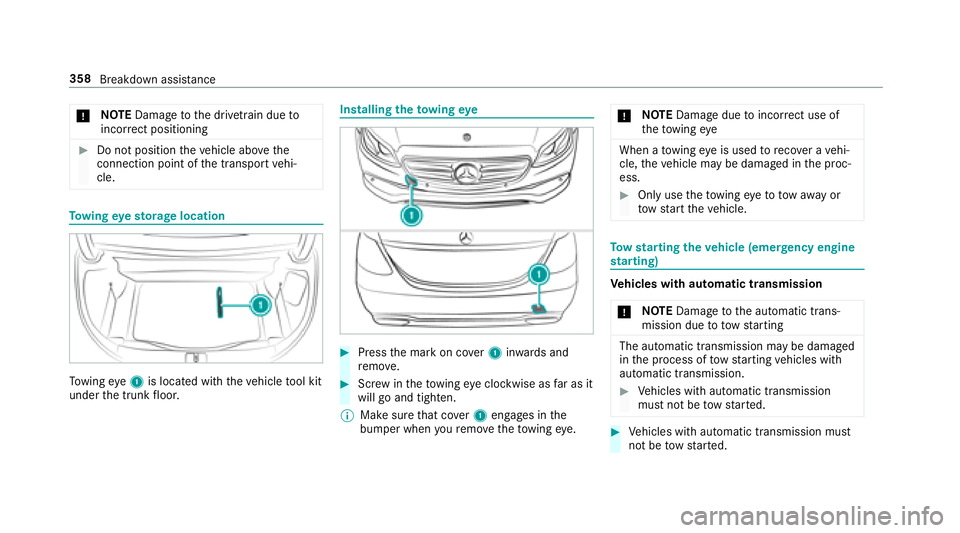
To wing eyesto rage location
Towing eye1 is located with theve hicle tool kit
under the trunk floor.
Installing theto wing eye
#Press the mark on co ver1 inwa rds and
re mo ve.
#Scr ew intheto wing eyeclockwise as far as it
will go and tighten.
% Make sure that co ver1 engages in the
bumper when youre mo vetheto wing eye. *
NO
TEDama gedue toincor rect use of
th eto wing eye
When a towing eye is used toreco ver a vehi‐
cle, theve hicle may be damaged in the proc‐
ess.
#Only use theto wing eyeto to waw ay or
to w start theve hicle.
To w starting theve hicle (eme rgency engine
st arting)
Ve hicles with automatic transmission
* NO
TEDama getothe automatic trans‐
mission due to towstarting
The automatic transmission may be damaged
in the process of tow starting vehicles with
automatic transmission.
#Ve hicles with automatic transmission
must not be tow star ted.
#Ve hicles with automatic transmission must
not be tow star ted.
358
Breakdown assis tance
Page 385 of 502
Only use tires, wheels or accessoriestested
and appr ovedby Mercedes-Benz.
* NO
TERisk todriving saf etyfrom retrea‐
ded tires
Re treaded tires are nei ther tested nor recom‐
mended byMercedes-Benz, since pr evious
damage cannot alw ays be de tected on
re treaded tires.
Fo rth is reason driving saf etycanno tbe guar ‐
anteed.
#Do no tuse used ti res if you ha veno
information about their pr evious usage.
* NO
TEPossible damage towheels or tires
when driving over obs tacles
Large wheels ha vea lo wer tire section wid th.
The lo werth e tire section width, the greater
is therisk of damage towheels or tires when
driving over obs tacles.
#Av oid obs tacles or drive part icularly
carefully.
* NO
TEDama getoelectronic component
parts from the use of tire-mounting tools
Ve hicles with a tire pressure monitoring
sy stem: Electronic component parts are
located in the wheel. Tire -mounting tools
should not be used in the area of theva lve.
This could otherwise damage the electronic
component parts.
#Ha ve the tires changed at a qualified
specialist workshop onl y.
*NO
TEDama getosummer tires at low
ambient temp eratures
Using summer tires at very low ambient tem‐
peratures can cause crac kstoform ,th ereby
damaging the tires permanentl y.
#Attemp eratures below 45 °F (7 °C) use
M+S tires.
Ac cessory part sth at are not appr ovedfo ryo ur
ve hicle byMercedes-Benz or are not being used
cor rectly can impair the operating saf ety. Before purc
hasing and using non-appr oved
accessori es, visit a qualified specialist workshop
and enquire about:
RSuitability
RLegal stipulations
RFa ctory recommendations
&
WARNING Risk of accident wi thhigh
per form ance tires
The special tire tread in combination with the
optimized tire compound means that therisk
of skidding or hydroplaning on wetro ads is
inc reased.
In addition, the tire grip is greatly reduced at
a low outside temp erature and tire running
te mp erature.
#Switch on the ESP®and adapt your
dr ivin gst yle accordingly.
#Use M+S tire at outside temp eratures
of less than 10 °C (50 °F).
Wheels and tires 383
Page 399 of 502
You can identify operating fluids appr ovedby
Mercedes-Benz bythefo llowing insc ript ions on
th e conta iner:
RMB-Freigabe (e.g. MB-Fr eigabe 229.51)
RMB-Approval (e.g. MB-App rova l 229.51)
Fu rther information on appr oved operating flu‐
ids:
Rin the Mercedes-Benz Specifications for
Operating Fluids at http://be vo.mercedes-
benz.com (byen tering the designation)
Rin the Mercedes-Benz Specifications for
Operating Fluids in the Mercedes-Benz BeVo
app (by entering the designation)
Rat a qualified specialist workshop
Fu el
Information on fuel grades forve hicles with
a ga soline engine
Obser vethe no tes on operating fluids
(
→page 396). *
NO
TEDama gecaused bythe wrong fuel
Even small amounts of the wrong fuel could
re sult in damage tothe fuel sy stem, the
engine and the emission control sy stem.
#Only refuel with lo w-sulfur unleaded
fuel.
This fuel may contain up to10 %ethanol.
Yo ur vehicle is suitable for use with E10 fuel.
Do not refuel using:
RDiesel
RE15, E85, E100
RGasoline containing me thanol (M15, M30,
M85, M100)
RGasoline with additives con taining me tal
If yo u accidenta llyrefuel with the wrong fuel:
#Do not switch the ignition on.
#Consult a qualified specialist workshop.
Ifth eav ailable fuel is not suf ficiently low in sul‐
fur, this can produce unpleasant odors. Only
refuel with fuel that has at least the octane
number specified in the instruction label in the
fuel filler flap (
→page 140).
If yo uwa nt maximum engine output: only
re fuel with unleaded premium grade gasoline
with an octane number of at least 91AKI/
95 RON.
As a temp orary measure, if there commended
fuel is not available, you may also use unleaded
re gular gasoline with an octane number of at
least 87AKI/91 RON.
* NO
TEPremature wearthro ugh unleaded
re gular gasoline
Unleaded regular gasoline can cause the
engine towe ar more quickly and impair lon‐
ge vity and per form ance.
If unleaded premium grade gasoline is
una vailable and you ha vetorefuel using
unleaded regular gasoline with 87AKI/
91 RON:
#Only fill th e fuel tank tohalf full with
unleaded regular gasoline and top up as
Te ch nical da ta397
Page 415 of 502
Displaymessages
Possible causes/consequences and MSolutions
If th e electric parking brake should not be applied, lea vethe ignition switched on, e.g. when washing theve hicle in
an automatic car wash or when having theve hicle towe d. Do not do this when having theve hicle towe d with the
re ar axle raised.
If th e electric parking brake is not applied automatically:
#Switch off the ignition and turn it back on.
#Re lease and then apply the electric parking brake manually .
If it is still not possible toapply the electric parking brake:
#Visit a qualified specialist workshop.
#Where necessar y,also safeguard the par kedve hicle against rolling away.
To release:
#Ifth e conditions for au tomatic release are fulfilled and the electric parking brake is not released automaticall y,
re lease the electric parking brake manually .
If it is still not possible torelease the electric parking brake:
#Do not continue driving under any circums tances. Consult a qualified specialist workshop.
Display messages and warning/indicator lamps 41
3
Page 436 of 502
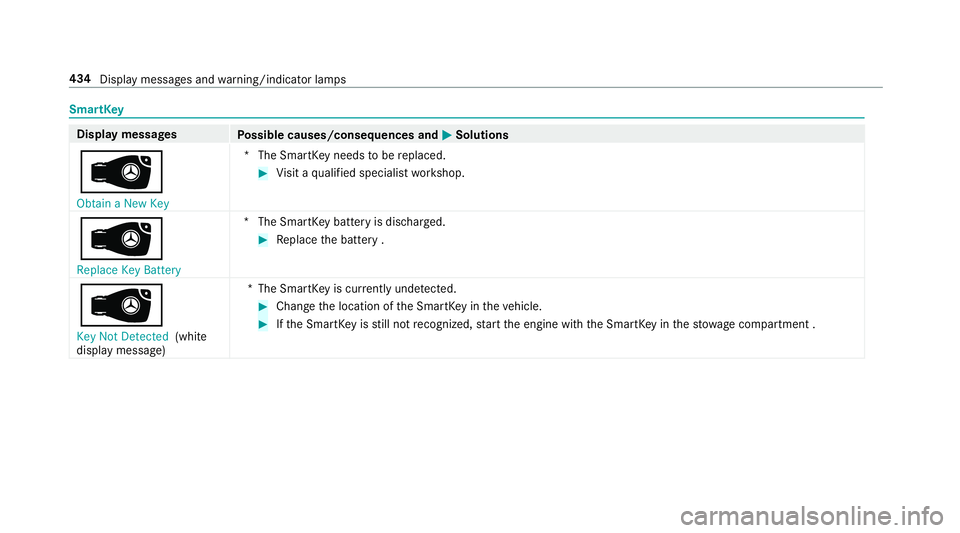
SmartKey
Displaymessages
Possible causes/consequences and MSolutions
Â
Obtain a New Key*T
he SmartK eyneeds tobe replaced.
#Visit a qualified specialist workshop.
Â
Replace Key Battery *T
he SmartK eybattery is dischar ged.
#Re place the battery .
Â
Key Not Detected (white
display message) *T
he SmartK eyis cur rently und etected.
#Change the location of the SmartK eyintheve hicle.
#Ifth e SmartK eyisstill not recognized, start the engine with the SmartK eyinthestow age compartment .
434
Display messages and warning/indicator lamps
Page 437 of 502
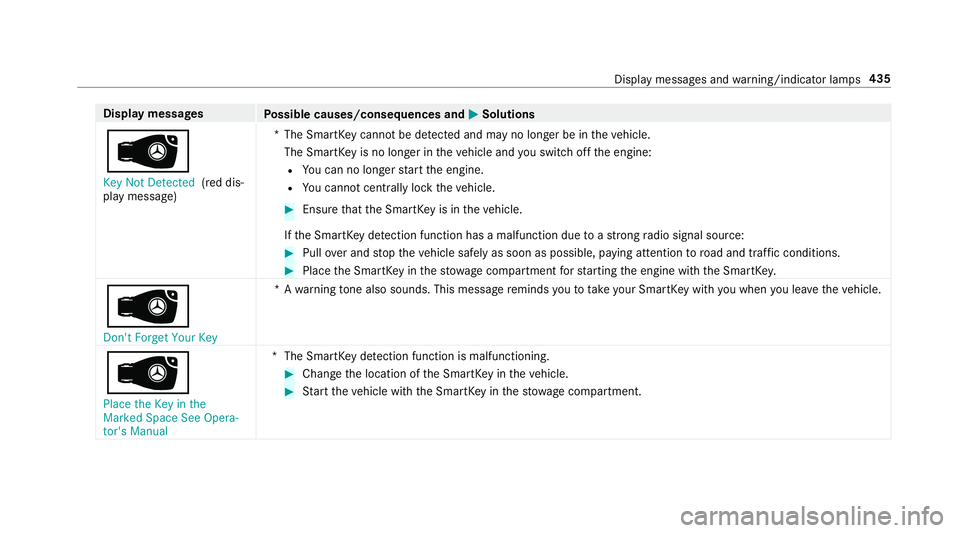
Displaymessages
Possible causes/consequences and MSolutions
Â
Key Not Detected(red dis‐
play message) *T
he SmartK eycannot be de tected and may no longer be in theve hicle.
The SmartK eyis no longer in theve hicle and youswit choff the engine:RYo u can no longe rst art the engine.
RYo u cannot centrally lock theve hicle.
#Ensure that the SmartK eyis in theve hicle.
If th e SmartK eydetection function has a malfunction due toast ro ng radio signal source:
#Pull over and stop theve hicle safely as soon as possible, paying attention toroad and traf fic conditions.
#Place the SmartK eyinthestow age compartment forst arting the engine with the SmartK ey.
Â
Don't Forget Your Key *A
warning tone also sounds. This message reminds youto take your SmartK eywith youwhen you lea vetheve hicle.
Â
Place the Key in the
Marked Space See Opera-
tor's Manual *T
he SmartK eydetection function is malfunctioning.
#Change the location of the SmartK eyintheve hicle.
#Start theve hicle with the SmartK eyinthestow age compartment.
Display messages and warning/indicator lamps 435