trunk MERCEDES-BENZ SL-Class 2001 R129 Owner's Guide
[x] Cancel search | Manufacturer: MERCEDES-BENZ, Model Year: 2001, Model line: SL-Class, Model: MERCEDES-BENZ SL-Class 2001 R129Pages: 302, PDF Size: 7.21 MB
Page 181 of 302
177 Driving instructions
Te ch n ica l
data Instruments
and controlsOperationDrivingInstrument
cluster displayPractical hints Car care Index Power assistance
BrakesThe condition of the parking brake system is checked
each time the vehicle is in the shop for the required
maintenance service.
If the parking brake is released and the brake warning
lamp in the instrument cluster stays on, the brake fluid
level in the reservoir is too low.
Brake pad wear or a leak in the system may be the
reason for low brake f luid in the reservoir.
Have the brake system inspected at an authorized
Mercedes-Benz Center immediately.
All checks and service work on the brake system should
be carried out by an authorized Mercedes-Benz Center.
Install only brake pads and brake fluid recommended by
Mercedes-Benz.
Wa r n i n g !
When the engine is not running, the brake and
steering systems are without power assistance.
Under these circumstances, a much greater effort is
necessary to stop or steer the vehicle.Wa r n i n g !
After driving in heavy rain for some time without
applying the brakes or through water deep enough
to wet brake components, the first braking action
may be somewhat reduced and increased pedal
pressure may be necessary to obtain expected
braking effect. Be sure to maintain a safe distance
from vehicles in front.Resting your foot on the brake pedal will cause
excessive and premature wear of the brake pads.It can also result in the brakes overheating thereby
significantly reducing their effectiveness. It may
not be possible to stop the vehicle in sufficient time
to avoid an accident.
Wa r n i n g !
If other than recommended brake pads are
installed, or other than recommended brake fluid
is used, the braking properties of the vehicle can be
degraded to an extent that safe braking is
substantially impaired. This could result in an
accident.The trunk is the preferred place to carry objects.
Page 219 of 302

215 Contents - Practical hints
Te ch n ica l
data Instruments
and controlsOperation DrivingInstrument
cluster displayPractical hintsCar care Index
Practical hints First aid kit ..................................... 216
Stowing things in the vehicle ...... 216
Vehicle tools .................................... 217
Vehicle jack ..................................... 218
Fuses ................................................ 219
Hood .................................................220
Automatic transmission
fluid level ...................................222
Checking engine oil level .............222
Coolant level ...................................224
Adding coolant ...............................225Windshield and
headlamp washer
fluid mixing ratio ..................... 226
Wheels ............................................ 227
Tire replacement ........................... 227
Rotating wheels ............................. 228
Spare wheel .................................... 229
Changing wheels ........................... 231
Tire inflation pressure ................. 235
Battery ............................................. 237
Battery Recycling ....................... 238
Jump starting ................................. 239
Towing the vehicle ........................ 241Exterior lamps ................................243
Headlamp assembly
(Halogen) .....................................244
Taillamp assemblies ..................250
Changing batteries in the
remote control ...........................252
Synchronizing ............................253
Raising soft top manually .............254
Replacing wiper blade .................258
Manual release of
fuel filler flap .............................260
Trunk lamp .....................................260
Page 220 of 302
216 First aid kit
Te ch n ica l
data Instruments
and controlsOperation DrivingInstrument
cluster displayPractical hintsCar care Index
First aid kit
The first aid kit is located in the storage compartment
behind the seats.Stowing things in the vehicle
Wa r n i n g !
To help avoid personal injury during a collision or
sudden maneuver, exercise care when stowing
things. Put luggage or cargo in the trunk if
possible.
Page 221 of 302
217 Vehicle tools
Te ch n ica l
data Instruments
and controlsOperation DrivingInstrument
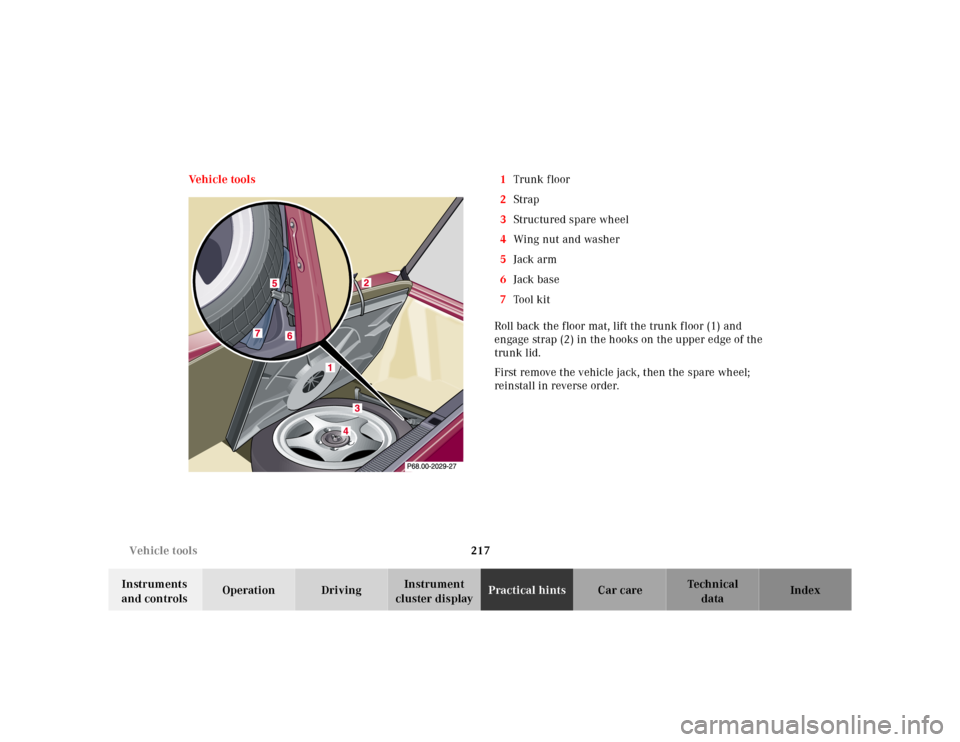
cluster displayPractical hintsCar care Index Vehicle tools 1Trunk f loor
2Strap
3Structured spare wheel
4Wing nut and washer
5Jack arm
6Jack base
7To o l k i t
Roll back the floor mat, lift the trunk floor (1) and
engage strap (2) in the hooks on the upper edge of the
trunk lid.
First remove the vehicle jack, then the spare wheel;
reinstall in reverse order.
Page 223 of 302
219 Fuses
Te ch n ica l
data Instruments
and controlsOperation DrivingInstrument
cluster displayPractical hintsCar care Index Fuses
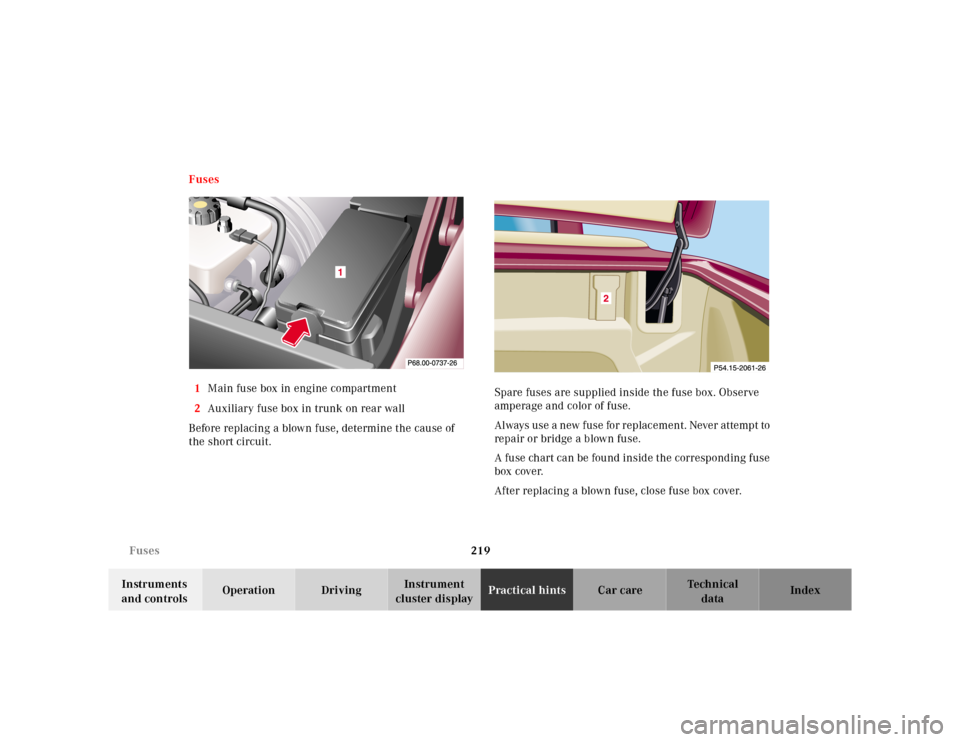
1Main fuse box in engine compartment
2Auxiliary fuse box in trunk on rear wall
Before replacing a blown fuse, determine the cause of
the short circuit.Spare fuses are supplied inside the fuse box. Observe
amperage and color of fuse.
Always use a new fuse for replacement. Never attempt to
repair or bridge a blown fuse.
A fuse chart can be found inside the corresponding fuse
box cover.
After replacing a blown fuse, close fuse box cover.
Page 241 of 302
237 Battery
Te ch n ica l
data Instruments
and controlsOperation DrivingInstrument
cluster displayPractical hintsCar care Index Battery
Important!
Battery replacement information:
The maintenance-free battery is located in the trunk
behind the right side cover panel.
The service life of the battery is dependent on its
condition of charge. The battery should always be kept
sufficiently charged, in order to last an optimum length
of time.Therefore, we strongly recommend that you have the
battery charge checked frequently, and corrected if
necessary, especially if you use the vehicle less than
approximately 200 miles (300 km) per month,
mostly for short distance trips, or if it is not used for
long periods of time.
Only charge a battery with a battery charger after the
battery has been disconnected from the vehicle’s
electrical circuit.
Always disconnect the battery negative lead first and
connect last.
When removing and connecting the battery, always
make sure that all electrical consumers are off and the
key is in steering lock position 0. The battery must
always be securely installed when the vehicle is in
operation. During removal and installation always
protect the disconnected battery positive (+) terminal
with the cover attached to the battery.
While the engine is running the battery terminal clamps
must not be loosened or detached, otherwise the
generator and other electronic components will be
damaged.
Wa r n i n g !
Failure to follow these instructions can result in
severe injury or death.Never lean over batteries while connecting, you
might get injured.Battery fluid contains sulfuric acid. Do not allow
this fluid to come in contact with eyes, skin or
clothing. In case it does, immediately flush affected
area with water and seek medical help.A battery will also produce hydrogen gas, which is
flammable and explosive. Keep flames or sparks
away from battery, avoid improper connection of
jumper cables, smoking etc.
Page 243 of 302
239 Jump starting
Te ch n ica l
data Instruments
and controlsOperation DrivingInstrument
cluster displayPractical hintsCar care Index Jump startingImportant!
A discharged battery can freeze at approx. +14°F
(–10°C). In that case, it must be thawed out before
jumper cables are used. Attempting to jump start a
frozen battery can result in it exploding, causing
personal injury.
Jumper cable specifications:
• Minimum cable cross-section of 25 mm
2 or approx.
2AWG
• Maximum length of 11.5 ft. (3.5 m).
If the battery is discharged, the engine should be started
with jumper cables and the (12 V) battery of another
vehicle.
Only use 12 V battery to jump start your vehicle. Jump
starting with more powerful battery could damage the
vehicle’s electrical systems, which will not be covered
by the Mercedes-Benz Limited Warranty.
The battery is located in the trunk behind the right side
cover panel.
Wa r n i n g !
Failure to follow these directions will cause
damage to the electronic components, and can lead
to a battery explosion and severe injury or death.Never lean over batteries while connecting or jump
starting, you might get injured.Battery fluid contains sulfuric acid. Do not allow
this fluid to come in contact with eyes, skin or
clothing. In case it does, immediately flush affected
area with water, and seek medical help if
necessary.A battery will also produce hydrogen gas, which is
flammable and very explosive. Keep flames or
sparks away from battery, avoid improper
connection of jumper cables, smoking etc.Read all instructions before proceeding.
Page 252 of 302
248 Exterior lamps
Te ch n ica l
data Instruments
and controlsOperation DrivingInstrument
cluster displayPractical hintsCar care Index
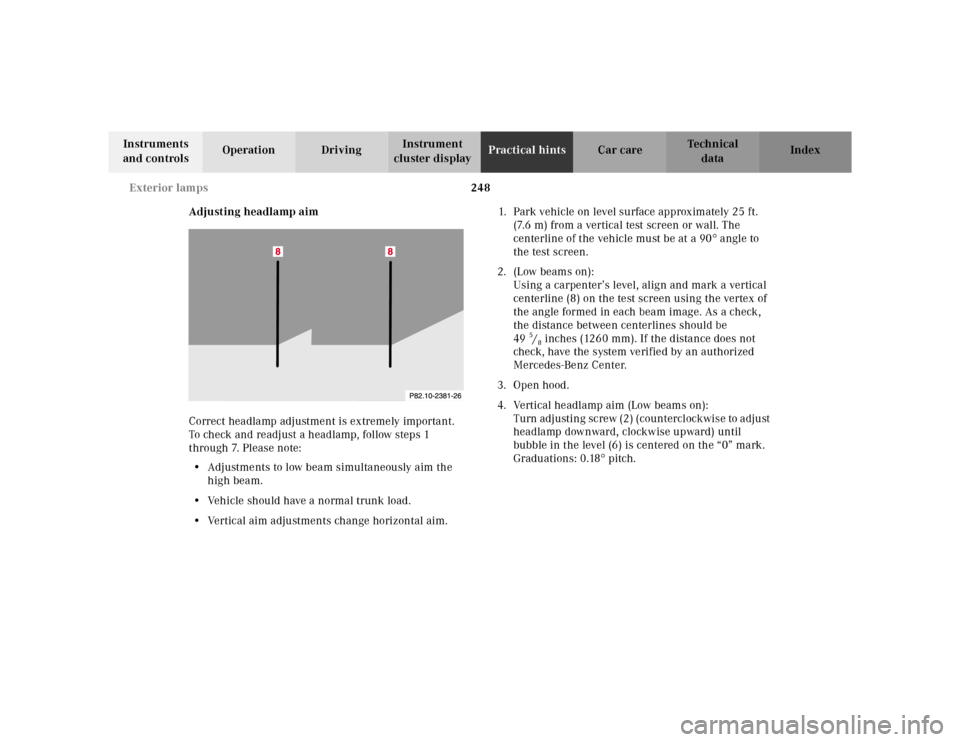
Adjusting headlamp aim
Correct headlamp adjustment is extremely important.
To check and readjust a headlamp, follow steps 1
through 7. Please note:
• Adjustments to low beam simultaneously aim the
high beam.
• Vehicle should have a normal trunk load.
• Vertical aim adjustments change horizontal aim.1. Park vehicle on level surface approximately 25 ft.
(7.6 m) from a vertical test screen or wall. The
centerline of the vehicle must be at a 90° angle to
the test screen.
2. (Low beams on):
Using a carpenter’s level, align and mark a vertical
centerline (8) on the test screen using the vertex of
the angle formed in each beam image. As a check,
the distance between centerlines should be
49
5/8 inches (1260 mm). If the distance does not
check, have the system verified by an authorized
Mercedes-Benz Center.
3. Open hood.
4. Vertical headlamp aim (Low beams on):
Turn adjusting screw (2) (counterclockwise to adjust
headlamp downward, clockwise upward) until
bubble in the level (6) is centered on the “0” mark.
Graduations: 0.18° pitch.
Page 264 of 302
260 Manual release of fuel filler flap
Te ch n ica l
data Instruments
and controlsOperation DrivingInstrument
cluster displayPractical hintsCar care Index
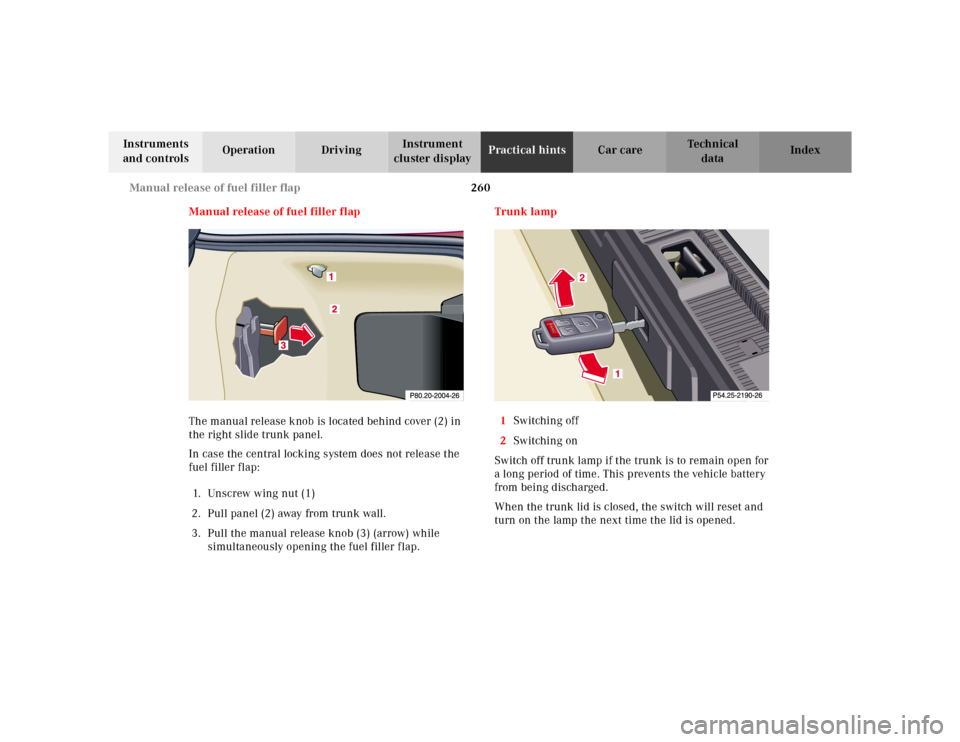
Manual release of fuel filler flap
The manual release knob is located behind cover (2) in
the right slide trunk panel.
In case the central locking system does not release the
fuel filler flap:
1. Unscrew wing nut (1)
2. Pull panel (2) away from trunk wall.
3. Pull the manual release knob (3) (arrow) while
simultaneously opening the fuel filler flap.Trunk lamp
1Switching off
2Switching on
Switch off trunk lamp if the trunk is to remain open for
a long period of time. This prevents the vehicle battery
from being discharged.
When the trunk lid is closed, the switch will reset and
turn on the lamp the next time the lid is opened.
Page 280 of 302

276 Technical data
Te ch n ica l
data Instruments
and controlsOperation DrivingInstrument
cluster displayPractical hints Car care Index
Electrical system Weights
(see certification tag)
Main dimensions Generator (alternator) 14 V/150 A
Battery 12V/100 Ah
Starter motor
SL 500:
SL 600:12 V / 1. 7 k W
12V/2.2 kW
Spark plugs
SL 500:
SL 600:
Electrode gap
Tightening torqueBosch F 8 DPER
Beru 14 FGH 8 DPUR X 2
Beru 14 FGH 8 DPUR X 2
0.039 in (1.0 mm)
15 – 22 ft.lb (20 – 30 Nm)Hardtop load max. 66 lb (30 kg)
Trunk load max. 220 lb (100 kg)
Overall vehicle length 177.1 in (4499 mm)
O ve r a l l v e h i c l e w i d t h 71.3 in ( 1812 m m )
Overall height 51.3 in (1303 mm)
Wheel base 99.0 in (2515 mm)
Track, front 60.4 in (1535 mm)
Track, rear 60.0 in (1523 mm)