warning MERCEDES-BENZ SPRINTER 2013 MY13 Operator’s Manual
[x] Cancel search | Manufacturer: MERCEDES-BENZ, Model Year: 2013, Model line: SPRINTER, Model: MERCEDES-BENZ SPRINTER 2013Pages: 334, PDF Size: 3.88 MB
Page 320 of 334
!
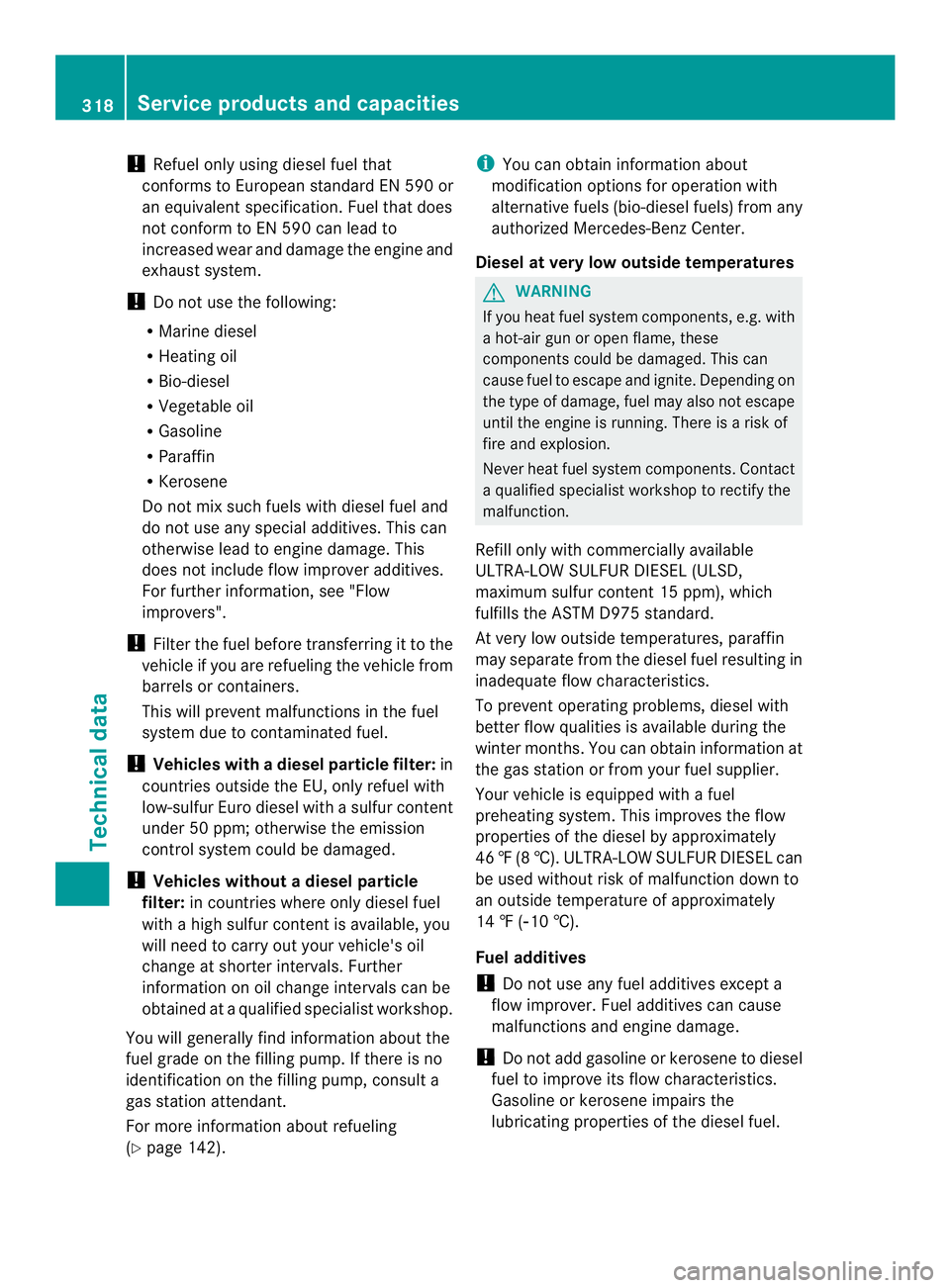
Refuel only using diesel fuel that
conforms to European standard EN 590 or
an equivalent specification. Fuel that does
not conform to EN 590 can lead to
increased wear and damage the engine and
exhaust system.
! Do not use the following:
R Marine diesel
R Heating oil
R Bio-diesel
R Vegetable oil
R Gasoline
R Paraffin
R Kerosene
Do not mix such fuels with diesel fuel and
do not use any special additives. This can
otherwise lead to engine damage.T his
does not include flow improver additives.
For further information, see "Flow
improvers".
! Filter the fuel before transferring it to the
vehicle if you are refueling the vehicle from
barrels or containers.
This will prevent malfunctions in the fuel
system due to contaminated fuel.
! Vehicles with adiesel particle filter: in
countries outside the EU, only refuel with
low-sulfur Euro diesel with a sulfur content
under 50 ppm; otherwise the emission
control syste mcould be damaged.
! Vehicles without adiesel particle
filter: in countries where only diesel fuel
with a high sulfur conten tis available, you
will need to carry out your vehicle's oil
change at shorter intervals. Further
information on oil change intervals can be
obtained at a qualified specialist workshop.
You will generally find information aboutt he
fuel grade on the filling pump. If there is no
identification on the filling pump, consult a
gas station attendant.
For more information about refueling
(Y page 142). i
You can obtain information about
modification options for operation with
alternative fuels (bio-diesel fuels) from any
authorized Mercedes-Ben zCenter.
Diesel at very low outside temperatures G
WARNING
If you heat fuel system components, e.g. with
a hot-air gun or open flame, these
components could be damaged. This can
cause fuel to escape and ignite. Depending on
the type of damage, fuel may also not escape
until the engine is running. There is a risk of
fire and explosion.
Never heat fuel system components. Contact
a qualified specialist workshop to rectify the
malfunction.
Refill only with commercially available
ULTRA-LOW SULFUR DIESEL (ULSD,
maximum sulfur content 15 ppm), which
fulfills the ASTM D975s tandard.
At very low outside temperatures, paraffin
may separate fro mthe diesel fuel resulting in
inadequate flow characteristics.
To prevent operating problems, diesel with
better flow qualities is available during the
winter months. You can obtain information at
the gas station or from your fuel supplier.
Your vehicle is equipped with afuel
preheating system. This improves the flow
properties of the diesel by approximately
46 ‡(8 †). ULTRA-LOW SULFUR DIESEL can
be used without risk of malfunction dow nto
an outside temperature of approximately
14 ‡ (002710 †).
Fuel additives
! Do no tuse any fuel additives except a
flow improver. Fuel additives can cause
malfunctions and engine damage.
! Do not add gasoline or kerosene to diesel
fuel to improve its flow characteristics.
Gasoline or kerosene impairs the
lubricating properties of the diesel fuel. 318
Service products and capacitiesTechnical data
Page 326 of 334
The steering is maintenance-free. Further
information can be obtained at any qualified
specialist workshop.
Brake fluid
G
WARNING
Brake fluid is hazardous to health. Do not
swallow brake fluid. See adoctor immediately
if you swallow brake fluid.
Make sure that brake fluid does not come into
contact with skin, clothing or eyes. Rinse
affected areas with plenty of clean water and
consult a doctor if necessary.
Always wear gloves and eye protection when
topping up brake fluid.
Store brake fluid only in the original closed
container and keep it out of the reach of
children. Comply with safety regulations
when handling brake fluid. G
WARNING
The brake fluid constantly absorbs moisture
from the air. This lowers the boiling point of
the brake fluid. If the boiling point of the brake
fluid is too low, vapor pockets may form in the
brake system when the brakes are applied
hard. This would impair braking efficiency.
There is a risk of an accident.
You should have the brake fluid renewed at
the specified intervals.
! Brake fluid corrodes paint, plastic and
rubber. If paint, plastic or rubber has come
into contact with brake fluid, rinse with
water immediately.
Only use brake fluids approved for Sprinter
vehicles. Always check for the identification
DOT 4plus.
Information about approved brake fluids can
be found in the Maintenance Booklet or
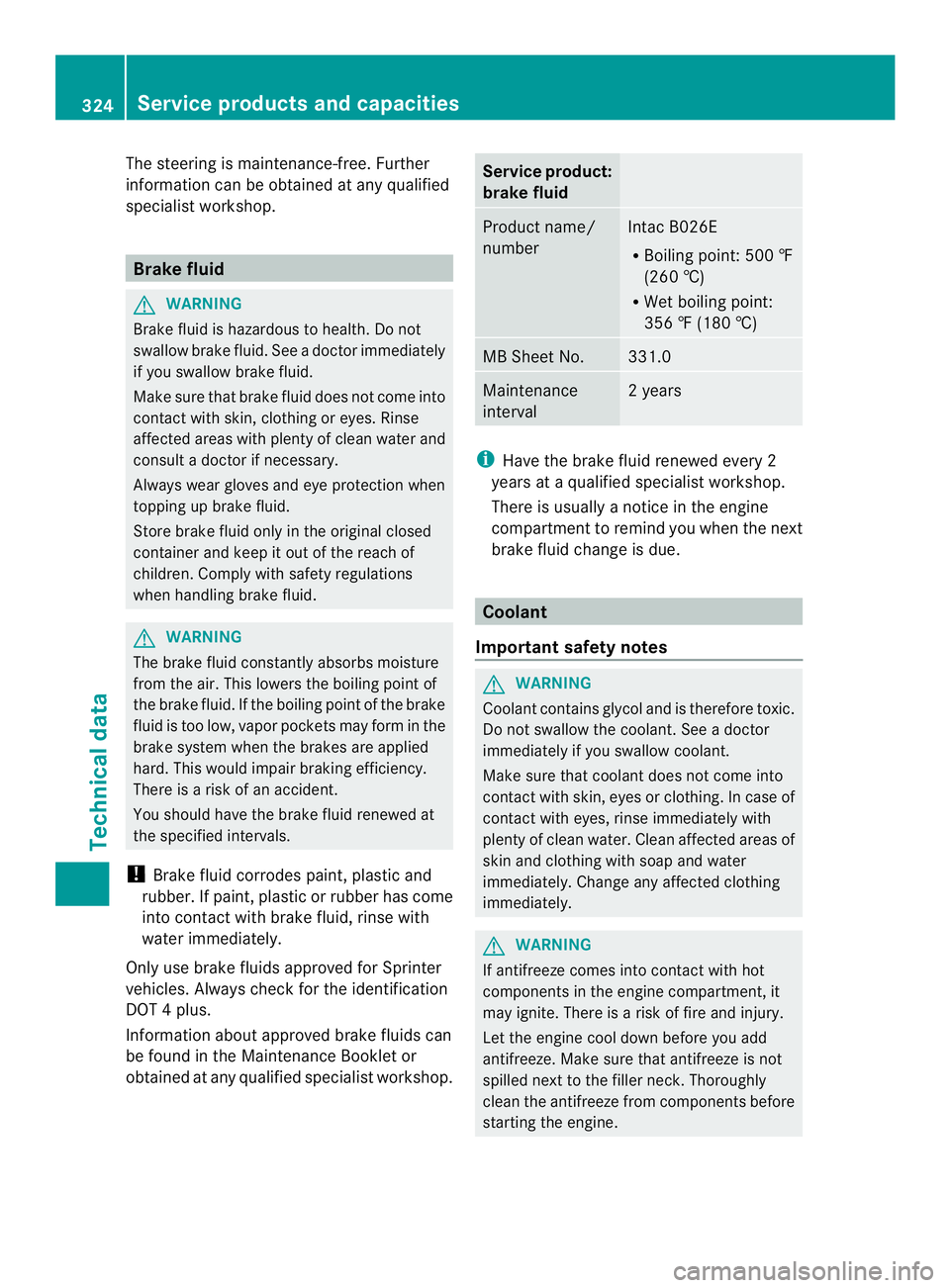
obtained at any qualified specialist workshop. Service product:
brake fluid Produc
tname/
number Intac B026E
R
Boiling point: 500 ‡
(260 †)
R Wet boiling point:
356 ‡ (180 †) MB Sheet No. 331.0
Maintenance
interval 2y
ears i
Have the brake fluid renewed every 2
years at a qualified specialist workshop.
There is usually a notice in the engine
compartment to remind you when the next
brake fluid change is due. Coolant
Important safety notes G
WARNING
Coolant contains glycol and is therefore toxic.
Do not swallow the coolant .See a doctor
immediately if you swallow coolant.
Make sure that coolant does not come into
contact with skin, eyes or clothing. In case of
contact with eyes, rinse immediately with
plenty of clean water. Clean affected areas of
skin and clothing with soap and water
immediately. Change any affected clothing
immediately. G
WARNING
If antifreeze comes into contact with hot
components in the engine compartment, it
may ignite. There is a risk of fire and injury.
Let the engine cool down before you add
antifreeze. Make sure that antifreeze is not
spilled nextt o the filler neck.T horoughly
clean the antifreeze from components before
starting the engine. 324
Service products and capacitiesTechnical data
Page 328 of 334
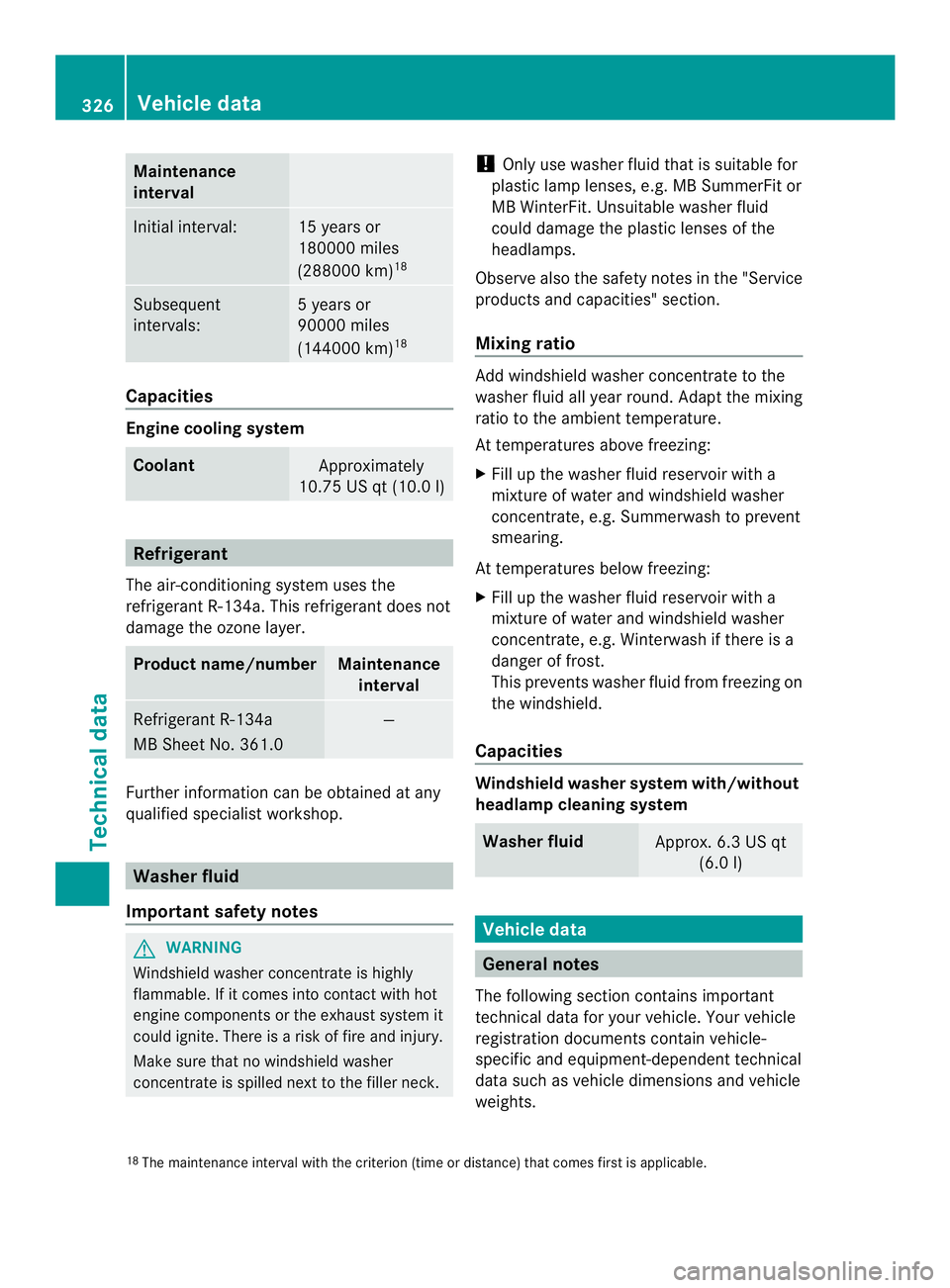
Maintenance
interval
Initial interval: 15 years or
180000 miles
(288000 km)
18 Subsequent
intervals: 5y
ears or
90000 miles
(144000 km) 18 Capacities
Engine cooling system
Coolant
Approximately
10.75 US qt (10.0 l) Refrigerant
The air-conditioning system uses the
refrigerant R-134a. This refrigerant does not
damage the ozone layer. Product name/number Maintenance
interval Refrigerant R-134a
MB Sheet No. 361.0 —
Further information can be obtained at any
qualified specialist workshop.
Washer fluid
Important safety notes G
WARNING
Windshield washer concentrate is highly
flammable. If it comes into contact with hot
engine components or the exhaust system it
could ignite. There is a risk of fire and injury.
Make sure that no windshield washer
concentrate is spilled next to the filler neck. !
Only use washer fluid that is suitable for
plastic lamp lenses, e.g. MB SummerFit or
MB WinterFit .Unsuitabl ewasher fluid
could damage the plastic lenses of the
headlamps.
Observe also the safety notes in the "Service
products and capacities" section.
Mixing ratio Add windshield washe
rconcentrate to the
washer fluid all year round. Adapt the mixing
ratio to the ambient temperature.
At temperatures above freezing:
X Fill up the washer fluid reservoir with a
mixture of water and windshield washer
concentrate, e.g. Summerwash to prevent
smearing.
At temperatures below freezing:
X Fill up the washer fluid reservoir with a
mixture of water and windshield washer
concentrate, e.g. Winterwash if there is a
danger of frost.
This prevents washer fluid from freezing on
the windshield.
Capacities Windshield washer system with/without
headlam
pcleaning system Washer fluid
Approx. 6.3 US qt
(6.0 l) Vehicle data
General notes
The following section contain simportant
technical data for yourv ehicle. Your vehicle
registration documents contain vehicle-
specific and equipment-dependen ttechnical
data such as vehicle dimensions and vehicle
weights.
18 The maintenance interval with the criterion (time or distance) that comes first is applicable. 326
Vehicle dataTechnical data
Page 329 of 334
Cargo tie-down points and carrier
systems
Cargo tie-down points General notes
!
Observe the informatio nonthe maximum
loading capacity of the individual cargo tie-
down points.
If you use several cargo tie-down points to
secure a load, you must always take the
maximum loading capacity of the weakest
cargo tie-down point into account.
If you brake hard, for example, the forces
acting could be up to several times the
weight force of the load. Always use
multiple cargo tie-down points in order to
distribute the force absorption. Load the
anchorages evenly.
You will find further information about cargo
tie-down points and cargo tie-down rings in
the "Transporting" section (Y page 234).
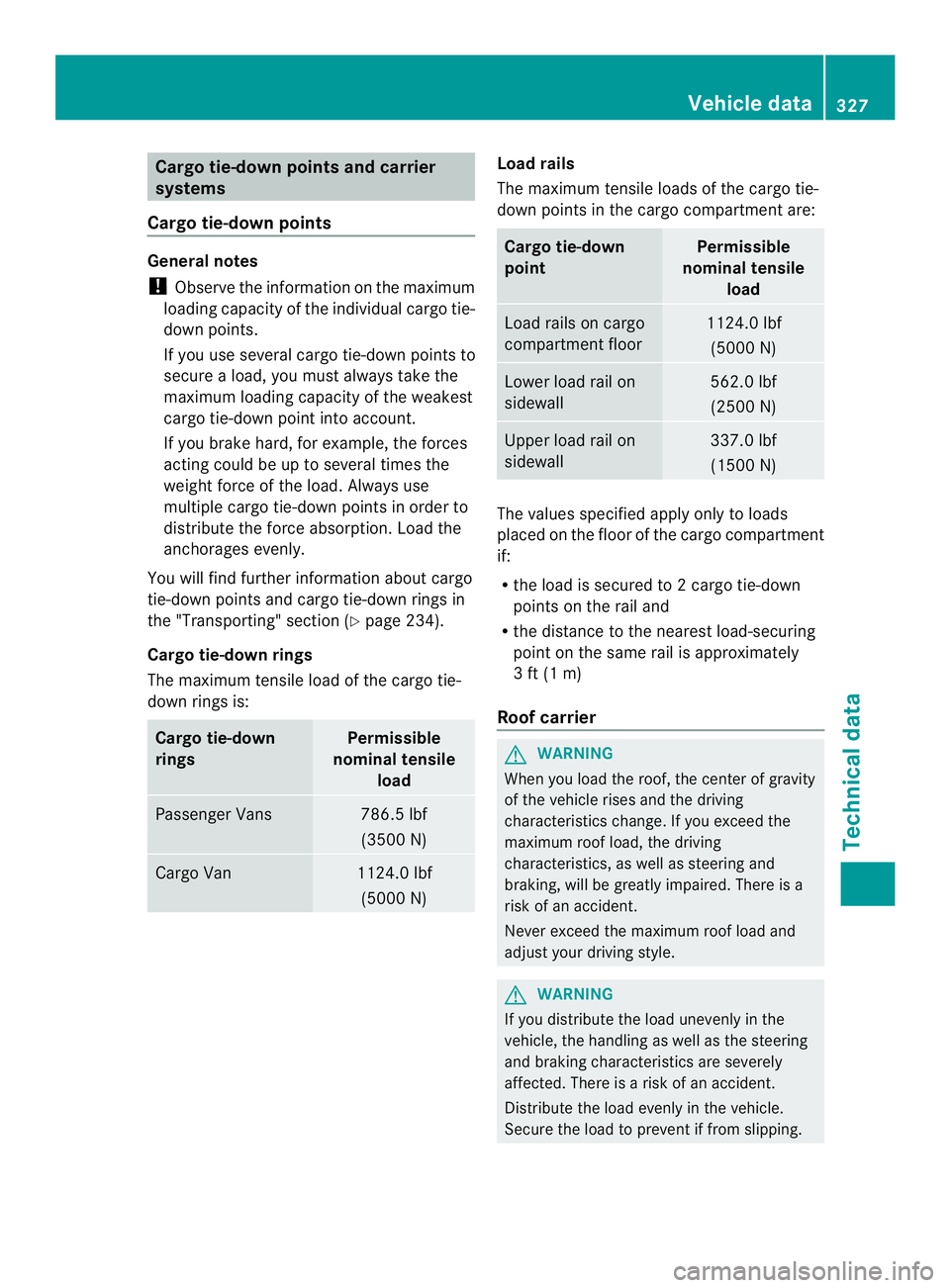
Cargo tie-down rings
The maximum tensile load of the cargo tie-
down rings is: Cargo tie-down
rings Permissible
nominal tensile load Passenger Vans 786.5 lbf
(3500 N) Cargo Van 1124.0 lbf
(5000 N) Load rails
The maximum tensile loads of the cargo tie-
down points in the cargo compartment are:
Cargo tie-down
point Permissible
nominal tensile load Load rails on cargo
compartment floor 1124.0 lbf
(5000 N) Lower load rail on
sidewall 562.0 lbf
(2500 N) Upper load rail on
sidewall 337.0 lbf
(1500 N) The values specified apply only to loads
placed on the floor of the cargo compartment
if:
R
the load is secured to 2cargo tie-down
points on the rail and
R the distance to the neares tload-securing
point on the same rail is approximately
3 ft (1 m)
Roof carrier G
WARNING
When you load the roof, the center of gravity
of the vehicle rises and the driving
characteristics change. If you exceed the
maximum roof load, the driving
characteristics, as well as steering and
braking, will be greatly impaired. There is a
risk of an accident.
Never exceed the maximum roof load and
adjust your driving style. G
WARNING
If you distribute the load unevenly in the
vehicle, the handling as well as the steering
and braking characteristics are severely
affected. There is a risk of an accident.
Distribute the load evenly in the vehicle.
Secure the load to prevent if from slipping. Vehicle data
327Technical data Z