fuel MERCEDES-BENZ SPRINTER 2013 MY13 Operator’s Manual
[x] Cancel search | Manufacturer: MERCEDES-BENZ, Model Year: 2013, Model line: SPRINTER, Model: MERCEDES-BENZ SPRINTER 2013Pages: 334, PDF Size: 3.88 MB
Page 28 of 334
G
WARNING
Objects in the driver's footwell can restrict the
pedal travel or obstruct adepressed pedal.
The operating and road safety of the vehicle
is jeopardized. There is a risk of an accident.
Make sure that all objects in the vehicle are
stowed correctly, and that they cannot enter
the driver's footwell. Install the floormats
securely and as specified in order to ensure
sufficien tclearance for the pedals. Do not use
loose floormats.
! If the engine is switched off and a device
which is connected to the on-board
diagnostics connection is being used, the
battery may discharge.
Connecting equipmen tto the diagnostics
connections can lead to emissions
monitoring information being reset. The
possible outcome may be that the vehicle no
longer fulfills the emissions laws and
regulations. This may be acriminal offense or
breach of road traffic regulations in certain
countries. Qualified specialist workshops
An authorized Sprinter Deale ris a qualified
specialist workshop. Aqualified specialist
workshop has the necessary specialist
knowledge, tools and qualifications to
correctly carry out the work required on the
vehicle. This is especially the case for work
relevan tto safety.
Observe the information in the Maintenance
Booklet.
The following work should always be carried
out at qualified specialist workshop:
R work relevant to safety
R service and maintenance work
R repair work
R modifications as well as installations and
alterations
R work on electronic components For this reason, we recommend an authorized
Sprinter Dealer. Proper use
G
WARNING
Gases and fluids from substances that
constitute a health hazard or react
aggressively can escape even from securely
closed containers. When transporting such
substances in the vehicle interior, your ability
to concentrate or your health could be
affected during the journey. Malfunctions,
short circuits or electrical componen tsystem
failures may also result .There is a risk of an
accident and fire.
Do not store or transport any substances in
the vehicle interior which are hazardous to
health or react aggressively.
Do not store or transport any substances in
the vehicle interior which are hazardous to
health or react aggressively.
These include:
R solvents
R fuel
R oils and greases
R cleaning agents
R acids
There are various warning stickers affixed to
your vehicle. If you remove warning stickers,
others may fail to recognize the dangers.
Leave the warning stickers in their original
position.
Observe the following information when
operating your vehicle:
R the safety information in these instructions
R the “Technical data“ section in this
Operator's Manual
R traffic rules and regulations
R motor vehicle laws and safety standards 26
Introduction
Page 29 of 334
Exhaust gas aftertreatment
The exhaust gas aftertreatmen trequires a
reducing agent known as Diesel Exhaust Fluid
(DEF) in order to function correctly. Filling up
the DEF tank is usually part of the service
scope. DEFc onsumption depends on
operational and driving conditions and it is
not necessary to wait until the next scheduled
service to replenish the fluid. Fluid should be
added regularly to the DEFs upply reservoir
during vehicle operation or, at the latest, after
receiving the first warning message via the
on-board computer.
To conform to emission regulations, you must
operate the vehicle with DE Fand refill the
supply regularly .The engine management
recognizes attempts to operate the vehicle
without DEF, with thinned DEF or with
another reducing agent. After previous
warning messages, the engine management
then prevents a further engine start.
If the DEF level drops below 1.5 US gal
(5.5 l), the first warning message is issued
and a warning tone sounds. After the
message appears for the first time, and under
normal driving conditions, the remaining DEF
supply will last for approximately 1,000 mi
(1,600 km).
After that, the 0.8 US gal (3.0 l)reserve mark
is reached. Once the reserve range has been
reached, you will receive the next warning
message and you will hearas eries of warning
tones. After the first message, the DEF
reserve will last for approximately 1,200 mi
(1,900 km). However, you will only be able to
start the engine another 16 times.
You should immediately add 2.0 US gal
(7.6 l) of DEF (Y page 144) or have the DEF
supply reservoir filled at a qualified specialist
workshop.
When the number of remaining engine starts
is 0 , the engine management prevents the
engine being started.
If the 0018 checkengine indicator lamp lights
up, the exhaust gas aftertreatment is faulty or
an emission-related malfunctio nhas occurred (Y
page 204). You will then only be
able to drive a maximum 50 mi (80 km) before
the engine managemen trestricts the number
of starts remaining.
If the exhaust gas aftertreatment is faulty,
have it checked and repaired at a qualified
specialist workshop.
Further information on DEF can be found in
the "Refueling" ( Ypage 143) and "Service
products and capacities" (Y page 320)
sections. Attachments, bodies, equipment and
conversions
General notes !
For safety reasons, have add-on
equipment manufactured and installed
according to the Sprinter body/equipment
mounting directives in force. These body/
equipment mounting directives ensure that
the chassis and the body form one unit and
that maximum operating and road safety is
achieved.
We recommend for safety reasons that:
R you carry out no other modifications to
the vehicle.
R you obtain the agreement of the
distributor named on the inside of the
front cover for any deviations from the
approved body/equipment mounting
directives.
Approval from certified inspection
agencies or official approvals cannot rule
out risks to your safety.
We recommend that you use genuine
Mercedes-Benzp arts as well as conversion
parts and accessories that have been
specifically approved by Mercedes-Ben zfor
the type of vehicle.
These parts have been specially tested to
establish their safety, reliability and
suitability. Introduction
27 Z
Page 35 of 334
Instrumen
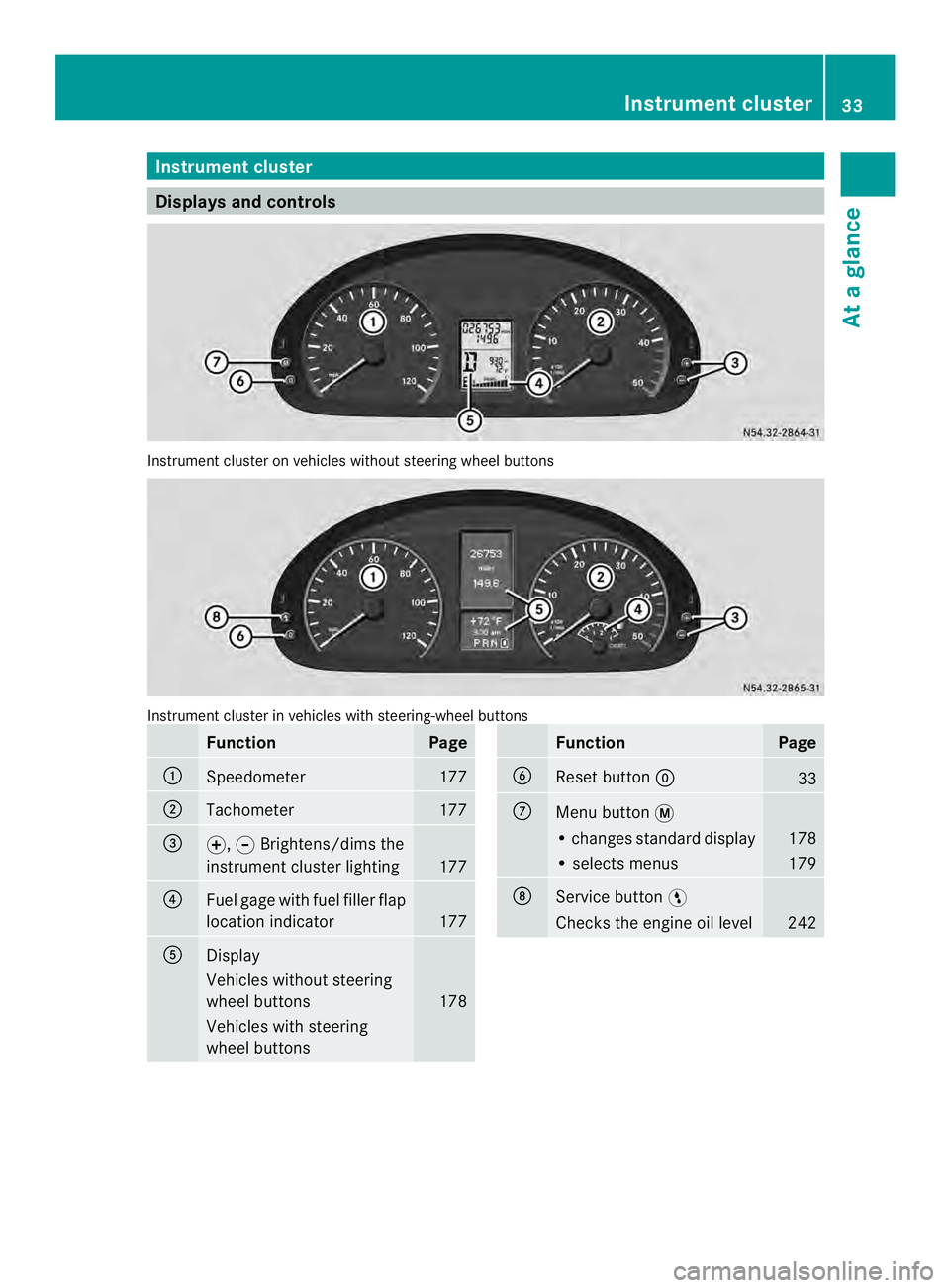
tcluster Displays and controls
Instrument cluster on vehicles without steering wheel buttons
Instrument cluster in vehicles with steering-wheel buttons
Function Page
0005
Speedometer 177
0006
Tachometer 177
0026
000E,
000FBrightens/dims the
instrumen tcluster lighting 177
0025
Fuel gage with fuel filler flap
location indicator
177
0023
Display
Vehicles without steering
wheel buttons
178
Vehicles with steering
wheel buttons Function Page
0024
Reset button
0007 33
0018
Menu button
0004 • changes standard display 178
• selects menus 179
0019
Service button
0012 Checks the engine oil level 242Instrument cluster
33At a glance
Page 37 of 334
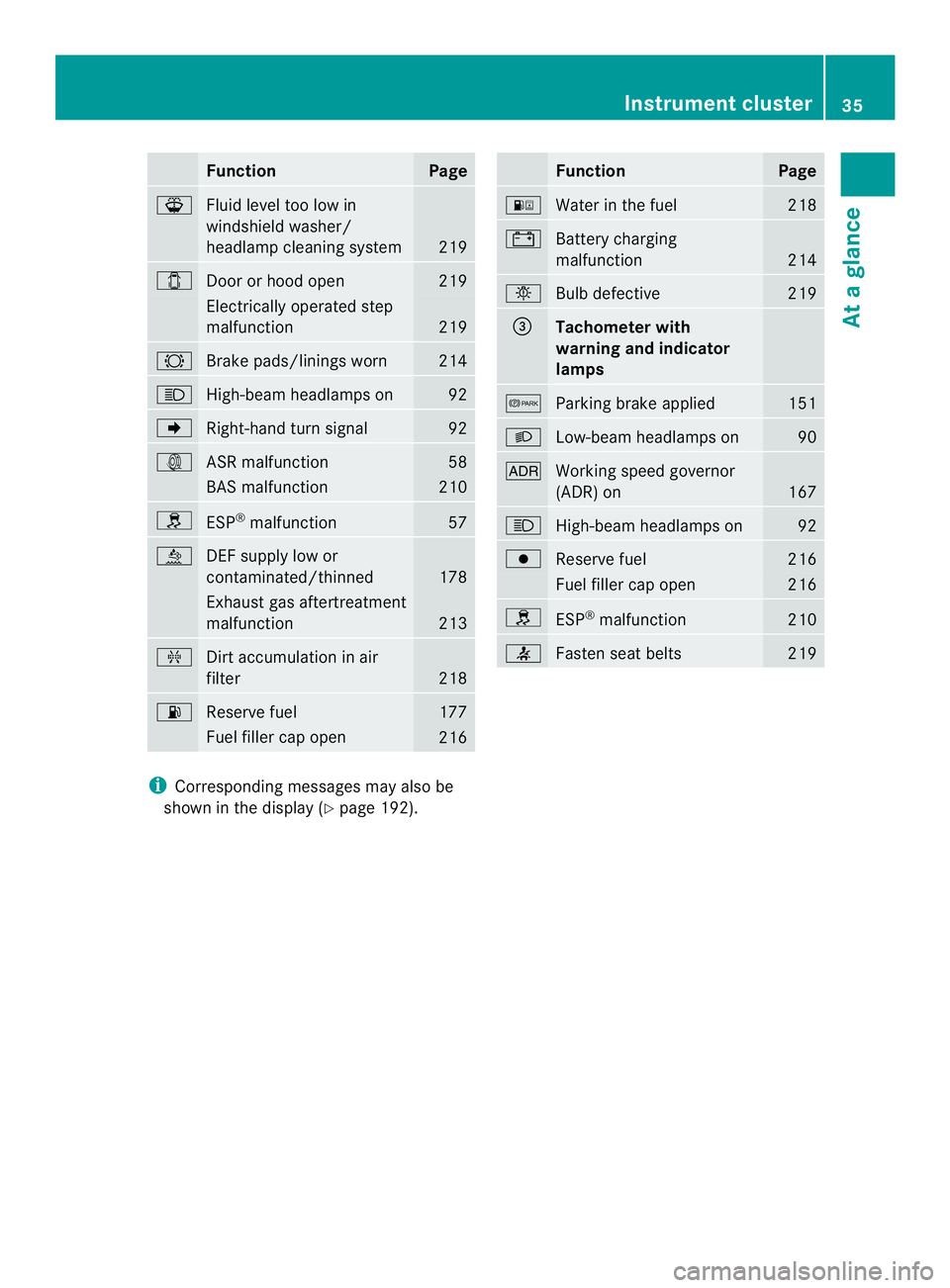
Function Page
000F
Fluid level too low in
windshield washer/
headlamp cleaning system
219
0004
Door or hood open 219
Electrically operated step
malfunction
219
0005
Brake pads/linings worn 214
0003
High-beam headlamps on 92
0003
Right-hand tur
nsignal 92
000A
ASR malfunction 58
BAS malfunction 210
0002
ESP
®
malfunction 57
0009
DE
Fs upply low or
contaminated/thinned 178
Exhaust gas aftertreatment
malfunction
213
0013
Dirt accumulation in air
filter
218
000A
Reserve fuel 177
Fuel fille
rcap open 216 Function Page
000E
Water in the fuel 218
0010
Battery charging
malfunction
214
0002
Bulb defective 219
0026
Tachometer with
warning and indicator
lamps
000B
Parking brake applied 151
0004
Low-beam headlamps on 90
0004
Working speed governor
(ADR) on
167
0003
High-beam headlamps on 92
0006
Reserve fuel 216
Fuel fille
rcap open 216
0002
ESP
®
malfunction 210
0014
Faste
nseat belts 219
i
Corresponding messages may also be
shown in the display (Y page 192). Instrument cluster
35At a glance
Page 121 of 334
The auxiliary heating works independently of
the engine and supplements the climate
control system in the vehicle. The auxiliary
heating heats the air in the vehicle interior to
the temperature set.
If your vehicle is equipped with a hot-water
auxiliary heater, the auxiliary heating also
keeps the coolant warm. This way, the load
on the engine is minimized and fuel is saved.
The heater booster function of the auxiliary
heating supports the climate control system
when the engine is runnin gand the outside
temperature is low.
You can use the auxiliary heating at an
outside temperature of up to 39 ‡ (4 †). At
an outside temperature above 39 ‡(4† ) the
auxiliary heating system and the heater
booster function switch off automatically.
i If the interior motion sensor (Y page 61)
is armed and the auxiliary heating is
switched on, it is possible that the interior
temperature monitoring may cause a false
alarm. In this case, either deactivate the
interior motion sensor or switch off the
auxiliary heating. Before switching on
X Check the fuel level and top up if necessary.
The auxiliary heating is operated directly
using the vehicle's fuel. The tan kmust be
at least a quarter full to ensure that the
auxiliary heating functions.
X Switch on climate control (Y page 112).
X Se tthe temperature control to the desired
temperature (Y page 113).
X Set the air distribution as required
(Y page 113).
X Open the center (Y page 117) and side air
vents (Y page 117) and set them to the
middle position.
i The auxiliary heating automatically
switches to heater booster mode after the
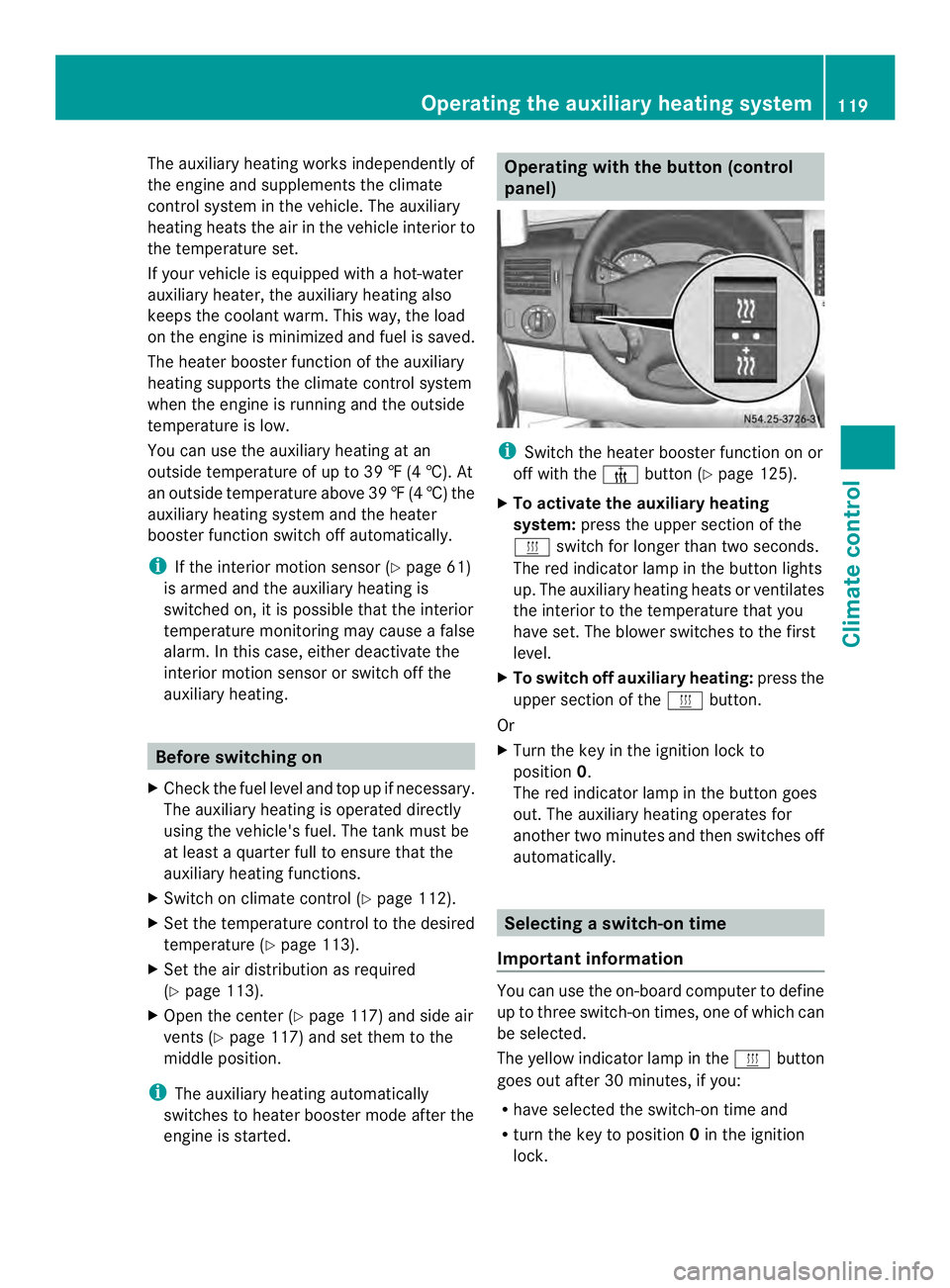
engine is started. Operating with the button (control
panel)
i
Switch the heater booster function on or
off with the 0013button (Y page 125).
X To activate the auxiliary heating
system: press the upper section of the
0020 switch for longer than two seconds.
The red indicator lamp in the button lights
up. The auxiliary heating heats or ventilates
the interior to the temperature that you
have set. The blower switches to the first
level.
X To switch off auxiliary heating: press the
upper section of the 0020button.
Or
X Turn the key in the ignition lock to
position 0.
The red indicator lamp in the button goes
out. The auxiliary heating operates for
another two minutes and then switches off
automatically. Selecting
aswitch-on time
Important information You can use the on-boar
dcomputer to define
up to three switch-on times, one of which can
be selected.
The yellow indicator lamp in the 0020button
goes out after 30 minutes, if you:
R have selected the switch-on time and
R turn the key to position 0in the ignition
lock. Operating the auxiliary heating system
119Climate control Z
Page 128 of 334
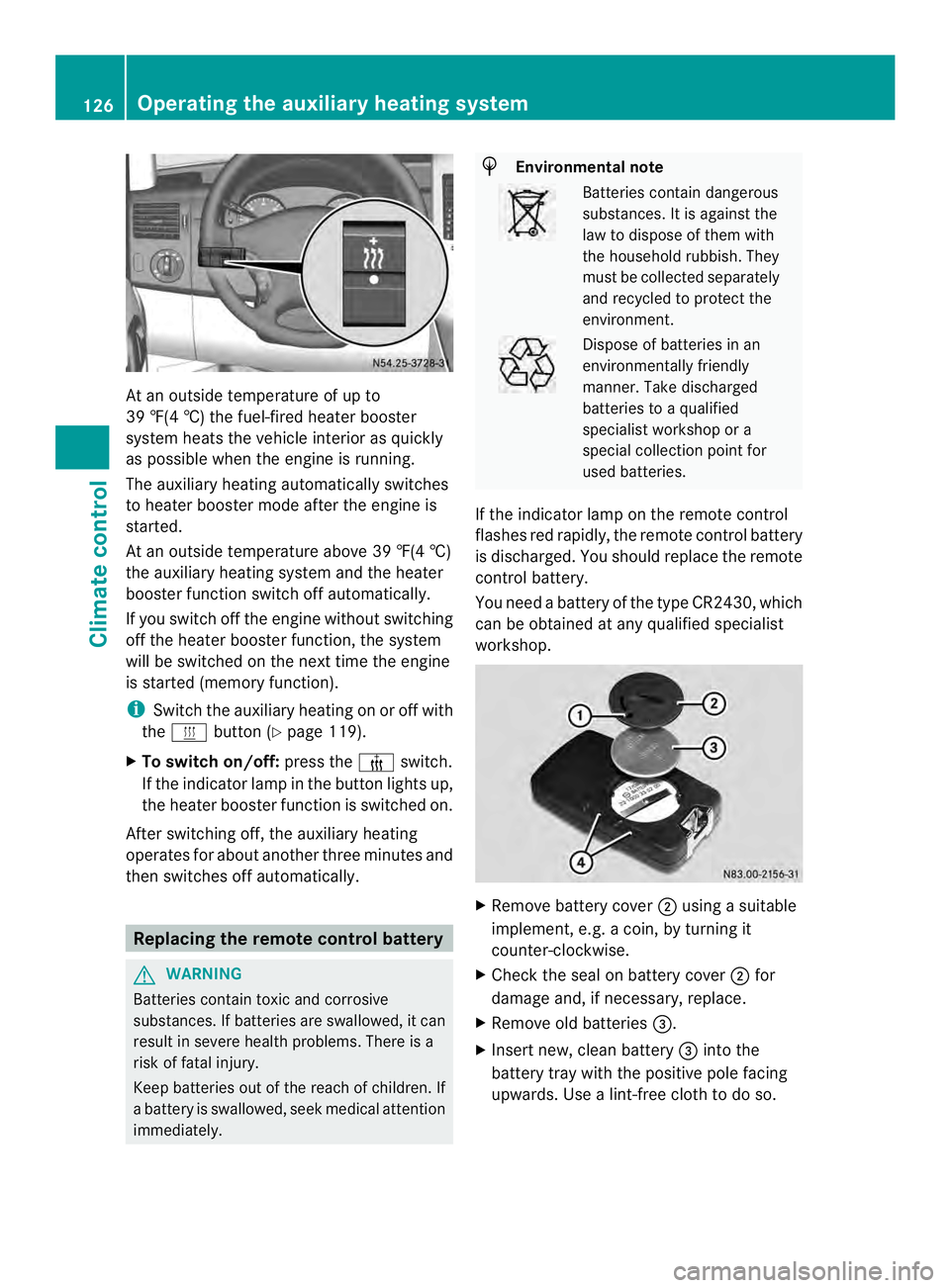
At an outside temperature of up to
39 ‡(4 †) the fuel-fired heate
rbooster
system heats the vehicle interior as quickly
as possible when the engine is running.
The auxiliary heating automatically switches
to heater booster mode after the engine is
started.
At an outside temperature above 39 ‡(4 †)
the auxiliary heating system and the heater
booster function switch off automatically.
If you switch off the engine without switching
off the heater booster function, the system
will be switched on the next time the engine
is started (memory function).
i Switch the auxiliary heating on or off with
the 0020 button (Y page 119).
X To switch on/off: press the0013switch.
If the indicator lamp in the button lights up,
the heater booster function is switched on.
After switching off, the auxiliary heating
operates for about another three minutes and
then switches off automatically. Replacing the remote control battery
G
WARNING
Batteries contain toxic and corrosive
substances. If batteries are swallowed, it can
result in severe health problems. There is a
risk of fatal injury.
Keep batteries out of the reach of children. If
a battery is swallowed, seek medical attention
immediately. H
Environmental note Batteries contain dangerous
substances. It is against the
law to dispose of them with
the household rubbish. They
must be collected separately
and recycled to protect the
environment.
Dispose of batteries in an
environmentally friendly
manner
.Take discharged
batteries to a qualified
specialist workshop or a
special collectio npoint for
used batteries.
If the indicator lamp on the remote control
flashes red rapidly, the remote control battery
is discharged. You should replace the remote
control battery.
You need a battery of the type CR2430, which
can be obtained at any qualified specialist
workshop. X
Remove battery cover 0006using a suitable
implement, e.g. a coin, by turning it
counter-clockwise.
X Check the seal on battery cover 0006for
damage and, if necessary, replace.
X Remove old batteries 0026.
X Insert new, clean battery 0026into the
battery tray with the positive pole facing
upwards. Use a lint-free cloth to do so. 126
Operating the auxiliary heating systemClimate control
Page 130 of 334
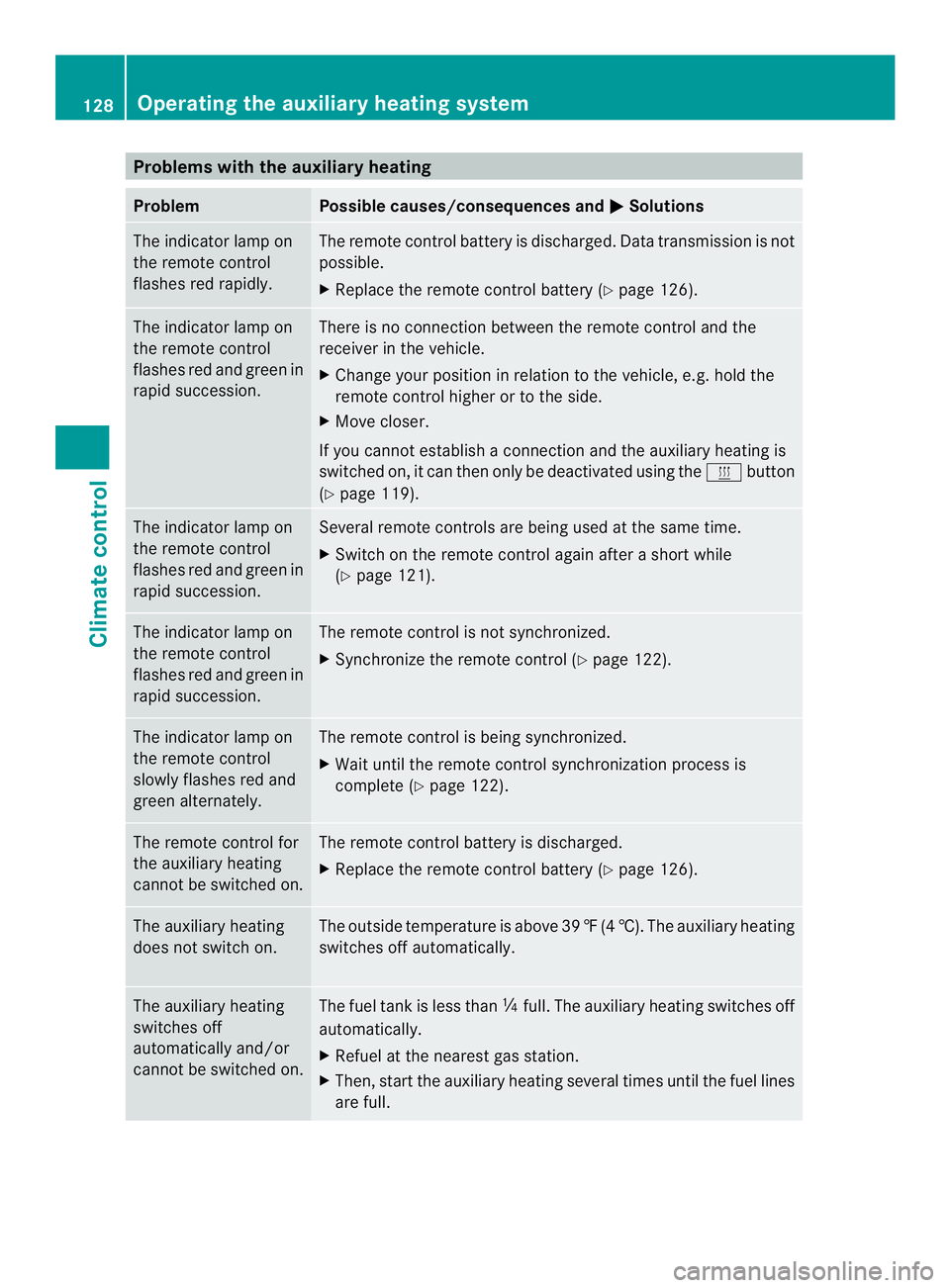
Problems with the auxiliary heating
Problem Possible causes/consequences and
0004 Solutions
The indicator lamp on
the remote control
flashes red rapidly. The remote control battery is discharged. Data transmission is not
possible.
X
Replace the remote control battery (Y page 126).The indicator lamp on
the remote control
flashes red and green in
rapid succession. There is no connection between the remote control and the
receiver in the vehicle.
X
Change your position in relation to the vehicle, e.g. hold the
remote control higher or to the side.
X Move closer.
If you cannot establish aconnection and the auxiliary heating is
switched on, it can then only be deactivated using the 0020button
(Y page 119). The indicator lamp on
the remote control
flashes red and green in
rapid succession. Several remote controls are being used at the same time.
X
Switch on the remote control again after a short while
(Y page 121). The indicator lamp on
the remote control
flashes red and green in
rapid succession. The remote control is not synchronized.
X
Synchronize the remote control (Y page 122).The indicator lamp on
the remote control
slowly flashes red and
green alternately. The remote control is being synchronized.
X
Wait until the remote control synchronization process is
complete (Y page 122). The remote control for
the auxiliary heating
cannot be switched on. The remote control battery is discharged.
X
Replace the remote control battery (Y page 126).The auxiliary heating
does not switch on. The outside temperature is above 39
‡(4† ). The auxiliary heating
switches off automatically. The auxiliary heating
switches off
automatically and/or
cannot be switched on. The fuel tan
kis less than 0002full. The auxiliary heating switches off
automatically.
X Refuel at the nearest gas station.
X Then, start the auxiliary heating several times until the fuel lines
are full. 128
Operating the auxiliary heating systemClimate control
Page 133 of 334
Useful information
............................132
Breaking-in notes .............................. 132
Driving ............................................... 132
Automatic transmission ...................138
Refueling ............................................ 142
Parking ............................................... 145
Driving tips ........................................ 147
Driving systems ................................ 155
Working mode ................................... 167
Towing atrailer ................................. 168 131Driving and parking
Page 139 of 334
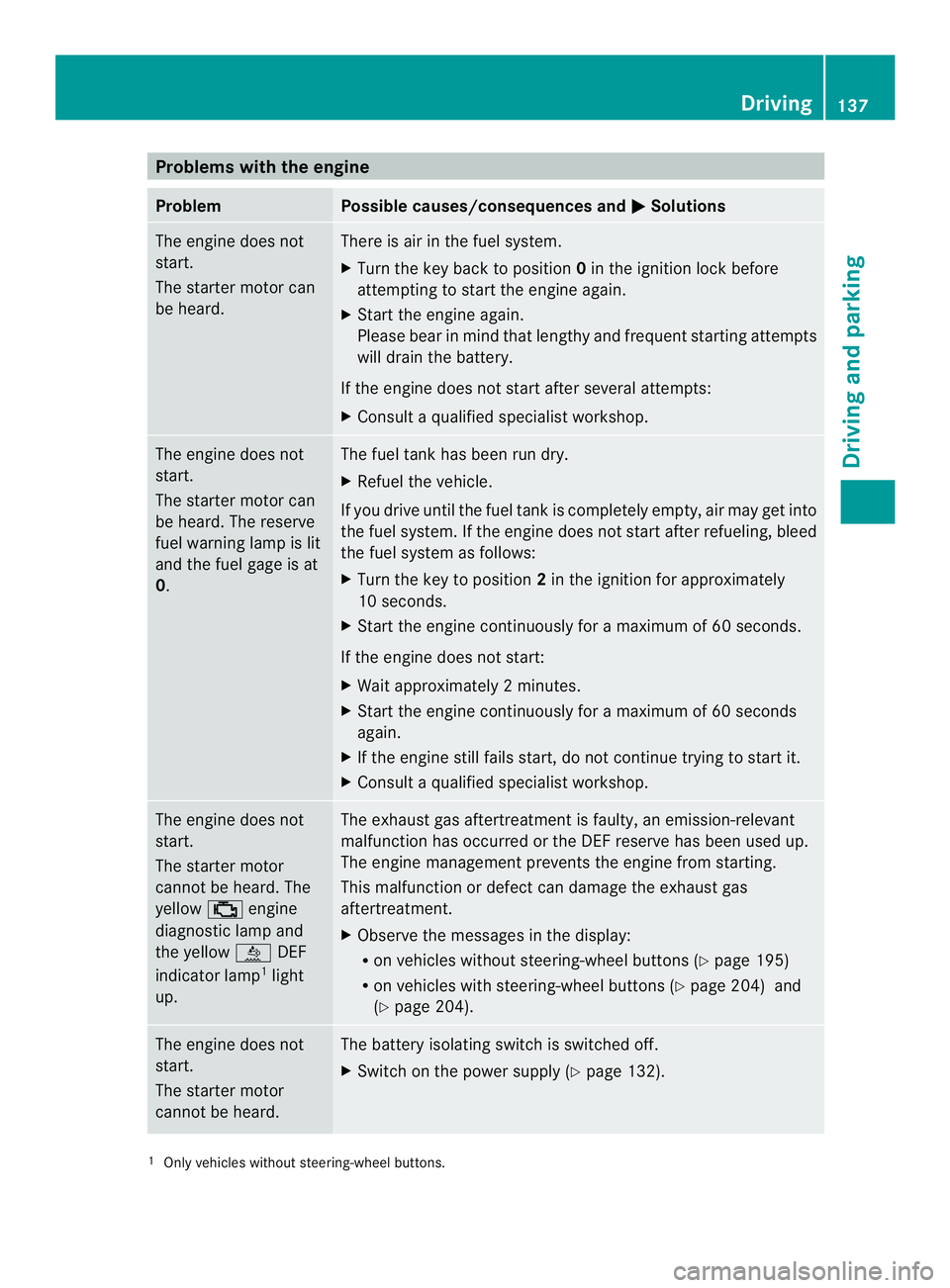
Problems with the engine
Problem Possible causes/consequences and
0004 Solutions
The engine does not
start.
The starter motor can
be heard. There is air in the fuel system.
X
Turn the key back to position 0in the ignition lock before
attempting to start the engine again.
X Start the engine again.
Please bear in mind that lengthy and frequent starting attempts
will drain the battery.
If the engine does not start after several attempts:
X Consult a qualified specialist workshop. The engine does not
start.
The starter motor can
be heard. The reserve
fuel warning lamp is lit
and the fuel gage is at
0. The fuel tank has been run dry.
X
Refuel the vehicle.
If you drive until the fuel tank is completely empty, air may get into
the fuel system. If the engine does not start after refueling, bleed
the fuel system as follows:
X Turn the key to position 2in the ignition for approximately
10 seconds.
X Start the engine continuously for a maximum of 60 seconds.
If the engine does not start:
X Wait approximately 2minutes.
X Start the engine continuously for a maximum of 60 seconds
again.
X If the engine still fails start, do not continue trying to start it.
X Consult a qualified specialist workshop. The engine does not
start.
The starter motor
cannot be heard. The
yellow
0018engine
diagnostic lamp and
the yellow 0009DEF
indicator lamp 1
light
up. The exhaust gas aftertreatmen
tis faulty, an emission-relevant
malfunction has occurred or the DEF reserve has been used up.
The engine management prevents the engine from starting.
This malfunction or defect can damage the exhaust gas
aftertreatment.
X Observe the messages in the display:
R on vehicles without steering-wheel buttons (Y page 195)
R on vehicles with steering-wheel buttons (Y page 204) and
(Y page 204). The engine does not
start.
The starter motor
cannot be heard. The battery isolating switch is switched off.
X
Switch on the power supply (Y page 132).1
Only vehicles without steering-wheel buttons. Driving
137Driving and parking Z
Page 144 of 334
lock in parking position
P, e.g. to have the
vehicle towed away. Refueling
Important safety notes
G
WARNING
Fuel is highly flammable. Improper handing of
fuel creates a risk of fire and explosion.
Avoid fire, open flames ,smoking and creating
sparks under all circumstances. Switch off the
engine and, if applicable, the auxiliary heating
before refueling. G
WARNING
Fuel is poisonous and hazardous to health.
There is a risk of injury.
You must make sure that fuel does not come
into contact with your skin, eyes or clothing
and that it is not swallowed. Do not inhale fuel
vapors .Keep fuel away from children.
If you or others come into contact with fuel,
observe the following:
R Wash away fuel from skin immediately
using soap and water.
R If fuel comes into contact with your eyes,
immediately rinse them thoroughly with
clean water. Seek medical assistance
without delay.
R If fuel is swallowed, seek medical
assistance without delay. Do not induce
vomiting.
R Immediately change out of clothing which
has come into contact with fuel. G
WARNING
If you mix diesel fuel with gasoline, the flash
point is lower than that of pure diesel fuel.
When the engine is running, exhaust system
components could overheat without being
noticed. There is a risk of fire.
Never refuel with gasoline. Never mix gasoline
with diesel fuel. H
Environmental note
If fuels are handled improperly, they pose a
danger to persons and the environment. Do
not allow fuels to run into the sewage system,
the surface waters, the ground water or into
the ground.
! Do not use gasoline to refuel vehicles with
a diesel engine. Even small amounts of
gasoline will cause damage to the fuel
system and engine.
! Do not switch on the ignition if you
accidentally refuel with the wrong fuel.
Otherwise, the fuel will enter the fuel lines.
Notify a qualified specialist workshop and
have the fuel tank and fuel lines drained
completely.
! Overfilling the fuel tank could damage the
fuel system.
! Take care not to spill any fuel on painted
surfaces. You could otherwise damage the
paintwork.
! Filter the fuel before transferring it to the
vehicle if you are refueling the vehicle from
barrels or containers.
This will preven tmalfunctions in the fuel
system due to contaminate dfuel.
Further information on fuel and on fuel grades
can be found in the "Technical data" section
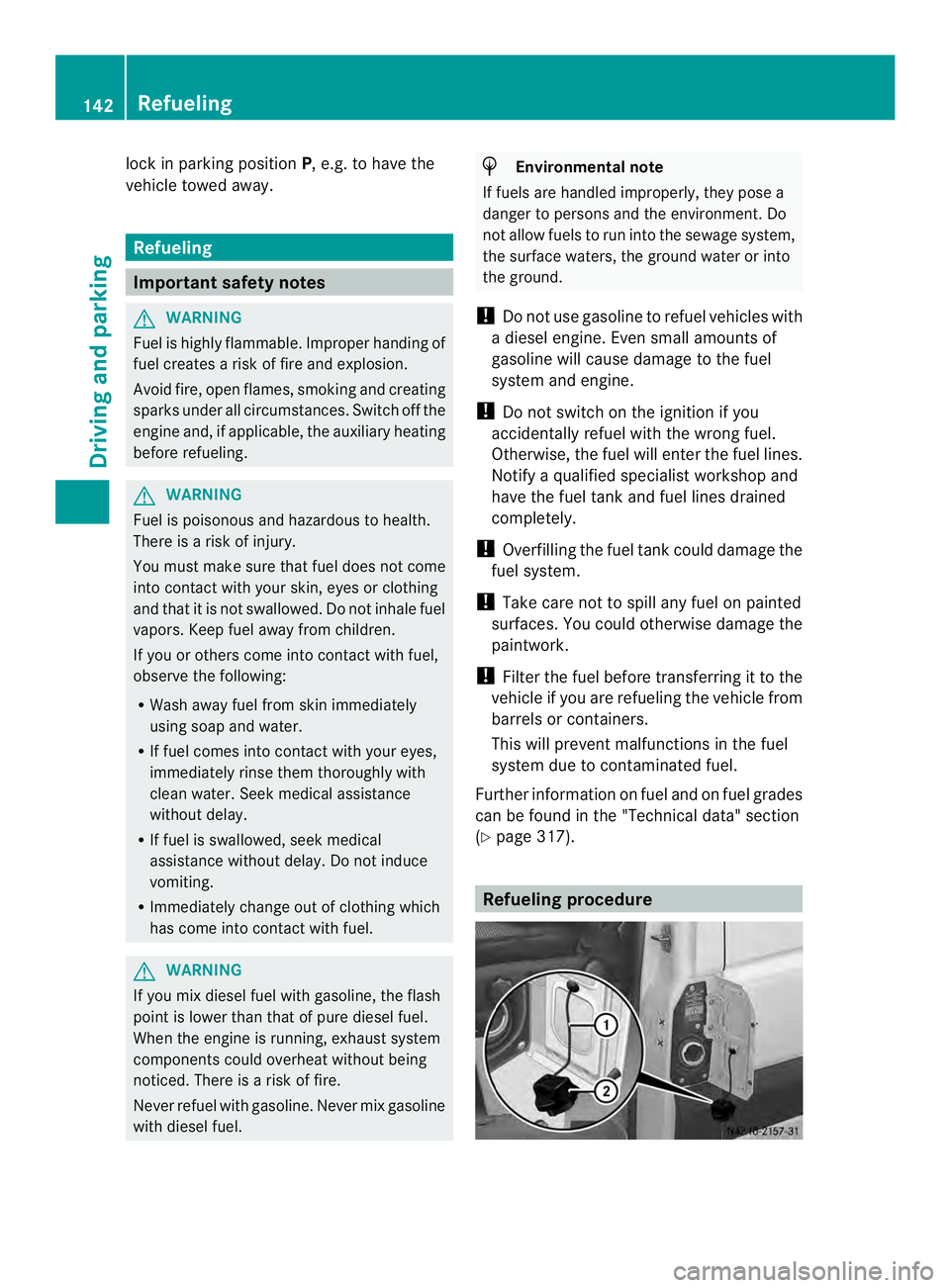
(Y page 317). Refueling procedure142
RefuelingDriving and pa
rking