seats MERCEDES-BENZ SPRINTER 2015 MY15 Operator’s Manual
[x] Cancel search | Manufacturer: MERCEDES-BENZ, Model Year: 2015, Model line: SPRINTER, Model: MERCEDES-BENZ SPRINTER 2015Pages: 334, PDF Size: 5.94 MB
Page 56 of 334
0043
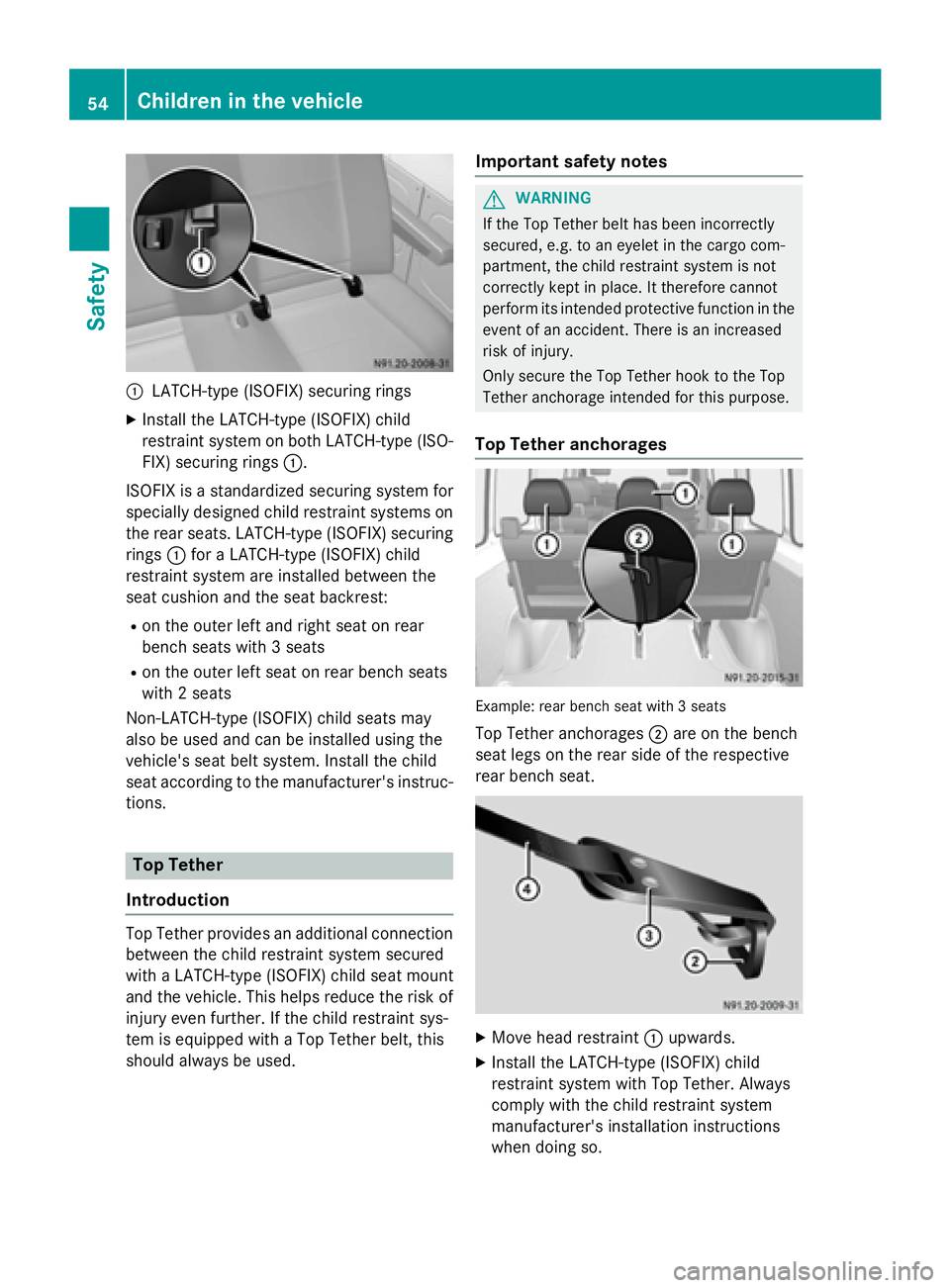
LATCH-type (ISOFIX) securing rings
X Install the LATCH-type (ISOFIX) child
restraint system on both LATCH-type (ISO-
FIX) securing rings 0043.
ISOFIX is a standardized securing system for
specially designed child restraint systems on
the rear seats. LATCH-type (ISOFIX) securing rings 0043for a LATCH-type (ISOFIX) child
restraint system are installed between the
seat cushion and the seat backrest:
R on the outer left and right seat on rear
bench seats with 3 seats
R on the outer left seat on rear bench seats
with 2 seats
Non-LATCH-type (ISOFIX) child seats may
also be used and can be installed using the
vehicle's seat belt system. Install the child
seat according to the manufacturer's instruc- tions. Top Tether
Introduction Top Tether provides an additional connection
between the child restraint system secured
with a LATCH-type (ISOFIX) child seat mount
and the vehicle. This helps reduce the risk of
injury even further. If the child restraint sys-
tem is equipped with a Top Tether belt, this
should always be used. Important safety notes G
WARNING
If the Top Tether belt has been incorrectly
secured, e.g. to an eyelet in the cargo com-
partment, the child restraint system is not
correctly kept in place. It therefore cannot
perform its intended protective function in the
event of an accident. There is an increased
risk of injury.
Only secure the Top Tether hook to the Top
Tether anchorage intended for this purpose.
Top Tether anchorages Example: rear bench seat with 3 seats
Top Tether anchorages 0044are on the bench
seat legs on the rear side of the respective
rear bench seat. X
Move head restraint 0043upwards.
X Install the LATCH-type (ISOFIX) child
restraint system with Top Tether. Always
comply with the child restraint system
manufacturer's installation instructions
when doing so. 54
Children in the vehicleSafety
Page 57 of 334
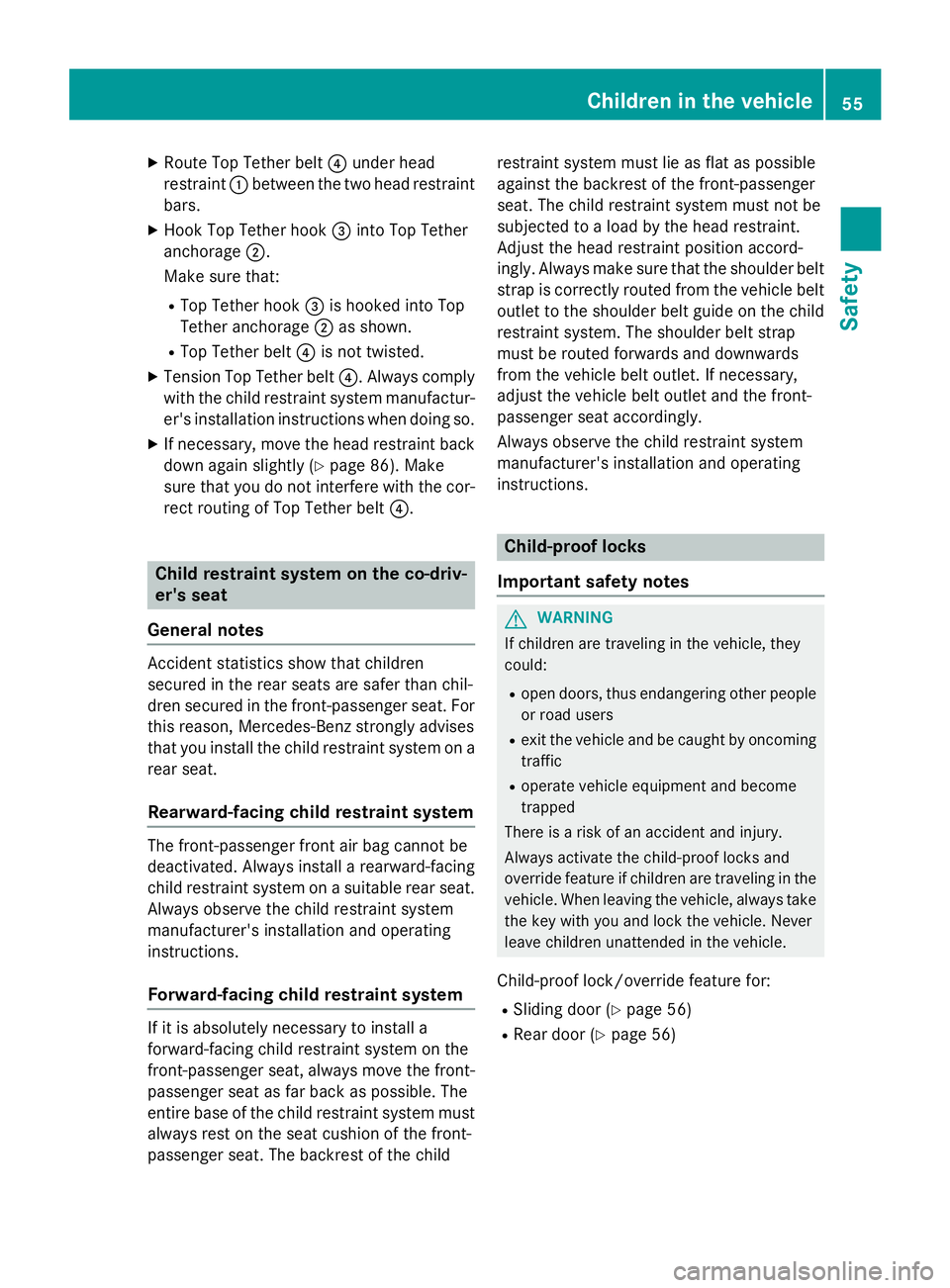
X
Route Top Tether belt 0085under head
restraint 0043between the two head restraint
bars.
X Hook Top Tether hook 0087into Top Tether
anchorage 0044.
Make sure that:
R Top Tether hook 0087is hooked into Top
Tether anchorage 0044as shown.
R Top Tether belt 0085is not twisted.
X Tension Top Tether belt 0085. Always comply
with the child restraint system manufactur- er's installation instructions when doing so.
X If necessary, move the head restraint back
down again slightly (Y page 86). Make
sure that you do not interfere with the cor-
rect routing of Top Tether belt 0085.Child restraint system on the co-driv-
er's seat
General notes Accident statistics show that children
secured in the rear seats are safer than chil-
dren secured in the front-passenger seat. For this reason, Mercedes-Benz strongly advises
that you install the child restraint system on a
rear seat.
Rearward-facing child restraint system The front-passenger front air bag cannot be
deactivated. Always install a rearward-facing
child restraint system on a suitable rear seat.
Always observe the child restraint system
manufacturer's installation and operating
instructions.
Forward-facing child restraint system If it is absolutely necessary to install a
forward-facing child restraint system on the
front-passenger seat, always move the front- passenger seat as far back as possible. The
entire base of the child restraint system must
always rest on the seat cushion of the front-
passenger seat. The backrest of the child restraint system must lie as flat as possible
against the backrest of the front-passenger
seat. The child restraint system must not be
subjected to a load by the head restraint.
Adjust the head restraint position accord-
ingly. Always make sure that the shoulder belt strap is correctly routed from the vehicle belt
outlet to the shoulder belt guide on the child
restraint system. The shoulder belt strap
must be routed forwards and downwards
from the vehicle belt outlet. If necessary,
adjust the vehicle belt outlet and the front-
passenger seat accordingly.
Always observe the child restraint system
manufacturer's installation and operating
instructions. Child-proof locks
Important safety notes G
WARNING
If children are traveling in the vehicle, they
could:
R open doors, thus endangering other people
or road users
R exit the vehicle and be caught by oncoming
traffic
R operate vehicle equipment and become
trapped
There is a risk of an accident and injury.
Always activate the child-proof locks and
override feature if children are traveling in the vehicle. When leaving the vehicle, always take
the key with you and lock the vehicle. Never
leave children unattended in the vehicle.
Child-proof lock/override feature for: R Sliding door (Y page 56)
R Rear door (Y page 56) Child
ren in the vehi cle
55Safety Z
Page 63 of 334
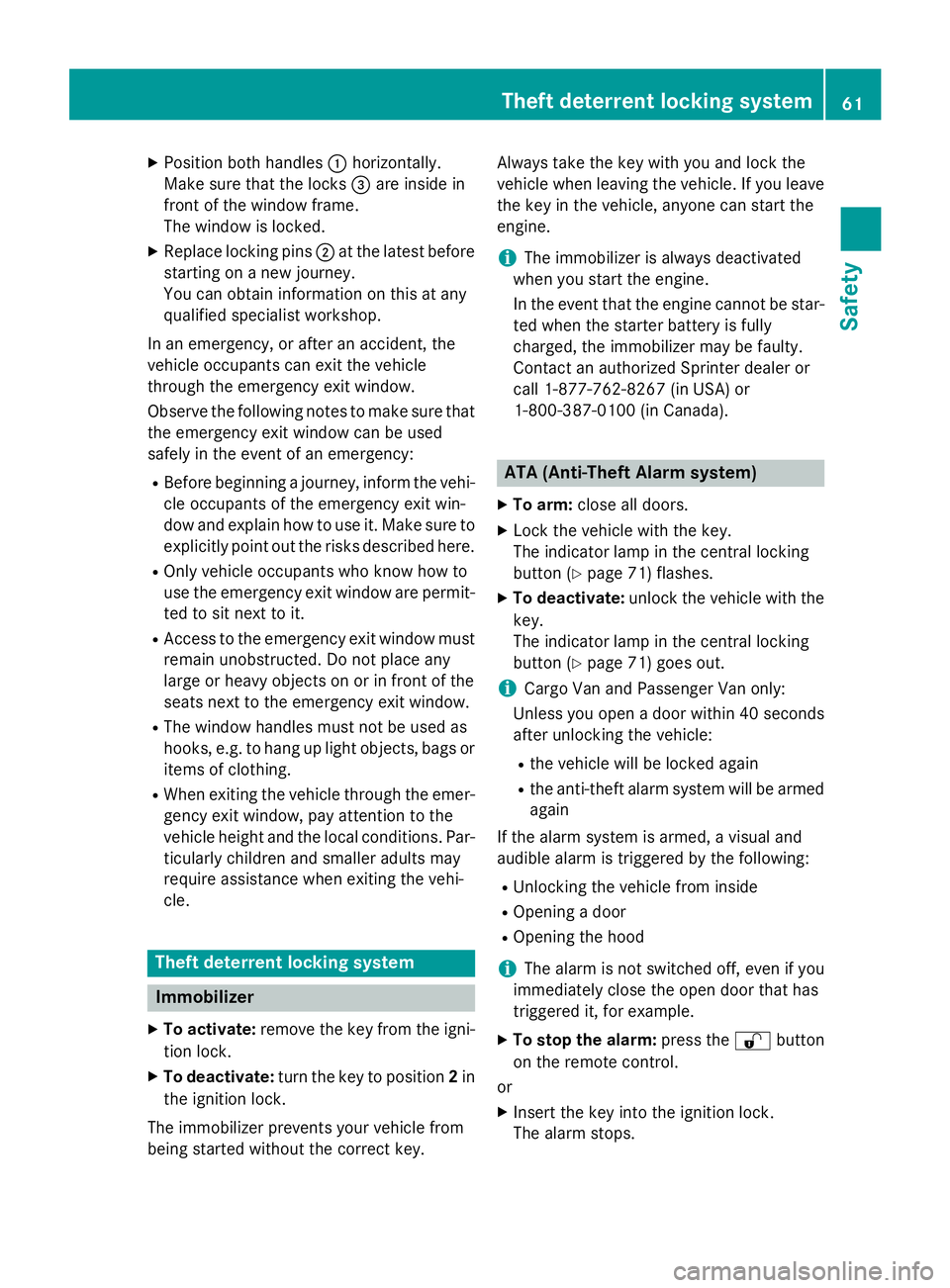
X
Position both handles 0043horizontally.
Make sure that the locks 0087are inside in
front of the window frame.
The window is locked.
X Replace locking pins 0044at the latest before
starting on a new journey.
You can obtain information on this at any
qualified specialist workshop.
In an emergency, or after an accident, the
vehicle occupants can exit the vehicle
through the emergency exit window.
Observe the following notes to make sure that
the emergency exit window can be used
safely in the event of an emergency:
R Before beginning a journey, inform the vehi-
cle occupants of the emergency exit win-
dow and explain how to use it. Make sure to
explicitly point out the risks described here.
R Only vehicle occupants who know how to
use the emergency exit window are permit-
ted to sit next to it.
R Access to the emergency exit window must
remain unobstructed. Do not place any
large or heavy objects on or in front of the
seats next to the emergency exit window.
R The window handles must not be used as
hooks, e.g. to hang up light objects, bags or
items of clothing.
R When exiting the vehicle through the emer-
gency exit window, pay attention to the
vehicle height and the local conditions. Par- ticularly children and smaller adults may
require assistance when exiting the vehi-
cle. Theft deterrent locking system
Immobilizer
X To activate: remove the key from the igni-
tion lock.
X To deactivate: turn the key to position 2in
the ignition lock.
The immobilizer prevents your vehicle from
being started without the correct key. Always take the key with you and lock the
vehicle when leaving the vehicle. If you leave
the key in the vehicle, anyone can start the
engine.
i The immobilizer is always deactivated
when you start the engine.
In the event that the engine cannot be star- ted when the starter battery is fully
charged, the immobilizer may be faulty.
Contact an authorized Sprinter dealer or
call 1-877-762-8267 (in USA) or
1-800-387-0100 (in Canada). ATA (Anti-Theft Alarm system)
X To arm: close all doors.
X Lock the vehicle with the key.
The indicator lamp in the central locking
button (Y page 71) flashes.
X To deactivate: unlock the vehicle with the
key.
The indicator lamp in the central locking
button (Y page 71) goes out.
i Cargo Van and Passenger Van only:
Unless you open a door within 40 seconds
after unlocking the vehicle:
R the vehicle will be locked again
R the anti-theft alarm system will be armed
again
If the alarm system is armed, a visual and
audible alarm is triggered by the following:
R Unlocking the vehicle from inside
R Opening a door
R Opening the hood
i The alarm is not switched off, even if you
immediately close the open door that has
triggered it, for example.
X To stop the alarm: press the0036button
on the remote control.
or
X Insert the key into the ignition lock.
The alarm stops. Theft deterrent locking system
61Safety Z
Page 83 of 334
Useful information
..............................82
Seats .................................................... 82
Steering wheel .................................... 88
Mirrors ................................................. 89 81Seats, steering wheel and mirrors
Page 84 of 334
Useful information
This Operator's Manual describes all models
as well as standard and optional equipment of your vehicle that were available at the time of going to print. Country-specific variations are
possible. Note that your vehicle may not be
equipped with all of the described functions.
This also applies to systems and functions
relevant to safety.
Read the information on qualified specialist
workshops (Y page 25). Seats
Important safety notes
G
WARNING
You could lose control of your vehicle if you do the following while driving:
R adjust the driver's seat, head restraint,
steering wheel or mirrors
R fasten the seat belt
There is a risk of an accident.
Adjust the driver's seat, head restraint, steer-
ing wheel and mirror and fasten your seat belt before starting the engine. G
WARNING
If the driver's seat is not engaged, it could
move unexpectedly while the vehicle is in
motion. This could cause you to lose control of the vehicle. There is a risk of an accident.
Always make sure that the driver's seat is
engaged before starting the engine. G
WARNING
When you adjust a seat, you or other vehicle
occupants could become trapped, e.g. on the seat guide rail. There is a risk of injury.
Make sure when adjusting a seat that no one
has any body parts in the sweep of the seat. G
WARNING
The seat belt does not offer the intended level of protection if you have not moved the back-
rest to an almost vertical position. When brak-
ing or in the event of an accident, you could
slide underneath the seat belt and sustain
abdomen or neck injuries, for example. This
poses an increased risk of injury or even fatal injury.
Adjust the seat properly before beginning
your journey. Always ensure that the backrest
is in an almost vertical position and that the
shoulder section of your seat belt is routed
across the center of your shoulder. G
WARNING
If head restraints are not installed and adjus-
ted correctly, they cannot provide protection
as intended. There is an increased risk of
injury in the head and neck area, e.g. in the
event of an accident or when braking.
Always drive with the head restraints instal-
led. Before driving off, make sure for every
vehicle occupant that the center of the head
restraint supports the back of the head at
about eye level.
Your seat must be adjusted in such a way that you can wear the seat belt correctly.
Observe the following points:
R Position the backrest in an almost vertical
position so that you are sitting virtually
upright. Do not drive with the backrest
reclined too far back.
R Your arms should be slightly bent when you
are holding the steering wheel.
R Avoid seat positions that prevent the seat
belt from being routed correctly. The shoul-
der section of the belt must be routed over the middle of your shoulder and be pulled
tight against your upper body. The lap belt
must always pass across your lap as low
down as possible, i.e. over your hip joints. 82
SeatsSeats, steering wheel and mirrors
Page 85 of 334
R
Adjust the head restraint so that it supports
the back of the head at eye level.
R The distance from the pedals should be
such that you can depress them fully.
Observe also the safety notes in the section
on "Air bags" (Y page 47)and "Children in the
vehicle" (Y page 51).
If you swap over the head restraints for the
front and rear seats, you will not be able to
adjust the height and angle of the head
restraints to the correct position.
Use the head restraint pad to adjust the head
restraint so that it is as close as possible to
the back of your head.
Before the journey, make sure the head
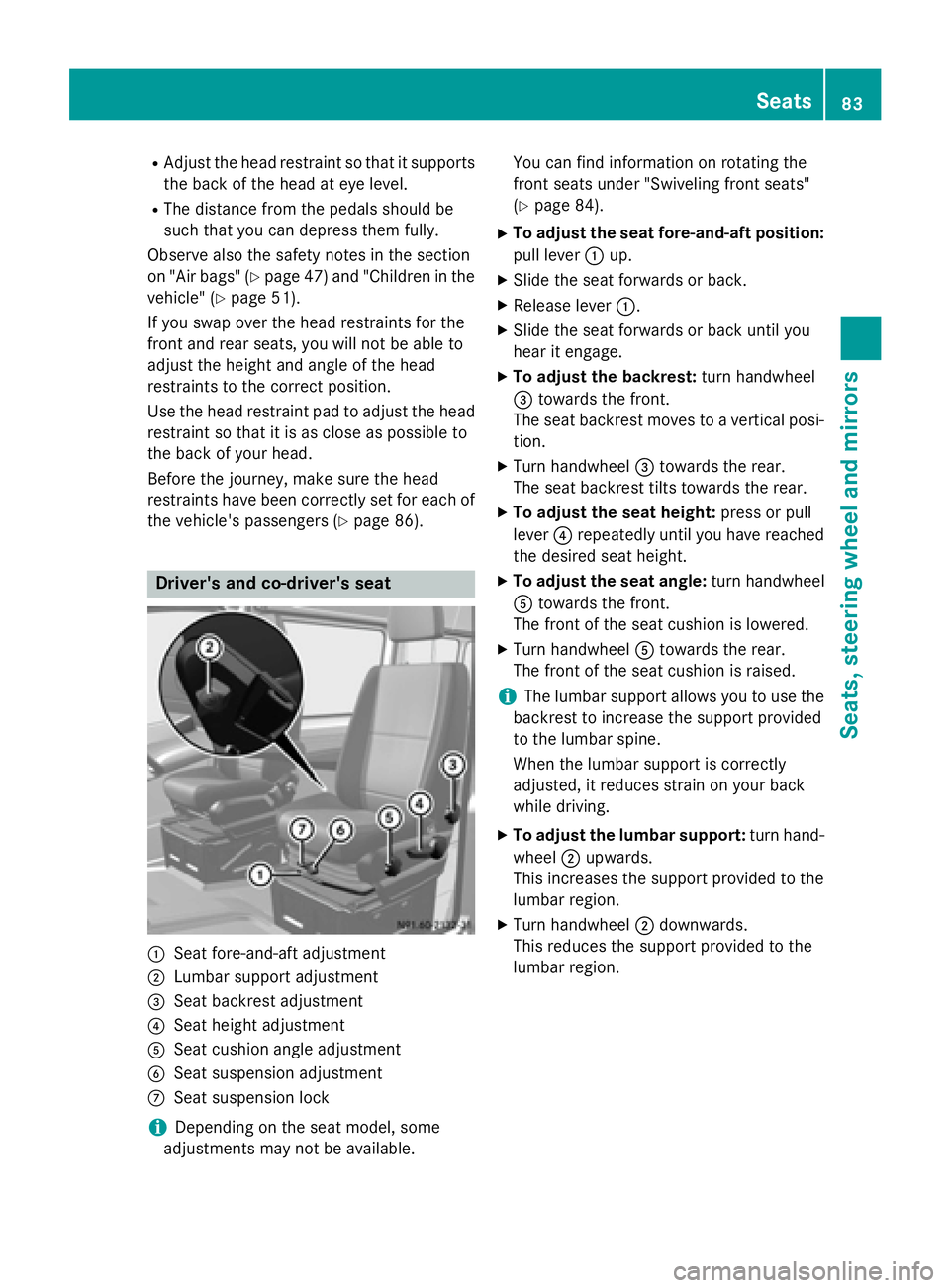
restraints have been correctly set for each of the vehicle's passengers (Y page 86).Driver's and co-driver's seat
0043
Seat fore-and-aft adjustment
0044 Lumbar support adjustment
0087 Seat backrest adjustment
0085 Seat height adjustment
0083 Seat cushion angle adjustment
0084 Seat suspension adjustment
006B Seat suspension lock
i Depending on the seat model, some
adjustments may not be available. You can find information on rotating the
front seats under "Swiveling front seats"
(Y
page 84).
X To adjust the seat fore-and-aft position:
pull lever 0043up.
X Slide the seat forwards or back.
X Release lever 0043.
X Slide the seat forwards or back until you
hear it engage.
X To adjust the backrest: turn handwheel
0087 towards the front.
The seat backrest moves to a vertical posi-
tion.
X Turn handwheel 0087towards the rear.
The seat backrest tilts towards the rear.
X To adjust the seat height: press or pull
lever 0085repeatedly until you have reached
the desired seat height.
X To adjust the seat angle: turn handwheel
0083 towards the front.
The front of the seat cushion is lowered.
X Turn handwheel 0083towards the rear.
The front of the seat cushion is raised.
i The lumbar support allows you to use the
backrest to increase the support provided
to the lumbar spine.
When the lumbar support is correctly
adjusted, it reduces strain on your back
while driving.
X To adjust the lumbar support: turn hand-
wheel 0044upwards.
This increases the support provided to the
lumbar region.
X Turn handwheel 0044downwards.
This reduces the support provided to the
lumbar region. Seats
83Seats, steering wheel and mirrors Z
Page 86 of 334
The seat suspension must be adapted to your
body weight. Adjust the seat suspension only while the seat is unoccupied.
X To adjust the seat suspension: take your
weight off the seat.
X Using handwheel 0084, set your body weight
(40 to 120 kg) for optimum seat suspen-
sion.
The seat suspension will become more rigid the higher you set the weight. It will then
not move as far.
If the seat moves up and down frequently and
to a great extent, you can lock the seat in the lower range.
X To engage the seat suspension lock:
turn lever 006Bupwards.
When it next moves, the seat will lock in
position.
X To release the seat suspension lock:
turn lever 006Bto the right.
The seat can now move up and down again. Swiveling front seats
G
WARNING
If the driver's and co-driver's seats are not
engaged facing the direction of travel while
driving, the restraint systems may not be able to provide the intended protection. There is an
increased risk of injury, possibly even fatal.
Engage the driver's and co-driver's seats so
they are facing the direction of travel before
starting the engine.
! When rotating the seats, make sure that
there is sufficient space to do so.
Move the seat forward or back first. This
will help to avoid contact with other parts of
the interior.
Push the handbrake lever down to the stop.
The parking brake or handbrake lever could
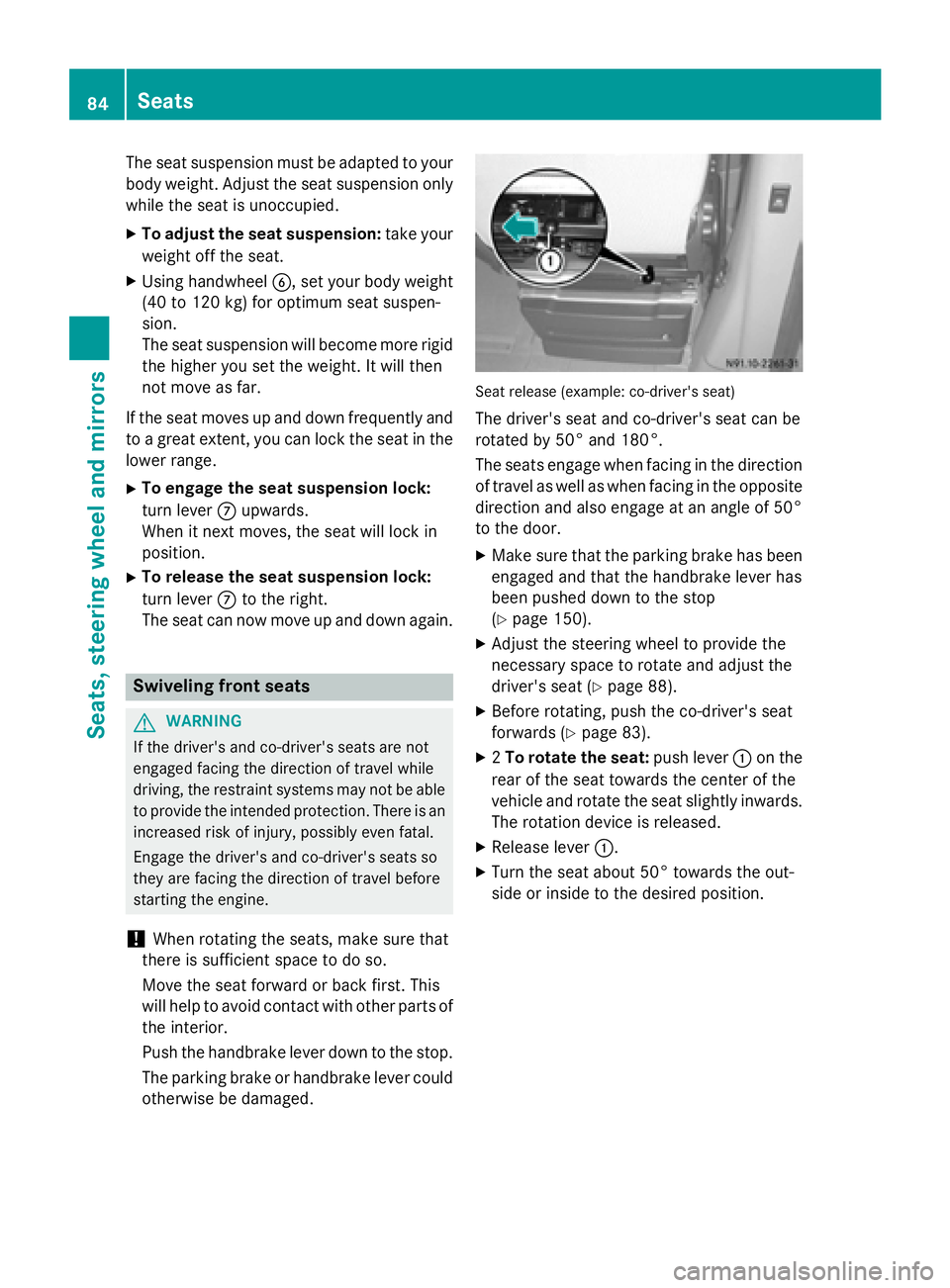
otherwise be damaged. Seat release (example: co-driver's seat)
The driver's seat and co-driver's seat can be
rotated by 50° and 180°.
The seats engage when facing in the direction of travel as well as when facing in the oppositedirection and also engage at an angle of 50°
to the door.
X Make sure that the parking brake has been
engaged and that the handbrake lever has
been pushed down to the stop
(Y page 150).
X Adjust the steering wheel to provide the
necessary space to rotate and adjust the
driver's seat (Y page 88).
X Before rotating, push the co-driver's seat
forwards (Y page 83).
X 2To rotate the seat: push lever0043on the
rear of the seat towards the center of the
vehicle and rotate the seat slightly inwards. The rotation device is released.
X Release lever 0043.
X Turn the seat about 50° towards the out-
side or inside to the desired position. 84
SeatsSeats, steering wheel and mirrors
Page 87 of 334
Twin co-driver's seat
X
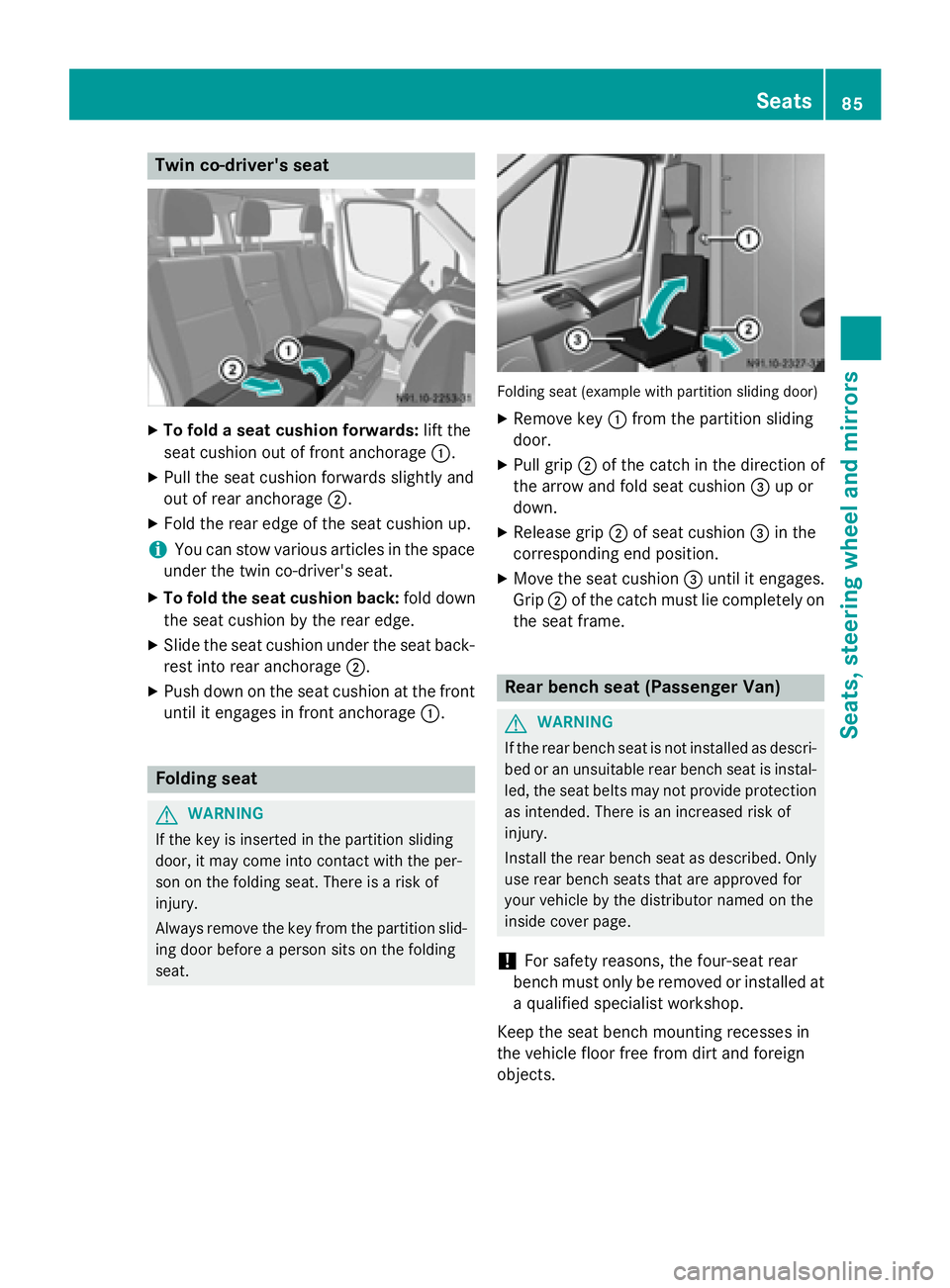
To fold a seat cushion forwards: lift the
seat cushion out of front anchorage 0043.
X Pull the seat cushion forwards slightly and
out of rear anchorage 0044.
X Fold the rear edge of the seat cushion up.
i You can stow various articles in the space
under the twin co-driver's seat.
X To fold the seat cushion back: fold down
the seat cushion by the rear edge.
X Slide the seat cushion under the seat back-
rest into rear anchorage 0044.
X Push down on the seat cushion at the front
until it engages in front anchorage 0043.Folding seat
G
WARNING
If the key is inserted in the partition sliding
door, it may come into contact with the per-
son on the folding seat. There is a risk of
injury.
Always remove the key from the partition slid- ing door before a person sits on the folding
seat. Folding seat (example with partition sliding door)
X Remove key 0043from the partition sliding
door.
X Pull grip 0044of the catch in the direction of
the arrow and fold seat cushion 0087up or
down.
X Release grip 0044of seat cushion 0087in the
corresponding end position.
X Move the seat cushion 0087until it engages.
Grip 0044of the catch must lie completely on
the seat frame. Rear bench seat (Passenger Van)
G
WARNING
If the rear bench seat is not installed as descri- bed or an unsuitable rear bench seat is instal-
led, the seat belts may not provide protection as intended. There is an increased risk of
injury.
Install the rear bench seat as described. Only
use rear bench seats that are approved for
your vehicle by the distributor named on the
inside cover page.
! For safety reasons, the four-seat rear
bench must only be removed or installed at
a qualified specialist workshop.
Keep the seat bench mounting recesses in
the vehicle floor free from dirt and foreign
objects. Seats
85Seats, steering wheel and mirrors Z
Page 88 of 334
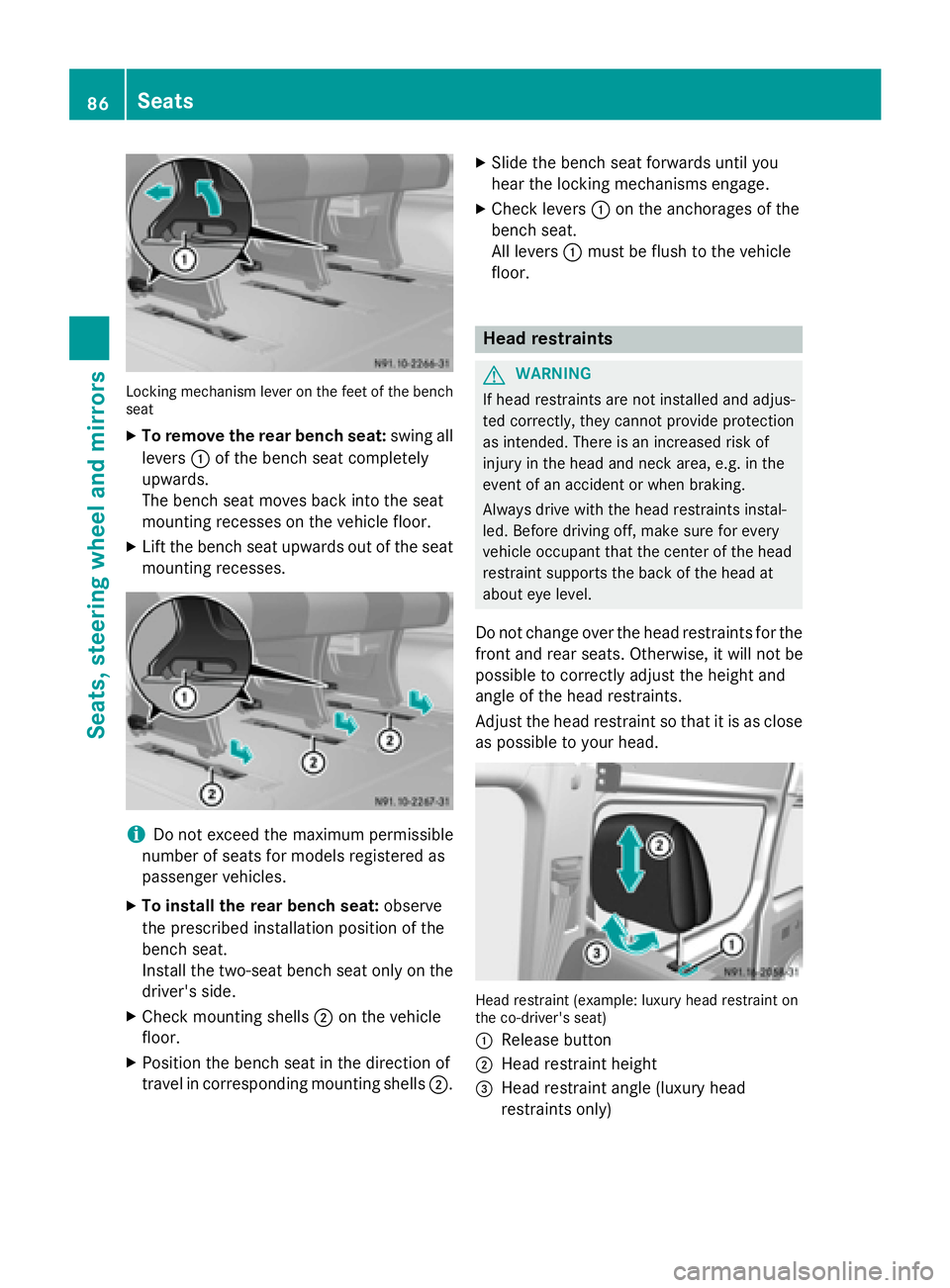
Locking mechanism lever on the feet of the bench
seat
X To remove the rear bench seat: swing all
levers 0043of the bench seat completely
upwards.
The bench seat moves back into the seat
mounting recesses on the vehicle floor.
X Lift the bench seat upwards out of the seat
mounting recesses. i
Do not exceed the maximum permissible
number of seats for models registered as
passenger vehicles.
X To install the rear bench seat: observe
the prescribed installation position of the
bench seat.
Install the two-seat bench seat only on the
driver's side.
X Check mounting shells 0044on the vehicle
floor.
X Position the bench seat in the direction of
travel in corresponding mounting shells 0044.X
Slide the bench seat forwards until you
hear the locking mechanisms engage.
X Check levers 0043on the anchorages of the
bench seat.
All levers 0043must be flush to the vehicle
floor. Head restraints
G
WARNING
If head restraints are not installed and adjus-
ted correctly, they cannot provide protection
as intended. There is an increased risk of
injury in the head and neck area, e.g. in the
event of an accident or when braking.
Always drive with the head restraints instal-
led. Before driving off, make sure for every
vehicle occupant that the center of the head
restraint supports the back of the head at
about eye level.
Do not change over the head restraints for the
front and rear seats. Otherwise, it will not be
possible to correctly adjust the height and
angle of the head restraints.
Adjust the head restraint so that it is as close as possible to your head. Head restraint (example: luxury head restraint on
the co-driver's seat)
0043 Release button
0044 Head restraint height
0087 Head restraint angle (luxury head
restraints only) 86
SeatsSeats, steering wheel and mirrors
Page 89 of 334
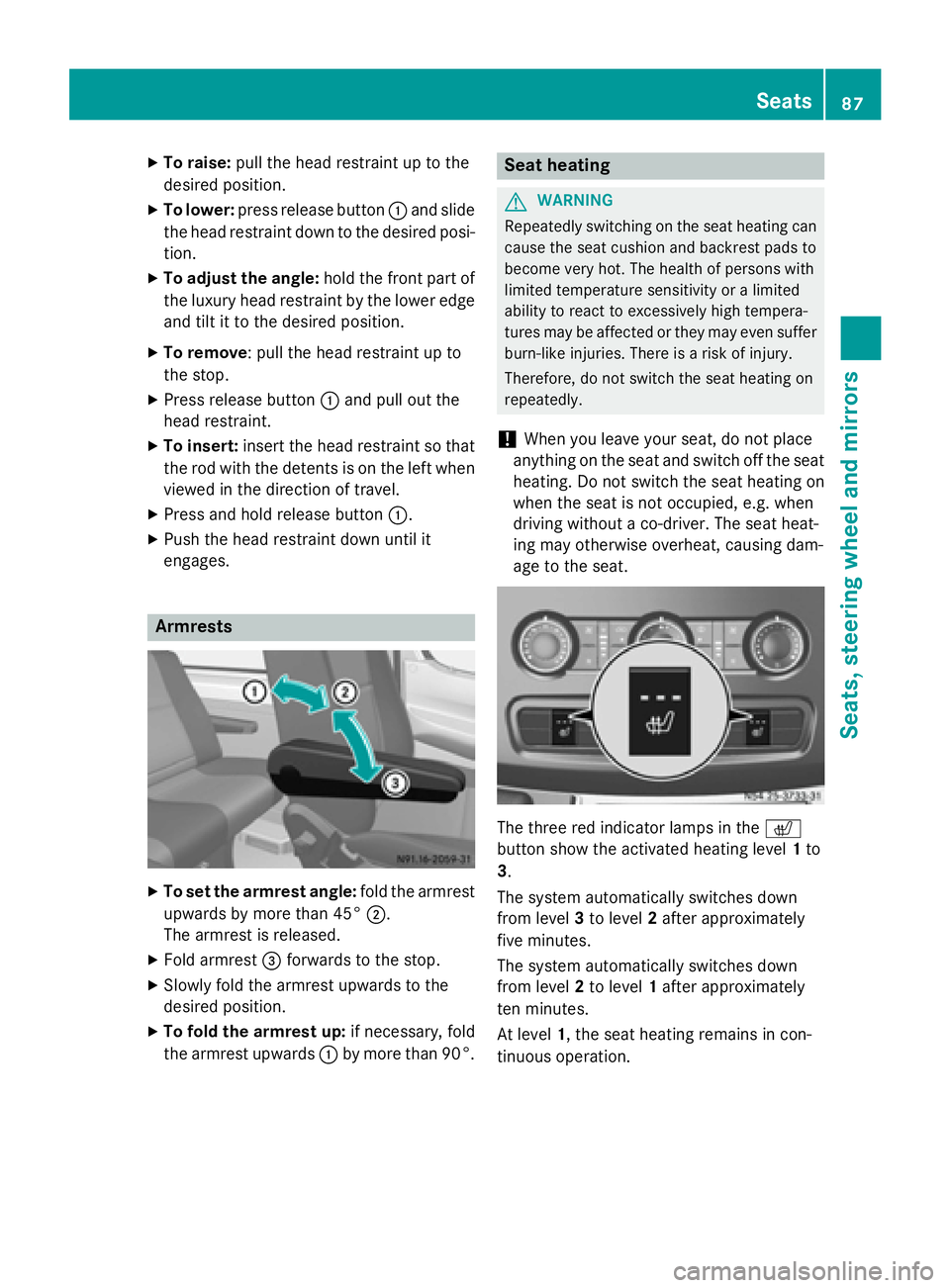
X
To raise: pull the head restraint up to the
desired position.
X To lower: press release button 0043and slide
the head restraint down to the desired posi- tion.
X To adjust the angle: hold the front part of
the luxury head restraint by the lower edge
and tilt it to the desired position.
X To remove : pull the head restraint up to
the stop.
X Press release button 0043and pull out the
head restraint.
X To insert: insert the head restraint so that
the rod with the detents is on the left when viewed in the direction of travel.
X Press and hold release button 0043.
X Push the head restraint down until it
engages. Armrests
X
To set the armrest angle: fold the armrest
upwards by more than 45° 0044.
The armrest is released.
X Fold armrest 0087forwards to the stop.
X Slowly fold the armrest upwards to the
desired position.
X To fold the armrest up: if necessary, fold
the armrest upwards 0043by more than 90°. Seat heating
G
WARNING
Repeatedly switching on the seat heating can
cause the seat cushion and backrest pads to
become very hot. The health of persons with
limited temperature sensitivity or a limited
ability to react to excessively high tempera-
tures may be affected or they may even suffer burn-like injuries. There is a risk of injury.
Therefore, do not switch the seat heating on
repeatedly.
! When you leave your seat, do not place
anything on the seat and switch off the seat
heating. Do not switch the seat heating on
when the seat is not occupied, e.g. when
driving without a co-driver. The seat heat-
ing may otherwise overheat, causing dam-
age to the seat. The three red indicator lamps in the
0072
button show the activated heating level 1to
3.
The system automatically switches down
from level 3to level 2after approximately
five minutes.
The system automatically switches down
from level 2to level 1after approximately
ten minutes.
At level 1, the seat heating remains in con-
tinuous operation. Seats
87Seats, steering wheel and mirrors Z