flat tire MERCEDES-BENZ SPRINTER 2019 MY19 with no MMS Operator’s Manual
[x] Cancel search | Manufacturer: MERCEDES-BENZ, Model Year: 2019, Model line: SPRINTER, Model: MERCEDES-BENZ SPRINTER 2019Pages: 322, PDF Size: 5.91 MB
Page 40 of 322
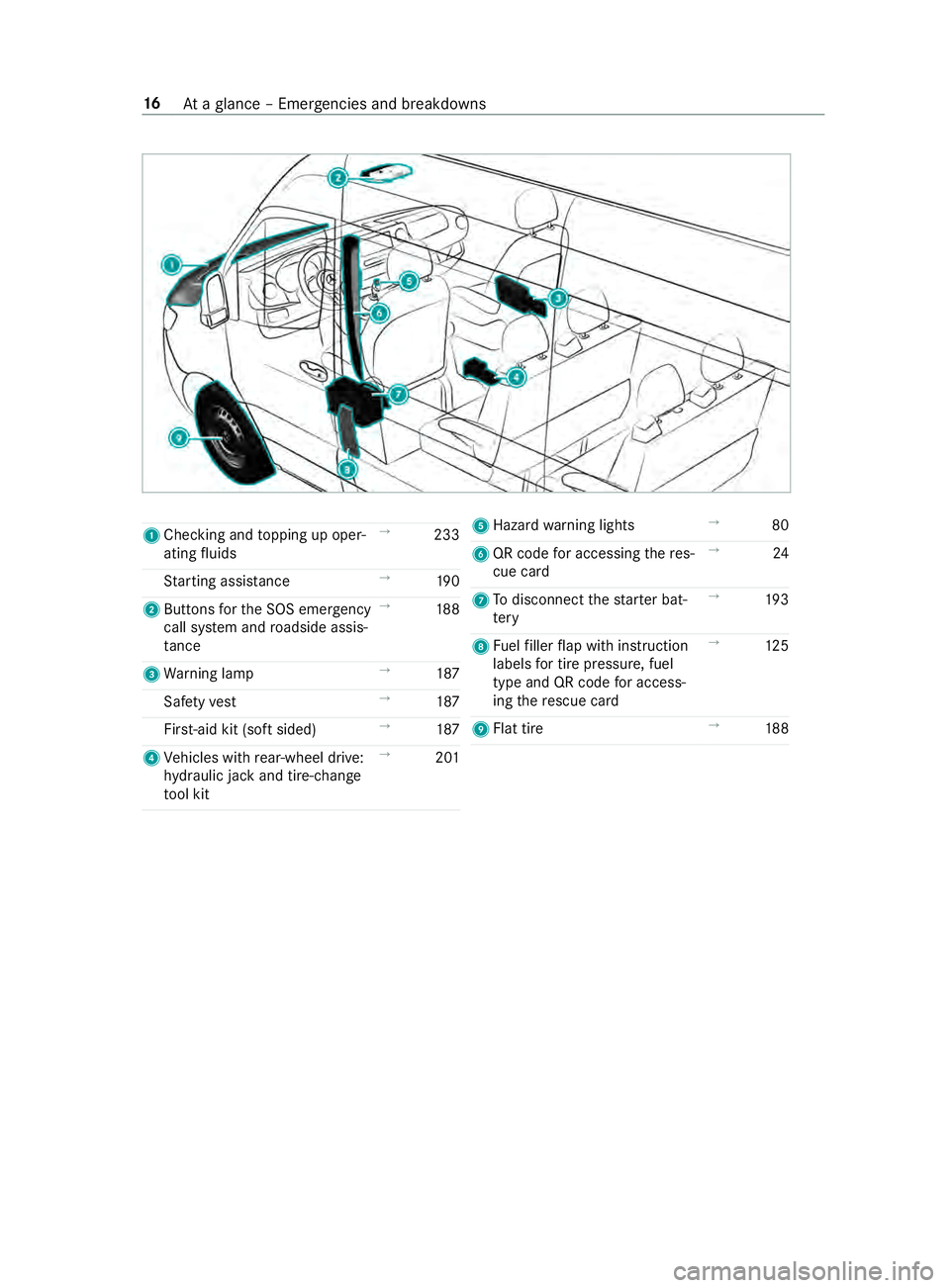
1
Checkin gand topping up oper‐
ating fluids →
233
St artin gassis tance →
19 0
2 Buttons fort he SOS emergency
call sy stem and roadside assis‐
ta nce →
188
3 Warning lamp →
187
Saf etyv est →
187
Fir st-ai dk it (so ftsided) →
187
4 Vehicles wit hrear-wheel drive:
hy draulic jac kand tire-change
to ol kit →
201 5
Hazar dwarning lights →
80
6 QR code fora ccessing ther es‐
cue card →
24
7 Todisconnect thes tarter bat‐
te ry →
19 3
8 Fuelfiller flap wit hinstruction
labels fort irep ressu re,fuel
type and QR code fora ccess‐
ing ther escue card →
12 5
9 Flattire →
188 16
Atag lanc e–Emer gencie sand breakdowns
Page 206 of 322
wa
sher and thea ssociated spr aycould cause
considerable damag etothevehicle.
To avo id damag etoyourvehicle, obser vethef ol‐
lowing when using apowerwa sher:
R maintain aminimum dis tance of 11.8 in
(30 cm) tothev ehicle when using 25° flat-
spr aynozzle sand di rtgrinder sor27.6in
(70 cm) whe nusing round-spra ynozzle sand
obse rvet he information in thee quipment
manufacturer's operating instructions.
R do no tdirect then ozzle of thep owerwa sher
directl yatsensitiv eparts suc hastires, slits,
electrical components, batteries, light bulbs
and ventilation slits.
R maintai naminimum di stanc eof1 9.7 in
(50 cm) forar ear vie wcamera. Wa
shing thev ehicle byhand Obser
vethel egal requirements, fore xamp le in
man ycountries washing byhand is only allo wed
at speciall ydesignated wash ba ys.Int his case,
mak esuret hat aspeciall ydesignated wash ba yis
used forw ashing byhand. #
Use amild cleaning agent, e.g. car shampoo. #
Washthev ehicle wit hlukew armw ater and a
sof tcar sponge. When doing so, do not
ex pose thev ehicle todirect sunlight. #
Carefully spr aythev ehicle wit hwater and dry
of fw ithal eather clo th.Bec arefulnot to
point thew ater je tdirectl ytow ards thea ir
inle tgrilles. The blo wershould be switched
of fw hiled oing so. #
Do no tlet thec leaning agent dr yonthe paint‐
wo rk.
At theo nse tofw inter,remo veall traces of road
salt deposits carefull yand as soon as possible. Note
sonc areofp aint and matte finish *
NO
TEPaint wo rkdamag eand cor rosion
due toinadequat ecare Fa
ilur etop romp tly and thoroughly remo ve
dir tfromb irdd roppings or other residue
could result in paintwor kdamag eand cor ro‐
sion at alater date. #
Cleand irto ffpaint and matt efinish
th oroughly and as soon as possible. 18 2
Maintenance and care
Page 212 of 322
Tr
iggering an automatic emer gency call Re
quirements:
R The ignition is switched on.
R The star terb atter yhas suf ficient charge.
If re stra int sy stems suc hasairbags or Emer gency
Te nsioning Device shave been activated af teran
accident, eCall ma yautomatically initia tean
emer gency call.
The eme rgency call has been made:
R Avoice connection is made totheM ercedes-
Benz emer gency cal lcenter.
R Am essa gewitha cciden tdataist ransmitted
to theM ercedes-Benz emer gency cal lcenter.
The Mercedes-Benz emergency cal lcenter
can transmit thev ehicle position dat atoone
of thee mer gency cal lcenters.
The SOS button in theo verhead cont rolp anel
fl ashes until thee mer gency cal lisfinished.
It is no tpossible toimmediately end an auto‐
matic emer gency call.
If no connection can be mad etothe emer gency
service seithe r,ac orresponding message
appears inthem edia displa y.
If no connection can be made tothee mer gency
services: #
Dialthe local emergency num berony our
mobile phone.
If an emer gency cal lhas been initia ted:
R Remain in thev ehicle if ther oad and traf fic
conditions permit youtodosou ntilavoice
connection is es tablished wit hthe emergency
call cen ters ervice pr ovider.
R Based on thec all, theo perator decides
whe ther it is necessar ytocallr escue teams
and/or thep olice tothea ccident site.
R If no vehicle occupant answers, an ambu‐
lance is sent tothev ehicle immediately. Tr
iggering amanual emer gency call #
Using theS OS but tonint heove rhead con‐
trol panel: presstheS OS button at leas tone
secon dlong.
The emer gency cal lhas been made:
R Avoice connection is made totheM ercedes-
Benz emer gency cal lcenter.
R Am essa gewitha cciden tdataist ransmitted
to theM ercedes-Benz emer gency cal lcenter. The Mercedes-Benz emergency cal
lcenter
can transmit thev ehicle position dat atoone
of thee mer gency cal lcenters.
R Remain in thev ehicle if ther oad and traf fic
conditions permit youtodosou ntilavoice
connection is es tablished wit hthe emergency
call cen ters ervice pr ovider. Tr
ansmitted data with thee mer gency call Dat
atransmitte dbythe eCall includes but is not
limited to:
R Vehicle's GPS position data
R GPS position dat aontheroute(af ewhun‐
dred me ters befor ethe incident)
R Direction of tra vel
R Vehicle identification number
R Vehicle driv etype
R Estimated number of people in thev ehicle
R Whe ther Mercedes PR Oconnect is available
or not
R Whe ther thee mer gency cal lwas initia ted
manually or automatically
R Time of thea ccident
Dat atransmit tedisv ehicle information. Fora ny
qu estions about thec ollection, use and sharing
of thee Call sy stem data, please contact MBU‐
SA 's Cus tomer Assis tance Center at 800-FOR-
MERC.
Fo rC anada, please contact MBC’ sCustomer
Assis tance Center at 1-800-387-0 100.
Cust omer requests forc ove redi nformation
should be submitted via thes ame channels.
Fo ra ccident clarificatio npurposes ,the following
measures can be take nu ptoa nhour af tert he
emer gency cal lhas been initia ted:
R The cur rent vehicle position can be de ter‐
mined
R Avoice connection tothev ehicle occupants
can be es tablished Flat tire
Note
sonf lat tires &
WARNING Risk of an accident whe ndriv‐
ing wi thaflat tire
Af lat tir egreatly impair sdriving characteris‐
tics, as well as steering and braking. 18 8
Breakdown assis tance
Page 213 of 322
#
Do no tdrive with aflat tire. #
Remo vethef lat tir eand ins tallthe
spar ewheel or consult aqualified spe‐
cialis tworks hop. In
thee vent of aflat tir eyou ha vethef ollowing
possibilities depending on your vehicle's equip‐
ment:
R Vehicles with Mercede sPRO connec t:in
th ee vent of aflat tire, youc an call Roadside
Assis tance via theR oadside Assis tance call
button in theo verhead cont rolp anel
(/ page164).
R Allvehicles: chang ethe wheel
(/ page221). Batte
ry Note
sont he12Vb attery &
WARNING Risk of an accident du eto
wo rkcar ried out incor rectl yont he bat‐
te ry
Wo rkcar ried out incor rectly on theb attery
can, fore xamp le, lead toas hor tcircuit .This
can lead tofunction restrictions in saf ety-re l‐
ev ant sy stems, fore xamp lethel ighting sys‐
te m, ABS (anti-loc kbraking sy stem) or ESP ®
(Elect ronic Stabilit yProgram). The ope rating
saf etyofy ourvehicle ma yberestricted.
Yo uc oul dlose control of thev ehicle in the
fo llowing situations:
R when braking
R inthee vent of ab rupt steering maneuvers
and/or when thev ehicle's speed is not
adap tedtot heroad conditions #
Inthee vent of ashortcircui tora simi‐
la ri ncident, contact aqualified special‐
is tw orks hop immediately. #
Do no tcontinue driving. #
Alwaysh ave workon theb atter ycarried
out at aqualified specialis tworks hop. R
Further information on ABS (/ page137)
R Further information on ESP ®
(/ page138)
Mercedes-Benz recommends that youh ave the
12 Vb atter yreplaced at aqualified specialist
wo rkshop, e.g. at an authorized Mercedes-Benz
Center. Should
youw ant toreplace theb atter yyourself,
obser vethef ollowing information:
R Alwaysr eplace adefectiv ebatter ywithab at‐
te ry whic hfulfills thev ehicle's specific
re qu irements.
R Use de tach able parts suc hasthevent hose,
elbo wfittin gort erminal co verfromt he bat‐
te ry to be replaced.
R Mak esuret hat thev ent hose is alw aysc on‐
nected toits original openin gonthe battery
side.
Ins tallth ee xisting or newly supplied stop
plugs.
Otherwise, gases or batter yacid could
escape.
R Mak esuret hat thed etachable parts ar econ‐
nec tedint he same wayasb efore.
Fo rs afet yr easons, Mercedes-Benz recommends
th at youo nlyu se bat teries that ha vebeen tested
and appr ovedfor your vehicle byMercedes-Benz.
These batteries pr ovide inc reased impact pr otec‐
tion topreve ntvehicle occupants from suf fering
aci db urns should theb atter ybed amaged in an
accident. &
WARNING Risk ofexplosion due toelec‐
tros tatic charge
Electros tatic charge can cause spa rksw hich
ma yignit ethe highly flammable gasm ixture
in theb atter y. #
Todischar geanye lectrostatic charge
th at ma yhave built up, touc ht he me tal
ve hicle body befor ehandling theb at‐
te ry. The highly
flammable gasm ixtur eisc reated while
th eb atter yisc harging and when jump-s tarting. &
WARNING Danger of chemical burns
from theb atter yacid
Batter yacid is caustic. #
Avoid contact wit hthe skin, eyes or
clo thing. #
Do no tlean overthe batter y. #
Do no tinhal ebattery gases. #
Keep children away from theb atter y. #
Immedia tely rinse batter yacido ffthor‐
oughly wit hplenty of clean waterand
seek medica lattention immediately. Breakdown assi
stance 18 9
Page 230 of 322

Fr
ont axle tir epressures on vehicles with all-wheel/rear wheel driv eand single tires
Max. front axle load 4101 lbs (1860 kg) Ti
re s/disc wheel Vehicl eload Max. front axle load
4101 lbs (1860 kg)
LT 24 5/75R1 6120/1 16QF ullyladen 320k Pa(3.2b ar/46 psi) Fr
ont axle tir epressures on vehicles with rear wheel driv eand single tires
Max. front axle load 4409 lbs (2000 kg) Ti
re s/disc wheel Vehicl eload Max. front axle load
4409 lbs (2000 kg)
LT 24 5/75R1 6120/1 16QF ullyladen
360k Pa(3.6b ar/52 psi) 1) 1)
Only valid forv ehicles wit halong wheelbase
17 1in( 4350 mm) and apermissible gross weight
of ove r7716l bs (3. 5t).
Re ar axle tir epressures on vehicles with all-wheel/rear wheel driv eand single tires
Max. rear axle load 535 7lbs (2430 kg) Ti
re s/disc wheel Vehicl eload Max.rear axle load
535 7lbs (2430 kg)
LT 24 5/75R1 6120/1 16QF ullyladen 480k Pa(4.8b ar/70 psi)
LT 24 5/75R1 6120/1 16 Q
Partiall yladen 2)
420 kPa(4.2b ar/6 1psi)2) 2)
It is onl ypermissible touse this reduced tire
pressur eifitcan be guaranteed byweighing the
ve hicle that ther ear axle load of 4960 lbs (2250
kg)w ill no tbee xceeded. In case of doubt,
inflat eto4 80 kPa(4.8 bar/70 psi).
Fr ont axle tir epressures on vehicles with all-wheel/rear wheel driv eand twin tires
Max. front axle load 4079 lbs (1850 kg)Ti
re s/disc wheel Vehicl eload Max. front axle load
4079 lbs (1850kg)
LT 21 5/85R1 6115/112 QF ullyladen 380k Pa(3.8b ar/55 psi) Max. front axl
eload 4409 lbs (2000 kg) Ti
re s/disc wheel Vehicl eload Max. front axle load
4409 lbs (2000 kg)
LT 21 5/85R1 6115/112 QF ullyladen 420k Pa(4.2b ar/ 61psi) 206
Wheels and tires
Page 232 of 322
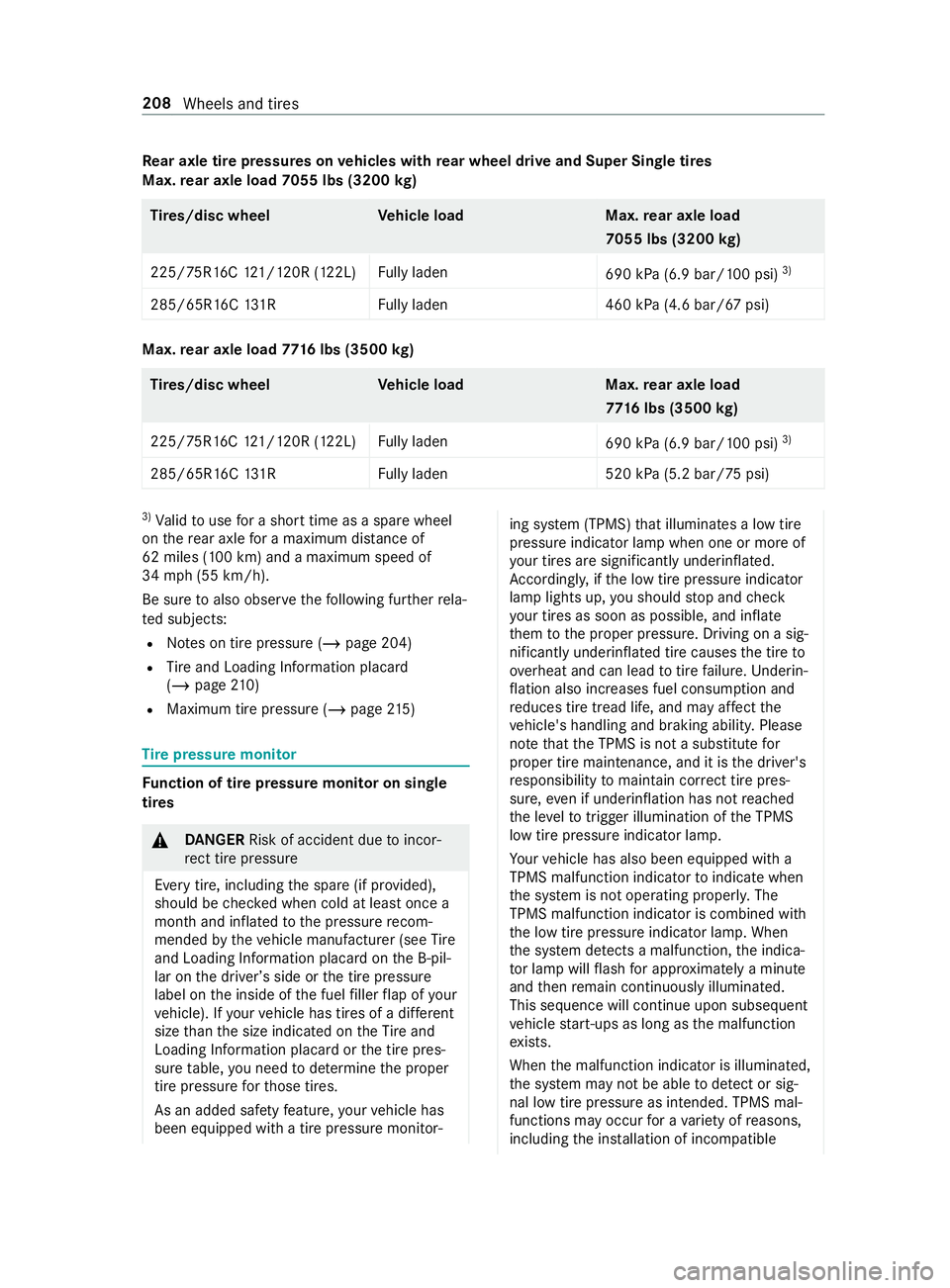
Re
ar axle tir epressures on vehicles with rear wheel driv eand Super Single tires
Max. rear axle load 7055 lbs (3200 kg)Ti
re s/disc wheel Vehicl eload Max.rear axle load
7055 lbs (3200 kg)
225/75R16C 121/120R (122L) Fullyl aden
690 kPa(6.9b ar/100 psi) 3)
285/65R16C 131R Fully laden 460 kPa(4.6b ar/6 7psi) Max
.rear axl eload 7716 lbs (3500 kg) Ti
re s/disc wheel Vehicl eload Max.rear axle load
77 16 lbs (3500 kg)
225/75R16C 121/120R (122L) Fullyl aden
690 kPa(6.9b ar/100 psi) 3)
285/65R16C 131R Fully laden 520 kPa(5.2b ar/7 5psi) 3)
Va lid touse foras horttime as aspar ew heel
on ther ear axle foram aximu mdista nce of
62 miles (100 km) and amaximum speed of
34 mph(55 km/h).
Be sur etoalso obse rvet he following fur ther rela‐
te ds ubjects:
R Notesont irep ressur e(/pag e204)
R Tire and Loadin gInforma tionp lacard
(/ page210)
R Maximum tirep ressure (/ page 215) Ti
re pressur emonitor Fu
nction of tir epressur emonitor on single
tires &
DANG ER Risk of acciden tdue toincor‐
re ct tir epressure
Ever ytire, including thes par e(if pr ovided),
should be checkedw hen cold at leas toncea
mont hand inflated tothep ressur erecom‐
mended bythev ehicle manufacturer (see Tire
and Loadin gInforma tionp lacar dont he B-pil‐
lar on thed rive r’ss ide or thet irep ressure
label on thei nside of thef uel filler flap of your
ve hicle). If your vehicle has tires of adiffe re nt
size than thes ize indicated on theT irea nd
Loading In form atio nplacar dort he tirepres‐
sur etable, youn eedtod etermine thep roper
tir ep ressur efor those tires.
As an added saf etyf eature, your vehicle has
been equipped wit hatirep ressur emonitor‐ ing sy
stem (TPMS) that illuminates alow tire
pressur eindicator lam pwhen one or mor eof
yo ur tires ar esignificantl yunde rinfla ted.
Ac cordingly ,ifthe lo wtirep ressur eindicator
lam plights up, yous houl dstopa nd check
yo ur tires as soon as possible, and inflate
th em tothep roper pressure. Driving on asig‐
nificantly underinflated tir ecauses thet ireto
ove rheat and can lead totiref ailure. Underin‐
fl atio nalso inc reases fuel consum ption and
re duces tir etread life, and ma yaffect the
ve hicle's handling and braking ability .Please
no te that theT PMS is no tasubstitut efor
proper tir emaintenance, and it is thed rive r's
re sponsibility tomaintain cor rect tir epres‐
sure, even if underinflation has no treached
th el eve ltot rigger illumination of theT PMS
lo wt irep ressur eindicator lamp.
Yo ur vehicle has also been equipped wit ha
TPMS malfunction indicator toindicat ewhen
th es ystem is no toperating properly .The
TPMS malfunction indicator is combined with
th el ow tirep ressur eindicator lamp. When
th es ystem de tects am alfunction, thei ndica‐
to rlamp willf lashfora pproxima tely am inute
and then remain continuously illumina ted.
This sequence will continue upon subsequent
ve hicle start-ups as lon gasthe malfunction
ex ists.
When them alfunction indicator is illuminated,
th es ystem ma ynotbe able todetect or sig‐
nal lo wtirep ressu reas intended. TPMS mal‐
function smayoccur forav ariety of reasons,
includin gthe ins tallation of incompatible 208
Wheels and tires
Page 238 of 322
tire's ability
tocome toas tandstill on awetpave‐
ment under controlle dconditions on aspecified
U. S. go vernment test sur face mad efroma sphalt
and concr ete.
Te mp eratur egrade &
WARNING Risk of accident from tire
ove rheating and tir efailure
The temp eratur egrade fort his tir eisestab‐
lished forat iret hat is properly inflated and
no to verloaded. Excessiv espeed, underinfla‐
tion, or excessiv eloading, either separatel yor
in combination, can cause excessiv eheat
build-up and possible tir efailure. #
Obser vether ecommended tir epres‐
sures and regular lych eckt he tir epres‐
sur eofa ll tires including thes pare
wheel. #
Adjus tthe tir epressur easn ecessar y. The
temp eratur egrades ar eA(highes tgrade), B
and C. These relat etoat ire'sresis tance toheat
and its ability torelease heat on aspecified test
wheel in laborator ytests under cont rolled condi‐
tions. Sus tained high temp eratures can cause the
material of thet iretod egenerat eand reduce tire
life. In addition, excessivel yhigh temp eratures
can lead tosudden tir efailure. Grade Crefer sto
ap erform anc ewhicha ll passenger vehicle tires
mus texhibit, accordin gtotheU.S. Depa rtment
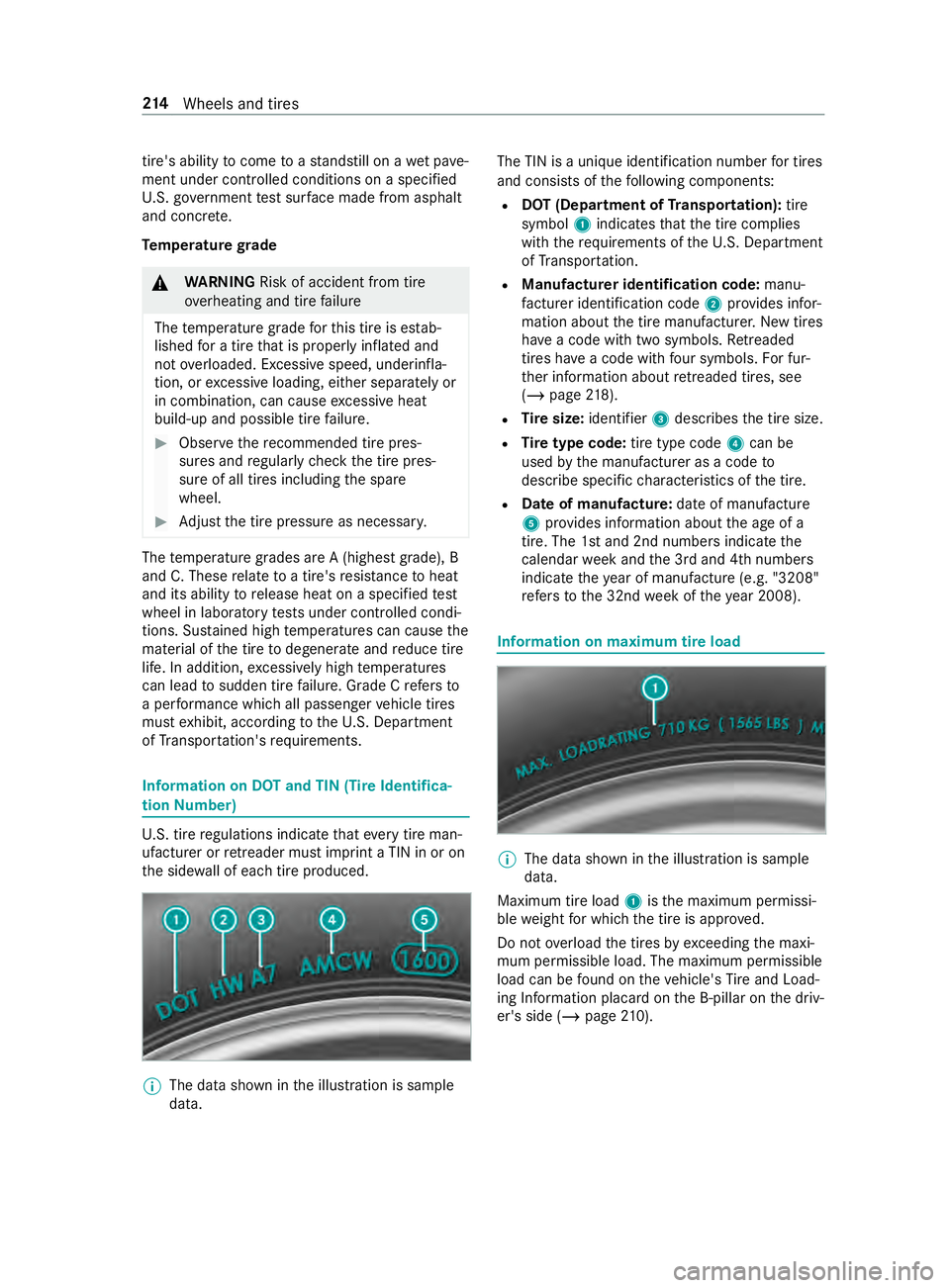
of Transpor tation's requ irements. Information on DO
Tand TIN (Tir eIdentifica‐
tion Number) U.
S. tir eregulations indicat ethat everyt irem an‐
ufacturer or retreade rmustimp rint aT IN in or on
th es ide wall of eac htirep roduced. %
The dat
ashown in thei llustration is sample
data. The TIN is
aunique identification number fort ires
and consists of thef ollowing components:
R DOT(Department of Transportation): tire
symbol 1indicates that thet irec omplies
wit hthe requ irements of theU .S. Depa rtment
of Transpor tation.
R Manufacturer identi fication code: manu‐
fa cturer identification code 2prov ides infor‐
matio nabout thet irem anufacturer .New tires
ha ve ac odew itht wo symbols. Retreaded
tires ha veac odew ithf our symbols.F or fur‐
th er information about retreade dtires, see
(/ page 218).
R Tire size: identifier 3describes thet ires ize.
R Tire type code: tiret ypec ode 4can be
used bythem anufacturer as acode to
describe specific characteristic softhe tire.
R Dat eofm anufactu re:date of manufacture
5 prov ides informatio nabout thea geof a
tire. The 1s tand 2nd number sindicat ethe
calendar week and the3 rdand 4t hnumbers
indicat ethe year of manufactur e(e.g. "3208"
re fers to the3 2ndw eek of they ear 2008). Information on maximum tir
eload %
The dat
ashown in thei llustration is sample
data.
Maximum tir eload 1isthem aximum permissi‐
ble weight forw hichthe tir eisa pprove d.
Do no toverload thet ires by ex ceeding them axi‐
mum permissible load. The maximum permissible
load can be found on thev ehicle's Tire and Load‐
ing In form atio nplacar dont he B-pillar on thed riv‐
er's side (/ page210). 214
Wheels and tires
Page 243 of 322

Befor
epurch asing and using non-appr oved
accesso ries, visit aqualified specialis tworks hop
and inquir eabout:
R Suitability
R Legal stipulations
R Factor yrecommendations
Obser vethef ollowing points when selecting,
ins talling and replacing tires:
R Use onl ytires and wheels of thes ame type,
design (winter tires, all-season tire) and
make.
R Onlyins tall wheels of thes ame size and tread
design on one axle (lef tand right).
It is onl ypermissible toins tallad iffe re nt
wheel size tothis in thee vent of aflat tir ein
order todriv etot he specialis tworks hop.
R Onlyins tall tires of thec orrect size ont othe
wheels.
R Ve
hicles with atirep ressur emonitoring
sy stem: all ins talled wheels mus tbeequip‐
ped wit hfunctioning sensor sfor thet irep res‐
sur em onitoring sy stem.
R Attemp eratures belo w50°F(10°C), use
winter tires or all-season tir emarke dM +Sfor
all wheels.
Wi nter tires bearing the004D snowflak esym‐
bol in addition totheM +S marking pr ovide
th eb estp ossible grip in wintr yroad condi‐
tions.
R Only use tires wit hthe same tread.
R Obser vethem aximum permissible speed for
th ei nstalled tires.
If th is is belo wthe vehicle's maximum speed,
th is mus tbeindicated in an appropriat elabel
in thed rive r's field of vision.
R Break in ne wtires at moderat espeeds fort he
fi rs t60m iles (100 km).
R Replace thet ires af ters ixyearsatt he latest,
re ga rdless of wear.
Fo rm orei nformation on wheels and tires, con‐
ta ct aq ualified specialis tworks hop.
% Ve
hicles with twin tires:
Fo rv ehicles wit htwin tires wit haGVW of
11 ,030 lbs or 12,125 lbs, onl yuse tires with
th ed imension LT215/85 R1 6which have
been appr ovedfor this vehicle bythem anu‐
fa cturer .Itisn otpermissibl etouse tires with
dif fere nt dimensions; doing so ma ylea dtoa ge
neral ope rating pe rmit being rende red
in va lid.
% Ve
hicles with single tires:
Fo rv ehicles wit hsingle tires wit haGVW less
th an or equal to9480 lbs, onl yuse tires with
th ed imension LT245/7 5R16whi chhave
been appr ovedfor this vehicle bythem anu‐
fa cturer .Itisn otpermissibl etouse tires with
dif fere nt dimensions; doing so ma ylea dtoa
ge neral ope rating pe rmit being rende red
in va lid.
% Ve
hicles with Super Single tires:
Fo rv ehicles wit hsingle tires wit haGVW of
11 ,030 lbs, onl yuse tires wit hthe dimen‐
sions 225/7 5R16C( FA)and 285/65 R16C
(RA) whic hhaveb een appr ovedfor this vehi‐
cle bythem anufacturer .Itisnotpermissible
to use tires wit hdiffe re nt dimensions; doing
so ma ylea dtoa general ope rating pe rmit
being rende redi nva lid.
Be sur etoalso obse rvet he following fur ther rela‐
te ds ubjects:
R Notesont irep ressur e(/pag e204)
R Tire and Loadin gInforma tionp lacard
(/ page210)
R Tire size designation, load-beari ng capacity,
speed rating and load ind ex (/pag e215 )
R Tire pressur etable
R Notesont he emergency spar ewheel
(/ page225) Note
sonr otating wheels &
WARNING Risk of inju rythro ugh dif fer‐
ent whee lsizes
Inter changing thef ront and rear wheels if the
wheels or tires ha vediffere nt dimensions may
se verely impair thed riving characteristics.
The wheel brakes or wheel suspension com‐
ponent smayalso be damaged. #
Rotate front and rear wheels onl yifthe
wheels and tires ar eofthe same dimen‐
sions. On
vehicles that ha vethes ame size front and
re ar wheels ,rotatet he wheels according tothe
inter vals in thet irem anufacturer's warrant ybook
in your vehicle documents. If this is no tavailable,
ro tate thet ires every3,000 (5,000) to
6,000 mile s(10 ,000 km) ,depending on the Wheels and tires
219
Page 246 of 322
Only position
thej ackont he jac ksuppor tpoints
intended fort his purpose. Youc oul do therwise
damag ethe vehicle.
Impor tant no tesonu singthej ack:
R Onlyusethev ehicle-speci ficj ackt hat has
been tested and appr ovedbyM ercedes-Benz
to raise thev ehicle. If thej ackisu sed incor‐
re ctly ,itc ould tip over while thev ehicle is
ra ised.
R The jac kisdesigned onl ytoraisethev ehicle
fo ras horttime whil eawheelisb eing
ch anged and is no tsuitable forc arrying out
maintenance workunde rthe vehicle.
R Avoid changing awheel on uphill and downhill
slopes.
R The jac kmustbep lacedonaf irm,flat and
non-slip sur face. If necessar y,use alarge,
fl at, load bearing and non-slip unde rlay.
R The base of thej ackisp ositioned vertically
under thej acks uppor tpoint.
Saf etyi nstruction swhile thev ehicle is raised:
R Do no tputyour hands or feet unde rthe vehi‐
cle.
R Do no tlie underneat hthe vehicle.
R Do no tstart thee ngine and do no trelease
th ep arking brake.
R Do no topen or close an ydoors.
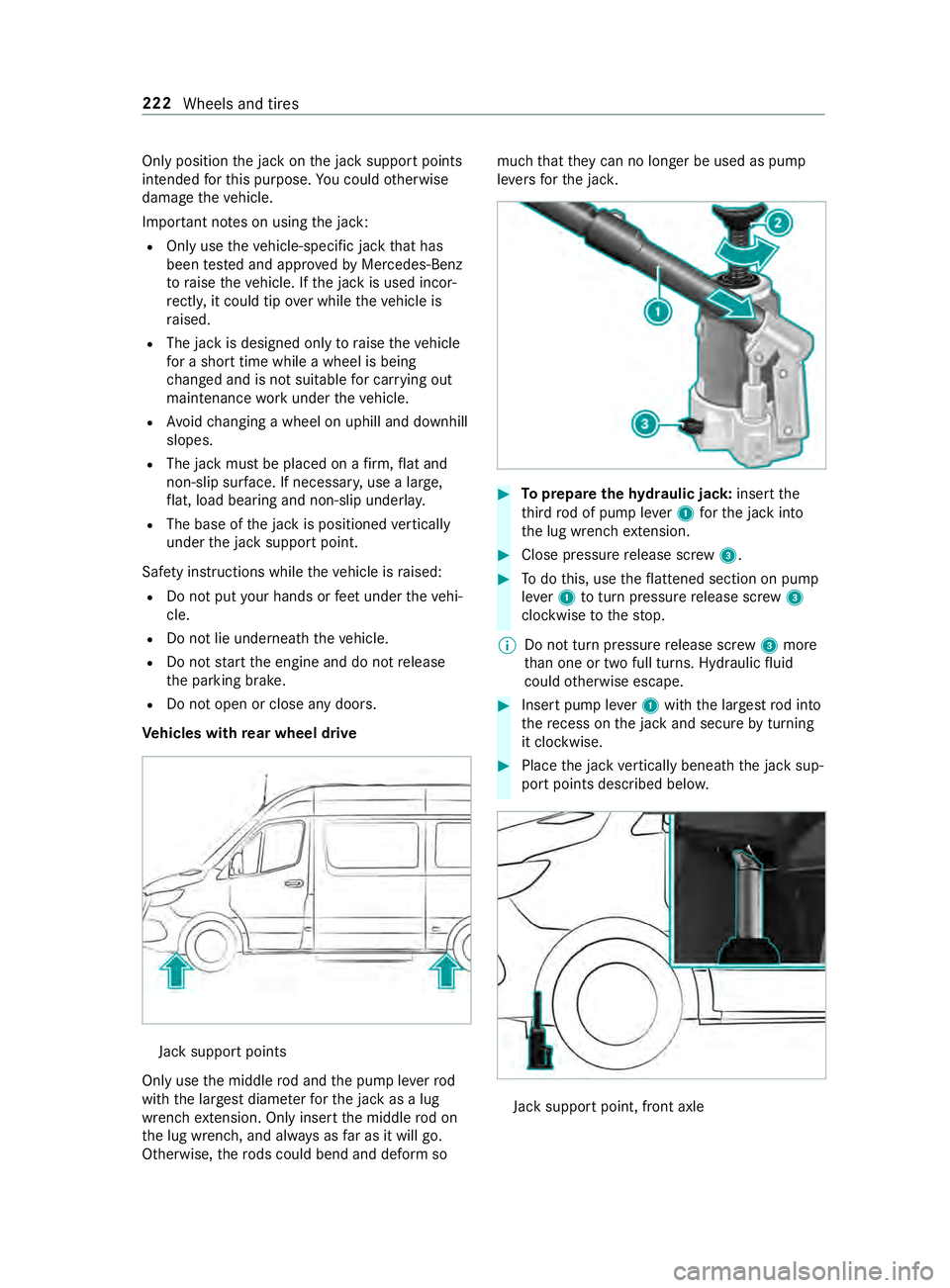
Ve hicles with rear wheel drive Jack
suppor tpoints
Only use them iddle roda nd thep um pleve rrod
wit hthe larges tdiame terf or thej ackasa lug
wrenc hextension. Only inse rtthem iddle rodon
th el ug wrench, and alw aysasf ar as it will go.
Otherwise, ther ods could bend and defor msomuc
hthat they can no longer be use daspump
le ve rs fort he jac k. #
Toprepar ethe hydrauli cjack: insertthe
th irdr od of pum plever 1fort he jac kinto
th el ug wrenc hextension. #
Close pressur erelease scr ew3. #
Todo this, use thef lattened sectio nonpump
le ver 1totur np ressur erelease scr ew3
clockwise tothes top.
% Do no
tturnp ressur erelease scr ew3 more
th an one or tw ofull turns .Hydraulic fluid
coul dotherwise escape. #
Inser tpum plever 1withthe larges trod into
th er eces sont he jac kand secur ebyturning
it clo ckwise. #
Place thej ackv erticall ybeneat hthe jac ksup‐
por tpoints described belo w. Jac
ksuppor tpoint, front axle 222
Wheels and tires
Page 252 of 322
#
Place ascrew driver int orecesses 2and
th en pr yoffco vers 1 . #
Using thel ug wrenc hfromt hevehicle tool kit,
unscr ewthen ow visible bolts counter-clock‐
wise byappr oximatel y20turns. #
Slightly raise spar ewheel car rier 4 and
unhook left-hand saf etyh ook 3. #
Assemble thep um pleve rfor thej acka nd
slide it int osleeve5 onther ight-ha ndside
of spar ewheel car rier 4. #
Raise thes par ew heel car rier wit hthe pump
le ve ra nd unhook right-han dsafet yh ook 3. #
Position loop 7ofextraction device 6on
th es par ew heel so that youw ill later be able
to attac hlug wrench 8. #
Prepar ethe jac k. #
Place thej ackb eneat hthe cor responding
jac ksuppor tpoint. #
Movethep um pleve rupa nd down until the
tir eisr aised amaximum of 1.18 in (3 cm) off
th eg round. #
Hook lug wrench 8intoloop 7ofextrac‐
tio nd evice 6 onthes par ew heel. #
Carefully remo vethes par ew heel from spare
wheel car rier 4.T he spar ewheel is heavy.
When thes par ew heel is remo ved, thec enter
of gr avity changes due totheh eavy weight of
th ew heel. The spar ewheel ma yslip down or
tip ove r. #
Remo vethes par ew heel extraction device
and stor eitinas afep lace. Youc an now
ins tallth es par ew heel to yo urvehicle. #
Lowe rthe vehicle.
Ve hicles with rear wheel drive: installin gthe
spar ewheel (vehicle with lo weredc hassis)
% In
thee vent of aflat tire, youm aystor et he
defectiv ewheel inside thev ehicle only .An
intact wheel ma ybestore dint he spare
wheel car rier onl ywhen thev ehicle is unla‐
den. Aladen vehicle mus tfirst be raised. #
Carefull yplace thes par ew heel ont ospare
wheel car rier 4.T he spar ewheel is heavy.
When youp lacethe spar ewheel ont ospare
wheel car rier 4,t he center of gravity
ch anges due tothew eight of thew heel. The
spar ewheel ma yslip down or tip over. #
Slide thep um pleve rfor thej acki ntos leeve
5 on spar ewheel car rier 4. #
Raise spar ewheel car rier 4 withthe pump
le ve ra nd attac hright-ha ndsafetyh ook 3. #
Slight lyraise spar ewheel car rier 4 and
attac hleft-hand saf etyh ook 3. #
Pull thep um pleve rout of slee ve5 . #
Using thel ug wrench, tighten saf etyh ook
bolts 3byturning them clockwise. #
Replace and engag ecovers 1. #
Close ther ear-end doors.
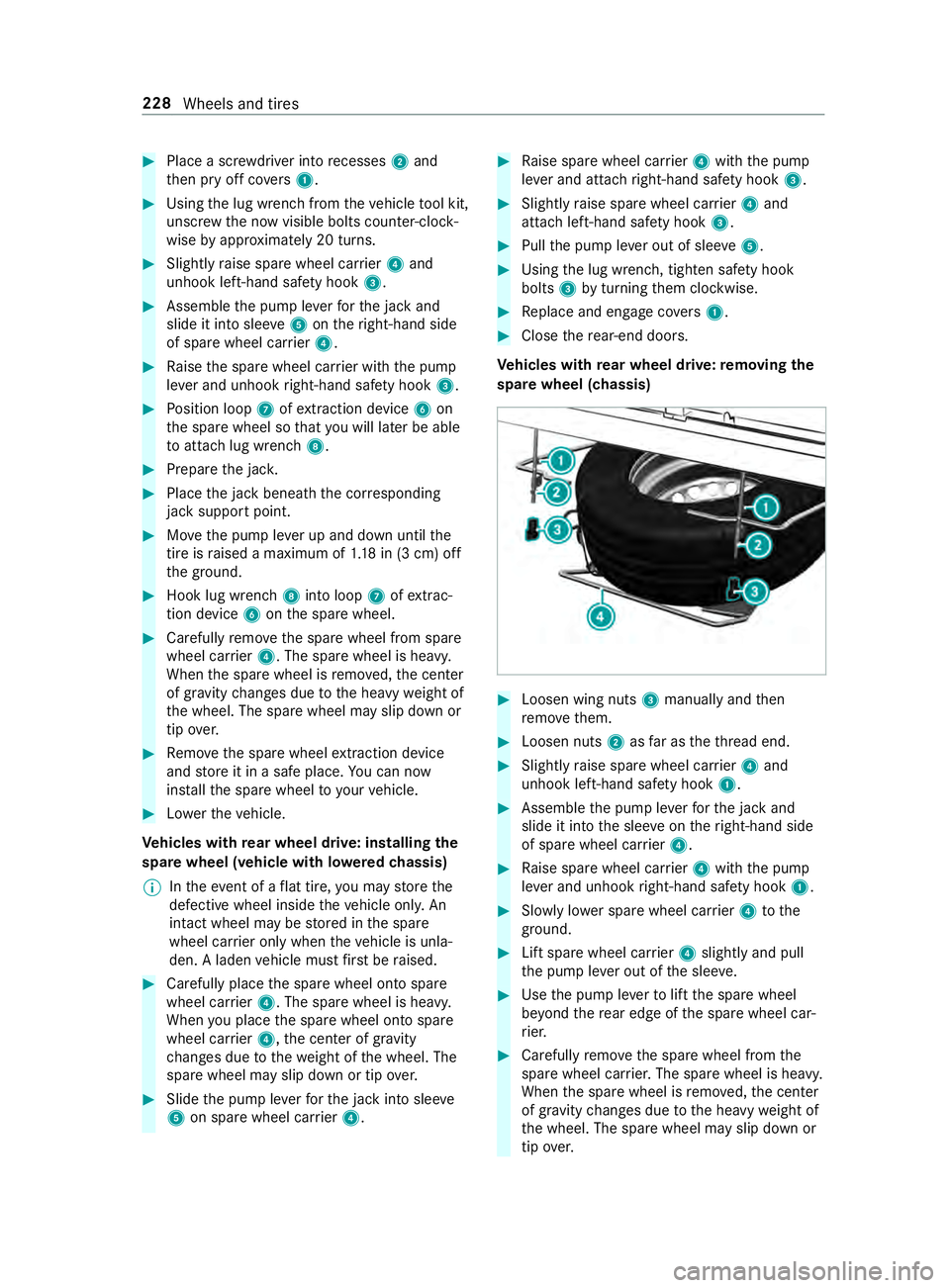
Ve hicles with rear wheel drive: removing the
spar ewheel (chassis) #
Loosen wing nuts 3manually and then
re mo vethem. #
Loosen nuts 2asfarast hethre ad end. #
Slightly raise spar ewheel car rier 4 and
unhook left-hand saf etyh ook 1. #
Assemble thep um pleve rfor thej acka nd
slide it int othe slee veon ther ight-ha ndside
of spar ewheel car rier 4. #
Raise spar ewheel car rier 4 withthe pump
le ve ra nd unhook right-han dsafet yh ook 1. #
Slowl ylow er spar ewhee lcarrier 4 tothe
ground. #
Lift spar ewheel car rier 4 slightl yand pull
th ep um pleve rout of thes lee ve. #
Use thep um pleve rtol iftt he spar ewheel
be yond ther ear edg eofthe spar ewheel car‐
ri er. #
Carefully remo vethes par ew heel from the
spar ewheel car rier .T he spar ewheel is heavy.
When thes par ew heel is remo ved, thec enter
of gr avity changes due totheh eavy weight of
th ew heel. The spar ewheel ma yslip down or
tip ove r. 228
Wheels and tires