brake Mercury Grand Marquis 1999 s Service Manual
[x] Cancel search | Manufacturer: MERCURY, Model Year: 1999, Model line: Grand Marquis, Model: Mercury Grand Marquis 1999Pages: 200, PDF Size: 1.16 MB
Page 157 of 200
SNOW TIRES AND CHAINS
Snow tires must be the same size and grade as the tires you
currently have on your vehicle.
The tires on your vehicle have all weather treads to provide traction in
rain and snow. However, in some climates, you may need to use snow
tires and chains. If you need to use chains, it is recommended that steel
wheels (of the same size and specifications) be used as chains may chip
aluminum wheels.
Follow these guidelines when using snow tires and chains:
²Use only SAE Class S chains.
²Install chains securely, verifying that the chains do not touch any
wiring, brake lines or fuel lines.
²Drive cautiously. If you hear the chains rub or bang against your
vehicle, stop and re-tighten the chains. If this does not work, remove
the chains to prevent damage to your vehicle.
²If possible, avoid fully loading your vehicle.
²Remove the tire chains when they are no longer needed. Do not use
tire chains on dry roads.
²The suspension insulation and bumpers will help prevent vehicle
damage. Do not remove these components from your vehicle when
using snow tires and chains.
WHAT YOU SHOULD KNOW ABOUT AUTOMOTIVE FUELS
Important safety precautions
Do not overfill the fuel tank. The pressure in an overfilled tank
may cause leakage and lead to fuel spray and fire.
If you do not use the proper fuel cap, the pressure in the fuel
tank can damage the fuel system or cause it to work improperly
in a collision.
Maintenance and care
157
Page 163 of 200

economy. Additionally, keeping records during summer and winter will
show how temperature impacts fuel economy. In general, lower
temperatures give lower fuel economy.
Driving style Ð good driving and fuel economy habits
Give consideration to the lists that follow and you may be able to change
a number of variables and improve your fuel economy.
Habits
²Smooth, moderate operation can yield up to 10% savings in fuel.
²Steady speeds without stopping will usually give the best fuel
economy.
²Idling for long periods of time (greater than one minute) may waste
fuel.
²Anticipate stopping; slowing down may eliminate the need to stop.
²Sudden or hard accelerations may reduce fuel economy.
²Slow down gradually.
²Drive at reasonable speeds (traveling at 105 km /h [65 mph] uses 15%
more fuel than traveling at 88 km/h [55 mph]).
²Revving the engine before turning it off may reduce fuel economy.
²Use of the air conditioner or defroster may reduce fuel economy.
²Use of speed control (if equipped) may improve fuel economy. Speed
control can help maintain a constant speed and reduce speed changes.
You may want to turn off the speed control in hilly terrain as
unnecessary shifting between third and fourth gears may occur and
could result in reduced fuel economy.
²Warming up a vehicle on cold mornings is not required and may
reduce fuel economy.
²Resting your foot on the brake pedal while driving may reduce fuel
economy.
²Combine errands and minimize stop-and-go driving.
Maintenance
²Keep tires properly inflated and use only recommended size.
²Operating a vehicle with the wheels out of alignment will reduce fuel
economy.
Maintenance and care
163
Page 166 of 200

Readiness for Inspection/Maintenance (I/M) testing
In some localities, it may be a legal requirement to pass an I/M test of
the on-board diagnostics system. If your ªCheck Engine/Service Engine
Soonº light is on, refer to the description in theWarning Lights and
Chimessection of theInstrumentationchapter. Your vehicle may not
pass the I/M test with the ªCheck Engine/Service Engine Soonº light on.
If the vehicle's powertrain system or its battery has just been serviced,
the on-board diagnostics system is reset to a ªnot ready for I/M testº
condition. To ready the on-board diagnostics system for I/M testing, a
minimum of 30 minutes of city and highway driving is necessary as
described below:
²First, at least 10 minutes of driving on an expressway or highway.
²Next, at least 20 minutes driving in stop-and-go, city-type traffic with
at least four idle periods.
Allow the vehicle to sit for at least eight hours without starting the
engine. Then, start the engine and complete the above driving cycle. The
engine must warm up to its normal operating temperature. Once started,
do not turn off the engine until the above driving cycle is complete.
EXTERIOR BULBS
Replacing exterior bulbs
Check the operation of the following lamps frequently:
²Headlamps
²Tail lamps
²Brakelamps
²High-mount brakelamp
²Turn signals
²Backup lamps
²License plate lamp
Do not remove lamp bulbs unless they will be replaced immediately. If a
bulb is removed for an extended period of time, contaminants may enter
the lamp housings and affect performance.
Maintenance and care
166
Page 169 of 200
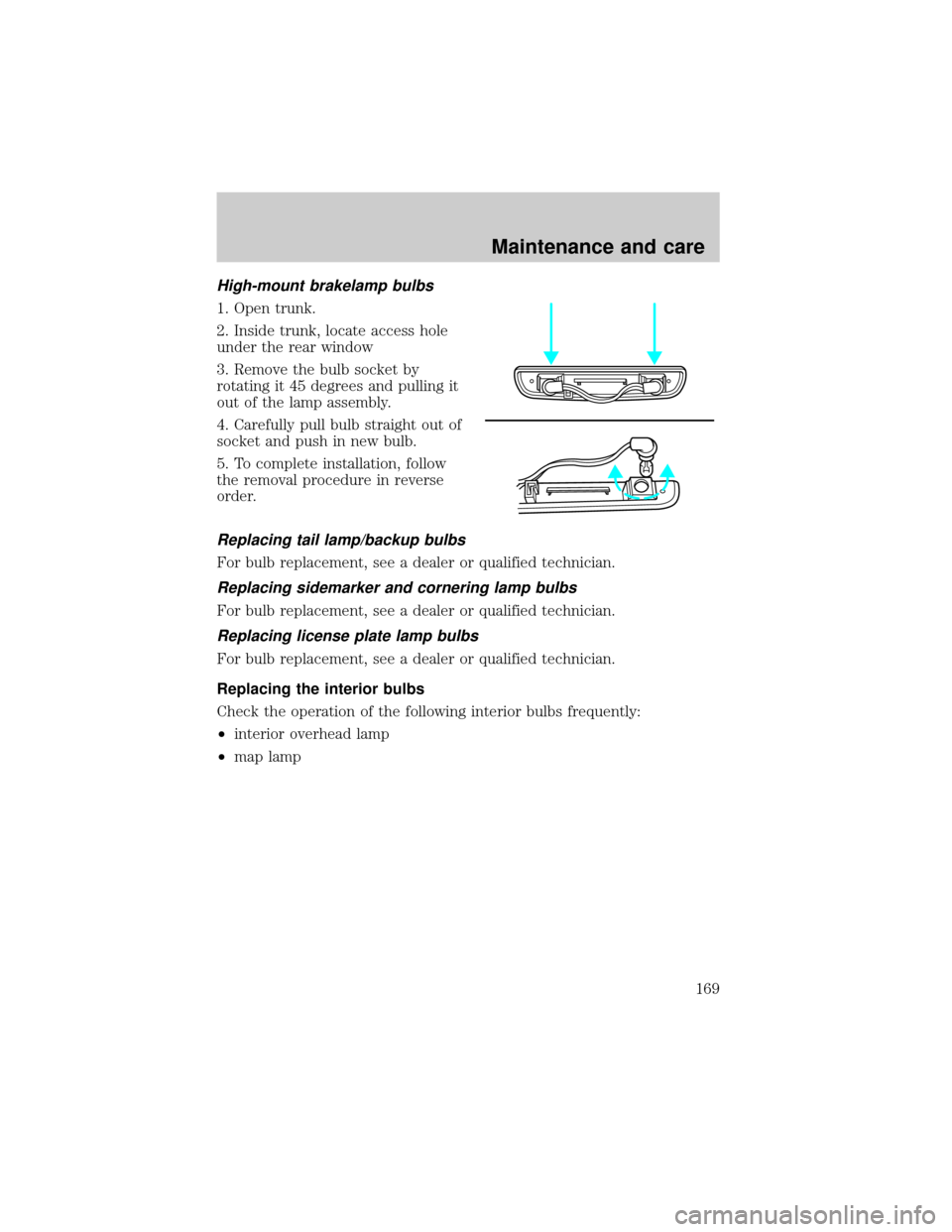
High-mount brakelamp bulbs
1. Open trunk.
2. Inside trunk, locate access hole
under the rear window
3. Remove the bulb socket by
rotating it 45 degrees and pulling it
out of the lamp assembly.
4. Carefully pull bulb straight out of
socket and push in new bulb.
5. To complete installation, follow
the removal procedure in reverse
order.
Replacing tail lamp/backup bulbs
For bulb replacement, see a dealer or qualified technician.
Replacing sidemarker and cornering lamp bulbs
For bulb replacement, see a dealer or qualified technician.
Replacing license plate lamp bulbs
For bulb replacement, see a dealer or qualified technician.
Replacing the interior bulbs
Check the operation of the following interior bulbs frequently:
²interior overhead lamp
²map lamp
Maintenance and care
169
Page 170 of 200
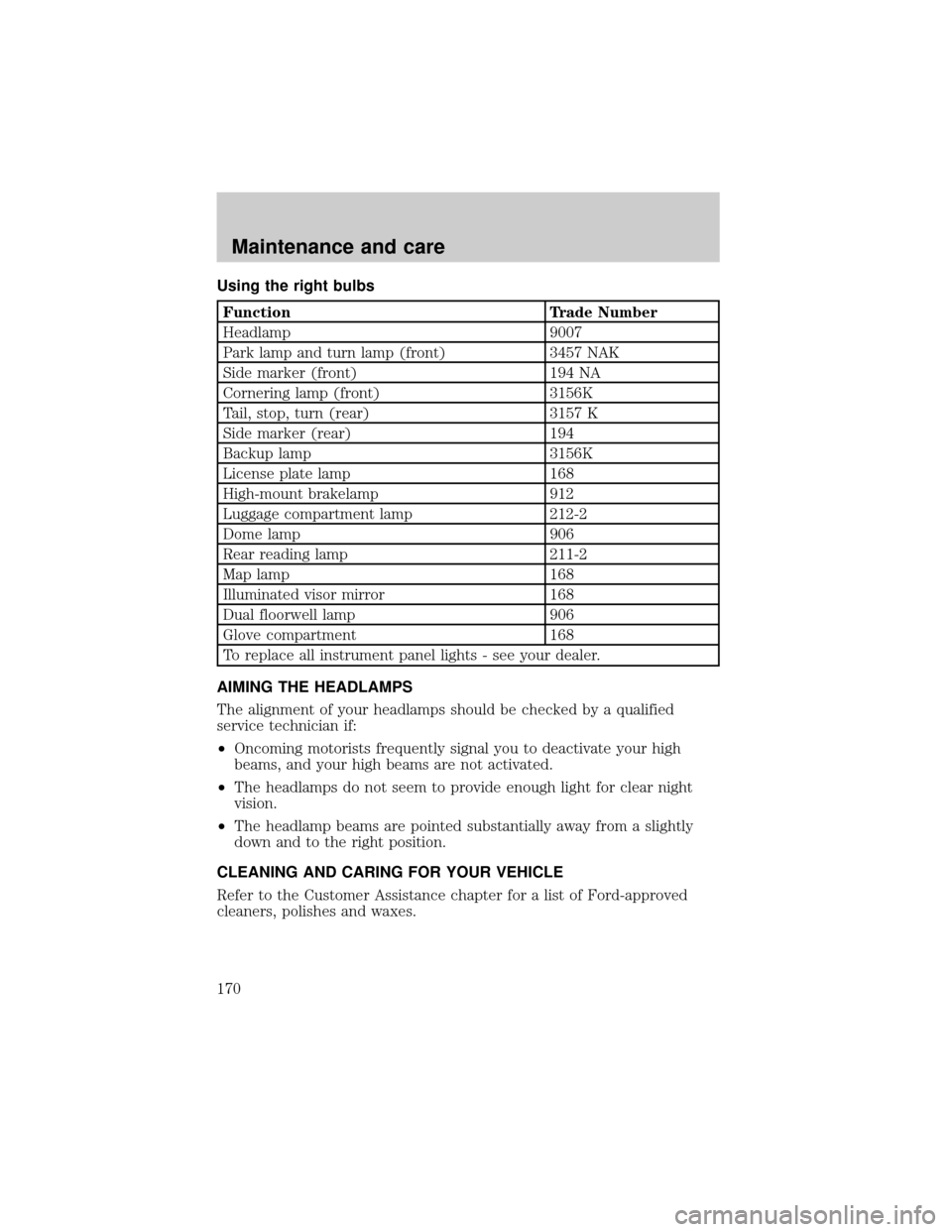
Using the right bulbs
Function Trade Number
Headlamp 9007
Park lamp and turn lamp (front) 3457 NAK
Side marker (front) 194 NA
Cornering lamp (front) 3156K
Tail, stop, turn (rear) 3157 K
Side marker (rear) 194
Backup lamp 3156K
License plate lamp 168
High-mount brakelamp 912
Luggage compartment lamp 212-2
Dome lamp 906
Rear reading lamp 211-2
Map lamp 168
Illuminated visor mirror 168
Dual floorwell lamp 906
Glove compartment 168
To replace all instrument panel lights - see your dealer.
AIMING THE HEADLAMPS
The alignment of your headlamps should be checked by a qualified
service technician if:
²Oncoming motorists frequently signal you to deactivate your high
beams, and your high beams are not activated.
²The headlamps do not seem to provide enough light for clear night
vision.
²The headlamp beams are pointed substantially away from a slightly
down and to the right position.
CLEANING AND CARING FOR YOUR VEHICLE
Refer to the Customer Assistance chapter for a list of Ford-approved
cleaners, polishes and waxes.
Maintenance and care
170
Page 171 of 200
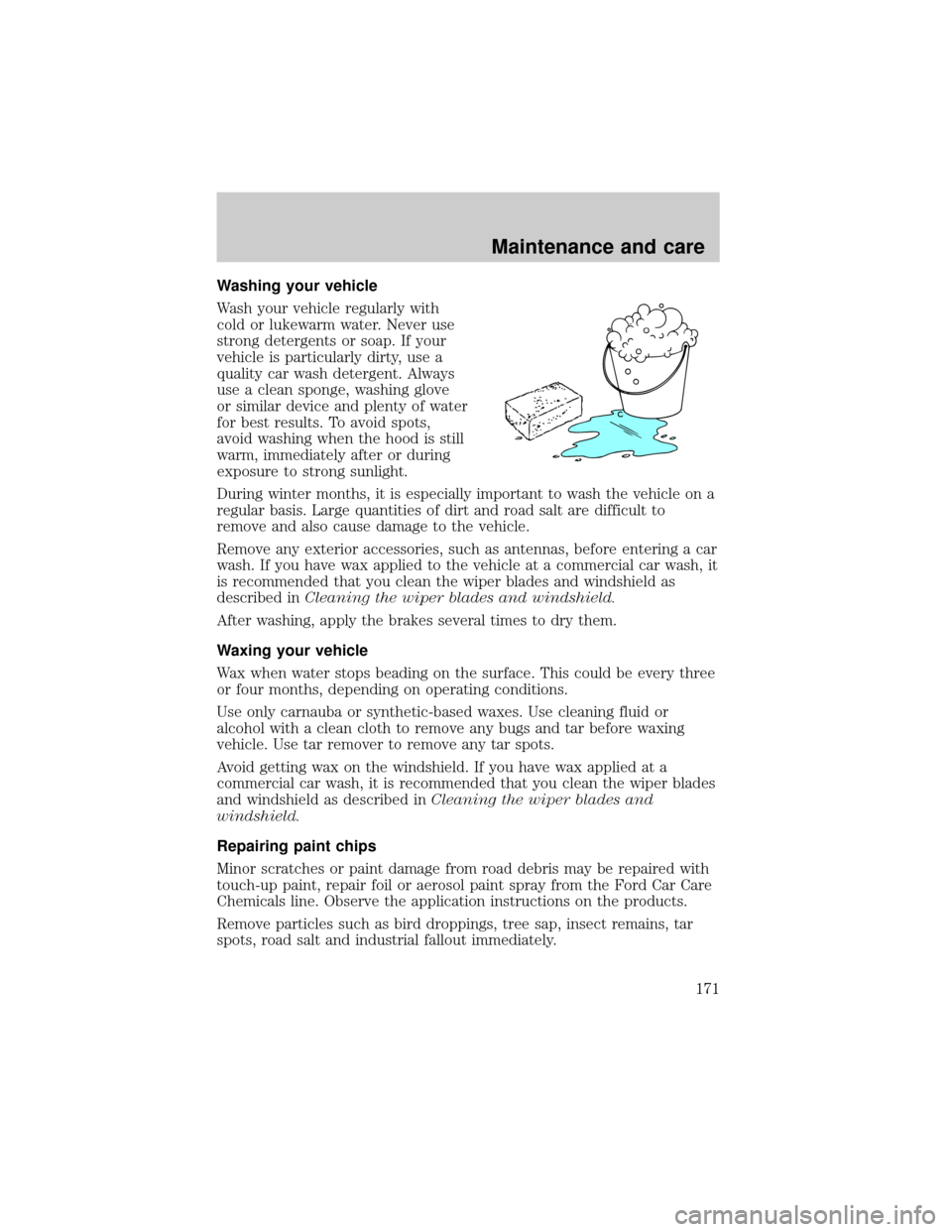
Washing your vehicle
Wash your vehicle regularly with
cold or lukewarm water. Never use
strong detergents or soap. If your
vehicle is particularly dirty, use a
quality car wash detergent. Always
use a clean sponge, washing glove
or similar device and plenty of water
for best results. To avoid spots,
avoid washing when the hood is still
warm, immediately after or during
exposure to strong sunlight.
During winter months, it is especially important to wash the vehicle on a
regular basis. Large quantities of dirt and road salt are difficult to
remove and also cause damage to the vehicle.
Remove any exterior accessories, such as antennas, before entering a car
wash. If you have wax applied to the vehicle at a commercial car wash, it
is recommended that you clean the wiper blades and windshield as
described inCleaning the wiper blades and windshield.
After washing, apply the brakes several times to dry them.
Waxing your vehicle
Wax when water stops beading on the surface. This could be every three
or four months, depending on operating conditions.
Use only carnauba or synthetic-based waxes. Use cleaning fluid or
alcohol with a clean cloth to remove any bugs and tar before waxing
vehicle. Use tar remover to remove any tar spots.
Avoid getting wax on the windshield. If you have wax applied at a
commercial car wash, it is recommended that you clean the wiper blades
and windshield as described inCleaning the wiper blades and
windshield.
Repairing paint chips
Minor scratches or paint damage from road debris may be repaired with
touch-up paint, repair foil or aerosol paint spray from the Ford Car Care
Chemicals line. Observe the application instructions on the products.
Remove particles such as bird droppings, tree sap, insect remains, tar
spots, road salt and industrial fallout immediately.
Maintenance and care
171
Page 175 of 200
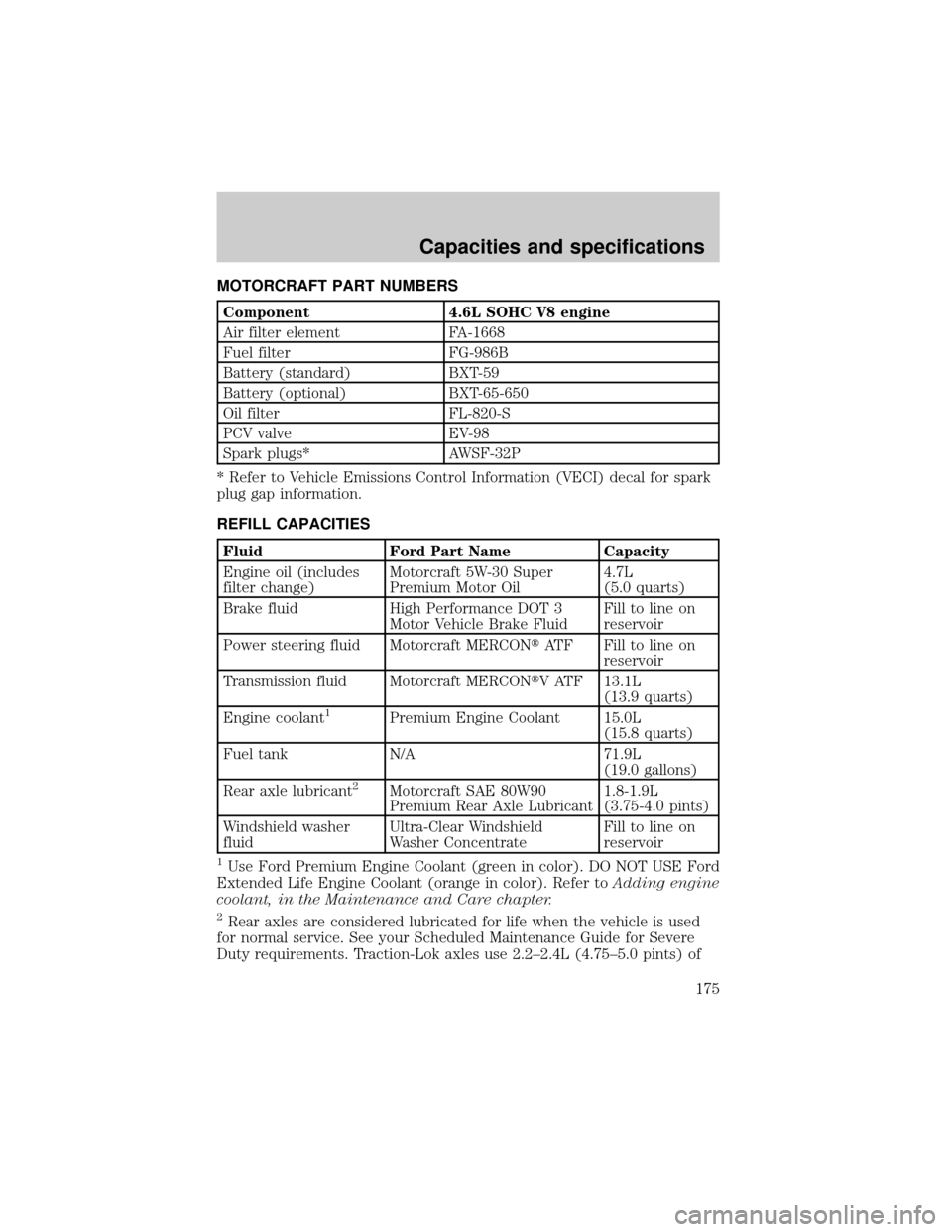
MOTORCRAFT PART NUMBERS
Component 4.6L SOHC V8 engine
Air filter element FA-1668
Fuel filter FG-986B
Battery (standard) BXT-59
Battery (optional) BXT-65-650
Oil filter FL-820-S
PCV valve EV-98
Spark plugs* AWSF-32P
* Refer to Vehicle Emissions Control Information (VECI) decal for spark
plug gap information.
REFILL CAPACITIES
Fluid Ford Part Name Capacity
Engine oil (includes
filter change)Motorcraft 5W-30 Super
Premium Motor Oil4.7L
(5.0 quarts)
Brake fluid High Performance DOT 3
Motor Vehicle Brake FluidFill to line on
reservoir
Power steering fluid Motorcraft MERCONtATF Fill to line on
reservoir
Transmission fluid Motorcraft MERCONtV ATF 13.1L
(13.9 quarts)
Engine coolant
1Premium Engine Coolant 15.0L
(15.8 quarts)
Fuel tank N/A 71.9L
(19.0 gallons)
Rear axle lubricant
2Motorcraft SAE 80W90
Premium Rear Axle Lubricant1.8-1.9L
(3.75-4.0 pints)
Windshield washer
fluidUltra-Clear Windshield
Washer ConcentrateFill to line on
reservoir
1Use Ford Premium Engine Coolant (green in color). DO NOT USE Ford
Extended Life Engine Coolant (orange in color). Refer toAdding engine
coolant, in the Maintenance and Care chapter.
2Rear axles are considered lubricated for life when the vehicle is used
for normal service. See your Scheduled Maintenance Guide for Severe
Duty requirements. Traction-Lok axles use 2.2±2.4L (4.75±5.0 pints) of
Capacities and specifications
175
Page 176 of 200
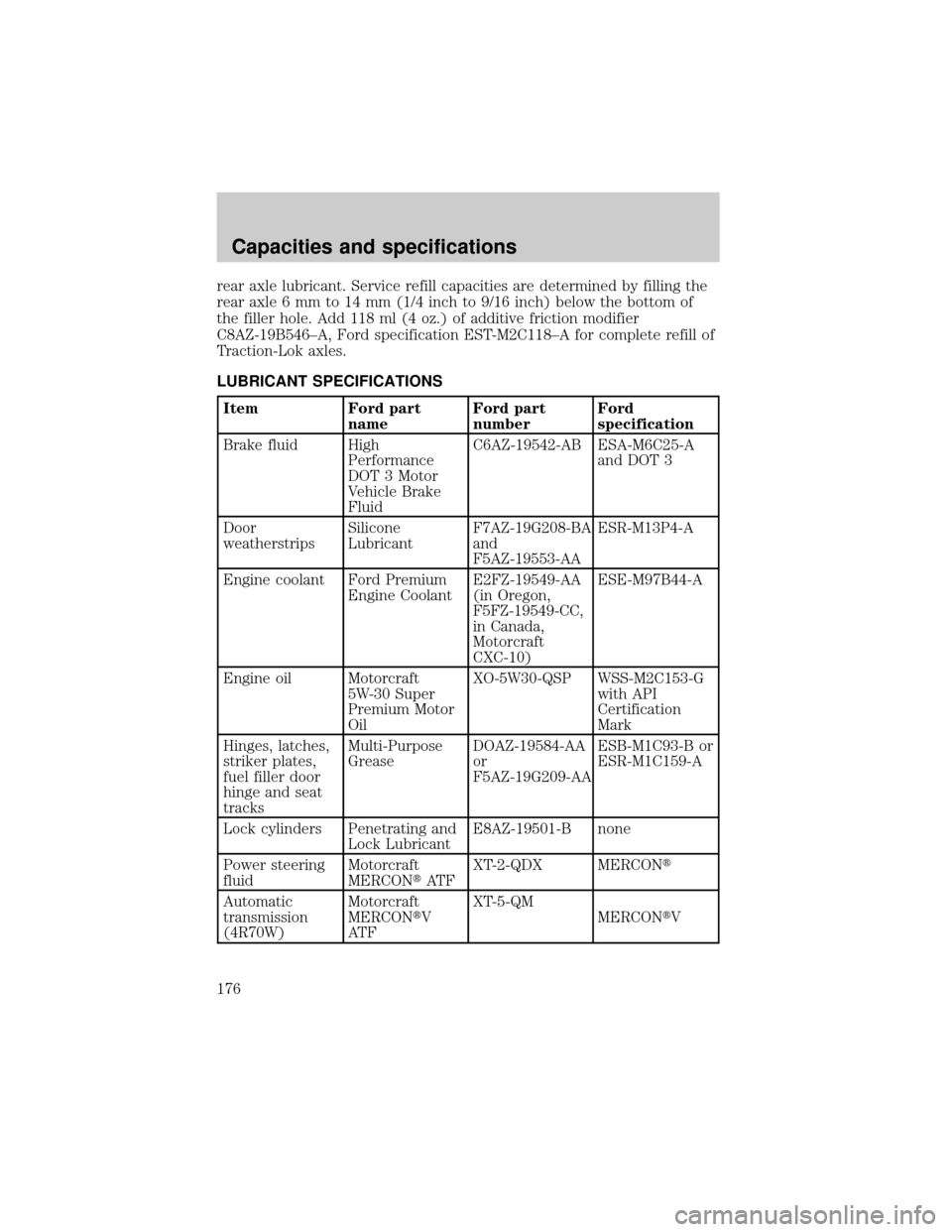
rear axle lubricant. Service refill capacities are determined by filling the
rear axle 6 mm to 14 mm (1/4 inch to 9/16 inch) below the bottom of
the filler hole. Add 118 ml (4 oz.) of additive friction modifier
C8AZ-19B546±A, Ford specification EST-M2C118±A for complete refill of
Traction-Lok axles.
LUBRICANT SPECIFICATIONS
Item Ford part
nameFord part
numberFord
specification
Brake fluid High
Performance
DOT 3 Motor
Vehicle Brake
FluidC6AZ-19542-AB ESA-M6C25-A
and DOT 3
Door
weatherstripsSilicone
LubricantF7AZ-19G208-BA
and
F5AZ-19553-AAESR-M13P4-A
Engine coolant Ford Premium
Engine CoolantE2FZ-19549-AA
(in Oregon,
F5FZ-19549-CC,
in Canada,
Motorcraft
CXC-10)ESE-M97B44-A
Engine oil Motorcraft
5W-30 Super
Premium Motor
OilXO-5W30-QSP WSS-M2C153-G
with API
Certification
Mark
Hinges, latches,
striker plates,
fuel filler door
hinge and seat
tracksMulti-Purpose
GreaseDOAZ-19584-AA
or
F5AZ-19G209-AAESB-M1C93-B or
ESR-M1C159-A
Lock cylinders Penetrating and
Lock LubricantE8AZ-19501-B none
Power steering
fluidMotorcraft
MERCONtAT FXT-2-QDX MERCONt
Automatic
transmission
(4R70W)Motorcraft
MERCONtV
AT FXT-5-QM
MERCONtV
Capacities and specifications
176
Page 193 of 200

Air bag supplemental restraint
system ..........................................90
and child safety seats ..............91
description ................................90
disposal ......................................94
indicator light ...........................93
passenger air bag .....................92
Air conditioning
automatic temperature
control system ......28,29,30,31,33
Air suspension ...........................111
Anti-theft system ........................76
Automatic transmission
driving an automatic
overdrive ...................113,114,115
Axle
refill capacities ........................175
Brakes ........................................106
anti-lock ............................106,107
anti-lock brake system
(ABS) warning light ...............107
fluid, checking and adding ....141
shift interlock ..........................112
Break-in period .............................2
CD changer ..................51,53,54,55
Child safety seats
attaching with tether straps ..100
in rear seat ...........................97,99
tether anchorage hardware ...100
Cleaning your vehicle ...............170
engine compartment ..............172
exterior .............................171,174
exterior lamps .........................173
interior .....................................174
plastic parts ............................173
washing ....................................171
waxing .....................................171
wheels ......................................172
windows ..................................174
wiper blades ............................173
Clock ............................................34
Compass, electronic ....................65calibration .................................67
set zone adjustment .................66
Controls ........................61,62,63,64
power seat ............................82,83
Coolant ......................................144
checking and adding ..............143
refill capacities ........................144
Customer Assistance
Ford accessories for your
vehicle .......................187,188,189
Ford Extended Service Plan .181
Getting assistance outside the
U.S. and Canada .....................186
Getting roadside assistance ...180
Getting the service you
need .........................................182
Ordering additional owner's
literature .................................191
The Dispute Settlement
Board ..................183,184,185,186
Defrost
rear window ..............................25
Emission control system ..........164
Engine
check engine/
service engine soon light ...........7
coolant .....................................142
idle speed control ...................150
service points ..........................138
starting after a collision .........120
Engine block heater .................104
Engine oil
checking and adding ..............140
dipstick ....................................139
specifications ...................139,140
Exhaust fumes ..........................105
Fail safe cooling .................145,146
Floor mats ...................................70
Fuel
choosing the right fuel ...........159
comparisons with EPA fuel
economy estimates .................164
Index
193
Page 194 of 200

detergent in fuel .....................161
filling your vehicle
with fuel ...........................157,159
quality ......................................160
running out of fuel .................161
safety information relating to
automotive fuels .....................157
Fuses ...................................121,122
Gas mileage (see Fuel
economy) ..............161,162,163,164
Gauges .........................................12
battery voltage gauge ...............16
engine coolant
temperature gauge ...................15
engine oil pressure gauge ........16
fuel gauge ..................................12
odometer ...................................14
speedometer .............................13
trip odometer ............................15
Hazard flashers .........................120
Head restraints ......................80,81
Headlamps
aiming ......................................170
bulb specifications ..................170
high beam ..............................9,24
Heating ........................................26
heating and air
conditioning system ............26,27
Hood ..........................................137
Ignition .......................................177
Inspection/maintenanc e(I/M)
testing ........................................166
Instrument panel ..........................6
cleaning ...................................173
Keyless entry system
keypad .......................................77
programmin gentry
code .................................77,78,79
Keys
positions of the ignition ...........56
Lamps
autolamp system .......................25daytime running light ...............25
headlamps .................................24
headlamps, flash to pass ..........24
instrument panel, dimming .....24
interior lamps .........................169
replacing bulbs ..166,167,168,169
Lane change indicator
(see Turn signal) ...................55,56
Lights, warning and indicator ......6
air bag ..........................................8
air suspension ...........................10
anti-lock brakes (ABS) .........9,22
brake .......................................8,23
charging system ..........................9
low coolant ................................10
low fuel ........................................6
oil pressure .................................9
overdrive off ..............................10
safety belt ...................................8
speed control ............................61
traction control active .........11,22
turn signal indicator ...................9
Locks
childproof ..................................70
Lumbar support, seats ...............84
Message center ...........................17
reset button .........................17,18
select button .............................18
Mirrors
automatic dimming
rearview mirror .........................65
side view mirrors (power) .......69
Motorcraft parts ........................161
Octane rating ............................160
Overdrive .....................................57
Parking brake ............................107
Power distribution box (see
Fuses) ........................................124
Power door locks ...................69,72
Power steering ...................110,111
fluid, checking and adding ....147
Index
194