wheel MITSUBISHI 380 2005 User Guide
[x] Cancel search | Manufacturer: MITSUBISHI, Model Year: 2005, Model line: 380, Model: MITSUBISHI 380 2005Pages: 1500, PDF Size: 47.87 MB
Page 1177 of 1500
SPECIAL TOOLS
BASIC BRAKE SYSTEM35A-12
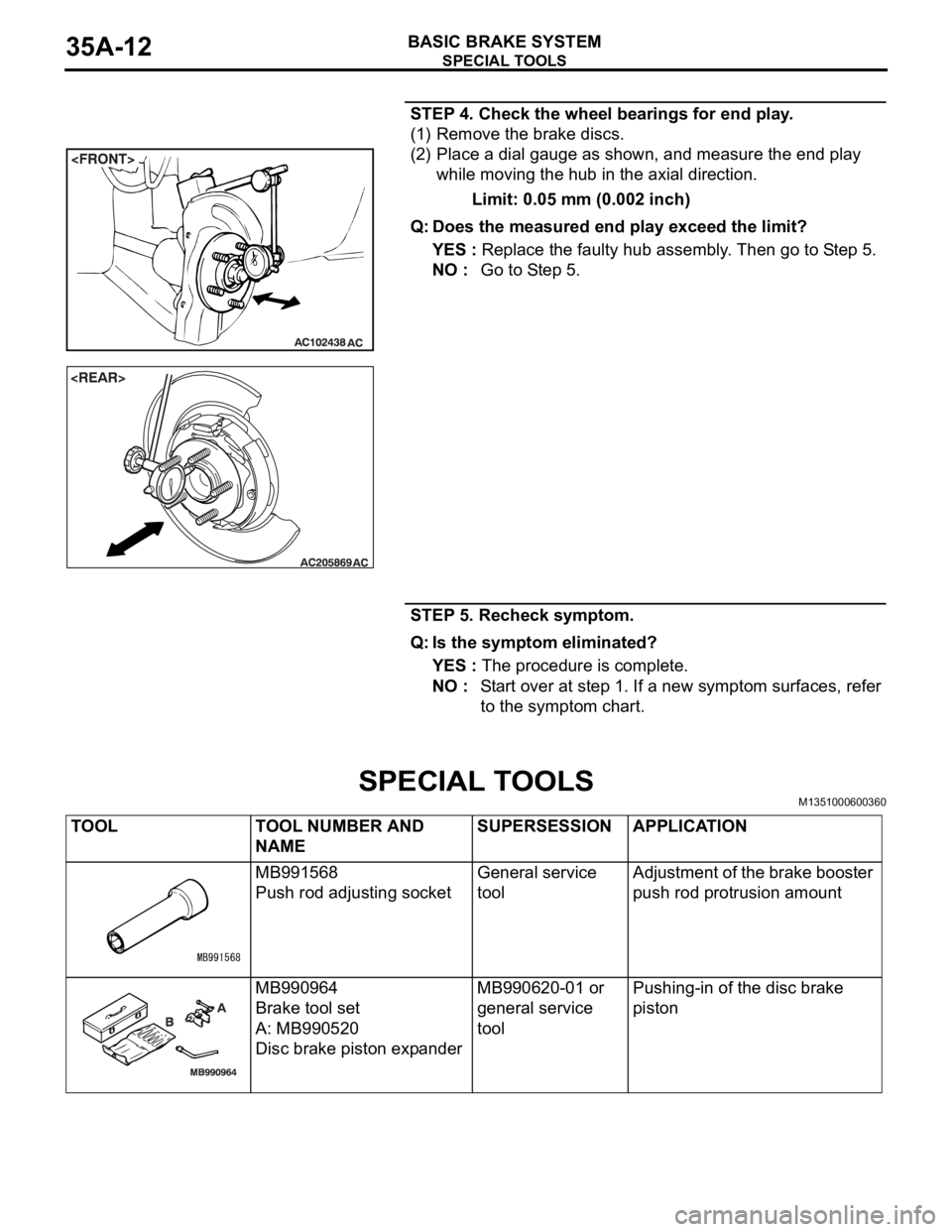
STEP 4. Check the wheel bearings for end play.
(1) Remove the brake discs.
(2) Place a dial gauge as shown, and measure the end play
while moving the hub in the axial direction.
Limit: 0.05 mm (0.002 inch)
Q: Does the measured end play exceed the limit?
YES : Replace the faulty hub assembly. Then go to Step 5.
NO : Go to Step 5.
STEP 5. Recheck symptom.
Q: Is the symptom eliminated?
YES : The procedure is complete.
NO : Start over at step 1. If a new symptom surfaces, refer
to the symptom chart.
SPECIAL TOOLSM1351000600360
TOOL TOOL NUMBER AND
NAMESUPERSESSION APPLICATION
MB991568
Push rod adjusting socketGeneral service
toolAdjustment of the brake booster
push rod protrusion amount
MB990964
Brake tool set
A: MB990520
Disc brake piston expanderMB990620-01 or
general service
toolPushing-in of the disc brake
piston
Page 1182 of 1500
ON-VEHICLE SERVICE
BASIC BRAKE SYSTEM35A-17
BRAKE FLUID LEVEL SENSOR CHECKM1351009100403
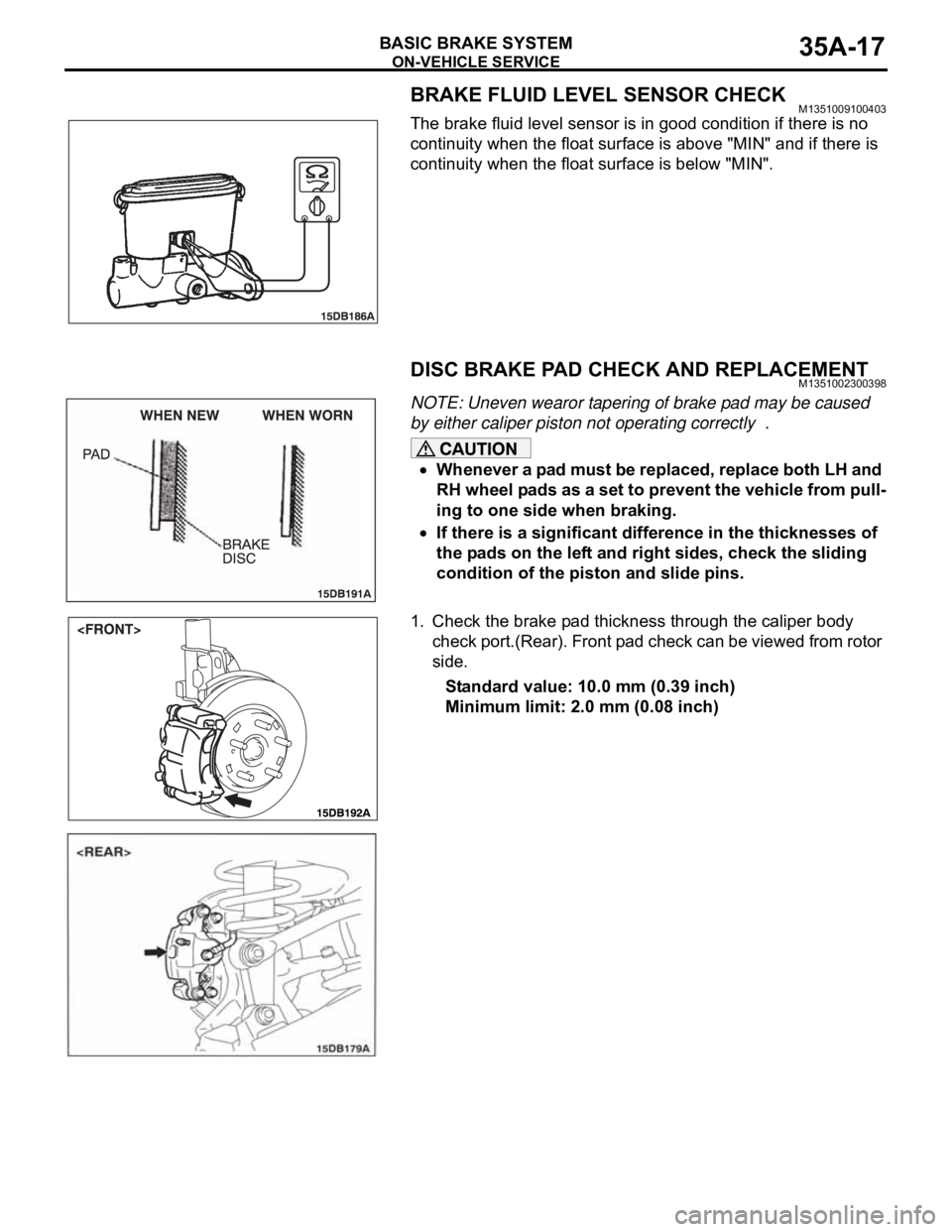
The brake fluid level sensor is in good condition if there is no
continuity when the float surface is above "MIN" and if there is
continuity when the float surface is below "MIN".
DISC BRAKE PAD CHECK AND REPLACEMENTM1351002300398
NOTE: Uneven wearor tapering of brake pad may be caused
by either caliper piston not operating correctly .
Whenever a pad must be replaced, replace both LH and
RH wheel pads as a set to prevent the vehicle from pull-
ing to one side when braking.
If there is a significant difference in the thicknesses of
the pads on the left and right sides, check the sliding
condition of the piston and slide pins.
1. Check the brake pad thickness through the caliper body
check port.(Rear). Front pad check can be viewed from rotor
side.
Standard value: 10.0 mm (0.39 inch)
Minimum limit: 2.0 mm (0.08 inch)
Page 1186 of 1500
ON-VEHICLE SERVICE
BASIC BRAKE SYSTEM35A-21
After a new brake disc is installed, always grind the
brake disc with an on-the-car type brake lathe. If this
step is not carried out, the brake disc run-out exceeds
the specified value, resulting in judder.
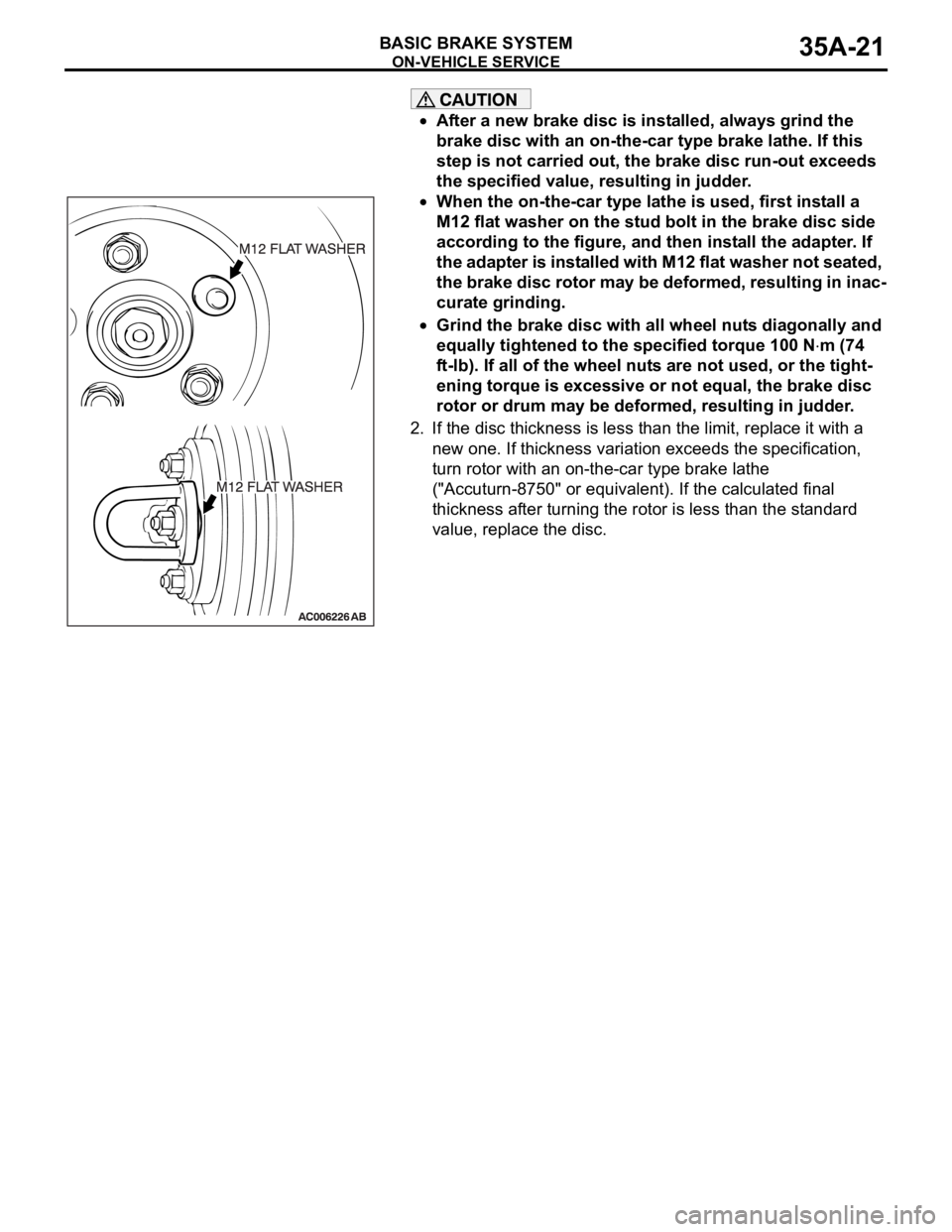
When the on-the-car type lathe is used, first install a
M12 flat washer on the stud bolt in the brake disc side
according to the figure, and then install the adapter. If
the adapter is installed with M12 flat washer not seated,
the brake disc rotor may be deformed, resulting in inac-
curate grinding.
Grind the brake disc with all wheel nuts diagonally and
equally tightened to the specified torque 100 N
m (74
ft-lb). If all of the wheel nuts are not used, or the tight-
ening torque is excessive or not equal, the brake disc
rotor or drum may be deformed, resulting in judder.
2. If the disc thickness is less than the limit, replace it with a
new one. If thickness variation exceeds the specification,
turn rotor with an on-the-car type brake lathe
("Accuturn-8750" or equivalent). If the calculated final
thickness after turning the rotor is less than the standard
value, replace the disc.
.
Page 1187 of 1500
ON-VEHICLE SERVICE
BASIC BRAKE SYSTEM35A-22
BRAKE DISC RUN-OUT CHECK AND
CORRECTION
1. Remove the brake assembly, and then hold it with wire.
2. Temporarily install the disc with the hub nut.
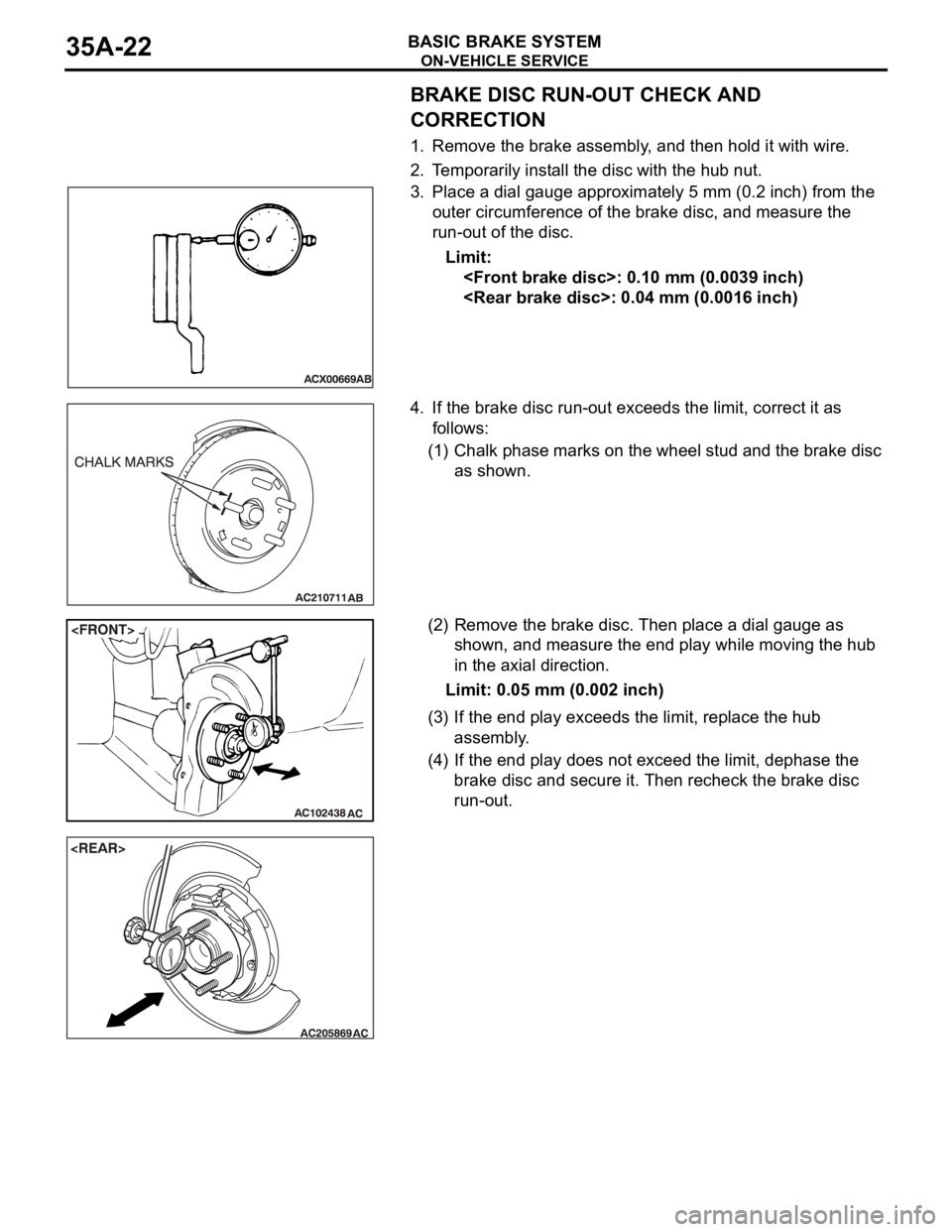
3. Place a dial gauge approximately 5 mm (0.2 inch) from the
outer circumference of the brake disc, and measure the
run-out of the disc.
Limit:
4. If the brake disc run-out exceeds the limit, correct it as
follows:
(1) Chalk phase marks on the wheel stud and the brake disc
as shown.
(2) Remove the brake disc. Then place a dial gauge as
shown, and measure the end play while moving the hub
in the axial direction.
Limit: 0.05 mm (0.002 inch)
(3) If the end play exceeds the limit, replace the hub
assembly.
(4) If the end play does not exceed the limit, dephase the
brake disc and secure it. Then recheck the brake disc
run-out.
Page 1188 of 1500
ON-VEHICLE SERVICE
BASIC BRAKE SYSTEM35A-23
After a new brake disc is installed, always grind the
brake disc with an on-the-car type brake lathe. If this
step is not carried out, the brake disc run-out exceeds
the specified value, resulting in judder.
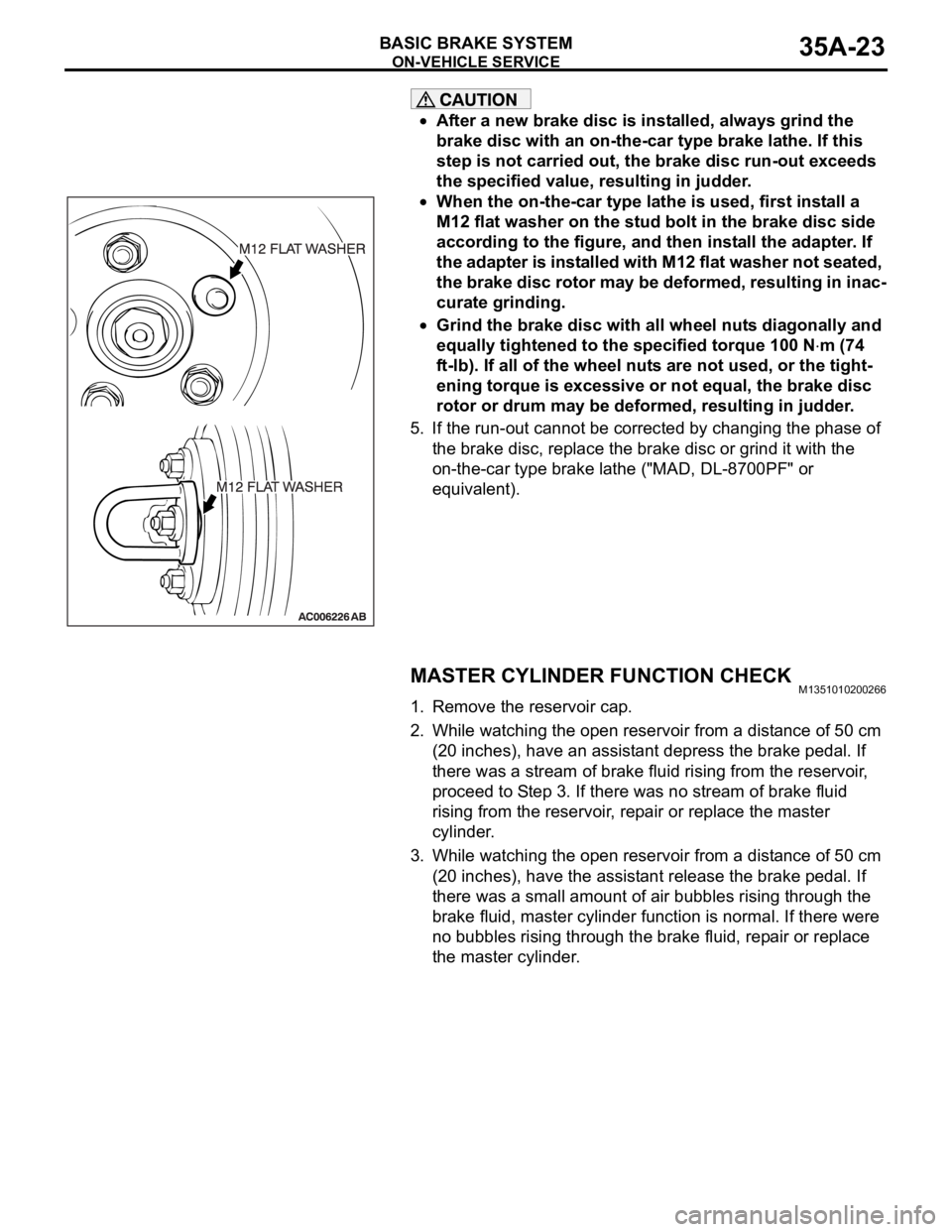
When the on-the-car type lathe is used, first install a
M12 flat washer on the stud bolt in the brake disc side
according to the figure, and then install the adapter. If
the adapter is installed with M12 flat washer not seated,
the brake disc rotor may be deformed, resulting in inac-
curate grinding.
Grind the brake disc with all wheel nuts diagonally and
equally tightened to the specified torque 100 N
m (74
ft-lb). If all of the wheel nuts are not used, or the tight-
ening torque is excessive or not equal, the brake disc
rotor or drum may be deformed, resulting in judder.
5. If the run-out cannot be corrected by changing the phase of
the brake disc, replace the brake disc or grind it with the
on-the-car type brake lathe ("MAD, DL-8700PF" or
equivalent).
MASTER CYLINDER FUNCTION CHECKM1351010200266
1. Remove the reservoir cap.
2. While watching the open reservoir from a distance of 50 cm
(20 inches), have an assistant depress the brake pedal. If
there was a stream of brake fluid rising from the reservoir,
proceed to Step 3. If there was no stream of brake fluid
rising from the reservoir, repair or replace the master
cylinder.
3. While watching the open reservoir from a distance of 50 cm
(20 inches), have the assistant release the brake pedal. If
there was a small amount of air bubbles rising through the
brake fluid, master cylinder function is normal. If there were
no bubbles rising through the brake fluid, repair or replace
the master cylinder.
Page 1199 of 1500
DISC BRAKE ASSEMBLY
BASIC BRAKE SYSTEM35A-34
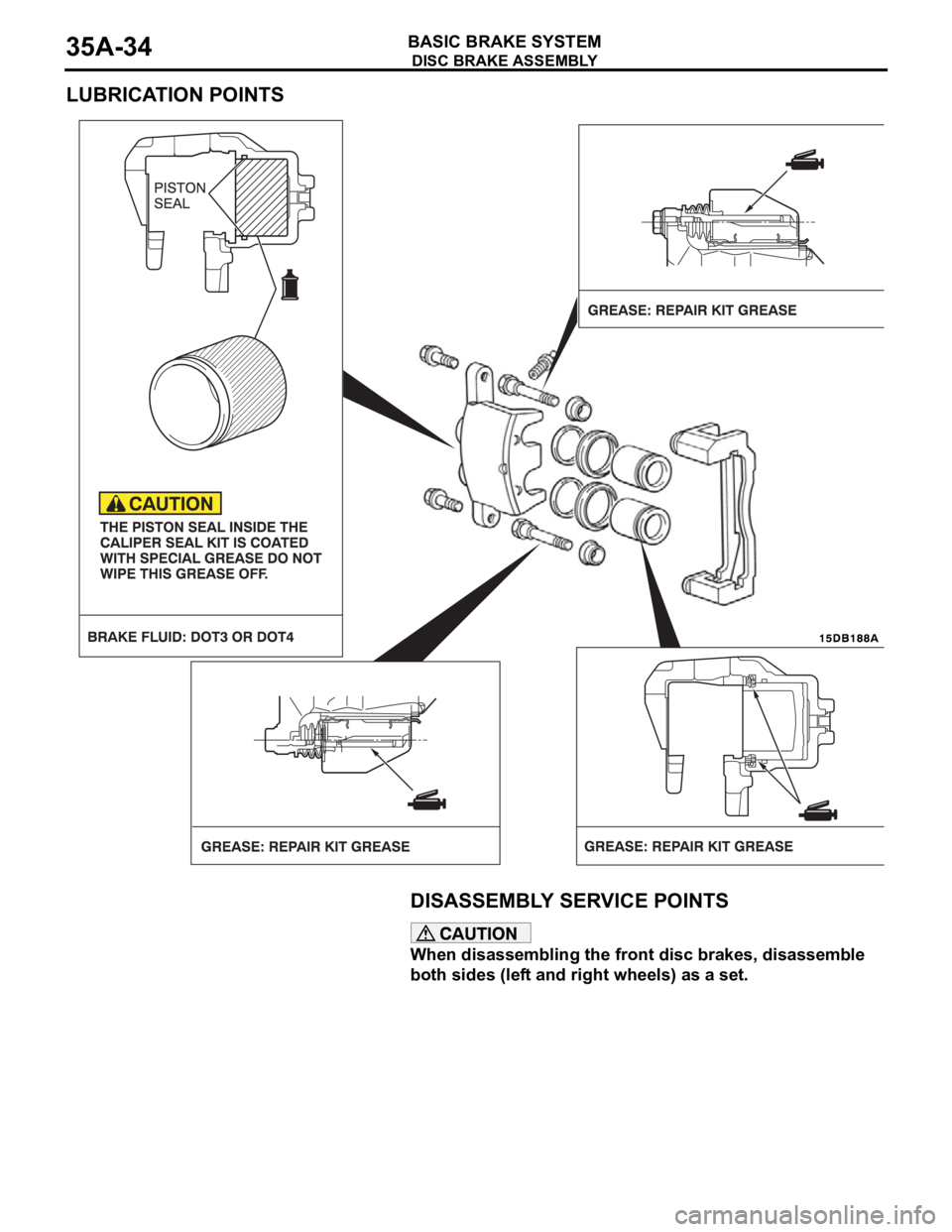
LUBRICATION POINTS
DISASSEMBLY SERVICE POINTS
When disassembling the front disc brakes, disassemble
both sides (left and right wheels) as a set.
.
Page 1204 of 1500

DISC BRAKE ASSEMBLY
BASIC BRAKE SYSTEM35A-39
PAD WEAR CHECK
Always replace both brake pads on each wheel as
a set (both front wheels or both rear wheels). Fail-
ure to do so will result in uneven braking, which
may cause unreliable brake operation.
If there is significant difference in the thickness of
the pads on the left and right sides, check the slid-
ing condition of the piston and slide pins.
1. Measure thickness at the thinnest and most worn area of the
pad.
Standard value: 10 mm (0.39 inch)
Minimum limit: 2.0 mm (0.08 inch)
2. Replace the pad assembly if pad thickness is less than the
limit value.
Page 1205 of 1500

SPECIFICATIONS
BASIC BRAKE SYSTEM35A-40
SPECIFICATIONS
FASTENER TIGHTENING SPECIFICATIONSM1351009600390
GENERAL SPECIFICATIONSM1351000200362
ITEM SPECIFICATION
Brake line
Brake tube flare nut 15
2 Nm
Brake pedal
Brake booster nut 14
2 Nm
Brake pedal bolt 13
2 Nm
Front disc brake
Brake hose connector bolt 30
4 Nm
Caliper bleeder 12.5
1.5 Nm
Front brake assembly mounting bolt 100
10 Nm
Front brake bolt (guide pin bolt) 36.5
1.5 Nm
Master cylinder assembly and brake booster
Brake booster nut 14
2 Nm
Brake master cylinder mounting nut 25
2 Nm
Rear disc brake
Brake hose connector bolt 30
4 Nm
Caliper bleeder 12.5
1.5 Nm
Rear brake assembly mounting bolt 60
5 Nm
Rear brake bolt (guide pin bolt) 36.5
1.5 Nm
ITEM SPECIFICATION
Master
cylinderType Tandem type
I.D. mm 25.4
Brake
boosterType Vacuum type, tandem
Effective dia. of power
cylinder mm 205 + 230
Boosting ratio 6.5
Rear wheel hydraulic control method Electronic brake-force distribution (EBD)
Front brakes Type Floating caliper, Aluminium housing, 2 piston, ventilated disc
Disc effective dia
thickness
mm 296 28.0
Wheel cylinder I.D. mm 42.0 x 2
Pad thickness mm 10.0
Clearance adjustment Automatic
Page 1206 of 1500

SPECIFICATIONS
BASIC BRAKE SYSTEM35A-41
SERVICE SPECIFICATIONSM1351000300477
LUBRICANTSM1351000400429
Rear brakes Type Floating caliper, Aluminium housing, 1 piston, ventilated disc
Disc effective dia
thickness
mm 303 18
Wheel cylinder I.D. mm 40.5
Pad thickness mm 10.0
Clearance adjustment Automatic ITEM SPECIFICATION
ITEM STANDARD VALUE LIMIT
Brake pedal height mm A/T 168.5
171.5
M/T 169.4 172.4
Brake pedal free play mm 3
8
Brake pedal to floor board clearance mm 110 or more
Disc brake pad thickness mm 10.0 Minimum 2.0
Disc brake disc thickness
mm Front 28.0 Minimum 26.4
Rear 18.0 Minimum 16.4
Disc brake disc run-out
mm Front
0.1
Rear
0.04
Disc brake drag force N Front 64 or less
Rear 54 or less
Hub end play mm 0.05
Brake booster push rod protruding length mm.
[When applying negative pressure of 66.7 kPa to the
brake booster]5.0
0.1
ITEM SPECIFIED LUBRICANT
Brake fluid DOT3 or DOT4
Piston boot, piston seal Repair kit grease
Front brake pin, rear brake pin (guide pin)
Page 1209 of 1500
GENERAL DESCRIPTION
PARKING BRAKES36-2
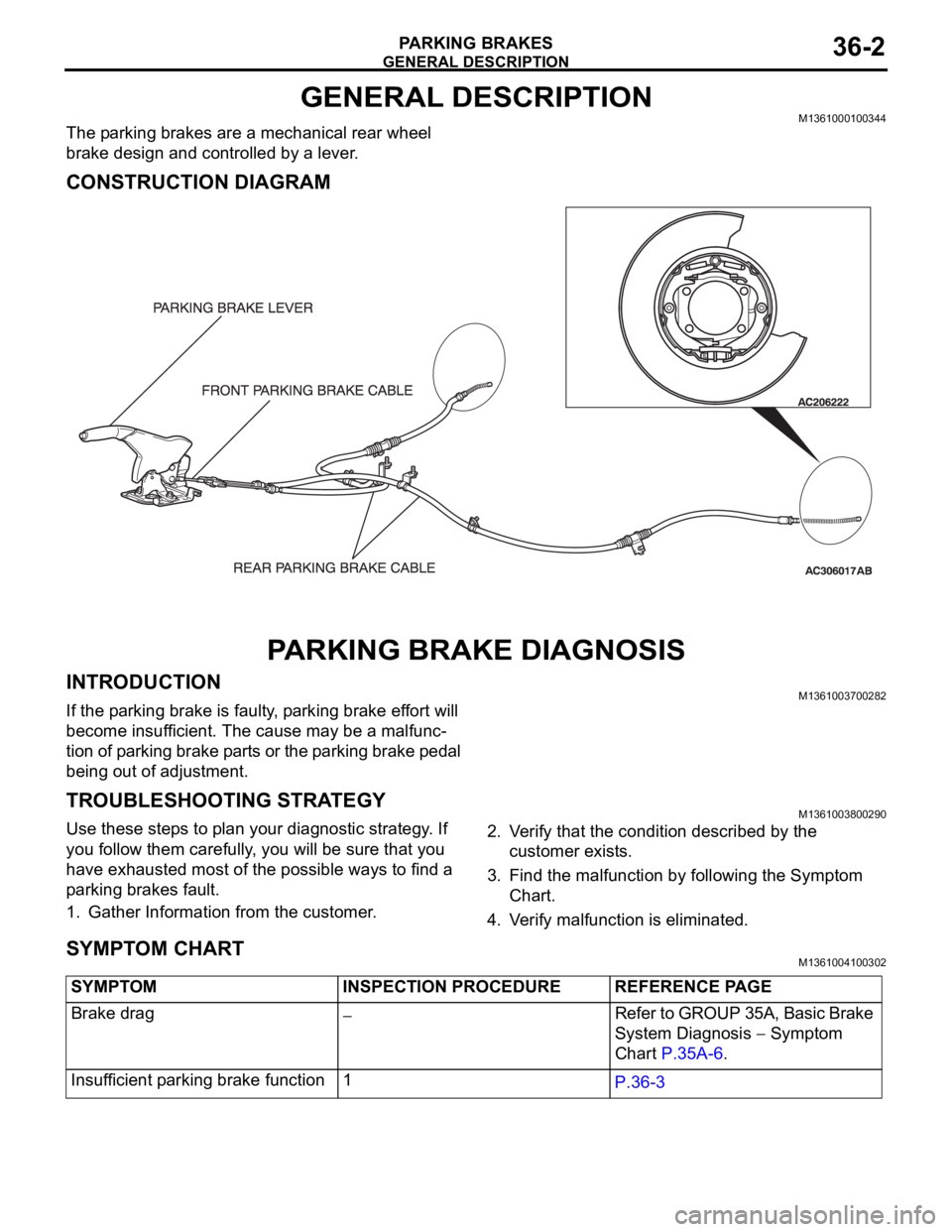
GENERAL DESCRIPTIONM1361000100344
The parking brakes are a mechanical rear wheel
brake design and controlled by a lever.
CONSTRUCTION DIAGRAM
PARKING BRAKE DIAGNOSIS
INTRODUCTIONM1361003700282
If the parking brake is faulty, parking brake effort will
become insufficient. The cause may be a malfunc-
tion of parking brake parts or the parking brake pedal
being out of adjustment.
TROUBLESHOOTING STRATEGYM1361003800290
Use these steps to plan your diagnostic strategy. If
you follow them carefully, you will be sure that you
have exhausted most of the possible ways to find a
parking brakes fault.
1. Gather Information from the customer.2. Verify that the condition described by the
customer exists.
3. Find the malfunction by following the Symptom
Chart.
4. Verify malfunction is eliminated.
SYMPTOM CHARTM1361004100302
SYMPTOM INSPECTION PROCEDURE REFERENCE PAGE
Brake drag
Refer to GROUP 35A, Basic Brake
System Diagnosis
Symptom
Chart P.35A-6.
Insufficient parking brake function 1
P.36-3