change wheel MITSUBISHI ASX 2012 (in English) User Guide
[x] Cancel search | Manufacturer: MITSUBISHI, Model Year: 2012, Model line: ASX, Model: MITSUBISHI ASX 2012Pages: 378, PDF Size: 18.2 MB
Page 297 of 378
WARNING
l Stop jacking up the vehicle as soon as the
tyre is raised off the ground. It is danger-
ous to raise the vehicle any higher.
l Do not get under your vehicle while using
the jack.
l Do not bump the raised vehicle or leave it
sitting on the jack for a long time. Both
are very dangerous.
l Do not use a jack except the one that
came with your vehicle.
l The jack should not be used for any pur-
pose other than to change a tyre.
l No one should be in your vehicle when us-
ing the jack.
l Do not start or run the engine while your
vehicle is on the jack.
l Do not turn the raised wheel. The tyres
still on the ground could turn and make
your vehicle fall off the jack.
5. Remove
the wheel nuts with the wheel nut wrench, then take the wheel off. CAUTION
l
Handle
the wheel carefully when chang-
ing the tyre, to avoid scratching the wheel
surface.
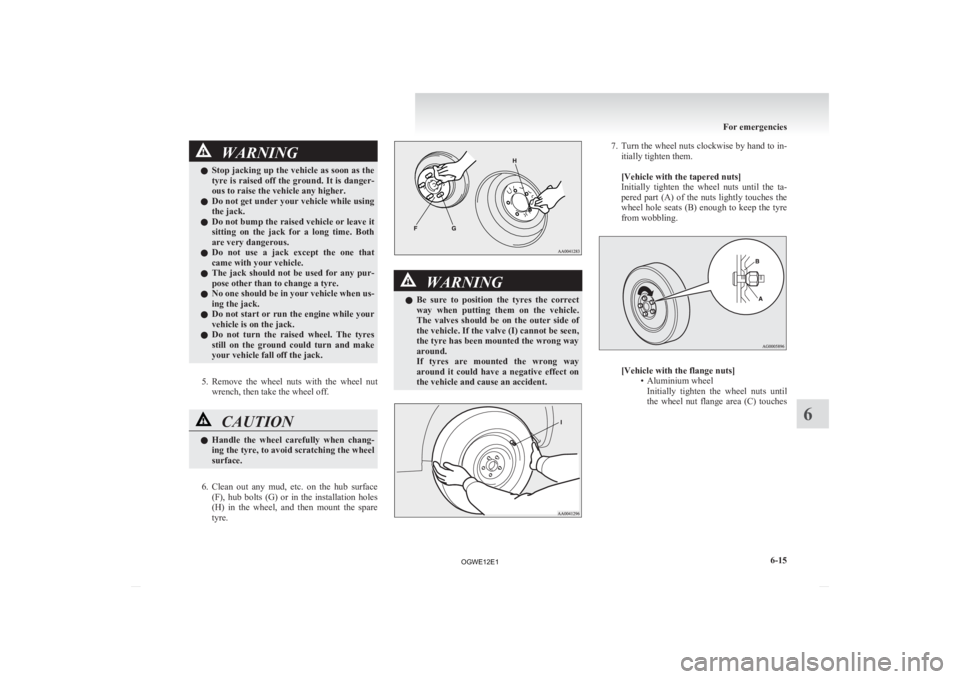
6. Clean
out any mud, etc. on the hub surface (F), hub bolts (G) or in the installation holes
(H) in the wheel, and then mount the spare
tyre. WARNING
l Be
sure to position the tyres the correct
way when putting them on the vehicle.
The valves should be on the outer side of
the vehicle. If the valve (I) cannot be seen,
the tyre has been mounted the wrong way
around.
If tyres are mounted the wrong way
around it could have a negative effect on
the vehicle and cause an accident. 7. Turn
the wheel nuts clockwise by hand to in-
itially tighten them.
[Vehicle with the tapered nuts]
Initially tighten the wheel nuts until the ta-
pered part (A) of the nuts lightly touches the
wheel hole seats (B) enough to keep the tyre
from wobbling. [Vehicle with the flange nuts]
•
Aluminium wheelInitially tighten the wheel nuts until
the wheel nut flange area (C) touches For emergencies
6-15 6
OGWE12E1
Page 298 of 378
the wheel enough to keep the tyre
from wobbling.
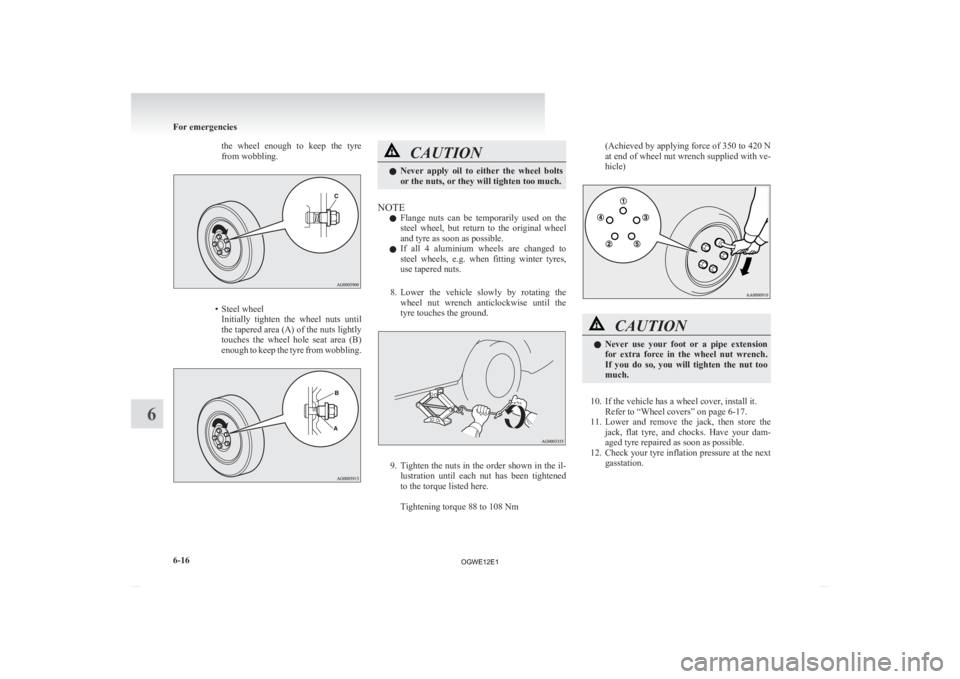
• Steel wheel
Initially tighten the wheel nuts until
the tapered area (A) of the nuts lightly
touches the wheel hole seat area (B)
enough to keep the tyre from wobbling. CAUTION
l
Never
apply oil to either the wheel bolts
or the nuts, or they will tighten too much.
NOTE l Flange
nuts can be temporarily used on the
steel wheel, but return to the original wheel
and tyre as soon as possible.
l If all 4 aluminium wheels are changed to
steel wheels, e.g. when fitting winter tyres,
use tapered nuts.
8. Lower the vehicle slowly by rotating the wheel nut wrench anticlockwise until the
tyre touches the ground. 9. Tighten
the nuts in the order shown in the il-
lustration until each nut has been tightened
to the torque listed here.
Tightening torque 88 to 108 Nm (Achieved
by applying force of 350 to 420 N
at end of wheel nut wrench supplied with ve-
hicle) CAUTION
l
Never
use your foot or a pipe extension
for extra force in the wheel nut wrench.
If you do so, you will tighten the nut too
much.
10. If the vehicle has a wheel cover, install it. Refer to “Wheel covers” on page
6-17.
11. Lower and remove the jack, then store the jack, flat tyre, and chocks. Have your dam-
aged tyre repaired as soon as possible.
12. Check your tyre inflation pressure at the next gasstation. For emergencies
6-16
6
OGWE12E1
Page 324 of 378
*- If the spare tyre wheel differs from the standard
tyre
wheel, do not perform tyre rotation using a
spare wheel. CAUTION
l
A
temporary spare tyre can be fitted tem-
porarily in place of a tyre that has been re-
moved during the tyre rotation. However,
it must not be included in the regular tyre
rotation sequence.
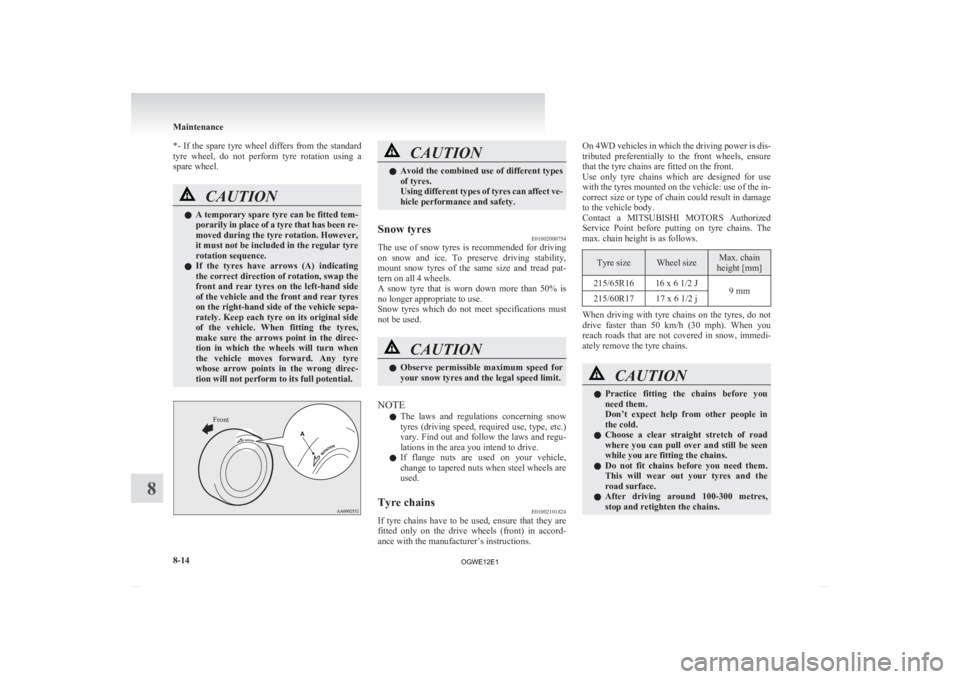
l If the tyres have arrows (A) indicating
the correct direction of rotation, swap the
front and rear tyres on the left-hand side
of the vehicle and the front and rear tyres
on the right-hand side of the vehicle sepa-
rately. Keep each tyre on its original side
of the vehicle. When fitting the tyres,
make sure the arrows point in the direc-
tion in which the wheels will turn when
the vehicle moves forward. Any tyre
whose arrow points in the wrong direc-
tion will not perform to its full potential.
Front CAUTION
l
Avoid
the combined use of different types
of tyres.
Using different types of tyres can affect ve-
hicle performance and safety.
Snow tyres E01002000754
The use of snow tyres is recommended for driving
on
snow and ice. To preserve driving stability,
mount snow tyres of the same size and tread pat-
tern on all 4 wheels.
A snow tyre that is worn down more than 50% is
no longer appropriate to use.
Snow tyres which do not meet specifications must
not be used. CAUTION
l
Observe
permissible maximum speed for
your snow tyres and the legal speed limit.
NOTE l The
laws and regulations concerning snow
tyres (driving speed, required use, type, etc.)
vary. Find out and follow the laws and regu-
lations in the area you intend to drive.
l If flange nuts are used on your vehicle,
change to tapered nuts when steel wheels are
used.
Tyre chains E01002101824
If tyre chains have to be used, ensure that they are
fitted
only on the drive wheels (front) in accord-
ance with the manufacturer’s instructions. On 4WD vehicles in which the driving power is dis-
tributed
preferentially to the front wheels, ensure
that the tyre chains are fitted on the front.
Use only tyre chains which are designed for use
with the tyres mounted on the vehicle: use of the in-
correct size or type of chain could result in damage
to the vehicle body.
Contact a MITSUBISHI MOTORS Authorized
Service Point before putting on tyre chains. The
max. chain height is as follows. Tyre size Wheel size Max. chain
height [mm]
215/65R16 16 x 6 1/2 J 9 mm
215/60R17 17 x 6 1/2 j When driving with tyre chains on the tyres, do not
drive
faster than 50 km/h (30 mph). When you
reach roads that are not covered in snow, immedi-
ately remove the tyre chains. CAUTION
l
Practice
fitting the chains before you
need them.
Don’t expect help from other people in
the cold.
l Choose a clear straight stretch of road
where you can pull over and still be seen
while you are fitting the chains.
l Do not fit chains before you need them.
This will wear out your tyres and the
road surface.
l After driving around 100-300 metres,
stop and retighten the chains. Maintenance
8-14
8
OGWE12E1
Page 363 of 378
4
4-wheel drive operation 4-32
AAccessory (Installation) 04
Accessory socket 5-61
Active stability control (ASC)
4-42
Additional equipment 8-17
Air conditioning 5-03 Important operation tips for the air condition-
ing 5-09
Air purifier 5-10
Airbag 2-24
Antenna 5-39
Anti-lock brake system (ABS) 4-39 Display 4-39
Warning lamp 4-39
Ashtray 5-60
Assist grips 5-70
Audio 5-10 Error codes 5-35
External audio input function 5-32
Handling of compact discs 5-38
Steering wheel audio remote control
switches 5-33
Auto Stop & Go (AS&G) system 4-18
Automatic transmission Fluid 9-15
Selector lever operation 4-25
Selector lever position 4-26
Sports mode 4-27
BBattery 8-08
Charge warning lamp 3-41 Discharged battery (Emergency starting) 6-02
Disposal information for used batteries
06
Specification 9-12
Bluetooth® 2.0 interface 5-41
Bonnet 8-03
Bottle holder 5-69
Brake assist system 4-37
Brake Anti-lock brake 4-39
Braking 4-35
Fluid 8-07,9-15
Parking brake 4-06
Bulb capacity 8-24
C Capacities 9-15
Card holder 5-59,5-66
Cargo loads 4-55
Catalytic converter
8-02
Cautions on handling of 4-wheel drive vehi-
cles 4-34
Central door locks 1-22
Charge warning lamp 3-41
Chassis number 9-02
Check engine warning lamp 3-40
Child restraint 2-15
Child-protection rear doors 1-26
Cigarette lighter 5-60
Cleaning Exterior of your vehicle 7-03
Interior of your vehicle 7-02
Clock 5-39
Clutch Fluid 8-07
Coat hook 5-70
Combination headlamps and dipper switch 3-44
Coolant (engine) 8-06,9-15
Cruise control 4-44 Cup holder 5-68
D Daytime running lamps
Bulb capacity
8-24
Replacement 8-30
Demister (rear window) 3-56
Diesel particulate filter (DPF) 4-16
Dimensions 9-04
Dipper (High/Low beam change) 3-46
Doors Central door locks 1-22
Child-protection 1-26
Dead Lock System 1-23
Lock and unlock 1-21
Driving, alcohol and drugs 4-02
E Economical driving 4-02
Electric power steering system (EPS)
4-41
Electric window control 1-34
Electrical system 9-12
Electronic immobilizer (Anti-theft starting sys-
tem) 1-03
Electronically controlled 4WD system 4-30
Emergency starting 6-02
Emergency stop signal system 4-38
Engine specifications 9-10
Engine switch 1-12
Engine Coolant 8-06,9-15
Number 9-02
Oil 8-04
Oil and filter 9-15
Overheating 6-04
Specifications 9-10 Alphabetical index
1
OGWE12E1
Page 366 of 378
T
Tachometer 3-02
Tail lamps
Bulb capacity
8-25
Replacement 8-31
Tailgate 1-26
Tank capacity 03
Tissue holder 5-67
Tools 6-06 Storage 6-05
Towing 6-18
Trailer towing 4-56
Transfer oil 9-15
Transmission Automatic transmission 4-25
Manual transmission 4-22
Turbocharger operation 4-18
Turn-signal indication lamps 3-39
Turn/Lane-change signals 3-49
Twin Clutch SST (Sport Shift Transmission) Fluid 9-15
Tyres 8-11 How to change a tyre 6-12
Inflation pressures 8-12
Rotation 8-13
Size (tyre and wheel) 9-13
Snow tyres 8-14
Tread wear indicators 8-13
Tyre chains 8-14
Tyre repair kit 6-06
UUSB input terminal 5-57
USB input terminal device
How to connect a USB memory device
5-57
How to connect an iPod 5-57 Used engine oils safety instructions and disposal in-
formation 05
V Vanity mirror lamp
Bulb capacity
8-25
Vehicle care precautions 7-02
Vehicle dimensions 9-04
Vehicle identification number plate 9-02
Vehicle information code plate 9-02
Vehicle labeling 9-02
Vehicle performance 9-06
Vehicle weight 9-07
Ventilators 5-02
W Warning lamps 3-40
Washer
Fluid 8-07,9-15
Switch 3-55
Washing 7-03
Waxing 7-04
Weatherstripping
8-17
Weight 9-07
Wheel Covers 6-17
Specification 9-13
Wiper Rear window 3-55
Windscreen 3-51
Wiper blades 8-15 Alphabetical index
4
OGWE12E1