steering wheel MITSUBISHI iMiEV 2014 1.G Owner's Manual
[x] Cancel search | Manufacturer: MITSUBISHI, Model Year: 2014, Model line: iMiEV, Model: MITSUBISHI iMiEV 2014 1.GPages: 262, PDF Size: 26.84 MB
Page 165 of 262

Safe driving techniques 6-4 Driving safety
6
Move the driver’s seat as far backward as possible, while still
keeping good visibil-
ity, and good control of the steering wheel, brakes, accele
rator, and controls.
Check the instrument panel indicators forany possible problem. Move the front passe
nger seat as far back
as possible. Make sure that infa
nts and small children
are properly restrained in accordance with all laws and regulations.
Check these by selecti
ng the defroster mode,
and set the blower swit
ch on high. You should
be able to feel the air blowing against the windshield. (Refer to “Defrosting or defogging the wind- shield and door windows” on page 7-9.) Check all the tires for heavy tread wear or uneven wear patterns.
Look for stones, nails,
glass, or other objects
stuck in the tread. Look
for any tread cuts or sidewall cracks. Check the wheel nuts for tightness, and the tires for proper pressures. Replace your tires beforethey are heavily worn out.
As your vehicle is equi
pped with a tire pres-
sure monitoring system, there is a risk ofdamage to the tire inflation pressure sensors when the tire is replaced on the rim. Tire replacement should, th
erefore, be performed
only by a certified i-MiEV dealer. Have someone watch while you turn all the exterior lights on and off. Also check the turn signal indicators and
high-beam indicators on
the instrument panel. Check the ground under the vehicle after parking overnight, for wa
ter, oil, or other
leaks. Make sure all the fluid levels are cor- rect.
N00629200124
Even this vehicle’s safety equipment, andyour safest driving, cannot guarantee that youcan avoid an accident or injury. However, if you give extra attention to the following areas, you can better protect yourself andyour passengers:
Drive defensively. Be aware of traffic, road and weather conditions. Leave plentyof stopping distance between your vehicle and the vehicle ahead. Before changing lanes, check your mir- rors and use your turn signal light. While driving, watch the behavior of other drivers, bicyc
lists, and pedestrians.
Always obey applicable
laws and regula-
tions. Be a polite and alert driver. Always leave room for unexpected events, such as sudden braking.
Defrosters Tires
Lights Fluid leaks Safe driving techniques
BK0209800US.book 4 ページ 2014年1月14日 火曜日 午前9時26分
Page 167 of 262
Parking 6-6 Driving safety
6
effective use of the re
generative brake and
prevent the service brake from overheating.If the brake pedal is continuously or fre- quently depressed on downhill roads, the ser- vice brake could overheat and the brakeperformance will be reduced.
N00629600317
When parking on a hill, set the parking brake, and turn the front wheels toward the curb on a downhill, or away from the curb on an uphill.If necessary, apply
chocks to wheels.
Never leave the electric motor unit running while you take a short sleep/rest.
Your front bumper can be damaged if you scrape it over curbs or parking stop blocks. Be careful when traveling up or down steep slopes where your bumper can scrape theroad. Always remove the key from the electric motor switch and lock all doors and the lift- gate when leaving
the vehicle unattended.
Always try to park your vehicle in a well litarea. More effort could be required to turn the steering wheel. Refer to “Electric power steering system(EPS)” on page 5-27.
NOTE
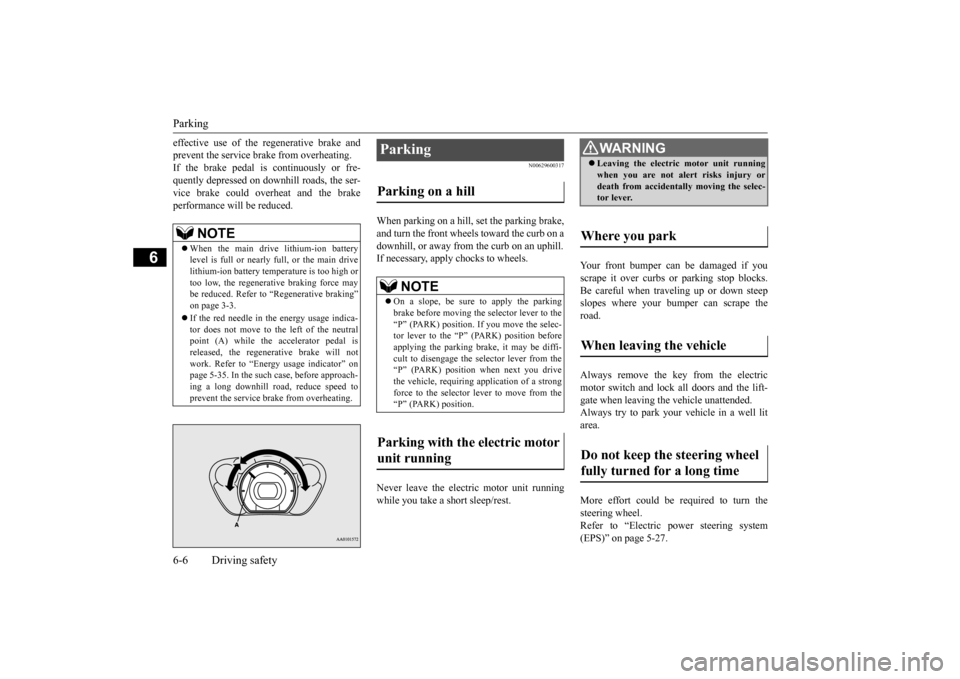
When the main drive lithium-ion battery level is full or nearly full, or the main drivelithium-ion battery temperature is too high or too low, the regenerative braking force may be reduced. Refer to “Regenerative braking”on page 3-3. If the red needle in the energy usage indica- tor does not move to the left of the neutral point (A) while the accelerator pedal is released, the regenera
tive brake will not
work. Refer to “Ener
gy usage indicator” on
page 5-35. In the such case, before approach- ing a long downhill road, reduce speed toprevent the service brake from overheating.
Parking Parking on a hill
NOTE
On a slope, be sure to apply the parking brake before moving the selector lever to the“P” (PARK) position. If you move the selec- tor lever to the “P” (PARK) position before applying the parking br
ake, it may be diffi-
cult to disengage the
selector lever from the
“P” (PARK) position when next you drive the vehicle, requiring a
pplication of a strong
force to the selector lever to move from the “P” (PARK) position.
Parking with the electric motor unit running
WA R N I N G Leaving the electric motor unit running when you are not alert risks injury ordeath from accidental
ly moving the selec-
tor lever.
Where you park When leaving the vehicle Do not keep the steering wheel fully turned for a long time
BK0209800US.book 6 ページ 2014年1月14日 火曜日 午前9時26分
Page 207 of 262
Tire repair kit 8-10 For emergencies
8
15. Check and adjust the tire pressure with
reference to the air pressure gauge on thecompressor. If you overinflate the tire, release air by loosening the hose’s end fit- ting.If there is a gap between the tire and wheel because the ti
re has moved inward
from the wheel rim, press the tire treadtowards the wheel to close the gap before running the compressor. (With no gaps, the tire pressure will rise.)
16. Turn OFF the compressor switch, then
pull the power cord plug out of the 12 Vpower outlet.
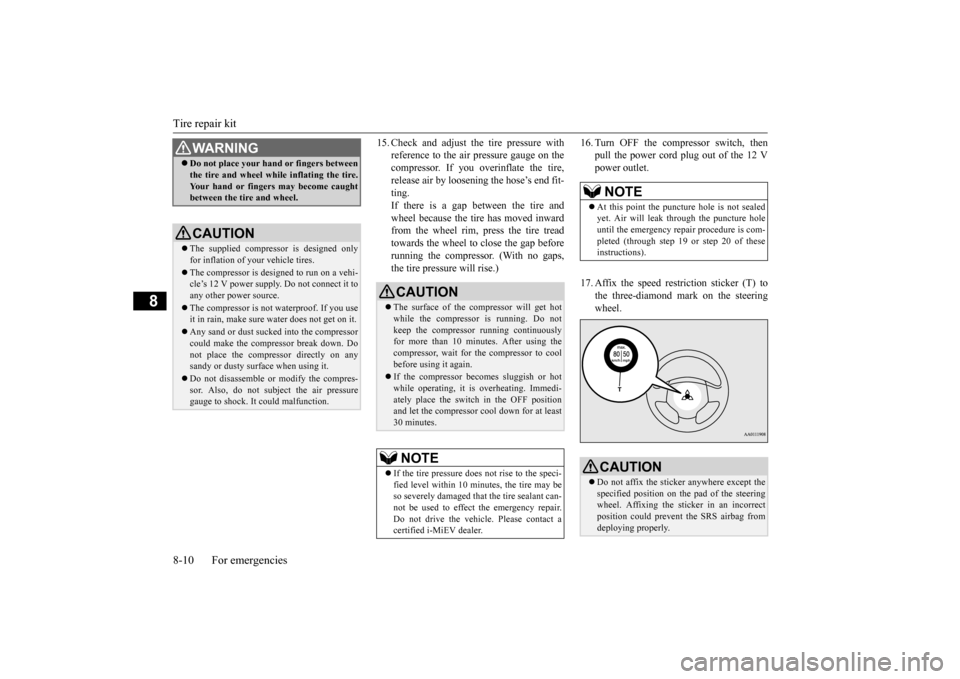
17. Affix the speed restriction sticker (T) to
the three-diamond mark on the steering wheel.
WA R N I N G Do not place your hand or fingers between the tire and wheel while inflating the tire.Your hand or fingers may become caughtbetween the tire and wheel.CAUTION The supplied compressor is designed only for inflation of your vehicle tires. The compressor is designed to run on a vehi- cle’s 12 V power supply. Do not connect it to any other power source. The compressor is not waterproof. If you use it in rain, make sure
water does not get on it.
Any sand or dust sucked into the compressor could make the compressor break down. Donot place the compressor directly on any sandy or dusty surface when using it. Do not disassemble or modify the compres- sor. Also, do not subject the air pressure gauge to shock. It could malfunction.
CAUTION The surface of the compressor will get hot while the compressor is running. Do not keep the compressor running continuouslyfor more than 10 minutes. After using the compressor, wait for the compressor to cool before using it again. If the compressor becomes sluggish or hot while operating, it is
overheating. Immedi-
ately place the switch in the OFF position and let the compressor c
ool down for at least
30 minutes.NOTE
If the tire pressure does not rise to the speci- fied level within 10 minutes, the tire may beso severely damaged that
the tire sealant can-
not be used to effect
the emergency repair.
Do not drive the vehicl
e. Please contact a
certified i-MiEV dealer.
NOTE
At this point the puncture hole is not sealed yet. Air will leak
through the puncture hole
until the emergency repa
ir procedure is com-
pleted (through step 19 or step 20 of theseinstructions).CAUTION Do not affix the sticke
r anywhere except the
specified position on th
e pad of the steering
wheel. Affixing the sticker in an incorrect position could prevent the SRS airbag fromdeploying properly.
BK0209800US.book 10 ページ 2014年1月14日 火曜日 午前9時26分
Page 210 of 262
Operation under adverse driving conditions
For emergencies 8-13
8
If a wheel gets stuck in
a ditch, do not try to
tow the vehicle. Please contact a certifie
d i-MiEV dealer or a
commercial tow truck service for assistance.There may be local re
gulations concerning
towing in your area. Obey the regulations in the area where you are driving your vehicle.
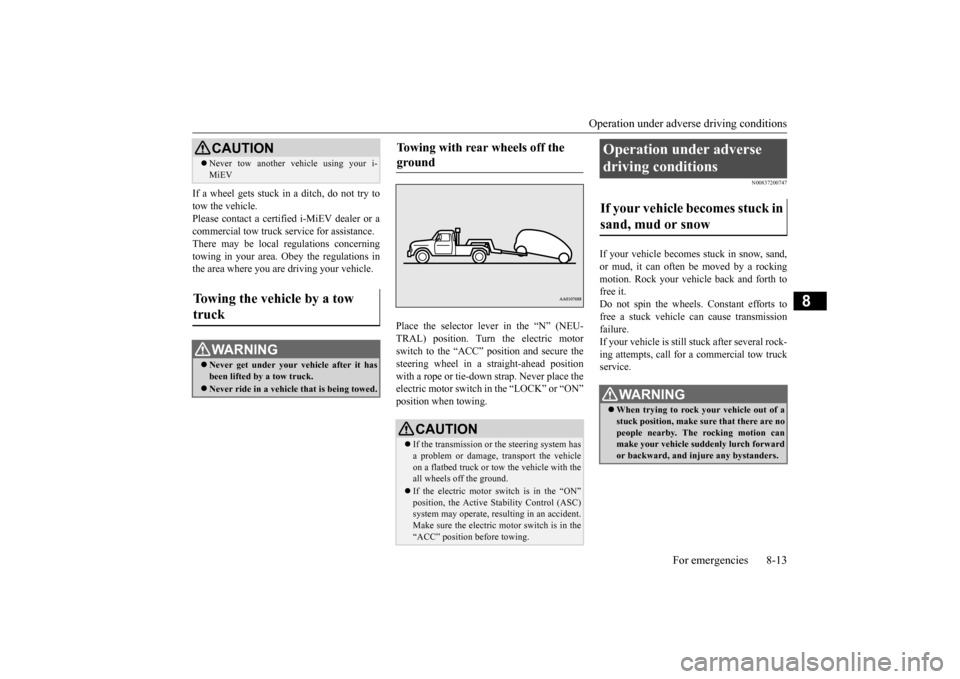
Place the selector lever in the “N” (NEU- TRAL) position. Turn the electric motorswitch to the “ACC” position and secure the steering wheel in a st
raight-ahead position
with a rope or tie-down strap. Never place theelectric motor switch in the “LOCK” or “ON” position when towing.
N00837200747
If your vehicle becomes stuck in snow, sand, or mud, it can often be moved by a rocking motion. Rock your vehicle back and forth to free it.Do not spin the wheels. Constant efforts to free a stuck vehicle can cause transmission failure.If your vehicle is still
stuck after several rock-
ing attempts, call for a commercial tow truck service.
Never tow another ve
hicle using your i-
MiEV
Towing the vehicle by a tow truck
WA R N I N G Never get under your vehicle after it has been lifted by a tow truck. Never ride in a vehicl
e that is being towed.
CAUTION
Towing with rear wheels off the ground
CAUTION If the transmission or the steering system has a problem or damage,
transport the vehicle
on a flatbed truck or to
w the vehicle with the
all wheels off the ground. If the electric motor switch is in the “ON” position, the Active St
ability Control (ASC)
system may operate, resu
lting in an accident.
Make sure the electric motor switch is in the “ACC” position before towing.
Operation under adverse driving conditions If your vehicle becomes stuck in sand, mud or snow
WA R N I N G When trying to rock
your vehicle out of a
stuck position, make sure that there are no people nearby. The rocking motion canmake your vehicle suddenly lurch forward or backward, and inju
re any bystanders.
BK0209800US.book 13 ページ 2014年1月14日 火曜日 午前9時26分
Page 225 of 262
Tires 9-14 Vehicle care and maintenance
9
Safety Too little pressure increases flexing in thetire and can cause tire failure. Too much pressure can cause a tire to lose its ability to cushion shock. Objects on the road andpotholes could then cause tire damage that may result in tire failure. Economy The wrong tire pressure can cause uneven wear patterns in the tire tread. These abnormal wear patterns will reduce the tread life, and the tire will have to be replaced sooner.Too little pressure also makes it harder for the tire to roll, and this uses up more power. Ride comfort and vehicle stability The superior riding
experience built into
your vehicle partly depends on the correcttire pressure. Too mu
ch pressure gives an
uncomfortable and ja
rring ride. Too little
pressure feels as if your vehicle is slow torespond. Unequal tire pressures can make steering your vehicle uneven and unpredictable.
The correct tire pressure for your vehicle is listed on the placard attached to the sill of the driver’s door. (Refer to “Tire and loading information plac-ard” on page 11-3.)
The recommended inflation pressures should be used for the tires listed below. Tire pressures should be checked, and adjusted if necessary, at least once a month. Pressures should be checked more often whenever weather temperatures changeseverely, becaus
e tire pressures change with
outdoor temperatures. The pressures listed on the placard are always
“cold inflation pres-
sure”. Cold inflation pressure is measured after the vehicle has been parked
for at least three
hours or is driven less than 1 mile (1.6 km) after having been parked for three hours. Cold inflation pressure must not go above themaximum values molded into the tire side- wall. After driving se
veral miles, your tire
inflation pressure may increase 14 to 41 KPA,2 to 6 PSI from the cold inflation pressure. Do not let air out of the tires to get back to the specified cold pressure, or your tire pressurewill be too low. You should also take the following safety pre- cautions:
Keep your tires inflated to the recom- mended pressures. (See the tire and load-ing information placard attached to the sill of the driver’s door.) Stay within the recommended load limits. Make sure that the weight of any load in your vehicle is evenly distributed. Drive at safe speeds. After filling your tires to the correct pres- sure, check them for damage and air leaks. Be sure to reinstall the caps on the valve stems.
N00939600427
Tire size
Front
Rear
145/65R15
72H
250 KPA, 36 PSI
—
175/60R15
81H
—
250 KPA, 36 PSI
Replacing tires and wheels
CAUTION Avoid using different size tires and wheels from the ones listed, and avoid the combined use of different types
of tires and wheels.
Using different size or
type tires and wheels
may affect driving safety. Refer to “Tires and wheels” on page 11-5. Even if a wheel has the same rim size and offset as the specifie
d type of wheel, its
shape may prevent it
from being fitted cor-
rectly. Consult a certified i-MiEV dealer before
using wheels that you
have.
BK0209800US.book 14 ページ 2014年1月14日 火曜日 午前9時26分
Page 228 of 262
General maintenance
Vehicle care and maintenance 9-17
9
If the blades are frozen to the windshield or rear window, do not operate the wipers until the ice has melted and the blades are freed,otherwise the wiper mo
tor may be damaged.
N00941500289
The next pages list th
e maintenance service
recommended by Mitsubishi Motors Corpo- ration. In addition to the general maintenancethat needs to be performed at the times listed, there are other parts which do not usually need regular maintenance.But, if any of these parts stops working prop- erly, your vehicle performance could suffer. Have these items checked if you notice a problem with them. See a certified i-MiEV dealer for assistance, if you have any questions.
N00941600033
Good brakes are essential to safe driving. Check the brake pads and brake linings for wear and check the rear wheel cylinders forleaks. For good braking performance, replace the brake pads with the same type pads as the originals.
N00941700047
Brake hoses and tubing should be checked for: Severe surface cracki
ng, scuffing or worn
spots. If the fabric casing of the hose isshowing through any cracks or worn spots in the rubber hose cover, the hose should be replaced. The brakes can fail if the hose wears through. Improper installation may cause twisting, or wheel, tire or
chassis interference.
N00941800077
Check the following parts for damage and grease leaks: Ball joint boots of the front suspension and steering linkage Bellows on both ends of the drive shaft
N00942500114
The hood lock release mechanism and hood safety catch should be
checked, cleaned, and
oiled when needed for easy movement and to
NOTE
Do not run the wipers on dry glass for a long time. This wears out the rubber and canscratch the glass.
During cold weather
NOTE
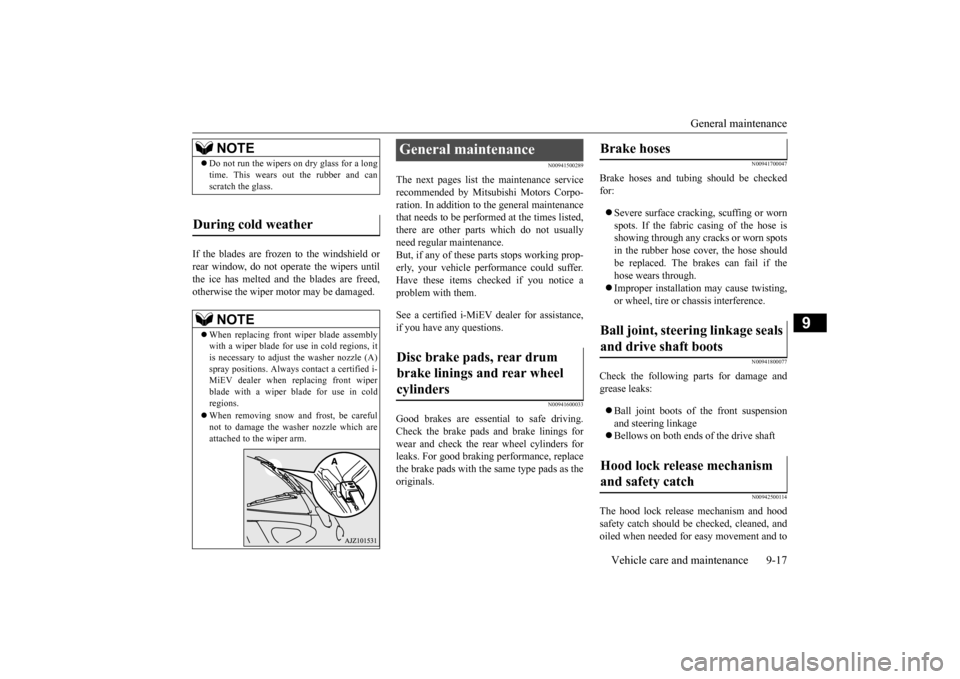
When replacing front wiper blade assembly with a wiper blade for use in cold regions, it is necessary to adjust the washer nozzle (A) spray positions. Always
contact a certified i-
MiEV dealer when re
placing front wiper
blade with a wiper blade for use in cold regions. When removing snow and frost, be careful not to damage the wash
er nozzle which are
attached to the wiper arm.
General maintenance Disc brake pads, rear drum brake linings and rear wheel cylinders
Brake hoses Ball joint, steering linkage seals and drive shaft boots Hood lock release mechanism and safety catch
BK0209800US.book 17 ページ 2014年1月14日 火曜日 午前9時26分
Page 235 of 262
Replacement of light bulbs 9-24 Vehicle care and maintenance
9
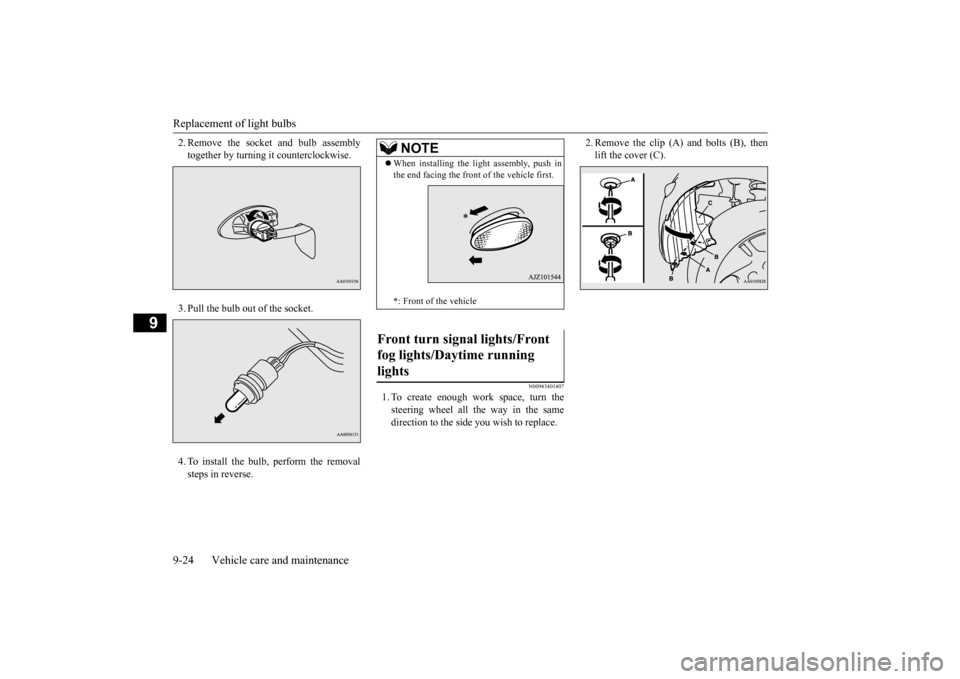
2. Remove the socket and bulb assembly together by turning it counterclockwise. 3. Pull the bulb out of the socket.4. To install the bulb, perform the removal steps in reverse.
N00943401407
1. To create enough work space, turn the steering wheel all the way in the same direction to the side
you wish to replace.
2. Remove the clip (A) and bolts (B), then lift the cover (C).
NOTE
When installing the light assembly, push in the end facing the front
of the vehicle first.
* : Front of the vehicle
Front turn signal lights/Front fog lights/Daytime running lights
BK0209800US.book 24 ページ 2014年1月14日 火曜日 午前9時26分
Page 256 of 262

Alphabetical index
12-1
12
Numerics
12V power outlet
................................
5-51
12V starter battery
................................
9-7
Specification
..................................
11-5
12V starter battery charging system warning light
.................................................
5-43
A
Accessory (installation)
.........................
3-6
Acoustic vehicle alerting system (AVAS)
....
5-23 Active stability control
........................
5-28
ASC indicator
.................................
5-30
ASC OFF indicator
.........................
5-30
ASC OFF switch
............................
5-29
Skid control function
.......................
5-29
Traction control function
.................
5-29
Air conditioning
...................................
7-4
Important air condi
tioning operating tips
..
7-10
Air purifier
.........................................
7-11
Aluminum wheels
...............................
9-32
Antenna
.............................................
7-22
Anti-lock braking system
.....................
5-25
Warning light
........................
5-26
, 5-27
ASC
..................................................
5-28
ASC indicator
.....................................
5-30
ASC OFF indicator
.............................
5-30
ASC OFF switch
................................
5-29
Assist grip
.........................................
5-56
Audio
AM/FM electronicall
y tuned radio with
CD player
....................................
7-11
Error codes
....................................
7-19
Handling of compact discs
..............
7-20
B
Back up lights
Bulb capacity
.................................
9-22
Replacement
..................................
9-25
Ball joint, steering li
nkage seals and drive
shaft boots
.......................................
9-17
Battery
12V starter battery charging system warn- ing light
.......................................
5-43
Disconnection and connection
...........
9-9
During cold weather
.........................
9-9
Main drive lithium-ion battery
...........
3-3
Brake
Anti-lock braking system
................
5-25
Braking
...........................................
6-5
Fluid
.......................................
9-7
, 11-6
Hose
.............................................
9-17
Parking brake
.................................
5-16
Parking brake lever stroke
...............
9-16
Pedal
.............................................
5-24
Pedal free play
...............................
9-16
Power brakes
..................................
5-24
Service brake
..................................
5-24
Warning light
.................................
5-42
Brake assist system
.............................
5-25
Break-in recommendations
....................
5-2
Bulb capacity
......................................
9-22
C
California Perchl
orate Materials
Requirements
.....................................
3-7
Capacities
..........................................
11-6
Card holder
...............................
5-51
, 5-55
Cargo loads
........................................
6-10
Certification label
...............................
11-3
Charging
Quick charging
...............................
3-24
Regular charging
...................
3-15
, 3-24
Charging indicator
..............................
5-42
Charging Timer
..................................
3-36
Charging troubleshooting guide
............
3-28
Chassis number
...................................
11-2
Child restraint
.....................................
4-13
Child safety locks for rear door
............
5-10
Cleaning
Inside of your vehicle
......................
9-29
Outside of your vehicle
...................
9-30
Clock
.................................................
7-22
BK0209800US.book 1 ページ 2014年1月14日 火曜日 午前9時26分
Page 259 of 262

Alphabetical index 12-4
12
Parking brake
.................................
5-16
Parking brake lever stroke
...............
9-16
Parking lights
Bulb capacity
.................................
9-22
Polishing
............................................
9-31
Power brakes
......................................
5-24
Power door locks
..................................
5-9
Power down warning light
...................
5-43
Power outlet
.......................................
5-51
Power windows
..................................
5-14
Precautions during Charging the Main Drive Lithium-ion Battery
..........................
3-14
Q
Quick charging
...................................
3-24
R
Radio
General information about your radio 7-23
Ready indicator
..................................
5-42
Rear combination lights
Bulb capacity
.................................
9-22
Replacement
..................................
9-25
Rear side-marker lights
Bulb capacity
.................................
9-22
Replacement
..................................
9-26
Rear turn signal lights
Bulb capacity
..................................
9-22
Replacement
...................................
9-25
Rear window defogger switch
..............
5-50
Rearview mirror
Inside
.............................................
5-16
Outside
..........................................
5-17
Refill capacities
..................................
11-6
Regenerative brake system indicator
.....
5-42
Regenerative braking
............................
3-3
Regular charging
........................
3-15
, 3-24
Remote Climate Control
.............
3-43
, 7-11
Replacement of light bulbs
...................
9-22
Replacing tires and wheels
...................
9-14
Reporting Safety Defects
.....................
10-2
Reservoir cap
.......................................
9-6
S
Safe driving techniques
.........................
6-4
Seat
....................................................
4-2
Front seats
.......................................
4-3
Heated seat
......................................
4-4
Rear seats
........................................
4-5
Seats and restraint systems
................
4-2
Seat belt
..............................................
4-8
Adjustable seat be
lt shoulder anchor
.4-11
Child restraint
.................................
4-13
Driver’s seat belt
reminder/warning light
..
4-10
Force limiter
..................................
4-13
Front passenger seat belt warning light
.....
4-11 Maintenance and inspection
.............
4-20
Pre-tensioner
..................................
4-12
Seat belt extender
...........................
4-12
Seat belt
instructions
.........................
4-8
Seat belt use
during pregnancy
.........
4-12
Service brake
......................................
5-24
Service precautions
...............................
9-2
Service reminder
........................
5-35
, 5-36
Skid control function
...........................
5-29
Snow tires
..........................................
9-15
Speedometer
......................................
5-34
Steering
Wheel lock
.....................................
5-20
Stop lights
Bulb capacity
.................................
9-22
Replacement
..................................
9-25
Storage spaces
....................................
5-54
Sun visors
..........................................
5-51
Supplemental Restraint System
............
4-21
How the Supplement
Restraint System
works
..........................................
4-23
Servicing
.......................................
4-34
Warning light
.................................
4-26
T
Tail lights
BK0209800US.book 4 ページ 2014年1月14日 火曜日 午前9時26分