fuel MITSUBISHI LANCER 2016 8.G Owners Manual
[x] Cancel search | Manufacturer: MITSUBISHI, Model Year: 2016, Model line: LANCER, Model: MITSUBISHI LANCER 2016 8.GPages: 392, PDF Size: 13.12 MB
Page 3 of 392
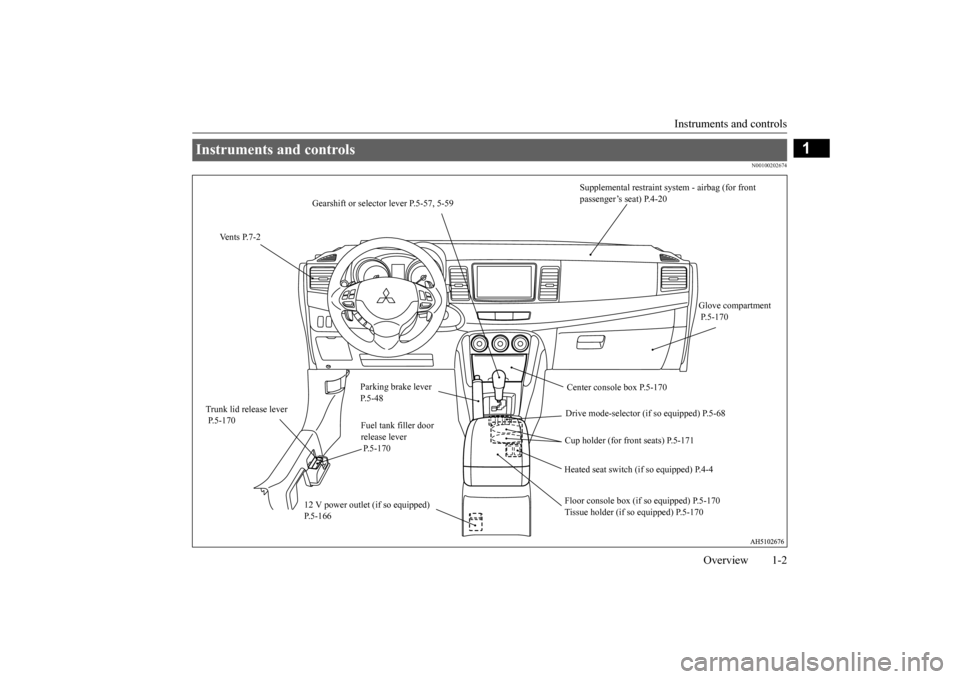
Instruments and controls
Overview
1-2
1
N00100202
674
Instruments and contr
ols
Gearshift or selector lever P
.5-57, 5-59
Vents P.7-2
Supplemental
restraint
system
- airbag
(for
front
passenger
’s seat) P
.4-2
0
Parking
brake
lever
P.5-48
12 V power outlet (if so equipped) P.5-166
Floor console box (i
f so e
qui
ppe
d) P
.5-170
Tissue
holder
(if so equipped)
P.5-170
Heated seat switch (i
f so equipped) P
.4-4
Cup h
older (fo
r front seats) P
.5-171
Dri
ve mode-selector (i
f so equipped) P
.5-68
Center console box P
.5-170
Glove
compartment
P.5-170
Fuel tank filler door release leve
r
P.5-170
Trunk lid release lever P.5-170
Page 8 of 392
Outside (Front)1-7
Overview
1
N0010060
2580
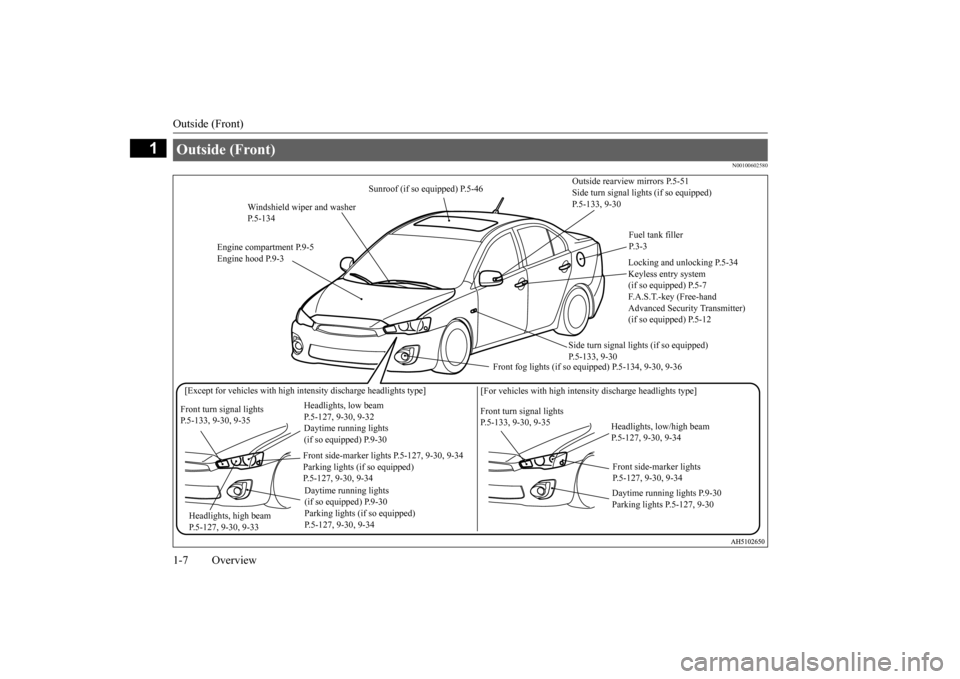
Outside (Fr
ont)
Locking a
nd unl
ocking P
.5-34
Keyless e
ntry system
(if so e
qui
ppe
d) P
.5-7
F.A.S.T
.-key
(Free-hand
Advanced
Security
Transmitter)
(if so equipped) P
.5-12
Sunro
of (i
f so
equipped) P
.5-4
6
Windshield wiper and washer P.5-134
Engi
ne com
partment
P.9-5
Engi
ne hood
P.9-3
Fuel
tank
filler
P.3-3
Outside
rearview mirro
rs P.5-51
Side
turn
signal
lights
(if so equipped)
P.5-133,
9-30
Side turn si
gnal lights (i
f so
equipped)
P.5-133,
9-30
Front
fog light
s (if so e
quipped) P
.5-134, 9-30, 9-36
[Except
for
vehicles
with
high intensity
dischar
ge headlights
type]
[For vehicles with high intens
ity di
scharge headlight
s type
]
Front turn
signal light
s
P.5-133, 9-30, 9-35
Front
turn si
gnal light
s
P.5-133,
9-30,
9-35
Front
side-marke
r light
s P.5-127, 9-30, 9-34
Parking lights (if so equipped) P.5-127, 9-30, 9-34Headlight
s, low beam
P.5-127,
9-30,
9-32
Daytime runni
ng light
s
(if so equipped) P
.9-30
Headlights,
low/high
beam
P.5-127, 9-30, 9-34
Headlights, high beam P.5-127,
9-30,
9-33
Daytime
running
lights
P.9-30
Parking
lights
P.5-127,
9-30
Daytime
running
lights
(if so equipped) P
.9-30
Parking lights (if so equipped) P.5-127,
9-30,
9-34
Front side-marker lights P.5-127,
9-30,
9-34
Page 17 of 392
3
General informationFuel selection
..................
.................................................................
3-2
Filling the fuel tank
................................................
..........................
3-3
Modifications to and racing
of your vehicle
....................................
3-5
Mitsubishi
Motors
genuin
e parts
.....................................................
3-6
California Perchlorate Materials Requirements
...............................
3-6
Page 18 of 392
Fuel selection3-2
General information
3
N0030100
1948
Your
vehicle
is designed
to use
unleaded
gas-
oline
only
. It is
equipped
with
a fuel
filler
tube
especially
designed
to
accept
only
a
small
diameter
unlead
ed gasolin
e dispensin
g
nozzle. In
the
United
States,
fuel
suppliers
are
required
by
law
to add
deter
gents
to their
gas-
oline
to
minimize
fuel-injector
fouling
and
minimize
intake-valve
deposits.
Deter
gent
gasoline
helps
keep
your
engine
in
tune
and
your
emission-control
system
working
prop-
erly
.
Your
vehicle
is
designed
to
operate
on
unleaded
gasoline
having
a minimum
octane
number of 87 [(MON+RON)/2], or 91 RON.MON: Motor Octane NumberRON: Research Octane Number Gasoline
sold
at
some
service
stations
con-
tains
oxygenates
such
as
ethanol,
although
the
oxygenates
may
not
be
identified
by
those
names.
Oxygenates
are
required
in
some
areas
of the
country
. Such
fuel
can
be
used
in
your vehicle.A mixture
of
up
to 10
%
ethanol
(grain
alco-
hol)
and
90% unlead
ed gasolin
e may
be used
in
your
vehicle,
provided
the
octane
number
is at
least
as
high
as
that
recommended
for
unleaded gasoline. Do
not
operate
your
vehicle
on
gasoline
con-
taining
methanol
(wood
alcohol).
Using
this
type
of
alcohol
could
adversely
affect
the
vehicle
’s performance
and
damage
critical
parts
of the
vehicle’
s fuel
system.
Many
areas
of
the
country
require
the
use
of
cleaner
burning
fuel
referred
to as “Reformu-
lated Gasoline”. Reformulated
gasoline
contains
oxygenates
and
is
specially
blended
to
reduce
vehicle
emissions and improve air quality
.
Mitsubish
i Motor
s Co
rporation
strongly
sup-
ports
the
use
of
reformulated
gasoline.
Prop-
erly
blended
reformulated
gasoline
has
no
adverse
effect
on
vehicle
performance
or
the
durability of the engine and fuel system.
Fuel
selection
W
AR
NING
Gasolin
e is highl
y flammable
and
expl
o-
sive. You coul
d be bur
ned,
seriousl
y
injur
ed or
killed
when
handling
it. When-
ever
you
refu
el
you
r veh
icle,
stop
the
engin
e and
keep
flames
, sparks,
and
smoking
materials
away
from
the
vehicle.
Always
handle
fuel
in well-ventilated
out-
door
areas.
CAUTIONUsi
ng
lead
ed
gas
olin
e in your
vehicle
will
damage
the
engine,
catalytic
converter
, and
the oxyge
n sensors.
Also,
using
lead
ed gaso-
line is illeg
al, and
will
voi
d your
warranty
cove
rage of
the engi
ne, cataly
tic
conve
rter,
and
oxygen
sensors.
Gasoline
detergent
additives
Octane r
equir
ement
Oxygenated gasoline Ethanol (Gasohol)
Methanol Reformulated gasoline
Page 19 of 392
Filling the fuel tank
General information
3-3
3
MMT
is
a manganese-containing
metallic
additive
that
is blended
into
some
gasolines
to increase the octane numbe
r.
Mitsubishi
Motors
Corporation
recommends
using gasolines without MMT
.
Use
of
gasolines
blended
with
MMT
may
adversely
affect
performance,
and
cause
the
malfunction
indicator
on
your
instrument
panel
to come
on.
If this
happens,
contact
an
authorized
Mitsubishi
Motors
dealer
or
a
repair facility of your choice for assistance.Your
vehicle
may
have
been
designed
to sat-
isfy
California’
s low-emission
regulations
based
on
clean-burning
low-sulfur
gasoline.
Gasoline
sold
in
parts
of
the
country
other
than
California
is allowed
to
have
a higher
sulfur
content.
Using
such
gasoline
could
adversely
affect
the
vehicle’
s catalytic
con-
verter
and
cause
the
engine
malfunction
indi-
cator
(“SER
VICE
ENGINE
SOON”
or
“CHECK
ENGINE”)
to
come
on.
Illumina-
tion
of
this
indicator
while
you
are
using
high-sulfur
gasoline
does
not
necessarily
mean
the
vehicle’
s emission-control
system
is
malfunctioning.
Your
authorized
Mitsubishi
Motors
dealer
may
suggest
you
try
using
a
different,
lower
-sulfur
brand
of unleaded
gas-
oline
to
determine
whether
the
problem
is
fuel-related.
N00301100900
MMT (methylcyclopentadienyl manganese tricarbonyl) Sulfur in gasoline
NOTE
Poor
-quality
gas
oline
can
caus
e problems
such
as poor
starting,
stalling
during
idling,
abnormal
engine
noise,
and
poor
accelera-
tion.
If you
experience
any
of
these
prob-
lems,
try using
a different bra
nd of gas
oline.
If the engine
malfunction
indicator
(“SER-
VICE
ENGINE SOON”
or “CH
ECK
ENGI
NE”)
flas
hes
, have
the
vehicle
inspected
as soon
as possible
by
the
nearest
authorized
Mitsubishi
Motors
dealer
or
a
repair facility of y
our choice.
Repeated
ly driving
short
distan
ces
at
low
speeds
can
cause
deposits
to form
in the fue
l
system
and
engi
ne, resulting
in poor
starting
and
poor
acceler
ation.
If
these problems
occu
r, you
are advi
sed to add
a deter
gen
t
additiv
e to the gasolin
e whe
n you
refuel
the
vehicle.
The additiv
e will remove
the depos-
its,
thereby
returni
ng
the engi
ne to a normal
condition.
Be sure
to use
a Mitsubi
shi
Mot
ors
Genui
ne clean
ing
additiv
e. Usi
ng
an
unsuitab
le additiv
e coul
d mak
e the engi
ne
malfunction.
For
details,
pleas
e contact
the
nearest authorized Mitsubi
shi Mot
ors dealer
.
Filling the fuel tank
W
AR
NING
Gasolin
e is highl
y flammable
and
expl
o-
sive. You coul
d be bur
ned,
seriousl
y
injur
ed or
killed
when
handling
it.
When
refueling
your
vehicle,
always
turn
the
engine
off
and
keep
away
from
flames,
spar
ks,
and
smoki
ng
materia
ls.
Always
handle
fuel
in well-ve
ntilate
d outdoor
areas.
Befor
e removing
the
fuel
cap,
be
sur
e to
get rid
of your
body’
s static
elect
ricity
by
touc
hing
a metal par
t of
the
car or fue
l
pump.
Any
static
elect
ricity
on
your
body
coul
d create
a spar
k that
igni
tes fue
l
vapor
.
Perform
the
whole
refueling
process
(opening
the
fuel
tank
filler
door
, remov-
ing
the
fuel
cap,
etc.)
by
yourself.
Do
not
let
any
other
person
come
near
the
fuel
tank
filler
. If you
allow
ed a person
to help
you
and
that
person
was
carrying
static
elect
ricit
y, fuel v
apor
coul
d be
igni
ted.
Do not move
away
from
the fuel tank
filler
until
refu
elin
g is finishe
d. If you
moved
away
and
did someth
ing else (for
examp
le,
sittin
g on a seat)
part-w
ay
through the
refu
elin
g process,
you
cou
ld pick
up
a
fresh c
harge of s
tatic electricity
.
Be careful not
to
inhale
fuel
vapor
. Fuel
contai
ns toxic
substances
.
Page 20 of 392
Filling the fuel tank3-4
General information
3
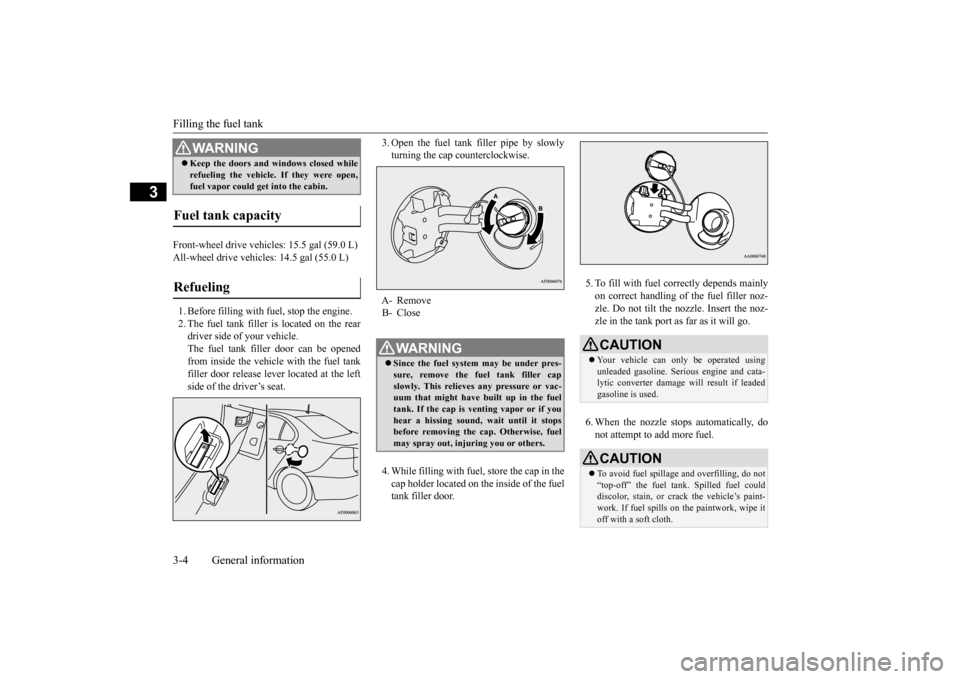
Front-wheel drive vehicles: 15.5 gal (59.0 L)All-wheel drive vehicles: 14.5 gal (55.0 L)1.Before filling with fuel, stop the engine.2.The
fuel
tank
filler
is located
on
the
rear
driver side of your vehicle. The
fuel
tank
filler
door
can
be
opened
from
inside
the
vehicle
with
the
fuel
tank
filler
door
release
lever
located
at the
left
side of the driver
’s seat.
3.Open
the
fuel
tank
filler
pipe
by
slowly
turning the cap counterclockwise.4.While
filling
with
fuel,
store
the
cap
in the
cap
holder
located
on
the
inside
of the
fuel
tank filler door
.
5.To fill
with
fuel
correctly
depends
mainly
on
correct
handling
of
the
fuel
filler
noz-
zle.
Do
not
tilt
the
nozzle.
Insert
the
noz-
zle in the tank port as far as it will go.6.When
the
nozzle
stops
automatically
, do
not attempt to add more fuel.
Keep
the
doors
and
windows
clos
ed while
refuelin
g the
veh
icle.
If the
y were ope
n,
fuel vapor
could get
into the
cabin.
Fuel tank capacity Refueling
W
AR
NING
A-Remove
B-
Close W
AR
NING
Since
the
fuel
system
may
be
under
pres-
sur
e, remove
the
fuel
tank
filler
cap
slowly
. This
relieves
any
pressur
e or
vac-
uum
that
might
have
built
up
in the
fuel
tank.
If the
cap
is venting
vapor
or if you
hear
a hissing
sound,
wait
until
it stops
befor
e removin
g the
cap.
Otherw
ise, fue
l
may
spray
out,
injuring
you
or others.
CAUTIONYour
vehicle
can
onl
y be ope
rated
using
unlead
ed gasolin
e. Serious
engi
ne and
cata-
lytic
conve
rter damag
e will
result
if lead
ed
gasoline
is used.
CAUTIONTo avoi
d fuel
spillag
e and
ove
rfilling,
do
not
“top-of
f”
the
fuel
tank.
Spilled
fuel
could
discolor
, stain,
or crack
the
vehicle’
s paint-
work.
If fuel
spills
on
the
paintw
ork,
wipe
it
off with
a soft
cloth.
Page 21 of 392
Modifications to and racing of your vehicle
General information
3-5
3
7.To close,
turn
the
fuel
tank
filler
cap
slowly
clockwise
until
you
hear
clicking
sounds,
then
gently
push
the
fuel
tank
filler door closed.
N00301600
048
This
vehicle
should
not
be
modified
with
non-Mitsubishi
Motors
genuine
parts.
Mit-
subishi
Motors
designs
and
manufactures
high
quality
vehicles
with
an
emphasis
on
safety
and
durabilit
y. Modifications
using
non-Mitsubishi
Motors
genuine
parts
may
affect
the
performance,
safety
and/or
durabil-
ity
of
your
vehicle,
and
may
violate
applica-
ble state and/or federal regulations. DAMAGE
OR
PERFORMANCE
PROB-
LEMS
RESUL
TING
FR
OM
MODIFICA-
TIONS
TO OR
RACING
OF
YOU
R
VEHICLE
ARE
NOT
COVERED
UNDER
W
ARRANTY
.
Examples
of
modifications
to
your
vehicle
that
can
cause
damage
or
performance
prob-
lems
include
the
following:
Failure
to use
Mitsubishi
Motors
genuine
partsFailure
to use
required
fuel
and
fluids
Failure to use proper size tires and wheelsModification
of
the
fuel,
intake,
exhaust,
emission,
suspension,
engine,
drive
train
or electrical wiring systems
Modification
of
any
onboard
com-
puter/control
module,
including
repro-
gramming,
or
replacing/adding
chips
to
any
onboard
computer/control
module
Review
the
Warranty
and
Maintenance
Man-
ual
for
further
details
regarding
warranty
cov-
erage.
N00301700
182
The
installation
of
accessories,
optional
parts,
etc.,
should
only
be
carried
out
within
the
limits
prescribed
by
law
in the
driving
area
and
in
accordance
with
the
guidelines
and
warnings
contained
within
the
documents
accompanying
this
vehicle.
Only
Mitsubis
hi
Motors
approved
acces
-
sories should be fitted to your vehicle.Improper
installation
of
electrical
parts
could
cause
fire.
Refer
to
the
“Modifica-
tion/alterations
to
the
electrical
or
fuel
systems”
section
with
in this
owner
’s man
-
ual.
W
AR
NING
Make
sur
e the
fuel
cap
is secur
ely closed.
If the
fuel
cap
is loose,
fuel
could
leak,
resulting
in a fire.
CAUTIONIf you
need
to replace
the fuel
tank
filler
cap
,
use only
the
cap
specified
for
your
model
vehicle. NOTE
If the
fuel
tank
filler
cap
is not
tight
while
driving,
the
engine
malfunction
indicator
(“SER
VICE
ENGINE
SOON”
or
“Check
engin
e light”)
may
come
on when
the
onboard
diagnostic
(OBD)
system
performs
a self check.
Always
tigh
ten
the
fuel
tan
k filler
cap
until
you
hear
clicking
sounds.
The indicator
will go off after drivin
g several
times.
If the
indicator
does not go off, con
-
tact
your authorized
Mitsubishi
Mot
ors
dealer
or a repair
facility
of your
choice
as
soon
as possible.
Modifications to and racing of your vehicle
Installation of accessories
CAUTIONBef
ore any electr
ical
or
electronic
accesso-
ries are installed,
consult
an
authorized
Mit-
subishi
Motors
dealer
.
Page 22 of 392
Mitsubishi Motors genuine parts3-6
General information
3
Using
a cellular
phone
or
radio
set
inside
the
vehicle
without
an
external
antenna
may
cause
electrical
system
interference,
which
could
lead
to unsafe
vehicle
opera-
tion.Tires
and
wheels
which
do
not
meet
spec-
ifications must not be used. Refer
to
the
“Specifications”
section
for
information
regarding
wheel
and
tire
sizes.
Due
to
the
large number
of
accessory
and
replacement
parts
provided
by
different
man-
ufacturers
in the
market,
it is not
always
pos-
sible
for
an
authorized
Mitsubishi
Motors
dealer
to
check
whether
the
attachment
or
installation
of
non-Mitsubishi
Motors
genu-
ine
parts
will
affect
the
driving
safety
of your
Mitsubishi-vehicle.
N0030180
0040
Mitsubishi
Motors
ma
nufactures
high
quality
vehicles
with
an
emphasis
on
safety
. It
is
important
to consult
an
authorized
Mitsubishi
Motors
dealer
before
installation
of
any
accessory
which
may
involve
modification
of
the electrical or fuel systems.
N0030140
0105
Mitsubishi
Motors
Genuine
Parts
are
designed
and
manufactured
to meet
high
stan-
dards
of
performance,
and
are
recommended
for
all
of your
maintenance
needs.
Also
avail-
able
from
your
Mitsubishi
Motors
dealer
are
a wide
variety
of
accessories
to
personalize
your
new
vehicle.
Each
Mitsubishi
vehicle
has
a selection
of
Mitsubishi
Motors
autho-
rized
accessories
to choose
from
to tailor
your
new
vehicle
to your
own
personal
preference.
Your
Mitsubishi
Motors
dealer
’s Parts
Man-
ager
has
information
on
various
audio
sys-
tems,
protection
items,
as well
as interior
and
exterior
accessories
available
for
your
spe-
cific model.
N0030010
0017
Certain
components
of
this
vehicle,
such
as
airbag
modules,
seat
belt
pretensioners,
and
button
cell
batteries,
may
contain
perchlorate
materials.Special
handling
may
apply
. For
additional
information,
see
www
.dtsc.ca.gov/hazardous-
waste/perchlorate.
W
AR
NING
If you
choose
to use
a cellu
lar phone
while
driv
ing,
you
must
not
allow
that
usage
to
distract
you
in the
safe
operation
of your
vehicle.
Anything,
including
cellular
pho
ne usage,
that
distracts
you
from
the
safe
operati
on
of
your
vehicle
increase
s
your
risk
of an
accident.
Refer to and
follow
all state and
local laws
in your
area
regard
ing cellu
lar phone
usage
while
driving.
Important
point!
Modification/alterations to the electrical or fuel systems
CAUTIONPlease
consult
an
authorized
Mitsubishi
Motors
dealer
concerning
any
such
acces-
sory
fitment
or modification.
If the
wires
interfere
with
the
vehicle
body
or
improper
installation
methods
are
used
(pro-
tective
fuses
not
included,
etc.),
electronic
devices
may
be
adversely
affected,
resulting
in a fire, vehicle damage, or other accident.
Mitsubishi Motors genuine parts
California
Per
chlorate
Materials Requir
ements
Page 65 of 392
Break-in recommendations
Features and controls
5-3
5
N00508700
297
Advanced
automobile
manufacturing
tech-
niques
permit
you
to operate
your
new
vehi-
cle
without
requiring
a long
break-in
period
of low-speed driving.However
, you
can
add
to
the
future
perfor
-
mance
and
economy
of
your
vehicle
by
observing
the
following
precautions
during
the first 300 miles (500 km). Drive
your
vehicle
at moderate
speeds
during
the break-in period. Avoid
revving
the
engine.
For
vehicles
with
turbochar
ger
, do
not
exceed
5,000
rpm for the first 600 miles (1,000 km).Avoid
rough
driving
such
as
fast
starts,
sudden
acceleration,
prolonged
high-
speed
driving
and
sudden
braking.
These
would
have
a detrimental
effect
on
the
engine
and
also
cause
increased
fuel
and
oil
consumption,
which
could
result
in
malfunction
of the
engine
components.
Be
particularly
careful
to avoid
full
accelera-
tion
while
in low
gear
.
Do
not
overload
the
vehicle.
Observe
the
seating
capacity
(See
“Car
go
load
precau-
tions”
on
page
6-10).
Do not use this vehicle for trailer towing.
N00508801
657
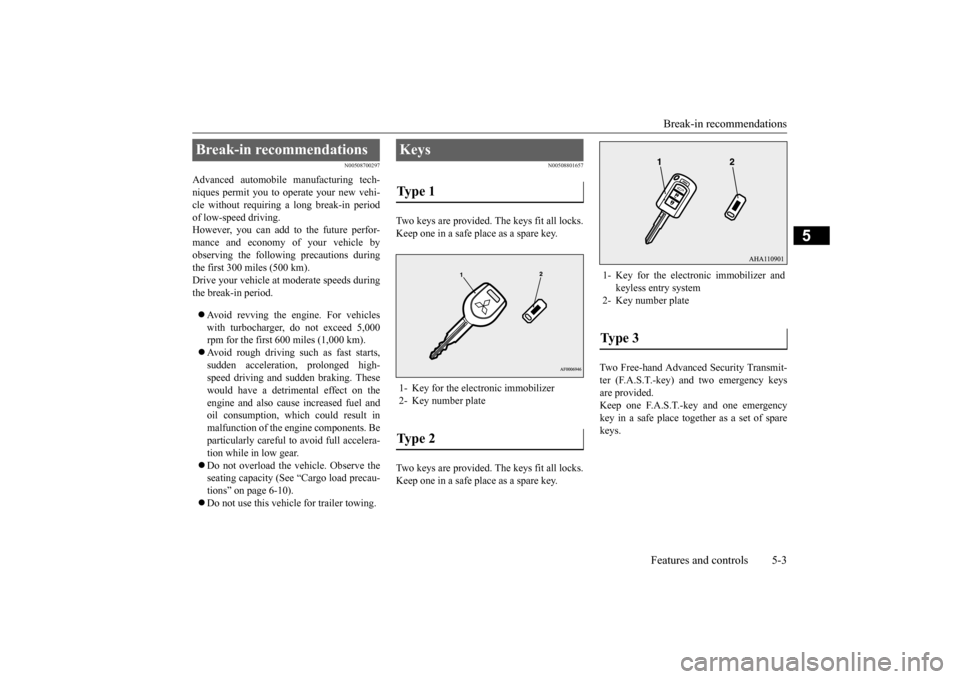
Two keys are provided. The keys fit all locks.
Keep one in a safe place as a spare key
.
Two keys are provided. The keys fit all locks.
Keep one in a safe place as a spare key
.
Two Free-hand
Advanced
Security
Transmit-
ter
(F.A.S.T
.-key)
and
two
emer
gency
keys
are provided.Keep
one
F.A.S.T
.-key
and
one
emer
gency
key
in a safe
place
together
as
a set
of
spare
keys.
Br
eak-in r
ecommendations
Keys Type 1 1-
Key for the electronic immobilizer
2-
Key number plate
Type 2
1-
Key
for
the
electronic
immobilizer
and
keyless entry system
2-
Key number plate
Type 3
Page 83 of 392
Free-hand Advanced Security Transmit
ter (F.A.S.T.-key) (if so equipped)
Features and controls
5-21
5
If the
engine
will
not
start
because
the
bat-
tery
is
weak
or
dischar
ged,
refer
to
“Jump-starting
the
engine”
on
page
8-2
for instructions.A longer
warm
up
peri
od
wil
l only
con-
sume
extra
fuel.
The
engine
is warmed
up
enough
for
driving
when
the
bar
graph
of
the
engine
coolant
temperature
display
starts
to move.
Refer
to “Interrupt
display
screen
(W
ith
ignition
switch
in the
“ON”
position)” on page 5-101.
Your
vehicle
is equipped
with
an
electroni-
cally
controlled
fuel
injection
system.
This
is
a
system
that
automatically
controls
fuel
injection.
There
is
no
need
to
depress
the
accelerator pedal when starting the engine.The starte
r mo
tor sho
uld
not
be run
for
mo
re
than
15
seconds
at a time.
To prevent
battery
drain,
wait
a few
seconds
between attempts to restart the engine.1.Make
sure
all
occupants
are
properly
seated with seat belts fastened.2.Make sure the parking brake is applied.3.Press
and
hold
the
brake
pedal
down
firmly with your right foot.4.Press
and
hold
the
clutch
pedal
all
the
way
down
(manual
transaxle).
5.On
vehicles
with
manual
transaxle,
place
the
gearshift
lever
in
the
“N”
(Neutral)
position.On
vehicles
with
continuously
variable
transmission
(CVT)
make
sure
the
selec-
tor lever is in the “P” (P
ARK) position.
6.While
pushing
the
ignition
switch
from
“LOCK”
(PUSH
OFF)
to “LOCK”
(PUSH
ON),
set
the
ignition
switch
to the
“ON”
position
and
confirm
that
all
warn-
ing
lights
and
warning
displays
are
oper
-
ating properly
.
7.Without
pressing
the
accelerator
pedal,
slowly
turn
the
ignition
switch
to
the
“ST
ART”
position
to
start
the
engine.
Release
the
ignition
switch
when
the
engine
starts.
After
several
attempts,
you
may
experience
that the engine still does not start.
W
AR
NING
Never
run
the
engi
ne in a clos
ed or poorly
ventilate
d area
any
longer
than
is need
ed
to move your
veh
icle
out
of the
area. Car
-
bon
monoxide
gas,
which
is odorless
and
extr
emely
poisonous,
could
build
up
and
cause serious injury or death.CAUTIONDo not
push-star
t the vehicle.
Do
not
run
the
engine
at high
rpms
or drive
at high speeds
until
the
engin
e has had a
chance
to warm
up.
Releas
e the ignition
switch
as soon
as the
engi
ne starts. Otherwi
se, the starter motor
will be damag
ed.
Starting
the
engine
NOTE
For
models
equipped
with
a manual
trans-
axle,
the
starter
will
not
operate
unless
the
clutch
pedal
is fully
depressed
(Clutch
inter
-
lock). This is a safety feature.
NOTE
On
vehicles
with
CVT
, the
starter
will
not
ope
rate
unless
the selector
lev
er is in the “P”
(PARK)
or “
N” (NE
UTRAL
) position.
For s
afety
reasons, s
tart the engi
ne in the “P”
(PARK)
position
so
that
the wheels
are
locked.NOTE
Minor
noi
ses may
be heard
on
engi
ne start-
up.
These will disappear
as the engi
ne warms
up.
When the engine is hard to start