clutch MITSUBISHI MONTERO 1987 1.G Workshop Manual
[x] Cancel search | Manufacturer: MITSUBISHI, Model Year: 1987, Model line: MONTERO, Model: MITSUBISHI MONTERO 1987 1.GPages: 284, PDF Size: 14.74 MB
Page 49 of 284
WIRING- HARNESS - Engine Compartment 8-29
; A-06 A-08 A-1 0 A-12 A-14
,.
1 A-15 8
I I
,I I I, I /
A-48
WI
&-ii& ’
A-35 Ai34 A!33 J-3:
A-39 A-37
36W618
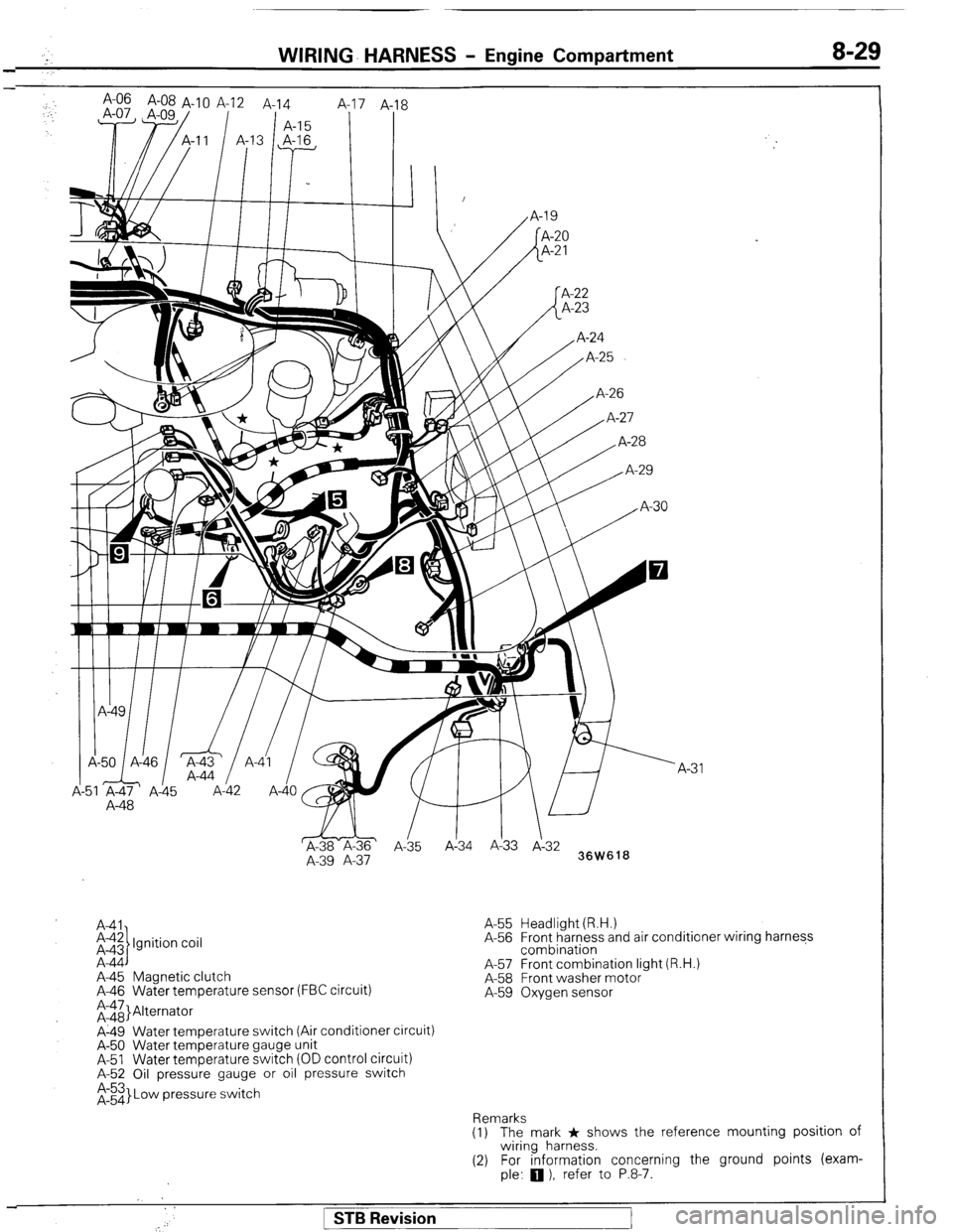
A41
i-$ Ignition coil
A-44
A-45 Magnetic clutch
A-46 Water temperature sensor (FBC circuit)
;rii}Alternator
A-49 Water temperature switch (Air conditioner circuit)
A-50 Water temperature gauge unit
A-51 Water temperature switch (OD control circuit)
A-52 Oil pressure gauge or oil pressure switch
$3 Low pressure switch A-55 Headlight (R.H.)
A-56 Front harness and air conditioner wiring harness
combination
A-57 Front combination light (R.H.)
A-58 Front washer motor
A-59 Oxygen sensor
Remarks
(1) The mark * shows the reference mounting position of
wiring harness.
(2) For information concerning the ground points (exam-
ple:
q ), refer to P.8-7.
1 STB Revision
Page 77 of 284
WIRING HARNESS - Air Conditioner Circuit 8-57
0
(Bl
0: Lw
@,0.85-WB B 0.3
ElFI Lvf L
Air conditioner relay I @ H ‘I *2 Air :on!$!er rela
85-Bw:o.85-Bw ) to feed back carburetor
u control unit
A-25 [Refer to P.8-39.1
l 20.85-BWr
l 10.85-BWL&
A-13 * Vacuum solenoid
valve
A-45
0.85-BWnBW
Is*la
Magnetic
clutch
(compressor)
U
Water temperature
switch
Condenser
Condenser blower -I-
BY
blower motor motor relay rl
37W611
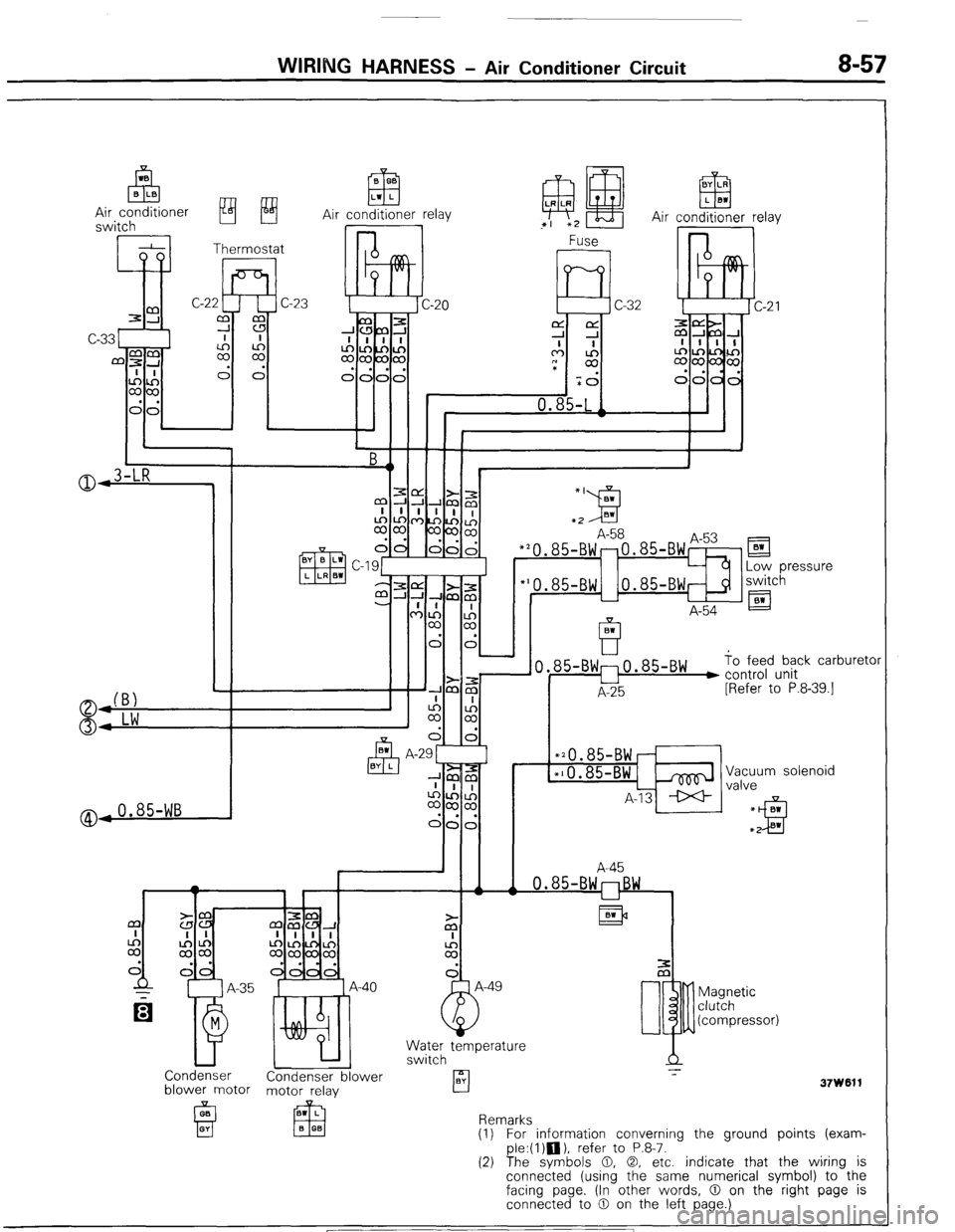
Remarks
(1) For information converning the ground points (exam-
ple:(l)n), refer to P.8-7.
(2) The svmbols 0, 0, etc. indicate that the wiring is
connedted (using the same numerical symbol) to-the
facing page. (In other words, 0 on the right page is
connected to 0 on the left page.) ) STB Revision
Page 111 of 284
STARTING SYSTEM-General Information 8-91
STARTING SYSTEM
GENERAL INFORMATION
NOBFAAJ
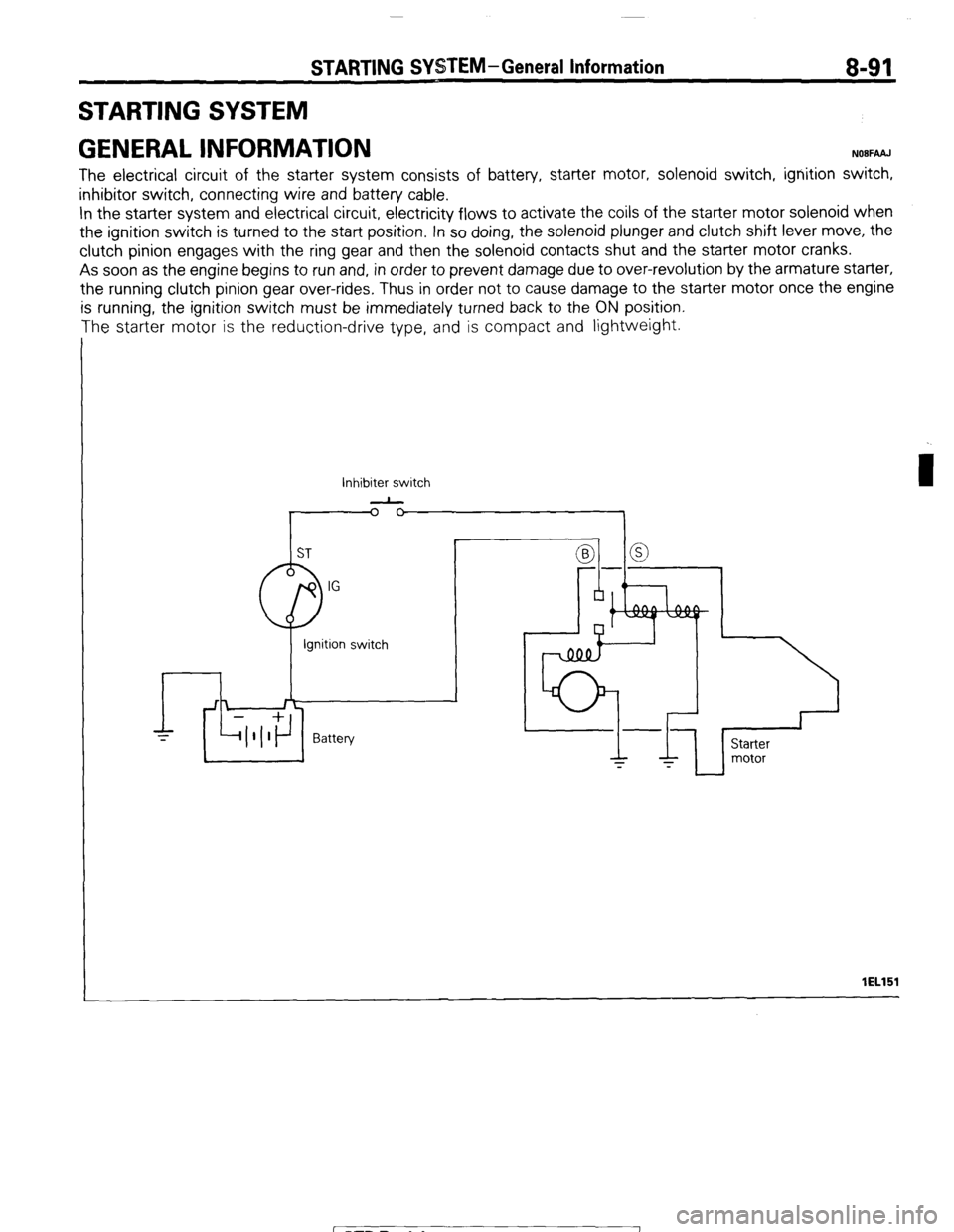
The electrical circuit of the starter system consists of battery, starter motor, solenoid switch, ignition switch,
inhibitor switch, connecting wire and battery cable.
In the starter system and electrical circuit, electricity flows to activate the coils of the starter motor solenoid when
the ignition switch is turned to the start position. In so doing, the solenoid plunger and clutch shift lever move, the
clutch pinion engages with the ring gear and then the solenoid contacts shut and the starter motor cranks.
As soon as the engine begins to run and, in order to prevent damage due to over-revolution by the armature starter,
the running clutch pinion gear over-rides, Thus in order not to cause damage to the starter motor once the engine
is running, the ignition switch must be immediately turned back to the ON position.
The starter motor is the reduction-drive type, and is compact and lightweight.
Inhibiter switch
-
I lEL151
1 STB Revision
Page 112 of 284
8-92 STARTING SYSTEM - General Information
“S” terminal
Sole;oid coil
“6” terminal -
clutch
Brush
gear type reduction
1 ST6 Revision
Page 120 of 284
STARTING SYSTEM -Starter Motor
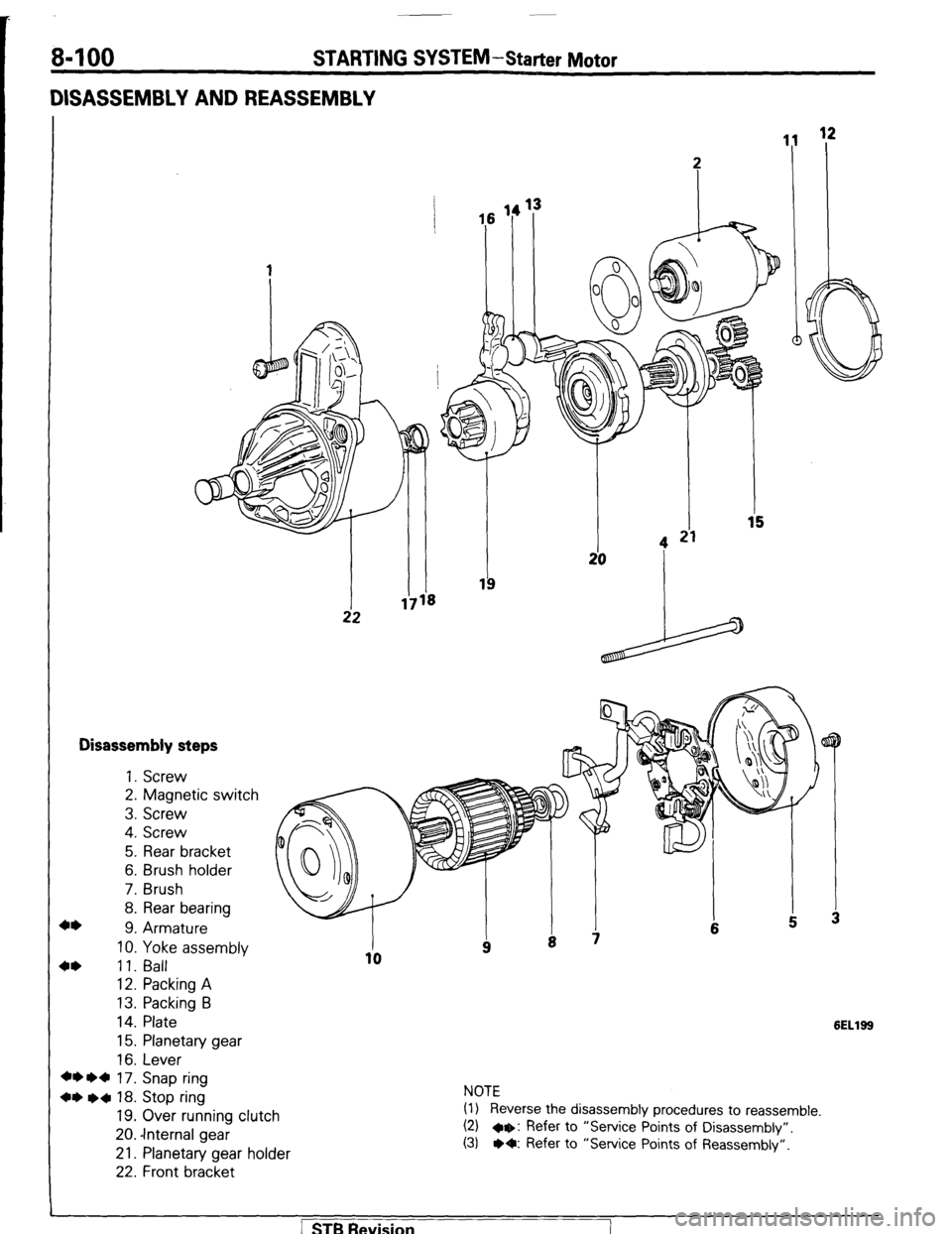
DISASSEMBLY AND REASSEMBLY
Disassembly steps
+* 1. Screw
2. Magnetic switch
3. Screw
4. Screw
5. Rear bracket
6. Brush holder
7. Brush
8. Rear bearing
9. Armature
10. Yoke assembly
4* 11. Ball
12. Packing A
13. Packing B
14. Plate
15. Planetary gear
16. Lever
+* l d 17. Snap ring
+* l a 18. Stop ring
19. Over running clutch
20. -Internal gear
21. Planetary gear holder
22. Front bracket
6ELlSS
NOTE
(1) Reverse the disassembly procedures to reassemble.
(2) a+: Refer to “Service Points of Disassembly”.
(3) l O: Refer to “Service Points of Reassembly”.
] STB Revision
Page 121 of 284
STARTING SYSTEM-Starter Motor 8-101
Snap
L Armature
1ELlO
pi-
SERVICE POINTS OF DISASSEMBLY
9. CAUTION OF ARMATURE/ll. BALL
When removing the armature, do not lose the ball which acts
as a bearing for the armature and tip.
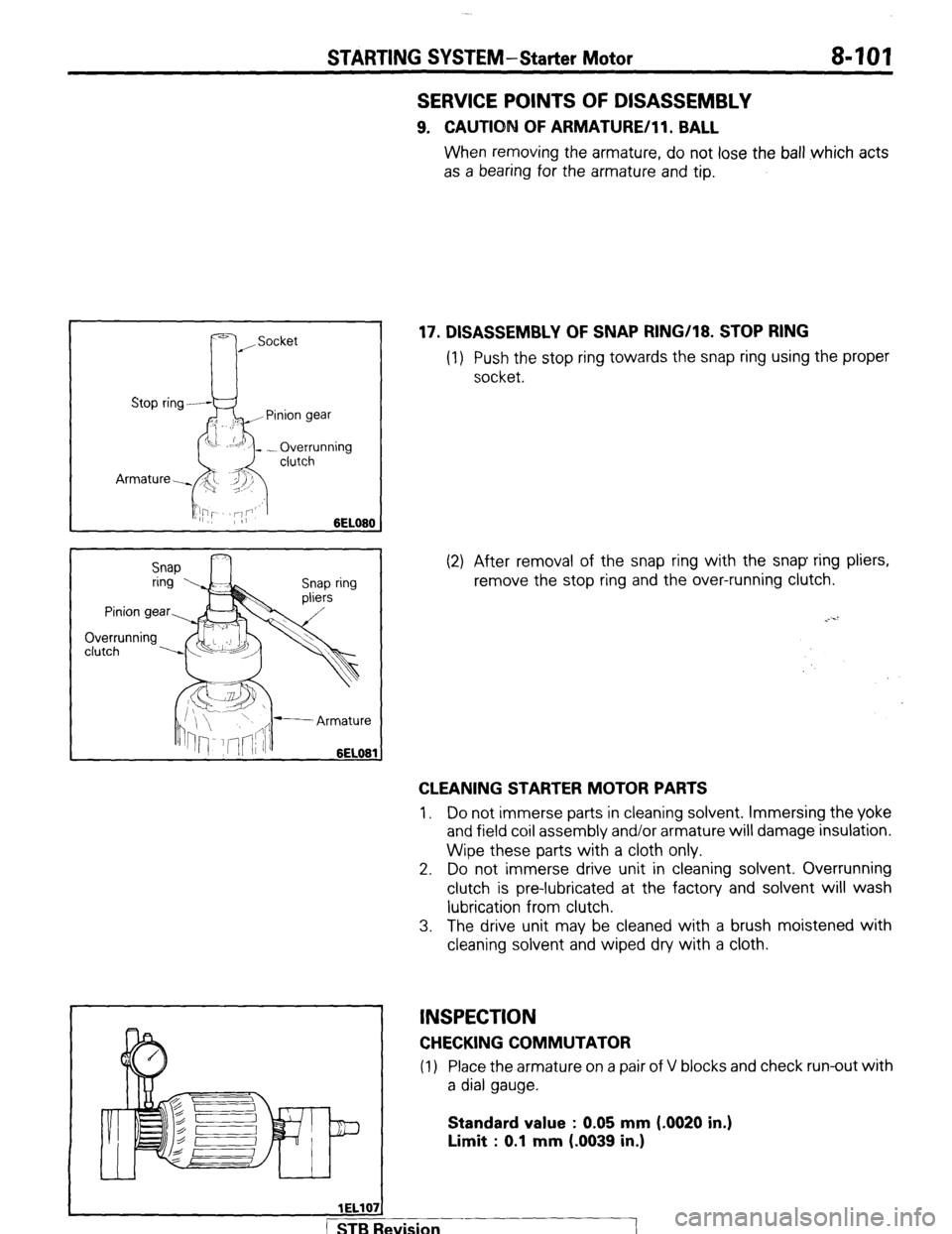
17. DISASSEMBLY OF SNAP RING/18. STOP RING
(1) Push the stop ring towards the snap ring using the proper
socket.
(2) After removal of the snap ring with the snap ring pliers,
remove the stop ring and the over-running clutch.
CLEANING STARTER MOTOR PARTS
1, Do not immerse parts in cleaning solvent. Immersing the yoke
and field coil assembly and/or armature will damage insulation.
Wipe these parts with a cloth only.
2. Do not immerse drive unit in cleaning solvent. Overrunning
clutch is pre-lubricated at the factory and solvent will wash
lubrication from clutch.
3. The drive unit may be cleaned with a brush moistened with
cleaning solvent and wiped dry with a cloth.
INSPECTION
CHECKING COMMUTATOR
(1) Place the armature on a pair of V blocks and check run-out with
a dial gauge.
Standard value : 0.05 mm (-0020 in.)
Limit : 0.1 mm (.0039 in.)
wision
I
Page 122 of 284
8-102 STARTING SYSTEM-Starter Motor
lEL116
lEL66
Brush holder
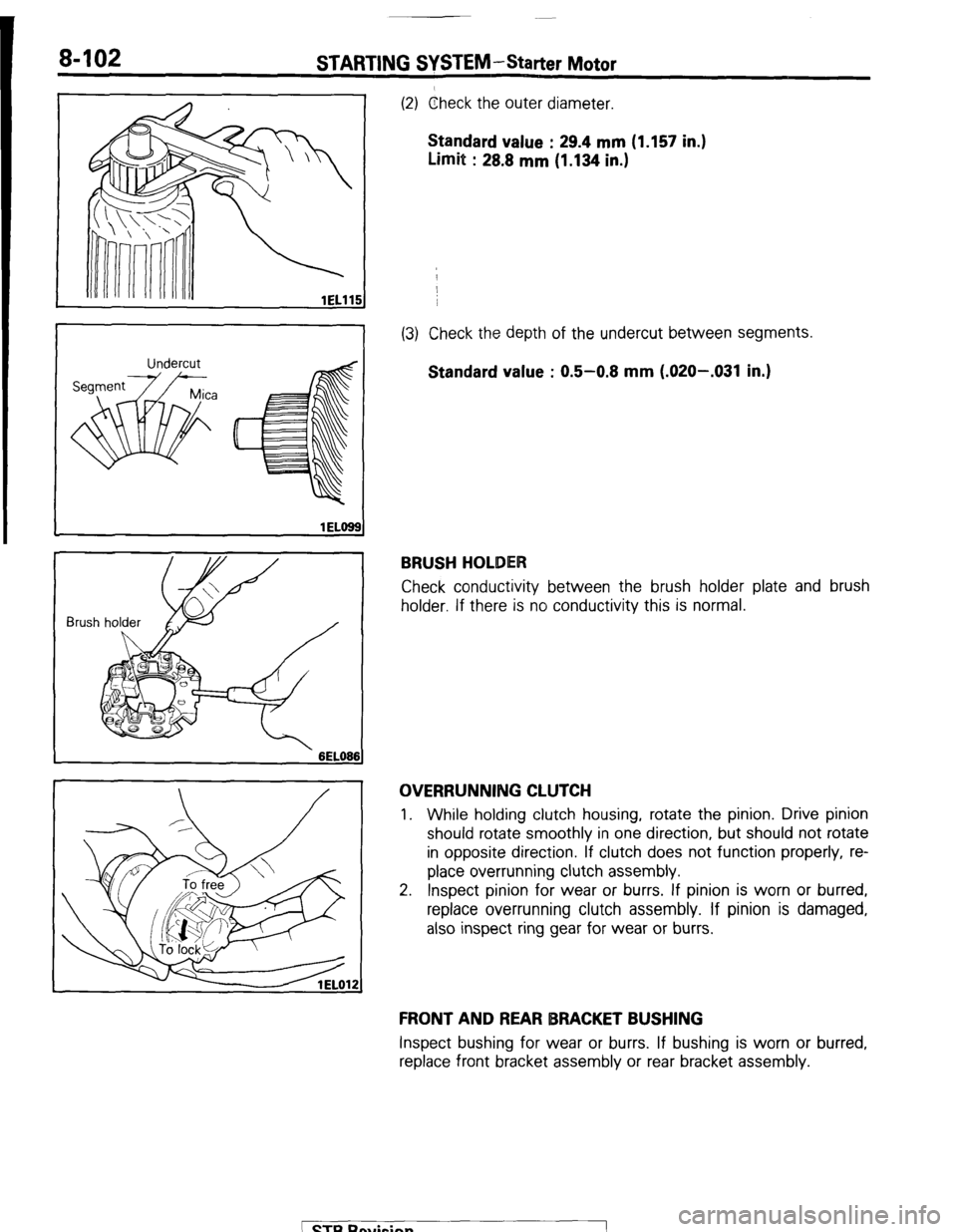
(2) Check the outer diameter.
Standard value : 29.4 mm (1.157 in.)
Limit : 28.8 mm (1.134 in.)
(3) Check the depth of the undercut between segments.
Standard value : 0.5-0.8 mm (.020-.031 in.)
BRUSH HOLDER
Check conductivity between the brush holder plate and brush
holder. If there is no conductivity this is normal.
OVERRUNNING CLUTCH
1. While holding clutch housing, rotate the pinion. Drive pinion
should rotate smoothly in one direction, but should not rotate
in opposite direction. If clutch does not function properly, re-
place overrunning clutch assembly.
2. Inspect pinion for wear or burrs. If pinion is worn or burred,
replace overrunning clutch assembly. If pinion is damaged,
also inspect ring gear for wear or burrs.
FRONT AND REAR IBRACKET BUSHING
Inspect bushing for wear or burrs. If bushing is worn or burred,
replace front bracket assembly or rear bracket assembly.
1 STB Revision
Page 124 of 284
8-104 STARTING SYSTEM-Starter Motor
SERVICE POINTS OF REASSEMBLY
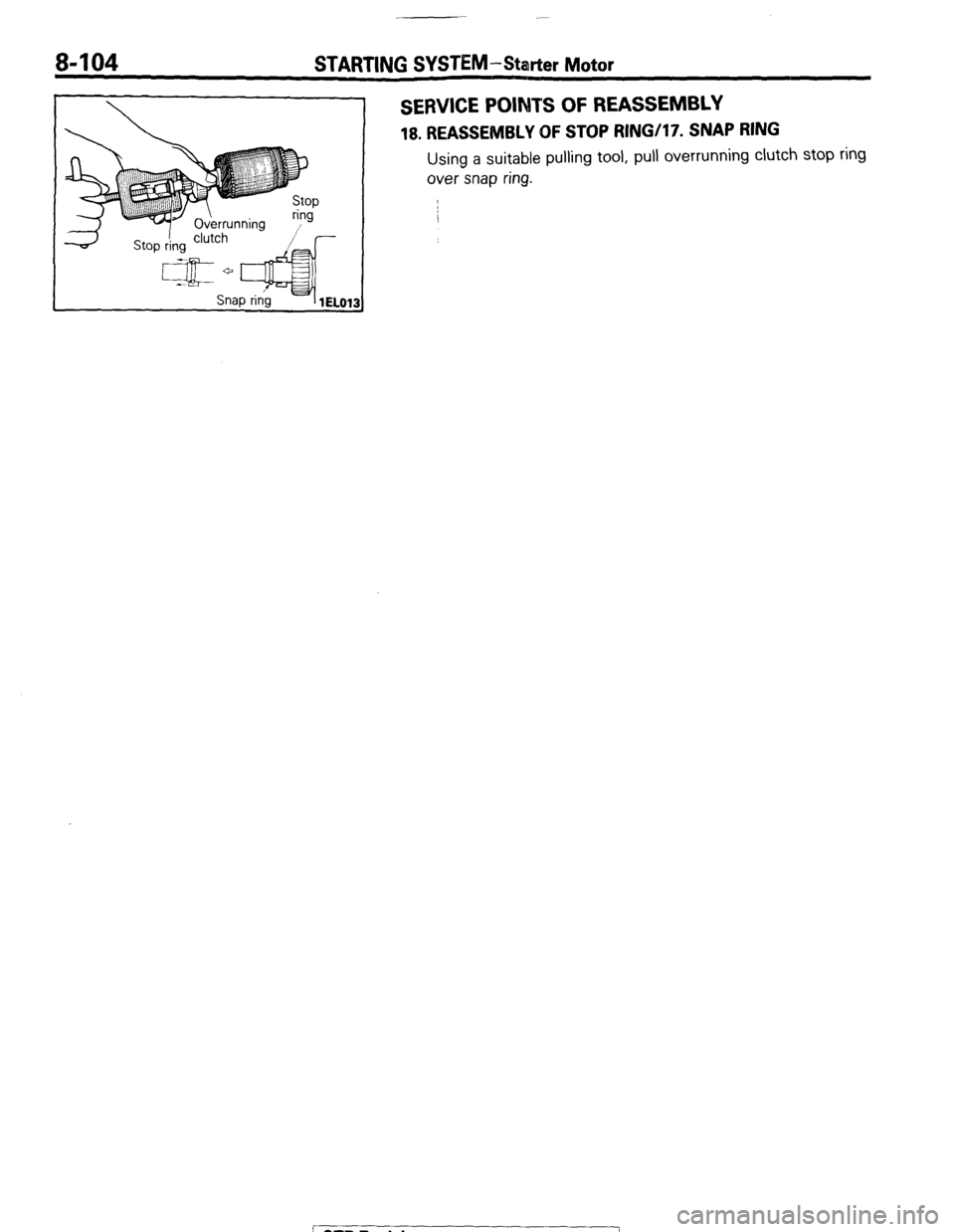
18. REASSEMBLY OF STOP RINGi17. SNAP RING
Using a suitable pulling tool, pull overrunning clutch stop ring
over snap ring.
1 STB Revision
--I
Page 237 of 284
24-1
AIR-CO IONING
CONTENTS
AIR-CONDITIONING
AIR CONDITIONER SWITCH ......................... 42
CIRCUIT DIAGRAM ...................................... . . 26
COMPRESSOR ............................................... 46
EVAPORATOR ............................................ . ... 43
GENERAL INFORMATION .............. . ....... . . . .... 19
RECEIVER DRIER, CONDENSER,
COMPRESSOR CLUTCH ASSEMBLY .......... 45
SAFETY PRECAUTIONS ................................ 28
SERVICE ADJUSTMENT PROCEDURES ...... 29
Compressor Drive Belt Adjustment ...........
40
Compressor Noise ..................................... 41
Handling Tubing and Fittings ..................... 39
Manifold Gauge Set Installation ................ 29
Performance Test ...................................... 34
Refrigerant Leak Repair Procedure ........... 34
Test Procedures ......................................... 29
Testing System for Leaks .......................... 33
SPECIAL TOOLS ............................................ 22
SPECIFICATIONS ...... . .
.. . ................................ 21
General Specifications ...............................
21
Service Specifications ................................
21
Torque Specifications ................................
21
TROUBLESHOOTING .................................... 22 Air is Emitted but Is Not Cool
Cool Air Flow Is Intermittent
Insufficient Air Flow
Insufficient Cooling
HEATERS
BLOWER ASSEMBLY . . . . . . . . . . . . . . . . . . ..a............... 14
CIRCUIT DIAGRAM . . . . . . . . . . . . . . . . . . . . . . . . . . . . . . . . . . . . . . . . 4
GENERAL INFORMATION . . . . . . . . . . . . . . . . . . . . . . . . . . . . . 2
HEATER CONTROL . . . . . . . . . . . . . . . . . . . . . . . . . . . . . . . . . . . . . . . . 9
HEATER UNIT . . . . . . . . . . . . . . . . . . . . . . . . . . . . . . . . . . . . . . . . . . . . . . . . . 12
SERVICE ADJUSTMENT PROCEDURES . . . . . . 5
Temperature Control System
Adjustment . . . . . . . . . . . . . . . . . . . . . . . . . . . . . . . . . . . . . . . . . . . . . . . . 5
Water Valve Replacement . . . . . . . . . . . . . . . . . . . . . . . 8
TROUBLESHOOTING . . . . . . . . . . . . . . . . . . . . . . . . . . . . . . . . . . . . 3
Blower Motor Inoperative
Blower Motor Operates on High
Speed Only
Improper Heat
No Ventilation Even When Mode
Selection Lever Is Operated
VENTILATORS . . . . . . . . . . . . . . . . . . . . . . . . . . . ..a..... . . . . . . . . . . . .
16
Page 256 of 284
24-20 AIR-CONDITION!NG-General Information
I
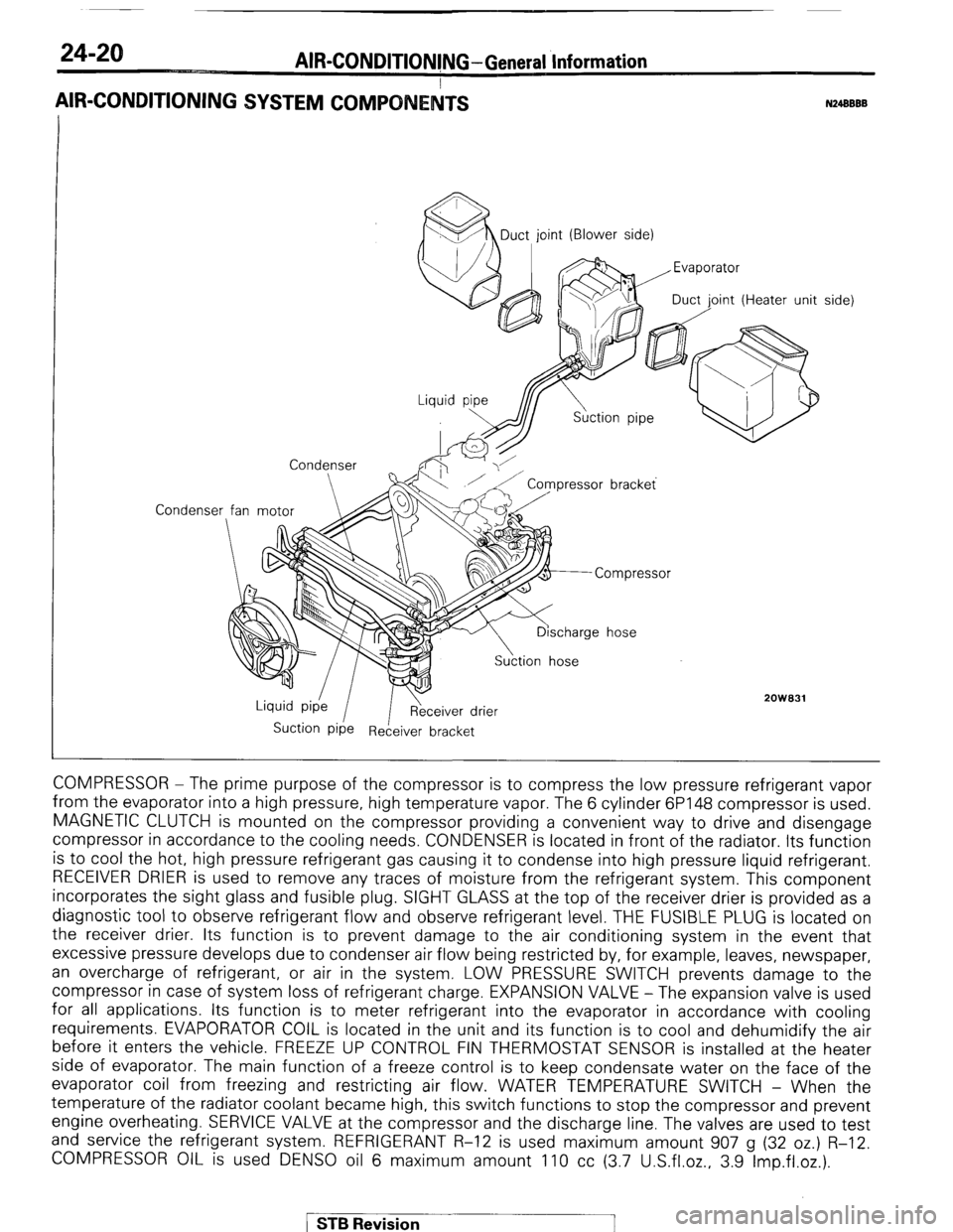
AIR-CONDITIONING SYSTEM COMPO
N24BBBB
Condenser MDuct, joint (Blower side)
oint (Heater unit
Condenser
2OWB31
Suction Pipe Receiver bracket side)
COMPRESSOR - The prime purpose of the compressor is to compress the low pressure refrigerant vapor
from the evaporator into a high pressure, high temperature vapor. The 6 cylinder 6P148 compressor is used.
MAGNETIC CLUTCH is mounted on the compressor providing a convenient way to drive and disengage
compressor in accordance to the cooling needs. CONDENSER is located in front of the radiator. Its function
is to cool the hot, high pressure refrigerant gas causing it to condense into high pressure liquid refrigerant.
RECEIVER DRIER is used to remove any traces of moisture from the refrigerant system. This component
incorporates the sight glass and fusible plug. SIGHT GLASS at the top of the receiver drier is provided as a
diagnostic tool to observe refrigerant flow and observe refrigerant level. THE FUSIBLE PLUG is located on
the receiver drier. Its function is to prevent damage to the air conditioning system in the event that
excessive pressure develops due to condenser air flow being restricted by, for example, leaves, newspaper,
an overcharge of refrigerant, or air in the system. LOW PRESSURE SWITCH prevents damage to the
compressor in case of system loss of refrigerant charge. EXPANSION VALVE - The expansion valve is used
for all applications. Its function is to meter refrigerant into the evaporator in accordance with cooling
requirements. EVAPORATOR COIL is located in the unit and its function is to cool and dehumidify the air
before it enters the vehicle. FREEZE UP CONTROL FIN THERMOSTAT SENSOR is installed at the heater
side of evaporator. The main function of a freeze control is to keep condensate water on the face of the
evaporator coil from freezing and restricting air flow. WATER TEMPERATURE SWITCH - When the
temperature of the radiator coolant became high, this switch functions to stop the compressor and prevent
engine overheating. SERVICE VALVE at the compressor and the discharge line. The valves are used to test
and service the refrigerant system. REFRIGERANT R-12 is used maximum amount 907 g (32 oz.) R-12.
COMPRESSOR OIL is used DENS0 oil 6 maximum amount 110 cc (3.7 U.S.fl.oz., 3.9 Imp.fl.oz.).
/ STB Revision