brakes MITSUBISHI OUTLANDER PHEV 2017 Owner's Manual (in English)
[x] Cancel search | Manufacturer: MITSUBISHI, Model Year: 2017, Model line: OUTLANDER PHEV, Model: MITSUBISHI OUTLANDER PHEV 2017Pages: 548, PDF Size: 25.5 MB
Page 197 of 548
NOTElAlthough it is possible to start the Plug-in
Hybrid EV System if quick charging has notfinished normally, the charging indicator is
continuously blinking.
Refer to “Charging troubleshooting guide” on page 3-21.Warning lamps
E00502400147Brake warning lamp (red)
E00502503950
This lamp illuminates whenthe operation mode of thepower switch is put in ON,
and goes off after a few sec- onds.
Always make sure that the
lamp goes off before driving.
With the operation mode in ON, the brake
warning lamp illuminates under the following conditions:
l When the parking brake lever has been
engaged.
l When the brake fluid level in the reser-
voir falls to a low level.
l When the braking system is an abnor-
mality.
With the operation mode in ON, a buzzer sounds under the following condition:
l The vehicle speed exceeds 8 km/h
(5 mph) with the parking brake applied.CAUTIONl In the situations listed below, brake perform-
ance may be compromised or the vehicle may become unstable if brakes are applied
suddenly; consequently, avoid driving at
high speeds or applying the brakes suddenly. Furthermore, the vehicle should be brought
to a stop in a safe location and to have it
checked.
• The brake warning lamp does not illumi-
nate when the parking brake is applied ordoes not turn off when the parking brake is released.
• The ABS warning lamp and brake warn-
ing lamp illuminate at the same time.
For details, refer to “ABS warning lamp”
on page 7-38.
• The brake warning lamp remains illumi-
nated during driving.
l The vehicle should be brought to a halt in
the following manner when brake perform- ance has deteriorated.
• Depress the brake pedal harder than usual.
Even if the brake pedal moves down to
the very end of its possible stroke, keep it
pressed down hard.CAUTION• Should the brakes fail, use regenerative
braking to reduce your speed and keep
pulling the Electric parking brake switch.
(Refer to “Electric parking brake” on page
7-03
Depress the brake pedal to operate the
stop lamp to alert the vehicles behind you.Electric parking brake warn-
ing lamp (yellow)
E00568900100
This warning lamp will illu-
minate when there is a fault in the Electric parking brake
system.
Normally, this warning lamp
illuminates when the opera-
tion mode of the power switch is put in ON,
and goes off in a few seconds.
Warning lamps
6-50OGGE17E1Instruments and controls6
Page 200 of 548
When the operation mode of the power
switch is put in ON, if the brake fluid is low,
this warning is displayed.
The warning lamp in the instrument cluster also illuminates.CAUTIONl If this warning stays illuminated and does
not go out while driving, there is a danger of ineffective braking. In this case, immediate-
ly park your vehicle in a safe place and we recommend you to have it checked.
l If the brake warning display is displayed and
the brake warning lamp and the ABS warn- ing lamp are illuminated at the same time,
the braking force distribution function will
not operate, so the vehicle may be destabi- lised during sudden braking. Avoid sudden
braking and high-speed driving, stop the ve-
hicle in a safe place, and we recommend you to have it checked.
l The vehicle should be brought to a halt in
the following manner when brake perform-
ance has deteriorated.
• Depress the brake pedal harder than usual.
Even if the brake pedal moves down to
the very end of its possible stroke, keep it pressed down hard.CAUTION• Should the brakes fail, use the regenera-
tive brake to reduce your speed and keep
pulling the Electric parking brake switch.
Refer to “Electric parking brake” on page
7-03
Depress the brake pedal to operate the
stop lamp to alert the vehicles behind you.Oil pressure warning display
E00524901309
If the engine oil pressure drops while the
Plug-in Hybrid EV System is operating, thewarning display is displayed on the informa-
tion screen in the multi information display.
CAUTIONl If the vehicle is driven while the engine oil
is low, or the oil level is normal but the warning is displayed, the engine may burn
out and be damaged.
l If the warning is displayed while the Plug-in
Hybrid EV System is operating, immediately
park your vehicle in a safe place and check
the engine oil level.CAUTIONl If the warning is displayed while the engine
oil level is normal, have it inspected.Combination headlamps
and dipper switch E00506004224
Headlamps
NOTElDo not leave the lights on for a long time
while the Plug-in Hybrid EV System is sta-tionary (not operating). A run-down auxili- ary battery could result.
l When it rains, or when the vehicle has been
washed, the inside of the lens sometimes be-
comes foggy, but this does not indicate a
functional problem.
When the lamp is switched on, the heat will remove the fog. However, if water gathers
inside the lamp, we recommend you to have it checked.
Combination headlamps and dipper switch
6-53OGGE17E1Instruments and controls6
Page 221 of 548
Economical drivingE00600102422
For economical driving, there are some tech- nical requirements that have to be met. Theprerequisite for low fuel consumption is a
properly adjusted engine. In order to achieve longer life of the vehicle and the most eco- nomical operation, we recommend you tohave the vehicle checked at regular intervals in accordance with the service standards.
Fuel economy and generation of exhaust gas
and noise are highly influenced by personal
driving habits as well as the particular operat- ing conditions. The following points shouldbe observed in order to minimize wear of
brakes, tyres and engine as well as to reduce
environmental pollution.
Starting and acceleration
Avoid driving when the accelerator pedal ispressed way down, such as for unnecessarily sudden starts, acceleration and deceleration.
Smoothly depress the accelerator pedal.
Observe the speed limit and keep the speed
as constant as possible while driving.
Idling
Parking for a long period with the ready indi-
cator illuminated will shorten the cruising
range.
Speed
The higher the vehicle speed, the more drive
battery is consumed. Avoid driving at full speed. Even a slight release of the accelerator
pedal will save a significant amount of drive battery.
Tyre inflation pressure
Check the tyre inflation pressures at regular intervals. Low tyre inflation pressure increa-ses road resistance and fuel consumption. In addition, low tyre pressures adversely affect
tyre wear and driving stability.
Cargo loads
Do not drive with unnecessary articles in the
luggage compartment. Especially during city
driving where frequent starting and stopping is necessary, the increased weight of the ve-
hicle will greatly affect fuel consumption. Al- so avoid driving with unnecessary luggage or carriers, etc., on the roof; the increased air re- sistance will increase fuel consumption.
Air conditioning
Too much cooling/heating can affect the cruising range, so maintain an appropriatetemperature to extend the cruising range.
Driving, alcohol and drugs
E00600200070
Driving after drinking alcohol is one of the
most frequent causes of accidents.
Your driving ability can be seriously im- paired even with blood alcohol levels far be-
low the legal minimum. If you have been drinking, don’t drive. Ride with a designated non-drinking driver, call a cab or a friend, or
use public transportation. Drinking coffee or
taking a cold shower will not make you so- ber.
Similarly, prescription and nonprescription
drugs affect your alertness, perception and re- action time. Consult with your doctor or
pharmacist before driving while under the in- fluence of any of these medications.WARNINGl NEVER DRINK AND DRIVE.
Your perceptions are less accurate, your
reflexes are slower and your judgment is impaired.Safe driving techniques
E00600301775
Driving safety and protection against injury
cannot be fully ensured. However, we recom- mend that you pay extra attention to the fol-
lowing:
Economical driving
7-02OGGE17E1Starting and driving7
Page 223 of 548
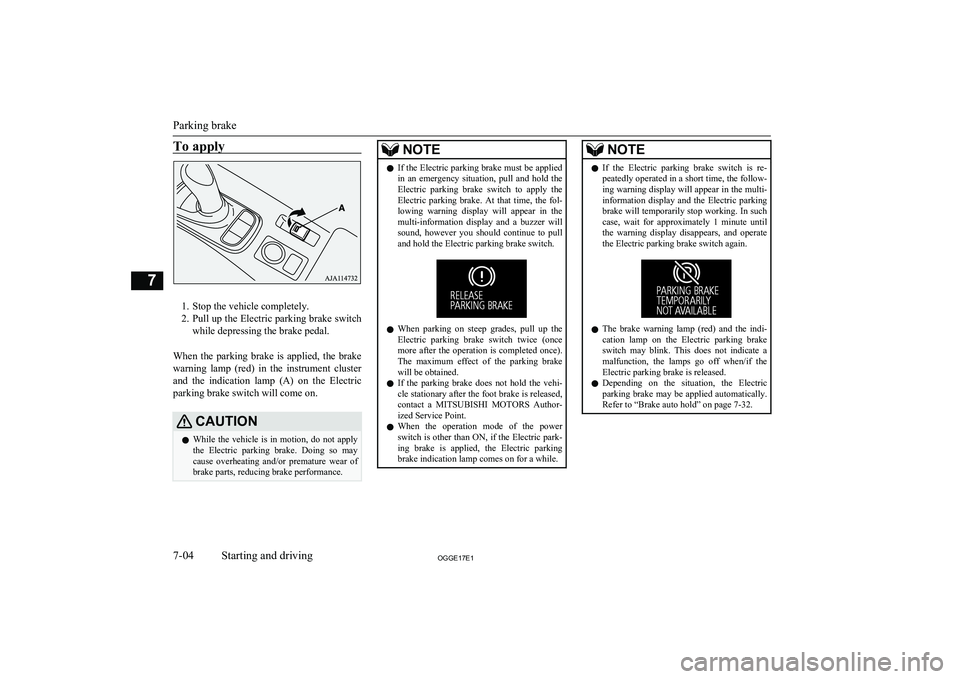
To apply
1. Stop the vehicle completely.
2. Pull up the Electric parking brake switch
while depressing the brake pedal.
When the parking brake is applied, the brake
warning lamp (red) in the instrument cluster and the indication lamp (A) on the Electric
parking brake switch will come on.
CAUTIONl While the vehicle is in motion, do not apply
the Electric parking brake. Doing so may cause overheating and/or premature wear of
brake parts, reducing brake performance.NOTEl If the Electric parking brake must be applied
in an emergency situation, pull and hold the
Electric parking brake switch to apply the
Electric parking brake. At that time, the fol- lowing warning display will appear in the
multi-information display and a buzzer will
sound, however you should continue to pull and hold the Electric parking brake switch.
l When parking on steep grades, pull up the
Electric parking brake switch twice (once
more after the operation is completed once).
The maximum effect of the parking brake will be obtained.
l If the parking brake does not hold the vehi-
cle stationary after the foot brake is released,
contact a MITSUBISHI MOTORS Author-
ized Service Point.
l When the operation mode of the power
switch is other than ON, if the Electric park- ing brake is applied, the Electric parking
brake indication lamp comes on for a while.
NOTEl If the Electric parking brake switch is re-
peatedly operated in a short time, the follow-
ing warning display will appear in the multi- information display and the Electric parkingbrake will temporarily stop working. In such
case, wait for approximately 1 minute until
the warning display disappears, and operate the Electric parking brake switch again.
l The brake warning lamp (red) and the indi-
cation lamp on the Electric parking brakeswitch may blink. This does not indicate a malfunction, the lamps go off when/if theElectric parking brake is released.
l Depending on the situation, the Electric
parking brake may be applied automatically.
Refer to “Brake auto hold” on page 7-32.
Parking brake
7-04OGGE17E1Starting and driving7
Page 243 of 548
NOTElDriving on rough roads can be hard on a ve-
hicle. Before you leave paved roads, be sure all scheduled maintenance and service has
been done, and that you have inspected your vehicle. Pay special attention to the condi- tion of the tyres, and check the tyre pres-
sures.
l MITSUBISHI
MOTORS is not responsible
for any damage or injury caused or liability
incurred by improper and negligent opera- tion of a vehicle by the operator. All techni-
ques of vehicle operation depend on the skill and experience of the operator and other par- ticipating parties. Any deviation from the
recommended operating instructions above is at their own risk.
l Note that the stopping distance required of a
4-wheel drive vehicle differs very little from
that of a 2-wheel drive vehicle. When driv- ing on a snow-covered road or a slippery,muddy surface, make sure that you keep a
sufficient distance between your vehicle and
the one ahead of you.
l The driving posture should be more upright;
adjust the seat to a good position for easy steering and pedal operation. Be sure to wear
the seat belt.
l After driving on rough roads, check each
part of the vehicle and wash it thoroughlywith water. Refer to the “Inspection andmaintenance following rough road opera-
tion” section and “Maintenance” section.NOTEl When moving out of mud, sand or fresh
snow, pressing the accelerator pedal may not
allow the Plug-in Hybrid EV system output to increase. In such situations, switching to
“4WD LOCK” with the 4WD lock switch and temporarily turning off the Active Sta- bility Control (ASC) with the “ASC OFF”
switch will make it easier to move out your vehicle.
Refer to “Operation under adverse driving
conditions: If your vehicle becomes stuck in sand, mud or snow” on page 9-26.
Climbing/descending sharp
grades
Your vehicle may not provide sufficient hill
climbing ability and regenerative brake on steep slope. Avoid driving on steep slopes
even though the vehicle is a 4-wheel drive vehicle.
Inspection and maintenance
following rough roadoperation E00606701407
After operating the vehicle in rough road
conditions, be sure to perform the following inspection and maintenance procedures:
l Check that the vehicle has not been dam-
aged by rocks, gravel, etc.
l Carefully wash the vehicle with water.
Drive the vehicle slowly while lightly
depressing the brake pedal in order to dry out the brakes. If the brakes still do
not function properly, we recommend you to have the brakes checked as soon
as possible.
l Remove the insects, dried grass, etc.
clogging the radiator core.
l Check the inside of the vehicle. If water
entry is found, dry the carpet etc.
l Inspect the headlamps. If the headlamp
bulb is flooded with water, we recom-
mend you to have it drained.Cautions on handling of 4-
wheel drive vehicles E00606801844
Tyres and wheels
Since the driving torque can be applied to the
4 wheels, the driving performance of the ve- hicle when operating in 4-wheel drive is
greatly affected by the condition of the tyres.
Pay close attention to the tyres.
Inspection and maintenance following rough road operation
7-24OGGE17E1Starting and driving7
Page 250 of 548
BrakingE00607002967
All the parts of the brake system are critical
to safety. We recommend you to have the ve- hicle checked at regular intervals according
to the service booklet.CAUTIONl Avoid driving habits that cause heavy brak-
ing and never “ride” the brakes by resting
your foot on the brake pedal while driving.
It causes brake overheating and fade.
Brake system
The service brake is divided into two brake
circuits. And your vehicle is equipped with
power brakes. If one brake circuit fails, the other is available to stop the vehicle. If you
should lose the power assist for some reason, the brakes will still work. In these situations,
even if the brake pedal moves down to the very end of its possible stroke or resists being
depressed, keep depressing the brake pedal
down harder and further than usual; stop
driving as soon as possible and have the brake system repaired.
WARNINGl Do not turn off the Plug-in Hybrid EV
System while your vehicle is in motion. If
you turn off the Plug-in Hybrid EV Sys- tem while driving, the power assistancefor the braking system will stop working
and your brakes will not work effectively.
l If the power assist is lost or if either brake
hydraulic system stops working properly,
have your vehicle checked immediately.
Warning display
The brake warning lamp illuminates to indi-
cate a fault in the braking system. A warning
is also displayed on the multi information display. Refer to "Brake warning lamp" and "Brake warning display" 6-50, 6-52.
When brakes are wet
Check the brake system while driving at a
low speed immediately after starting, espe- cially when the brakes are wet, to confirm
they work normally.
A film of water can be formed on the brake discs and prevent normal braking after driv-
ing in heavy rain or through large puddles, or after the vehicle is washed. If this occurs, dry
the brakes out by driving slowly while lightly
depressing the brake pedal.
When driving downhillWARNINGl Do not leave any objects near the brake
pedal or let a floor mat slide under it; do- ing so could prevent the full pedal stroke
that would be necessary in an emergency. Make sure that the pedal can be operated freely at all times. Make sure that thefloor mat is securely held in place.CAUTIONl Put the selector lever to “B” position accord-
ing to the grade of a slope or the speed in along downward slope, and use the regenera-
tive brake together.
If you depress the brake pedal and slowing down is repeated frequently, the foot brake
may be overheated and effectiveness may worsen.
Braking
7-31OGGE17E1Starting and driving7
Page 251 of 548
CAUTIONlEffectiveness of the regenerative brake be-
comes weak when the drive battery is close
to full charge and loses its effect at the full
charge.
In this case, since the foot brake is effective,
use the foot brake and slow down your vehi-
cle speed beforehand.
The energy usage indicator stops swaying in the charge zone closer to full charge.
Refer to “Energy usage indicator” on page 6-02
In such case, drive at low speed in advance.
And if needed use the foot brake to slow
down the vehicle speed before the vehicle speed increases.
The regenerative brake comes to be effective if the drive battery remaining power is con-
sumed.
Brake pad
l Avoid hard braking situations.
New brakes need to be broken-in by
moderate use for the first 200 km
(124 miles).
l The disc brakes are provided with a
warning device which emits a shrieking
metallic sound while braking if the brake pads have reached their wear limit. Ifyou hear this sound, have the brake padsreplaced immediately.
WARNINGl Driving with worn brake pads will make
it harder to stop, and can cause an acci-
dent.Brake auto hold
E00652000051
When the vehicle is stopped at traffic signalsetc., the vehicle can be held stationary with
the brake auto hold system even if you re-
lease your foot from the brake pedal. When the accelerator pedal is depressed, the brakes are released.
WARNINGl Do not overly rely on the brake auto hold
system. On a steep slope, depress the brake pedal firmly because the systemmay not hold the vehicle stationary.
l Never leave the vehicle while it is being
stopped by the brake auto hold system.
When leaving the vehicle, apply the park- ing brake and put the select position to
the “P” (PARK) position.
l Do not use the brake auto hold system
when driving on slippery roads. The sys- tem may not hold the vehicle stationary
and an accident could occur.NOTEl While operating the brake auto hold system,
you may hear an operation noise to increasebraking force when the system detected the
movement of the vehicle. This does not indi- cate a malfunction.
How to use brake auto hold
To turn on brake auto hold
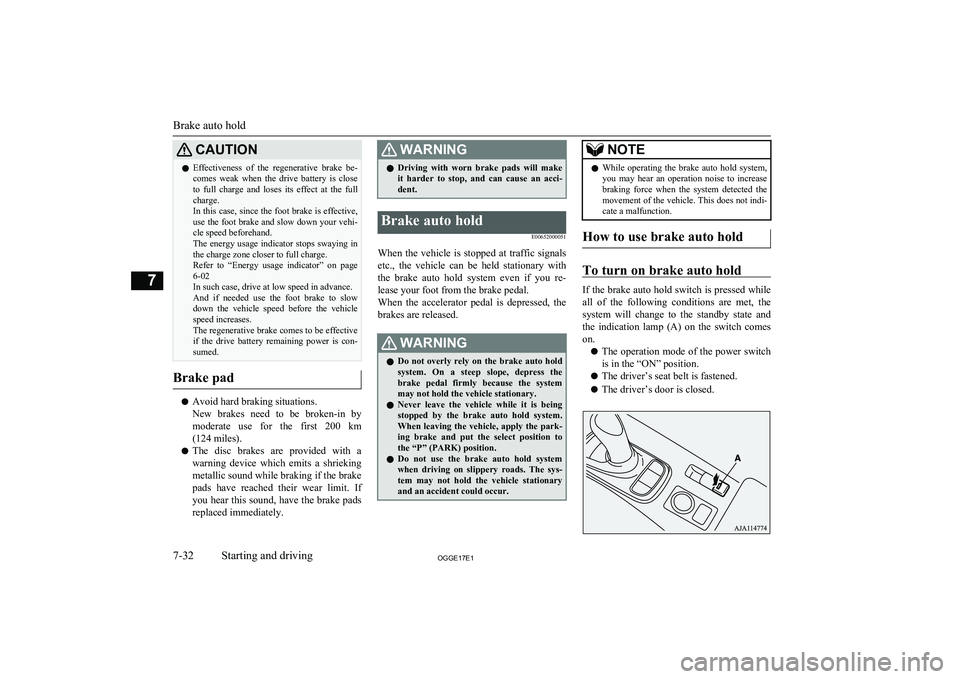
If the brake auto hold switch is pressed while
all of the following conditions are met, the system will change to the standby state and
the indication lamp (A) on the switch comes on.
l The operation mode of the power switch
is in the “ON” position.
l The driver’s seat belt is fastened.
l The driver’s door is closed.
Brake auto hold
7-32OGGE17E1Starting and driving7
Page 253 of 548
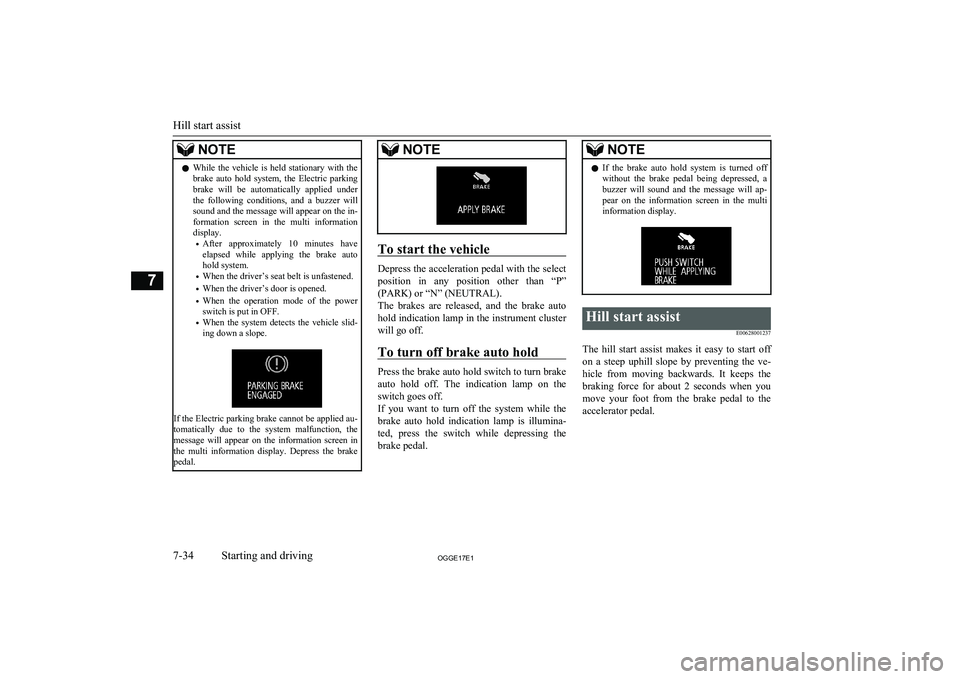
NOTElWhile the vehicle is held stationary with the
brake auto hold system, the Electric parking brake will be automatically applied under
the following conditions, and a buzzer will sound and the message will appear on the in-
formation screen in the multi information display.
• After approximately 10 minutes have
elapsed while applying the brake auto
hold system.
• When the driver’s seat belt is unfastened.
• When the driver’s door is opened.
• When the operation mode of the power
switch is put in OFF.
• When the system detects the vehicle slid-
ing down a slope.
If the Electric parking brake cannot be applied au- tomatically due to the system malfunction, the
message will appear on the information screen in
the multi information display. Depress the brake pedal.
NOTE
To start the vehicle
Depress the acceleration pedal with the select
position in any position other than “P” (PARK) or “N” (NEUTRAL).
The brakes are released, and the brake auto hold indication lamp in the instrument cluster
will go off.
To turn off brake auto hold
Press the brake auto hold switch to turn brake
auto hold off. The indication lamp on the switch goes off.
If you want to turn off the system while the brake auto hold indication lamp is illumina-
ted, press the switch while depressing the brake pedal.
NOTEl If the brake auto hold system is turned off
without the brake pedal being depressed, abuzzer will sound and the message will ap-
pear on the information screen in the multi
information display.Hill start assist
E00628001237
The hill start assist makes it easy to start offon a steep uphill slope by preventing the ve-
hicle from moving backwards. It keeps the
braking force for about 2 seconds when you move your foot from the brake pedal to the
accelerator pedal.
Hill start assist
7-34OGGE17E1Starting and driving7
Page 255 of 548
Brake assist systemE00627001793
The brake assist system is a device assisting drivers who cannot depress the brake pedalfirmly when it is necessary to do so (such as
in emergency stop situations) and provides
greater braking force.
If the brake pedal is depressed suddenly, the brakes will be applied with more force thanusual.CAUTIONl The brake assist system is not a device de-
signed to exercise braking force greater than its capacity. Make sure to always keep a suf-
ficient distance between your vehicle and a
vehicle in front of you without relying too much on the brake assist system.NOTEl Once the brake assist system is operational,
it maintains great braking force even if the
brake pedal is lightly released.
To stop its operation, completely remove
your foot from the brake pedal.NOTEl When the brake assist system is in use, you
may feel as if the depressed brake pedal issoft, the pedal moves in small motions inconjunction with the sound of the ABS oper- ation, or the vehicle body and the steering
wheel vibrate. This occurs when the brake
assist system is operating normally and does not indicate faulty operation. Continue to
firmly depress the brake pedal.
l You may hear an operation noise when the
brake pedal is depressed suddenly while sta-
tionary. This does not indicate a malfunction
and the brake assist system is operating nor- mally.
l When the anti-lock brake system warning
lamp or only Active Stability Control warn- ing lamp illuminate, the brake assist system
in not functioning.Emergency stop signal
system E00626001060
This is a device that reduces the possibility ofrear end collisions by the rapid and automatic blinking of the hazard warning lamps to alert
vehicles approaching from behind during sudden braking. When the emergency stop
signal system operates, the hazard warning indication lamp in the instrument cluster
blinks rapidly at the same time.
CAUTIONl If the ABS warning or ASC warning is dis-
played, the emergency stop signal system may not operate. Refer to “ABS warning lamp/display” on page 7-38.
Refer to “ASC warning display” on page
7-42.NOTEl [Activating condition for the emergency stop
signal system]
It activates when all of the following condi-
tions are met.
• The vehicle speed is approximately
55 km/h (34 mph) or higher.
• The brake pedal has been depressed, and
the system judges that it was sudden brak- ing from the vehicle deceleration and theoperating condition of the anti-lock brake
system (ABS).
[Deactivating condition for the emergency
stop signal system]
It deactivates when one of the following conditions is met.
• The brake pedal is released.
• The hazard warning flasher switch is
pressed.
• The system judges that it was not sudden
braking from the vehicle deceleration and
the operating condition of the anti-lock
brake system (ABS).
Brake assist system
7-36OGGE17E1Starting and driving7
Page 256 of 548
Anti-lock brake system(ABS) E00607102489
Environmental conditions can have an effect
on braking. During sudden braking when there is snow, ice, oil, water etc. on the road
surface, a skid may occur. In this situation, steering control and braking effectiveness is
reduced and the stopping distance is in-
creased. The vehicle may also go into an un- controlled spin.
The ABS helps prevent the wheels from lock-
ing during braking, thus maintaining direc-
tional stability, ensuring controllability and
providing optimum braking force.
Operating hints
l Always maintain the same distance from
the vehicle in front of you as you would for a vehicle not equipped with ABS.
Compared with vehicles not fitted with ABS, your vehicle may require a longer
stopping distance in the following cases: • Driving on gravel or snow-covered
roads.
• Driving with snow traction device
(tyre chains) installed.
• Driving on roads where the road sur-
face is pitted or has other differences in surface height.
• Driving on bumpy roads or other poor
driving surfaces.
l Operation of ABS is not restricted to sit-
uations where brakes are applied sud-
denly. This system may also operate to
prevent wheel lock when you are driving over manholes, steel road-work plates,
or the vehicle is driven over steps or lev-
el differences in the road, road markings, or other surfaces which are difficult for
the wheels to grip.
l When the ABS is activated, you may
feel the brake pedal pulsation and the vi-
brations of the vehicle body and steering
wheel. You may also hear a characteris-
tic noise. At this time, you may feel as if the pedal attempts to resist being de-
pressed.
This is a normal result of the ABS oper- ation, and does not indicate a problem.
If this situation occurs, depress the brake pedal more firmly in order tooperate the ABS. Do not pump the
brake. This will result in reduced braking performance.l You will hear the operation sound of the
motor coming from the Plug-in Hybrid
EV System compartment immediately following start off after starting the
Plug-in Hybrid EV System. If the brake
pedal is depressed at that moment, you can feel the brake pedal pulsating.
This pulsation is due to the self-diagno-
sis operation of the ABS and does not
indicate a malfunction.
l The ABS will operate after the vehicle
has accelerated to a speed in excess of
approximately 10 km/h (6 mph). It stops
operating when the vehicle decelerates
to a speed below about 5 km/h (3 mph).CAUTIONl Even the ABS cannot prevent the natural
laws of physics from acting on the vehicle. Itcannot for instance avoid accidents that may
result from excessive speed on bends or fol- lowing another vehicle too closely or aqua-
planing. It should remain the driver’s task to observe safety precautions to judge speeds and brake applications correctly in such con-
ditions.
l Be sure to use tyres of the same type and
size on 4 wheels.
If tyre types or sizes are mixed, ABS may not function normally.
Anti-lock brake system (ABS)
7-37OGGE17E1Starting and driving7