run flat MITSUBISHI OUTLANDER PHEV 2017 Owner's Manual (in English)
[x] Cancel search | Manufacturer: MITSUBISHI, Model Year: 2017, Model line: OUTLANDER PHEV, Model: MITSUBISHI OUTLANDER PHEV 2017Pages: 548, PDF Size: 25.5 MB
Page 234 of 548
6.When the READY indicator changes
from blinking to staying on, the startup of Plug-in Hybrid EV System is activa-ted and the vehicle is now ready to drive.CAUTIONl Do not press the power switch while holding
the select lever at the operated position.NOTEl Continue to depress the brake pedal until the
READY indicator in the meter stays on.
l After the Plug-in Hybrid EV System has not
started for a while, the brake pedal effort needed to start the Plug-in Hybrid EV Sys-tem may become greater.
If this occurs, depress the brake pedal more
than usual.
l You can drive your vehicle even if the en-
gine is stopped.
l The Plug-in Hybrid EV System can be star-
ted in any operation mode.
l If the READY indicator does not come on,
check the select position indicator. If the in-
dicator does not indicate “P”, press the elec-
trical parking switch to display “P” position.
l If the READY indicator does not come on,
turn the power switch to OFF once and, after a while, press the power switch to start Plu- gin Hybrid EV System.Stopping the Plug-in Hybrid
EV System
E00620801457
1. Stop your vehicle completely.
2. Apply the parking brake firmly while
depressing the brake pedal.
3. After pressing the electrical parking
switch, press the power switch to stop the Plug-in Hybrid EV System. (Refer to“Electrical Parking switch” on page
7-19.)
WARNINGl Never stop the Plug-in Hybrid EV System
during running except in an emergency. The effectiveness of the brake becomes
very poor and the steering wheel becomes very heavy, which can easily lead to an ac-
cident.NOTEl Do not operate the power switch during run-
ning except in an emergency. If you have to stop the Plug-in Hybrid EV System becauseof an emergency during operation, continue to press the power switch for three seconds
or longer or press the power switch three times or more quickly. The Plug-in Hybrid
EV System stops, the operation mode turns to ACC, and the selector lever position shifts
to the “P” position at very slow speed.NOTEl If you press the power switch when the se-
lector lever position is other than the “P” po-
sition while your vehicle is stopped, the se- lector lever position automatically shifts to
the “P” position, Plug-in Hybrid EV System stops, and the power mode turns to “OFF”.
l If the parking lock mechanism is faulty, a
warning is displayed on the information
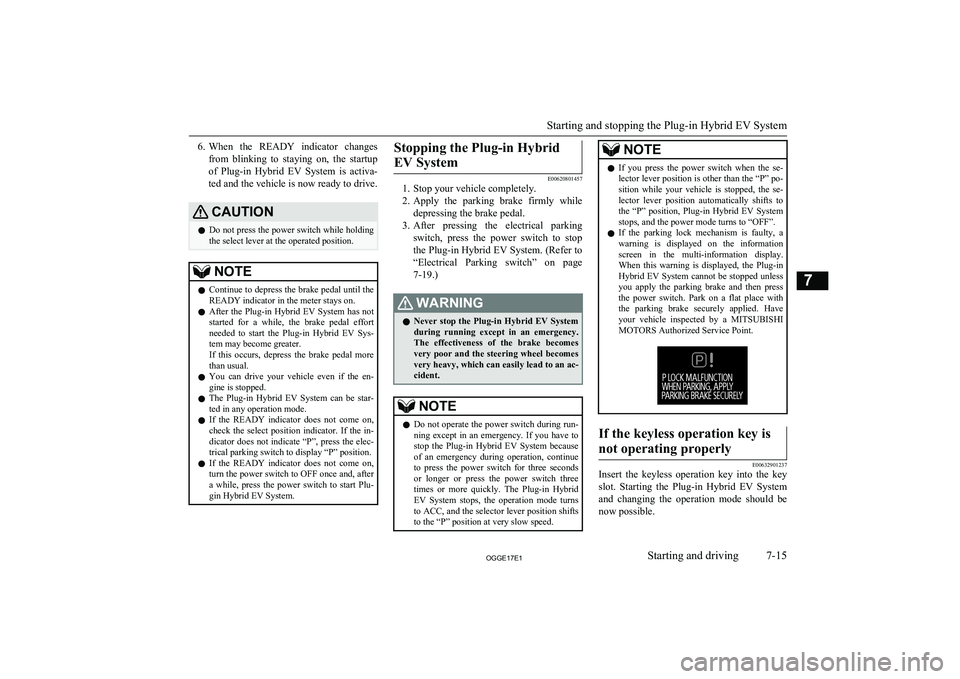
screen in the multi-information display. When this warning is displayed, the Plug-in
Hybrid EV System cannot be stopped unless
you apply the parking brake and then press the power switch. Park on a flat place with
the parking brake securely applied. Have your vehicle inspected by a MITSUBISHI
MOTORS Authorized Service Point.If the keyless operation key is
not operating properly
E00632901237
Insert the keyless operation key into the key
slot. Starting the Plug-in Hybrid EV System and changing the operation mode should be now possible.
Starting and stopping the Plug-in Hybrid EV System
7-15OGGE17E1Starting and driving7
Page 308 of 548
CAUTION•When driving on a slippery road covered
by rain water, snow, ice, etc.
• When passing through a place where the
brightness suddenly changes, like the inlet or outlet of a tunnel.
• When turning steep curves.
• When the road surface is reflecting the
light shining from the direction opposite
to the running direction.
• Vehicle largely lurches when it is running
over steps or other irregularities of the
road surface.
• When the headlamp illumination is inade-
quate because of contaminated or deterio-
rated lenses or improperly aimed head- lamps.
• When the vehicle is leaning much to one
side due to heavy luggage on it or improp-
erly adjusted tyre pressures.
• When oncoming vehicles’ headlamps
shine the sensor.
• When the vehicle is equipped with non-
standard tyres (including excessively worn tyres), is using a snow traction de-
vice (tyre chains), or has non-specified
components such as a modified suspen- sion.
• When the windscreen is covered with wa-
ter droplets, snow, dust, etc.
l Follow the instructions given below to keep
your LDW in good operating conditions.
• Always keep the windscreen clean.CAUTION•Avoid applying a strong shock or pressure
to the sensor. Do not attempt to detach or disassemble it.
• Do not put anything like a sticker on the
area in front of the sensor lens of the windscreen.
• Use only
MITSUBISHI MOTORS GEN-
UINE Parts when replacing the wind-
screen wipers.Tyre pressure monitoring
system (TPMS) E00637100282
The tyre pressure monitoring system (TPMS)
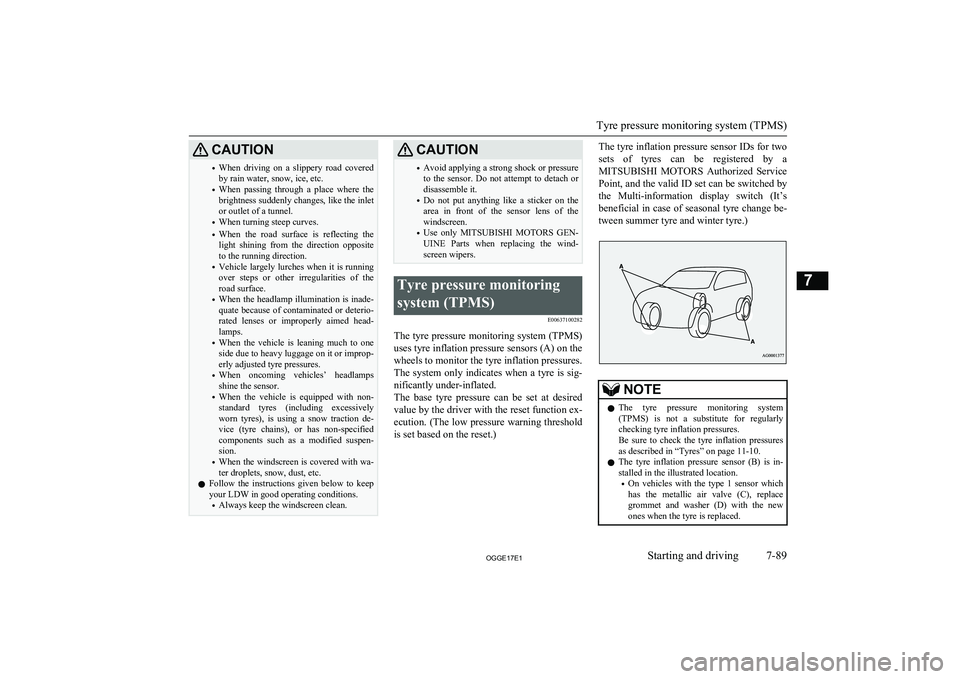
uses tyre inflation pressure sensors (A) on the wheels to monitor the tyre inflation pressures.
The system only indicates when a tyre is sig-
nificantly under-inflated.
The base tyre pressure can be set at desired value by the driver with the reset function ex-
ecution. (The low pressure warning threshold is set based on the reset.)
The tyre inflation pressure sensor IDs for two
sets of tyres can be registered by aMITSUBISHI MOTORS Authorized Service
Point, and the valid ID set can be switched by the Multi-information display switch (It’s
beneficial in case of seasonal tyre change be-
tween summer tyre and winter tyre.)NOTEl The tyre pressure monitoring system
(TPMS) is not a substitute for regularlychecking tyre inflation pressures.
Be sure to check the tyre inflation pressures as described in “Tyres” on page 11-10.
l The tyre inflation pressure sensor (B) is in-
stalled in the illustrated location.
• On vehicles with the type 1 sensor which
has the metallic air valve (C), replace
grommet and washer (D) with the new ones when the tyre is replaced.
Tyre pressure monitoring system (TPMS)
7-89OGGE17E1Starting and driving7
Page 441 of 548
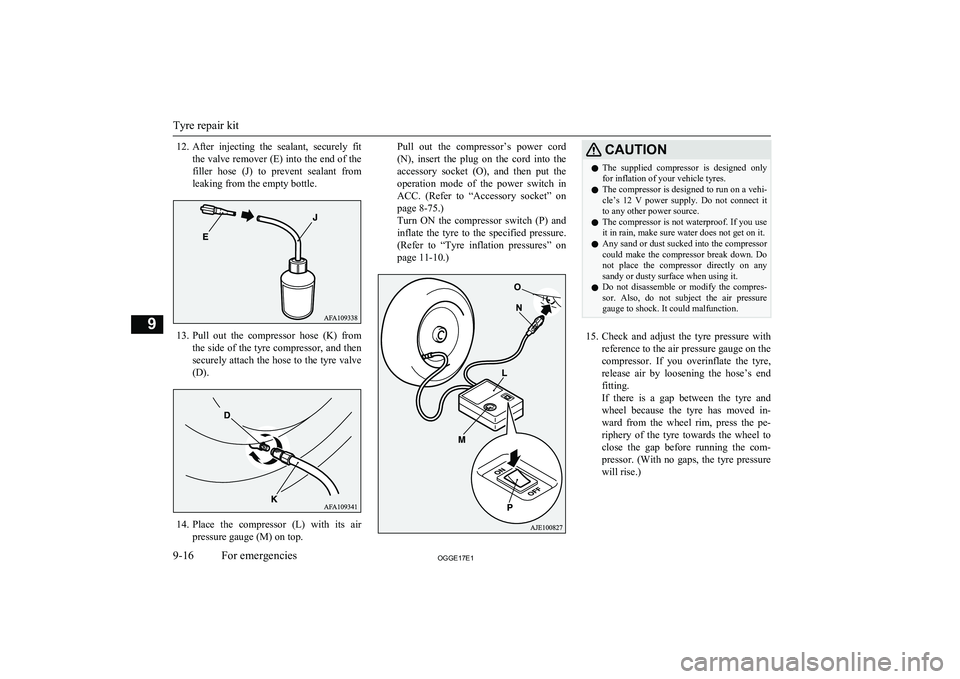
12.After injecting the sealant, securely fit
the valve remover (E) into the end of the filler hose (J) to prevent sealant from
leaking from the empty bottle.
13. Pull out the compressor hose (K) from
the side of the tyre compressor, and then
securely attach the hose to the tyre valve (D).
14. Place the compressor (L) with its air
pressure gauge (M) on top.
Pull out the compressor’s power cord
(N), insert the plug on the cord into the accessory socket (O), and then put the
operation mode of the power switch in ACC. (Refer to “Accessory socket” on
page 8-75.)
Turn ON the compressor switch (P) and inflate the tyre to the specified pressure.
(Refer to “Tyre inflation pressures” on page 11-10.)CAUTIONl The supplied compressor is designed only
for inflation of your vehicle tyres.
l The compressor is designed to run on a vehi-
cle’s 12 V power supply. Do not connect itto any other power source.
l The compressor is not waterproof. If you use
it in rain, make sure water does not get on it.
l Any sand or dust sucked into the compressor
could make the compressor break down. Do not place the compressor directly on anysandy or dusty surface when using it.
l Do not disassemble or modify the compres-
sor. Also, do not subject the air pressure
gauge to shock. It could malfunction.
15. Check and adjust the tyre pressure with
reference to the air pressure gauge on the
compressor. If you overinflate the tyre, release air by loosening the hose’s end
fitting.
If there is a gap between the tyre and
wheel because the tyre has moved in-
ward from the wheel rim, press the pe- riphery of the tyre towards the wheel to
close the gap before running the com- pressor. (With no gaps, the tyre pressure
will rise.)
Tyre repair kit
9-16OGGE17E1For emergencies9
Page 442 of 548
CAUTIONlBe careful not to get your fingers trapped be-
tween the tyre and wheel as the tyre inflates.
l The surface of the compressor will get hot
while the compressor is running. Do not
keep the compressor running continuously for more than 10 minutes. After using the compressor, wait for the compressor to cool
before using it again.
l If the compressor becomes sluggish or hot
while operating, it is overheating. Immedi- ately place the switch in the OFF positionand let the compressor cool down for at least30 minutes.NOTEl If the tyre pressure does not rise to the speci-
fied level within 10 minutes, the tyre may be
so severely damaged that the tyre sealant
cannot be used to effect an emergency re- pair. Please contact a MITSUBISHI
MOTORS Authorized Service Point or an-
other specialist in this event.
16. Turn OFF the compressor switch, then
pull the power cord plug out of the sock- et.
NOTEl Simply putting sealant and air into the tyre
using the tyre repair kit does not seal the
puncture hole. Air will leak through the puncture hole until the emergency repair procedure is completed (through step 19 or
step 20 of these instructions).
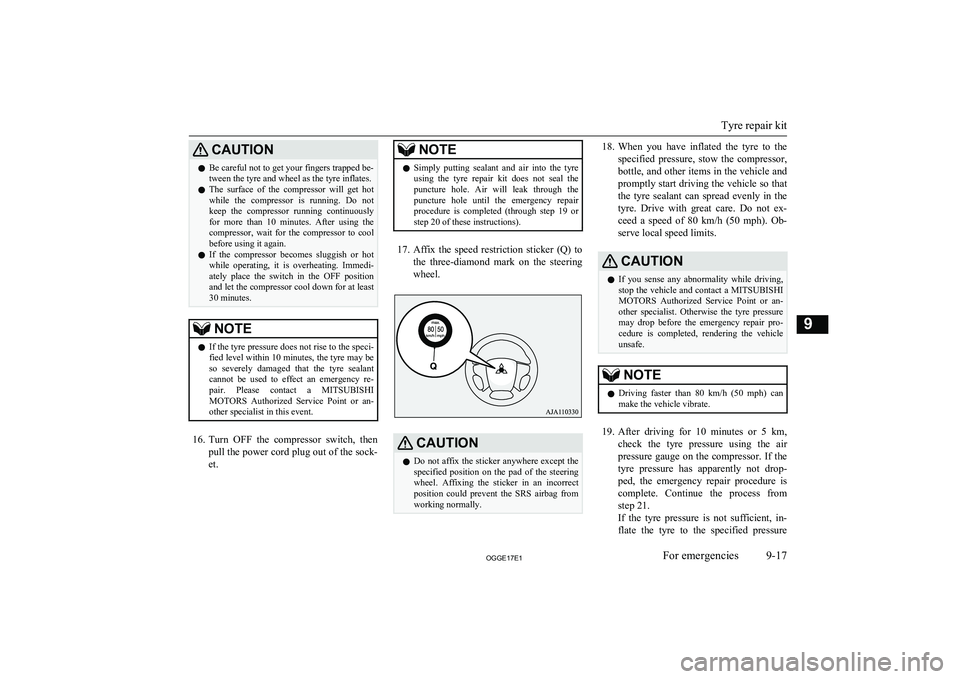
17. Affix the speed restriction sticker (Q) to
the three-diamond mark on the steering wheel.
CAUTIONl Do not affix the sticker anywhere except the
specified position on the pad of the steeringwheel. Affixing the sticker in an incorrect
position could prevent the SRS airbag from working normally.18. When you have inflated the tyre to the
specified pressure, stow the compressor,
bottle, and other items in the vehicle and
promptly start driving the vehicle so that the tyre sealant can spread evenly in the
tyre. Drive with great care. Do not ex- ceed a speed of 80 km/h (50 mph). Ob-
serve local speed limits.CAUTIONl If you sense any abnormality while driving,
stop the vehicle and contact a MITSUBISHI
MOTORS Authorized Service Point or an-
other specialist. Otherwise the tyre pressure
may drop before the emergency repair pro- cedure is completed, rendering the vehicle
unsafe.NOTEl Driving faster than 80 km/h (50 mph)
can
make the vehicle vibrate.
19. After driving for 10 minutes or 5 km ,
check the tyre pressure using the air
pressure gauge on the compressor. If the
tyre pressure has apparently not drop- ped, the emergency repair procedure iscomplete. Continue the process from
step 21.
If the tyre pressure is not sufficient, in- flate the tyre to the specified pressure
Tyre repair kit
9-17OGGE17E1For emergencies9
Page 451 of 548
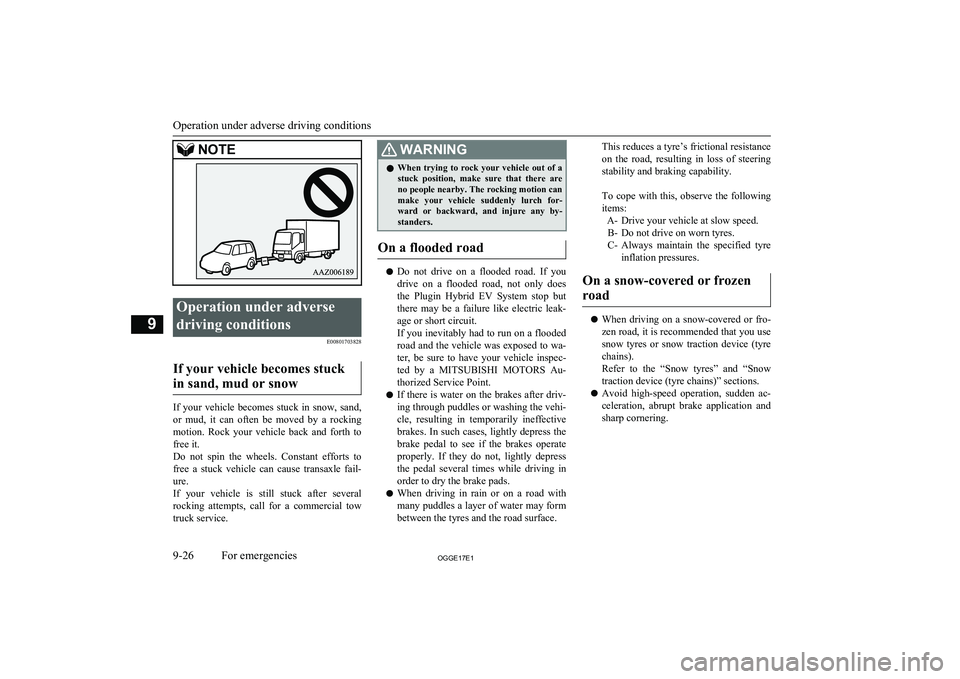
NOTEOperation under adversedriving conditions E00801703828
If your vehicle becomes stuck
in sand, mud or snow
If your vehicle becomes stuck in snow, sand,
or mud, it can often be moved by a rocking
motion. Rock your vehicle back and forth to
free it.
Do not spin the wheels. Constant efforts to
free a stuck vehicle can cause transaxle fail-
ure.
If your vehicle is still stuck after several rocking attempts, call for a commercial tow
truck service.
WARNINGl When trying to rock your vehicle out of a
stuck position, make sure that there are
no people nearby. The rocking motion can make your vehicle suddenly lurch for-
ward or backward, and injure any by- standers.
On a flooded road
l Do not drive on a flooded road. If you
drive on a flooded road, not only does the Plugin Hybrid EV System stop but
there may be a failure like electric leak- age or short circuit.
If you inevitably had to run on a flooded
road and the vehicle was exposed to wa- ter, be sure to have your vehicle inspec-
ted by a MITSUBISHI MOTORS Au-
thorized Service Point.
l If there is water on the brakes after driv-
ing through puddles or washing the vehi- cle, resulting in temporarily ineffective
brakes. In such cases, lightly depress the brake pedal to see if the brakes operate
properly. If they do not, lightly depress the pedal several times while driving in
order to dry the brake pads.
l When driving in rain or on a road with
many puddles a layer of water may form
between the tyres and the road surface.
This reduces a tyre’s frictional resistance
on the road, resulting in loss of steering stability and braking capability.
To cope with this, observe the following
items: A- Drive your vehicle at slow speed.B- Do not drive on worn tyres.
C- Always maintain the specified tyre
inflation pressures.
On a snow-covered or frozen road
l When driving on a snow-covered or fro-
zen road, it is recommended that you use snow tyres or snow traction device (tyre chains).
Refer to the “Snow tyres” and “Snow
traction device (tyre chains)” sections.
l Avoid high-speed operation, sudden ac-
celeration, abrupt brake application and
sharp cornering.
Operation under adverse driving conditions
9-26OGGE17E1For emergencies9