weight MITSUBISHI OUTLANDER PHEV 2017 Owner's Manual (in English)
[x] Cancel search | Manufacturer: MITSUBISHI, Model Year: 2017, Model line: OUTLANDER PHEV, Model: MITSUBISHI OUTLANDER PHEV 2017Pages: 548, PDF Size: 25.5 MB
Page 30 of 548
lIt is the battery to operate the motor and
the air conditioning.
In addition to the drive battery, OUT-
LANDER PHEV has the auxiliary bat-
tery to operate lamps, wipers, etc.
l Compact, light-weight lithium ion bat-
tery with high energy density is used for the drive battery.
l The drive battery has the following char-
acteristics.
Please read this carefully paying atten-
tion to the following:
Characteristics
l The same as ordinary lithium-ion batter-
ies, the battery capacity of the drive bat-
tery gradually reduces with time. As the
drive battery capacity decreases, the ini- tial EV cruising range and the vehicle
performance will similarly decrease.
Depending on the usage conditions, such as frequent quick acceleration/decelera- tion, extremely hot weather, storing the
vehicle in high ambient temperatures, etc., the rate of battery capacity drop will
increase.
l The performance may be changed due to
the ambient temperature.
At low ambient temperature, in particu- lar, the EV cruising range is short and
the charging time is long, compared to operation at normal temperature. Also,charging may be stopped before com-
plete charging.
l When the ambient temperature lowers,
the engine will start frequently, even if there remains much power in the drive
battery.
l Because the engine starts frequently, the
fuel consumption will increase.
l The battery is gradually discharged with-
out use and the battery charge is low-
ered.
l It is not necessary to consume the bat-
tery completely before charging.Precautions for operation
l If your vehicle is not used for a long
time, check the drive battery level dis-
play every 3 months.
If the drive battery level display shows
0, charge the battery until some indica- tion appears. Alternatively, start the
Plug-in Hybrid EV System and turn on the ready indicator.
The engine will then automatically start to charge the drive battery.
Wait until the engine automatically
stops, then put the operation mode of the
power switch in OFF.
l MITSUBISHI
Motors collects drive bat-
teries. If you scrap your vehicle, please
consult a MITSUBISHI MOTORS Au-
thorized Service Point.
EV cruising range
E00205100025
lEven if the charge level is the same, the
EV cruising range may vary depending on driving conditions. Since driving at
high speed or climbing on a hill requires higher consumption of the drive batterythan usual, the EV cruising range is shortened.
EV cruising range
2-05OGGE17E1General information2
Page 90 of 548
CAUTIONlWhen driving with a child in the rear seat,
please use the child protection to prevent ac-
cidental door opening which may cause an accident.Tailgate*
E00301402634WARNINGlIt is dangerous to drive with the tailgate
open, since carbon monoxide (CO) gas can enter the cabin.
You cannot see or smell CO. It can cause
unconsciousness and even death.
l When opening and closing the tailgate,
make sure that there are no people near-
by and be careful not to hit your head or
pinch your hands, neck, etc.
l When there is a build up of snow or ice, it
should be removed before opening the
tailgate. If you open the tailgate without removing it, there is a possibility that the tailgate may close suddenly due to theweight of that snow or ice.WARNINGl When you open the tailgate make sure
that the tailgate is opened fully and re-
mains fully open. If you only open the tail- gate halfway there is a risk that the tail-
gate may drop and slam shut. If you open
the tailgate whilst your vehicle is parked on an incline it is more difficult to do so
than on the flat and also it may drop and slam shut.CAUTIONl To avoid damage to the tailgate, make sure
the area above and behind the tailgate is
clear before opening it.
To lock/unlock
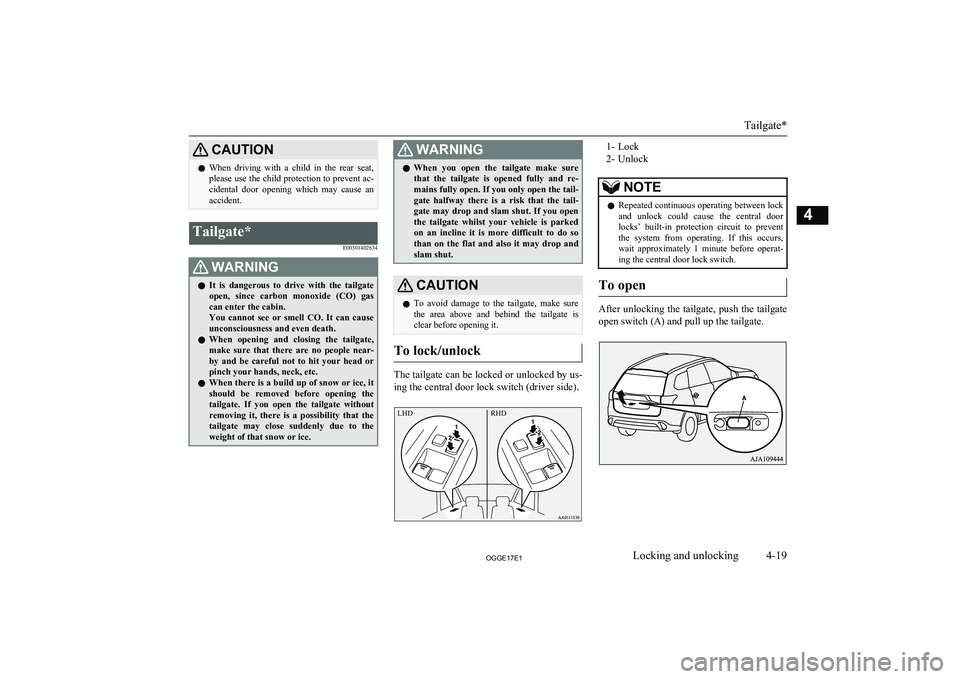
The tailgate can be locked or unlocked by us-
ing the central door lock switch (driver side).
1- Lock
2- UnlockNOTEl Repeated continuous operating between lock
and unlock could cause the central doorlocks’ built-in protection circuit to preventthe system from operating. If this occurs,
wait approximately 1 minute before operat-
ing the central door lock switch.
To open
After unlocking the tailgate, push the tailgate
open switch (A) and pull up the tailgate.
Tailgate*
4-19OGGE17E1Locking and unlocking4 LHD RHD
Page 117 of 548
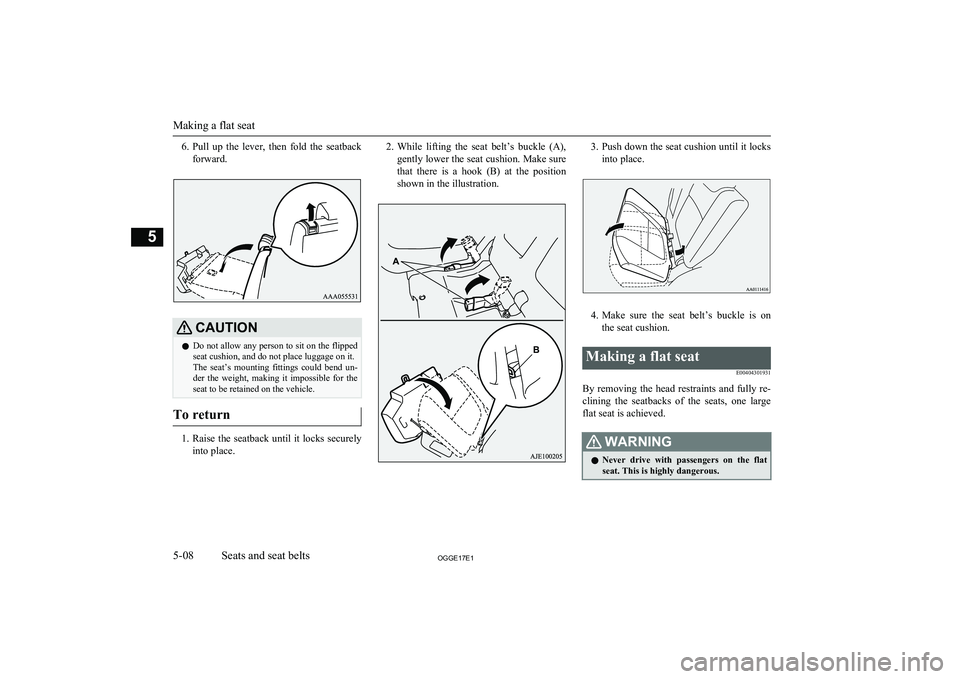
6.Pull up the lever, then fold the seatback
forward.CAUTIONl Do not allow any person to sit on the flipped
seat cushion, and do not place luggage on it.
The seat’s mounting fittings could bend un-
der the weight, making it impossible for the
seat to be retained on the vehicle.
To return
1. Raise the seatback until it locks securely
into place.
2. While lifting the seat belt’s buckle (A),
gently lower the seat cushion. Make sure
that there is a hook (B) at the position shown in the illustration.3. Push down the seat cushion until it locks
into place.
4. Make sure the seat belt’s buckle is on
the seat cushion.
Making a flat seat
E00404301931
By removing the head restraints and fully re-
clining the seatbacks of the seats, one large flat seat is achieved.
WARNINGl Never drive with passengers on the flat
seat. This is highly dangerous.
Making a flat seat
5-08OGGE17E1Seats and seat belts5
Page 121 of 548
If the vehicle is driven with the seat belt still
unfastened, the warning lamp will blink and
the tone will sound intermittently until the
seat belt is fastened. At the same time, “FAS-
TEN SEAT BELT” is displayed on the infor- mation screen in the multi information dis-
play for the driver.WARNINGl Do not install any accessory or sticker
that makes the lamp difficult to see.NOTEl If the seat belt subsequently remains unfas-
tened, the warning lamp and the tone will is-
sue further warnings each time the vehicle starts moving from a stop.
l For the front passenger seat, the warning
function works only while a person is sitting
on the seat.
l When luggage is placed on the front passen-
ger seat, a sensor in the seat cushion may,
depending on the weight and position of the
luggage, cause the warning tone to sound
and the warning lamp to come on.For the rear passenger’s seats
E00415501021
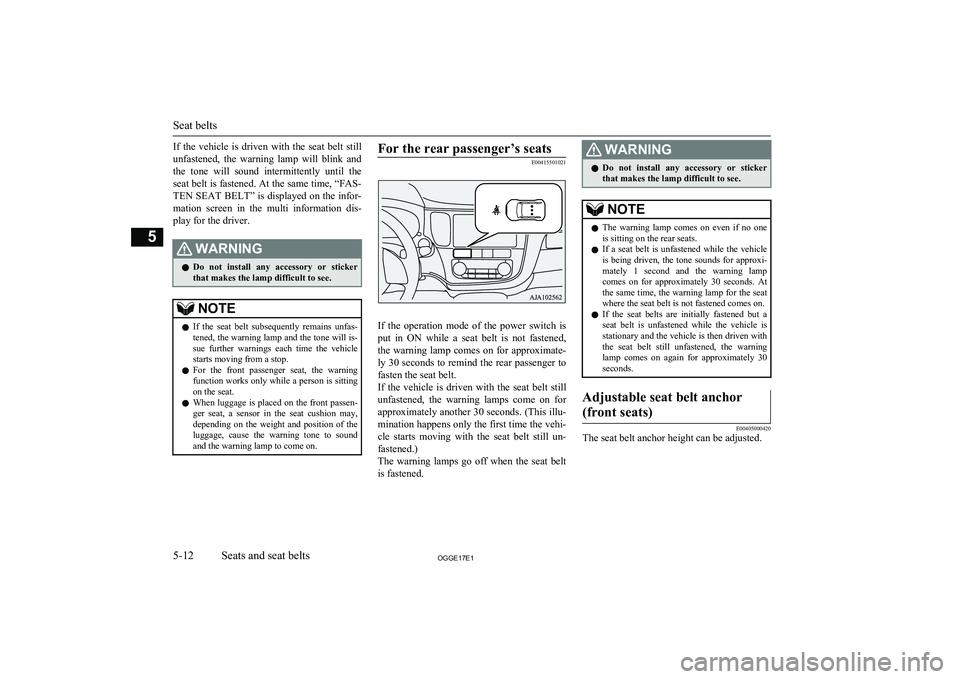
If the operation mode of the power switch is
put in ON while a seat belt is not fastened,
the warning lamp comes on for approximate-
ly 30 seconds to remind the rear passenger to fasten the seat belt.
If the vehicle is driven with the seat belt still
unfastened, the warning lamps come on for
approximately another 30 seconds. (This illu-
mination happens only the first time the vehi- cle starts moving with the seat belt still un-
fastened.)
The warning lamps go off when the seat belt is fastened.
WARNINGl Do not install any accessory or sticker
that makes the lamp difficult to see.NOTEl The warning lamp comes on even if no one
is sitting on the rear seats.
l If a seat belt is unfastened while the vehicle
is being driven, the tone sounds for approxi- mately 1 second and the warning lampcomes on for approximately 30 seconds. At the same time, the warning lamp for the seat
where the seat belt is not fastened comes on.
l If the seat belts are initially fastened but a
seat belt is unfastened while the vehicle is
stationary and the vehicle is then driven with the seat belt still unfastened, the warning
lamp comes on again for approximately 30 seconds.Adjustable seat belt anchor
(front seats)
E00405000420
The seat belt anchor height can be adjusted.
Seat belts
5-12OGGE17E1Seats and seat belts5
Page 126 of 548
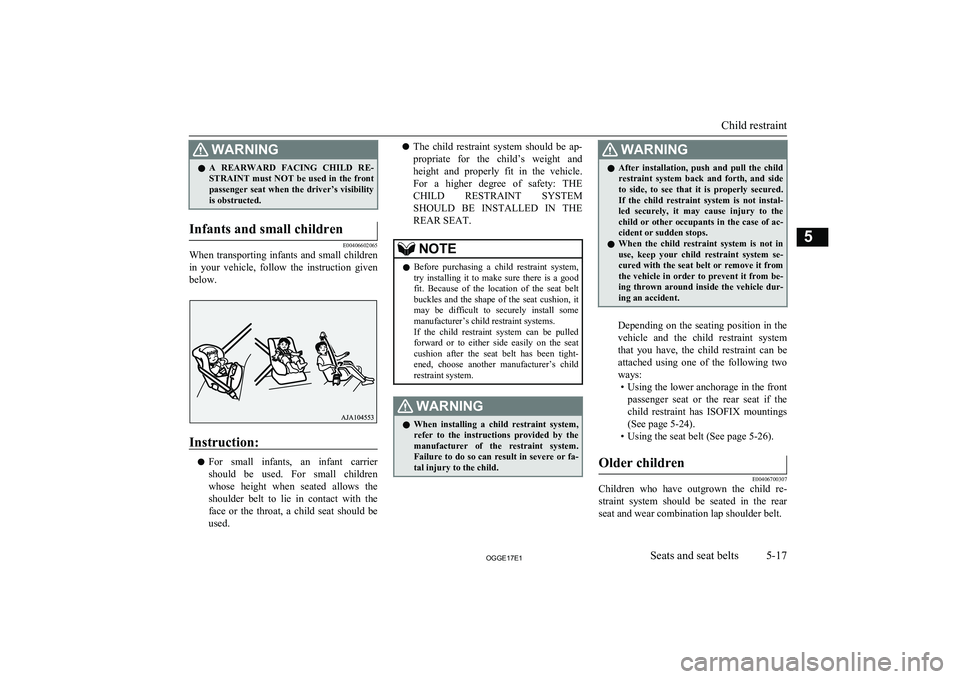
WARNINGlA REARWARD FACING CHILD RE-
STRAINT must NOT be used in the front passenger seat when the driver’s visibilityis obstructed.Infants and small children
E00406602065
When transporting infants and small children
in your vehicle, follow the instruction given below.
Instruction:
l For small infants, an infant carrier
should be used. For small children whose height when seated allows the shoulder belt to lie in contact with the
face or the throat, a child seat should be used.
l The child restraint system should be ap-
propriate for the child’s weight and
height and properly fit in the vehicle. For a higher degree of safety: THECHILD RESTRAINT SYSTEM
SHOULD BE INSTALLED IN THE REAR SEAT.NOTEl Before purchasing a child restraint system,
try installing it to make sure there is a good fit. Because of the location of the seat belt
buckles and the shape of the seat cushion, it may be difficult to securely install some
manufacturer’s child restraint systems.
If the child restraint system can be pulled forward or to either side easily on the seatcushion after the seat belt has been tight-
ened, choose another manufacturer’s child restraint system.WARNINGl When installing a child restraint system,
refer to the instructions provided by themanufacturer of the restraint system.Failure to do so can result in severe or fa-tal injury to the child.WARNINGl After installation, push and pull the child
restraint system back and forth, and sideto side, to see that it is properly secured.
If the child restraint system is not instal-
led securely, it may cause injury to the
child or other occupants in the case of ac- cident or sudden stops.
l When the child restraint system is not in
use, keep your child restraint system se- cured with the seat belt or remove it fromthe vehicle in order to prevent it from be- ing thrown around inside the vehicle dur-
ing an accident.
Depending on the seating position in the
vehicle and the child restraint system
that you have, the child restraint can be attached using one of the following two
ways: • Using the lower anchorage in the front
passenger seat or the rear seat if the
child restraint has ISOFIX mountings (See page 5-24).
• Using the seat belt (See page 5-26).
Older children
E00406700307
Children who have outgrown the child re-
straint system should be seated in the rear
seat and wear combination lap shoulder belt.
Child restraint
5-17OGGE17E1Seats and seat belts5
Page 208 of 548
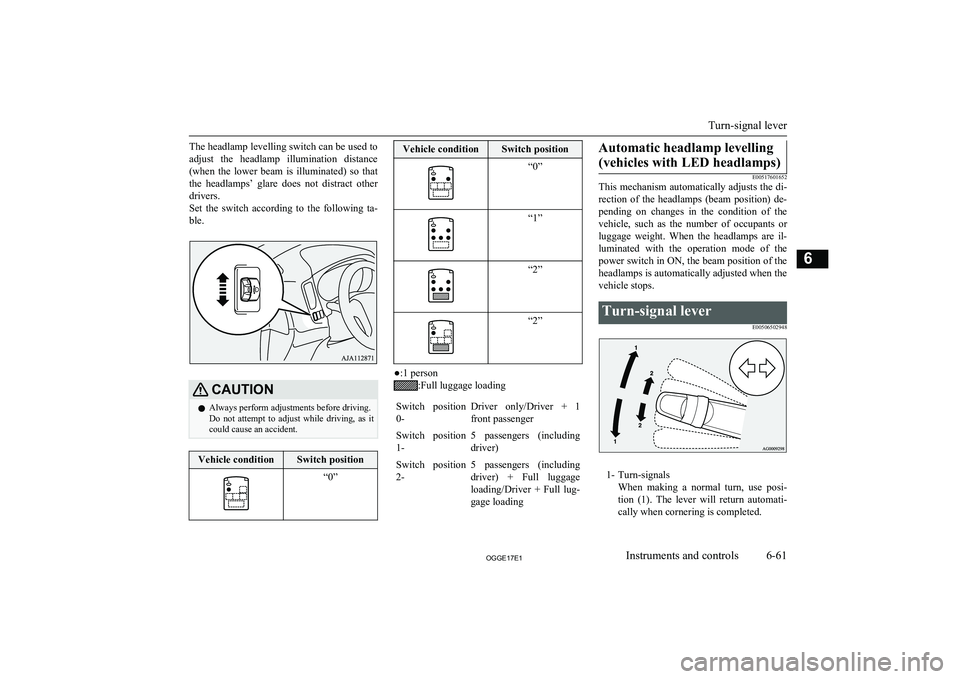
The headlamp levelling switch can be used to
adjust the headlamp illumination distance (when the lower beam is illuminated) so that the headlamps’ glare does not distract otherdrivers.
Set the switch according to the following ta- ble.CAUTIONl Always perform adjustments before driving.
Do not attempt to adjust while driving, as it could cause an accident.Vehicle conditionSwitch position“0”Vehicle conditionSwitch position“0”“1”“2”“2”
●:1 person
:Full luggage loading
Switch position
0-Driver only/Driver + 1
front passengerSwitch position 1-5 passengers (including
driver)Switch position 2-5 passengers (including
driver) + Full luggage loading/Driver + Full lug-
gage loadingAutomatic headlamp levelling
(vehicles with LED headlamps)
E00517601652
This mechanism automatically adjusts the di-
rection of the headlamps (beam position) de- pending on changes in the condition of the
vehicle, such as the number of occupants or luggage weight. When the headlamps are il-
luminated with the operation mode of the power switch in ON, the beam position of theheadlamps is automatically adjusted when thevehicle stops.
Turn-signal lever
E00506502948
1- Turn-signalsWhen making a normal turn, use posi-
tion (1). The lever will return automati- cally when cornering is completed.
Turn-signal lever
6-61OGGE17E1Instruments and controls6
Page 221 of 548
Economical drivingE00600102422
For economical driving, there are some tech- nical requirements that have to be met. Theprerequisite for low fuel consumption is a
properly adjusted engine. In order to achieve longer life of the vehicle and the most eco- nomical operation, we recommend you tohave the vehicle checked at regular intervals in accordance with the service standards.
Fuel economy and generation of exhaust gas
and noise are highly influenced by personal
driving habits as well as the particular operat- ing conditions. The following points shouldbe observed in order to minimize wear of
brakes, tyres and engine as well as to reduce
environmental pollution.
Starting and acceleration
Avoid driving when the accelerator pedal ispressed way down, such as for unnecessarily sudden starts, acceleration and deceleration.
Smoothly depress the accelerator pedal.
Observe the speed limit and keep the speed
as constant as possible while driving.
Idling
Parking for a long period with the ready indi-
cator illuminated will shorten the cruising
range.
Speed
The higher the vehicle speed, the more drive
battery is consumed. Avoid driving at full speed. Even a slight release of the accelerator
pedal will save a significant amount of drive battery.
Tyre inflation pressure
Check the tyre inflation pressures at regular intervals. Low tyre inflation pressure increa-ses road resistance and fuel consumption. In addition, low tyre pressures adversely affect
tyre wear and driving stability.
Cargo loads
Do not drive with unnecessary articles in the
luggage compartment. Especially during city
driving where frequent starting and stopping is necessary, the increased weight of the ve-
hicle will greatly affect fuel consumption. Al- so avoid driving with unnecessary luggage or carriers, etc., on the roof; the increased air re- sistance will increase fuel consumption.
Air conditioning
Too much cooling/heating can affect the cruising range, so maintain an appropriatetemperature to extend the cruising range.
Driving, alcohol and drugs
E00600200070
Driving after drinking alcohol is one of the
most frequent causes of accidents.
Your driving ability can be seriously im- paired even with blood alcohol levels far be-
low the legal minimum. If you have been drinking, don’t drive. Ride with a designated non-drinking driver, call a cab or a friend, or
use public transportation. Drinking coffee or
taking a cold shower will not make you so- ber.
Similarly, prescription and nonprescription
drugs affect your alertness, perception and re- action time. Consult with your doctor or
pharmacist before driving while under the in- fluence of any of these medications.WARNINGl NEVER DRINK AND DRIVE.
Your perceptions are less accurate, your
reflexes are slower and your judgment is impaired.Safe driving techniques
E00600301775
Driving safety and protection against injury
cannot be fully ensured. However, we recom- mend that you pay extra attention to the fol-
lowing:
Economical driving
7-02OGGE17E1Starting and driving7
Page 248 of 548
NOTElEven if the battery charge mode switch is
pressed, the battery charge mode may not beactivated depending on the remaining drive
battery capacity or the remaining fuel quan- tity and the control.
l It is recommended to use the battery charge
mode switch at least 20 minutes before youclimb, in order to continue a speed of more
than 100 km/h (62 mph), or when a long slope (gradient of more than 4 %) is expec-
ted. (According to a towing weight, it may not be able to continue the speed.)
l When using the battery charge switch with a
vehicle that has stopped in the heath a long
time, it may not charge.
l The charging time close to full charge of the
drive battery becomes longer depending on the condition of the drive battery, a driving
condition or a environment.
l The engine may stop near full charge.
l If you press the battery charge switch in or-
der to generate electricity while using gaso-
line, the fuel consumption will suffer.
We recommend you to consider the environ- ment.NOTEl When the engine is started while parking,
there is a risk of receiving a penalty due to idling stop ordinances.
You should use the battery charge mode
switch that conforms to the relevant munici- pality.
If you press the battery charge switch in or-
der to generate electricity using gasoline, the fuel consumption will suffer.
l If the battery save mode switch or the EV
switch is pressed while the battery charge
mode is activated, the battery charge mode is
cancelled and the battery save mode or EV
priority mode is activated.
Refer to “Battery save mode switch” on page 7-27 or “EV switch” on page 7-25.
If the battery charge mode switch is pressed
again, the mode will be returned to the bat- tery charge mode.Acoustic Vehicle Alerting
System (AVAS) E00631601051
The Acoustic Vehicle Alerting System(AVAS) is a device that uses sound to alert
pedestrians of the presence of the vehicle. The system operates when the vehicle speed
is about 35 km/h (22 mph) or less and the en-
gine is not running.
The sound starts when the AVAS is operated
in the following conditions.
l When the vehicle speed is about 3 km/h
(2 mph) or less with engine not runningand the brake pedal is not depressed.
l When the vehicle speed is about 3 km/h
(2 mph) to 35 km/h (22 mph) and engine
is not running.
The sound does not start in the following ca-
ses.
l When the vehicle speed is about 3 km/h
(2 mph) or less and the brake pedal is depressed.
l When the vehicle speed is about 35 km/h
(22 mph) or more.
l When the select position is in “P”
(PARK) position.
l When the AVAS OFF indicator in the
meter is illuminating.
l When the engine is running.
Acoustic Vehicle Alerting System (AVAS)
7-29OGGE17E1Starting and driving7
Page 275 of 548
CAUTIONlNeither control nor a warning are performed
in the following situation.
• Something other than a vehicle ap-
proaches, such as a pedestrian.
• When there is an abnormality in the sys-
tem (When the ACC detectes an abnor-mality, “ACC SERVICE REQUIRED” is
indicated.)
l The ACC makes neither acceleration nor de-
celeration control and only issues warning inthe following situation.
• The vehicle in front is parked or moving
at an extremely slow speed.
l The ACC may not be able to maintain the
set speed or the distance to a vehicle in front
and may not alert the driver, if the system
cannot detect the vehicle in front properly, in
the following situations.
• When a vehicle cuts in front of your vehi-
cle very closely.
• When a vehicle in front is offset to the left
or right.
• When a vehicle in front is towing a trailer.
• The vehicle in front is moving at a speed
much lower than your vehicle’s.
• A motorcycle or a bicycle.
• A freight trailer that is not carrying a con-
tainer.
• The vehicle has a protruding load from
the carrier.
• When the vehicle has a low weight.
• When the vehicle has an extremely high
ground clearance.CAUTION• When there is repeated steep uphill and
downhill driving.
• When driving on an irregular or uneven
road surface.
• When being driven in a tunnel.
• When you are carrying extremely heavy
loads in the rear seats or luggage area.
• When the Plug-in Hybrid EV System is
starting.
• When driving in curved sections of road
including their entrance/outlet or running
beside a closed lane in a traffic work or
similar zone.
• When the cover part in front of the sensor
and the sensor become dirty or have snow
and ice adhering to it*.
• When water, snow or sand on the road are
extorted by the vehicle in front or an on- coming vehicle*.
*: After the ACC control has been cancelled automatically due to detection of a state of
decline in performance, the ACC will not operate in the temporary condition and will
inform the driver by buzzer and indication.
When the ACC is in the state in which it can operate, indication is cancelled. Should indi-
cations not be cancelled, then there is a pos- sible abnormality in the system.
Please contact a MITSUBISHI MOTORS
Authorized Service Point.Cruise control switch
E00634801054
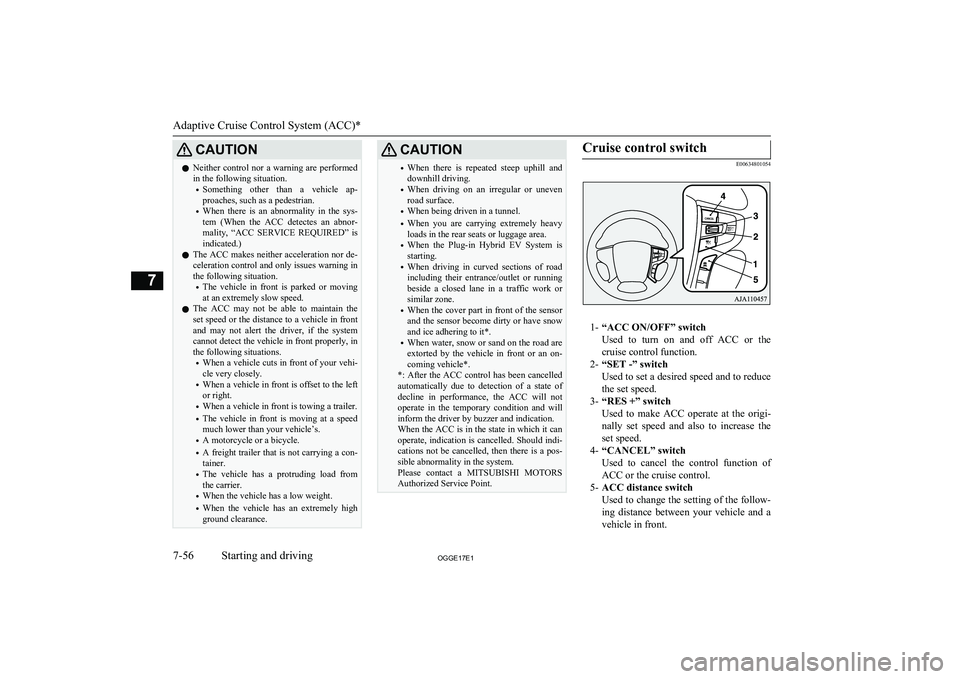
1- “ACC ON/OFF” switch
Used to turn on and off ACC or the
cruise control function.
2- “SET -” switch
Used to set a desired speed and to reduce the set speed.
3- “RES +” switch
Used to make ACC operate at the origi-
nally set speed and also to increase the set speed.
4- “CANCEL” switch
Used to cancel the control function of
ACC or the cruise control.
5- ACC distance switch
Used to change the setting of the follow-
ing distance between your vehicle and a vehicle in front.
Adaptive Cruise Control System (ACC)*
7-56OGGE17E1Starting and driving7
Page 300 of 548
WARNING•When a vehicle is travelling alongside
of your vehicle at nearly the same speed
for prolonged periods of time.
• When the heights of the next lane and
your lane are different.
• Immediately after the BSW has been
turned on.
• Immediately after the power switch is
turned on.
• Under adverse weather conditions,
such as rain, snow, strong winds, snow or sand storms.
• When your vehicle comes too close to
another vehicle.
• While multiple vehicles are overtaking
your vehicle.
• When driving near a pot hole and
tramline.
• When a surrounding vehicle or an on-
coming vehicle is splashing water, snow or dirt.
• When driving on a curve including the
beginning and the end of the curve.
• When driving on a road with alternat-
ing up and down steep slopes.
• When driving on a bumpy or rough
road.
• When the rear of your vehicle is weigh-
ed down or your vehicle is leaning to
the right or left due to the weight of passengers and luggage or the improp-
er adjustment of tyre pressure.
• When the bumper surface around the
sensor is covered with dirt, snow and
ice, etc.WARNING• When the sensor is extremely hot or
cold (while the vehicle is parked for a
long period of time under a blazing sun or in cold weather).CAUTIONl To maintain proper performance of the
BSW, follow the instructions below.
• Always clean the bumper surface around
the sensor.
• Avoid impacting the sensor or its sur-
rounding area.
• Do not put a sticker on the sensor or its
surrounding bumper surface.
• Do not paint the sensor or its surrounding
bumper surface.
• Do not modify the sensor or its surround-
ing area.
l If the bumper has experienced an impact, the
sensor may have been damaged and the
BSW may not function properly. Have the
vehicle inspected at a MITSUBISHI
MOTORS Authorized Service Point.To operate
E00652300067
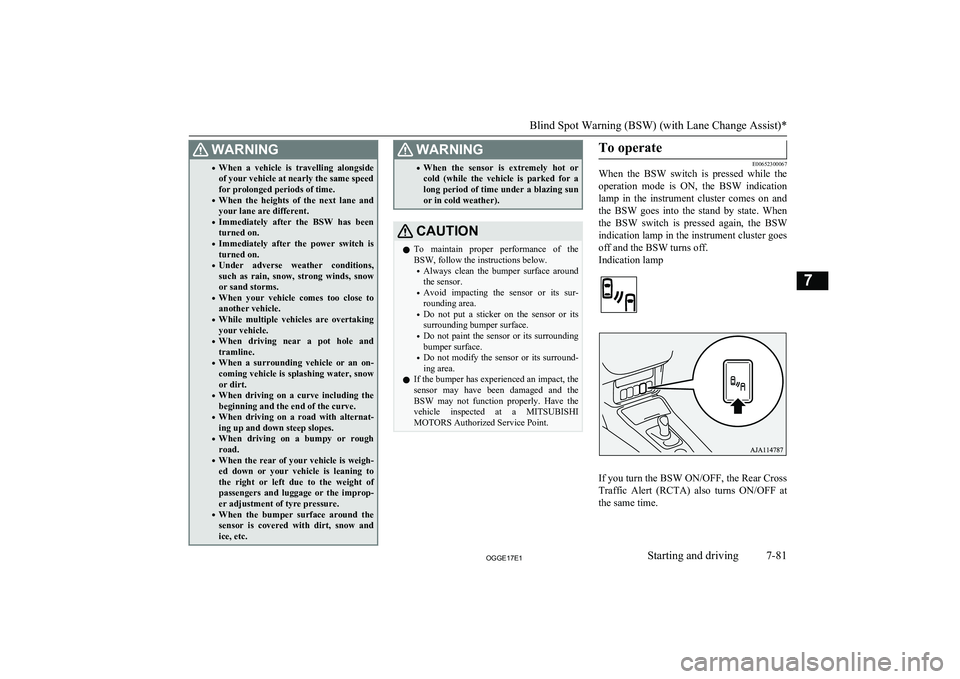
When the BSW switch is pressed while the
operation mode is ON, the BSW indication
lamp in the instrument cluster comes on and the BSW goes into the stand by state. When the BSW switch is pressed again, the BSW
indication lamp in the instrument cluster goes
off and the BSW turns off.
Indication lamp
If you turn the BSW ON/OFF, the Rear Cross Traffic Alert (RCTA) also turns ON/OFF at the same time.
Blind Spot Warning (BSW) (with Lane Change Assist)*
7-81OGGE17E1Starting and driving7